Cyber Crime
We’ll examine:
• Definition of Cyber Crime
• Computer Crimes
• Sexual Predator
• Cyber Stalking
• Computer Theft
Definition of Cyber Crime
• “Any illegal act involving a computer, its
systems, or its applications”
• Must be intentional – not accidental
• Types or categories of cyber Crime- 3 T’s
– Tool of the crime – traditional crime w/ a
computer
– Target of the crime – Hacking
– Tangential to the crime – drug records
Computer Crimes
• Computer Theft
• Computer Trespass
• Computer Invasion of Privacy
• Computer Forgery
• Computer Password Disclosure
Computer Crimes
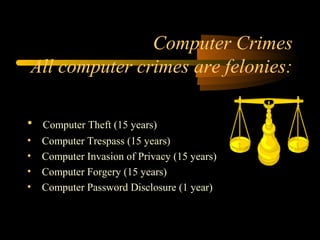
All computer crimes are felonies:
• Computer Theft (15 years)
• Computer Trespass (15 years)
• Computer Invasion of Privacy (15 years)
• Computer Forgery (15 years)
• Computer Password Disclosure (1 year)
Computer Crimes
• Any person who uses a computer or computer
network with knowledge that such use is without
authority and with the intention of:
• (1) Taking or appropriating any property of
another, whether or not with the intention of
depriving the owner of possession;
• (2) Obtaining property by any deceitful means or
artful practice;
Computer Crimes (condt.)
• (3) Converting property to such person's use
in violation of an agreement or other known
legal obligation to make a specified
application or disposition of such property
• Shall be guilty of the crime of computer
theft.
Computer Trespass
• Any person who uses a computer or
computer network with knowledge that
such use is without authority and with the
intention of:
• (1) Deleting or in any way removing, either
temporarily or permanently, any computer
program or data from a computer or
computer network;
Computer Trespass
(condt.)
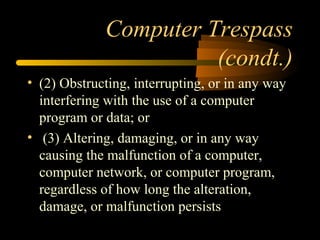
• (2) Obstructing, interrupting, or in any way
interfering with the use of a computer
program or data; or
• (3) Altering, damaging, or in any way
causing the malfunction of a computer,
computer network, or computer program,
regardless of how long the alteration,
damage, or malfunction persists
Computer Trespass
(condt.)
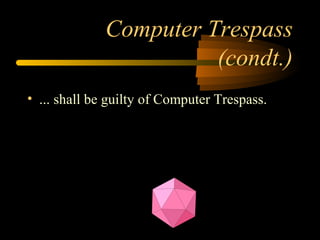
• ... shall be guilty of Computer Trespass.
Computer Invasion of Privacy
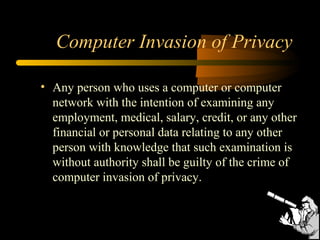
• Any person who uses a computer or computer
network with the intention of examining any
employment, medical, salary, credit, or any other
financial or personal data relating to any other
person with knowledge that such examination is
without authority shall be guilty of the crime of
computer invasion of privacy.
Computer Forgery
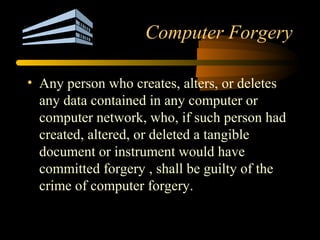
• Any person who creates, alters, or deletes
any data contained in any computer or
computer network, who, if such person had
created, altered, or deleted a tangible
document or instrument would have
committed forgery , shall be guilty of the
crime of computer forgery.
Computer Forgery
• The absence of a tangible writing directly
created or altered by the offender shall not
be a defense to the crime of computer
forgery if a creation, alteration, or deletion
of data was involved in lieu of a tangible
document or instrument.
Computer Password Disclosure
• Any person who discloses a number, code,
password, or other means of access to a computer
or computer network knowing that such disclosure
is without authority and which results in damages
(including the fair market value of any services
used and victim expenditure) to the owner of the
computer or computer network in excess of
$500.00 shall be guilty of the crime of computer
password disclosure.
More Computer Crimes
• Remaining computer crimes are “crime
specific,” such as
• Sexual Offenses, Stalking Offenses and
Theft Offenses
Federal Laws on Cyber Crime
• Computer Fraud and Abuse Act of 1986
– Three goals
• Confidentiality of data communications
• Integrity of data communications
• Availability of data communications
– CFAA is a general purpose cyber crime law
Intercepting Communications
• It shall be unlawful for any person
intentionally and secretly to intercept by the
use of any device, instrument, or apparatus
the contents of a message sent by telephone,
telegraph, letter, or by any other means of
private communication;
Intercepting Communications
• But, what if the police seize a computer and
discover a conversation where a crime is
discussed. That conversation, if by
telephone or telegraph, would have been
protected. Not the case with a computer.
Courts have ruled that you should know that
a computer makes a printed record, so it’s
okay for police to use it
Computer Assisted Sexual
Exploitation
• However, Legislature has
recently enacted a
misdemeanor statute that
makes the use of a computer
in the communication itself
illegal. It is directly on
point, but is it binding
Computer Assisted Sexual
Exploitation
• It shall be unlawful for any person
intentionally or willfully to utilize a
computer on-line service, Internet service,
or local bulletin board service to seduce,
solicit, lure, or entice, or attempt to
seduce, solicit, lure, or entice a child or
another person believed by such person to
be a child,
Computer Assisted Sexual
Exploitation
• (d) (1) .. to commit any illegal act ... relating to
the offense of sodomy or aggravated sodomy; ...
relating to the offense of child molestation or
aggravated child molestation; ... relating to the
offense of enticing a child for indecent purposes;
... relating to the offense of public indecency; or
to engage in any conduct that by its nature is an
unlawful sexual offense against a child.
Computer Assisted Sexual
Exploitation
• (d) (2) Any person who violates above
paragraph of this subsection shall be
guilty of a misdemeanor of a high and
aggravated nature.
Anonymity Opportunity
• Today, a sexual pervert can “hang around”
in teenage chat rooms and find suitable
victims with little risk of detection. Kids
are naturally curious anyway, but teenagers
are looking for someone who listens to
them, a need which chat rooms seem to fill.
Anonymity Opportunity
• After awhile, the “friendship” will develop
to the point that the predator can talk about
sex. Again, teenagers are naturally curious,
so this is not seen as dangerous to the
teenager.
Anonymity Opportunity
• Once the predator has established a trusting
relationship, he/she will seek to make a
physical encounter. Usually, this encounter
will be solely about sex for the predator.
There is too much danger in these
encounters to make “friendly” contacts.
Anonymity Opportunity
• The child usually seeks to get out of the
situation once she/he realizes that this
“friend” is not what was portrayed on the
Internet. However, in many instances, it is
too late to back out or stop the assault. If
the child will tell about it, capture is not
difficult as the “paper trail” is fairly easy to
follow
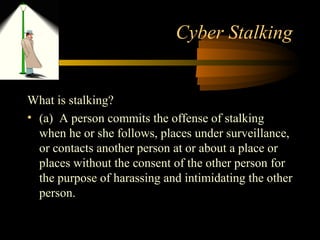
Cyber Stalking
What is stalking?
• (a) A person commits the offense of stalking
when he or she follows, places under surveillance,
or contacts another person at or about a place or
places without the consent of the other person for
the purpose of harassing and intimidating the other
person.
Protecting Children
(& networks)
• Keep Computer In Public Access Room
• Install Child Safe Software (Net Nanny,
Cyber Patrol, etc.)
• Know How To Track “History”
• Watch Your Child At The Computer,
Regardless of Age
• Use a FIREWALL – #1 network protection
Final points
– Number one fraud on the internet?
• Auctions!! E bay users, pay with a credit card!
– Most common computer attack?
• Viruses- “malicious logic” vs. worms
• Worms are self-replicating, death by expansion, filling hard
drive or bandwidth
– Denial of Service Attacks- it’s cyber crime
• Floods the server with data, prevents access
– Carnivore – FBI tool for internet wiretaps
• Makes a copy of email for law enforcement
– Money laundering – transfer of money from illegal
operations to legal ones - $1M weighs 30- 50 lbs!
In Closing
• Cyber Crime Is Still Crime
• Computers Offer Widespread Havoc
• Computers Have Detection Issues,
Good and Bad
• Forensic Computer Specialists Are
Vital To Crime Fighting Efforts
Thank a lot for your precious
time!
Please feel free to ask any Question….

Cyber Crime

  • 1.
  • 2.
    We’ll examine: • Definitionof Cyber Crime • Computer Crimes • Sexual Predator • Cyber Stalking • Computer Theft
  • 3.
    Definition of CyberCrime • “Any illegal act involving a computer, its systems, or its applications” • Must be intentional – not accidental • Types or categories of cyber Crime- 3 T’s – Tool of the crime – traditional crime w/ a computer – Target of the crime – Hacking – Tangential to the crime – drug records
  • 4.
    Computer Crimes • ComputerTheft • Computer Trespass • Computer Invasion of Privacy • Computer Forgery • Computer Password Disclosure
  • 5.
    Computer Crimes All computercrimes are felonies: • Computer Theft (15 years) • Computer Trespass (15 years) • Computer Invasion of Privacy (15 years) • Computer Forgery (15 years) • Computer Password Disclosure (1 year)
  • 6.
    Computer Crimes • Anyperson who uses a computer or computer network with knowledge that such use is without authority and with the intention of: • (1) Taking or appropriating any property of another, whether or not with the intention of depriving the owner of possession; • (2) Obtaining property by any deceitful means or artful practice;
  • 7.
    Computer Crimes (condt.) •(3) Converting property to such person's use in violation of an agreement or other known legal obligation to make a specified application or disposition of such property • Shall be guilty of the crime of computer theft.
  • 8.
    Computer Trespass • Anyperson who uses a computer or computer network with knowledge that such use is without authority and with the intention of: • (1) Deleting or in any way removing, either temporarily or permanently, any computer program or data from a computer or computer network;
  • 9.
    Computer Trespass (condt.) • (2)Obstructing, interrupting, or in any way interfering with the use of a computer program or data; or • (3) Altering, damaging, or in any way causing the malfunction of a computer, computer network, or computer program, regardless of how long the alteration, damage, or malfunction persists
  • 10.
    Computer Trespass (condt.) • ...shall be guilty of Computer Trespass.
  • 11.
    Computer Invasion ofPrivacy • Any person who uses a computer or computer network with the intention of examining any employment, medical, salary, credit, or any other financial or personal data relating to any other person with knowledge that such examination is without authority shall be guilty of the crime of computer invasion of privacy.
  • 12.
    Computer Forgery • Anyperson who creates, alters, or deletes any data contained in any computer or computer network, who, if such person had created, altered, or deleted a tangible document or instrument would have committed forgery , shall be guilty of the crime of computer forgery.
  • 13.
    Computer Forgery • Theabsence of a tangible writing directly created or altered by the offender shall not be a defense to the crime of computer forgery if a creation, alteration, or deletion of data was involved in lieu of a tangible document or instrument.
  • 14.
    Computer Password Disclosure •Any person who discloses a number, code, password, or other means of access to a computer or computer network knowing that such disclosure is without authority and which results in damages (including the fair market value of any services used and victim expenditure) to the owner of the computer or computer network in excess of $500.00 shall be guilty of the crime of computer password disclosure.
  • 15.
    More Computer Crimes •Remaining computer crimes are “crime specific,” such as • Sexual Offenses, Stalking Offenses and Theft Offenses
  • 16.
    Federal Laws onCyber Crime • Computer Fraud and Abuse Act of 1986 – Three goals • Confidentiality of data communications • Integrity of data communications • Availability of data communications – CFAA is a general purpose cyber crime law
  • 17.
    Intercepting Communications • Itshall be unlawful for any person intentionally and secretly to intercept by the use of any device, instrument, or apparatus the contents of a message sent by telephone, telegraph, letter, or by any other means of private communication;
  • 18.
    Intercepting Communications • But,what if the police seize a computer and discover a conversation where a crime is discussed. That conversation, if by telephone or telegraph, would have been protected. Not the case with a computer. Courts have ruled that you should know that a computer makes a printed record, so it’s okay for police to use it
  • 19.
    Computer Assisted Sexual Exploitation •However, Legislature has recently enacted a misdemeanor statute that makes the use of a computer in the communication itself illegal. It is directly on point, but is it binding
  • 20.
    Computer Assisted Sexual Exploitation •It shall be unlawful for any person intentionally or willfully to utilize a computer on-line service, Internet service, or local bulletin board service to seduce, solicit, lure, or entice, or attempt to seduce, solicit, lure, or entice a child or another person believed by such person to be a child,
  • 21.
    Computer Assisted Sexual Exploitation •(d) (1) .. to commit any illegal act ... relating to the offense of sodomy or aggravated sodomy; ... relating to the offense of child molestation or aggravated child molestation; ... relating to the offense of enticing a child for indecent purposes; ... relating to the offense of public indecency; or to engage in any conduct that by its nature is an unlawful sexual offense against a child.
  • 22.
    Computer Assisted Sexual Exploitation •(d) (2) Any person who violates above paragraph of this subsection shall be guilty of a misdemeanor of a high and aggravated nature.
  • 23.
    Anonymity Opportunity • Today,a sexual pervert can “hang around” in teenage chat rooms and find suitable victims with little risk of detection. Kids are naturally curious anyway, but teenagers are looking for someone who listens to them, a need which chat rooms seem to fill.
  • 24.
    Anonymity Opportunity • Afterawhile, the “friendship” will develop to the point that the predator can talk about sex. Again, teenagers are naturally curious, so this is not seen as dangerous to the teenager.
  • 25.
    Anonymity Opportunity • Oncethe predator has established a trusting relationship, he/she will seek to make a physical encounter. Usually, this encounter will be solely about sex for the predator. There is too much danger in these encounters to make “friendly” contacts.
  • 26.
    Anonymity Opportunity • Thechild usually seeks to get out of the situation once she/he realizes that this “friend” is not what was portrayed on the Internet. However, in many instances, it is too late to back out or stop the assault. If the child will tell about it, capture is not difficult as the “paper trail” is fairly easy to follow
  • 27.
    Cyber Stalking What isstalking? • (a) A person commits the offense of stalking when he or she follows, places under surveillance, or contacts another person at or about a place or places without the consent of the other person for the purpose of harassing and intimidating the other person.
  • 28.
    Protecting Children (& networks) •Keep Computer In Public Access Room • Install Child Safe Software (Net Nanny, Cyber Patrol, etc.) • Know How To Track “History” • Watch Your Child At The Computer, Regardless of Age • Use a FIREWALL – #1 network protection
  • 29.
    Final points – Numberone fraud on the internet? • Auctions!! E bay users, pay with a credit card! – Most common computer attack? • Viruses- “malicious logic” vs. worms • Worms are self-replicating, death by expansion, filling hard drive or bandwidth – Denial of Service Attacks- it’s cyber crime • Floods the server with data, prevents access – Carnivore – FBI tool for internet wiretaps • Makes a copy of email for law enforcement – Money laundering – transfer of money from illegal operations to legal ones - $1M weighs 30- 50 lbs!
  • 30.
    In Closing • CyberCrime Is Still Crime • Computers Offer Widespread Havoc • Computers Have Detection Issues, Good and Bad • Forensic Computer Specialists Are Vital To Crime Fighting Efforts
  • 31.
    Thank a lotfor your precious time! Please feel free to ask any Question….