PERVASIVE
COMPUTING
Temportary for rishuu reference
slide...delete it
 Pervasive computing refers to embedding computers and communication in our
environment. Pervasive computing provides an attractive vision for the future of
computing. The idea behind the pervasive computing is to make the computing power
disappear in the environment, but will always be there whenever needed or in other
words it means availability and invisibility. These invisible computers won’t have
keyboards or screens, but will watch us, listen to us and interact with us. Pervasive
computing makes the computer operate in the messy and unstructured world of real
people and real objects. Distributed devices in this environment must have the ability
to dynamically discover and integrate other devices. The prime goal of this
technology is to make human life more simple, safe and efficient by using the
ambient intelligence of computers.
Out Line
 What is Pervasive Computing?
 Why Pervasive Computing?
 Examples
 Founder of Pervasive Computing
 History
 Goal
 How? (Pervasive Computing Technologies)
 MIT- OXYGEN PROJECT
 Issues
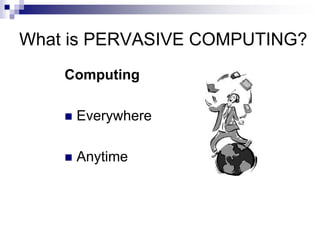
What is PERVASIVE COMPUTING?
Computing
 Everywhere
 Anytime
PERVASIVE COMPUTING
 􀂄 Technology View
Computers everywhere – embedded into
fridges, washing machines, door locks, cars,
furniture, people etc.
intelligent environment
 􀂄 User View
Invisible: implicit interaction with the environment
 􀂄 Pervasive = mobile computing + intelligent
environment
 Pervasive (Ubiquitous, Omnipresent)
Computing integrates computation into the
environment, rather than having computers
which are distinct objects.
 It enables people to interact with
information-processing devices more
naturally and casually, in whatever location
or context they are.
Why Pervasive Computing?
 Around Eight billion embedded
microprocessors are produced each year.
 This number is expected to rise dramatically
over the next decade, making electronic
devices ever more pervasive.
 They may be interconnected via wired and
wireless technologies into broader, more
capable, networks.
Pervasive Computing Example
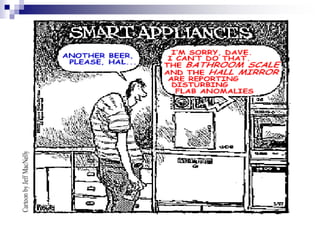
• For instance, your washing machine or TV
could detect its own failure and notify its
maintenance company to arrange for a
repair.
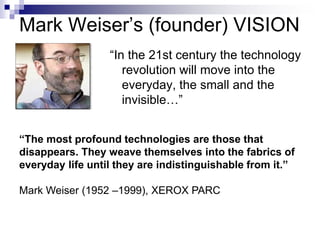
Mark Weiser’s (founder) VISION
“In the 21st century the technology
revolution will move into the
everyday, the small and the
invisible…”
“The most profound technologies are those that
disappears. They weave themselves into the fabrics of
everyday life until they are indistinguishable from it.”
Mark Weiser (1952 –1999), XEROX PARC
History
 Pervasive computing is the third wave of computing
technologies to emerge since computers first appeared:
 First Wave - Mainframe computing era: one computer
shared by many people, via workstations.
 Second Wave - Personal computing era: one computer
used by one person, requiring a conscious interaction.
Users largely bound to desktop.
 Third Wave – Pervasive computing era: one person,
many computers. Millions of computers embedded in the
environment, allowing technology to recede into the
background.
Goals of Pervasive Computing
Invisible technology
Integration of virtual and physical worlds
(virtual reality)
Throughout desks, rooms, buildings,
and life
Pervasive Applications
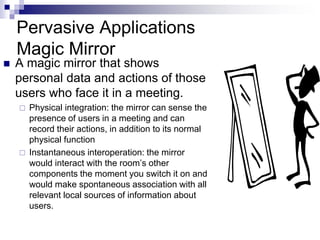
Magic Mirror
 A magic mirror that shows
personal data and actions of those
users who face it in a meeting.
 Physical integration: the mirror can sense the
presence of users in a meeting and can
record their actions, in addition to its normal
physical function
 Instantaneous interoperation: the mirror
would interact with the room’s other
components the moment you switch it on and
would make spontaneous association with all
relevant local sources of information about
users.
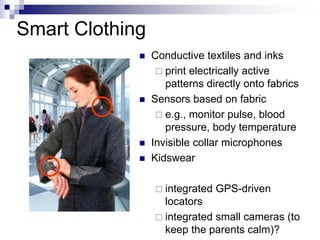
Smart Clothing
 Conductive textiles and inks
 print electrically active
patterns directly onto fabrics
 Sensors based on fabric
 e.g., monitor pulse, blood
pressure, body temperature
 Invisible collar microphones
 Kidswear
 integrated GPS-driven
locators
 integrated small cameras (to
keep the parents calm)?
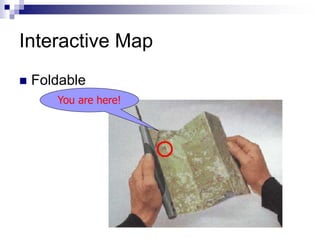
Interactive Map
 Foldable
You are here!
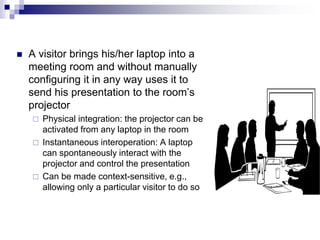
 A visitor brings his/her laptop into a
meeting room and without manually
configuring it in any way uses it to
send his presentation to the room’s
projector
 Physical integration: the projector can be
activated from any laptop in the room
 Instantaneous interoperation: A laptop
can spontaneously interact with the
projector and control the presentation
 Can be made context-sensitive, e.g.,
allowing only a particular visitor to do so
Pervasive Computing Technologies
 Pervasive computing involves three converging
areas of Information and Communications
Technology:
Computing (‘smart devices’),
Communications (‘connectivity’)
User interfaces
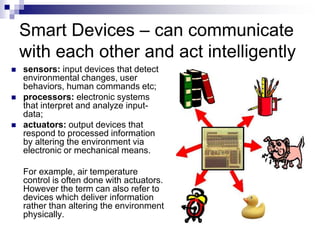
Smart Devices – can communicate
with each other and act intelligently
 sensors: input devices that detect
environmental changes, user
behaviors, human commands etc;
 processors: electronic systems
that interpret and analyze input-
data;
 actuators: output devices that
respond to processed information
by altering the environment via
electronic or mechanical means.
For example, air temperature
control is often done with actuators.
However the term can also refer to
devices which deliver information
rather than altering the environment
physically.
Smart Devices (cont.)
 Can remember important events
 They have a memory
 Show context-sensitive behavior
 They may have sensors
 Location/situation/context
awareness
 Are responsive/proactive
 Communicate with environment
 Networked with other smart objects
Connectivity (network)
 Pervasive computing systems rely on the
interlinking of independent electronic devices
into broader networks.
 This can be achieved via both wired and
wireless networking technologies (such as WiFi
or Bluetooth), with the devices themselves being
capable of assessing the most effective form of
connectivity in any given scenario.
 The effective development of pervasive
computing systems depends on their degree of
interoperability, as well as on the convergence
of standards for wired and wireless
technologies.
User Interfaces
 New user interfaces are developed that is capable
of sensing and supplying more information about
users, and the broader environment, to the
computer for processing.
 For example recognizing a person’s face, or
responding to gestures. It might also be based on
sound, scent or touch recognition, or other
sensory information like temperature.
 The output might also be in any of these formats.
Applications for Pervasive Computing
 Healthcare
Intelligent bandages that can tell how the
injury is doing or video consultations with
doctors, that can treat patients at home.
 Home care
 Transport
 Environmental Monitoring
 Industry & Academia
MIT- OXYGEN PROJECT
 For over forty years, computation has centered
about machines, not people. We were/are
pampering them in air-conditioned rooms or
carrying them around with us.
 But in the near future computation will be
human-centered. It will be freely available
everywhere, like oxygen in the air we breathe. It
will enter the human world, handling our goals
and needs and helping us to do more while
doing less.
Issues
 Engineering Issues
Current lack of low cost technology to locate
devices and the lack of suitable power
sources.
Communications, software and hardware
are likely to suffer from faults.
Also faulty systems may be harder to repair
because of the degree of interconnection.
Issues
 Privacy, security and safety
Gathers sensitive data, for example on users
everyday interactions, movements,
preferences and attitudes, without user
intervention or consent;
Retrieves and use information from large
databases/archives of stored data;
Alters the environment via actuating devices.
•Pervasive Computing (IEEE)
•Personal and Ubiquitous Computing (Springer)
•Pervasive and Mobile Computing journal, PMC (Elsevier)
•Ubiquitous Computing and Communication Journal –
UbiCC Journal
Journal
THANK YOU…

pervasive-computing-09022014092937-pervasive-computing.ppt

  • 1.
  • 2.
    Temportary for rishuureference slide...delete it  Pervasive computing refers to embedding computers and communication in our environment. Pervasive computing provides an attractive vision for the future of computing. The idea behind the pervasive computing is to make the computing power disappear in the environment, but will always be there whenever needed or in other words it means availability and invisibility. These invisible computers won’t have keyboards or screens, but will watch us, listen to us and interact with us. Pervasive computing makes the computer operate in the messy and unstructured world of real people and real objects. Distributed devices in this environment must have the ability to dynamically discover and integrate other devices. The prime goal of this technology is to make human life more simple, safe and efficient by using the ambient intelligence of computers.
  • 3.
    Out Line  Whatis Pervasive Computing?  Why Pervasive Computing?  Examples  Founder of Pervasive Computing  History  Goal  How? (Pervasive Computing Technologies)  MIT- OXYGEN PROJECT  Issues
  • 4.
    What is PERVASIVECOMPUTING? Computing  Everywhere  Anytime
  • 5.
    PERVASIVE COMPUTING  􀂄Technology View Computers everywhere – embedded into fridges, washing machines, door locks, cars, furniture, people etc. intelligent environment  􀂄 User View Invisible: implicit interaction with the environment  􀂄 Pervasive = mobile computing + intelligent environment
  • 6.
     Pervasive (Ubiquitous,Omnipresent) Computing integrates computation into the environment, rather than having computers which are distinct objects.  It enables people to interact with information-processing devices more naturally and casually, in whatever location or context they are.
  • 7.
    Why Pervasive Computing? Around Eight billion embedded microprocessors are produced each year.  This number is expected to rise dramatically over the next decade, making electronic devices ever more pervasive.  They may be interconnected via wired and wireless technologies into broader, more capable, networks.
  • 8.
    Pervasive Computing Example •For instance, your washing machine or TV could detect its own failure and notify its maintenance company to arrange for a repair.
  • 9.
    Mark Weiser’s (founder)VISION “In the 21st century the technology revolution will move into the everyday, the small and the invisible…” “The most profound technologies are those that disappears. They weave themselves into the fabrics of everyday life until they are indistinguishable from it.” Mark Weiser (1952 –1999), XEROX PARC
  • 10.
    History  Pervasive computingis the third wave of computing technologies to emerge since computers first appeared:  First Wave - Mainframe computing era: one computer shared by many people, via workstations.  Second Wave - Personal computing era: one computer used by one person, requiring a conscious interaction. Users largely bound to desktop.  Third Wave – Pervasive computing era: one person, many computers. Millions of computers embedded in the environment, allowing technology to recede into the background.
  • 11.
    Goals of PervasiveComputing Invisible technology Integration of virtual and physical worlds (virtual reality) Throughout desks, rooms, buildings, and life
  • 12.
    Pervasive Applications Magic Mirror A magic mirror that shows personal data and actions of those users who face it in a meeting.  Physical integration: the mirror can sense the presence of users in a meeting and can record their actions, in addition to its normal physical function  Instantaneous interoperation: the mirror would interact with the room’s other components the moment you switch it on and would make spontaneous association with all relevant local sources of information about users.
  • 14.
    Smart Clothing  Conductivetextiles and inks  print electrically active patterns directly onto fabrics  Sensors based on fabric  e.g., monitor pulse, blood pressure, body temperature  Invisible collar microphones  Kidswear  integrated GPS-driven locators  integrated small cameras (to keep the parents calm)?
  • 15.
  • 16.
     A visitorbrings his/her laptop into a meeting room and without manually configuring it in any way uses it to send his presentation to the room’s projector  Physical integration: the projector can be activated from any laptop in the room  Instantaneous interoperation: A laptop can spontaneously interact with the projector and control the presentation  Can be made context-sensitive, e.g., allowing only a particular visitor to do so
  • 17.
    Pervasive Computing Technologies Pervasive computing involves three converging areas of Information and Communications Technology: Computing (‘smart devices’), Communications (‘connectivity’) User interfaces
  • 18.
    Smart Devices –can communicate with each other and act intelligently  sensors: input devices that detect environmental changes, user behaviors, human commands etc;  processors: electronic systems that interpret and analyze input- data;  actuators: output devices that respond to processed information by altering the environment via electronic or mechanical means. For example, air temperature control is often done with actuators. However the term can also refer to devices which deliver information rather than altering the environment physically.
  • 19.
    Smart Devices (cont.) Can remember important events  They have a memory  Show context-sensitive behavior  They may have sensors  Location/situation/context awareness  Are responsive/proactive  Communicate with environment  Networked with other smart objects
  • 20.
    Connectivity (network)  Pervasivecomputing systems rely on the interlinking of independent electronic devices into broader networks.  This can be achieved via both wired and wireless networking technologies (such as WiFi or Bluetooth), with the devices themselves being capable of assessing the most effective form of connectivity in any given scenario.  The effective development of pervasive computing systems depends on their degree of interoperability, as well as on the convergence of standards for wired and wireless technologies.
  • 21.
    User Interfaces  Newuser interfaces are developed that is capable of sensing and supplying more information about users, and the broader environment, to the computer for processing.  For example recognizing a person’s face, or responding to gestures. It might also be based on sound, scent or touch recognition, or other sensory information like temperature.  The output might also be in any of these formats.
  • 22.
    Applications for PervasiveComputing  Healthcare Intelligent bandages that can tell how the injury is doing or video consultations with doctors, that can treat patients at home.  Home care  Transport  Environmental Monitoring  Industry & Academia
  • 23.
    MIT- OXYGEN PROJECT For over forty years, computation has centered about machines, not people. We were/are pampering them in air-conditioned rooms or carrying them around with us.  But in the near future computation will be human-centered. It will be freely available everywhere, like oxygen in the air we breathe. It will enter the human world, handling our goals and needs and helping us to do more while doing less.
  • 24.
    Issues  Engineering Issues Currentlack of low cost technology to locate devices and the lack of suitable power sources. Communications, software and hardware are likely to suffer from faults. Also faulty systems may be harder to repair because of the degree of interconnection.
  • 25.
    Issues  Privacy, securityand safety Gathers sensitive data, for example on users everyday interactions, movements, preferences and attitudes, without user intervention or consent; Retrieves and use information from large databases/archives of stored data; Alters the environment via actuating devices.
  • 26.
    •Pervasive Computing (IEEE) •Personaland Ubiquitous Computing (Springer) •Pervasive and Mobile Computing journal, PMC (Elsevier) •Ubiquitous Computing and Communication Journal – UbiCC Journal Journal
  • 27.