Exocortical Dreams

Brainstorming desirable intelligence
     augmenting technologies
Exocortex is part of you
• Exocortex is extension of your neocortex via external
  technological devices and systems
   – Especially ones more deeply and seamlessly interfaced
       • But this is a goal of many computational/communication devices
       • Natural drivers in this direction
• All computational and communication devices that extend
  your effective intelligence are part of it
• Some of your exocortex is shared with other people
   – Beginning of group mind
• The devices that are part of your mind and effective
  intelligence are as important and should be as secured /
  safeguarded / not be trespassed on as your physical brain.
What kind of tools do you dream of?
• Voice interfaces
• Software assistant
   – Takes notes (voice?), does research, notes what I need and fetches it,
     notifies me of relevant things
   – Is my appointment secretary
   – Is my budget manager..
   – Remembers everything
   – Finds anything relevant and useful to what I am doing
   – muse
• Internet of Things
   – Not just physical things hooked to internet with all their information
   – Internet of conceptual things as well
       • No dead unconnected data
Human Computer Interface
• What kinds of interfaces are best for humans?
• Take advantage of our strengths, augment our weaknesses
   – Strengths
      •   Chunking
      •   Pattern recognition (especially visual)
      •   Induction and abduction
      •   Complex (mostly social) inter-relationships
   – Weakness
      •   Memory
      •   Computation
      •   Analysis with too many non-chunkable free variables
      •   Large scale sifting of information
      •   Finding patterns in data sets to large for us
Dumb data, duplication
• Information about an object X of type Y should always be
  associated with that instance
• Instances should persist and have identity for long lived “things”
• Today the connection, the “what is this about” is largely not
  automated but in users heads or particular software
• Can’t have internet of things like this or much reasoning and pulling
  together relevant information.
• Many copies of somewhat differing data about same things in many
  formats
• Relationships between things seldom 1st class entities in programs
  and systems
• Persistent, distributed cloud of software objects / agents / actors
Software Agents
• More or less autonomous software programs
   – Long running
   – Task focused (specialized or task assignable)
   – May cooperate with other agents in agent ecology
• Some agents are mobile
   – Many are designed as loadable modules on any suitable
     platform
   – May propagate copies much like a worm or virus
• Search agents are a simple example
• Shopping and auction agents
• Some types of bots would qualify
Software Agents
• One being’s worm is another being’s research
  tool
  – Traveling software entities phone home
• The invisible hand in the world of software bots
  – Bidding on tasks
  – Contracts
  – Subcontract
• Describing what is needed
• Representing knowledge
Mobile Computing
• There’s an app for that
   – Not yet for many things and not that smart but..
       • Location based computing is huge
           – context awareness
           – Augmented reality
           – Proximity notices (people, events, tasks..)
       • Sensor processing
       • Explosion of cheap ubiquitous partial solutions
   – Input an issue
       • Voice input much needed
   – Pulling out a device and navigating menus to an app and
     navigating its menus is too slow
       • Causes much less use than would be beneficial
   – Flash mobs
       • People/machines (cyborgs) flocking on information feeds
Digital Research Assistant
• System that scans a corpus of articles and other
  sources
• Does data mining and other techniques to extract
  concepts
• May be tuned to look for particular keywords
  – System to find bi-metals tried and suggest new ones is
    famous example, several patentable finds
• Scan of blogosphere and google results looking
  for information on given topics
  – Some automation composing results with references
Everything is intelligent
• Any object with state can have sensors and give off
  information
• Augmented objects can change state on external
  request / message
• Sets of such objects can exhibit unified complex
  behaviors
• Adaptive systems reconfigure within programmed
  limits
   –   Based on past history
   –   Current data
   –   Situation models
   –   State machines
Wearable computing
• Land of cyborgs
• Feeds into senses
     – Eye patch or other visual input
     – Ear buds
     – Haptic
•   Input is still a problem – needs voice
•   Getting better at external brain “mind reading”
•   Power is big challenge
•   Not looking like a complete cyborg is important
•   Need wearable systems to record everything
     – Don’t record and you can’t learn more from what you experience
     – Don’t record and there is less of you in the metaverse
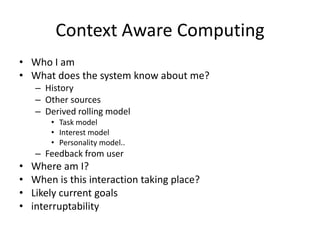
Context Aware Computing
• Who I am
• What does the system know about me?
    – History
    – Other sources
    – Derived rolling model
        • Task model
        • Interest model
        • Personality model..
    – Feedback from user
•   Where am I?
•   When is this interaction taking place?
•   Likely current goals
•   interruptability
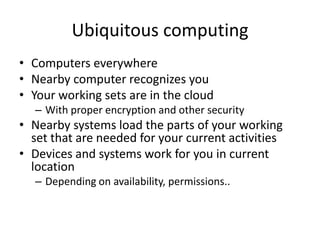
Ubiquitous computing
• Computers everywhere
• Nearby computer recognizes you
• Your working sets are in the cloud
  – With proper encryption and other security
• Nearby systems load the parts of your working
  set that are needed for your current activities
• Devices and systems work for you in current
  location
  – Depending on availability, permissions..
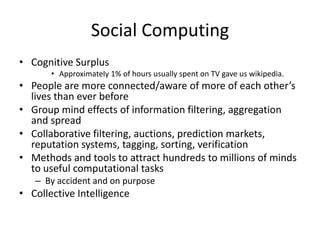
Social Computing
• Cognitive Surplus
       • Approximately 1% of hours usually spent on TV gave us wikipedia.
• People are more connected/aware of more of each other’s
  lives than ever before
• Group mind effects of information filtering, aggregation
  and spread
• Collaborative filtering, auctions, prediction markets,
  reputation systems, tagging, sorting, verification
• Methods and tools to attract hundreds to millions of minds
  to useful computational tasks
   – By accident and on purpose
• Collective Intelligence
What kind of tools to you crave?
• Brainstorm!

Exo cortex

  • 1.
    Exocortical Dreams Brainstorming desirableintelligence augmenting technologies
  • 2.
    Exocortex is partof you • Exocortex is extension of your neocortex via external technological devices and systems – Especially ones more deeply and seamlessly interfaced • But this is a goal of many computational/communication devices • Natural drivers in this direction • All computational and communication devices that extend your effective intelligence are part of it • Some of your exocortex is shared with other people – Beginning of group mind • The devices that are part of your mind and effective intelligence are as important and should be as secured / safeguarded / not be trespassed on as your physical brain.
  • 3.
    What kind oftools do you dream of? • Voice interfaces • Software assistant – Takes notes (voice?), does research, notes what I need and fetches it, notifies me of relevant things – Is my appointment secretary – Is my budget manager.. – Remembers everything – Finds anything relevant and useful to what I am doing – muse • Internet of Things – Not just physical things hooked to internet with all their information – Internet of conceptual things as well • No dead unconnected data
  • 4.
    Human Computer Interface •What kinds of interfaces are best for humans? • Take advantage of our strengths, augment our weaknesses – Strengths • Chunking • Pattern recognition (especially visual) • Induction and abduction • Complex (mostly social) inter-relationships – Weakness • Memory • Computation • Analysis with too many non-chunkable free variables • Large scale sifting of information • Finding patterns in data sets to large for us
  • 5.
    Dumb data, duplication •Information about an object X of type Y should always be associated with that instance • Instances should persist and have identity for long lived “things” • Today the connection, the “what is this about” is largely not automated but in users heads or particular software • Can’t have internet of things like this or much reasoning and pulling together relevant information. • Many copies of somewhat differing data about same things in many formats • Relationships between things seldom 1st class entities in programs and systems • Persistent, distributed cloud of software objects / agents / actors
  • 6.
    Software Agents • Moreor less autonomous software programs – Long running – Task focused (specialized or task assignable) – May cooperate with other agents in agent ecology • Some agents are mobile – Many are designed as loadable modules on any suitable platform – May propagate copies much like a worm or virus • Search agents are a simple example • Shopping and auction agents • Some types of bots would qualify
  • 7.
    Software Agents • Onebeing’s worm is another being’s research tool – Traveling software entities phone home • The invisible hand in the world of software bots – Bidding on tasks – Contracts – Subcontract • Describing what is needed • Representing knowledge
  • 8.
    Mobile Computing • There’san app for that – Not yet for many things and not that smart but.. • Location based computing is huge – context awareness – Augmented reality – Proximity notices (people, events, tasks..) • Sensor processing • Explosion of cheap ubiquitous partial solutions – Input an issue • Voice input much needed – Pulling out a device and navigating menus to an app and navigating its menus is too slow • Causes much less use than would be beneficial – Flash mobs • People/machines (cyborgs) flocking on information feeds
  • 9.
    Digital Research Assistant •System that scans a corpus of articles and other sources • Does data mining and other techniques to extract concepts • May be tuned to look for particular keywords – System to find bi-metals tried and suggest new ones is famous example, several patentable finds • Scan of blogosphere and google results looking for information on given topics – Some automation composing results with references
  • 10.
    Everything is intelligent •Any object with state can have sensors and give off information • Augmented objects can change state on external request / message • Sets of such objects can exhibit unified complex behaviors • Adaptive systems reconfigure within programmed limits – Based on past history – Current data – Situation models – State machines
  • 11.
    Wearable computing • Landof cyborgs • Feeds into senses – Eye patch or other visual input – Ear buds – Haptic • Input is still a problem – needs voice • Getting better at external brain “mind reading” • Power is big challenge • Not looking like a complete cyborg is important • Need wearable systems to record everything – Don’t record and you can’t learn more from what you experience – Don’t record and there is less of you in the metaverse
  • 12.
    Context Aware Computing •Who I am • What does the system know about me? – History – Other sources – Derived rolling model • Task model • Interest model • Personality model.. – Feedback from user • Where am I? • When is this interaction taking place? • Likely current goals • interruptability
  • 13.
    Ubiquitous computing • Computerseverywhere • Nearby computer recognizes you • Your working sets are in the cloud – With proper encryption and other security • Nearby systems load the parts of your working set that are needed for your current activities • Devices and systems work for you in current location – Depending on availability, permissions..
  • 14.
    Social Computing • CognitiveSurplus • Approximately 1% of hours usually spent on TV gave us wikipedia. • People are more connected/aware of more of each other’s lives than ever before • Group mind effects of information filtering, aggregation and spread • Collaborative filtering, auctions, prediction markets, reputation systems, tagging, sorting, verification • Methods and tools to attract hundreds to millions of minds to useful computational tasks – By accident and on purpose • Collective Intelligence
  • 15.
    What kind oftools to you crave? • Brainstorm!

Editor's Notes

  • #2 Disclaimer: Actionable ideas may become actualized by myself and or others here or who see this chat log.