
INTRODUCTION TO PROJECT
MANAGEMENT
PROJECT
Defining Project
A Project is a work effort made over a finite
period of time with a ‘start’ and ‘finish’ to
create a unique product, service or result.
Project Characteristics
• Unique,
• Projects are temporary in nature and have a
definite beginning & ending date,
• A single, definable purpose & well-defined end-
terms or deliverables;
• Utilizing skills & talents from multiple professions
& organizations,
•The ‘process’ of working to achieve a goal;
• Progressive elaboration, i.e., developing in steps;
• A successful project is one that meets or
exceeds the expectations of the stakeholders.
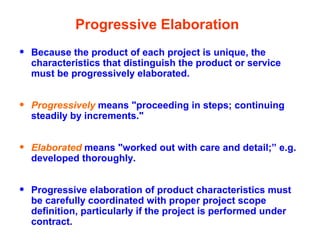
Progressive Elaboration
• Because the product of each project is unique, the
characteristics that distinguish the product or service
must be progressively elaborated.
• Progressively means "proceeding in steps; continuing
steadily by increments."
• Elaborated means "worked out with care and detail;” e.g.
developed thoroughly.
• Progressive elaboration of product characteristics must
be carefully coordinated with proper project scope
definition, particularly if the project is performed under
contract.
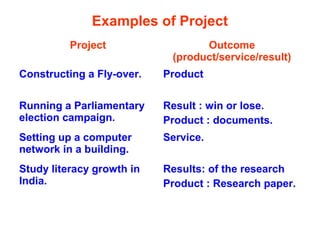
Examples of Project
Project Outcome
(product/service/result)
Constructing a Fly-over. Product
Running a Parliamentary
election campaign.
Result : win or lose.
Product : documents.
Setting up a computer
network in a building.
Service.
Study literacy growth in
India.
Results: of the research
Product : Research paper.
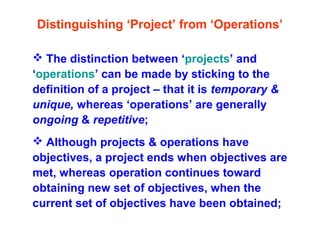
Distinguishing ‘Project’ from ‘Operations’
 The distinction between ‘projects’ and
‘operations’ can be made by sticking to the
definition of a project – that it is temporary &
unique, whereas ‘operations’ are generally
ongoing & repetitive;
 Although projects & operations have
objectives, a project ends when objectives are
met, whereas operation continues toward
obtaining new set of objectives, when the
current set of objectives have been obtained;
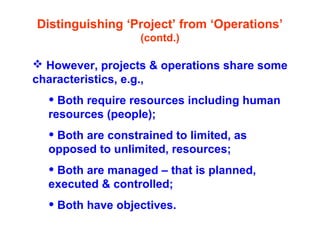
Distinguishing ‘Project’ from ‘Operations’
(contd.)
 However, projects & operations share some
characteristics, e.g.,
• Both require resources including human
resources (people);
• Both are constrained to limited, as
opposed to unlimited, resources;
• Both are managed – that is planned,
executed & controlled;
• Both have objectives.
Project ‘Goal’
 For virtually every project, the goal is to hit a
three dimensional target –
• Complete the work for a customer or end-
user in accordance with :
a)Budget – specified or allowable ‘Cost’ for
the project;
b)Schedule – ‘Time’ period over which the
work is to be done;
Project ‘Goal’ (contd.)
c) Performance requirements – the required
features of the project end-term deliverables,
or final result, including necessary attributes
of the final product or service, technological
specifications, quality & quantity measures,
and whatever else is important to the
customer or end-user.
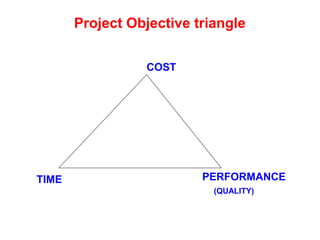
Project Objective triangle
COST
TIME PERFORMANCE
(QUALITY)
Projects & strategic planning
 Since projects are often utilized as a means
of achieving an organization’s strategic plan,
projects are typically authorized as a result of
one or more of the following strategic
considerations :
• A market demand, e.g. an oil company
authorizes a project to build a new refinery in
response to chronic gasoline shortage;
• An organization need, e.g. a training
company authorizes a project to create a new
course in order to increase revenues;
Projects & strategic planning (contd.)
• A customer request, e.g. an electrical utility
company authorises a project to build a new
sub-station to serve a new industrial park;
• A technological advancement, e.g. a software
firm authorises a new project to develop a new
generation of video games;
• A legal requirement, e.g. a paint manufacturer
authorises a project to establish guidelines for
handling of a new toxic material.
Types of Projects
 The following are the different types of projects
that project managers, new to project
management, might be involved with :
 Construction projects,
 Defense projects,
 Petrochemical,
 IT projects,
 Product development projects,
 Advertising & marketing projects,
Types of Projects (contd.)
 Up-grade projects,
 Bank projects,
 Event management,
 Music concerts,
 Fashion shows,
 Disaster recovery projects, etc.
PROJECT MANAGEMENT
Project Management
Project management is the application of
knowledge, skills, tools & techniques to project
activities to meet project requirements;
 Project management is accomplished through
the application & integration of the project
management processes of initiating, planning,
executing, monitoring & controlling and
closing;
 Almost every project must work within the
triple constraint combination of time, cost
(resources) and quality (performance).
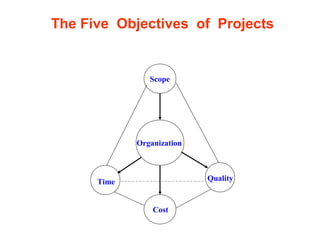
The Five Objectives of Projects
Scope
Organization
Time
Cost
Quality
Guidelines to Project management
• The organization is temporary & established for
the life of the project ;
• In many cases, a project forms part of a larger
project structure ;
• The project objectives & product characteristics
may be defined & achieved progressively
during the course of the project ;
• The result of a project may be the creation of one
or several units of a product ;
• The interaction between project activities may
be complex.
Elements of Project Management
• Identification of the project ;
• Technical & financial appraisal of the project ;
• Economic or socio-economic appraisal of the
project, when necessary ;
• Proper formulation of the project ;
• Plan for implementation of the project ;
• Actual implementation of the project ;
• Monitoring the implementation ;
• Control action / rectification ;
• Evaluation at the end of the project.
HISTORY OF PROJECT
MANAGEMENT
 Traditionally, the management of projects was
considered more of an art than a science;
 Most project managers would begin their careers in
a technical field and as they progressed, they would
become more involved in the management of their
projects;
 This is when they would develop a need for project
management education;
 The worldwide trend towards project management
has been accompanied by formal project management
education & training;
Background
 There are now many academic and certification
programmes available from universities & colleges
around the world;
 Historically, as the discipline of project
management grew and become established, so a
number of institutions & associations were formed
to represent the project management practitioners
with respect to education, professional
accreditation, ethics and body of knowledge;
Background
Background
 The project management standards are
associated with the following :
• Body of knowledge,
• Certification of project managers (PMP) ,
• Unit standards,
• Ethics and governance,
• Global forum.
Body of Knowledge
 Over the past fifty years, a considerable body of
knowledge has been built up around project
management tools, skills, techniques & processes;
 This data base of information has been developed
into what the Project Management Institute (PMI) call
the Project Management Body Of Knowledge
(PMBOK);
 There are number of institutes, associations and
government bodies around the world which have
produced a body of knowledge, unit standards &
competency standards – they all have presence in the
internet;
Body of Knowledge
 Some of the institutes are :
• Project Management Institute (PMI), USA;
(PMBOK)
• Association for Project Management (AIM), UK
[BOK];
• Australian Institute of Project Management
(AIPM);
• International Project management Association
(IPMA);
• Association for construction Project Managers
(ACPM), etc.
Body of Knowledge
 There are number of standards published by
different bodies;
 Project management techniques
• nearly all the special project management
techniques used today, were developed during
the 1950s and 1960s by US defense – aerospace
industry (DoD & NASA);
• this includes – CPM/PERT, Earned value (EV),
configuration management, value engineering &
work breakdown structure (WBS), etc.
PROJECT MANAGEMENT
AREAS OF EXPERTISE
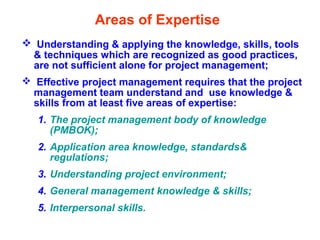
Areas of Expertise
 Understanding & applying the knowledge, skills, tools
& techniques which are recognized as good practices,
are not sufficient alone for project management;
 Effective project management requires that the project
management team understand and use knowledge &
skills from at least five areas of expertise:
1. The project management body of knowledge
(PMBOK);
2. Application area knowledge, standards&
regulations;
3. Understanding project environment;
4. General management knowledge & skills;
5. Interpersonal skills.
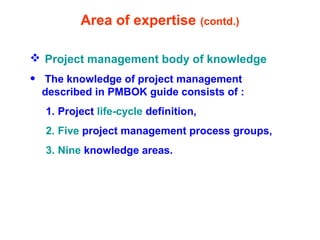
Area of expertise (contd.)
 Project management body of knowledge
• The knowledge of project management
described in PMBOK guide consists of :
1. Project life-cycle definition,
2. Five project management process groups,
3. Nine knowledge areas.
Area of expertise (contd.)
 Application area knowledge, standards &
regulations
• Each application area generally has a set of accepted
standards & practices, often codified in regulations.
These application areas are :
1. Functional departments & supporting disciplines,
such as legal, production & inventory mgmt,
marketing, logistics & personnel,
2. Technical elements, such as software development,
water & sanitation engg, or construction engg,
3. Management specializations, such as government
contracting, community development, etc.,
4. Industry groups, such as automotive, chemical,
agricultural & financial services.
Area of expertise (contd.)
 Understanding the project environment
• The project team should consider the project in
the contexts of :
1. Cultural & social environment,
2. International & political environment,
3. Physical environment.
 General management knowledge & skills
• This encompasses planning, organizing, staffing,
directing & controlling the operations of an
enterprise.
• It includes supporting disciplines, such as –
Financial mgmt / sales & marketing/ contracts &
commercial law /SCM /Personnel administration /
OB / compensation / Health & safety / IT, etc.
Area of expertise (contd.)
 Interpersonal skills
• The management of interpersonal relations
include :
 Effective communication,
 Influencing the organization,
 Leadership,
 Motivation,
 Negotiation & conflict management,
 Problem-solving.
34
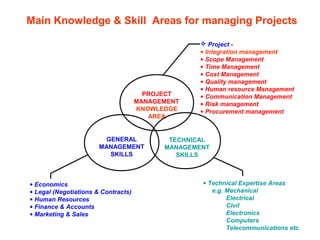
PROJECT
MANAGEMENT
KNOWLEDGE
AREA
GENERAL
MANAGEMENT
SKILLS
TECHNICAL
MANAGEMENT
SKILLS
 Project -
• Integration management
• Scope Management
• Time Management
• Cost Management
• Quality management
• Human resource Management
• Communication Management
• Risk management
• Procurement management
• Economics
• Legal (Negotiations & Contracts)
• Human Resources
• Finance & Accounts
• Marketing & Sales
• Technical Expertise Areas
e.g. Mechanical
Electrical
Civil
Electronics
Computers
Telecommunications etc.
Main Knowledge & Skill Areas for managing Projects
PROJECT LIFE-CYCLE
Project Life Cycle
• The collection of phases that are performed in
completing a project.
• Each project phase is marked by completion of one
or more deliverables.
• The conclusion of a project phase is generally
marked by a review of both key deliverables and
project performance to date.
Determine if the project should continue into its
next phase.
Detect and correct errors.
Project Life Cycle
• The project life cycle defines the beginning and the
end of a project.
• Project life cycles generally define:
- What technical work should be done in
each phase;
- When the deliverables are to be generated in
each phase & how each deliverable is
reviewed, verified & validated;
- Who should be involved in each phase;
- How to control & approve each phase.
Project Lifecycle
 The PMBOK (4th
edition) states that as projects
are unique & involve a certain degree of risk,
organizations performing projects will generally
sub-divide their projects into several project
phases to provide better management control;
 Collectively these project phases are called the
‘project life cycle’;
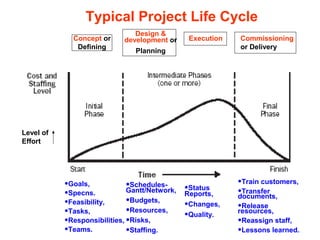
 The four-phase project life-cycle is given below :
1. Concept & initiation phase,
2. Design & development phase,
3. Execution phase,
4. Commissioning & handover phase.
Typical Project Life Cycle
Concept or
Defining
Design &
development or
Planning
Execution Commissioning
or Delivery
•Goals,
•Specns.
•Feasibility,
•Tasks,
•Responsibilities,
•Teams.
•Schedules-
Gantt/Network,
•Budgets,
•Resources,
•Risks,
•Staffing.
•Status
Reports,
•Changes,
•Quality.
•Train customers,
•Transfer
documents,
•Release
resources,
•Reassign staff,
•Lessons learned.
Level of
Effort
Life-cycle characteristics
 Most project life cycles share a number of
characteristics :
• Phases are generally sequential & are usually
defined by some form of technical information transfer;
• Cost & staffing levels are low at the start, peak during
the intermediate phase & drop rapidly as the project
draws to a conclusion;
• The level of uncertainty is highest, and hence, risk of
failing to achieve the objectives is greatest at the start
of the project - the certainty of completion generally
gets progressively better as the project continues;
Life-cycle characteristics (contd.)
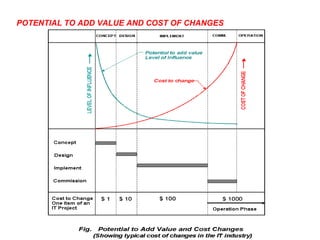
• The ability of the stakeholders to influence the
final characteristics of the project’s product and
the final cost of the project is highest at the start &
gets progressively lower as the project continues;
• A major contributor to the phenomenon is that
the cost of changes and correcting errors
generally increases as the project continues.
POTENTIAL TO ADD VALUE AND COST OF CHANGES

Ibm projectmgmt-1

  • 1.
  • 2.
  • 3.
    Defining Project A Projectis a work effort made over a finite period of time with a ‘start’ and ‘finish’ to create a unique product, service or result.
  • 4.
    Project Characteristics • Unique, •Projects are temporary in nature and have a definite beginning & ending date, • A single, definable purpose & well-defined end- terms or deliverables; • Utilizing skills & talents from multiple professions & organizations, •The ‘process’ of working to achieve a goal; • Progressive elaboration, i.e., developing in steps; • A successful project is one that meets or exceeds the expectations of the stakeholders.
  • 5.
    Progressive Elaboration • Becausethe product of each project is unique, the characteristics that distinguish the product or service must be progressively elaborated. • Progressively means "proceeding in steps; continuing steadily by increments." • Elaborated means "worked out with care and detail;” e.g. developed thoroughly. • Progressive elaboration of product characteristics must be carefully coordinated with proper project scope definition, particularly if the project is performed under contract.
  • 6.
    Examples of Project ProjectOutcome (product/service/result) Constructing a Fly-over. Product Running a Parliamentary election campaign. Result : win or lose. Product : documents. Setting up a computer network in a building. Service. Study literacy growth in India. Results: of the research Product : Research paper.
  • 7.
    Distinguishing ‘Project’ from‘Operations’  The distinction between ‘projects’ and ‘operations’ can be made by sticking to the definition of a project – that it is temporary & unique, whereas ‘operations’ are generally ongoing & repetitive;  Although projects & operations have objectives, a project ends when objectives are met, whereas operation continues toward obtaining new set of objectives, when the current set of objectives have been obtained;
  • 8.
    Distinguishing ‘Project’ from‘Operations’ (contd.)  However, projects & operations share some characteristics, e.g., • Both require resources including human resources (people); • Both are constrained to limited, as opposed to unlimited, resources; • Both are managed – that is planned, executed & controlled; • Both have objectives.
  • 9.
    Project ‘Goal’  Forvirtually every project, the goal is to hit a three dimensional target – • Complete the work for a customer or end- user in accordance with : a)Budget – specified or allowable ‘Cost’ for the project; b)Schedule – ‘Time’ period over which the work is to be done;
  • 10.
    Project ‘Goal’ (contd.) c)Performance requirements – the required features of the project end-term deliverables, or final result, including necessary attributes of the final product or service, technological specifications, quality & quantity measures, and whatever else is important to the customer or end-user.
  • 11.
  • 12.
    Projects & strategicplanning  Since projects are often utilized as a means of achieving an organization’s strategic plan, projects are typically authorized as a result of one or more of the following strategic considerations : • A market demand, e.g. an oil company authorizes a project to build a new refinery in response to chronic gasoline shortage; • An organization need, e.g. a training company authorizes a project to create a new course in order to increase revenues;
  • 13.
    Projects & strategicplanning (contd.) • A customer request, e.g. an electrical utility company authorises a project to build a new sub-station to serve a new industrial park; • A technological advancement, e.g. a software firm authorises a new project to develop a new generation of video games; • A legal requirement, e.g. a paint manufacturer authorises a project to establish guidelines for handling of a new toxic material.
  • 14.
    Types of Projects The following are the different types of projects that project managers, new to project management, might be involved with :  Construction projects,  Defense projects,  Petrochemical,  IT projects,  Product development projects,  Advertising & marketing projects,
  • 15.
    Types of Projects(contd.)  Up-grade projects,  Bank projects,  Event management,  Music concerts,  Fashion shows,  Disaster recovery projects, etc.
  • 16.
  • 17.
    Project Management Project managementis the application of knowledge, skills, tools & techniques to project activities to meet project requirements;  Project management is accomplished through the application & integration of the project management processes of initiating, planning, executing, monitoring & controlling and closing;  Almost every project must work within the triple constraint combination of time, cost (resources) and quality (performance).
  • 18.
    The Five Objectivesof Projects Scope Organization Time Cost Quality
  • 19.
    Guidelines to Projectmanagement • The organization is temporary & established for the life of the project ; • In many cases, a project forms part of a larger project structure ; • The project objectives & product characteristics may be defined & achieved progressively during the course of the project ; • The result of a project may be the creation of one or several units of a product ; • The interaction between project activities may be complex.
  • 20.
    Elements of ProjectManagement • Identification of the project ; • Technical & financial appraisal of the project ; • Economic or socio-economic appraisal of the project, when necessary ; • Proper formulation of the project ; • Plan for implementation of the project ; • Actual implementation of the project ; • Monitoring the implementation ; • Control action / rectification ; • Evaluation at the end of the project.
  • 21.
  • 22.
     Traditionally, themanagement of projects was considered more of an art than a science;  Most project managers would begin their careers in a technical field and as they progressed, they would become more involved in the management of their projects;  This is when they would develop a need for project management education;  The worldwide trend towards project management has been accompanied by formal project management education & training; Background
  • 23.
     There arenow many academic and certification programmes available from universities & colleges around the world;  Historically, as the discipline of project management grew and become established, so a number of institutions & associations were formed to represent the project management practitioners with respect to education, professional accreditation, ethics and body of knowledge; Background
  • 24.
    Background  The projectmanagement standards are associated with the following : • Body of knowledge, • Certification of project managers (PMP) , • Unit standards, • Ethics and governance, • Global forum.
  • 25.
    Body of Knowledge Over the past fifty years, a considerable body of knowledge has been built up around project management tools, skills, techniques & processes;  This data base of information has been developed into what the Project Management Institute (PMI) call the Project Management Body Of Knowledge (PMBOK);  There are number of institutes, associations and government bodies around the world which have produced a body of knowledge, unit standards & competency standards – they all have presence in the internet;
  • 26.
    Body of Knowledge Some of the institutes are : • Project Management Institute (PMI), USA; (PMBOK) • Association for Project Management (AIM), UK [BOK]; • Australian Institute of Project Management (AIPM); • International Project management Association (IPMA); • Association for construction Project Managers (ACPM), etc.
  • 27.
    Body of Knowledge There are number of standards published by different bodies;  Project management techniques • nearly all the special project management techniques used today, were developed during the 1950s and 1960s by US defense – aerospace industry (DoD & NASA); • this includes – CPM/PERT, Earned value (EV), configuration management, value engineering & work breakdown structure (WBS), etc.
  • 28.
  • 29.
    Areas of Expertise Understanding & applying the knowledge, skills, tools & techniques which are recognized as good practices, are not sufficient alone for project management;  Effective project management requires that the project management team understand and use knowledge & skills from at least five areas of expertise: 1. The project management body of knowledge (PMBOK); 2. Application area knowledge, standards& regulations; 3. Understanding project environment; 4. General management knowledge & skills; 5. Interpersonal skills.
  • 30.
    Area of expertise(contd.)  Project management body of knowledge • The knowledge of project management described in PMBOK guide consists of : 1. Project life-cycle definition, 2. Five project management process groups, 3. Nine knowledge areas.
  • 31.
    Area of expertise(contd.)  Application area knowledge, standards & regulations • Each application area generally has a set of accepted standards & practices, often codified in regulations. These application areas are : 1. Functional departments & supporting disciplines, such as legal, production & inventory mgmt, marketing, logistics & personnel, 2. Technical elements, such as software development, water & sanitation engg, or construction engg, 3. Management specializations, such as government contracting, community development, etc., 4. Industry groups, such as automotive, chemical, agricultural & financial services.
  • 32.
    Area of expertise(contd.)  Understanding the project environment • The project team should consider the project in the contexts of : 1. Cultural & social environment, 2. International & political environment, 3. Physical environment.  General management knowledge & skills • This encompasses planning, organizing, staffing, directing & controlling the operations of an enterprise. • It includes supporting disciplines, such as – Financial mgmt / sales & marketing/ contracts & commercial law /SCM /Personnel administration / OB / compensation / Health & safety / IT, etc.
  • 33.
    Area of expertise(contd.)  Interpersonal skills • The management of interpersonal relations include :  Effective communication,  Influencing the organization,  Leadership,  Motivation,  Negotiation & conflict management,  Problem-solving.
  • 34.
    34 PROJECT MANAGEMENT KNOWLEDGE AREA GENERAL MANAGEMENT SKILLS TECHNICAL MANAGEMENT SKILLS  Project - •Integration management • Scope Management • Time Management • Cost Management • Quality management • Human resource Management • Communication Management • Risk management • Procurement management • Economics • Legal (Negotiations & Contracts) • Human Resources • Finance & Accounts • Marketing & Sales • Technical Expertise Areas e.g. Mechanical Electrical Civil Electronics Computers Telecommunications etc. Main Knowledge & Skill Areas for managing Projects
  • 35.
  • 36.
    Project Life Cycle •The collection of phases that are performed in completing a project. • Each project phase is marked by completion of one or more deliverables. • The conclusion of a project phase is generally marked by a review of both key deliverables and project performance to date. Determine if the project should continue into its next phase. Detect and correct errors.
  • 37.
    Project Life Cycle •The project life cycle defines the beginning and the end of a project. • Project life cycles generally define: - What technical work should be done in each phase; - When the deliverables are to be generated in each phase & how each deliverable is reviewed, verified & validated; - Who should be involved in each phase; - How to control & approve each phase.
  • 38.
    Project Lifecycle  ThePMBOK (4th edition) states that as projects are unique & involve a certain degree of risk, organizations performing projects will generally sub-divide their projects into several project phases to provide better management control;  Collectively these project phases are called the ‘project life cycle’;  The four-phase project life-cycle is given below : 1. Concept & initiation phase, 2. Design & development phase, 3. Execution phase, 4. Commissioning & handover phase.
  • 39.
    Typical Project LifeCycle Concept or Defining Design & development or Planning Execution Commissioning or Delivery •Goals, •Specns. •Feasibility, •Tasks, •Responsibilities, •Teams. •Schedules- Gantt/Network, •Budgets, •Resources, •Risks, •Staffing. •Status Reports, •Changes, •Quality. •Train customers, •Transfer documents, •Release resources, •Reassign staff, •Lessons learned. Level of Effort
  • 40.
    Life-cycle characteristics  Mostproject life cycles share a number of characteristics : • Phases are generally sequential & are usually defined by some form of technical information transfer; • Cost & staffing levels are low at the start, peak during the intermediate phase & drop rapidly as the project draws to a conclusion; • The level of uncertainty is highest, and hence, risk of failing to achieve the objectives is greatest at the start of the project - the certainty of completion generally gets progressively better as the project continues;
  • 41.
    Life-cycle characteristics (contd.) •The ability of the stakeholders to influence the final characteristics of the project’s product and the final cost of the project is highest at the start & gets progressively lower as the project continues; • A major contributor to the phenomenon is that the cost of changes and correcting errors generally increases as the project continues.
  • 42.
    POTENTIAL TO ADDVALUE AND COST OF CHANGES