Information Systems
Project Management
What a Project Manager isn’t.
• A Project Manager is not a adminstrative assistant.
• A Project Manager is not a functional manager.
– A Project manager is not responsible for
• hiring, firing, raises, annual reviews.
What is a Project Manager?
PM’s are the coxswains of the project.
Make sure everyone is insync with the project objectives.
Motivate the team.
Maintain the proper cadence of the project to the end.
PMI - PMBOK
• PMI – Project Management Institute
– Initiated in 1969 at the Georgia Institute of Technology
– PMI's objectives are:
• Global standards of project management practices.
• Develop common terminology common terminology and techniques.
• Provide guidelines of instruction and career development.
• PMBOK Guide
Requirements
• Bachelor’s college degree
– 4500 hours of project management experience within 36 months
• Additional classes for PMP specific requirements
• Pass the exam
– 200 questions on 5 different topics
– 4 hours to complete the exam
• Maintain certification by taking additional classes throughout the year.
PMI Code of Ethics and
Professional Conduct
• Applies to:
– PMI members
– Non-members with a PMI certification
– Non-members who apply to commence a PMI certification process
– Non-members who volunteer for the PMI
• Values: Responsibility, Respect, Fairness, Honesty
• Basic Rules: Don’t steal, don’t cheat, and don’t lie.
What is a project
• Exist to bring a product, service, or a result that didn’t exist before.
• Defined start and end dates - temporary in nature.
• Completed when the goals and objectives are completed as stated in the Scope
Statement.
• Progressive elaboration.
• Not repetitive in nature i.e. operational environment.
• There is a handoff of the project deliverables to the support staff.
Project Management
Process Groups
1. Initiating
2. Planning
3. Executing
4. Monitoring and Controlling
5. Closing
Project Management
Knowledge Areas
1. Project Integration Management
2. Project Scope Management
3. Project Time Management
4. Project Cost Management
5. Project Quality Management
6. Project Human Resource Management
7. Project Communications Management
8. Project Risk Management
9. Project Procurement Management
10. Project Stakeholder Management
Project Integration Management
• Identifying the work of the project
– creating the Project Charter
– assigning the Project Manager
• Creating a Project Plan
– combining and integrating all the appropriate processes
• Monitoring the project
– change control process
– replanning as needed
• Closing the project
– compare estimated and actual budget
– compare planned/baseline and actual schedule
– document lessons learned
Project Scope Management
• Collect project requirements
• Define the scope, assumptions and constraints
– Create Scope Statement
• Work Breakdown Structure (WBS)
– Outline of tasks in text format
– Hierarchy in diagram similar to an organizational structure
• Continuously validate and control scope
Project Time Management
• Define and sequence all required project activities
• Estimate the resources for each of the activities
• Estimate the duration for each of the activities
• Develop a project schedule
Key Stakeholder Management
• What is a stakeholder
– Vested interest in the project
– Involved in the project work
– Examples include:
• Project sponsor
• Project manager
• Functional managers
• Team members
• Stakeholder analysis
– Role and potential impact on the project.
– Develop a stakeholder management plan.
• Information includes: Name, project influence,
Information to gain their support.
Communication Management
• Effective and efficient communication
• Keep the stakeholders informed with both good and bad news.
• Communications methods.
– Interactive communication
– Push communications.
– Pull communications.
• Communications management plan.
– Information to include: who, frequency, information type, format,
Risk Management
• Risks
– A risk is something that is uncertain and can have an impact against your projects objective.
– A project can have both positive and negative risks.
• How to manage risks
– Create a risk register, a risk management plan.
• List the risk
• Cost
• Timing (within the project schedule)
• Trigger
• Rank
• Probability and impact
• Strategies for the Responding to Risks
– Avoid the risk
– Transfer the risk
– Mitigate the risk
– Accept the risk
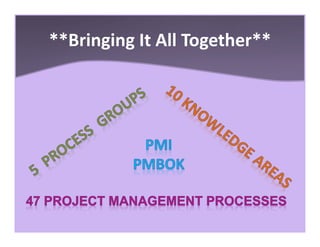
**Bringing It All Together**
47 Project Management Processes
10 PMBOK Knowledge Areas Categorized
by the 5 Process Groups
Measuring Project Success
• Triple Constraint – This is focused on
project outputs. If there is a change in Time,
Cost, or Scope, the project manager must make
an equivalent change to one or more of the
other constraints in order to keep balance -
without sacrificing the quality of the outcome.
• Business Outcomes – When the project
manager makes decisions about project
outputs, the effect on business outcomes must
be considered. In order to do this, it will be
important to define goals, objectives and
expectations at the beginning of the project,
monitor progress throughout the project, and
measure success at the close of the project.
http://www.pmi.org/Knowledge-Center/Next-Level-Up-How-Do-You-Measure-Project-Success.aspx
Thank you!
Questions??

PM LnL

  • 1.
  • 2.
    What a ProjectManager isn’t. • A Project Manager is not a adminstrative assistant. • A Project Manager is not a functional manager. – A Project manager is not responsible for • hiring, firing, raises, annual reviews.
  • 3.
    What is aProject Manager? PM’s are the coxswains of the project. Make sure everyone is insync with the project objectives. Motivate the team. Maintain the proper cadence of the project to the end.
  • 4.
    PMI - PMBOK •PMI – Project Management Institute – Initiated in 1969 at the Georgia Institute of Technology – PMI's objectives are: • Global standards of project management practices. • Develop common terminology common terminology and techniques. • Provide guidelines of instruction and career development. • PMBOK Guide
  • 5.
    Requirements • Bachelor’s collegedegree – 4500 hours of project management experience within 36 months • Additional classes for PMP specific requirements • Pass the exam – 200 questions on 5 different topics – 4 hours to complete the exam • Maintain certification by taking additional classes throughout the year.
  • 6.
    PMI Code ofEthics and Professional Conduct • Applies to: – PMI members – Non-members with a PMI certification – Non-members who apply to commence a PMI certification process – Non-members who volunteer for the PMI • Values: Responsibility, Respect, Fairness, Honesty • Basic Rules: Don’t steal, don’t cheat, and don’t lie.
  • 7.
    What is aproject • Exist to bring a product, service, or a result that didn’t exist before. • Defined start and end dates - temporary in nature. • Completed when the goals and objectives are completed as stated in the Scope Statement. • Progressive elaboration. • Not repetitive in nature i.e. operational environment. • There is a handoff of the project deliverables to the support staff.
  • 8.
    Project Management Process Groups 1.Initiating 2. Planning 3. Executing 4. Monitoring and Controlling 5. Closing
  • 9.
    Project Management Knowledge Areas 1.Project Integration Management 2. Project Scope Management 3. Project Time Management 4. Project Cost Management 5. Project Quality Management 6. Project Human Resource Management 7. Project Communications Management 8. Project Risk Management 9. Project Procurement Management 10. Project Stakeholder Management
  • 10.
    Project Integration Management •Identifying the work of the project – creating the Project Charter – assigning the Project Manager • Creating a Project Plan – combining and integrating all the appropriate processes • Monitoring the project – change control process – replanning as needed • Closing the project – compare estimated and actual budget – compare planned/baseline and actual schedule – document lessons learned
  • 11.
    Project Scope Management •Collect project requirements • Define the scope, assumptions and constraints – Create Scope Statement • Work Breakdown Structure (WBS) – Outline of tasks in text format – Hierarchy in diagram similar to an organizational structure • Continuously validate and control scope
  • 12.
    Project Time Management •Define and sequence all required project activities • Estimate the resources for each of the activities • Estimate the duration for each of the activities • Develop a project schedule
  • 13.
    Key Stakeholder Management •What is a stakeholder – Vested interest in the project – Involved in the project work – Examples include: • Project sponsor • Project manager • Functional managers • Team members • Stakeholder analysis – Role and potential impact on the project. – Develop a stakeholder management plan. • Information includes: Name, project influence, Information to gain their support.
  • 14.
    Communication Management • Effectiveand efficient communication • Keep the stakeholders informed with both good and bad news. • Communications methods. – Interactive communication – Push communications. – Pull communications. • Communications management plan. – Information to include: who, frequency, information type, format,
  • 15.
    Risk Management • Risks –A risk is something that is uncertain and can have an impact against your projects objective. – A project can have both positive and negative risks. • How to manage risks – Create a risk register, a risk management plan. • List the risk • Cost • Timing (within the project schedule) • Trigger • Rank • Probability and impact • Strategies for the Responding to Risks – Avoid the risk – Transfer the risk – Mitigate the risk – Accept the risk
  • 16.
  • 17.
    47 Project ManagementProcesses 10 PMBOK Knowledge Areas Categorized by the 5 Process Groups
  • 18.
    Measuring Project Success •Triple Constraint – This is focused on project outputs. If there is a change in Time, Cost, or Scope, the project manager must make an equivalent change to one or more of the other constraints in order to keep balance - without sacrificing the quality of the outcome. • Business Outcomes – When the project manager makes decisions about project outputs, the effect on business outcomes must be considered. In order to do this, it will be important to define goals, objectives and expectations at the beginning of the project, monitor progress throughout the project, and measure success at the close of the project. http://www.pmi.org/Knowledge-Center/Next-Level-Up-How-Do-You-Measure-Project-Success.aspx
  • 19.