Project Management for Success
       
         Bright Ighoroje
       
         bright@bnettel.com
       
         www.bnettel.com
       
         bright.bnettel.com
Preview


    Based on the Project Management Body of 
    Knowlege (PMBOK) version 4

    Prepares you for the qualifying exams for 
    Project Management Professional (PMP) and 
    Certified Associate Project Manager (CAPM) 
    Certifications
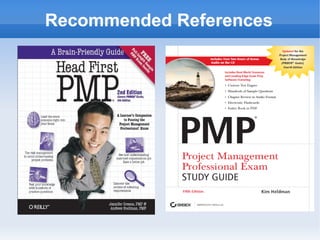
Recommended References
Who is here today?

    Class Introduction

    My Name is .......................

    I am a ................................


    How many of you are 

    (i) currently 

    (ii) interested in
    managing projects?
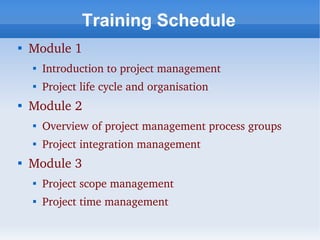
Training Schedule

    Module 1
    
        Introduction to project management
    
        Project life cycle and organisation

    Module 2
    
        Overview of project management process groups
    
        Project integration management

    Module 3
    
        Project scope management
    
        Project time management

    Module 4
    
        Project cost management
    
        Project quality management

    Module 5
    
        Project human resource management
    
        Project communication management

    Module 6
    
        Project risk management
    
        Project procurement management

    Module 7
    
        Introduction to Project Management Information 
        Systems
    
        Project Management Case Studies

    Module 8
    
        Review of PMBOK
    
        Project Management Professional Examination
    
        Other Project Management Standards
    
        The Next Level
Project Management
Module 1

    Introduction to project management

    Project life cycle and organisation
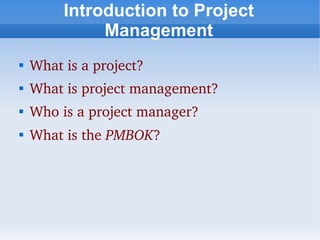
Introduction to Project
              Management

    What is a project?

    What is project management?

    Who is a project manager?

    What is the PMBOK?
Discussion


What is a project?
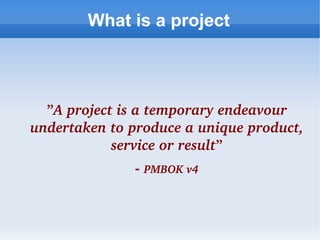
What is a project


  ”A project is a temporary endeavour 
undertaken to produce a unique product, 
            service or result”
               ­ PMBOK v4
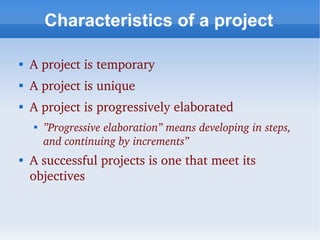
Characteristics of a project


    A project is temporary

    A project is unique

    A project is progressively elaborated
    
        ”Progressive elaboration” means developing in steps, 
        and continuing by increments”

    A successful projects is one that meet its 
    objectives
Projects vs Operations


    While projects are temporary and unique, 
    operations are ongoing and repetitive.

    The purpose of a project is to attain its objective 
    and then terminate. Conversely, the objective of 
    an ongoing operation is to sustain the business.

    A project concludes when its specific objectives 
    have been attained, while operations adopt a 
    new set of objectives and the work continues.
Examples of projects ...
How do Projects Originate?


    A market demand 

    An organizational need 

    A customer request 

    A technological advance 

    A legal requirement 
What is Project Management?


 ”Project management is the application 
of knowledge, skills, tools and techniques 
    to project activities to meet project 
               requirements”
                ­ PMBOK v4
Managing Projects involves ...


    Identifying requirements

    Establishing clear and achievable objectives

    Balancing the competing demands for quality, 
    scope, time, cost, quality, resources and risk

    Adapting the specifications, plans, and approach 
    to the different concerns and expectations of the 
    various stakeholders
Project Management Processes


    Initiating 

    Planning

    Executing

    Monitoring and Controlling

    Closing
Who is responsible for achieving the
        project objectives?
Characteristics of Good Project
              Managers

    Excellent communication skills

    Excellent planning skills

    Excellent budgeting skills

    Excellent conflict resolution skills

    Excellent leadership skills

    Excellent motivators

    Excellent Management skills

    Excellent Interpersonal skills
General Management Skills


    Financial management and accounting

    Sales and marketing

    Contracts and commercial law

    Manufacturing and distribution

    Strategic planning, tactical planning, and 
    operational planning

    Organizational structures and staffing

    Health and safety practices

    Information technology
What About Expertise?


    Much of the knowledge and many of the tools 
    and techniques for managing projects are 
    unique to project management

     Effective project management requires
    
        The Project Management Body of Knowledge
    
        Application area knowledge, standards, and 
        regulations
    
        Understanding the project environment
    
        General management knowledge and skills
    
        Interpersonal skills
Project Management Body of
             Knowledge

    The primary purpose of the PMBOK is to 
    identify that subset of the Project Management 
    Body of Knowledge that is generally recognized 
    as good practice. 

    The PMBOK also provides and promotes a 
    common lexicon for discussing, writing, and 
    applying project management. Such a standard 
    lexicon is an essential element of a profession.

    The PMBOK is a very popular, but not the sole 
    project management standard.
What is 'Good Practice'?


    'Good practice' means that there is general 
    agreement that the correct application of these 
    skills, tools, and techniques can enhance the 
    chances of success over a wide range of 
    different projects. 

    Good practice does not mean that the 
    knowledge described should always be applied 
    uniformly on all projects; the project 
    management team is responsible for 
    determining what is appropriate for any given 
    project.
What the PMBOK Contains


    The knowledge of project management 
    described in the PMBOK consists of:
    
        Project life cycle definition
    
        Five Project Management Process Groups
    
        Nine Knowledge Areas
Knowledge Areas


    The knowledge areas describe the key 
    competencies that project managers must 
    develop

    PMBOK specifies nine knowledge areas

    The knowldge areas and the proccess groups 
    form the core of the PMBOK
PMBOK Knowledge Areas


    Project Scope Management 
    
        Involves defining and managing all the work 
        required to successfully complete the project.

    Project Time Management
    
        Includes estimating how long it will take to 
        complete the work, developing appropriate project 
        schedules.

    Project Cost management
    
        Consists of preparing and managinh the budget for 
        the project

    Project Quality Management
    
        Ensures that the project will satisfy the stated or 
        implied needs for which it was undertaken

    Project Human Resource Management
    
        Concerned with making effective use of the people 
        involved with the project. Leadership and motivation 
        is included

    Project Communications Management
    
        Involves generating, collecting, disseminating, and 
        storing project information

    Project Risk Management
    
        Involves identifying, analyzing, and responding to 
        risks related to the project

    Project Procurement Management
    
        Involves acquiring or procuring goods and services 
        that are needed for a project from outside the 
        performing organization.

    Project Integration Management
    
        Is an overarching function that affects and is 
        affected by all other knowledge areas
Project Management Context


    Sub­projects

    Program management

    Portfolio management

    Project management office (PMO)
Sub-projects


    Projects are frequently divided into more 
    manageable components or subprojects

    The individual subprojects can be referred to as 
    projects and managed as such.

    Subprojects are often contracted to an external 
    enterprise or to another functional unit in the 
    performing organization. 

    Examples...
Programs and Portfolios


    A program is a group of related projects 
    managed in a coordinated way to obtain 
    benefits and control not available from 
    managing them individually.

    A portfolio is a collection of projects or 
    programs and other work that are grouped 
    together to facilitate effective management of 
    that work to meet strategic business objectives

    The projects or programs in the portfolio may 
    not necessarily be interdependent or directly 
    related
Project Management Office


    A project management office (PMO) is an 
    organizational unit to centralize and coordinate 
    the management of projects under its domain. 

    A PMO oversees the management of projects, 
    programs, or a combination of both. 

    The PMO focuses on the coordinated planning, 
    prioritization and execution of projects and 
    subprojects that are tied to the parent 
    organization’s or client’s overall business 
    objectives.
Key Features of PMO


    Shared and coordinated resources across all 
    projects administered by the PMO

    Identification and development of project 
    management methodology, best practices, and 
    standards

    Clearinghouse and management for project 
    policies, procedures, templates, and other 
    shared documentation

    Centralized configuration management for all 
    projects administered by the PMO
What type of project manager do you 
            want to be?
???

Project management 1

  • 1.
    Project Management for Success  Bright Ighoroje  bright@bnettel.com  www.bnettel.com  bright.bnettel.com
  • 2.
    Preview  Based on the Project Management Body of  Knowlege (PMBOK) version 4  Prepares you for the qualifying exams for  Project Management Professional (PMP) and  Certified Associate Project Manager (CAPM)  Certifications
  • 3.
  • 4.
    Who is heretoday? Class Introduction  My Name is .......................  I am a ................................ How many of you are   (i) currently   (ii) interested in managing projects?
  • 5.
    Training Schedule  Module 1  Introduction to project management  Project life cycle and organisation  Module 2  Overview of project management process groups  Project integration management  Module 3  Project scope management  Project time management
  • 6.
    Module 4  Project cost management  Project quality management  Module 5  Project human resource management  Project communication management  Module 6  Project risk management  Project procurement management
  • 7.
    Module 7  Introduction to Project Management Information  Systems  Project Management Case Studies  Module 8  Review of PMBOK  Project Management Professional Examination  Other Project Management Standards  The Next Level
  • 8.
  • 9.
    Module 1  Introduction to project management  Project life cycle and organisation
  • 10.
    Introduction to Project Management  What is a project?  What is project management?  Who is a project manager?  What is the PMBOK?
  • 11.
  • 12.
    What is aproject ”A project is a temporary endeavour  undertaken to produce a unique product,  service or result” ­ PMBOK v4
  • 13.
    Characteristics of aproject  A project is temporary  A project is unique  A project is progressively elaborated  ”Progressive elaboration” means developing in steps,  and continuing by increments”  A successful projects is one that meet its  objectives
  • 14.
    Projects vs Operations  While projects are temporary and unique,  operations are ongoing and repetitive.  The purpose of a project is to attain its objective  and then terminate. Conversely, the objective of  an ongoing operation is to sustain the business.  A project concludes when its specific objectives  have been attained, while operations adopt a  new set of objectives and the work continues.
  • 15.
  • 16.
    How do ProjectsOriginate?  A market demand   An organizational need   A customer request   A technological advance   A legal requirement 
  • 17.
    What is ProjectManagement? ”Project management is the application  of knowledge, skills, tools and techniques  to project activities to meet project  requirements” ­ PMBOK v4
  • 18.
    Managing Projects involves...  Identifying requirements  Establishing clear and achievable objectives  Balancing the competing demands for quality,  scope, time, cost, quality, resources and risk  Adapting the specifications, plans, and approach  to the different concerns and expectations of the  various stakeholders
  • 19.
    Project Management Processes  Initiating   Planning  Executing  Monitoring and Controlling  Closing
  • 20.
    Who is responsiblefor achieving the project objectives?
  • 21.
    Characteristics of GoodProject Managers  Excellent communication skills  Excellent planning skills  Excellent budgeting skills  Excellent conflict resolution skills  Excellent leadership skills  Excellent motivators  Excellent Management skills  Excellent Interpersonal skills
  • 22.
    General Management Skills  Financial management and accounting  Sales and marketing  Contracts and commercial law  Manufacturing and distribution  Strategic planning, tactical planning, and  operational planning  Organizational structures and staffing  Health and safety practices  Information technology
  • 24.
    What About Expertise?  Much of the knowledge and many of the tools  and techniques for managing projects are  unique to project management   Effective project management requires  The Project Management Body of Knowledge  Application area knowledge, standards, and  regulations  Understanding the project environment  General management knowledge and skills  Interpersonal skills
  • 25.
    Project Management Bodyof Knowledge  The primary purpose of the PMBOK is to  identify that subset of the Project Management  Body of Knowledge that is generally recognized  as good practice.   The PMBOK also provides and promotes a  common lexicon for discussing, writing, and  applying project management. Such a standard  lexicon is an essential element of a profession.  The PMBOK is a very popular, but not the sole  project management standard.
  • 26.
    What is 'GoodPractice'?  'Good practice' means that there is general  agreement that the correct application of these  skills, tools, and techniques can enhance the  chances of success over a wide range of  different projects.   Good practice does not mean that the  knowledge described should always be applied  uniformly on all projects; the project  management team is responsible for  determining what is appropriate for any given  project.
  • 27.

    What the PMBOKContains  The knowledge of project management  described in the PMBOK consists of:  Project life cycle definition  Five Project Management Process Groups  Nine Knowledge Areas
  • 28.
    Knowledge Areas  The knowledge areas describe the key  competencies that project managers must  develop  PMBOK specifies nine knowledge areas  The knowldge areas and the proccess groups  form the core of the PMBOK
  • 29.
    PMBOK Knowledge Areas  Project Scope Management   Involves defining and managing all the work  required to successfully complete the project.  Project Time Management  Includes estimating how long it will take to  complete the work, developing appropriate project  schedules.  Project Cost management  Consists of preparing and managinh the budget for  the project
  • 30.
    Project Quality Management  Ensures that the project will satisfy the stated or  implied needs for which it was undertaken  Project Human Resource Management  Concerned with making effective use of the people  involved with the project. Leadership and motivation  is included  Project Communications Management  Involves generating, collecting, disseminating, and  storing project information
  • 31.
    Project Risk Management  Involves identifying, analyzing, and responding to  risks related to the project  Project Procurement Management  Involves acquiring or procuring goods and services  that are needed for a project from outside the  performing organization.  Project Integration Management  Is an overarching function that affects and is  affected by all other knowledge areas
  • 32.
    Project Management Context  Sub­projects  Program management  Portfolio management  Project management office (PMO)
  • 33.
    Sub-projects  Projects are frequently divided into more  manageable components or subprojects  The individual subprojects can be referred to as  projects and managed as such.  Subprojects are often contracted to an external  enterprise or to another functional unit in the  performing organization.   Examples...
  • 34.
    Programs and Portfolios  A program is a group of related projects  managed in a coordinated way to obtain  benefits and control not available from  managing them individually.  A portfolio is a collection of projects or  programs and other work that are grouped  together to facilitate effective management of  that work to meet strategic business objectives  The projects or programs in the portfolio may  not necessarily be interdependent or directly  related
  • 35.
    Project Management Office  A project management office (PMO) is an  organizational unit to centralize and coordinate  the management of projects under its domain.   A PMO oversees the management of projects,  programs, or a combination of both.   The PMO focuses on the coordinated planning,  prioritization and execution of projects and  subprojects that are tied to the parent  organization’s or client’s overall business  objectives.
  • 36.
    Key Features ofPMO  Shared and coordinated resources across all  projects administered by the PMO  Identification and development of project  management methodology, best practices, and  standards  Clearinghouse and management for project  policies, procedures, templates, and other  shared documentation  Centralized configuration management for all  projects administered by the PMO
  • 37.
  • 40.