IENG-6103 ADVANCED INDUSTRIAL
PROJECT MANAGEMENT
Project Management
Chapter-1
Dr.K.BALASUNDARAM
Assistant Professor
Outline of presentations
What is a project & Project management
Organization for industrial projects
The role of people at different positions,
Project environment
Project classification
What is a Project?
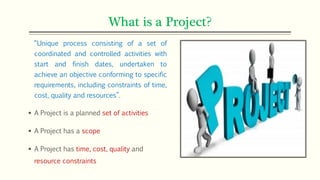
“Unique process consisting of a set of
coordinated and controlled activities with
start and finish dates, undertaken to
achieve an objective conforming to specific
requirements, including constraints of time,
cost, quality and resources”.
 A Project is a planned set of activities
 A Project has a scope
 A Project has time, cost, quality and
resource constraints
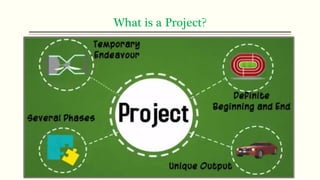
What is a Project?
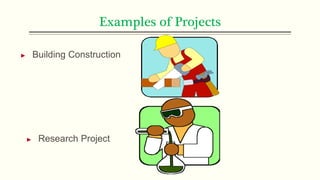
Examples of Projects
► Building Construction
► Research Project
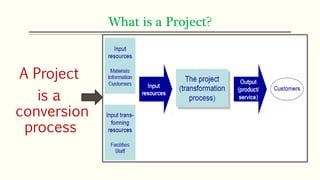
What is a Project?
A Project
is a
conversion
process
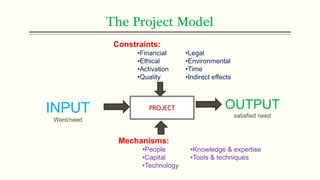
The Project Model
PROJECTINPUT
Want/need
OUTPUT
satisfied need
Constraints:
•Financial •Legal
•Ethical •Environmental
•Activation •Time
•Quality •Indirect effects
Mechanisms:
•People •Knowledge & expertise
•Capital •Tools & techniques
•Technology
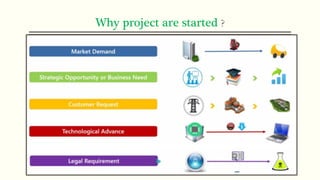
Why project are started ?
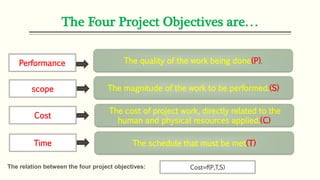
The Four Project Objectives are…
Performance
scope
Cost
Time
The quality of the work being done(P).
The magnitude of the work to be performed.(S)
The cost of project work, directly related to the
human and physical resources applied.(C)
The schedule that must be met(T)
The relation between the four project objectives: Cost=f(P,T,S)
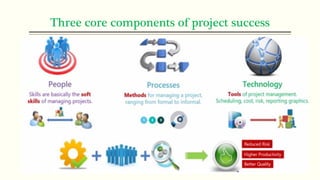
Three core components of project success
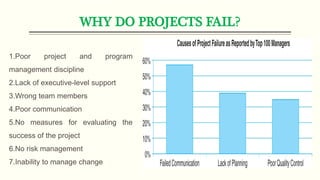
WHY DO PROJECTS FAIL?
1.Poor project and program
management discipline
2.Lack of executive-level support
3.Wrong team members
4.Poor communication
5.No measures for evaluating the
success of the project
6.No risk management
7.Inability to manage change
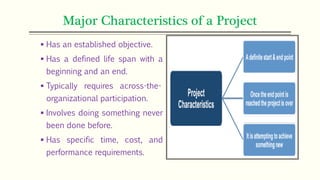
Major Characteristics of a Project
 Has an established objective.
 Has a defined life span with a
beginning and an end.
 Typically requires across-the-
organizational participation.
 Involves doing something never
been done before.
 Has specific time, cost, and
performance requirements.
PROJECT
MANAGEMENT
What is Project Management?
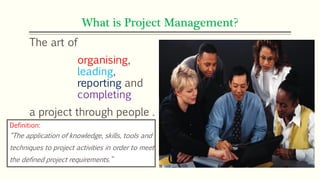
The art of
organising,
leading,
reporting and
completing
a project through people .
Definition:
“The application of knowledge, skills, tools and
techniques to project activities in order to meet
the defined project requirements.”
What is Project Management?
“Project Management is the application of knowledge, skills, tools and
techniques to project activities to meet project requirements.”
The purpose of project management is prediction and prevention
Allows you to narrow your focus, reach desired goals and achieve those
goals within specific time, and cost parameters.
Project Management can help you…..
Organize your work better
Deliver projects on time and within budget
Communicate with project team members more clearly and
effectively!
Terminology of Project management
Some of the key Terms:
Vision
Is an idealistic view of the desired outcomes to be
produced after successful project completion.
Project objective Something toward which work is to be directed, attainable,
or achieved
Deliverable
Any measurable, tangible, verifiable outcome, result, or
item that must be produced to complete a project or part
of a project
Risk
Any event that can potentially and probably will adversely
affect the ability of the project to produce the required
deliverables.
Terminology of Project management
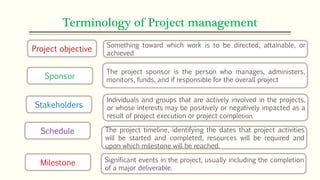
Project objective
Something toward which work is to be directed, attainable, or
achieved
Sponsor
The project sponsor is the person who manages, administers,
monitors, funds, and if responsible for the overall project
Stakeholders
Individuals and groups that are actively involved in the projects,
or whose interests may be positively or negatively impacted as a
result of project execution or project completion.
Schedule
Milestone
The project timeline, identifying the dates that project activities
will be started and completed, resources will be required and
upon which milestone will be reached.
Significant events in the project, usually including the completion
of a major deliverable.
Project Vs Project Management
Project management
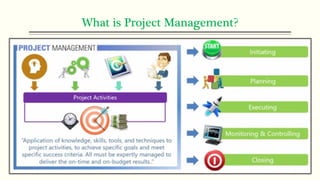
 Project management is the practice of initiating, planning, executing,
controlling, and closing the work of a team to achieve specific goals and
meet specific success criteria at the specified time.
 The primary challenge of project management is to achieve all of the
project goals within the given constraints.
Project
 A project is a temporary endeavor designed to produce a unique
product, service or result with a defined beginning and end (usually time-
constrained, and often constrained by funding or staffing) undertaken to
meet unique goals and objectives, typically to bring about beneficial change
or added value.
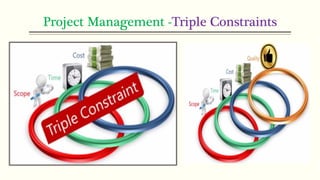
Project Management -Triple Constraints
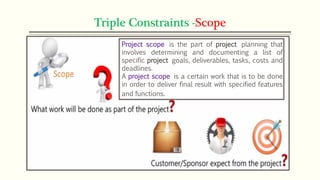
Triple Constraints -Scope
Project scope is the part of project planning that
involves determining and documenting a list of
specific project goals, deliverables, tasks, costs and
deadlines.
A project scope is a certain work that is to be done
in order to deliver final result with specified features
and functions.
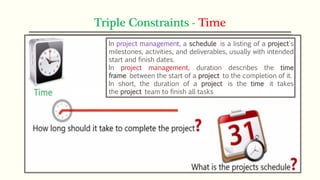
Triple Constraints - Time
In project management, a schedule is a listing of a project's
milestones, activities, and deliverables, usually with intended
start and finish dates.
In project management, duration describes the time
frame between the start of a project to the completion of it.
In short, the duration of a project is the time it takes
the project team to finish all tasks
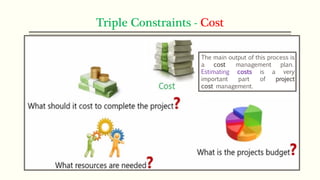
Triple Constraints - Cost
The main output of this process is
a cost management plan.
Estimating costs is a very
important part of project
cost management.
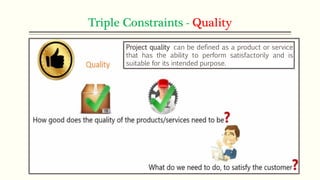
Triple Constraints - Quality
Project quality can be defined as a product or service
that has the ability to perform satisfactorily and is
suitable for its intended purpose.
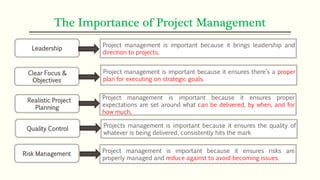
The Importance of Project Management
Leadership
Clear Focus &
Objectives
Realistic Project
Planning
Quality Control
Risk Management
Project management is important because it brings leadership and
direction to projects.
Project management is important because it ensures there’s a proper
plan for executing on strategic goals.
Project management is important because it ensures proper
expectations are set around what can be delivered, by when, and for
how much.
Projects management is important because it ensures the quality of
whatever is being delivered, consistently hits the mark
Project management is important because it ensures risks are
properly managed and reduce against to avoid becoming issues.
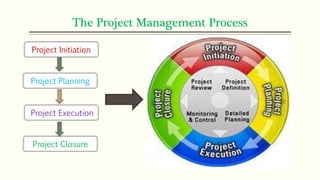
The Project Management Process
Project Initiation
Project Planning
Project Execution
Project Closure
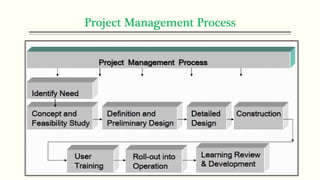
Project Management Process
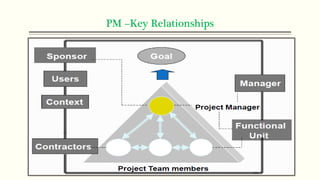
PM –Key Relationships
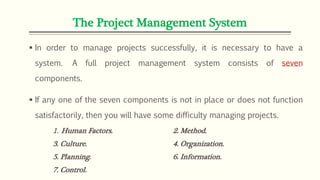
The Project Management System
 In order to manage projects successfully, it is necessary to have a
system. A full project management system consists of seven
components.
 If any one of the seven components is not in place or does not function
satisfactorily, then you will have some difficulty managing projects.
1. Human Factors. 2. Method.
3. Culture. 4. Organization.
5. Planning. 6. Information.
7. Control.
Project Management Techniques
►Gantt chart
►Critical Path Method (CPM)
►Program Evaluation and Review
Technique (PERT)
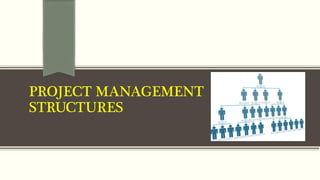
PROJECT MANAGEMENT
STRUCTURES
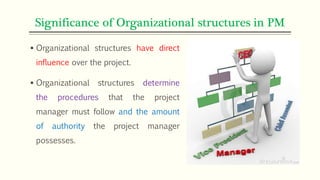
Significance of Organizational structures in PM
 Organizational structures have direct
influence over the project.
 Organizational structures determine
the procedures that the project
manager must follow and the amount
of authority the project manager
possesses.
Organization
Definition Organization:
A set of organizational units and their different relationships with each
other.
 Organizational units can be organized according to many different
categories, for example by function or by project type. Typical
examples of organizational units:
 Functional organization: Research, Development, Marketing, Sales
 Project organization: Project 1, Project 2, ….
 A organization usually has 3 different types of relationships between
organizational units.
 Reporting structure : To report status information
 Decision structure : To propagating decisions
 Communication structure : To exchange of information
Choosing the Appropriate Project Management
Structure
Project Considerations:
Size of project
Strategic importance
Novelty and need for innovation
Need for integration (number of departments
involved)
Budget and time constraints
Stability of resource requirements
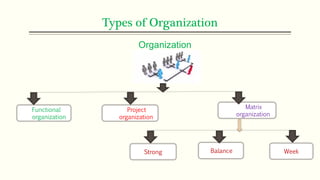
Types of Organization
Organization
Functional
organization
Project
organization
Matrix
organization
WeekBalanceStrong
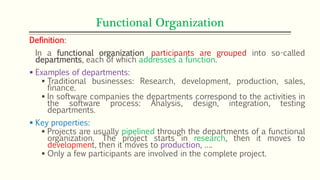
Functional Organization
Definition:
In a functional organization participants are grouped into so-called
departments, each of which addresses a function.
 Examples of departments:
 Traditional businesses: Research, development, production, sales,
finance.
 In software companies the departments correspond to the activities in
the software process: Analysis, design, integration, testing
departments.
 Key properties:
 Projects are usually pipelined through the departments of a functional
organization. The project starts in research, then it moves to
development, then it moves to production, ….
 Only a few participants are involved in the complete project.
Functional Organization
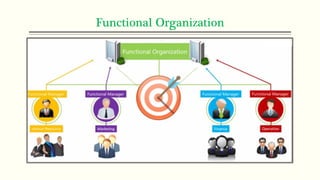
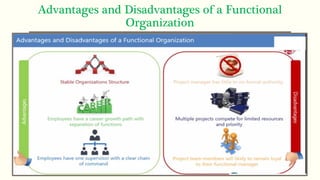
Advantages and Disadvantages of a Functional
Organization
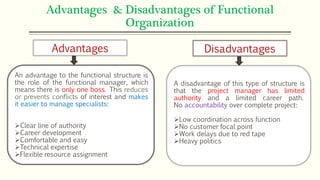
Advantages & Disadvantages of Functional
Organization
An advantage to the functional structure is
the role of the functional manager, which
means there is only one boss. This reduces
or prevents conflicts of interest and makes
it easier to manage specialists:
Clear line of authority
Career development
Comfortable and easy
Technical expertise
Flexible resource assignment
A disadvantage of this type of structure is
that the project manager has limited
authority and a limited career path.
No accountability over complete project:
Low coordination across function
No customer focal point
Work delays due to red tape
Heavy politics
Advantages Disadvantages
Project Organization
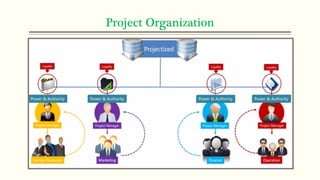
 Projectized organization is a project focused organizational structure
where project manager has the final authority over the project to
make project decisions, priorities, acquire and assign resources.
Key properties:
 Teams are assembled for a project as it is created. Each project
has a project leader.
 All participants are involved in the complete project.
 Teams are disassembled when the project terminates
Project Organization
 A projectized organization refers specifically to an organizational
structure that has been set up in a manner in which the project manager
leads the group and in which the project manager has the
ultimate authority to make any and all decisions involving
the organization.
 In a projectized structure, all the work is looked at as a project. The
project manager has complete control, unlike in the functional structure,
and all team members report directly to the project manager.
Project Organization
 Sometimes these team members are permanent, and sometimes they
are hired as temporary workers to help with the project until its
completion.
 The project manager works with complete autonomy (central
authority, power) over the project, team is on the project full time and
report to the project manager.
 As a project manager, you have the responsibility to take authority,
rather than waiting for someone to give you the authority.
Project Organization
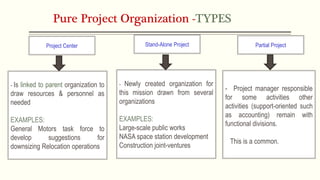
Pure Project Organization -TYPES
Project Center Partial ProjectStand-Alone Project
- Is linked to parent organization to
draw resources & personnel as
needed
EXAMPLES:
General Motors task force to
develop suggestions for
downsizing Relocation operations
- Project manager responsible
for some activities other
activities (support-oriented such
as accounting) remain with
functional divisions.
This is a common.
- Newly created organization for
this mission drawn from several
organizations
EXAMPLES:
Large-scale public works
NASA space station development
Construction joint-ventures
Advantages & Disadvantages of Project
Organizations
Advantages & Disadvantages of Project
Organizations
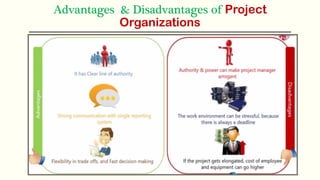
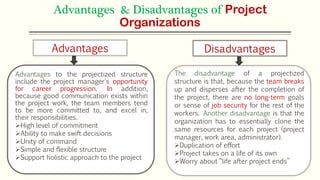
Advantages to the projectized structure
include the project manager's opportunity
for career progression. In addition,
because good communication exists within
the project work, the team members tend
to be more committed to, and excel in,
their responsibilities.
High level of commitment
Ability to make swift decisions
Unity of command
Simple and flexible structure
Support holistic approach to the project
The disadvantage of a projectized
structure is that, because the team breaks
up and disperses after the completion of
the project, there are no long-term goals
or sense of job security for the rest of the
workers. Another disadvantage is that the
organization has to essentially clone the
same resources for each project (project
manager, work area, administrator).
Duplication of effort
Project takes on a life of its own
Worry about “life after project ends”
Advantages Disadvantages
Matrix Organization
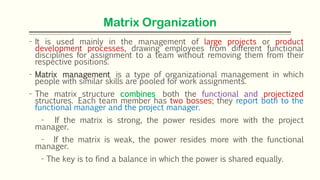
- It is used mainly in the management of large projects or product
development processes, drawing employees from different functional
disciplines for assignment to a team without removing them from their
respective positions.
- Matrix management is a type of organizational management in which
people with similar skills are pooled for work assignments.
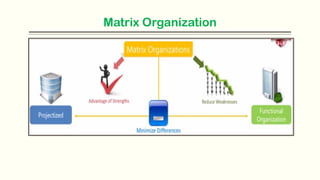
- The matrix structure combines both the functional and projectized
structures. Each team member has two bosses; they report both to the
functional manager and the project manager.
- If the matrix is strong, the power resides more with the project
manager.
- If the matrix is weak, the power resides more with the functional
manager.
- The key is to find a balance in which the power is shared equally.
Matrix Organization
Advantages & Disadvantages of Matrix Structure
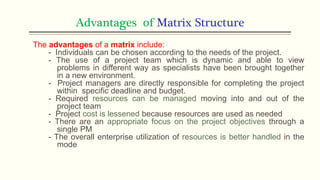
Advantages of Matrix Structure
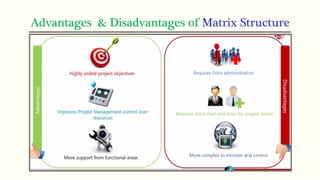
The advantages of a matrix include:
- Individuals can be chosen according to the needs of the project.
- The use of a project team which is dynamic and able to view
problems in different way as specialists have been brought together
in a new environment.
- Project managers are directly responsible for completing the project
within specific deadline and budget.
- Required resources can be managed moving into and out of the
project team
- Project cost is lessened because resources are used as needed
- There are an appropriate focus on the project objectives through a
single PM
- The overall enterprise utilization of resources is better handled in the
mode
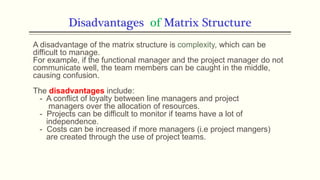
Disadvantages of Matrix Structure
A disadvantage of the matrix structure is complexity, which can be
difficult to manage.
For example, if the functional manager and the project manager do not
communicate well, the team members can be caught in the middle,
causing confusion.
The disadvantages include:
- A conflict of loyalty between line managers and project
managers over the allocation of resources.
- Projects can be difficult to monitor if teams have a lot of
independence.
- Costs can be increased if more managers (i.e project mangers)
are created through the use of project teams.
PROJECT
MANAGER
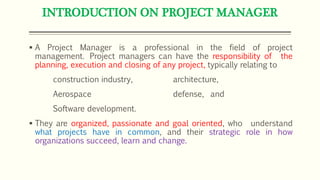
INTRODUCTION ON PROJECT MANAGER
 A Project Manager is a professional in the field of project
management. Project managers can have the responsibility of the
planning, execution and closing of any project, typically relating to
construction industry, architecture,
Aerospace defense, and
Software development.
 They are organized, passionate and goal oriented, who understand
what projects have in common, and their strategic role in how
organizations succeed, learn and change.
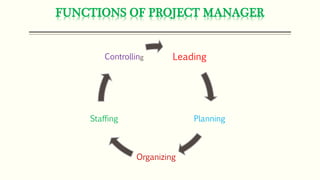
FUNCTIONS OF PROJECT MANAGER
Leading
Planning
Organizing
Staffing
Controlling
FUNCTIONS OF PROJECT MANAGER
Leading
A project manager is expected to be an
able leader of a chosen group of people
working for a common objective. These
people may belong to various functional
disciplines who are guided by the leader.
some key duties for leading projects
include:
- setting team direction
-coordinating activities across different
organizational function
- motivating team members
FUNCTIONS OF PROJECT MANAGER
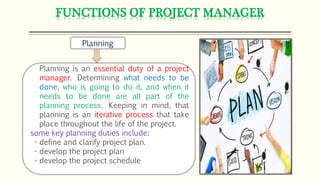
Planning
Planning is an essential duty of a project
manager. Determining what needs to be
done, who is going to do it, and when it
needs to be done are all part of the
planning process. Keeping in mind, that
planning is an iterative process that take
place throughout the life of the project.
some key planning duties include:
- define and clarify project plan.
- develop the project plan
- develop the project schedule
FUNCTIONS OF PROJECT MANAGER
Organizing
Organizing is about setting up the
project team’s structure.
some of the key organizing duties
include
-Determine the organizational structure
of the project term
-identify roles and positions
-identify services to be provided by
external companies
-staff project positions
FUNCTIONS OF PROJECT MANAGER
Staffing
The process of placing proper
staff in their positions is called
staffing.
It is one of the important duties
of management to appoint the
right type of personnel for
various disciplines.
FUNCTIONS OF PROJECT MANAGER
Controlling
Controlling is all about keeping the project
on track. A plan, while it is being
implemented, encounters various
problems.
For example, a supplier may not deliver
goods on time; or a machine fails in the
preliminary test, etc.
some key controlling functions include
- defining project baselines
- tracking project progress
- project status reporting
- determining and taking corrective actions
RESPONSIBIBILITIES OF A PROJECT MANAGER
1. The project manager is the person responsible for managing the project.
2. The project manager is the person responsible for accomplishing the project
objectives within the constraints of the project. He is responsible for the outcome of
the project.
3. The project manager is involved with the Planning, Controlling and monitoring, and
also managing and directing the assigned project resources to best meet project
objectives.
4. The project manager controls and monitors project scope, time and cost in managing
project manager controls and monitors project scope, time and cost in managing
project requirements.
5. The project manager examines the organizational culture and determines whether
project management is recognized as a valid as role with accountability and authority
for managing the project.
6. The project manager is responsible for identifying, monitoring and responding to risk
Project Manager
 A successful Project Manager must
simultaneously manage the four basic elements
of a project:
1. Resources, 2. Time, 3. Money, and most
importantly, scope.
 All these elements are interrelated. Each must be
managed effectively. All must be managed
together if the project is to be a success. The
resource that can be leveraged to the greatest
extent in all projects is the people involved.
Ultimately responsible for the
Project’s Success
Plan and Act
Focus on the project’s end
Be a manager & leader
PROJECT
ENVIRONMENT
Project environment
 Project environment represents a connection, where the project is
processed.
 The environment not only formulates the project but also estimates it.
 The project environment analysis is held at the beginning of the
project.
 All impact factors are analyzed in this analysis: project risks and
chances, stakeholders and their interests, measures for the control.
The stakeholder type is thereby analyzed. It distinguishes between
active and passive type.
 The first group represents project team and project manager,
principal and customer. The second group contains authorities, works
council, competitors, persons affected by the project indirectly.
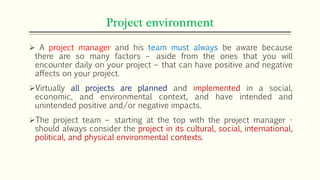
Project environment
 A project manager and his team must always be aware because
there are so many factors – aside from the ones that you will
encounter daily on your project – that can have positive and negative
affects on your project.
Virtually all projects are planned and implemented in a social,
economic, and environmental context, and have intended and
unintended positive and/or negative impacts.
The project team – starting at the top with the project manager -
should always consider the project in its cultural, social, international,
political, and physical environmental contexts.
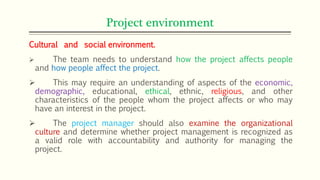
Project environment
Cultural and social environment.
 The team needs to understand how the project affects people
and how people affect the project.
 This may require an understanding of aspects of the economic,
demographic, educational, ethical, ethnic, religious, and other
characteristics of the people whom the project affects or who may
have an interest in the project.
 The project manager should also examine the organizational
culture and determine whether project management is recognized as
a valid role with accountability and authority for managing the
project.
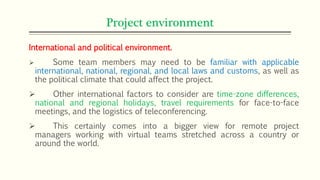
Project environment
International and political environment.
 Some team members may need to be familiar with applicable
international, national, regional, and local laws and customs, as well as
the political climate that could affect the project.
 Other international factors to consider are time-zone differences,
national and regional holidays, travel requirements for face-to-face
meetings, and the logistics of teleconferencing.
 This certainly comes into a bigger view for remote project
managers working with virtual teams stretched across a country or
around the world.
PROJECT
CLASSIFICATION
Short Term vs. Long Term Projects
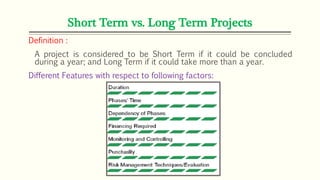
Definition :
A project is considered to be Short Term if it could be concluded
during a year; and Long Term if it could take more than a year.
Different Features with respect to following factors:
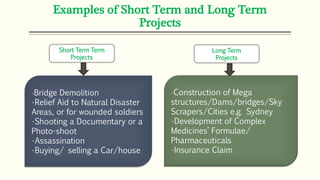
Examples of Short Term and Long Term
Projects
•Bridge Demolition
•Relief Aid to Natural Disaster
Areas, or for wounded soldiers
•Shooting a Documentary or a
Photo-shoot
•Assassination
•Buying/ selling a Car/house
•Construction of Mega
structures/Dams/bridges/Sky
Scrapers/Cities e.g. Sydney
•Development of Complex
Medicines’ Formulae/
Pharmaceuticals
•Insurance Claim
Short Term Term
Projects
Long Term
Projects
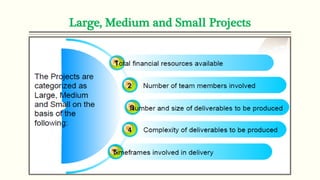
Large, Medium and Small Projects
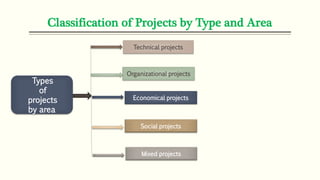
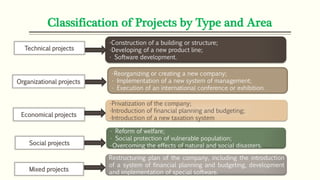
Classification of Projects by Type and Area
Types
of
projects
by area
Technical projects
Organizational projects
Economical projects
Social projects
Mixed projects
Classification of Projects by Type and Area
Technical projects
Organizational projects
Economical projects
Social projects
Mixed projects
-Construction of a building or structure;
•Developing of a new product line;
• Software development.
•Reorganizing or creating a new company;
• Implementation of a new system of management;
• Execution of an international conference or exhibition.
•Privatization of the company;
•Introduction of financial planning and budgeting;
•Introduction of a new taxation system
• Reform of welfare;
• Social protection of vulnerable population;
•Overcoming the effects of natural and social disasters.
Restructuring plan of the company, including the introduction
of a system of financial planning and budgeting, development
and implementation of special software.
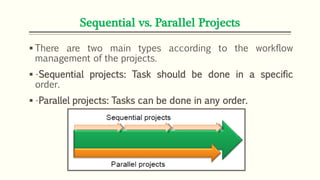
Sequential vs. Parallel Projects
 There are two main types according to the workflow
management of the projects.
 •Sequential projects: Task should be done in a specific
order.
 •Parallel projects: Tasks can be done in any order.
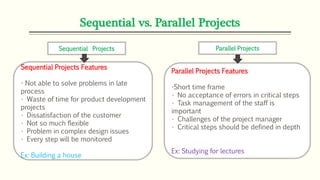
Sequential vs. Parallel Projects
Sequential Projects Features
- Not able to solve problems in late
process
• Waste of time for product development
projects
• Dissatisfaction of the customer
• Not so much flexible
• Problem in complex design issues
• Every step will be monitored
Ex: Building a house
Parallel Projects Features
-Short time frame
• No acceptance of errors in critical steps
• Task management of the staff is
important
• Challenges of the project manager
• Critical steps should be defined in depth
Ex: Studying for lectures
Sequential Projects Parallel Projects
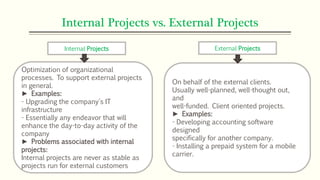
Internal Projects vs. External Projects
Optimization of organizational
processes. To support external projects
in general.
► Examples:
- Upgrading the company's IT
infrastructure
- Essentially any endeavor that will
enhance the day-to-day activity of the
company
► Problems associated with internal
projects:
Internal projects are never as stable as
projects run for external customers
On behalf of the external clients.
Usually well-planned, well-thought out,
and
well-funded. Client oriented projects.
► Examples:
- Developing accounting software
designed
specifically for another company.
- Installing a prepaid system for a mobile
carrier.
Internal Projects External Projects

Project management

  • 1.
    IENG-6103 ADVANCED INDUSTRIAL PROJECTMANAGEMENT Project Management Chapter-1 Dr.K.BALASUNDARAM Assistant Professor
  • 2.
    Outline of presentations Whatis a project & Project management Organization for industrial projects The role of people at different positions, Project environment Project classification
  • 3.
    What is aProject? “Unique process consisting of a set of coordinated and controlled activities with start and finish dates, undertaken to achieve an objective conforming to specific requirements, including constraints of time, cost, quality and resources”.  A Project is a planned set of activities  A Project has a scope  A Project has time, cost, quality and resource constraints
  • 4.
    What is aProject?
  • 5.
    Examples of Projects ►Building Construction ► Research Project
  • 6.
    What is aProject? A Project is a conversion process
  • 7.
    The Project Model PROJECTINPUT Want/need OUTPUT satisfiedneed Constraints: •Financial •Legal •Ethical •Environmental •Activation •Time •Quality •Indirect effects Mechanisms: •People •Knowledge & expertise •Capital •Tools & techniques •Technology
  • 8.
    Why project arestarted ?
  • 9.
    The Four ProjectObjectives are… Performance scope Cost Time The quality of the work being done(P). The magnitude of the work to be performed.(S) The cost of project work, directly related to the human and physical resources applied.(C) The schedule that must be met(T) The relation between the four project objectives: Cost=f(P,T,S)
  • 10.
    Three core componentsof project success
  • 11.
    WHY DO PROJECTSFAIL? 1.Poor project and program management discipline 2.Lack of executive-level support 3.Wrong team members 4.Poor communication 5.No measures for evaluating the success of the project 6.No risk management 7.Inability to manage change
  • 12.
    Major Characteristics ofa Project  Has an established objective.  Has a defined life span with a beginning and an end.  Typically requires across-the- organizational participation.  Involves doing something never been done before.  Has specific time, cost, and performance requirements.
  • 13.
  • 14.
    What is ProjectManagement? The art of organising, leading, reporting and completing a project through people . Definition: “The application of knowledge, skills, tools and techniques to project activities in order to meet the defined project requirements.”
  • 15.
    What is ProjectManagement?
  • 16.
    What is ProjectManagement? “Project Management is the application of knowledge, skills, tools and techniques to project activities to meet project requirements.” The purpose of project management is prediction and prevention Allows you to narrow your focus, reach desired goals and achieve those goals within specific time, and cost parameters. Project Management can help you….. Organize your work better Deliver projects on time and within budget Communicate with project team members more clearly and effectively!
  • 17.
    Terminology of Projectmanagement Some of the key Terms: Vision Is an idealistic view of the desired outcomes to be produced after successful project completion. Project objective Something toward which work is to be directed, attainable, or achieved Deliverable Any measurable, tangible, verifiable outcome, result, or item that must be produced to complete a project or part of a project Risk Any event that can potentially and probably will adversely affect the ability of the project to produce the required deliverables.
  • 18.
    Terminology of Projectmanagement Project objective Something toward which work is to be directed, attainable, or achieved Sponsor The project sponsor is the person who manages, administers, monitors, funds, and if responsible for the overall project Stakeholders Individuals and groups that are actively involved in the projects, or whose interests may be positively or negatively impacted as a result of project execution or project completion. Schedule Milestone The project timeline, identifying the dates that project activities will be started and completed, resources will be required and upon which milestone will be reached. Significant events in the project, usually including the completion of a major deliverable.
  • 19.
    Project Vs ProjectManagement Project management  Project management is the practice of initiating, planning, executing, controlling, and closing the work of a team to achieve specific goals and meet specific success criteria at the specified time.  The primary challenge of project management is to achieve all of the project goals within the given constraints. Project  A project is a temporary endeavor designed to produce a unique product, service or result with a defined beginning and end (usually time- constrained, and often constrained by funding or staffing) undertaken to meet unique goals and objectives, typically to bring about beneficial change or added value.
  • 20.
  • 21.
    Triple Constraints -Scope Projectscope is the part of project planning that involves determining and documenting a list of specific project goals, deliverables, tasks, costs and deadlines. A project scope is a certain work that is to be done in order to deliver final result with specified features and functions.
  • 22.
    Triple Constraints -Time In project management, a schedule is a listing of a project's milestones, activities, and deliverables, usually with intended start and finish dates. In project management, duration describes the time frame between the start of a project to the completion of it. In short, the duration of a project is the time it takes the project team to finish all tasks
  • 23.
    Triple Constraints -Cost The main output of this process is a cost management plan. Estimating costs is a very important part of project cost management.
  • 24.
    Triple Constraints -Quality Project quality can be defined as a product or service that has the ability to perform satisfactorily and is suitable for its intended purpose.
  • 25.
    The Importance ofProject Management Leadership Clear Focus & Objectives Realistic Project Planning Quality Control Risk Management Project management is important because it brings leadership and direction to projects. Project management is important because it ensures there’s a proper plan for executing on strategic goals. Project management is important because it ensures proper expectations are set around what can be delivered, by when, and for how much. Projects management is important because it ensures the quality of whatever is being delivered, consistently hits the mark Project management is important because it ensures risks are properly managed and reduce against to avoid becoming issues.
  • 26.
    The Project ManagementProcess Project Initiation Project Planning Project Execution Project Closure
  • 27.
  • 28.
  • 29.
    The Project ManagementSystem  In order to manage projects successfully, it is necessary to have a system. A full project management system consists of seven components.  If any one of the seven components is not in place or does not function satisfactorily, then you will have some difficulty managing projects. 1. Human Factors. 2. Method. 3. Culture. 4. Organization. 5. Planning. 6. Information. 7. Control.
  • 30.
    Project Management Techniques ►Ganttchart ►Critical Path Method (CPM) ►Program Evaluation and Review Technique (PERT)
  • 31.
  • 32.
    Significance of Organizationalstructures in PM  Organizational structures have direct influence over the project.  Organizational structures determine the procedures that the project manager must follow and the amount of authority the project manager possesses.
  • 33.
    Organization Definition Organization: A setof organizational units and their different relationships with each other.  Organizational units can be organized according to many different categories, for example by function or by project type. Typical examples of organizational units:  Functional organization: Research, Development, Marketing, Sales  Project organization: Project 1, Project 2, ….  A organization usually has 3 different types of relationships between organizational units.  Reporting structure : To report status information  Decision structure : To propagating decisions  Communication structure : To exchange of information
  • 34.
    Choosing the AppropriateProject Management Structure Project Considerations: Size of project Strategic importance Novelty and need for innovation Need for integration (number of departments involved) Budget and time constraints Stability of resource requirements
  • 35.
  • 36.
    Functional Organization Definition: In afunctional organization participants are grouped into so-called departments, each of which addresses a function.  Examples of departments:  Traditional businesses: Research, development, production, sales, finance.  In software companies the departments correspond to the activities in the software process: Analysis, design, integration, testing departments.  Key properties:  Projects are usually pipelined through the departments of a functional organization. The project starts in research, then it moves to development, then it moves to production, ….  Only a few participants are involved in the complete project.
  • 37.
  • 38.
    Advantages and Disadvantagesof a Functional Organization
  • 39.
    Advantages & Disadvantagesof Functional Organization An advantage to the functional structure is the role of the functional manager, which means there is only one boss. This reduces or prevents conflicts of interest and makes it easier to manage specialists: Clear line of authority Career development Comfortable and easy Technical expertise Flexible resource assignment A disadvantage of this type of structure is that the project manager has limited authority and a limited career path. No accountability over complete project: Low coordination across function No customer focal point Work delays due to red tape Heavy politics Advantages Disadvantages
  • 40.
    Project Organization  Projectizedorganization is a project focused organizational structure where project manager has the final authority over the project to make project decisions, priorities, acquire and assign resources. Key properties:  Teams are assembled for a project as it is created. Each project has a project leader.  All participants are involved in the complete project.  Teams are disassembled when the project terminates
  • 41.
    Project Organization  Aprojectized organization refers specifically to an organizational structure that has been set up in a manner in which the project manager leads the group and in which the project manager has the ultimate authority to make any and all decisions involving the organization.  In a projectized structure, all the work is looked at as a project. The project manager has complete control, unlike in the functional structure, and all team members report directly to the project manager.
  • 42.
    Project Organization  Sometimesthese team members are permanent, and sometimes they are hired as temporary workers to help with the project until its completion.  The project manager works with complete autonomy (central authority, power) over the project, team is on the project full time and report to the project manager.  As a project manager, you have the responsibility to take authority, rather than waiting for someone to give you the authority.
  • 43.
  • 44.
    Pure Project Organization-TYPES Project Center Partial ProjectStand-Alone Project - Is linked to parent organization to draw resources & personnel as needed EXAMPLES: General Motors task force to develop suggestions for downsizing Relocation operations - Project manager responsible for some activities other activities (support-oriented such as accounting) remain with functional divisions. This is a common. - Newly created organization for this mission drawn from several organizations EXAMPLES: Large-scale public works NASA space station development Construction joint-ventures
  • 45.
    Advantages & Disadvantagesof Project Organizations
  • 46.
    Advantages & Disadvantagesof Project Organizations Advantages to the projectized structure include the project manager's opportunity for career progression. In addition, because good communication exists within the project work, the team members tend to be more committed to, and excel in, their responsibilities. High level of commitment Ability to make swift decisions Unity of command Simple and flexible structure Support holistic approach to the project The disadvantage of a projectized structure is that, because the team breaks up and disperses after the completion of the project, there are no long-term goals or sense of job security for the rest of the workers. Another disadvantage is that the organization has to essentially clone the same resources for each project (project manager, work area, administrator). Duplication of effort Project takes on a life of its own Worry about “life after project ends” Advantages Disadvantages
  • 47.
    Matrix Organization - Itis used mainly in the management of large projects or product development processes, drawing employees from different functional disciplines for assignment to a team without removing them from their respective positions. - Matrix management is a type of organizational management in which people with similar skills are pooled for work assignments. - The matrix structure combines both the functional and projectized structures. Each team member has two bosses; they report both to the functional manager and the project manager. - If the matrix is strong, the power resides more with the project manager. - If the matrix is weak, the power resides more with the functional manager. - The key is to find a balance in which the power is shared equally.
  • 48.
  • 49.
    Advantages & Disadvantagesof Matrix Structure
  • 50.
    Advantages of MatrixStructure The advantages of a matrix include: - Individuals can be chosen according to the needs of the project. - The use of a project team which is dynamic and able to view problems in different way as specialists have been brought together in a new environment. - Project managers are directly responsible for completing the project within specific deadline and budget. - Required resources can be managed moving into and out of the project team - Project cost is lessened because resources are used as needed - There are an appropriate focus on the project objectives through a single PM - The overall enterprise utilization of resources is better handled in the mode
  • 51.
    Disadvantages of MatrixStructure A disadvantage of the matrix structure is complexity, which can be difficult to manage. For example, if the functional manager and the project manager do not communicate well, the team members can be caught in the middle, causing confusion. The disadvantages include: - A conflict of loyalty between line managers and project managers over the allocation of resources. - Projects can be difficult to monitor if teams have a lot of independence. - Costs can be increased if more managers (i.e project mangers) are created through the use of project teams.
  • 52.
  • 53.
    INTRODUCTION ON PROJECTMANAGER  A Project Manager is a professional in the field of project management. Project managers can have the responsibility of the planning, execution and closing of any project, typically relating to construction industry, architecture, Aerospace defense, and Software development.  They are organized, passionate and goal oriented, who understand what projects have in common, and their strategic role in how organizations succeed, learn and change.
  • 54.
    FUNCTIONS OF PROJECTMANAGER Leading Planning Organizing Staffing Controlling
  • 55.
    FUNCTIONS OF PROJECTMANAGER Leading A project manager is expected to be an able leader of a chosen group of people working for a common objective. These people may belong to various functional disciplines who are guided by the leader. some key duties for leading projects include: - setting team direction -coordinating activities across different organizational function - motivating team members
  • 56.
    FUNCTIONS OF PROJECTMANAGER Planning Planning is an essential duty of a project manager. Determining what needs to be done, who is going to do it, and when it needs to be done are all part of the planning process. Keeping in mind, that planning is an iterative process that take place throughout the life of the project. some key planning duties include: - define and clarify project plan. - develop the project plan - develop the project schedule
  • 57.
    FUNCTIONS OF PROJECTMANAGER Organizing Organizing is about setting up the project team’s structure. some of the key organizing duties include -Determine the organizational structure of the project term -identify roles and positions -identify services to be provided by external companies -staff project positions
  • 58.
    FUNCTIONS OF PROJECTMANAGER Staffing The process of placing proper staff in their positions is called staffing. It is one of the important duties of management to appoint the right type of personnel for various disciplines.
  • 59.
    FUNCTIONS OF PROJECTMANAGER Controlling Controlling is all about keeping the project on track. A plan, while it is being implemented, encounters various problems. For example, a supplier may not deliver goods on time; or a machine fails in the preliminary test, etc. some key controlling functions include - defining project baselines - tracking project progress - project status reporting - determining and taking corrective actions
  • 60.
    RESPONSIBIBILITIES OF APROJECT MANAGER 1. The project manager is the person responsible for managing the project. 2. The project manager is the person responsible for accomplishing the project objectives within the constraints of the project. He is responsible for the outcome of the project. 3. The project manager is involved with the Planning, Controlling and monitoring, and also managing and directing the assigned project resources to best meet project objectives. 4. The project manager controls and monitors project scope, time and cost in managing project manager controls and monitors project scope, time and cost in managing project requirements. 5. The project manager examines the organizational culture and determines whether project management is recognized as a valid as role with accountability and authority for managing the project. 6. The project manager is responsible for identifying, monitoring and responding to risk
  • 61.
    Project Manager  Asuccessful Project Manager must simultaneously manage the four basic elements of a project: 1. Resources, 2. Time, 3. Money, and most importantly, scope.  All these elements are interrelated. Each must be managed effectively. All must be managed together if the project is to be a success. The resource that can be leveraged to the greatest extent in all projects is the people involved. Ultimately responsible for the Project’s Success Plan and Act Focus on the project’s end Be a manager & leader
  • 62.
  • 63.
    Project environment  Projectenvironment represents a connection, where the project is processed.  The environment not only formulates the project but also estimates it.  The project environment analysis is held at the beginning of the project.  All impact factors are analyzed in this analysis: project risks and chances, stakeholders and their interests, measures for the control. The stakeholder type is thereby analyzed. It distinguishes between active and passive type.  The first group represents project team and project manager, principal and customer. The second group contains authorities, works council, competitors, persons affected by the project indirectly.
  • 64.
    Project environment  Aproject manager and his team must always be aware because there are so many factors – aside from the ones that you will encounter daily on your project – that can have positive and negative affects on your project. Virtually all projects are planned and implemented in a social, economic, and environmental context, and have intended and unintended positive and/or negative impacts. The project team – starting at the top with the project manager - should always consider the project in its cultural, social, international, political, and physical environmental contexts.
  • 65.
    Project environment Cultural andsocial environment.  The team needs to understand how the project affects people and how people affect the project.  This may require an understanding of aspects of the economic, demographic, educational, ethical, ethnic, religious, and other characteristics of the people whom the project affects or who may have an interest in the project.  The project manager should also examine the organizational culture and determine whether project management is recognized as a valid role with accountability and authority for managing the project.
  • 66.
    Project environment International andpolitical environment.  Some team members may need to be familiar with applicable international, national, regional, and local laws and customs, as well as the political climate that could affect the project.  Other international factors to consider are time-zone differences, national and regional holidays, travel requirements for face-to-face meetings, and the logistics of teleconferencing.  This certainly comes into a bigger view for remote project managers working with virtual teams stretched across a country or around the world.
  • 67.
  • 68.
    Short Term vs.Long Term Projects Definition : A project is considered to be Short Term if it could be concluded during a year; and Long Term if it could take more than a year. Different Features with respect to following factors:
  • 69.
    Examples of ShortTerm and Long Term Projects •Bridge Demolition •Relief Aid to Natural Disaster Areas, or for wounded soldiers •Shooting a Documentary or a Photo-shoot •Assassination •Buying/ selling a Car/house •Construction of Mega structures/Dams/bridges/Sky Scrapers/Cities e.g. Sydney •Development of Complex Medicines’ Formulae/ Pharmaceuticals •Insurance Claim Short Term Term Projects Long Term Projects
  • 70.
    Large, Medium andSmall Projects
  • 71.
    Classification of Projectsby Type and Area Types of projects by area Technical projects Organizational projects Economical projects Social projects Mixed projects
  • 72.
    Classification of Projectsby Type and Area Technical projects Organizational projects Economical projects Social projects Mixed projects -Construction of a building or structure; •Developing of a new product line; • Software development. •Reorganizing or creating a new company; • Implementation of a new system of management; • Execution of an international conference or exhibition. •Privatization of the company; •Introduction of financial planning and budgeting; •Introduction of a new taxation system • Reform of welfare; • Social protection of vulnerable population; •Overcoming the effects of natural and social disasters. Restructuring plan of the company, including the introduction of a system of financial planning and budgeting, development and implementation of special software.
  • 73.
    Sequential vs. ParallelProjects  There are two main types according to the workflow management of the projects.  •Sequential projects: Task should be done in a specific order.  •Parallel projects: Tasks can be done in any order.
  • 74.
    Sequential vs. ParallelProjects Sequential Projects Features - Not able to solve problems in late process • Waste of time for product development projects • Dissatisfaction of the customer • Not so much flexible • Problem in complex design issues • Every step will be monitored Ex: Building a house Parallel Projects Features -Short time frame • No acceptance of errors in critical steps • Task management of the staff is important • Challenges of the project manager • Critical steps should be defined in depth Ex: Studying for lectures Sequential Projects Parallel Projects
  • 75.
    Internal Projects vs.External Projects Optimization of organizational processes. To support external projects in general. ► Examples: - Upgrading the company's IT infrastructure - Essentially any endeavor that will enhance the day-to-day activity of the company ► Problems associated with internal projects: Internal projects are never as stable as projects run for external customers On behalf of the external clients. Usually well-planned, well-thought out, and well-funded. Client oriented projects. ► Examples: - Developing accounting software designed specifically for another company. - Installing a prepaid system for a mobile carrier. Internal Projects External Projects