PROJECT
MANAGEMENT
TRAINING
Educaree
Module 1
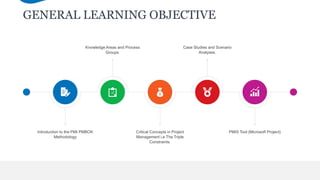
GENERAL LEARNING OBJECTIVE
Introduction to the PMI PMBOK
Methodology
Critical Concepts in Project
Management i.e The Triple
Constraints.
PMIS Tool (Microsoft Project)
Knowledge Areas and Process
Groups.
Case Studies and Scenario
Analyses.
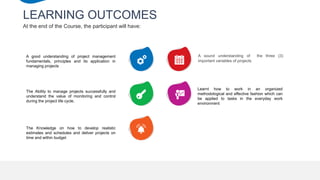
At the end of the Course, the participant will have:
LEARNING OUTCOMES
A good understanding of project management
fundamentals, principles and its application in
managing projects
The Ability to manage projects successfully and
understand the value of monitoring and control
during the project life cycle.
The Knowledge on how to develop realistic
estimates and schedules and deliver projects on
time and within budget
Learnt how to work in an organized
methodological and effective fashion which can
be applied to tasks in the everyday work
environment
A sound understanding of the three (3)
important variables of projects
MORE LEARNING OUTCOMES
Learn what project management is and the qualities of an effective project manager.
Understand the nine knowledge areas of project management and how they can be
applied to your project.
Discover the phases of a project and what deliverables are expected when.
Identify a project’s key stakeholders.
Understand the different types of business cases and how to create a Statement of
Work.
Learn to be prepared for the unexpected by utilizing risk management and change
control.
Learn how to organize project activities by creating aWork Breakdown Structure.
Create a network diagram to track your project’s progress.
Learn budgeting and estimating techniques.
WHY PROJECT MANAGEMENT?
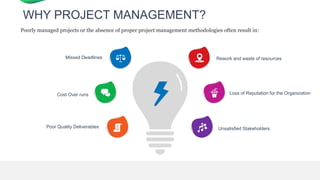
Poorly managed projects or the absence of proper project management methodologies often result in:
Rework and waste of resources
Unsatisfied Stakeholders
Loss of Reputation for the Organization
Missed Deadlines
Poor Quality Deliverables
Cost Over runs
WHY PROJECT
MANAGEMENT?
• Projects are a key way to create value and benefits in organizations.
In today’s business environment, organizational leaders need to be
able to manage with tighter budgets, shorter timelines, scarcity of
resources, and rapidly changing technology. The business
environment is dynamic with an accelerating rate of change.
• Effective and efficient project management should be considered a
strategic competency within organizations. It enables organizations
• Tie project results to business goals,
• Compete more effectively in their markets,
• Sustain the organization, and
• Respond to the impact of business environment changes on
projects by appropriately adjusting project management plans
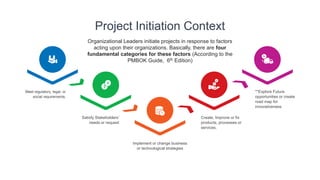
Organizational Leaders initiate projects in response to factors
acting upon their organizations. Basically, there are four
fundamental categories for these factors (According to the
PMBOK Guide, 6th Edition)
Project Initiation Context
Meet regulatory, legal, or
social requirements.
Satisfy Stakeholders’
needs or request
Implement or change business
or technological strategies
Create, Improve or fix
products, processes or
services.
**Explore Future
opportunities or create
road map for
innovativeness
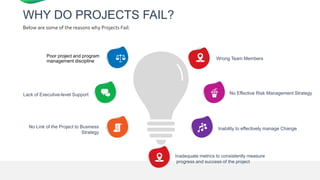
WHY DO PROJECTS FAIL?
Below are some of the reasons why Projects Fail:
Wrong Team Members
Inability to effectively manage Change
No Effective Risk Management Strategy
Poor project and program
management discipline
No Link of the Project to Business
Strategy
Lack of Executive-level Support
Inadequate metrics to consistently measure
progress and success of the project
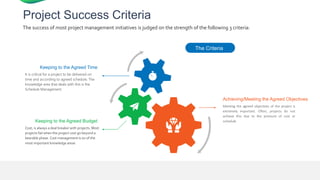
Project Success Criteria
The success of most project management initiatives is judged on the strength of the following 3 criteria:
Keeping to the Agreed Time
It is critical for a project to be delivered on
time and according to agreed schedule. The
knowledge area that deals with this is the
Schedule Management
Keeping to the Agreed Budget
Cost, is always a deal breaker with projects. Most
projects fail when the project cost go beyond a
bearable phase. Cost management is on of the
most important knowledge areas
Achieving/Meeting the Agreed Objectives
Meeting the agreed objectives of the project is
extremely important. Often, projects do not
achieve this due to the pressure of cost or
schedule
The Criteria
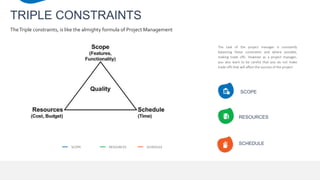
TRIPLE CONSTRAINTS
TheTriple constraints, is like the almighty formula of Project Management
SCOPE RESOURCES SCHEDULE
The task of the project manager is constantly
balancing these constraints and where possible,
making trade offs. However as a project manager,
you also want to be careful that you do not make
trade offs that will affect the success of the project
SCHEDULE
RESOURCES
SCOPE
PROJECT SUCCESS
GOLDEN RULES
i. You must have consensus on project outcome and deliverables
ii. You have to build the best team possible
iii. You as the project manager must develop a viable plan and keep
it as up to date as possible.
iv. Your Project Cost Plan, must be as comprehensive as possible.
v. In balancing the triple constraints, you must have a realistic
schedule plan.
vi. People/stakeholder management is extremely important. You
must always remember that.
vii. You must always have the support of management and critical
stakeholders.
viii. As a project manager, you must be willing to change.
ix. The most important task of a project manager is Effective
Communication.
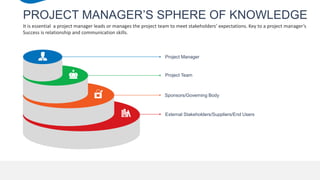
PROJECT MANAGER’S SPHERE OF KNOWLEDGE
It is essential a project manager leads or manages the project team to meet stakeholders’ expectations. Key to a project manager’s
Success is relationship and communication skills.
Project Manager
Project Team
Sponsors/Governing Body
External Stakeholders/Suppliers/End Users
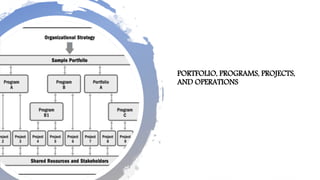
PORTFOLIO, PROGRAMS, PROJECTS,
AND OPERATIONS
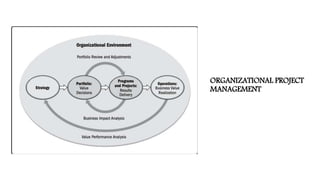
ORGANIZATIONAL PROJECT
MANAGEMENT
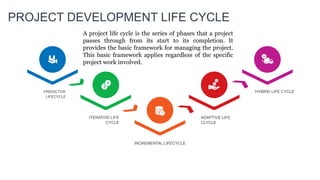
A project life cycle is the series of phases that a project
passes through from its start to its completion. It
provides the basic framework for managing the project.
This basic framework applies regardless of the specific
project work involved.
PROJECT DEVELOPMENT LIFE CYCLE
PREDICTIVE
LIFECYCLE
ITERATIVE LIFE
CYCLE
INCREMENTAL LIFECYCLE
ADAPTIVE LIFE
CLYCLE
HYBRID LIFE CYCLE
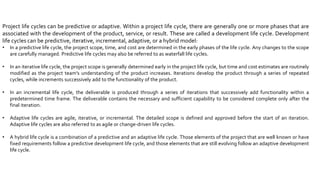
Project life cycles can be predictive or adaptive. Within a project life cycle, there are generally one or more phases that are
associated with the development of the product, service, or result. These are called a development life cycle. Development
life cycles can be predictive, iterative, incremental, adaptive, or a hybrid model:
• In a predictive life cycle, the project scope, time, and cost are determined in the early phases of the life cycle. Any changes to the scope
are carefully managed. Predictive life cycles may also be referred to as waterfall life cycles.
• In an iterative life cycle, the project scope is generally determined early in the project life cycle, but time and cost estimates are routinely
modified as the project team’s understanding of the product increases. Iterations develop the product through a series of repeated
cycles, while increments successively add to the functionality of the product.
• In an incremental life cycle, the deliverable is produced through a series of iterations that successively add functionality within a
predetermined time frame. The deliverable contains the necessary and sufficient capability to be considered complete only after the
final iteration.
• Adaptive life cycles are agile, iterative, or incremental. The detailed scope is defined and approved before the start of an iteration.
Adaptive life cycles are also referred to as agile or change-driven life cycles.
• A hybrid life cycle is a combination of a predictive and an adaptive life cycle. Those elements of the project that are well known or have
fixed requirements follow a predictive development life cycle, and those elements that are still evolving follow an adaptive development
life cycle.
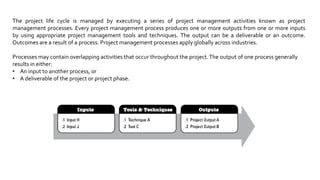
The project life cycle is managed by executing a series of project management activities known as project
management processes. Every project management process produces one or more outputs from one or more inputs
by using appropriate project management tools and techniques. The output can be a deliverable or an outcome.
Outcomes are a result of a process. Project management processes apply globally across industries.
Processes may contain overlapping activities that occur throughout the project.The output of one process generally
results in either:
• An input to another process, or
• A deliverable of the project or project phase.
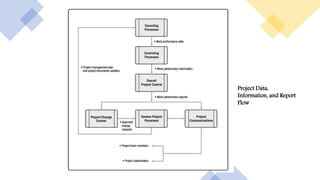
Project Data,
Information, and Report
Flow
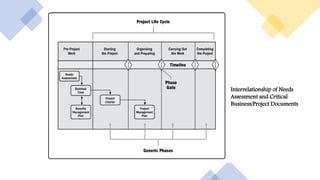
Interrelationship of Needs
Assessment and Critical
Business/Project Documents
PROJECT BUSINESS
CASE
The project business case is a documented economic feasibility study used to
establish the validity of the benefits of a selected component lacking sufficient
definition and that is used as a basis for the authorization of further project
management activities. The business case lists the objectives and reasons for
project initiation. It helps measure the project success at the end of the project
against the project objectives. The business case is a project business
document that is used throughout the project life cycle. The business case
may be used before the project initiation and may result in a go/no-go
decision for the project.
A needs assessment often precedes the business case. The needs assessment
involves understanding business goals and objectives, issues, and
opportunities and recommending proposals to address them. The results of
the needs assessment may be summarized in the business case document.
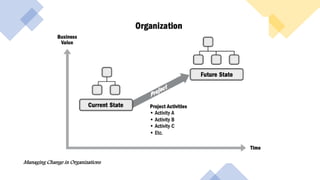
Managing Change in Organizations
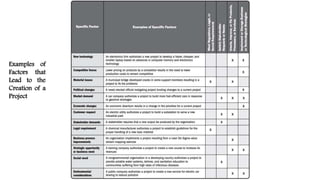
Examples of
Factors that
Lead to the
Creation of a
Project
PROJECT
BENEFITS
MANAGEMENT
PLAN
• The project benefits management plan is the document that describes how and when
the benefits of the project will be delivered and describes the mechanisms that should be
in place to measure those benefits. A project benefit is defined as an outcome of actions,
behaviors, products, services, or results that provide value to the sponsoring
organization as well as to the project’s intended beneficiaries. Development of the
benefits management plan begins early in the project life cycle with the definition of the
target benefits to be realized. The benefits management plan describes key elements of
the benefits and may include but is not limited to documenting the following:
• Target benefits (e.g., the expected tangible and intangible value to be gained by
implementation of the project; financial value is expressed as net present value);
• Strategic alignment (e.g., how well the project benefits align to the business
strategies of the organization);
• Timeframe for realizing benefits (e.g., benefits by phase, short-term, long-term,
ongoing);
• Benefits owner (e.g., the accountable person to monitor, record, and report
benefits throughout the timeframe established in the plan);
• Metrics (e.g., the measures to be used to show benefits realized, direct measures,
and indirect measures);
• Assumptions (e.g., factors expected to be in place or to be in evidence); and
• Risks (e.g., risks for realization of benefits).
• Projects may be separated into distinct phases or subcomponents. These phases or subcomponents are
generally given names that indicate the type of work done in that phase. Examples of phase names include but
are not limited to:
• Concept development,
• Feasibility study,
• Customer requirements,
• Solution development
• Design,
• Prototype,
• Build
• Test
• Transition,
• Commissioning,
• Milestone review, and
• Lessons learned.
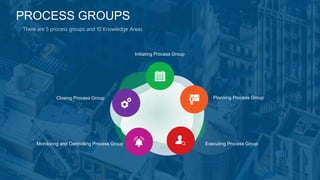
PROCESS GROUPS
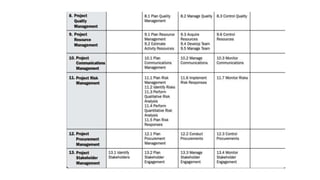
There are 5 process groups and 10 Knowledge Areas
Initiating Process Group
Closing Process Group Planning Process Group
Monitoring and Controlling Process Group Executing Process Group
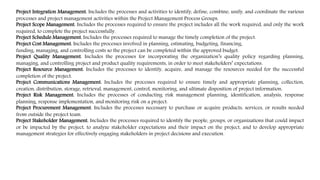
Project Integration Management. Includes the processes and activities to identify, define, combine, unify, and coordinate the various
processes and project management activities within the Project Management Process Groups.
Project Scope Management. Includes the processes required to ensure the project includes all the work required, and only the work
required, to complete the project successfully.
Project Schedule Management. Includes the processes required to manage the timely completion of the project.
Project Cost Management. Includes the processes involved in planning, estimating, budgeting, financing,
funding, managing, and controlling costs so the project can be completed within the approved budget.
Project Quality Management. Includes the processes for incorporating the organization’s quality policy regarding planning,
managing, and controlling project and product quality requirements, in order to meet stakeholders’ expectations.
Project Resource Management. Includes the processes to identify, acquire, and manage the resources needed for the successful
completion of the project.
Project Communications Management. Includes the processes required to ensure timely and appropriate planning, collection,
creation, distribution, storage, retrieval, management, control, monitoring, and ultimate disposition of project information.
Project Risk Management. Includes the processes of conducting risk management planning, identification, analysis, response
planning, response implementation, and monitoring risk on a project.
Project Procurement Management. Includes the processes necessary to purchase or acquire products, services, or results needed
from outside the project team.
Project Stakeholder Management. Includes the processes required to identify the people, groups, or organizations that could impact
or be impacted by the project, to analyze stakeholder expectations and their impact on the project, and to develop appropriate
management strategies for effectively engaging stakeholders in project decisions and execution.
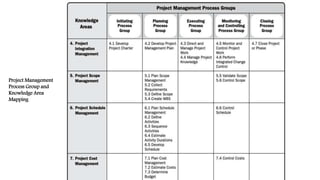
Project Management
Process Group and
Knowledge Area
Mapping
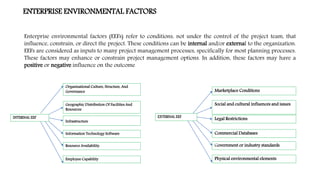
ENTERPRISE ENVIRONMENTAL FACTORS
Enterprise environmental factors (EEFs) refer to conditions, not under the control of the project team, that
influence, constrain, or direct the project. These conditions can be internal and/or external to the organization.
EEFs are considered as inputs to many project management processes, specifically for most planning processes.
These factors may enhance or constrain project management options. In addition, these factors may have a
positive or negative influence on the outcome
INTERNAL EEF
Geographic Distribution Of Facilities And
Resources
Organizational Culture, Structure, And
Governance
Infrastructure
Information Technology Software
Resource Availability.
Employee Capability
EXTERNAL EEF
Social and cultural influences and issues
Marketplace Conditions
Legal Restrictions
Commercial Databases
Government or industry standards
Physical environmental elements
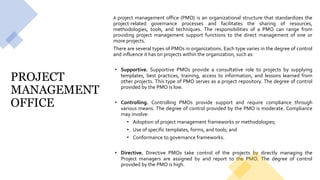
PROJECT
MANAGEMENT
OFFICE
A project management office (PMO) is an organizational structure that standardizes the
project-related governance processes and facilitates the sharing of resources,
methodologies, tools, and techniques. The responsibilities of a PMO can range from
providing project management support functions to the direct management of one or
more projects.
There are several types of PMOs in organizations. Each type varies in the degree of control
and influence it has on projects within the organization, such as:
• Supportive. Supportive PMOs provide a consultative role to projects by supplying
templates, best practices, training, access to information, and lessons learned from
other projects. This type of PMO serves as a project repository. The degree of control
provided by the PMO is low.
• Controlling. Controlling PMOs provide support and require compliance through
various means. The degree of control provided by the PMO is moderate. Compliance
may involve:
• Adoption of project management frameworks or methodologies;
• Use of specific templates, forms, and tools; and
• Conformance to governance frameworks.
• Directive. Directive PMOs take control of the projects by directly managing the
Project managers are assigned by and report to the PMO. The degree of control
provided by the PMO is high.
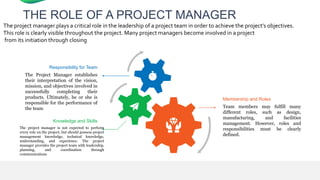
THE ROLE OF A PROJECT MANAGER
The project manager plays a critical role in the leadership of a project team in order to achieve the project’s objectives.
This role is clearly visible throughout the project. Many project managers become involved in a project
from its initiation through closing
Responsibility for Team
The Project Manager establishes
their interpretation of the vision,
mission, and objectives involved in
successfully completing their
products. Ultimately, he or she is
responsible for the performance of
the team
Knowledge and Skills
The project manager is not expected to perform
every role on the project, but should possess project
management knowledge, technical knowledge,
understanding, and experience. The project
manager provides the project team with leadership,
planning, and coordination through
communications
Membership and Roles
Team members may fulfill many
different roles, such as design,
manufacturing, and facilities
management. However, roles and
responsibilities must be clearly
defined.
The Criteria
END OF MODULE ONE (1)

Project management [module 1]

  • 1.
  • 2.
    GENERAL LEARNING OBJECTIVE Introductionto the PMI PMBOK Methodology Critical Concepts in Project Management i.e The Triple Constraints. PMIS Tool (Microsoft Project) Knowledge Areas and Process Groups. Case Studies and Scenario Analyses.
  • 3.
    At the endof the Course, the participant will have: LEARNING OUTCOMES A good understanding of project management fundamentals, principles and its application in managing projects The Ability to manage projects successfully and understand the value of monitoring and control during the project life cycle. The Knowledge on how to develop realistic estimates and schedules and deliver projects on time and within budget Learnt how to work in an organized methodological and effective fashion which can be applied to tasks in the everyday work environment A sound understanding of the three (3) important variables of projects
  • 4.
    MORE LEARNING OUTCOMES Learnwhat project management is and the qualities of an effective project manager. Understand the nine knowledge areas of project management and how they can be applied to your project. Discover the phases of a project and what deliverables are expected when. Identify a project’s key stakeholders. Understand the different types of business cases and how to create a Statement of Work. Learn to be prepared for the unexpected by utilizing risk management and change control. Learn how to organize project activities by creating aWork Breakdown Structure. Create a network diagram to track your project’s progress. Learn budgeting and estimating techniques.
  • 5.
    WHY PROJECT MANAGEMENT? Poorlymanaged projects or the absence of proper project management methodologies often result in: Rework and waste of resources Unsatisfied Stakeholders Loss of Reputation for the Organization Missed Deadlines Poor Quality Deliverables Cost Over runs
  • 6.
    WHY PROJECT MANAGEMENT? • Projectsare a key way to create value and benefits in organizations. In today’s business environment, organizational leaders need to be able to manage with tighter budgets, shorter timelines, scarcity of resources, and rapidly changing technology. The business environment is dynamic with an accelerating rate of change. • Effective and efficient project management should be considered a strategic competency within organizations. It enables organizations • Tie project results to business goals, • Compete more effectively in their markets, • Sustain the organization, and • Respond to the impact of business environment changes on projects by appropriately adjusting project management plans
  • 7.
    Organizational Leaders initiateprojects in response to factors acting upon their organizations. Basically, there are four fundamental categories for these factors (According to the PMBOK Guide, 6th Edition) Project Initiation Context Meet regulatory, legal, or social requirements. Satisfy Stakeholders’ needs or request Implement or change business or technological strategies Create, Improve or fix products, processes or services. **Explore Future opportunities or create road map for innovativeness
  • 8.
    WHY DO PROJECTSFAIL? Below are some of the reasons why Projects Fail: Wrong Team Members Inability to effectively manage Change No Effective Risk Management Strategy Poor project and program management discipline No Link of the Project to Business Strategy Lack of Executive-level Support Inadequate metrics to consistently measure progress and success of the project
  • 9.
    Project Success Criteria Thesuccess of most project management initiatives is judged on the strength of the following 3 criteria: Keeping to the Agreed Time It is critical for a project to be delivered on time and according to agreed schedule. The knowledge area that deals with this is the Schedule Management Keeping to the Agreed Budget Cost, is always a deal breaker with projects. Most projects fail when the project cost go beyond a bearable phase. Cost management is on of the most important knowledge areas Achieving/Meeting the Agreed Objectives Meeting the agreed objectives of the project is extremely important. Often, projects do not achieve this due to the pressure of cost or schedule The Criteria
  • 10.
    TRIPLE CONSTRAINTS TheTriple constraints,is like the almighty formula of Project Management SCOPE RESOURCES SCHEDULE The task of the project manager is constantly balancing these constraints and where possible, making trade offs. However as a project manager, you also want to be careful that you do not make trade offs that will affect the success of the project SCHEDULE RESOURCES SCOPE
  • 11.
    PROJECT SUCCESS GOLDEN RULES i.You must have consensus on project outcome and deliverables ii. You have to build the best team possible iii. You as the project manager must develop a viable plan and keep it as up to date as possible. iv. Your Project Cost Plan, must be as comprehensive as possible. v. In balancing the triple constraints, you must have a realistic schedule plan. vi. People/stakeholder management is extremely important. You must always remember that. vii. You must always have the support of management and critical stakeholders. viii. As a project manager, you must be willing to change. ix. The most important task of a project manager is Effective Communication.
  • 12.
    PROJECT MANAGER’S SPHEREOF KNOWLEDGE It is essential a project manager leads or manages the project team to meet stakeholders’ expectations. Key to a project manager’s Success is relationship and communication skills. Project Manager Project Team Sponsors/Governing Body External Stakeholders/Suppliers/End Users
  • 13.
  • 15.
  • 16.
    A project lifecycle is the series of phases that a project passes through from its start to its completion. It provides the basic framework for managing the project. This basic framework applies regardless of the specific project work involved. PROJECT DEVELOPMENT LIFE CYCLE PREDICTIVE LIFECYCLE ITERATIVE LIFE CYCLE INCREMENTAL LIFECYCLE ADAPTIVE LIFE CLYCLE HYBRID LIFE CYCLE
  • 17.
    Project life cyclescan be predictive or adaptive. Within a project life cycle, there are generally one or more phases that are associated with the development of the product, service, or result. These are called a development life cycle. Development life cycles can be predictive, iterative, incremental, adaptive, or a hybrid model: • In a predictive life cycle, the project scope, time, and cost are determined in the early phases of the life cycle. Any changes to the scope are carefully managed. Predictive life cycles may also be referred to as waterfall life cycles. • In an iterative life cycle, the project scope is generally determined early in the project life cycle, but time and cost estimates are routinely modified as the project team’s understanding of the product increases. Iterations develop the product through a series of repeated cycles, while increments successively add to the functionality of the product. • In an incremental life cycle, the deliverable is produced through a series of iterations that successively add functionality within a predetermined time frame. The deliverable contains the necessary and sufficient capability to be considered complete only after the final iteration. • Adaptive life cycles are agile, iterative, or incremental. The detailed scope is defined and approved before the start of an iteration. Adaptive life cycles are also referred to as agile or change-driven life cycles. • A hybrid life cycle is a combination of a predictive and an adaptive life cycle. Those elements of the project that are well known or have fixed requirements follow a predictive development life cycle, and those elements that are still evolving follow an adaptive development life cycle.
  • 18.
    The project lifecycle is managed by executing a series of project management activities known as project management processes. Every project management process produces one or more outputs from one or more inputs by using appropriate project management tools and techniques. The output can be a deliverable or an outcome. Outcomes are a result of a process. Project management processes apply globally across industries. Processes may contain overlapping activities that occur throughout the project.The output of one process generally results in either: • An input to another process, or • A deliverable of the project or project phase.
  • 19.
  • 20.
    Interrelationship of Needs Assessmentand Critical Business/Project Documents
  • 21.
    PROJECT BUSINESS CASE The projectbusiness case is a documented economic feasibility study used to establish the validity of the benefits of a selected component lacking sufficient definition and that is used as a basis for the authorization of further project management activities. The business case lists the objectives and reasons for project initiation. It helps measure the project success at the end of the project against the project objectives. The business case is a project business document that is used throughout the project life cycle. The business case may be used before the project initiation and may result in a go/no-go decision for the project. A needs assessment often precedes the business case. The needs assessment involves understanding business goals and objectives, issues, and opportunities and recommending proposals to address them. The results of the needs assessment may be summarized in the business case document.
  • 22.
    Managing Change inOrganizations
  • 23.
    Examples of Factors that Leadto the Creation of a Project
  • 24.
    PROJECT BENEFITS MANAGEMENT PLAN • The projectbenefits management plan is the document that describes how and when the benefits of the project will be delivered and describes the mechanisms that should be in place to measure those benefits. A project benefit is defined as an outcome of actions, behaviors, products, services, or results that provide value to the sponsoring organization as well as to the project’s intended beneficiaries. Development of the benefits management plan begins early in the project life cycle with the definition of the target benefits to be realized. The benefits management plan describes key elements of the benefits and may include but is not limited to documenting the following: • Target benefits (e.g., the expected tangible and intangible value to be gained by implementation of the project; financial value is expressed as net present value); • Strategic alignment (e.g., how well the project benefits align to the business strategies of the organization); • Timeframe for realizing benefits (e.g., benefits by phase, short-term, long-term, ongoing); • Benefits owner (e.g., the accountable person to monitor, record, and report benefits throughout the timeframe established in the plan); • Metrics (e.g., the measures to be used to show benefits realized, direct measures, and indirect measures); • Assumptions (e.g., factors expected to be in place or to be in evidence); and • Risks (e.g., risks for realization of benefits).
  • 25.
    • Projects maybe separated into distinct phases or subcomponents. These phases or subcomponents are generally given names that indicate the type of work done in that phase. Examples of phase names include but are not limited to: • Concept development, • Feasibility study, • Customer requirements, • Solution development • Design, • Prototype, • Build • Test • Transition, • Commissioning, • Milestone review, and • Lessons learned.
  • 26.
    PROCESS GROUPS There are5 process groups and 10 Knowledge Areas Initiating Process Group Closing Process Group Planning Process Group Monitoring and Controlling Process Group Executing Process Group
  • 27.
    Project Integration Management.Includes the processes and activities to identify, define, combine, unify, and coordinate the various processes and project management activities within the Project Management Process Groups. Project Scope Management. Includes the processes required to ensure the project includes all the work required, and only the work required, to complete the project successfully. Project Schedule Management. Includes the processes required to manage the timely completion of the project. Project Cost Management. Includes the processes involved in planning, estimating, budgeting, financing, funding, managing, and controlling costs so the project can be completed within the approved budget. Project Quality Management. Includes the processes for incorporating the organization’s quality policy regarding planning, managing, and controlling project and product quality requirements, in order to meet stakeholders’ expectations. Project Resource Management. Includes the processes to identify, acquire, and manage the resources needed for the successful completion of the project. Project Communications Management. Includes the processes required to ensure timely and appropriate planning, collection, creation, distribution, storage, retrieval, management, control, monitoring, and ultimate disposition of project information. Project Risk Management. Includes the processes of conducting risk management planning, identification, analysis, response planning, response implementation, and monitoring risk on a project. Project Procurement Management. Includes the processes necessary to purchase or acquire products, services, or results needed from outside the project team. Project Stakeholder Management. Includes the processes required to identify the people, groups, or organizations that could impact or be impacted by the project, to analyze stakeholder expectations and their impact on the project, and to develop appropriate management strategies for effectively engaging stakeholders in project decisions and execution.
  • 28.
    Project Management Process Groupand Knowledge Area Mapping
  • 30.
    ENTERPRISE ENVIRONMENTAL FACTORS Enterpriseenvironmental factors (EEFs) refer to conditions, not under the control of the project team, that influence, constrain, or direct the project. These conditions can be internal and/or external to the organization. EEFs are considered as inputs to many project management processes, specifically for most planning processes. These factors may enhance or constrain project management options. In addition, these factors may have a positive or negative influence on the outcome INTERNAL EEF Geographic Distribution Of Facilities And Resources Organizational Culture, Structure, And Governance Infrastructure Information Technology Software Resource Availability. Employee Capability EXTERNAL EEF Social and cultural influences and issues Marketplace Conditions Legal Restrictions Commercial Databases Government or industry standards Physical environmental elements
  • 31.
    PROJECT MANAGEMENT OFFICE A project managementoffice (PMO) is an organizational structure that standardizes the project-related governance processes and facilitates the sharing of resources, methodologies, tools, and techniques. The responsibilities of a PMO can range from providing project management support functions to the direct management of one or more projects. There are several types of PMOs in organizations. Each type varies in the degree of control and influence it has on projects within the organization, such as: • Supportive. Supportive PMOs provide a consultative role to projects by supplying templates, best practices, training, access to information, and lessons learned from other projects. This type of PMO serves as a project repository. The degree of control provided by the PMO is low. • Controlling. Controlling PMOs provide support and require compliance through various means. The degree of control provided by the PMO is moderate. Compliance may involve: • Adoption of project management frameworks or methodologies; • Use of specific templates, forms, and tools; and • Conformance to governance frameworks. • Directive. Directive PMOs take control of the projects by directly managing the Project managers are assigned by and report to the PMO. The degree of control provided by the PMO is high.
  • 32.
    THE ROLE OFA PROJECT MANAGER The project manager plays a critical role in the leadership of a project team in order to achieve the project’s objectives. This role is clearly visible throughout the project. Many project managers become involved in a project from its initiation through closing Responsibility for Team The Project Manager establishes their interpretation of the vision, mission, and objectives involved in successfully completing their products. Ultimately, he or she is responsible for the performance of the team Knowledge and Skills The project manager is not expected to perform every role on the project, but should possess project management knowledge, technical knowledge, understanding, and experience. The project manager provides the project team with leadership, planning, and coordination through communications Membership and Roles Team members may fulfill many different roles, such as design, manufacturing, and facilities management. However, roles and responsibilities must be clearly defined. The Criteria
  • 34.

Editor's Notes

  • #8 The PMBOK® Guide provides more detail about key concepts, emerging trends, considerations for tailoring the project management processes, and information on how tools and techniques are applied to projects. Project managers may use one or more methodologies to implement the project management processes outlined in the standard.
  • #16 Within portfolios or programs, projects are a means of achieving organizational goals and objectives. This is often accomplished in the context of a strategic plan that is the primary factor guiding investments in projects. Alignment with the organization’s strategic business goals can be achieved through the systematic management of portfolios, programs, and projects through the application of organizational project management (OPM). OPM is defined as a framework in which portfolio, program, and project management are integrated with organizational enablers in order to achieve strategic objectives.
  • #18 It is up to the project management team to determine the best life cycle for each project. The project life cycle needs to be flexible enough to deal with the variety of factors included in the project. Life cycle flexibility may be accomplished by: Identifying the process or processes needed to be performed in each phase, Performing the process or processes identified in the appropriate phase Adjusting the various attributes of a phase (e.g., name, duration, exit criteria, and entrance criteria).
  • #22 Projects are temporary, but their deliverables may exist beyond the end of the project. Projects may produce deliverables of a social, economic, material, or environmental nature. For example, a project to build a national monument will create a deliverable expected to last for centuries.
  • #28 Project management is not new. It has been in use for hundreds of years. Examples of project outcomes include: uuPyramids of Giza, uuOlympic games, uuGreat Wall of China, uuTaj Mahal, uuPublication of a children’s book, uuPanama Canal, uuDevelopment of commercial jet airplanes, uuPolio vaccine, uuHuman beings landing on the moon, uuCommercial software applications, uuPortable devices to use the global positioning system (GPS), and uuPlacement of the International Space Station into Earth’s orbit.