
GOOGLE PROJECT LOON
UnderThe Guidance of : Submitted by:
Mr. K.Purna chand, M.Tech P. EswarVarma
Department of Computer science and engineering 12215A0503
CONTENTS
 Introduction
 What is project Loon
 Working principle of project Loon
 Technology Used
 Equipment used
 Advantages
 Disadvantages
2/16
INTRODUCTION
 Project Loon is a research and development project being developed
by Google with the mission of providing Internet access to rural and remote
areas.
 A balloon is a flexible bag filled with air or gas.
 The balloon is also considerably used to gather weather information such
as atmospheric pressure, temperature, humidity and wind speed.
 It allows people to communicate with others as well.
3/16
WHAT IS PROJECT LOON
History
In 2008, Google had considered contracting with
or acquiring Space Data Corp., a company that sends
balloons carrying small base stations about 20 miles
(32 km) up in the air for providing connectivity to
truckers and oil companies in the southern United
States, but didn't do so.
4/16
CONTINUE…
Unofficial development on the project
began in 2011 under incubation
in Google X with a series of trial runs
in California's Central Valley. The
project was officially announced as a
Google project on 14 June 2013.
5/16
WORKING PRINCIPLE OF PROJECT LOON
 Each super-pressure balloon is massive with a whopping 15-meter
diameter.
 It is made of very thin, very light polyethylene plastic though, so it lifts up
the sky easily.
 It is strong enough to lift the flight computer and other electronics. All
these are powered by a solar power panel.
6/16
USER CONNECTIVITY
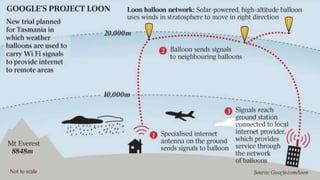
 Users of the service connect to the balloon network using a special
Internet antenna attached to their building.
 The signal travels through the balloon network from balloon to
balloon, then to a ground-based station connected to an Internet
service provider (ISP).
 The system aims to improve communication during natural
disasters to affected regions.
7/16
8
TECHNOLOGY USED
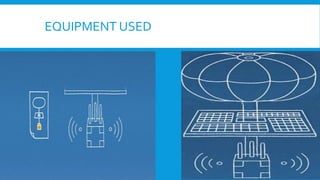
 The small box (payload) hangs below the envelope, and
looks very similar to the basket in a hot air balloon.
 It holds electronic devices, such as circuit boards, radio
antennas, solar panels, batteries, GPS, and devices to
monitor weather conditions.
 The circuit boards control the overall balloon system and
radio antennas are for communications.
9/16
EQUIPMENT USED
10/16
A Google Project
Loon Balloon
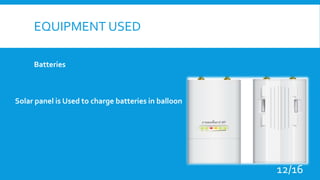
Batteries
EQUIPMENT USED
12/16
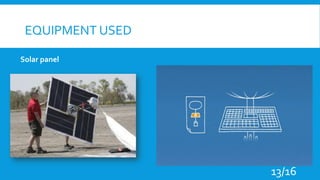
Solar panel is Used to charge batteries in balloon
Solar panel
EQUIPMENT USED
13/16
13
EQUIPMENT USED
ADVANTAGES
 Lower Cost
 Availability of Information
 Use of Renewable Energy
 Weather Surveillance
14/16
DISADVANTAGES
 Hardware Failure
 internet privacy
 Not a replacement of satellite communication.
15/16
CONCLUSION
 Project Loon is an ambitious project and the world will highly benefit from
it.
 Project Loon, an initiative to help fill in those internet gaps through the use
of networked balloons.
 The goal is to provide broadband-like internet for the two-thirds of the
world that doesn’t have access to a reliable internet connection by balloon.
 It is still in experimental phase.
16/16
GOOGLE PROJECT LOON
ThankYou.
GOOGLE PRO

Google ballon

  • 1.
    GOOGLE PROJECT LOON UnderTheGuidance of : Submitted by: Mr. K.Purna chand, M.Tech P. EswarVarma Department of Computer science and engineering 12215A0503
  • 2.
    CONTENTS  Introduction  Whatis project Loon  Working principle of project Loon  Technology Used  Equipment used  Advantages  Disadvantages 2/16
  • 3.
    INTRODUCTION  Project Loonis a research and development project being developed by Google with the mission of providing Internet access to rural and remote areas.  A balloon is a flexible bag filled with air or gas.  The balloon is also considerably used to gather weather information such as atmospheric pressure, temperature, humidity and wind speed.  It allows people to communicate with others as well. 3/16
  • 4.
    WHAT IS PROJECTLOON History In 2008, Google had considered contracting with or acquiring Space Data Corp., a company that sends balloons carrying small base stations about 20 miles (32 km) up in the air for providing connectivity to truckers and oil companies in the southern United States, but didn't do so. 4/16
  • 5.
    CONTINUE… Unofficial development onthe project began in 2011 under incubation in Google X with a series of trial runs in California's Central Valley. The project was officially announced as a Google project on 14 June 2013. 5/16
  • 6.
    WORKING PRINCIPLE OFPROJECT LOON  Each super-pressure balloon is massive with a whopping 15-meter diameter.  It is made of very thin, very light polyethylene plastic though, so it lifts up the sky easily.  It is strong enough to lift the flight computer and other electronics. All these are powered by a solar power panel. 6/16
  • 7.
    USER CONNECTIVITY  Usersof the service connect to the balloon network using a special Internet antenna attached to their building.  The signal travels through the balloon network from balloon to balloon, then to a ground-based station connected to an Internet service provider (ISP).  The system aims to improve communication during natural disasters to affected regions. 7/16
  • 8.
  • 9.
    TECHNOLOGY USED  Thesmall box (payload) hangs below the envelope, and looks very similar to the basket in a hot air balloon.  It holds electronic devices, such as circuit boards, radio antennas, solar panels, batteries, GPS, and devices to monitor weather conditions.  The circuit boards control the overall balloon system and radio antennas are for communications. 9/16
  • 10.
    EQUIPMENT USED 10/16 A GoogleProject Loon Balloon
  • 11.
    Batteries EQUIPMENT USED 12/16 Solar panelis Used to charge batteries in balloon
  • 12.
  • 13.
  • 14.
    ADVANTAGES  Lower Cost Availability of Information  Use of Renewable Energy  Weather Surveillance 14/16
  • 15.
    DISADVANTAGES  Hardware Failure internet privacy  Not a replacement of satellite communication. 15/16
  • 16.
    CONCLUSION  Project Loonis an ambitious project and the world will highly benefit from it.  Project Loon, an initiative to help fill in those internet gaps through the use of networked balloons.  The goal is to provide broadband-like internet for the two-thirds of the world that doesn’t have access to a reliable internet connection by balloon.  It is still in experimental phase. 16/16
  • 17.