
Project-Based Learning
Project-based learning (PBL) is a model
that organizes learning around projects
 Projects are complex tasks,
based on challenging questions
or problems, that involve
students in design, problem-
solving, decision making, or
investigative activities; give
students the opportunity to
work relatively autonomously
over extended periods of time;
in realistic products or
presentations.
 (Jones, Rasmussen, & Moffitt, 1997; Thomas,
Mergendoller, & Michaelson, 1999).
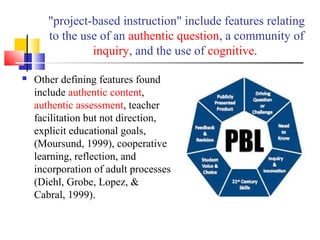
"project-based instruction" include features relating
to the use of an authentic question, a community of
inquiry, and the use of cognitive.
 Other defining features found
include authentic content,
authentic assessment, teacher
facilitation but not direction,
explicit educational goals,
(Moursund, 1999), cooperative
learning, reflection, and
incorporation of adult processes
(Diehl, Grobe, Lopez, &
Cabral, 1999).
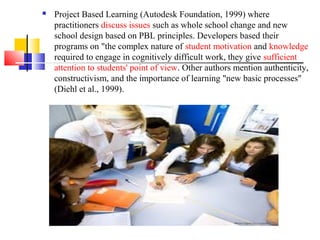
 Project Based Learning (Autodesk Foundation, 1999) where
practitioners discuss issues such as whole school change and new
school design based on PBL principles. Developers based their
programs on "the complex nature of student motivation and knowledge
required to engage in cognitively difficult work, they give sufficient
attention to students' point of view. Other authors mention authenticity,
constructivism, and the importance of learning "new basic processes"
(Diehl et al., 1999).
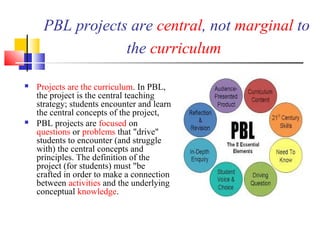
PBL projects are central, not marginal to
the curriculum
 Projects are the curriculum. In PBL,
the project is the central teaching
strategy; students encounter and learn
the central concepts of the project,
 PBL projects are focused on
questions or problems that "drive"
students to encounter (and struggle
with) the central concepts and
principles. The definition of the
project (for students) must "be
crafted in order to make a connection
between activities and the underlying
conceptual knowledge.
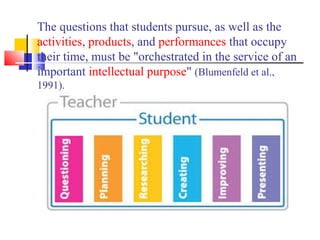
The questions that students pursue, as well as the
activities, products, and performances that occupy
their time, must be "orchestrated in the service of an
important intellectual purpose" (Blumenfeld et al.,
1991).
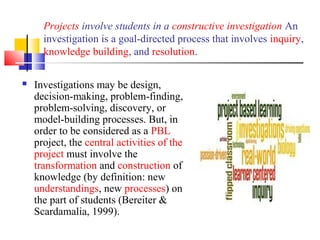
Projects involve students in a constructive investigation An
investigation is a goal-directed process that involves inquiry,
knowledge building, and resolution.
 Investigations may be design,
decision-making, problem-finding,
problem-solving, discovery, or
model-building processes. But, in
order to be considered as a PBL
project, the central activities of the
project must involve the
transformation and construction of
knowledge (by definition: new
understandings, new processes) on
the part of students (Bereiter &
Scardamalia, 1999).
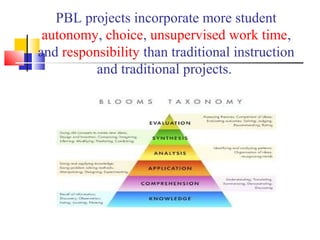
PBL projects incorporate more student
autonomy, choice, unsupervised work time,
and responsibility than traditional instruction
and traditional projects.
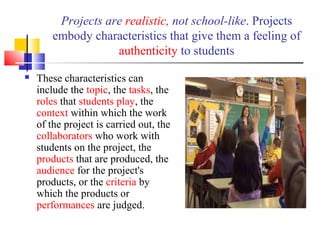
Projects are realistic, not school-like. Projects
embody characteristics that give them a feeling of
authenticity to students
 These characteristics can
include the topic, the tasks, the
roles that students play, the
context within which the work
of the project is carried out, the
collaborators who work with
students on the project, the
products that are produced, the
audience for the project's
products, or the criteria by
which the products or
performances are judged.
Gordon (1998) makes the distinction between academic
challenges, scenario challenges, and real-life challenges. PBL
incorporates real-life challenges where the focus is on
authentic (not simulated) problems or questions and where
solutions have the potential to be implemented.
Project based learning rusul's presentation

Project based learning rusul's presentation

  • 1.
  • 2.
    Project-based learning (PBL)is a model that organizes learning around projects  Projects are complex tasks, based on challenging questions or problems, that involve students in design, problem- solving, decision making, or investigative activities; give students the opportunity to work relatively autonomously over extended periods of time; in realistic products or presentations.  (Jones, Rasmussen, & Moffitt, 1997; Thomas, Mergendoller, & Michaelson, 1999).
  • 3.
    "project-based instruction" includefeatures relating to the use of an authentic question, a community of inquiry, and the use of cognitive.  Other defining features found include authentic content, authentic assessment, teacher facilitation but not direction, explicit educational goals, (Moursund, 1999), cooperative learning, reflection, and incorporation of adult processes (Diehl, Grobe, Lopez, & Cabral, 1999).
  • 4.
     Project BasedLearning (Autodesk Foundation, 1999) where practitioners discuss issues such as whole school change and new school design based on PBL principles. Developers based their programs on "the complex nature of student motivation and knowledge required to engage in cognitively difficult work, they give sufficient attention to students' point of view. Other authors mention authenticity, constructivism, and the importance of learning "new basic processes" (Diehl et al., 1999).
  • 5.
    PBL projects arecentral, not marginal to the curriculum  Projects are the curriculum. In PBL, the project is the central teaching strategy; students encounter and learn the central concepts of the project,  PBL projects are focused on questions or problems that "drive" students to encounter (and struggle with) the central concepts and principles. The definition of the project (for students) must "be crafted in order to make a connection between activities and the underlying conceptual knowledge.
  • 6.
    The questions thatstudents pursue, as well as the activities, products, and performances that occupy their time, must be "orchestrated in the service of an important intellectual purpose" (Blumenfeld et al., 1991).
  • 7.
    Projects involve studentsin a constructive investigation An investigation is a goal-directed process that involves inquiry, knowledge building, and resolution.  Investigations may be design, decision-making, problem-finding, problem-solving, discovery, or model-building processes. But, in order to be considered as a PBL project, the central activities of the project must involve the transformation and construction of knowledge (by definition: new understandings, new processes) on the part of students (Bereiter & Scardamalia, 1999).
  • 8.
    PBL projects incorporatemore student autonomy, choice, unsupervised work time, and responsibility than traditional instruction and traditional projects.
  • 9.
    Projects are realistic,not school-like. Projects embody characteristics that give them a feeling of authenticity to students  These characteristics can include the topic, the tasks, the roles that students play, the context within which the work of the project is carried out, the collaborators who work with students on the project, the products that are produced, the audience for the project's products, or the criteria by which the products or performances are judged.
  • 10.
    Gordon (1998) makesthe distinction between academic challenges, scenario challenges, and real-life challenges. PBL incorporates real-life challenges where the focus is on authentic (not simulated) problems or questions and where solutions have the potential to be implemented.