PROBLEM BASED
LEARNING IN 21ST
CENTURY LEARNINGBy: Siti Mastura Baharudin (sitimastura@usm.my)
INTRODUCTION
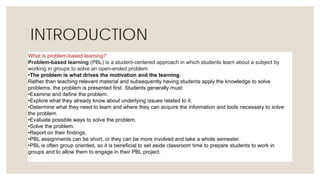
What is problem-based learning?
Problem-based learning (PBL) is a student-centered approach in which students learn about a subject by
working in groups to solve an open-ended problem.
•The problem is what drives the motivation and the learning.
Rather than teaching relevant material and subsequently having students apply the knowledge to solve
problems, the problem is presented first. Students generally must:
•Examine and define the problem.
•Explore what they already know about underlying issues related to it.
•Determine what they need to learn and where they can acquire the information and tools necessary to solve
the problem.
•Evaluate possible ways to solve the problem.
•Solve the problem.
•Report on their findings.
•PBL assignments can be short, or they can be more involved and take a whole semester.
•PBL is often group oriented, so it is beneficial to set aside classroom time to prepare students to work in
groups and to allow them to engage in their PBL project.
THE USE OF PBL
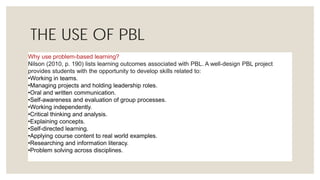
Why use problem-based learning?
Nilson (2010, p. 190) lists learning outcomes associated with PBL. A well-design PBL project
provides students with the opportunity to develop skills related to:
•Working in teams.
•Managing projects and holding leadership roles.
•Oral and written communication.
•Self-awareness and evaluation of group processes.
•Working independently.
•Critical thinking and analysis.
•Explaining concepts.
•Self-directed learning.
•Applying course content to real world examples.
•Researching and information literacy.
•Problem solving across disciplines.
BASIC STEPS
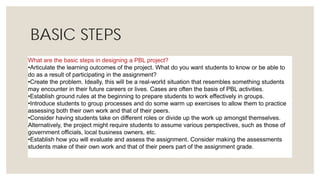
What are the basic steps in designing a PBL project?
•Articulate the learning outcomes of the project. What do you want students to know or be able to
do as a result of participating in the assignment?
•Create the problem. Ideally, this will be a real-world situation that resembles something students
may encounter in their future careers or lives. Cases are often the basis of PBL activities.
•Establish ground rules at the beginning to prepare students to work effectively in groups.
•Introduce students to group processes and do some warm up exercises to allow them to practice
assessing both their own work and that of their peers.
•Consider having students take on different roles or divide up the work up amongst themselves.
Alternatively, the project might require students to assume various perspectives, such as those of
government officials, local business owners, etc.
•Establish how you will evaluate and assess the assignment. Consider making the assessments
students make of their own work and that of their peers part of the assignment grade.
Credit:
1. Slide 5: Public domain; pmbbun; pixabay
THANK YOU!

Problem Based Learning

  • 1.
    PROBLEM BASED LEARNING IN21ST CENTURY LEARNINGBy: Siti Mastura Baharudin (sitimastura@usm.my)
  • 2.
    INTRODUCTION What is problem-basedlearning? Problem-based learning (PBL) is a student-centered approach in which students learn about a subject by working in groups to solve an open-ended problem. •The problem is what drives the motivation and the learning. Rather than teaching relevant material and subsequently having students apply the knowledge to solve problems, the problem is presented first. Students generally must: •Examine and define the problem. •Explore what they already know about underlying issues related to it. •Determine what they need to learn and where they can acquire the information and tools necessary to solve the problem. •Evaluate possible ways to solve the problem. •Solve the problem. •Report on their findings. •PBL assignments can be short, or they can be more involved and take a whole semester. •PBL is often group oriented, so it is beneficial to set aside classroom time to prepare students to work in groups and to allow them to engage in their PBL project.
  • 3.
    THE USE OFPBL Why use problem-based learning? Nilson (2010, p. 190) lists learning outcomes associated with PBL. A well-design PBL project provides students with the opportunity to develop skills related to: •Working in teams. •Managing projects and holding leadership roles. •Oral and written communication. •Self-awareness and evaluation of group processes. •Working independently. •Critical thinking and analysis. •Explaining concepts. •Self-directed learning. •Applying course content to real world examples. •Researching and information literacy. •Problem solving across disciplines.
  • 4.
    BASIC STEPS What arethe basic steps in designing a PBL project? •Articulate the learning outcomes of the project. What do you want students to know or be able to do as a result of participating in the assignment? •Create the problem. Ideally, this will be a real-world situation that resembles something students may encounter in their future careers or lives. Cases are often the basis of PBL activities. •Establish ground rules at the beginning to prepare students to work effectively in groups. •Introduce students to group processes and do some warm up exercises to allow them to practice assessing both their own work and that of their peers. •Consider having students take on different roles or divide up the work up amongst themselves. Alternatively, the project might require students to assume various perspectives, such as those of government officials, local business owners, etc. •Establish how you will evaluate and assess the assignment. Consider making the assessments students make of their own work and that of their peers part of the assignment grade.
  • 6.
    Credit: 1. Slide 5:Public domain; pmbbun; pixabay
  • 7.