Authentic Learning
By
Brooke Kersey (Ford)
What is Authentic Learning?
 “Authentic learning is a relatively new term that
describes learning through applying knowledge in real-
life contexts and situations.” (Rule, 2006)
 “Authentic learning typically focuses on real-world,
complex problems and their solutions, using role-
playing exercises, problem-based activities, case
studies, and participation in virtual communities of
practice.” (Lombardi, 2007)
The Four Themes of Authentic Learning
According to Rule, 2006
 “An activity that involves real-world problems and that
mimics the work of professionals: the activity involves
presentation of findings to audiences beyond classroom.”
 “Use of open-ended inquiry, thinking skills and
metacognition.”
 “Students engage in discourse and social learning in a
community of learners.”
 “Students direct their own learning in project work.”
Authentic Learning for the 21st Century by
Lombardi
 “Learning by doing”
 “Learning researchers have distilled the essence of the authentic
learning experience down to 10 design elements:
 Real-world relevance
 Ill defined problem
 Sustained Investigation
 Multiple sources and perspectives
 Collaboration
 Reflection (metacognition)
 Interdisciplinary perspective
 Integrated assessment
 Polished products
 Multiple interpretations and outcomes”
Authentic Learning for the 21st
Century by Lombardi
 “Technological support for today’s authentic learning
environments commonly includes:
 High-speed Internet connectivity for provision of
multimedia information
 Asynchronous and synchronous communication and
social networking tools for the support of teamwork
 Intelligent tutoring systems, virtual laboratories, and
feedback mechanisms
 Mobile devices for accessing and inputting data during
field-based investigations
What makes authentic learning
effective? (Lombardi, 2007)
 “Three principles illustrate the alignment
between learning research and authentic
learning:
 Learners look for connections
 Long-lived attachments come with practice
 New contexts need to be explored”
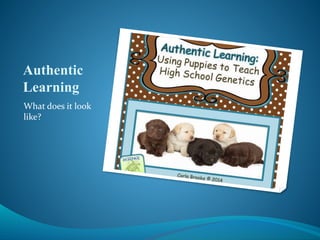
Authentic
Learning
What does it look
like?
References
 Lombardi, M. (2007). Authentic Learning for the 21st Century: An Overview. Educause Learning
Initiative. Retrieved from https://net.educause.edu/ir/library/pdf/ELI3009.pdf.
 Rule, A. (2006). Editorial: The Components of Authentic Learning. Journal of Authentic Learning.
Retrieved from
https://dspace.sunyconnect.suny.edu/bitstream/handle/1951/35263/editorial_rule.pdf?sequence=1.
 Mims, C. (2003). Authentic Learning:
A Practical Introduction & Guide for Implementation. Meridian: A Middle School Computer
Technologies Journal. Retrieved from http://www.ncsu.edu/meridian/win2003/authentic_learning/.
 Brooks, C. (2004). Authentic Learning: Using Puppies to Teach High School Genetics. Retrieved
from http://www.google.com/imgres?imgurl=http://3.bp.blogspot.com/-
WFldDW9gNQQ/VGwXLjfZgUI/AAAAAAAAAFw/0nCP7XU9jHA/s1600/Lab%25252Bpups%25
252Bpic.jpg&imgrefurl=http://nittygrittyscience.blogspot.com/2014/11/authentic-learning-using-
puppies-
to.html&h=720&w=720&tbnid=RJNP7JHZ1etOTM:&zoom=1&docid=hNar2oeRQv7rYM&ei=kUT
WVLzqHMikgwTznIOYBQ&tbm=isch&ved=0CB0QMygVMBU4ZA

Authentic learning

  • 1.
  • 2.
    What is AuthenticLearning?  “Authentic learning is a relatively new term that describes learning through applying knowledge in real- life contexts and situations.” (Rule, 2006)  “Authentic learning typically focuses on real-world, complex problems and their solutions, using role- playing exercises, problem-based activities, case studies, and participation in virtual communities of practice.” (Lombardi, 2007)
  • 3.
    The Four Themesof Authentic Learning According to Rule, 2006  “An activity that involves real-world problems and that mimics the work of professionals: the activity involves presentation of findings to audiences beyond classroom.”  “Use of open-ended inquiry, thinking skills and metacognition.”  “Students engage in discourse and social learning in a community of learners.”  “Students direct their own learning in project work.”
  • 4.
    Authentic Learning forthe 21st Century by Lombardi  “Learning by doing”  “Learning researchers have distilled the essence of the authentic learning experience down to 10 design elements:  Real-world relevance  Ill defined problem  Sustained Investigation  Multiple sources and perspectives  Collaboration  Reflection (metacognition)  Interdisciplinary perspective  Integrated assessment  Polished products  Multiple interpretations and outcomes”
  • 5.
    Authentic Learning forthe 21st Century by Lombardi  “Technological support for today’s authentic learning environments commonly includes:  High-speed Internet connectivity for provision of multimedia information  Asynchronous and synchronous communication and social networking tools for the support of teamwork  Intelligent tutoring systems, virtual laboratories, and feedback mechanisms  Mobile devices for accessing and inputting data during field-based investigations
  • 6.
    What makes authenticlearning effective? (Lombardi, 2007)  “Three principles illustrate the alignment between learning research and authentic learning:  Learners look for connections  Long-lived attachments come with practice  New contexts need to be explored”
  • 7.
  • 8.
    References  Lombardi, M.(2007). Authentic Learning for the 21st Century: An Overview. Educause Learning Initiative. Retrieved from https://net.educause.edu/ir/library/pdf/ELI3009.pdf.  Rule, A. (2006). Editorial: The Components of Authentic Learning. Journal of Authentic Learning. Retrieved from https://dspace.sunyconnect.suny.edu/bitstream/handle/1951/35263/editorial_rule.pdf?sequence=1.  Mims, C. (2003). Authentic Learning: A Practical Introduction & Guide for Implementation. Meridian: A Middle School Computer Technologies Journal. Retrieved from http://www.ncsu.edu/meridian/win2003/authentic_learning/.  Brooks, C. (2004). Authentic Learning: Using Puppies to Teach High School Genetics. Retrieved from http://www.google.com/imgres?imgurl=http://3.bp.blogspot.com/- WFldDW9gNQQ/VGwXLjfZgUI/AAAAAAAAAFw/0nCP7XU9jHA/s1600/Lab%25252Bpups%25 252Bpic.jpg&imgrefurl=http://nittygrittyscience.blogspot.com/2014/11/authentic-learning-using- puppies- to.html&h=720&w=720&tbnid=RJNP7JHZ1etOTM:&zoom=1&docid=hNar2oeRQv7rYM&ei=kUT WVLzqHMikgwTznIOYBQ&tbm=isch&ved=0CB0QMygVMBU4ZA