LESSON PLAN


Name: Monica Colţ
Date: January, 20th, 2011
School: School No.150 “St.Elefterie”
Grade: 7 (L1)
Level: intermediate
No. of students: 29
Textbook: High Flyer Intermediate, Longman
Topic:
Unit 11 – Great Adventures: An Adventure Story
Relative clauses (who, that, whose, which, where)
Time: 50 min
Location: the classroom

Type of lesson: developing skills
Functions:
     - to narrate according to the events in the text
     - to initiate discussion
     - to predict content
Skills: reading, writing, listening, speaking (integrated receptive and productive skills)
Lesson aims:
     - to develop students’ reading-comprehension skills
     - to develop students’ speaking skills (talking about adventure trips)
     - to make students aware of the use of relative pronouns (who, whose, that, which) and
          adverbs (where) in relative clauses
Aids: whiteboard, textbook, work-sheets, flashcards, power-point presentation, tape
Specific competences:
     1. to use properly, in various contexts, words and phrases related to the main concept of the
          lesson - “adventure”(based on the mind map)
     2. to express points of view based on personal experience on the topic of the lesson,
          “adventure story” to skim the narrative text for the general idea; to scan the text for
          detailed information (based on the idea that stories are an important aspect of culture)
     3. to identify the main stress in the compound words (based on the listening activity)
     4. to use relative pronouns (who, whose, that, which) and adverbs (where) in relative
          clauses to emphasize the stylistic dimension of the adventure story
     5. to order the events in a narrative text as they appear in the text (based on the logical
          sequence of the events)
     6. to write a possible (either optimistic or pessimistic) ending for the adventure story
     7. to expand the story according to the experiences of the character and the student’s
          personal experience
Teaching methods: brainstorming, conversation, dialogue, exercise, explanation, role play
Evaluation:
- initial: homework check-up
- continue: through activities, error correction
- final: through oral and written feed-back and homework


                                               1
Stages of lesson:

Warm-up
Activity 1
General Competence: to develop positive attitude towards learning English
Specific competence: to correct mistakes
Method: dialogue
Procedure: Teacher (T) checks the homework first. Ss read their homework and correct it if
necessary.
Interaction:
T-S; S-T
Class management: whole class activity
Timing: 5 min

Lead-in
Activity 2
General Competence: to express curiosity about the lives of children from other cultural spaces
Specific competence: to use properly, in various contexts, words and phrases related to the main
concept of the lesson - “adventure” (based on the mind map)
Method: conversation
Aids: flash-cards
Procedure: Each group of Ss receives flash-cards on the topic “adventure.”
Ss work in groups of 6 or 8 to discover the word related to the flash-cards:
Group 1 – adventure (lama, jaguar, risky trip, torchlight, compass, steep mountain)
Group 2 – Inca (Inca leader and his family, Sun God, Machu Picchu, temple, Inca map)
Group 3 – Treasure (coins, jewellery, gold, statues)
Group 4 – Exploration (magnifying-glass, binoculars to look high and low, children on a trip,
map)
Whole-class activity: power-point presentation to check and expand orally the meaning of each
concept. Ss write a sentence which bridges these words, relevant to the topic of the lesson.
Interaction: Ss-Ss; Ss-T
Class management: group work and then whole class activity
Timing: 5 min

Pre-Reading
Activity 3
General Competence: to express flexibility in exchanging ideas while working in a group
(values and attitudes)
Specific competence: to express points of view based on personal experience on the topic of the
lesson, “adventure story.”
Method: conversation
Aids: work-sheets (a table with 2 columns / 2 lists: things you know for sure/ things you don’t
know – not sure of)
Procedure: T challenges Ss introducing a strong motivational task related to Ss’ previous
experience on the topic “adventure:” “An adventure trip means things that happen according to
the plan and expectations, but especially surprises or situations in which you have to find a
solution. Have you ever been on an adventure trip?” Ss work in groups to write a list of things
they are sure about (3) and things they are not sure about, or they don’t know (3). They discuss
the possibilities and one S from the group (a task at any S’s choice) writes the lists. The points of
view are shared with the class. Such task can also be solved individually or as pair work.
Interaction: Ss-Ss; Ss-Ss-T
Class management: group work activity
Timing: 5 min

Activity 4
General Competence: to raise awareness concerning the knowledge about different geographical
areas
Specific competence: to skim the narrative text for the general idea; to scan the text for detailed
information (based on the idea that stories are an important aspect of culture)
Method: dialogue
Aids: the text in the textbook
Procedure: T announces the purpose of the lesson: “Today we are going to be reading and
talking about the adventure story of a child and his friends who travel to a place in the Andes,
where the Incas lived about 6oo years ago. We will find out together what the children are
looking for in this far away land. Can you make a guess before reading the adventure story?”
T tells Ss that the text is quite long and they need to skim and scan it (T accompanies the sentence
with a drawing: a magnifying glass, which indicates that they will discover the text together.)
Skimming for the general/ main idea of the adventure story: Ss answer the questions addressed by
T to the whole class. Scanning the text: Speed game: “Facts only!” Students find the name of a
mountain/river/city/a year/an American archeologist (ex. 8/48)
Interaction: S-S; S-T
Class management: whole class activity, followed by pair work activity
Timing: 5 min

While-Reading
Activity 5
General Competence: to receive and produce an oral message
Specific competence: to identify the main stress in the compound words (based on the listening
activity)
Method: dialogue
Aids: tape, a sheet of paper
Procedure: Ss work in pairs. T asks Ss to identify three or more compound words in the
adventure story (for example: water bottles), then to talk to the partner to explain them orally. Ss
listen to the compound words on the tape and identify the main stress in these words. Ss repeat
the words and draw a simple graph to represent the music of the word. Then they listen to the
words again and check the stress.
Interaction: S-S; S-T
Class management: pair work activity
Timing: 5 min

Activity 6
General Competence: to understand and interpret a written message in English
Specific competence: to use relative pronouns (who, whose, that, which) and adverbs (where) in
relative clauses to emphasize the stylistic dimension of the adventure story
Method: conversation
Aids: work-sheets; handouts
Procedure:
T asks Ss to look at an image on the screen, representing a cave and two explorers. T tells the Ss
that they can make sentences about the image with the help of words like: who, which, that,
whose, where. They are asked to use the right word to join the sentences written on the work-
sheets and to make them easy to read. Ss work in pairs, and then T checks the answers as a whole
class activity (power point presentation and also handouts which help emphasize the main points


                                               3
concerning relative clauses). After the first example T elicits what is a relative clause, its position
and the introductory word (the relative clause is the sentence which adds more information about
one of the nouns in the main clause and begins with who, whose, which, that and where. The
relative clause goes immediately after the noun. The relative pronouns are: who, whose, that,
which; where is a relative adverb). Ss notice that these sentences make the text more fluent and
easy to read, as they connect ideas expressed by the narrator.
Interaction: S – S; Ss-T
Class management: pair work; whole class activity
Timing: 5 min

Activity 7
General Competence: to express curiosity about the lives of the people from other cultural
spaces
Specific competence: to order the events in a narrative text as they appear in the text (based on
the logical sequence of the events)
Method: conversation
Aids: work-sheets; textbook
Procedure:
Ss read the text silently. Then they order the events written on the work-sheet (main ideas written
as titles) as they appear in the story. T asks Ss to discuss and predict the end of the story, then to
write a short idea. T discusses the results as a whole class activity. Then T asks students to tell
briefly the content of the 1st (or 2nd /3rd /4th ) paragraph. T can overcome Ss’ difficulties in
identifying the paragraphs by asking Ss to read aloud the first sentence of each paragraph (usually
the topic sentence).
Interaction: Ss-Ss; Ss-T
Class management: group work
Timing: 5 min

Activity 8
General Competence: to develop interest in the discovery of socio-cultural specific expressed in
texts in English
Specific competence: to write a possible (optimistic or pessimistic) ending for the adventure
story
Method: conversation
Aids: textbook
Procedure:
T discusses with Ss the ending of the story (exercise 14 page 49), either positive or negative.
They give reasons for their choice (e.g. Does the optimistic ending match the story?)
Interaction: Ss-Ss; Ss-T
Class management: group work
Timing: 5 min

Activity 9
General Competence: express curiosity about the lives of children from other cultural spaces
Specific competence: to expand the story according to the character’s adventures in the
adventure story and S’s personal experience
Method: role-play
Aids: textbook


Procedure:
T asks Ss from each group to pick out any card from the “Fishbowl:” one of them is for the role
of the narrator. S – “narrator” answers three questions asked by his classmates. Then a different
narrator is chosen.
Interaction: S-Ss
Class management: whole class activity
Timing: 5min

Activity 10 Feed-back - giving assignment; evaluation of the lesson
General Competence: to develop interest in the discovery of socio-cultural specific expressed in
texts in English
Specific competence: to write a different ending for the adventure story based on the evolution of
the events and characters
Method: conversation
Aids: textbook
Procedure: T assigns the homework. Ss ask questions in case there are aspects that need to be
clarified
Interaction: S-T
Class management: individual work
Timing: 5 min (20 min homework at home)

Bibliography:
Primary sources :
    Acevedo, Ana, and Gower, Marisol. High Flyer Intermediate. Harlow, Essex:
       Longman, 2004. 48-49

Secondary sources:
    Harmer, Jeremy. The Practice of English Language Teaching (3d ed.). Harlow,
      Essex: Longman, 2001.
    McCallum, George. 101 Games for Students of English as a Second or Foreign
      Language. Oxford: Oxford University Press, 1980.
    Sesnan, Barry. How to Teach English. Oxford: Oxford University Press, 2004.


Electronic sources:
http://articles.famouswhy.com/category/lesson_plans/archive.html
http://jobs.languagelink.ru/tefl_clinic/practical_teaching/reading_skills/exploiting_readers/i
deas2.php
http://iteslj.org/Techniques/Mehta-Vocabulary.html
http://www.englishcompanion.com/assignments/reading/103readingactivities.htm

http://curriculum2009.edu.ro/Ciclul_gimnazial/


                                               5
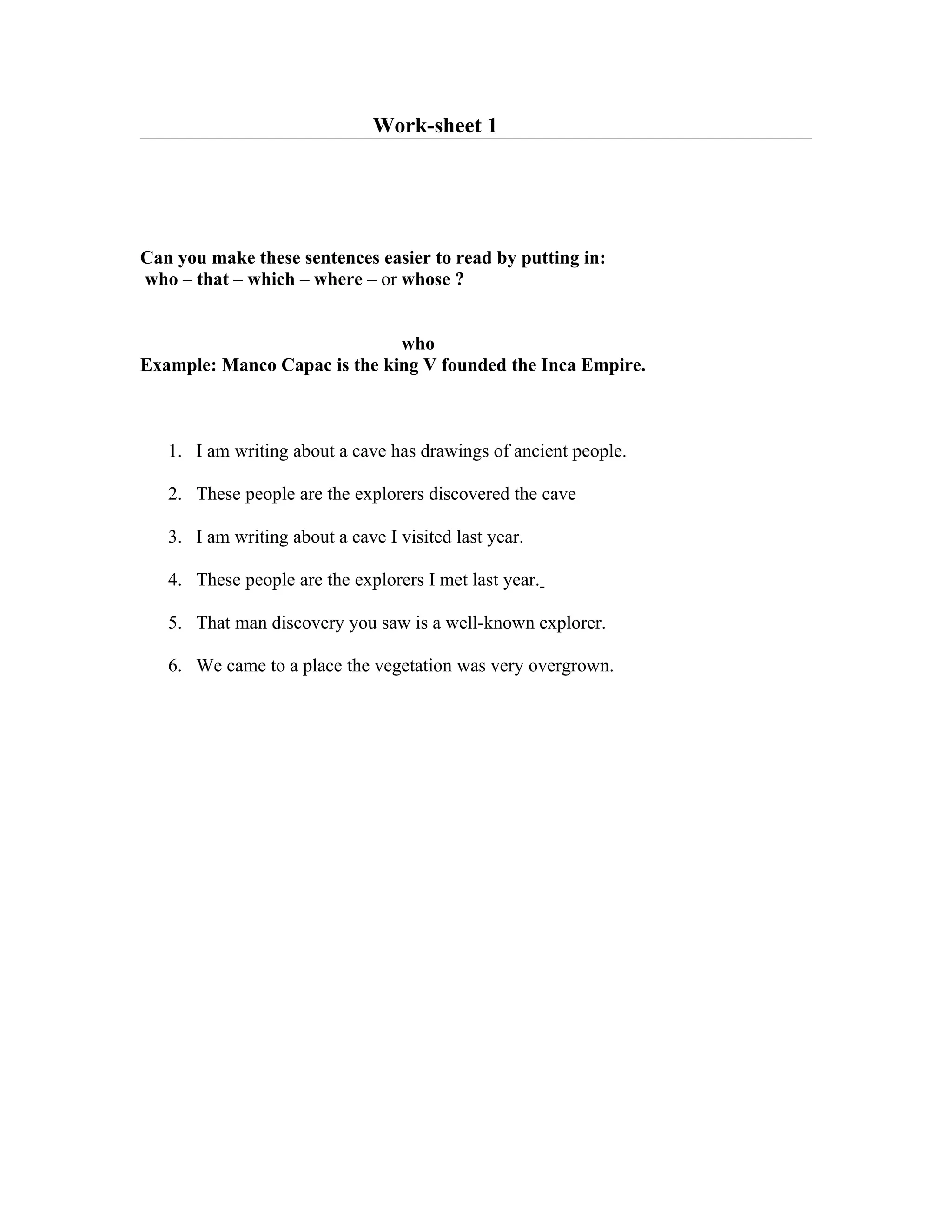
Work-sheet 1


Can you make these sentences easier to read by putting in:
who – that – which – where – or whose ?


                              who
Example: Manco Capac is the king V founded the Inca Empire.


   1. I am writing about a cave has drawings of ancient people.

   2. These people are the explorers discovered the cave

   3. I am writing about a cave I visited last year.

   4. These people are the explorers I met last year.

   5. That man discovery you saw is a well-known explorer.

   6. We came to a place the vegetation was very overgrown.
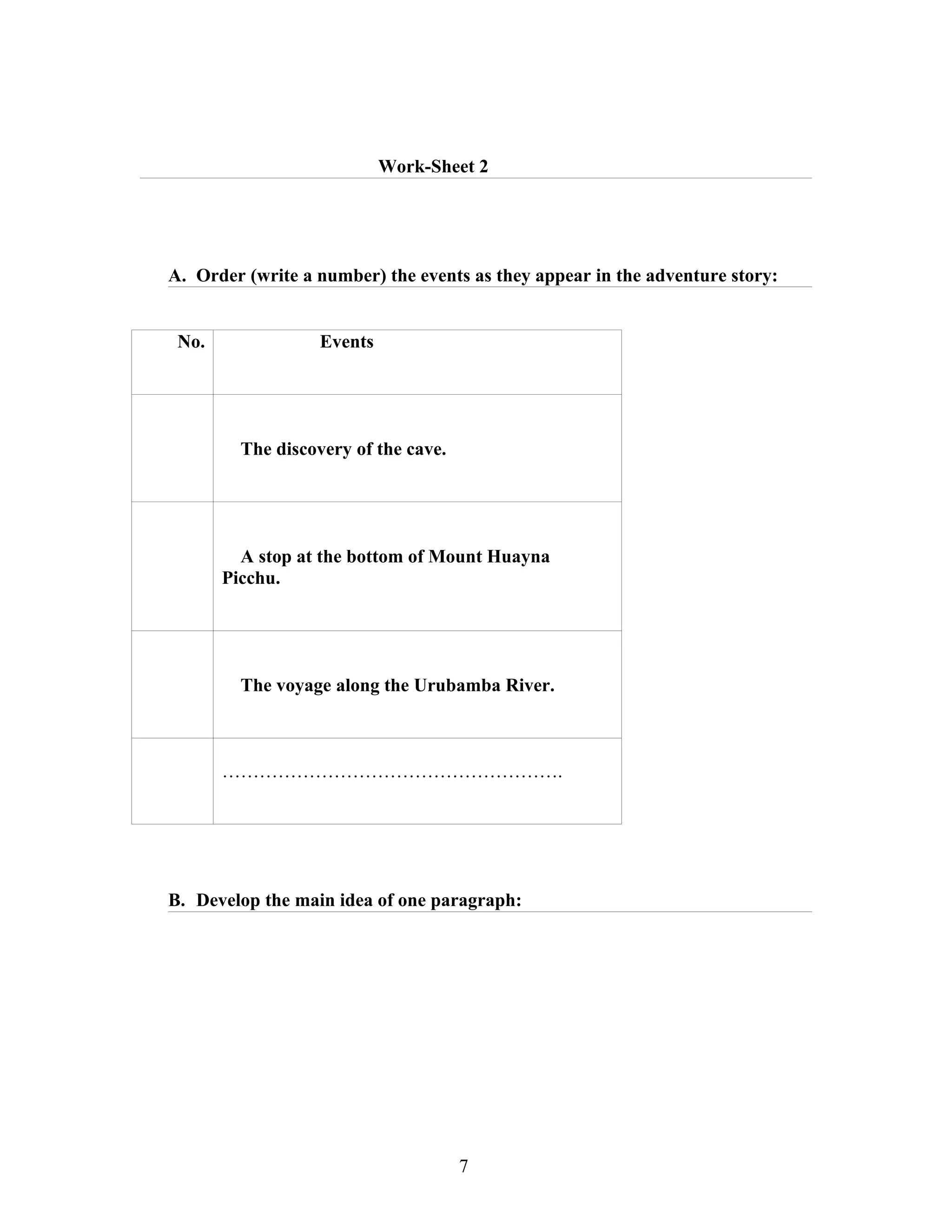
Work-Sheet 2


A. Order (write a number) the events as they appear in the adventure story:


 No.               Events


         The discovery of the cave.


         A stop at the bottom of Mount Huayna
       Picchu.


         The voyage along the Urubamba River.


       ……………………………………………….


B. Develop the main idea of one paragraph:


                                      7
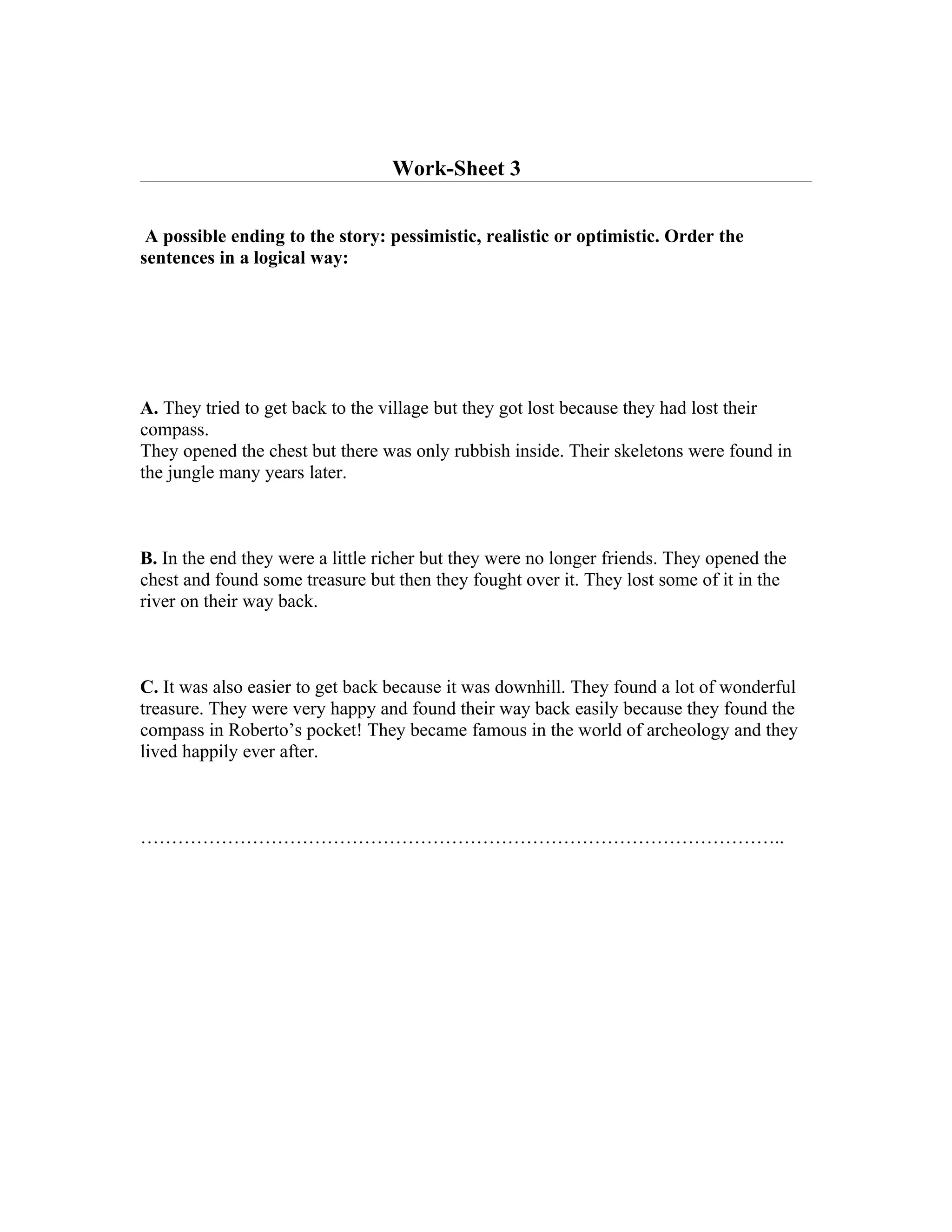
Work-Sheet 3


 A possible ending to the story: pessimistic, realistic or optimistic. Order the
sentences in a logical way:


A. They tried to get back to the village but they got lost because they had lost their
compass.
They opened the chest but there was only rubbish inside. Their skeletons were found in
the jungle many years later.


B. In the end they were a little richer but they were no longer friends. They opened the
chest and found some treasure but then they fought over it. They lost some of it in the
river on their way back.


C. It was also easier to get back because it was downhill. They found a lot of wonderful
treasure. They were very happy and found their way back easily because they found the
compass in Roberto’s pocket! They became famous in the world of archeology and they
lived happily ever after.


…………………………………………………………………………………………..
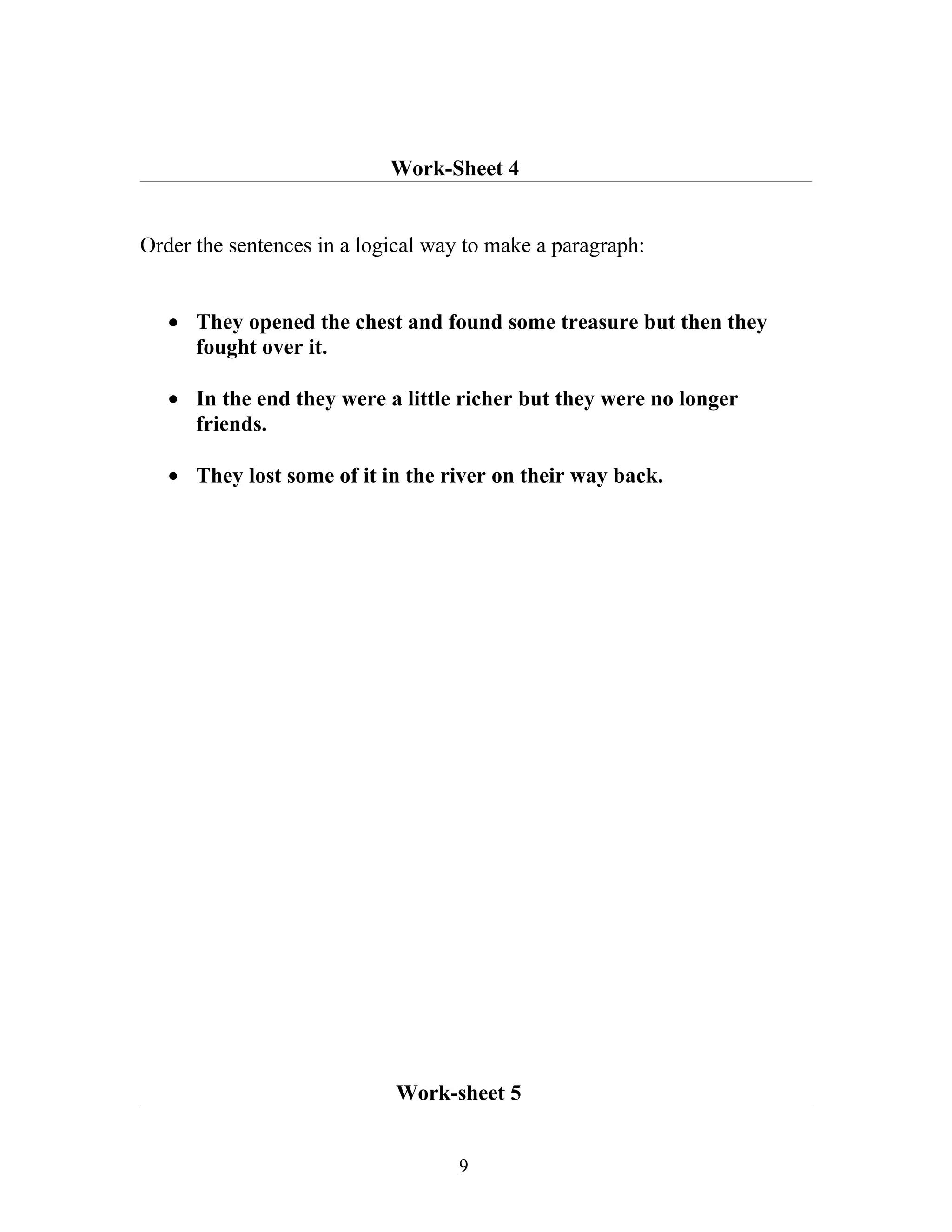
Work-Sheet 4


Order the sentences in a logical way to make a paragraph:


   • They opened the chest and found some treasure but then they
     fought over it.

   • In the end they were a little richer but they were no longer
     friends.

   • They lost some of it in the river on their way back.


                            Work-sheet 5


                                    9
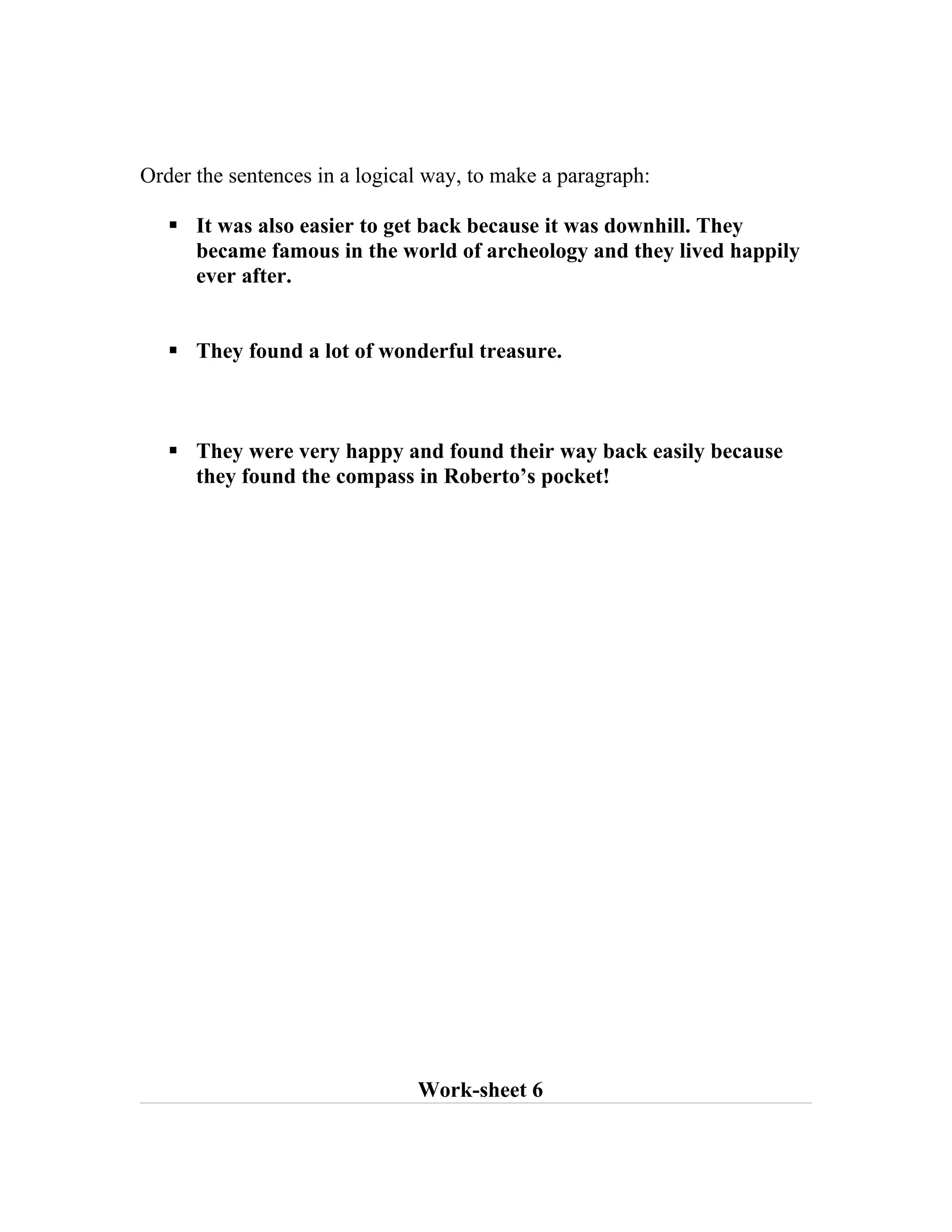
Order the sentences in a logical way, to make a paragraph:

    It was also easier to get back because it was downhill. They
     became famous in the world of archeology and they lived happily
     ever after.


    They found a lot of wonderful treasure.


    They were very happy and found their way back easily because
     they found the compass in Roberto’s pocket!


                               Work-sheet 6
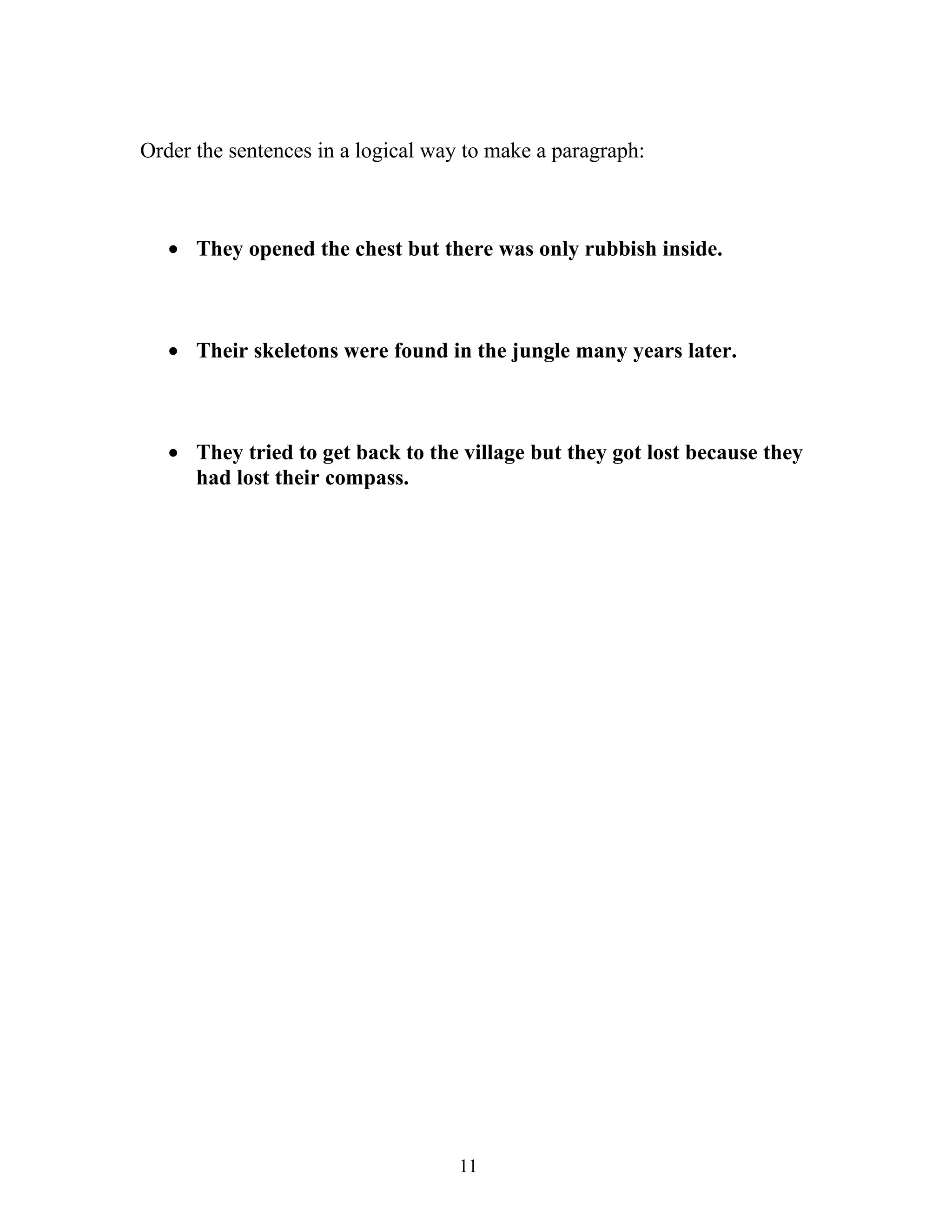
Order the sentences in a logical way to make a paragraph:


   • They opened the chest but there was only rubbish inside.


   • Their skeletons were found in the jungle many years later.


   • They tried to get back to the village but they got lost because they
     had lost their compass.


                                    11
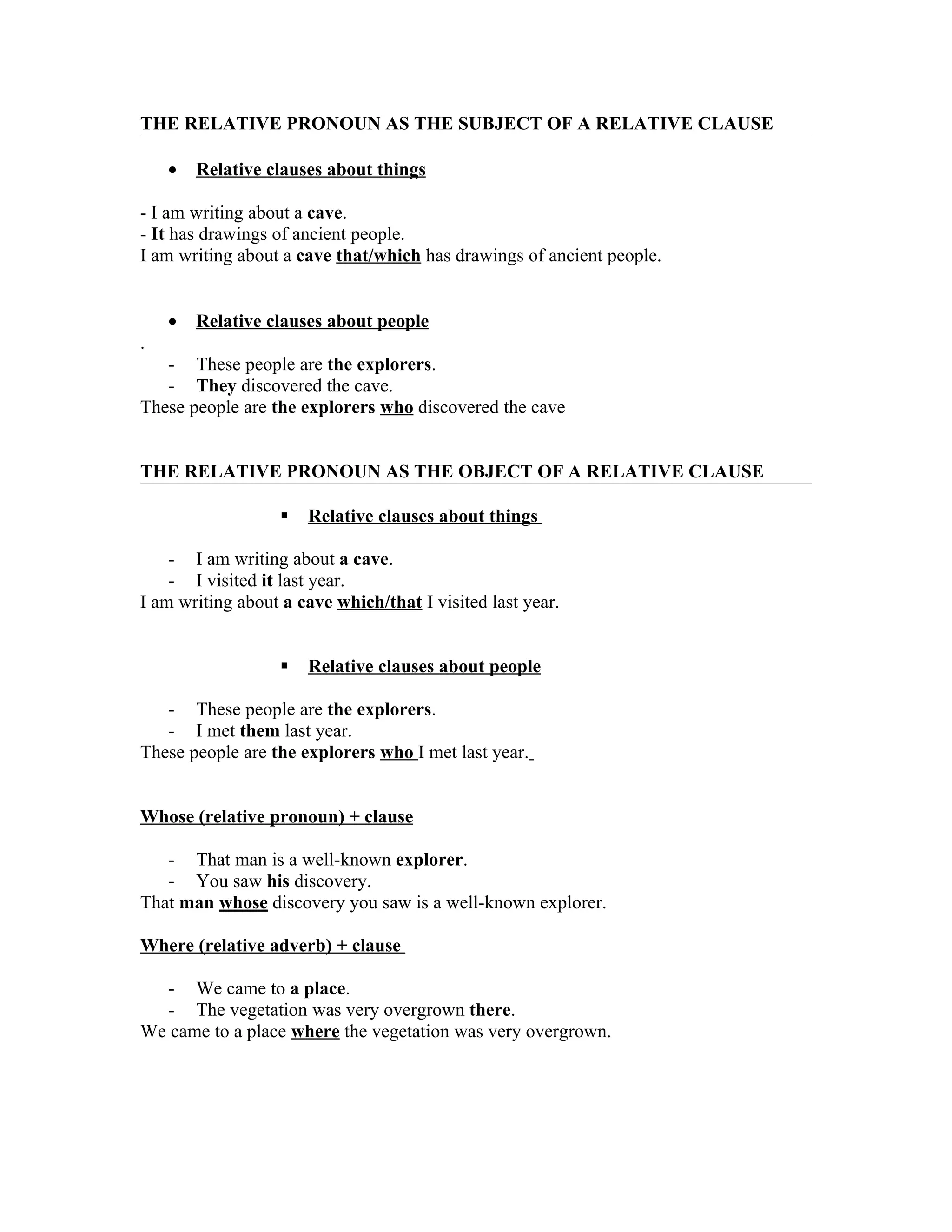
THE RELATIVE PRONOUN AS THE SUBJECT OF A RELATIVE CLAUSE

    •   Relative clauses about things

- I am writing about a cave.
- It has drawings of ancient people.
I am writing about a cave that/which has drawings of ancient people.


    •   Relative clauses about people
.
   - These people are the explorers.
   - They discovered the cave.
These people are the explorers who discovered the cave


THE RELATIVE PRONOUN AS THE OBJECT OF A RELATIVE CLAUSE

                      Relative clauses about things

    - I am writing about a cave.
    - I visited it last year.
I am writing about a cave which/that I visited last year.


                      Relative clauses about people

   - These people are the explorers.
   - I met them last year.
These people are the explorers who I met last year.


Whose (relative pronoun) + clause

   - That man is a well-known explorer.
   - You saw his discovery.
That man whose discovery you saw is a well-known explorer.

Where (relative adverb) + clause

  - We came to a place.
  - The vegetation was very overgrown there.
We came to a place where the vegetation was very overgrown.
13

Lesson Plan

  • 1.
    LESSON PLAN Name: MonicaColţ Date: January, 20th, 2011 School: School No.150 “St.Elefterie” Grade: 7 (L1) Level: intermediate No. of students: 29 Textbook: High Flyer Intermediate, Longman Topic: Unit 11 – Great Adventures: An Adventure Story Relative clauses (who, that, whose, which, where) Time: 50 min Location: the classroom Type of lesson: developing skills Functions: - to narrate according to the events in the text - to initiate discussion - to predict content Skills: reading, writing, listening, speaking (integrated receptive and productive skills) Lesson aims: - to develop students’ reading-comprehension skills - to develop students’ speaking skills (talking about adventure trips) - to make students aware of the use of relative pronouns (who, whose, that, which) and adverbs (where) in relative clauses Aids: whiteboard, textbook, work-sheets, flashcards, power-point presentation, tape Specific competences: 1. to use properly, in various contexts, words and phrases related to the main concept of the lesson - “adventure”(based on the mind map) 2. to express points of view based on personal experience on the topic of the lesson, “adventure story” to skim the narrative text for the general idea; to scan the text for detailed information (based on the idea that stories are an important aspect of culture) 3. to identify the main stress in the compound words (based on the listening activity) 4. to use relative pronouns (who, whose, that, which) and adverbs (where) in relative clauses to emphasize the stylistic dimension of the adventure story 5. to order the events in a narrative text as they appear in the text (based on the logical sequence of the events) 6. to write a possible (either optimistic or pessimistic) ending for the adventure story 7. to expand the story according to the experiences of the character and the student’s personal experience Teaching methods: brainstorming, conversation, dialogue, exercise, explanation, role play Evaluation: - initial: homework check-up - continue: through activities, error correction - final: through oral and written feed-back and homework 1
  • 2.
    Stages of lesson: Warm-up Activity1 General Competence: to develop positive attitude towards learning English Specific competence: to correct mistakes Method: dialogue Procedure: Teacher (T) checks the homework first. Ss read their homework and correct it if necessary. Interaction: T-S; S-T Class management: whole class activity Timing: 5 min Lead-in Activity 2 General Competence: to express curiosity about the lives of children from other cultural spaces Specific competence: to use properly, in various contexts, words and phrases related to the main concept of the lesson - “adventure” (based on the mind map) Method: conversation Aids: flash-cards Procedure: Each group of Ss receives flash-cards on the topic “adventure.” Ss work in groups of 6 or 8 to discover the word related to the flash-cards: Group 1 – adventure (lama, jaguar, risky trip, torchlight, compass, steep mountain) Group 2 – Inca (Inca leader and his family, Sun God, Machu Picchu, temple, Inca map) Group 3 – Treasure (coins, jewellery, gold, statues) Group 4 – Exploration (magnifying-glass, binoculars to look high and low, children on a trip, map) Whole-class activity: power-point presentation to check and expand orally the meaning of each concept. Ss write a sentence which bridges these words, relevant to the topic of the lesson. Interaction: Ss-Ss; Ss-T Class management: group work and then whole class activity Timing: 5 min Pre-Reading Activity 3 General Competence: to express flexibility in exchanging ideas while working in a group (values and attitudes) Specific competence: to express points of view based on personal experience on the topic of the lesson, “adventure story.” Method: conversation Aids: work-sheets (a table with 2 columns / 2 lists: things you know for sure/ things you don’t know – not sure of) Procedure: T challenges Ss introducing a strong motivational task related to Ss’ previous experience on the topic “adventure:” “An adventure trip means things that happen according to the plan and expectations, but especially surprises or situations in which you have to find a solution. Have you ever been on an adventure trip?” Ss work in groups to write a list of things they are sure about (3) and things they are not sure about, or they don’t know (3). They discuss the possibilities and one S from the group (a task at any S’s choice) writes the lists. The points of view are shared with the class. Such task can also be solved individually or as pair work. Interaction: Ss-Ss; Ss-Ss-T
  • 3.
    Class management: groupwork activity Timing: 5 min Activity 4 General Competence: to raise awareness concerning the knowledge about different geographical areas Specific competence: to skim the narrative text for the general idea; to scan the text for detailed information (based on the idea that stories are an important aspect of culture) Method: dialogue Aids: the text in the textbook Procedure: T announces the purpose of the lesson: “Today we are going to be reading and talking about the adventure story of a child and his friends who travel to a place in the Andes, where the Incas lived about 6oo years ago. We will find out together what the children are looking for in this far away land. Can you make a guess before reading the adventure story?” T tells Ss that the text is quite long and they need to skim and scan it (T accompanies the sentence with a drawing: a magnifying glass, which indicates that they will discover the text together.) Skimming for the general/ main idea of the adventure story: Ss answer the questions addressed by T to the whole class. Scanning the text: Speed game: “Facts only!” Students find the name of a mountain/river/city/a year/an American archeologist (ex. 8/48) Interaction: S-S; S-T Class management: whole class activity, followed by pair work activity Timing: 5 min While-Reading Activity 5 General Competence: to receive and produce an oral message Specific competence: to identify the main stress in the compound words (based on the listening activity) Method: dialogue Aids: tape, a sheet of paper Procedure: Ss work in pairs. T asks Ss to identify three or more compound words in the adventure story (for example: water bottles), then to talk to the partner to explain them orally. Ss listen to the compound words on the tape and identify the main stress in these words. Ss repeat the words and draw a simple graph to represent the music of the word. Then they listen to the words again and check the stress. Interaction: S-S; S-T Class management: pair work activity Timing: 5 min Activity 6 General Competence: to understand and interpret a written message in English Specific competence: to use relative pronouns (who, whose, that, which) and adverbs (where) in relative clauses to emphasize the stylistic dimension of the adventure story Method: conversation Aids: work-sheets; handouts Procedure: T asks Ss to look at an image on the screen, representing a cave and two explorers. T tells the Ss that they can make sentences about the image with the help of words like: who, which, that, whose, where. They are asked to use the right word to join the sentences written on the work- sheets and to make them easy to read. Ss work in pairs, and then T checks the answers as a whole class activity (power point presentation and also handouts which help emphasize the main points 3
  • 4.
    concerning relative clauses).After the first example T elicits what is a relative clause, its position and the introductory word (the relative clause is the sentence which adds more information about one of the nouns in the main clause and begins with who, whose, which, that and where. The relative clause goes immediately after the noun. The relative pronouns are: who, whose, that, which; where is a relative adverb). Ss notice that these sentences make the text more fluent and easy to read, as they connect ideas expressed by the narrator. Interaction: S – S; Ss-T Class management: pair work; whole class activity Timing: 5 min Activity 7 General Competence: to express curiosity about the lives of the people from other cultural spaces Specific competence: to order the events in a narrative text as they appear in the text (based on the logical sequence of the events) Method: conversation Aids: work-sheets; textbook Procedure: Ss read the text silently. Then they order the events written on the work-sheet (main ideas written as titles) as they appear in the story. T asks Ss to discuss and predict the end of the story, then to write a short idea. T discusses the results as a whole class activity. Then T asks students to tell briefly the content of the 1st (or 2nd /3rd /4th ) paragraph. T can overcome Ss’ difficulties in identifying the paragraphs by asking Ss to read aloud the first sentence of each paragraph (usually the topic sentence). Interaction: Ss-Ss; Ss-T Class management: group work Timing: 5 min Activity 8 General Competence: to develop interest in the discovery of socio-cultural specific expressed in texts in English Specific competence: to write a possible (optimistic or pessimistic) ending for the adventure story Method: conversation Aids: textbook Procedure: T discusses with Ss the ending of the story (exercise 14 page 49), either positive or negative. They give reasons for their choice (e.g. Does the optimistic ending match the story?) Interaction: Ss-Ss; Ss-T Class management: group work Timing: 5 min Activity 9 General Competence: express curiosity about the lives of children from other cultural spaces Specific competence: to expand the story according to the character’s adventures in the adventure story and S’s personal experience Method: role-play Aids: textbook Procedure:
  • 5.
    T asks Ssfrom each group to pick out any card from the “Fishbowl:” one of them is for the role of the narrator. S – “narrator” answers three questions asked by his classmates. Then a different narrator is chosen. Interaction: S-Ss Class management: whole class activity Timing: 5min Activity 10 Feed-back - giving assignment; evaluation of the lesson General Competence: to develop interest in the discovery of socio-cultural specific expressed in texts in English Specific competence: to write a different ending for the adventure story based on the evolution of the events and characters Method: conversation Aids: textbook Procedure: T assigns the homework. Ss ask questions in case there are aspects that need to be clarified Interaction: S-T Class management: individual work Timing: 5 min (20 min homework at home) Bibliography: Primary sources :  Acevedo, Ana, and Gower, Marisol. High Flyer Intermediate. Harlow, Essex: Longman, 2004. 48-49 Secondary sources:  Harmer, Jeremy. The Practice of English Language Teaching (3d ed.). Harlow, Essex: Longman, 2001.  McCallum, George. 101 Games for Students of English as a Second or Foreign Language. Oxford: Oxford University Press, 1980.  Sesnan, Barry. How to Teach English. Oxford: Oxford University Press, 2004. Electronic sources: http://articles.famouswhy.com/category/lesson_plans/archive.html http://jobs.languagelink.ru/tefl_clinic/practical_teaching/reading_skills/exploiting_readers/i deas2.php http://iteslj.org/Techniques/Mehta-Vocabulary.html http://www.englishcompanion.com/assignments/reading/103readingactivities.htm http://curriculum2009.edu.ro/Ciclul_gimnazial/ 5
  • 6.
    Work-sheet 1 Can youmake these sentences easier to read by putting in: who – that – which – where – or whose ? who Example: Manco Capac is the king V founded the Inca Empire. 1. I am writing about a cave has drawings of ancient people. 2. These people are the explorers discovered the cave 3. I am writing about a cave I visited last year. 4. These people are the explorers I met last year. 5. That man discovery you saw is a well-known explorer. 6. We came to a place the vegetation was very overgrown.
  • 7.
    Work-Sheet 2 A. Order(write a number) the events as they appear in the adventure story: No. Events The discovery of the cave. A stop at the bottom of Mount Huayna Picchu. The voyage along the Urubamba River. ………………………………………………. B. Develop the main idea of one paragraph: 7
  • 8.
    Work-Sheet 3 Apossible ending to the story: pessimistic, realistic or optimistic. Order the sentences in a logical way: A. They tried to get back to the village but they got lost because they had lost their compass. They opened the chest but there was only rubbish inside. Their skeletons were found in the jungle many years later. B. In the end they were a little richer but they were no longer friends. They opened the chest and found some treasure but then they fought over it. They lost some of it in the river on their way back. C. It was also easier to get back because it was downhill. They found a lot of wonderful treasure. They were very happy and found their way back easily because they found the compass in Roberto’s pocket! They became famous in the world of archeology and they lived happily ever after. …………………………………………………………………………………………..
  • 9.
    Work-Sheet 4 Order thesentences in a logical way to make a paragraph: • They opened the chest and found some treasure but then they fought over it. • In the end they were a little richer but they were no longer friends. • They lost some of it in the river on their way back. Work-sheet 5 9
  • 10.
    Order the sentencesin a logical way, to make a paragraph:  It was also easier to get back because it was downhill. They became famous in the world of archeology and they lived happily ever after.  They found a lot of wonderful treasure.  They were very happy and found their way back easily because they found the compass in Roberto’s pocket! Work-sheet 6
  • 11.
    Order the sentencesin a logical way to make a paragraph: • They opened the chest but there was only rubbish inside. • Their skeletons were found in the jungle many years later. • They tried to get back to the village but they got lost because they had lost their compass. 11
  • 12.
    THE RELATIVE PRONOUNAS THE SUBJECT OF A RELATIVE CLAUSE • Relative clauses about things - I am writing about a cave. - It has drawings of ancient people. I am writing about a cave that/which has drawings of ancient people. • Relative clauses about people . - These people are the explorers. - They discovered the cave. These people are the explorers who discovered the cave THE RELATIVE PRONOUN AS THE OBJECT OF A RELATIVE CLAUSE  Relative clauses about things - I am writing about a cave. - I visited it last year. I am writing about a cave which/that I visited last year.  Relative clauses about people - These people are the explorers. - I met them last year. These people are the explorers who I met last year. Whose (relative pronoun) + clause - That man is a well-known explorer. - You saw his discovery. That man whose discovery you saw is a well-known explorer. Where (relative adverb) + clause - We came to a place. - The vegetation was very overgrown there. We came to a place where the vegetation was very overgrown.
  • 13.