Project Seminar 
On 
“Performance Analysis of 
Epidemic Routing Protocol in DTN” 
Presented by: 
Jashanpreet pal Kaur 
M.Tech- CE
Why DTN?????? 
Adhoc networks 
1)The protocols first establish 
a end to end path between 
source and destination to 
communicate. 
2)Delays are more 
DTN 
1)Follow Store & Forward 
approach 
• Intermittent connectivity 
• Opportunistic N/w’s 
2)Less delays (delay tolerate 
3)Consist of variousprotocols: 
Epidemic, PRoHET, Spray 
&wait, direct delivery, First 
contact
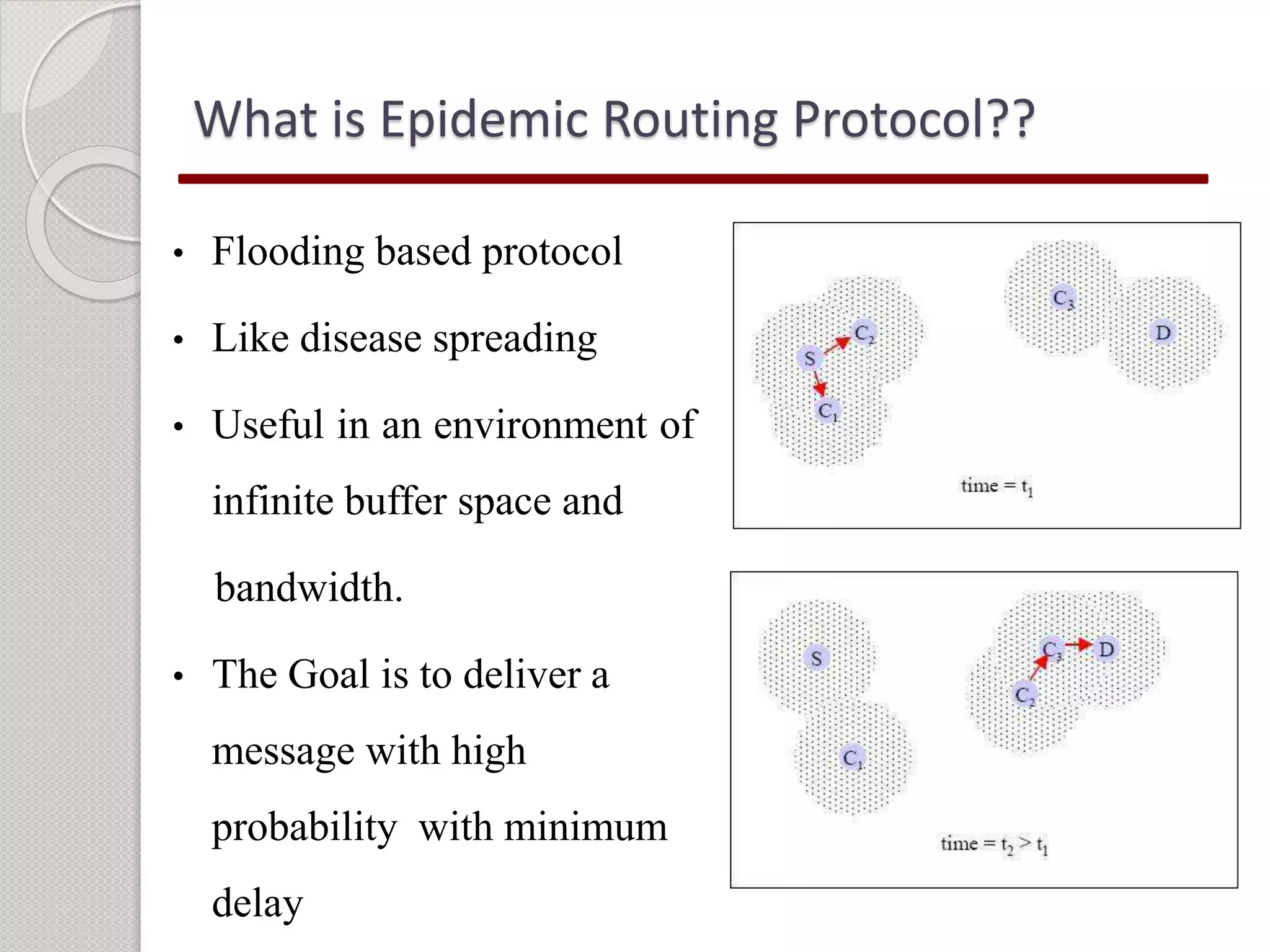
What is Epidemic Routing Protocol?? 
• Flooding based protocol 
• Like disease spreading 
• Useful in an environment of 
infinite buffer space and 
bandwidth. 
• The Goal is to deliver a 
message with high 
probability with minimum 
delay
PROJECT OBJECTIVE 
• The main objective is to check that for which mobility 
models among the Random waypoint, Map based 
mobility , Shortest Path Movement, and Map Route 
based movement the Epidemic protocol performs best 
when buffer size at each node is varied. 
• At what range of nodes its performance is best or static.
Methodology Used 
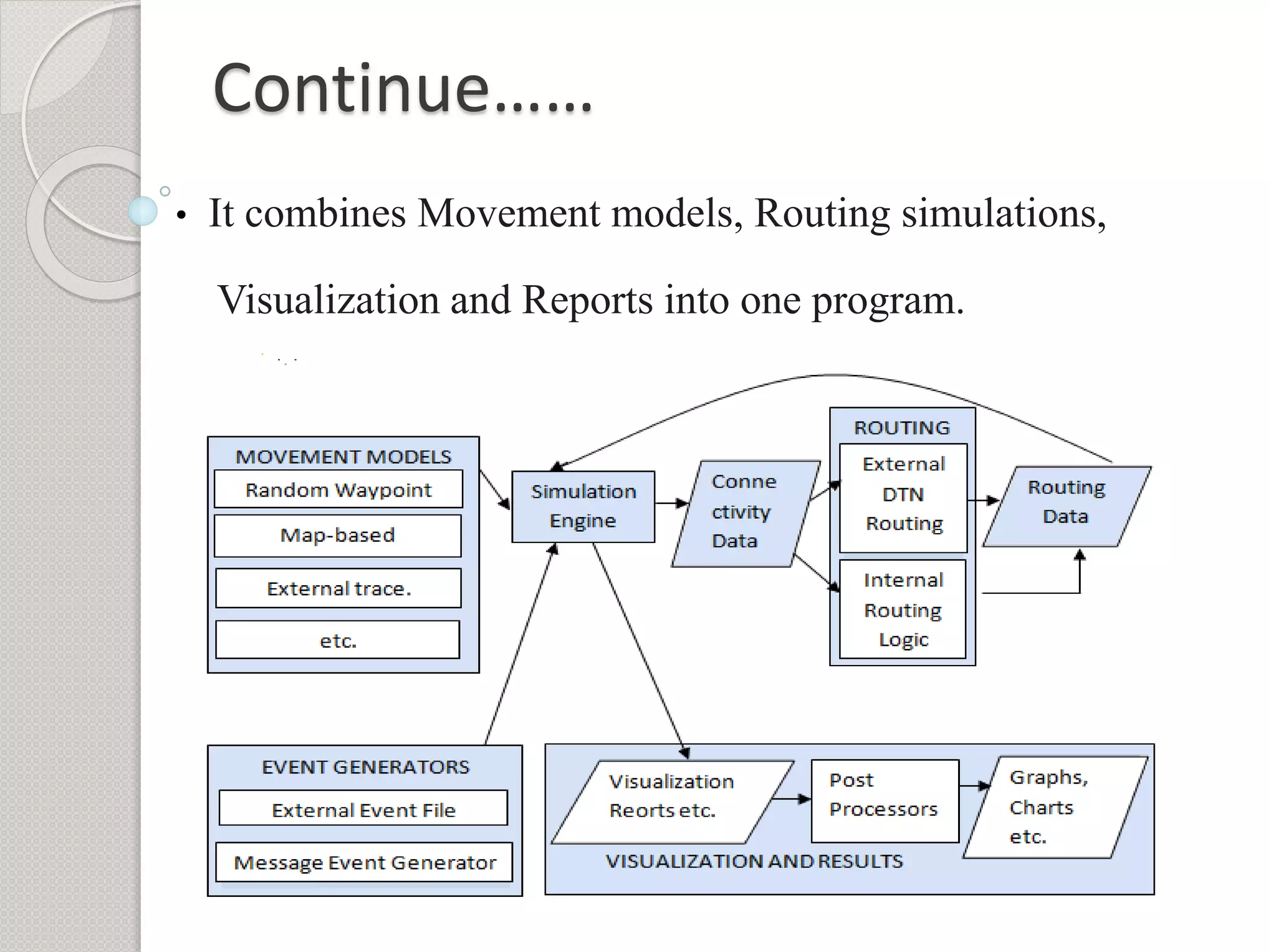
• ONE –Opportunistic Networking Environment Simulator 
( Latest version 1.4.1) 
• Java Based Simulator for research in DTN’s 
• Runs on Linux,Windows or any platform that supporting 
a Java 
• Users can simulate different scenarios in easily and flexible 
manner for routing protocols based on mobility models.
Continue…… 
• It combines Movement models, Routing simulations, 
Visualization and Reports into one program.
Project Work: 
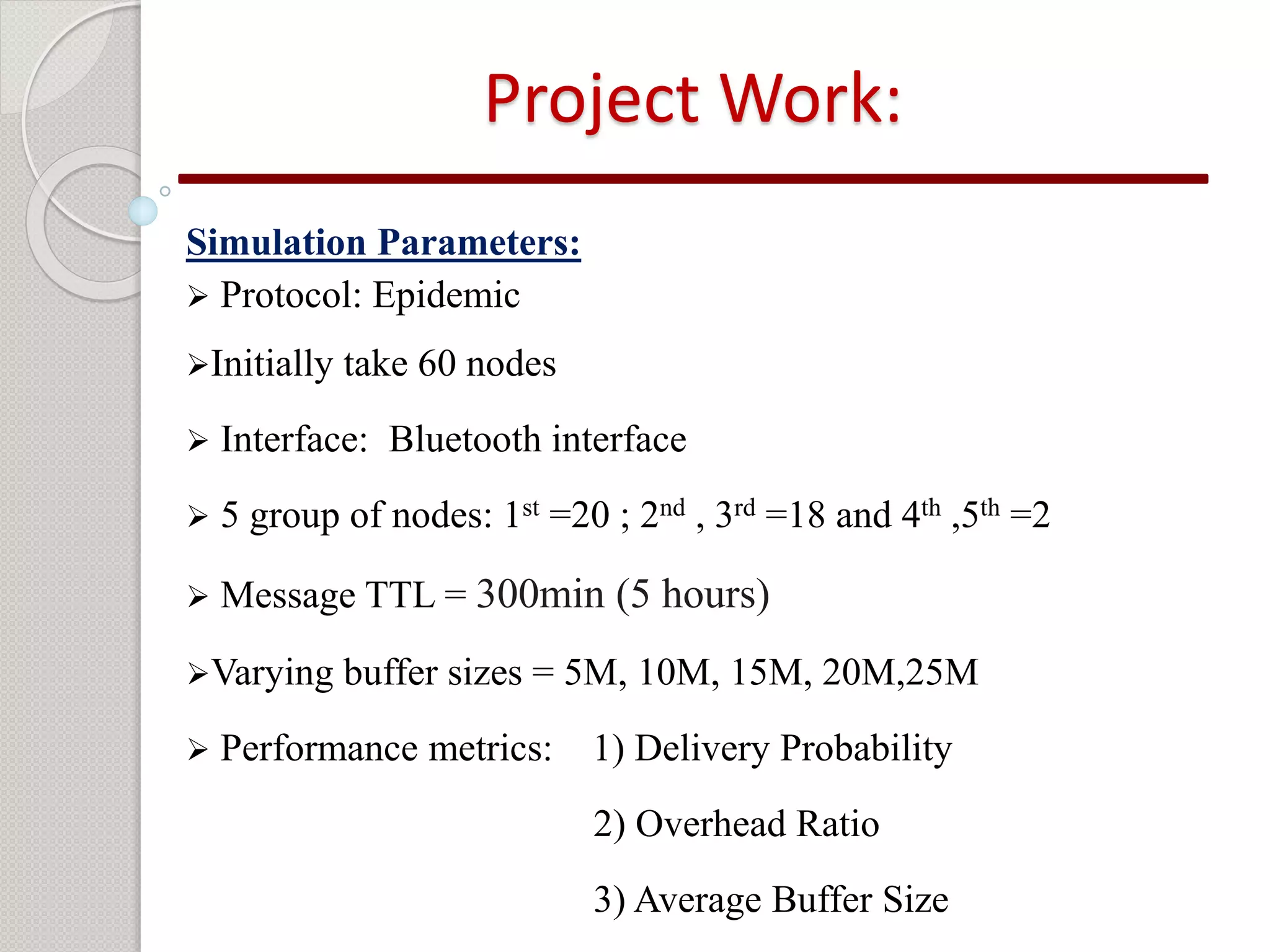
Simulation Parameters: 
 Protocol: Epidemic 
Initially take 60 nodes 
 Interface: Bluetooth interface 
 5 group of nodes: 1st =20 ; 2nd , 3rd =18 and 4th ,5th =2 
 Message TTL = 300min (5 hours) 
Varying buffer sizes = 5M, 10M, 15M, 20M,25M 
 Performance metrics: 1) Delivery Probability 
2) Overhead Ratio 
3) Average Buffer Size
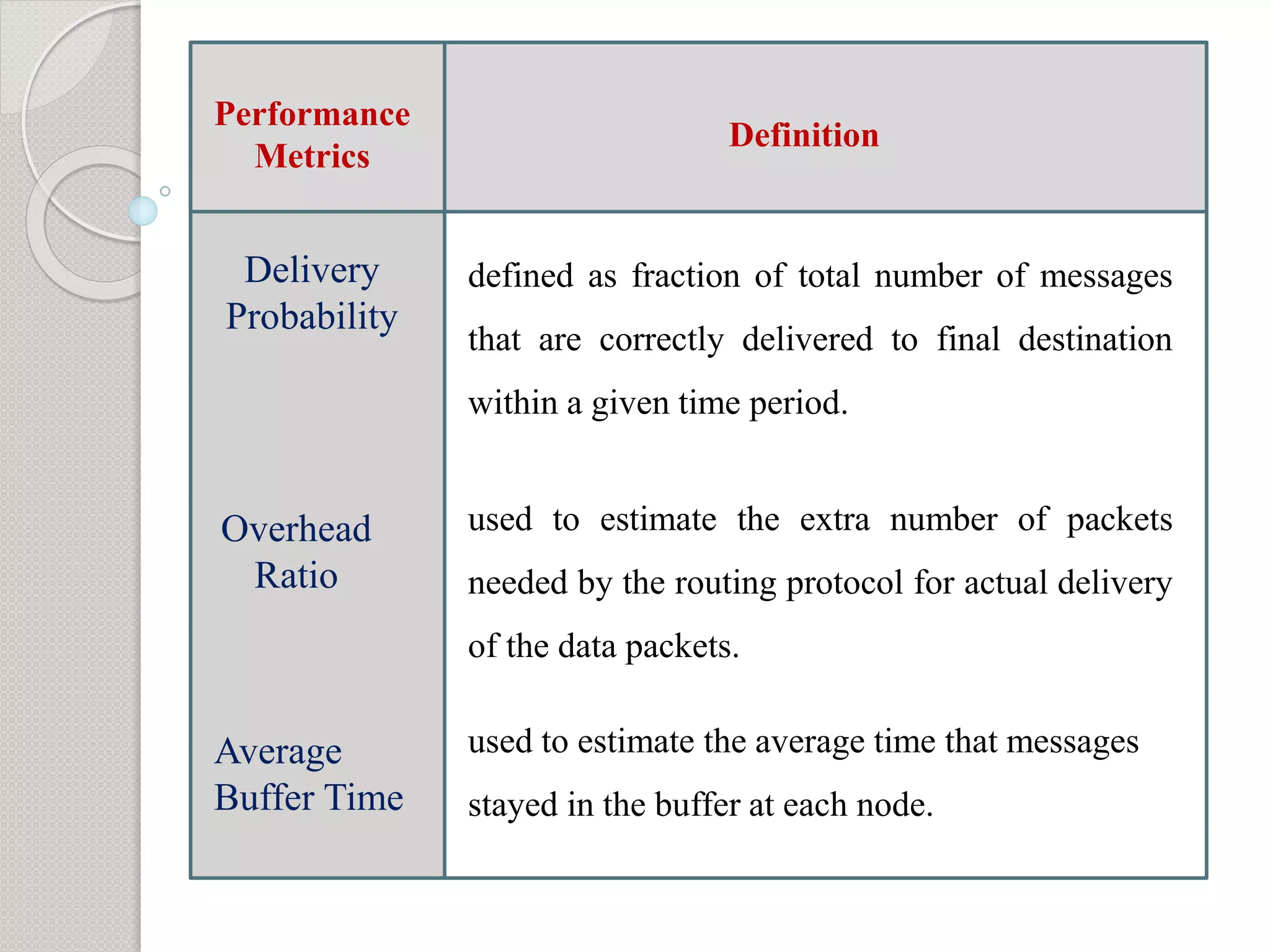
Performance 
Metrics 
Definition 
Delivery 
Probability 
Overhead 
Ratio 
Average 
Buffer Time 
defined as fraction of total number of messages 
that are correctly delivered to final destination 
within a given time period. 
used to estimate the extra number of packets 
needed by the routing protocol for actual delivery 
of the data packets. 
used to estimate the average time that messages 
stayed in the buffer at each node.
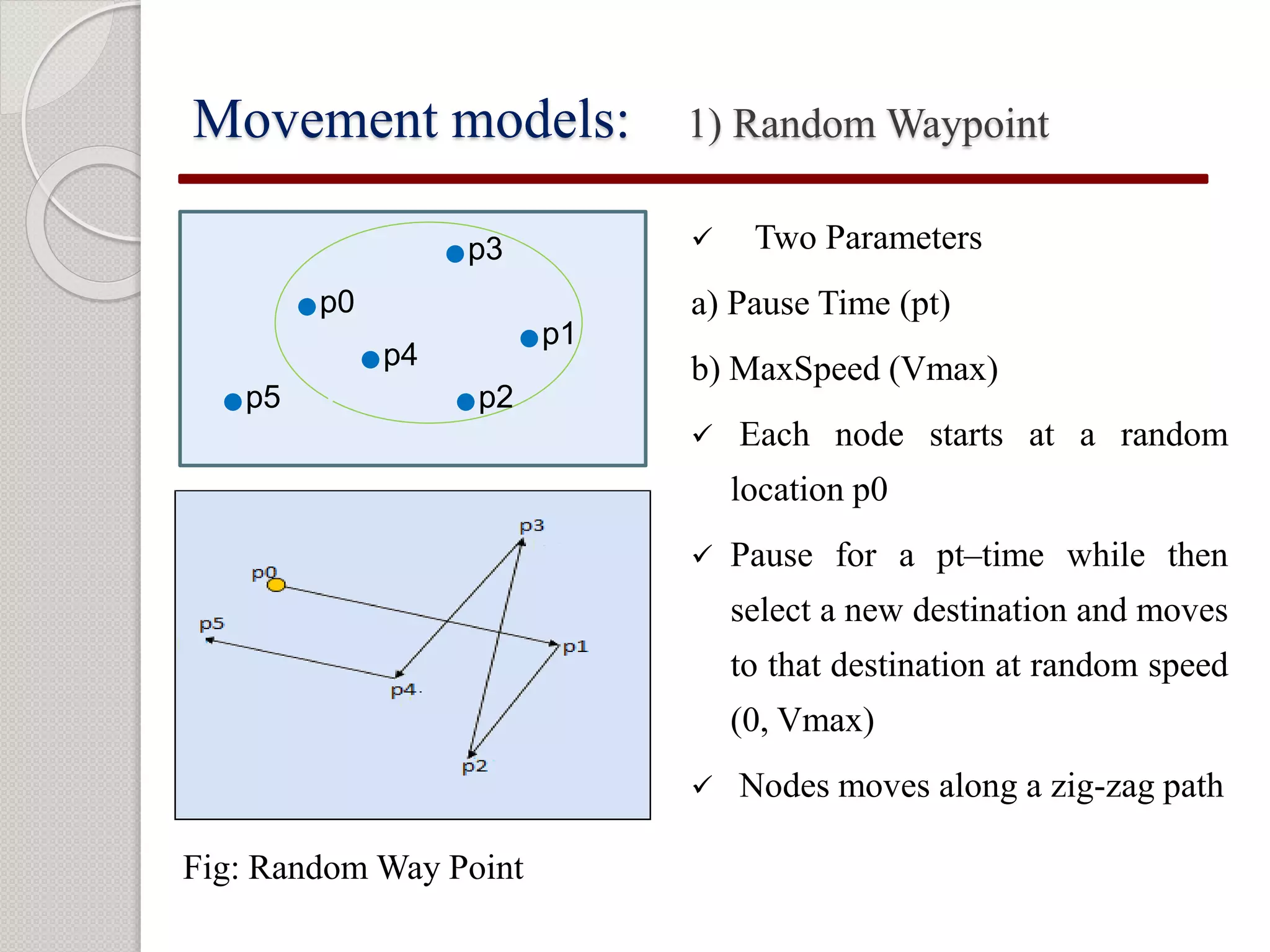
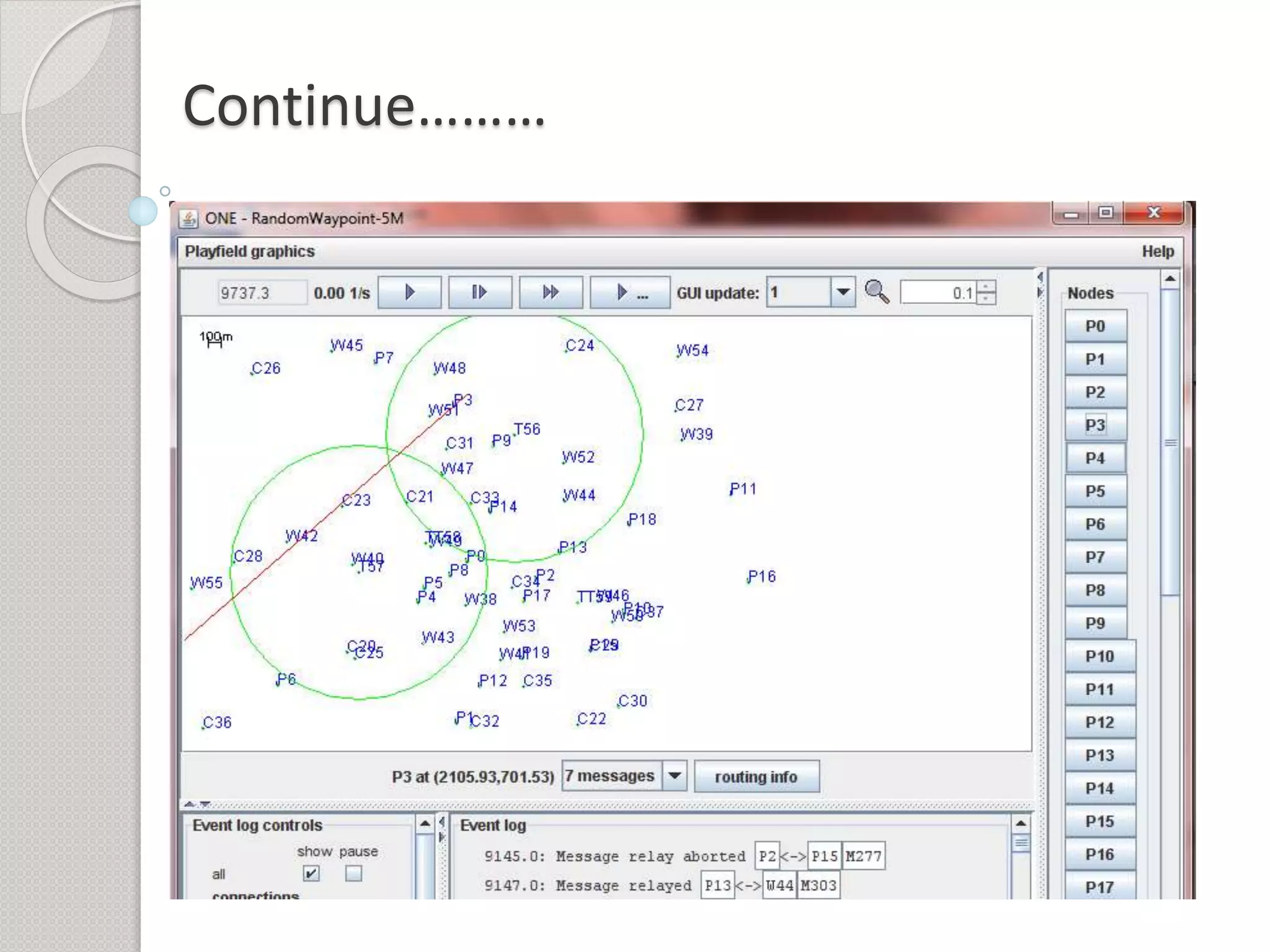
Movement models: 1) Random Waypoint 
Fig: RandomWay Point 
 Two Parameters 
a) Pause Time (pt) 
b) MaxSpeed (Vmax) 
 Each node starts at a random 
location p0 
 Pause for a pt–time while then 
select a new destination and moves 
to that destination at random speed 
(0, Vmax) 
 Nodes moves along a zig-zag path 
p0 
p3 
p1 
p2 
p4 
p5
Continue………
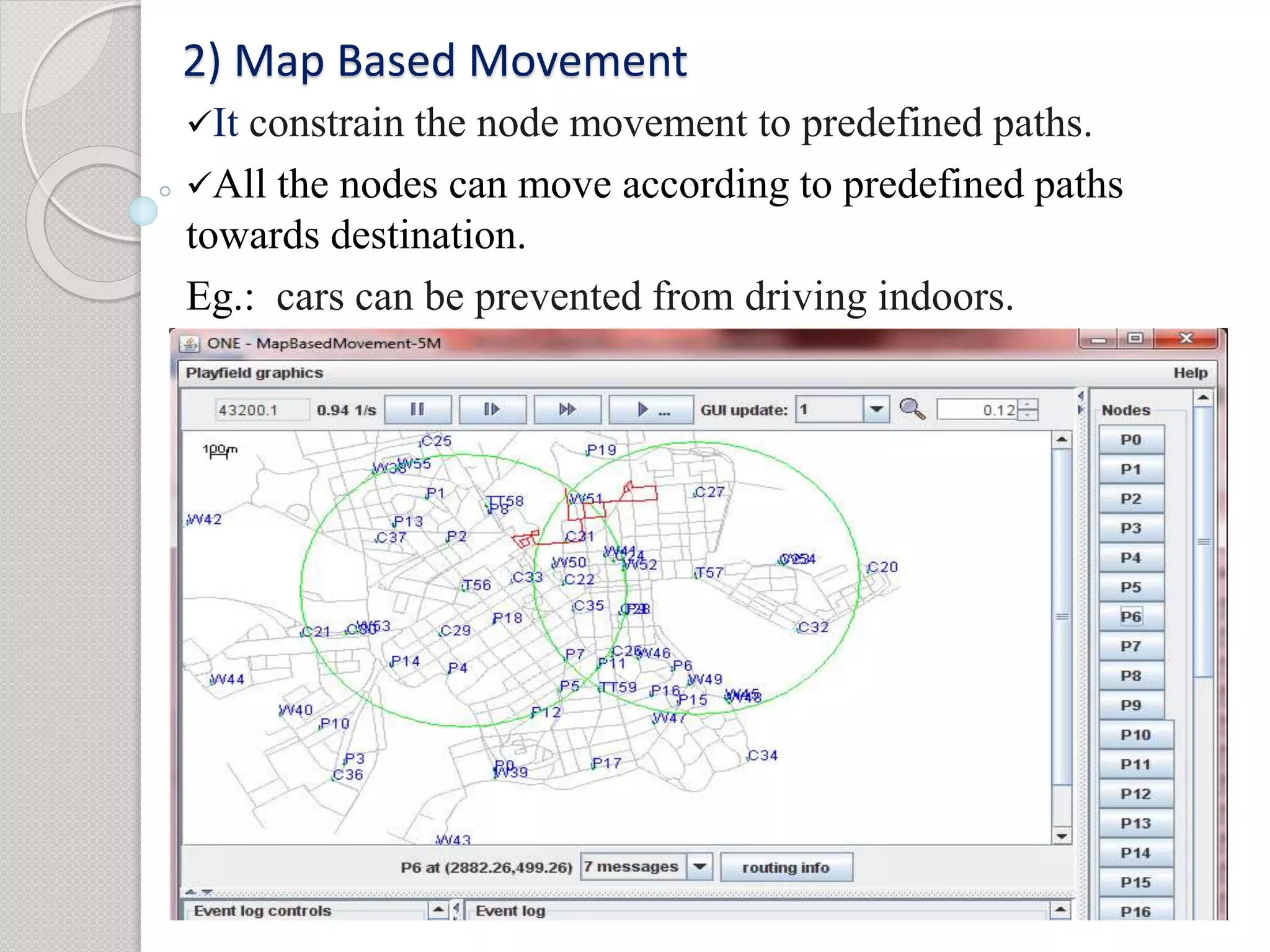
2) Map Based Movement 
It constrain the node movement to predefined paths. 
All the nodes can move according to predefined paths 
towards destination. 
Eg.: cars can be prevented from driving indoors.
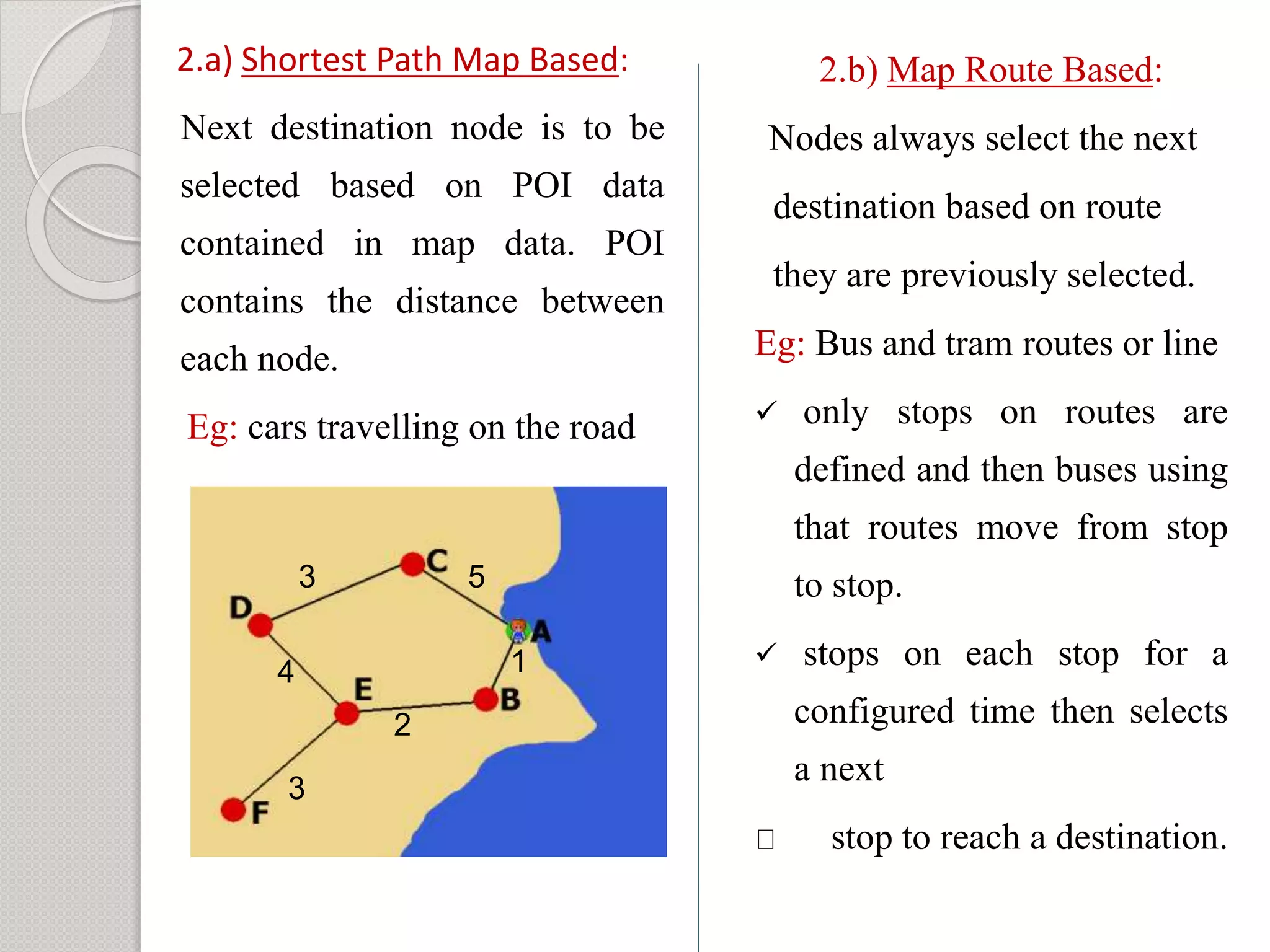
2.a) Shortest Path Map Based: 
Next destination node is to be 
selected based on POI data 
contained in map data. POI 
contains the distance between 
each node. 
Eg: cars travelling on the road 
2.b) Map Route Based: 
Nodes always select the next 
destination based on route 
they are previously selected. 
Eg: Bus and tram routes or line 
 only stops on routes are 
defined and then buses using 
that routes move from stop 
to stop. 
 stops on each stop for a 
configured time then selects 
a next 
stop to reach a destination. 
1 
5 
1 
3 
4 
2 
3
Simulation Setup 
Step 1: Setup a scenario for simulation 
(Name, Time and Nodes group) 
Step 2: Specify the Network Interface (Bluetooth Interface) 
Step 3: Specify group of nodes, TTL of message, Buffer size 
at each node 
Step 4: Mobility model setting 
Step 5: time for message creation 
Step 6: reports creation setting 
Step 7: GUI settings ( image is set where nodes move)
Running Simulation 
 At last run the simulation 5 time for each buffer 
size 
 we have 5 scenario for each movement model and total 
scenario are =20 
 Simulation is run in the command prompt 
 Their reports are generated in the reports folder 
 Now for the above three metrics we have to compared 
for all mobility models 
one –b5 
one
Simulation Results 
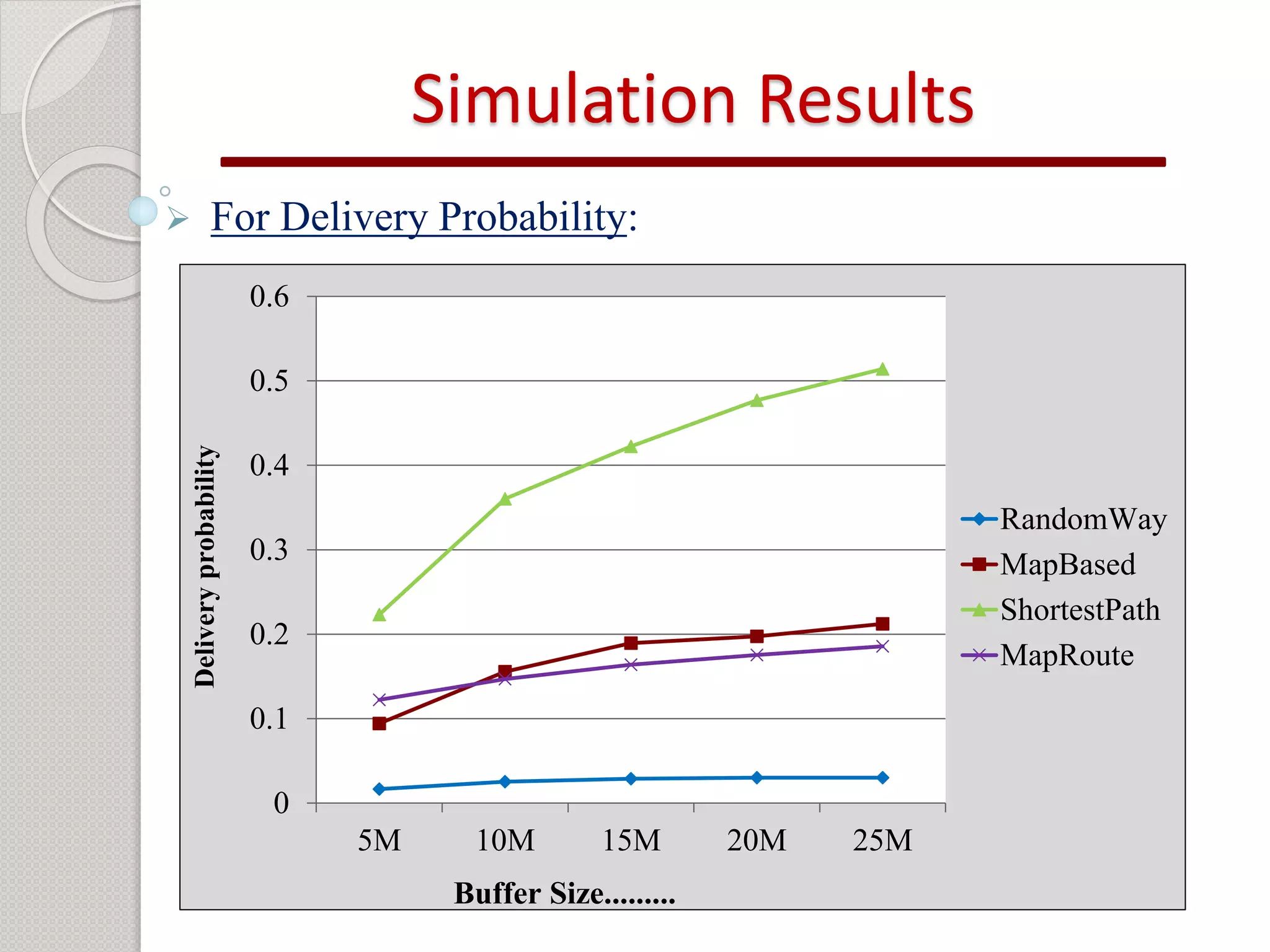
 For Delivery Probability: 
0.6 
0.5 
0.4 
0.3 
0.2 
0.1 
0 
5M 10M 15M 20M 25M 
RandomWay 
MapBased 
ShortestPath 
MapRoute 
Buffer Size......... 
Delivery probability
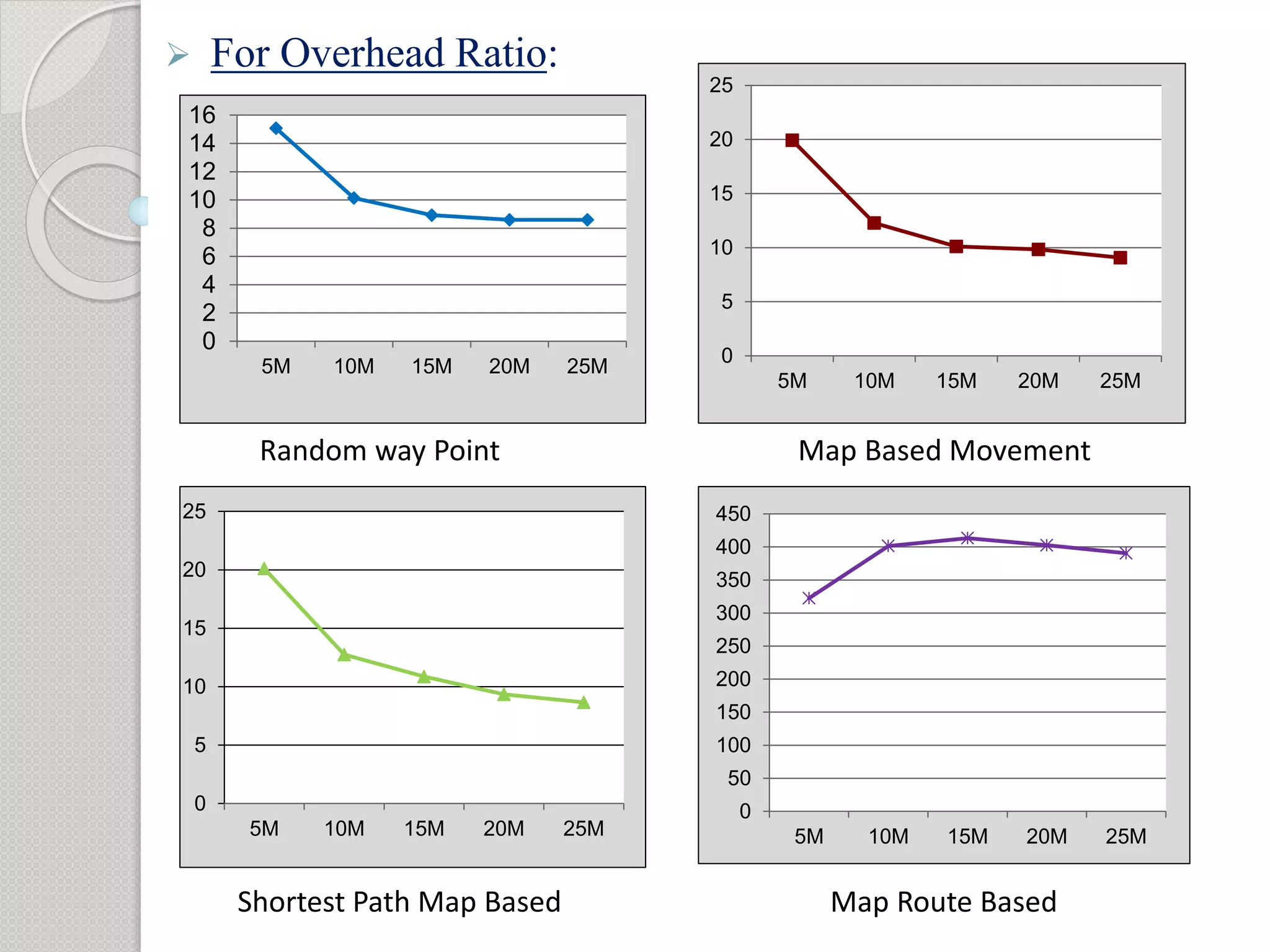
 For Overhead Ratio: 
25 
20 
15 
10 
5 
Random way Point Map Based Movement 
450 
400 
350 
300 
250 
200 
150 
100 
50 
Shortest Path Map Based Map Route Based 
16 
14 
12 
10 
8 
6 
4 
2 
0 
5M 10M 15M 20M 25M 
0 
5M 10M 15M 20M 25M 
25 
20 
15 
10 
5 
0 
5M 10M 15M 20M 25M 
0 
5M 10M 15M 20M 25M
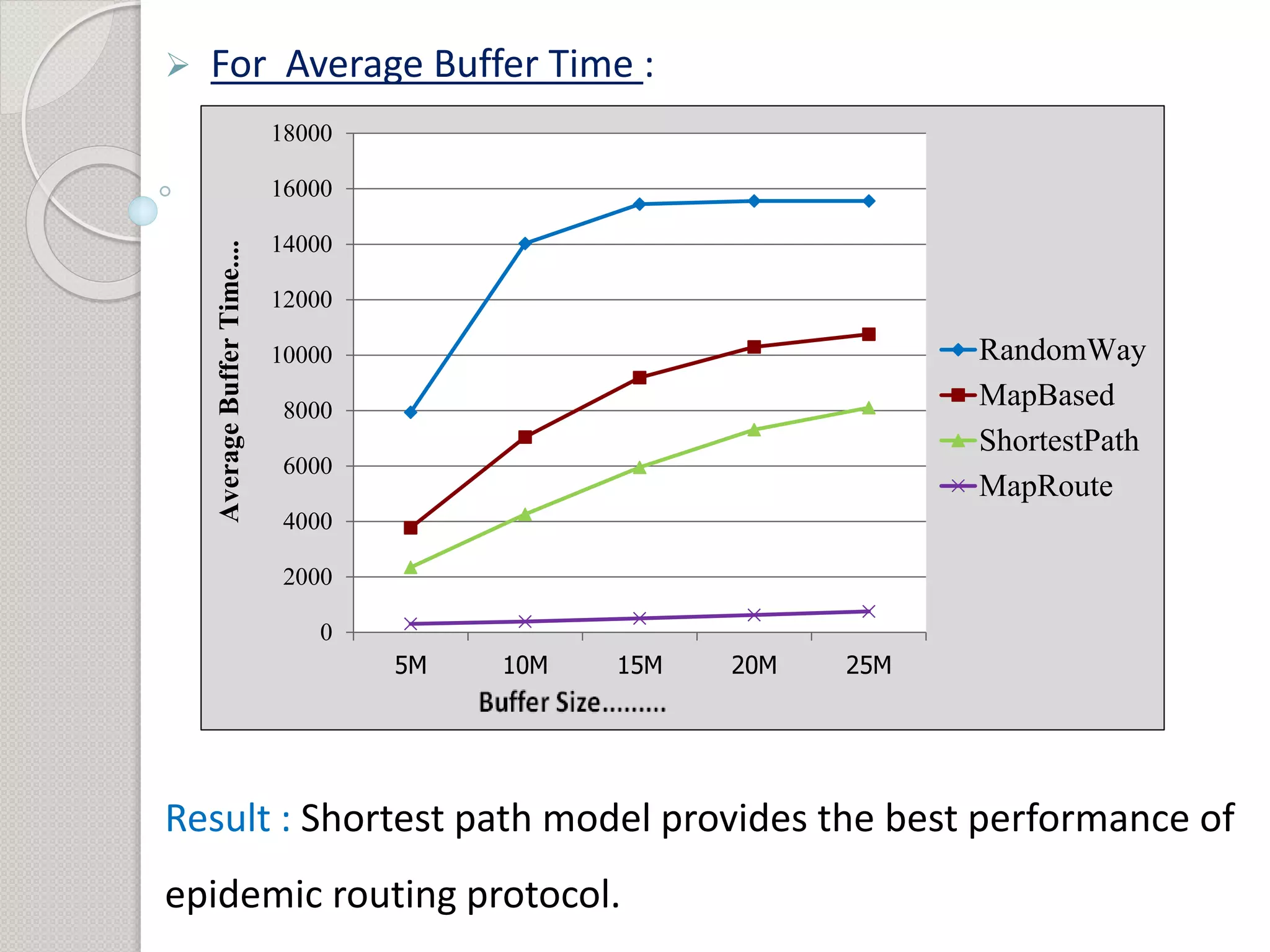
 For Average Buffer Time : 
18000 
16000 
14000 
12000 
10000 
8000 
6000 
4000 
2000 
0 
5M 10M 15M 20M 25M 
RandomWay 
MapBased 
ShortestPath 
MapRoute 
Average Buffer Time.... 
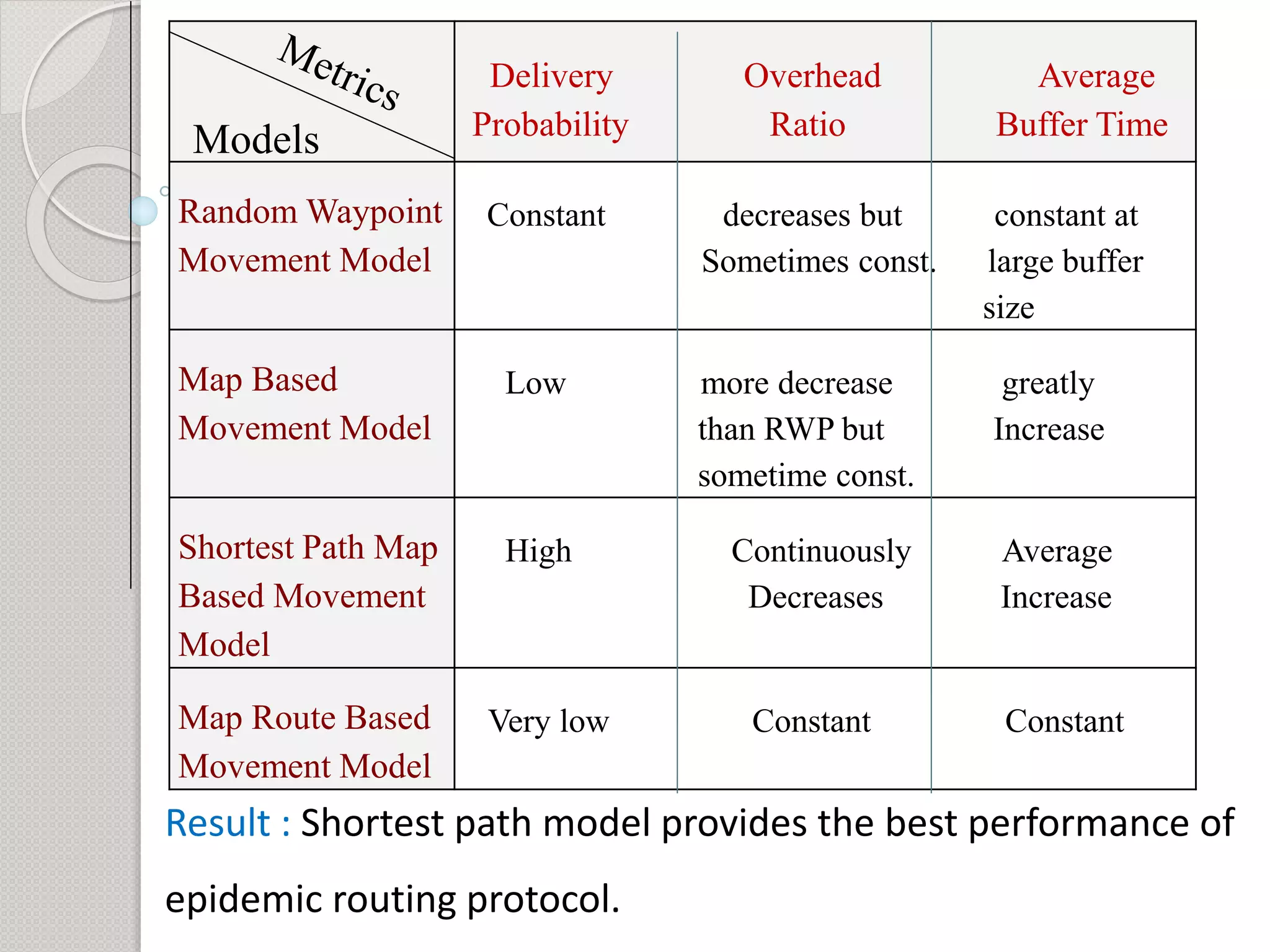
Result : Shortest path model provides the best performance of 
epidemic routing protocol.
Delivery Overhead Average 
Probability Ratio Buffer Time 
Models 
Random Waypoint 
Movement Model 
Constant decreases but constant at 
Sometimes const. large buffer 
size 
Map Based 
Movement Model 
Low more decrease greatly 
than RWP but Increase 
sometime const. 
Shortest Path Map 
Based Movement 
Model 
High Continuously Average 
Decreases Increase 
Map Route Based 
Movement Model 
Very low Constant Constant 
Result : Shortest path model provides the best performance of 
epidemic routing protocol.
Range of nodes for best performance: 
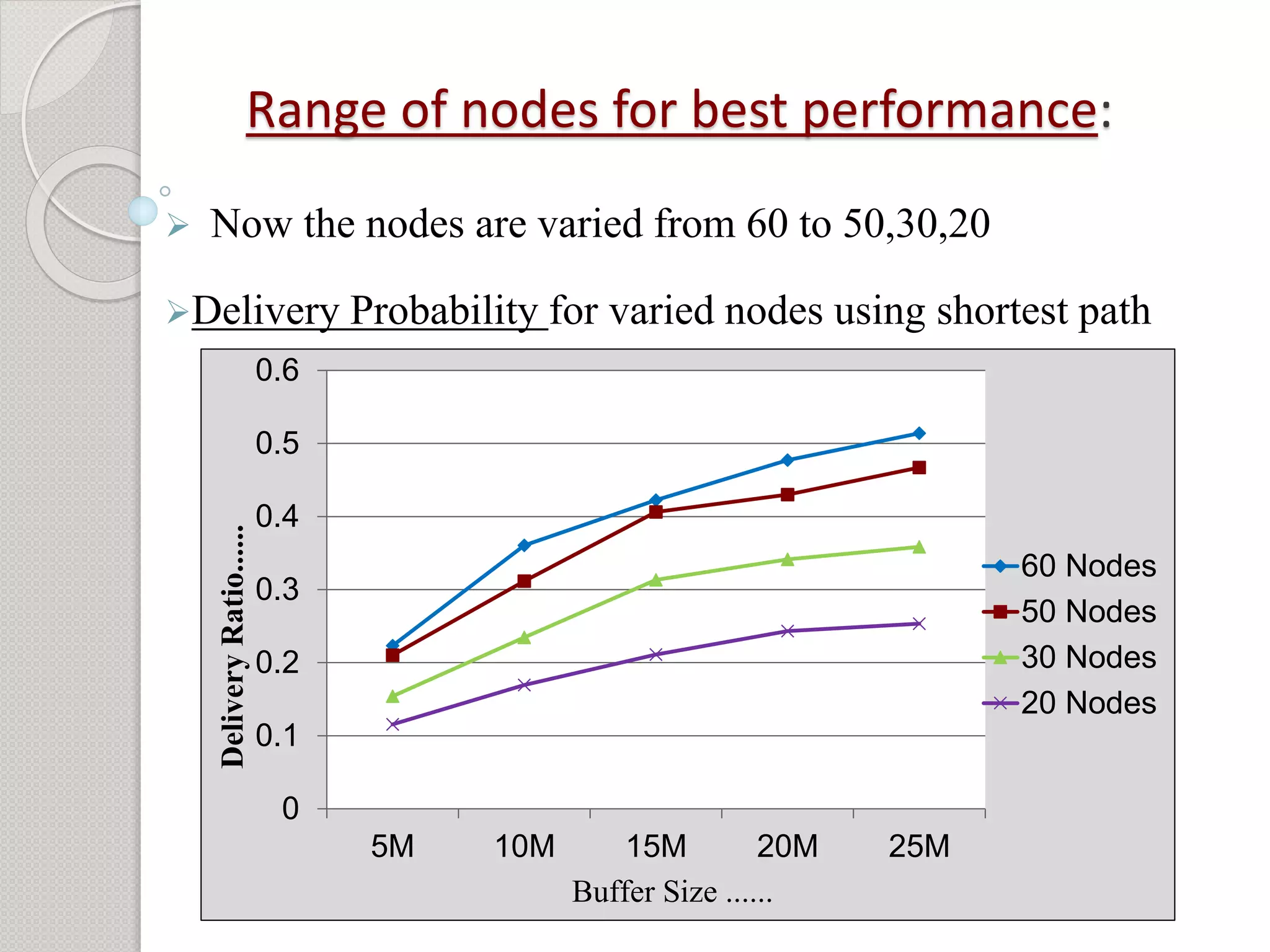
 Now the nodes are varied from 60 to 50,30,20 
Delivery Probability for varied nodes using shortest path 
0.6 
model: 
0.5 
0.4 
0.3 
0.2 
0.1 
0 
5M 10M 15M 20M 25M 
60 Nodes 
50 Nodes 
30 Nodes 
20 Nodes 
Delivery Ratio...... 
Buffer Size ......
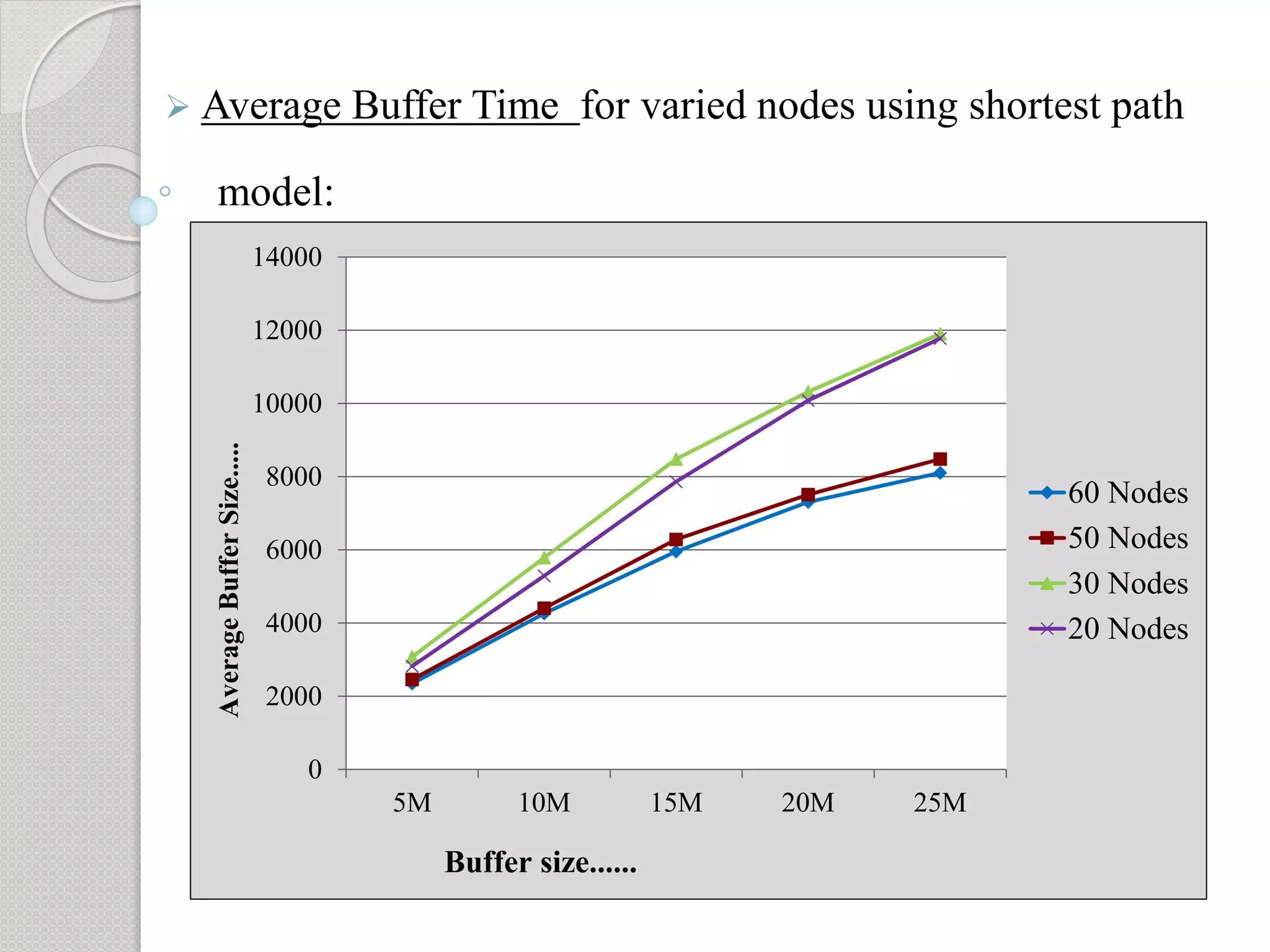
 Average Buffer Time for varied nodes using shortest path 
model: 
14000 
12000 
10000 
8000 
6000 
4000 
2000 
0 
5M 10M 15M 20M 25M 
60 Nodes 
50 Nodes 
30 Nodes 
20 Nodes 
Buffer size...... 
Average Buffer Size.....
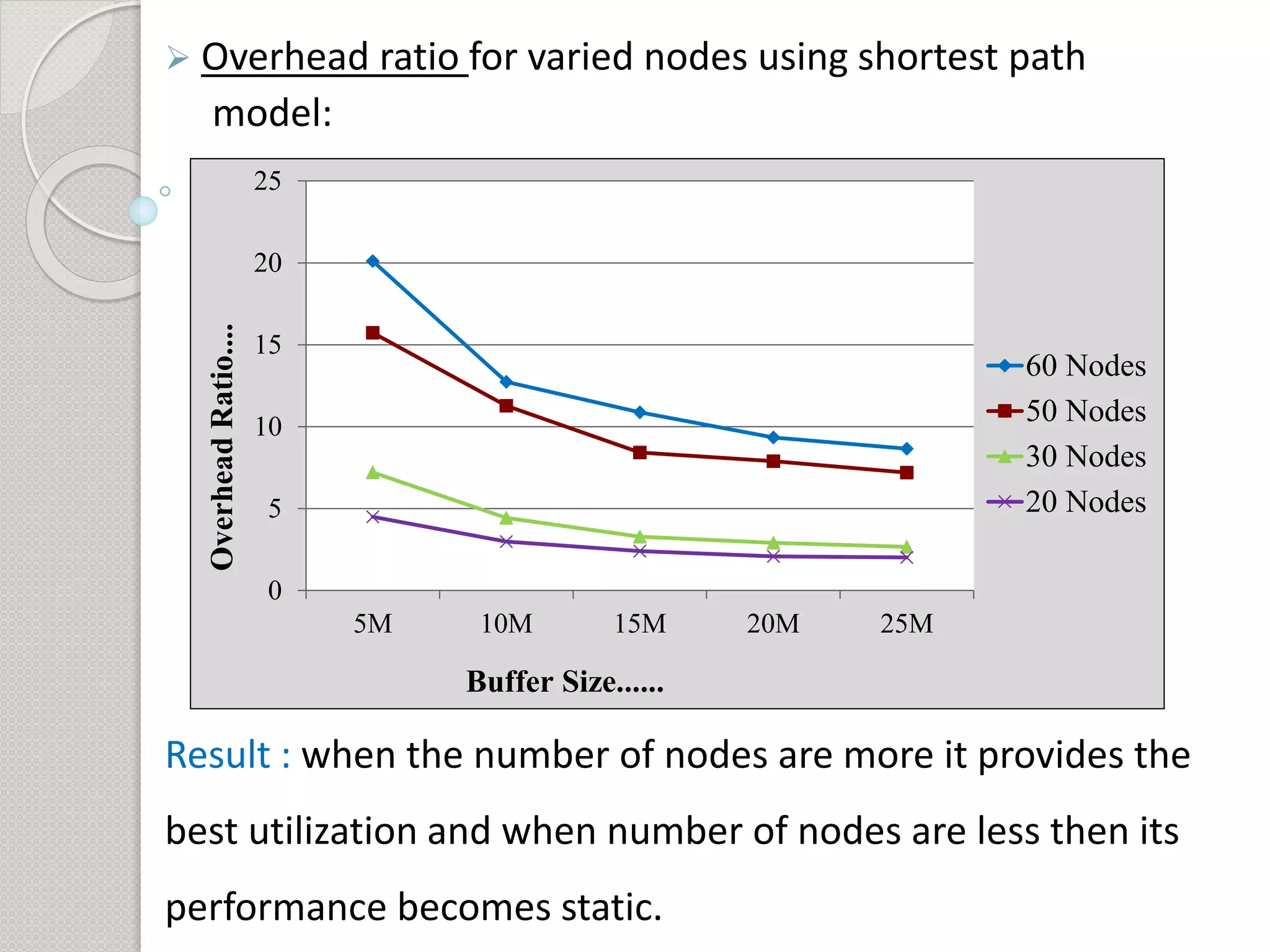
 Overhead ratio for varied nodes using shortest path 
model: 
25 
20 
15 
10 
5 
0 
5M 10M 15M 20M 25M 
60 Nodes 
50 Nodes 
30 Nodes 
20 Nodes 
Overhead Ratio.... 
Buffer Size...... 
Result : when the number of nodes are more it provides the 
best utilization and when number of nodes are less then its 
performance becomes static.
Conclusion 
The analysis of scenarios concludes that the shortest path 
map based mobility model is best among all for routing 
using epidemic routing protocol. Then after varying the 
number of nodes concludes that this model provides the 
best delivery ratio and less overheads when number of 
nodes is more and static performance when number of 
nodes are too less.
Future Scope 
There are two main problems in the epidemic routing 
protocol. It comsumes a lot of resources and unauthorized 
access to the messages. Then it is further interesting to see 
the malicious node effects to recover the messages from 
them and for decreasing the resource consumption instead 
of using FIFO strategy, we can any other strategy or 
removing the messages from the buffer that has already 
forwarded. The Quota sampling is used instead of using the 
flooding strategy.
References 
[1] Professor Jorg Ott of Helinski University of Technology: “A Tutorial paper on the 
Opportunistic Networking Environment Simulator” presented in May 29, 2008 
[2] Paritosh Puri, M.P Singh: “A Survey paper on Delay Tolerant Networking”presented in 
2013. 
[3] Harminder Singh Bindra and A. L. Sangal:“ The Performance comparison of the 
RAPID, 
Epidemic, PRoHET routing protocols in DTN ” presented in the April 2, 2012. 
[4] Anders Lindgreny, Avri Doria, Olov Schelen: “The Probabilistic Routing in case of DTN 
Intermittently Connected Networks” presented in December 2002. 
[5] Neena V V, V Mary Anita Rajam: “Performance Analysis of Epidemic Routing Protocol 
for 
Opportunistic Networks in Different Mobility Patterns ” presentesd in Jan. 09, 2013. 
[6] Forrest Warthman : “A Tutorial Delay tolerant networks” presented in May 3, 2003. 
[7] Sushant Jain, Kevin Fall, Rabin Patra: “Routing in DTN” presented in Aug 4, 2008.
Thank You

Project

  • 1.
    Project Seminar On “Performance Analysis of Epidemic Routing Protocol in DTN” Presented by: Jashanpreet pal Kaur M.Tech- CE
  • 2.
    Why DTN?????? Adhocnetworks 1)The protocols first establish a end to end path between source and destination to communicate. 2)Delays are more DTN 1)Follow Store & Forward approach • Intermittent connectivity • Opportunistic N/w’s 2)Less delays (delay tolerate 3)Consist of variousprotocols: Epidemic, PRoHET, Spray &wait, direct delivery, First contact
  • 3.
    What is EpidemicRouting Protocol?? • Flooding based protocol • Like disease spreading • Useful in an environment of infinite buffer space and bandwidth. • The Goal is to deliver a message with high probability with minimum delay
  • 4.
    PROJECT OBJECTIVE •The main objective is to check that for which mobility models among the Random waypoint, Map based mobility , Shortest Path Movement, and Map Route based movement the Epidemic protocol performs best when buffer size at each node is varied. • At what range of nodes its performance is best or static.
  • 5.
    Methodology Used •ONE –Opportunistic Networking Environment Simulator ( Latest version 1.4.1) • Java Based Simulator for research in DTN’s • Runs on Linux,Windows or any platform that supporting a Java • Users can simulate different scenarios in easily and flexible manner for routing protocols based on mobility models.
  • 6.
    Continue…… • Itcombines Movement models, Routing simulations, Visualization and Reports into one program.
  • 7.
    Project Work: SimulationParameters:  Protocol: Epidemic Initially take 60 nodes  Interface: Bluetooth interface  5 group of nodes: 1st =20 ; 2nd , 3rd =18 and 4th ,5th =2  Message TTL = 300min (5 hours) Varying buffer sizes = 5M, 10M, 15M, 20M,25M  Performance metrics: 1) Delivery Probability 2) Overhead Ratio 3) Average Buffer Size
  • 8.
    Performance Metrics Definition Delivery Probability Overhead Ratio Average Buffer Time defined as fraction of total number of messages that are correctly delivered to final destination within a given time period. used to estimate the extra number of packets needed by the routing protocol for actual delivery of the data packets. used to estimate the average time that messages stayed in the buffer at each node.
  • 9.
    Movement models: 1)Random Waypoint Fig: RandomWay Point  Two Parameters a) Pause Time (pt) b) MaxSpeed (Vmax)  Each node starts at a random location p0  Pause for a pt–time while then select a new destination and moves to that destination at random speed (0, Vmax)  Nodes moves along a zig-zag path p0 p3 p1 p2 p4 p5
  • 10.
  • 11.
    2) Map BasedMovement It constrain the node movement to predefined paths. All the nodes can move according to predefined paths towards destination. Eg.: cars can be prevented from driving indoors.
  • 12.
    2.a) Shortest PathMap Based: Next destination node is to be selected based on POI data contained in map data. POI contains the distance between each node. Eg: cars travelling on the road 2.b) Map Route Based: Nodes always select the next destination based on route they are previously selected. Eg: Bus and tram routes or line  only stops on routes are defined and then buses using that routes move from stop to stop.  stops on each stop for a configured time then selects a next stop to reach a destination. 1 5 1 3 4 2 3
  • 13.
    Simulation Setup Step1: Setup a scenario for simulation (Name, Time and Nodes group) Step 2: Specify the Network Interface (Bluetooth Interface) Step 3: Specify group of nodes, TTL of message, Buffer size at each node Step 4: Mobility model setting Step 5: time for message creation Step 6: reports creation setting Step 7: GUI settings ( image is set where nodes move)
  • 14.
    Running Simulation At last run the simulation 5 time for each buffer size  we have 5 scenario for each movement model and total scenario are =20  Simulation is run in the command prompt  Their reports are generated in the reports folder  Now for the above three metrics we have to compared for all mobility models one –b5 one
  • 15.
    Simulation Results For Delivery Probability: 0.6 0.5 0.4 0.3 0.2 0.1 0 5M 10M 15M 20M 25M RandomWay MapBased ShortestPath MapRoute Buffer Size......... Delivery probability
  • 16.
     For OverheadRatio: 25 20 15 10 5 Random way Point Map Based Movement 450 400 350 300 250 200 150 100 50 Shortest Path Map Based Map Route Based 16 14 12 10 8 6 4 2 0 5M 10M 15M 20M 25M 0 5M 10M 15M 20M 25M 25 20 15 10 5 0 5M 10M 15M 20M 25M 0 5M 10M 15M 20M 25M
  • 17.
     For AverageBuffer Time : 18000 16000 14000 12000 10000 8000 6000 4000 2000 0 5M 10M 15M 20M 25M RandomWay MapBased ShortestPath MapRoute Average Buffer Time.... Result : Shortest path model provides the best performance of epidemic routing protocol.
  • 18.
    Delivery Overhead Average Probability Ratio Buffer Time Models Random Waypoint Movement Model Constant decreases but constant at Sometimes const. large buffer size Map Based Movement Model Low more decrease greatly than RWP but Increase sometime const. Shortest Path Map Based Movement Model High Continuously Average Decreases Increase Map Route Based Movement Model Very low Constant Constant Result : Shortest path model provides the best performance of epidemic routing protocol.
  • 19.
    Range of nodesfor best performance:  Now the nodes are varied from 60 to 50,30,20 Delivery Probability for varied nodes using shortest path 0.6 model: 0.5 0.4 0.3 0.2 0.1 0 5M 10M 15M 20M 25M 60 Nodes 50 Nodes 30 Nodes 20 Nodes Delivery Ratio...... Buffer Size ......
  • 20.
     Average BufferTime for varied nodes using shortest path model: 14000 12000 10000 8000 6000 4000 2000 0 5M 10M 15M 20M 25M 60 Nodes 50 Nodes 30 Nodes 20 Nodes Buffer size...... Average Buffer Size.....
  • 21.
     Overhead ratiofor varied nodes using shortest path model: 25 20 15 10 5 0 5M 10M 15M 20M 25M 60 Nodes 50 Nodes 30 Nodes 20 Nodes Overhead Ratio.... Buffer Size...... Result : when the number of nodes are more it provides the best utilization and when number of nodes are less then its performance becomes static.
  • 22.
    Conclusion The analysisof scenarios concludes that the shortest path map based mobility model is best among all for routing using epidemic routing protocol. Then after varying the number of nodes concludes that this model provides the best delivery ratio and less overheads when number of nodes is more and static performance when number of nodes are too less.
  • 23.
    Future Scope Thereare two main problems in the epidemic routing protocol. It comsumes a lot of resources and unauthorized access to the messages. Then it is further interesting to see the malicious node effects to recover the messages from them and for decreasing the resource consumption instead of using FIFO strategy, we can any other strategy or removing the messages from the buffer that has already forwarded. The Quota sampling is used instead of using the flooding strategy.
  • 24.
    References [1] ProfessorJorg Ott of Helinski University of Technology: “A Tutorial paper on the Opportunistic Networking Environment Simulator” presented in May 29, 2008 [2] Paritosh Puri, M.P Singh: “A Survey paper on Delay Tolerant Networking”presented in 2013. [3] Harminder Singh Bindra and A. L. Sangal:“ The Performance comparison of the RAPID, Epidemic, PRoHET routing protocols in DTN ” presented in the April 2, 2012. [4] Anders Lindgreny, Avri Doria, Olov Schelen: “The Probabilistic Routing in case of DTN Intermittently Connected Networks” presented in December 2002. [5] Neena V V, V Mary Anita Rajam: “Performance Analysis of Epidemic Routing Protocol for Opportunistic Networks in Different Mobility Patterns ” presentesd in Jan. 09, 2013. [6] Forrest Warthman : “A Tutorial Delay tolerant networks” presented in May 3, 2003. [7] Sushant Jain, Kevin Fall, Rabin Patra: “Routing in DTN” presented in Aug 4, 2008.
  • 25.