http://copelabs.ulusofona.pt
Human-centered Computing Lab
Crowd Assisted Approach
for Pervasive Opportunistic Sensing
Paulo Mendes and Waldir Moreira
waldir.junior@ulusofona.pt
March 27th, 2015
2nd IEEE PerCom Workshop on Crowd Assisted Sensing Pervasive Systems and Communications (CASPer 2015)
St. Louis, USA
Waldir Moreira, waldir.junior@ulusofona.pt http://copelabs.ulusofona.pt
Agenda

Introduction

Crowd Assisted Opportunistic Sensing Framework

Evaluation

Conclusions and Future Work
Waldir Moreira, waldir.junior@ulusofona.pt http://copelabs.ulusofona.pt
Introduction

New paradigms emerged, impacting on how people access information
– Proliferation of mobile, and very powerful, personal devices
• Support more intensive computation, provide data storage, and
offer long-range communication channels
• Useful to extract information about people daily habits
– Pervasive, opportunistic computing
• Allows devices to share content, resources, and services according
to how people interact
– Crowd assisted sensing
• Users actively or passively participate in sensing data collection
Waldir Moreira, waldir.junior@ulusofona.pt http://copelabs.ulusofona.pt
Introduction

Despite of these options, mobile sensing applications are programmed
using models, which still rely on static configurations

There is the need for a cooperative middleware
– Seamlessly consider individual sensors from different devices

Maestroo, a crowd assisted pervasive opportunistic sensing framework
– Exploits user mobility and sensor diversity on devices
– Extracts and shares sensing data according to user needs
– Expanding sensing applicability
– Overcoming coverage limitation and sensor availability
Waldir Moreira, waldir.junior@ulusofona.pt http://copelabs.ulusofona.pt
Crowd Assisted Opp. Sensing Framework

Challenges to address
– Sensor availability, processing cost, limited coverage,
communication intermittency, device heterogeneity

How to address
– Sensing abstraction: allowing sampling control of available
sensors
– Virtual sensing: using sensing data obtained from sensors on
other devices
– Robust processing: well-known servers or cloud systems
– Opportunism: data collection and exchange done as users interact
Waldir Moreira, waldir.junior@ulusofona.pt http://copelabs.ulusofona.pt
Crowd Assisted Opp. Sensing Framework

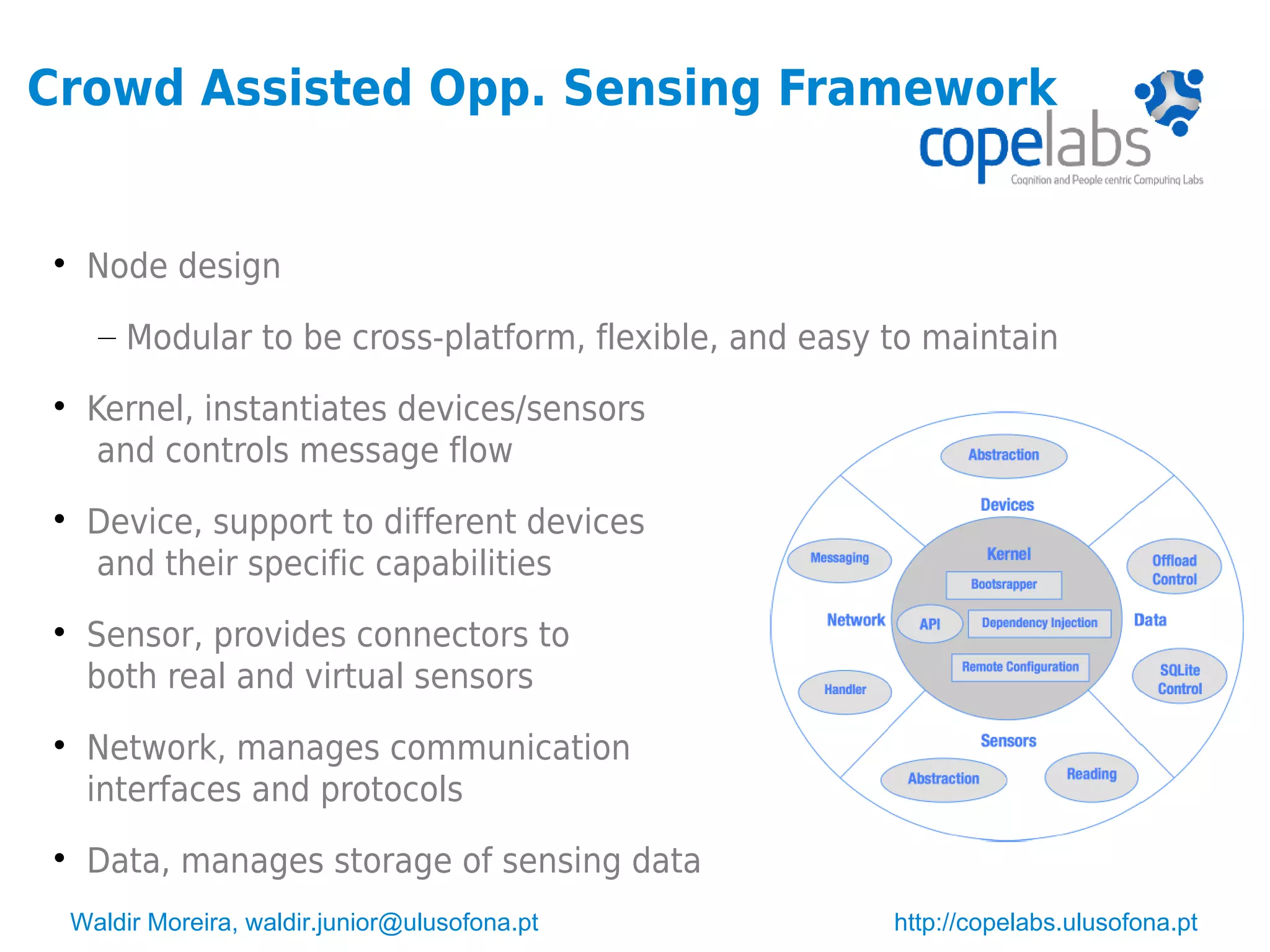
Node design
– Modular to be cross-platform, flexible, and easy to maintain

Kernel, instantiates devices/sensors
and controls message flow

Device, support to different devices
and their specific capabilities

Sensor, provides connectors to
both real and virtual sensors

Network, manages communication
interfaces and protocols

Data, manages storage of sensing data
Waldir Moreira, waldir.junior@ulusofona.pt http://copelabs.ulusofona.pt
Crowd Assisted Opp. Sensing Framework

The user can control
– Sensors and virtual sensors
– General settings (identifier and type), memory size and export types
– Data by managing the SQLite internal database, and the server dumps
– Network by defining messaging and state operations, as well as by
defining the broadcast interval used to share sensing data

Design choices
– C#/.NET Framework to allow cross platform development
– Dependency injection/TinyIoC library for less dependencies (runtime)
– SQLite for data handling
– Protobuffers for fast (de)serialization of message objects (readings)
Waldir Moreira, waldir.junior@ulusofona.pt http://copelabs.ulusofona.pt
Crowd Assisted Opp. Sensing Framework

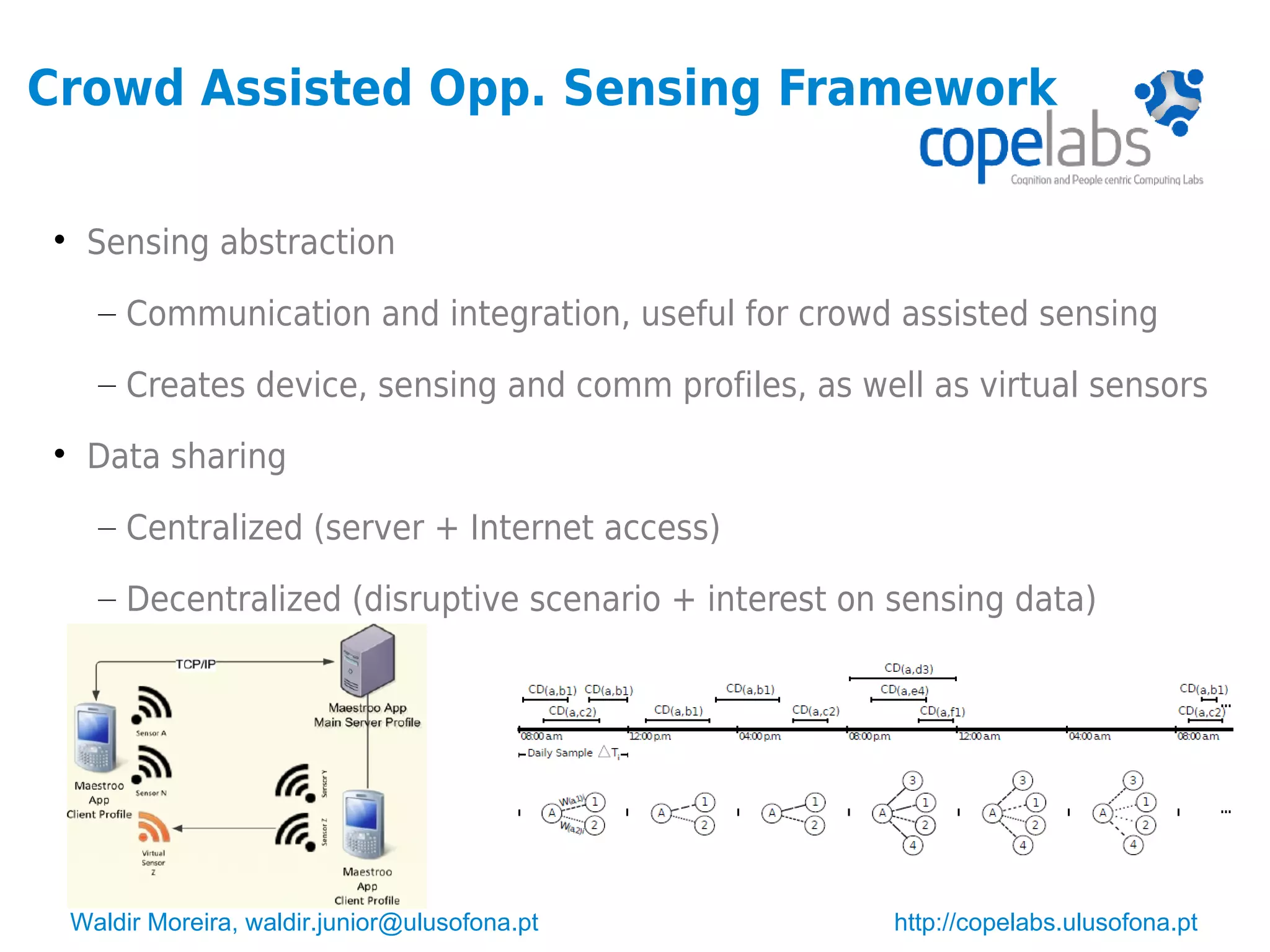
Sensing abstraction
– Communication and integration, useful for crowd assisted sensing
– Creates device, sensing and comm profiles, as well as virtual sensors

Data sharing
– Centralized (server + Internet access)
– Decentralized (disruptive scenario + interest on sensing data)
Waldir Moreira, waldir.junior@ulusofona.pt http://copelabs.ulusofona.pt
Evaluation

Centralized scenario
– Goal: sensing framework stability (sensor operation and broadcast int.)
– Devices:
• Samsung phone: accelerometer, GPS and Wi-Fi
• Android emulator: temperature, gyroscope and Wi-Fi
• Workstation: backend server for data storage and inference
– Process: devices dump data to server, virtual sensor used
– Results:
• Broadcast interval is not below 7 milliseconds
• Otherwise, network flooding occurs
• Boot loading times are less than 5 seconds on real devices
Waldir Moreira, waldir.junior@ulusofona.pt http://copelabs.ulusofona.pt
Evaluation

Decentralized scenario
– Goal: capability to share sensing data in an opportunistic scenario
– Proposals:
• SCORP, data-centric opportunistic forwarding
• dLife, based on the levels of social interaction between users
• Bubble Rap, a community-based proposal
• Spray and Wait, a social-oblivious proposal
– Process: sensing data is exchanged among devices based on user
interest
Waldir Moreira, waldir.junior@ulusofona.pt http://copelabs.ulusofona.pt
Evaluation

Decentralized scenario
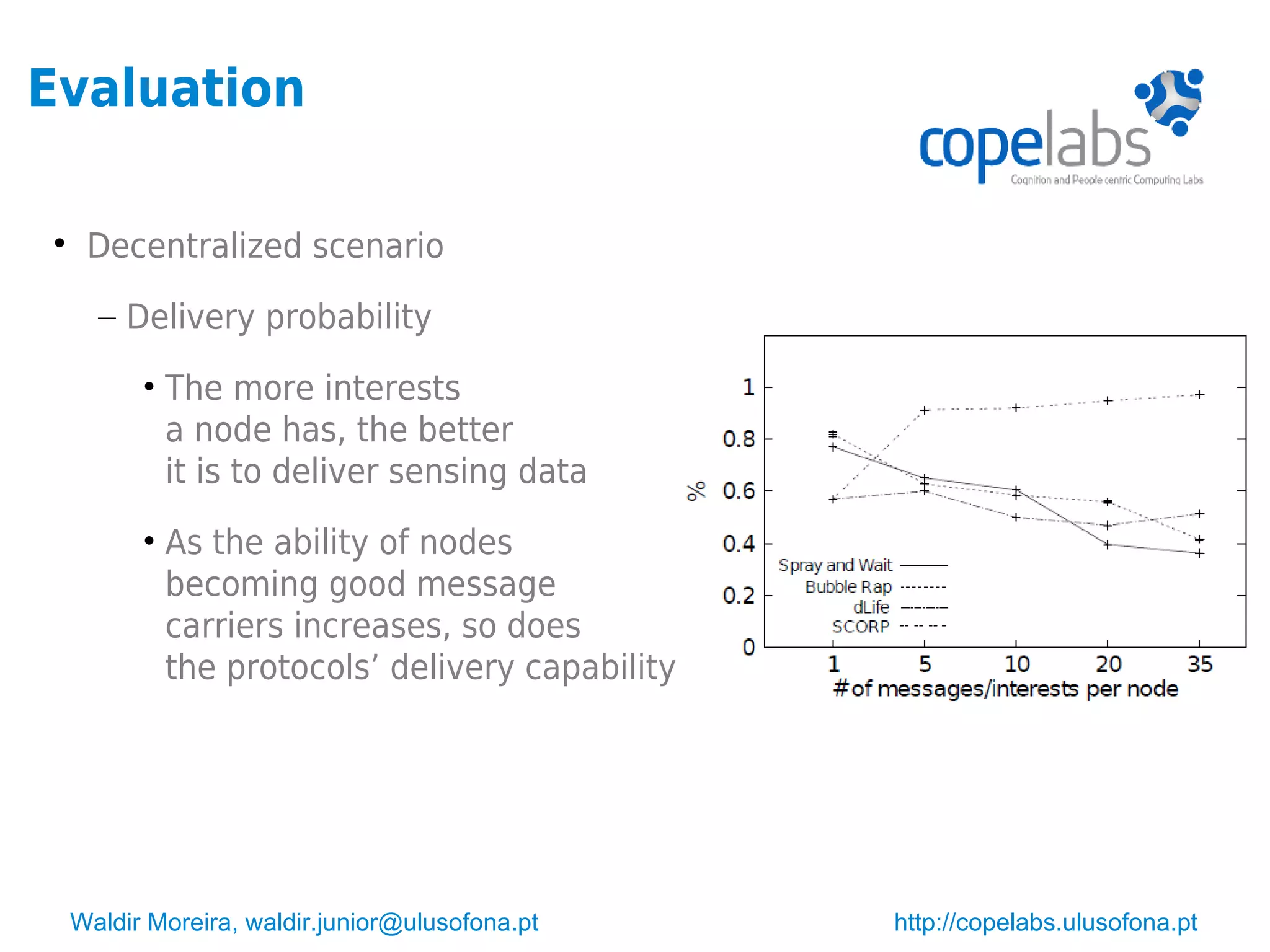
– Delivery probability
• The more interests
a node has, the better
it is to deliver sensing data
• As the ability of nodes
becoming good message
carriers increases, so does
the protocols’ delivery capability
Waldir Moreira, waldir.junior@ulusofona.pt http://copelabs.ulusofona.pt
Evaluation

Decentralized scenario
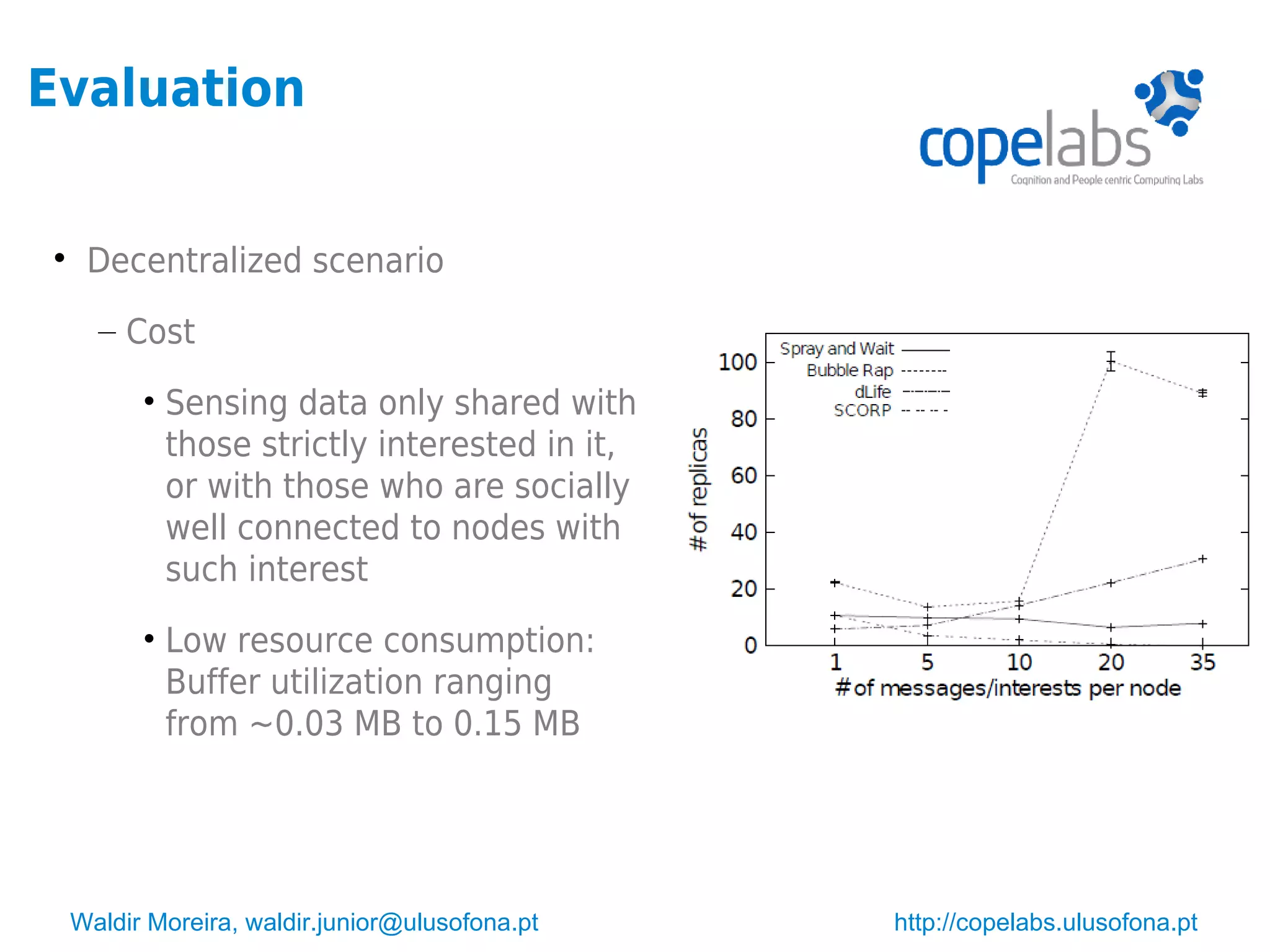
– Cost
• Sensing data only shared with
those strictly interested in it,
or with those who are socially
well connected to nodes with
such interest
• Low resource consumption:
Buffer utilization ranging
from ~0.03 MB to 0.15 MB
Waldir Moreira, waldir.junior@ulusofona.pt http://copelabs.ulusofona.pt
Evaluation

Decentralized scenario
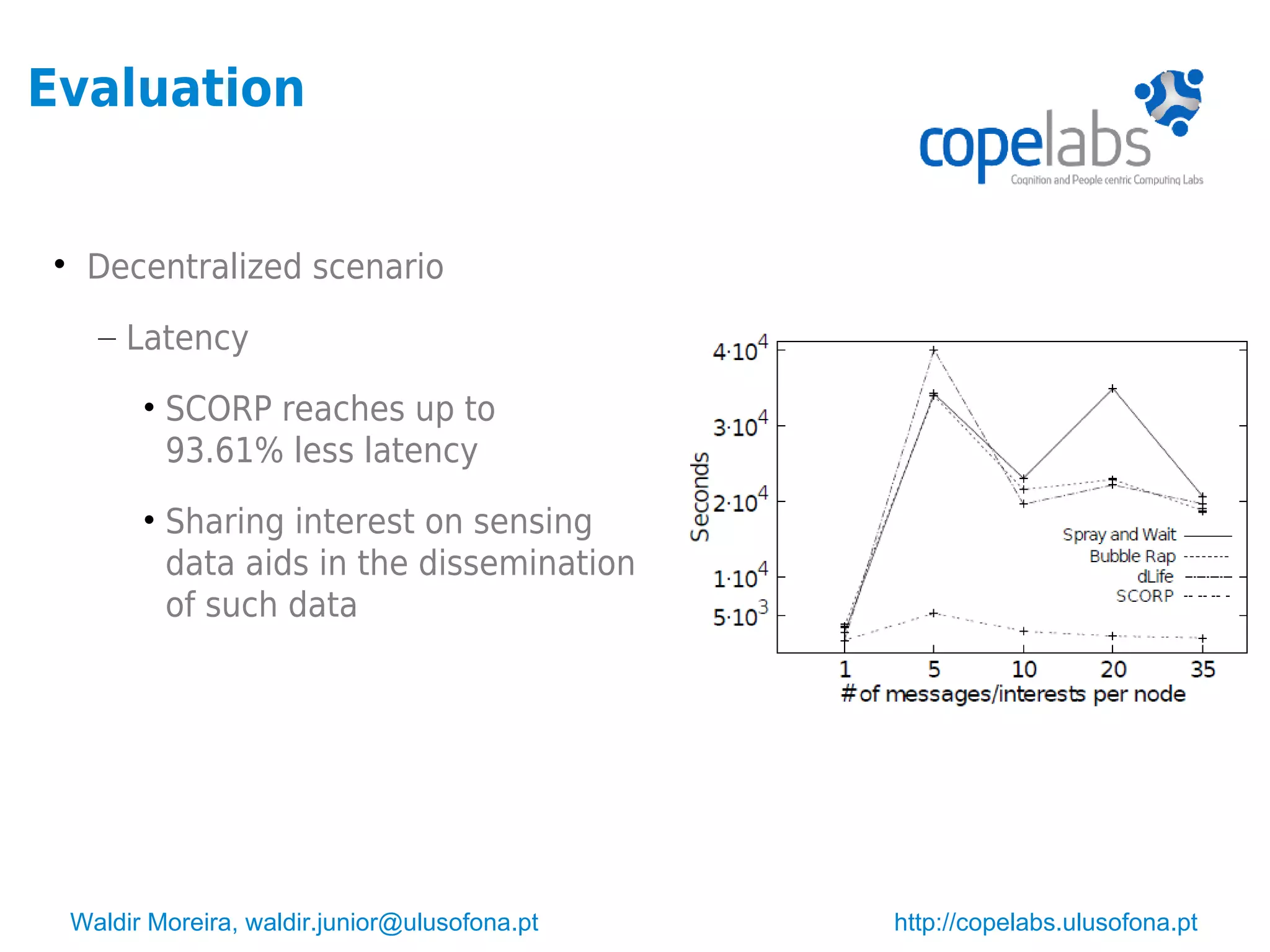
– Latency
• SCORP reaches up to
93.61% less latency
• Sharing interest on sensing
data aids in the dissemination
of such data
Waldir Moreira, waldir.junior@ulusofona.pt http://copelabs.ulusofona.pt
Conclusions and Future Work

Maestroo exploits user mobility and the diversity of sensing devices
– Overcome the coverage and sensor availability limitations

Stable in centralized scenario (broadcast interval)

In decentralized scenario, Maestroo delivers 97% of sensing data in an
average of 46.9 minutes, creating up to 13.9 times less replicas

Future steps (to increase the data accuracy)
– Allocation of sensing activities (same and different devices)
– Incentives for sensing
– Continuous sensing
– Context privacy
– Reliability of data readings
Crowd Assisted Approach for Pervasive Opportunistic Sensing

Crowd Assisted Approach for Pervasive Opportunistic Sensing

  • 1.
    http://copelabs.ulusofona.pt Human-centered Computing Lab CrowdAssisted Approach for Pervasive Opportunistic Sensing Paulo Mendes and Waldir Moreira waldir.junior@ulusofona.pt March 27th, 2015 2nd IEEE PerCom Workshop on Crowd Assisted Sensing Pervasive Systems and Communications (CASPer 2015) St. Louis, USA
  • 2.
    Waldir Moreira, waldir.junior@ulusofona.pthttp://copelabs.ulusofona.pt Agenda  Introduction  Crowd Assisted Opportunistic Sensing Framework  Evaluation  Conclusions and Future Work
  • 3.
    Waldir Moreira, waldir.junior@ulusofona.pthttp://copelabs.ulusofona.pt Introduction  New paradigms emerged, impacting on how people access information – Proliferation of mobile, and very powerful, personal devices • Support more intensive computation, provide data storage, and offer long-range communication channels • Useful to extract information about people daily habits – Pervasive, opportunistic computing • Allows devices to share content, resources, and services according to how people interact – Crowd assisted sensing • Users actively or passively participate in sensing data collection
  • 4.
    Waldir Moreira, waldir.junior@ulusofona.pthttp://copelabs.ulusofona.pt Introduction  Despite of these options, mobile sensing applications are programmed using models, which still rely on static configurations  There is the need for a cooperative middleware – Seamlessly consider individual sensors from different devices  Maestroo, a crowd assisted pervasive opportunistic sensing framework – Exploits user mobility and sensor diversity on devices – Extracts and shares sensing data according to user needs – Expanding sensing applicability – Overcoming coverage limitation and sensor availability
  • 5.
    Waldir Moreira, waldir.junior@ulusofona.pthttp://copelabs.ulusofona.pt Crowd Assisted Opp. Sensing Framework  Challenges to address – Sensor availability, processing cost, limited coverage, communication intermittency, device heterogeneity  How to address – Sensing abstraction: allowing sampling control of available sensors – Virtual sensing: using sensing data obtained from sensors on other devices – Robust processing: well-known servers or cloud systems – Opportunism: data collection and exchange done as users interact
  • 6.
    Waldir Moreira, waldir.junior@ulusofona.pthttp://copelabs.ulusofona.pt Crowd Assisted Opp. Sensing Framework  Node design – Modular to be cross-platform, flexible, and easy to maintain  Kernel, instantiates devices/sensors and controls message flow  Device, support to different devices and their specific capabilities  Sensor, provides connectors to both real and virtual sensors  Network, manages communication interfaces and protocols  Data, manages storage of sensing data
  • 7.
    Waldir Moreira, waldir.junior@ulusofona.pthttp://copelabs.ulusofona.pt Crowd Assisted Opp. Sensing Framework  The user can control – Sensors and virtual sensors – General settings (identifier and type), memory size and export types – Data by managing the SQLite internal database, and the server dumps – Network by defining messaging and state operations, as well as by defining the broadcast interval used to share sensing data  Design choices – C#/.NET Framework to allow cross platform development – Dependency injection/TinyIoC library for less dependencies (runtime) – SQLite for data handling – Protobuffers for fast (de)serialization of message objects (readings)
  • 8.
    Waldir Moreira, waldir.junior@ulusofona.pthttp://copelabs.ulusofona.pt Crowd Assisted Opp. Sensing Framework  Sensing abstraction – Communication and integration, useful for crowd assisted sensing – Creates device, sensing and comm profiles, as well as virtual sensors  Data sharing – Centralized (server + Internet access) – Decentralized (disruptive scenario + interest on sensing data)
  • 9.
    Waldir Moreira, waldir.junior@ulusofona.pthttp://copelabs.ulusofona.pt Evaluation  Centralized scenario – Goal: sensing framework stability (sensor operation and broadcast int.) – Devices: • Samsung phone: accelerometer, GPS and Wi-Fi • Android emulator: temperature, gyroscope and Wi-Fi • Workstation: backend server for data storage and inference – Process: devices dump data to server, virtual sensor used – Results: • Broadcast interval is not below 7 milliseconds • Otherwise, network flooding occurs • Boot loading times are less than 5 seconds on real devices
  • 10.
    Waldir Moreira, waldir.junior@ulusofona.pthttp://copelabs.ulusofona.pt Evaluation  Decentralized scenario – Goal: capability to share sensing data in an opportunistic scenario – Proposals: • SCORP, data-centric opportunistic forwarding • dLife, based on the levels of social interaction between users • Bubble Rap, a community-based proposal • Spray and Wait, a social-oblivious proposal – Process: sensing data is exchanged among devices based on user interest
  • 11.
    Waldir Moreira, waldir.junior@ulusofona.pthttp://copelabs.ulusofona.pt Evaluation  Decentralized scenario – Delivery probability • The more interests a node has, the better it is to deliver sensing data • As the ability of nodes becoming good message carriers increases, so does the protocols’ delivery capability
  • 12.
    Waldir Moreira, waldir.junior@ulusofona.pthttp://copelabs.ulusofona.pt Evaluation  Decentralized scenario – Cost • Sensing data only shared with those strictly interested in it, or with those who are socially well connected to nodes with such interest • Low resource consumption: Buffer utilization ranging from ~0.03 MB to 0.15 MB
  • 13.
    Waldir Moreira, waldir.junior@ulusofona.pthttp://copelabs.ulusofona.pt Evaluation  Decentralized scenario – Latency • SCORP reaches up to 93.61% less latency • Sharing interest on sensing data aids in the dissemination of such data
  • 14.
    Waldir Moreira, waldir.junior@ulusofona.pthttp://copelabs.ulusofona.pt Conclusions and Future Work  Maestroo exploits user mobility and the diversity of sensing devices – Overcome the coverage and sensor availability limitations  Stable in centralized scenario (broadcast interval)  In decentralized scenario, Maestroo delivers 97% of sensing data in an average of 46.9 minutes, creating up to 13.9 times less replicas  Future steps (to increase the data accuracy) – Allocation of sensing activities (same and different devices) – Incentives for sensing – Continuous sensing – Context privacy – Reliability of data readings