Routing Protocols for
Delay Tolerant Network:
A Survey and Comparison

              Authors:
          R. S. Mangrulkar
                 &
      Dr. Mohammad Atique
Introduction
• DTN evolves from MANET

• Main principal for routing message in DTN is “Store and
  Forward”

   o Store: Each node in DTN stores incoming message in the buffer.
   o Forward: Deliver it to the other desirable nodes towards
     destination whenever contact is initiated.

    “Contact” in DTN is the message exchange between two or
     more nodes when they move in transmission range of each
     other.
Introduction
• MANET uses 2 phase approach to deliver data:

  1. Setup the route from source to destination

  2. transmit data and maintain route information till
     transmission is over
Routing Strategies in DTN
• Routing in DTN is mainly categorized into:
  1. Flooding strategy: replicates the messages to
     enough nodes so that the destination nodes
     must receive it.

  2. Forwarding Strategy: uses knowledge about the
     network to select the best path (shortest one) to
     the destination.
Flooding Strategy
• Multiple copies of the same message will be
  created and delivered to a set of nodes called
  relay nodes which store the message until they
  can “contact” with the destination node.

• Advantages:
  o Good chance of bringing the source in contact with
    destination
  o High probability of message delivery to succeed
  o No global or local knowledge about network
Flooding Strategy
1. Single Hop Transmission
• the source and destination come in contact with
  each other directly
• possible when the source and destination are one
  hop apart or immediate neighbor of each other

 no relayed messages
 very less resources are required

 large delay and less probability of message delivery
Flooding Strategy
2. Two-Hop Relay
• Source node along with the nodes coming in
   contact with source node and working in a
   cooperative manner to successfully deliver the
   message to the destination

 increases the message delivery probability
 increases the bandwidth and storage consumption
• same fundamental advantages and limitations as
  direct transmission
Flooding Strategy
3. Tree Based Flooding
• Distribute copies of messages to other relay
  nodes which come in contact with the already
  discovered node

• One extra control field added to the message
  for the information about the number of copies
  a relay node can make and forward
Flooding Strategy
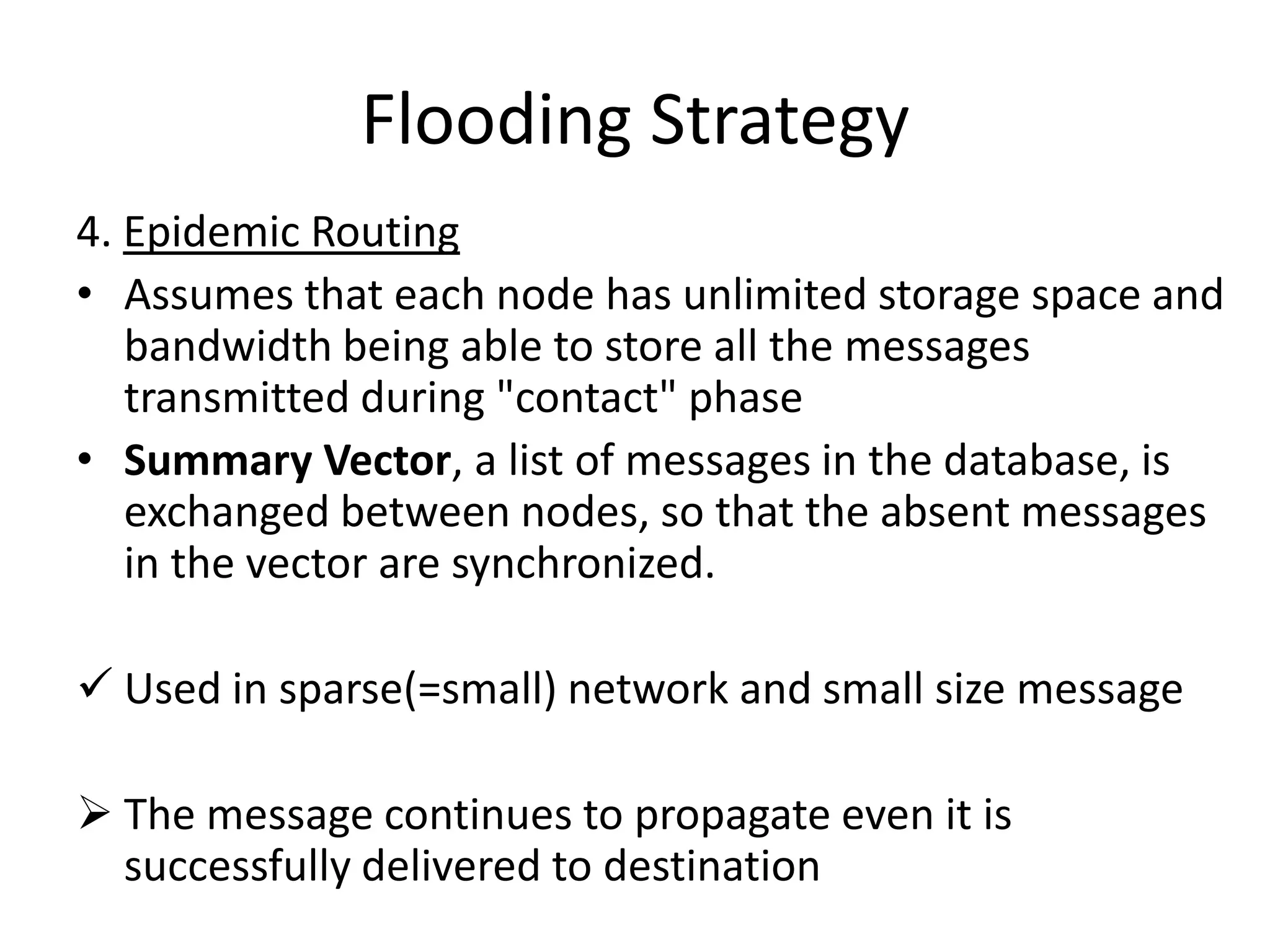
4. Epidemic Routing
• Assumes that each node has unlimited storage space and
   bandwidth being able to store all the messages
   transmitted during "contact" phase
• Summary Vector, a list of messages in the database, is
   exchanged between nodes, so that the absent messages
   in the vector are synchronized.

 Used in sparse(=small) network and small size message

 The message continues to propagate even it is
  successfully delivered to destination
Flooding Strategy
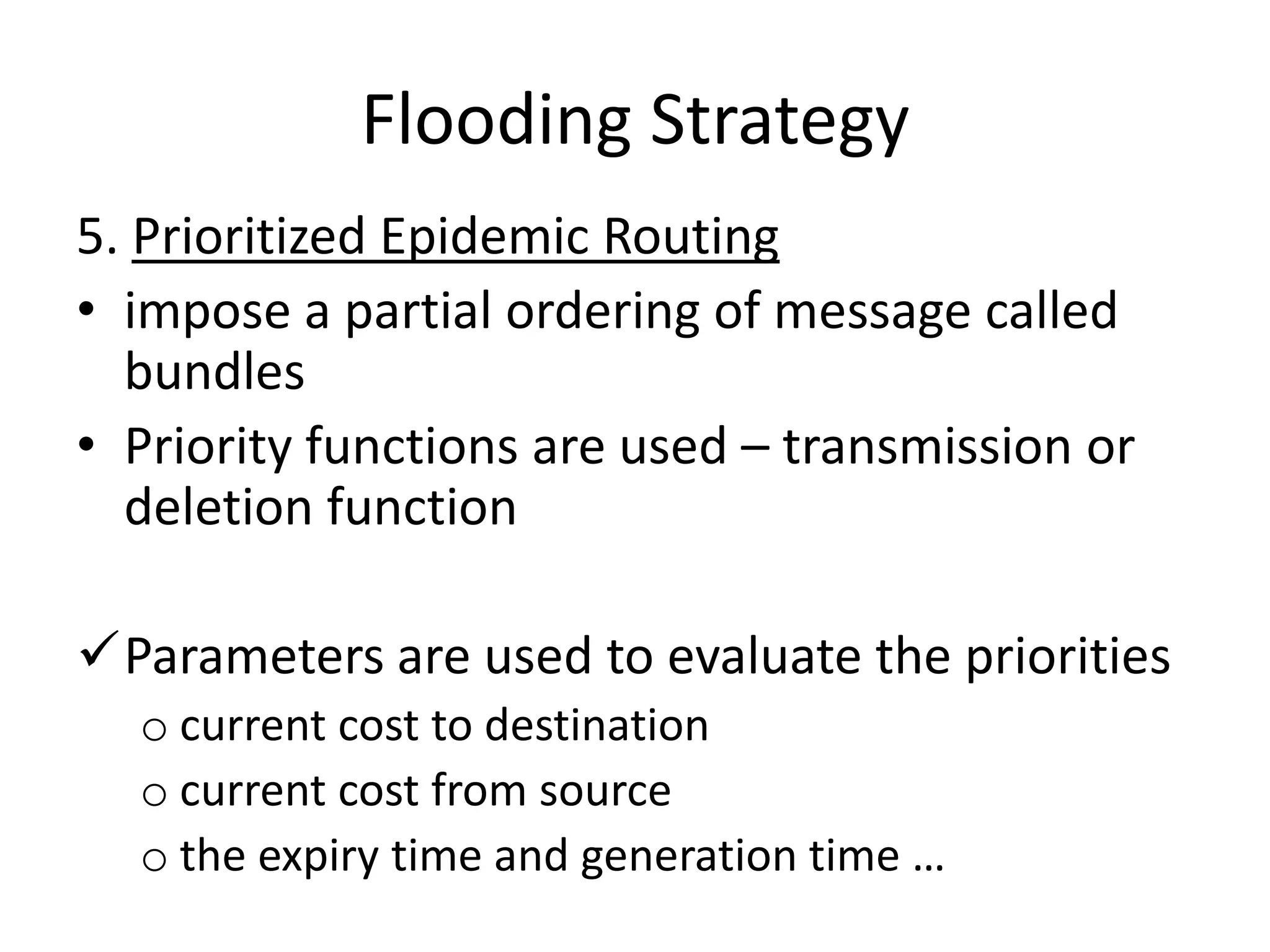
5. Prioritized Epidemic Routing
• impose a partial ordering of message called
  bundles
• Priority functions are used – transmission or
  deletion function

Parameters are used to evaluate the priorities
  o current cost to destination
  o current cost from source
  o the expiry time and generation time …
Flooding Strategy
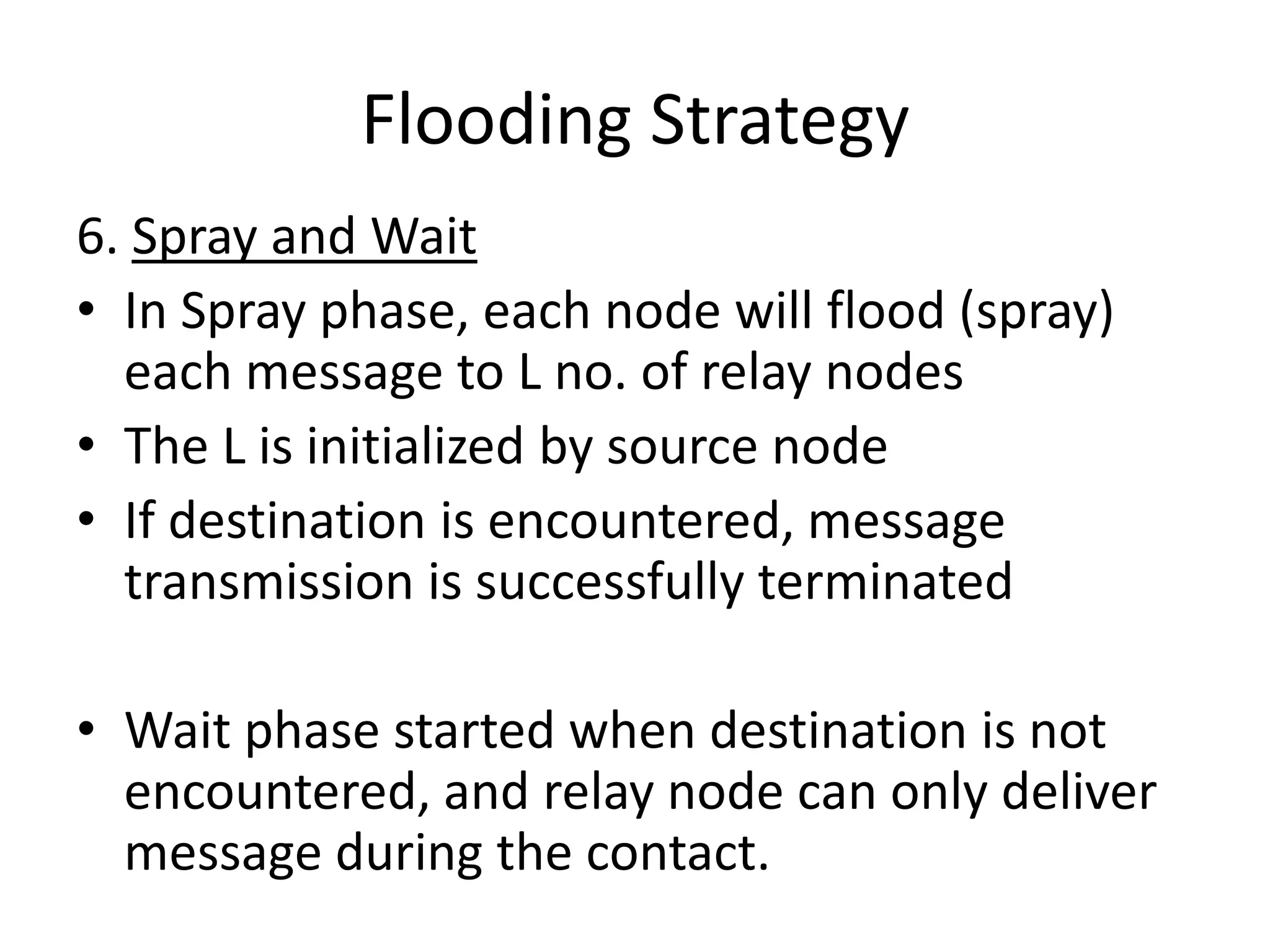
6. Spray and Wait
• In Spray phase, each node will flood (spray)
  each message to L no. of relay nodes
• The L is initialized by source node
• If destination is encountered, message
  transmission is successfully terminated

• Wait phase started when destination is not
  encountered, and relay node can only deliver
  message during the contact.
Flooding Strategy
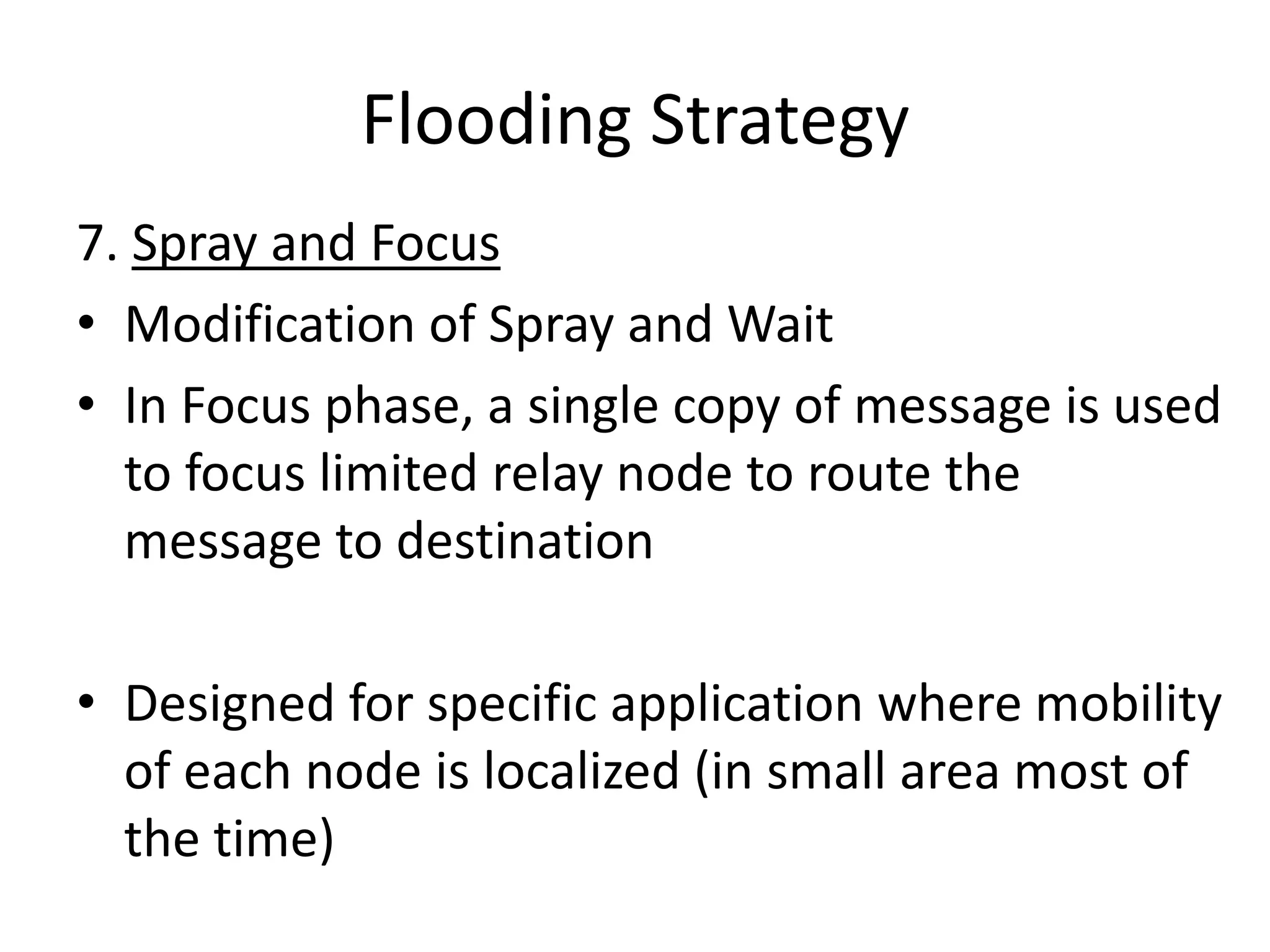
7. Spray and Focus
• Modification of Spray and Wait
• In Focus phase, a single copy of message is used
  to focus limited relay node to route the
  message to destination

• Designed for specific application where mobility
  of each node is localized (in small area most of
  the time)
Flooding Strategy
8. MaxProp strategy
• City environment
• Nodes = city buses (high probability to meet)

• Order of stored messages:
   – 1st phase: based on hop count information of each
     message from low to high
   – 2nd phase: based on cost from high to low

• Buffer is utilized in:
   – Front end of buffer is used by 1st phase
   – Back end of buffer is used by 2nd phase
Flooding Strategy
9. Opportunistic Routing with Window-Aware Replication
• Main goal:
   – Reduce resource utilization
   – Reduce partial and dropped messages during transmission

• Partial messages arises when a node move out of
  transmission range while message transmission is going on

• Number of bytes to be transferred is estimated to help utilize
  the bandwidth effectively

• Nodes need to be able to measure its speed and direction –
  equipped with GPS-like devices
Flooding Strategy
10. Cost Efficient Erasure Code Routing (CEECR)
• Based on erasure based coding
• Divides the original message into subsets
  (=blocks) and transmits individually
• Decoding technique is used to obtain the
  original message

• Advantage of Erasure Coding: chances to
  recover original messages in case of failure in
  trans.
Flooding Strategy
11. Constant Cost Quality Routing (CCQR)
• Message flooding only within high quality
  nodes in DTN.

• The nodal cost is used as a parameter referring
  to the total number of messages received by a
  given node during the entire routing process

• Solve nodal imbalance problems
Flooding Strategy
12. A-SMART:
• An Advance Controlled-Flooding Routing with
  Group Structures
• Nodes are called companion nodes forming an
  ANYCAST group
  – Periodically broadcast its group identities and hop
    distance to build routing table

• 1st phase: introduce extra phase to route the
  message to the companion nodes
• 2nd phase is same as SMART protocol
Flooding Strategy
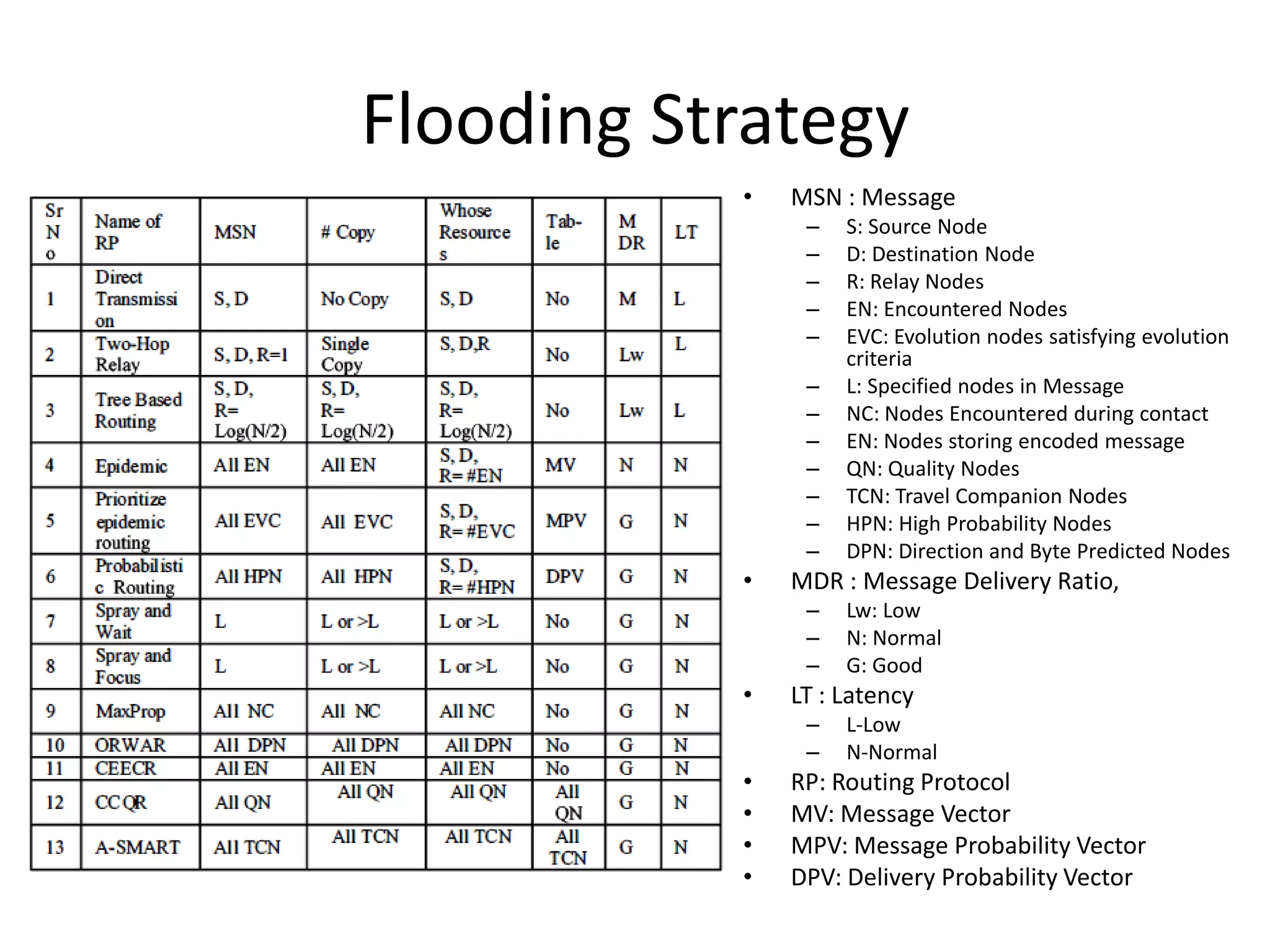
           •   MSN : Message
                –   S: Source Node
                –   D: Destination Node
                –   R: Relay Nodes
                –   EN: Encountered Nodes
                –   EVC: Evolution nodes satisfying evolution
                    criteria
                –   L: Specified nodes in Message
                –   NC: Nodes Encountered during contact
                –   EN: Nodes storing encoded message
                –   QN: Quality Nodes
                –   TCN: Travel Companion Nodes
                –   HPN: High Probability Nodes
                –   DPN: Direction and Byte Predicted Nodes
           •   MDR : Message Delivery Ratio,
                –   Lw: Low
                –   N: Normal
                –   G: Good
           •   LT : Latency
                –   L-Low
                –   N-Normal
           •   RP: Routing Protocol
           •   MV: Message Vector
           •   MPV: Message Probability Vector
           •   DPV: Delivery Probability Vector
Forwarding Strategy
• Makes use of network topology and local/global
  knowledge to find the best route path to deliver
  the message to the destination.
• No message replication
• Network parameters are required for estimating
  a single path

• Advantages:
  o No replication -> less bandwidth and consumption
  o Faster since the best path routing is used
Forwarding Strategy
1. Location Based Routing Stategy
• Each node in the network is assigned the coordinate – GPS
  coordinate.
• Then distance formula, calculating minimum distance
  between source and destination, is used to estimate the cost
  of delivering message

• Path estimation – coordinates of source, destination and
  intermediate node
 eliminates the need for storing routing tables and control
  information transfer management

 Obstacles
 Mobility of a node changes the physical coordinate
Forwarding Strategy
2. Gradient Routing strategy
• Weights are assigned to the nodes representing
  suitability of message delivery
• Relay nodes contact one another to have better
  metric for message destination, and then pass
  the message to the next node

• Suitable for Sensor Network
Forwarding Strategy
3. Label Based Forwarding Strategy
• Firstly, create groups, called “labeled group”
• Then, the groups are chosen to be the next node
  or groups to forward the message to destination

Efficiently utilize bandwidth and consumption
Forwarding Strategy
4. Bubble Rap Forwarding Strategy
• Focus on issues of
 o Community – divide the nodes in specific communities or
   groups
 o Centrality - always becomes centre of attraction

• Global ranking: used for a node to bubble the
  message up to the hierarchical rankings tree until it
  reaches a node which is in the same community as
  the destination node
• Local ranking: further bubble the message until the
  message is reached destination or expires
Forwarding Strategy
5. NECTAR
• Based on neighborhood contact history –
   Neighborhood Index – to determine the most
   appropriated route

• Use heuristic knowledge based on mobility
• relay in controlled manner to limit the traffic in the
  network.

 Improve the number of delivered messages
 Consume fewer resource in the limited network
Forwarding Strategy
6. CREAST
• An opportunistic forwarding protocol based on
   conditional residual* time
                                 *Residual = remaining after most of sth has gone


• Conditional residual time – a parameter estimating
  the time remaining for a pair of nodes to meet using
  only local knowledge of the past contacts.

 Lower end-to-end delay, since no global knowledge
  and no future contact schedule is dependent
 Better delivery ratio compared to flooding protocols
Forwarding Strategy
7. Conditional Shortest Path Routing (CSPR)
• Based on human mobility traces
• Use conditional intermeeting time
  – As a parameter computing the average intermeeting time
    between two nodes relative to a meeting with third node
    using local knowledge of the past contacts.
  – To estimate best path towards destination in shortest
    path routing algorithm

 Achieve high delivery rate
 Lower end-to-end delay compared shortest path
  routing protocols
Forwarding Strategy
8. QoNSW (Quality of Node with Spray and Wait)
• QoN (Quality of Node) refers to the activity of node,
   or the number a node meets other different nodes
   within given interval of time

• Node: the more meeting to others, the greater QoN
• Find the best suitable relay node to route message

 Significant improvements on Binary Spray and Wait
  and Simple Spray and Wait
Forwarding Strategy
9. Single Copy Replication routing protocol (SCR)
• duplicate the message to the node selected as best
   relay node
• Time Interval – as a parameter to select the node

• Starts message transmission in Critical Transmission
  Rang(CTR)
• Stop transferring out of communication range
 Reduces the overhead by decreasing message
  delivery failure due to node's movement out of
  transmission range
Forwarding Strategy
10. CRHC
• Based on Hierarchical forwarding and cluster control
  mechanism

• Reduces messages transmission by allowing
  transmission permission to Cluster Head

 higher delivery rate and lower delay

 needs to maintain the information regarding partial
  nodes of the network luster Head
Forwarding Strategy
11. PROCCS
• based on repetitive contact patterns and their time
  sequencing to improve routing

• Greedy path probabilistic approach – to calculate
  probability of path and then best path is selected as the
  path for routing message

• Contact graph – for particular time issued by PROCCS to
  calculate best path

 high message delivery ratio with no message replication as
  compared to PROPHET and Epidemic.
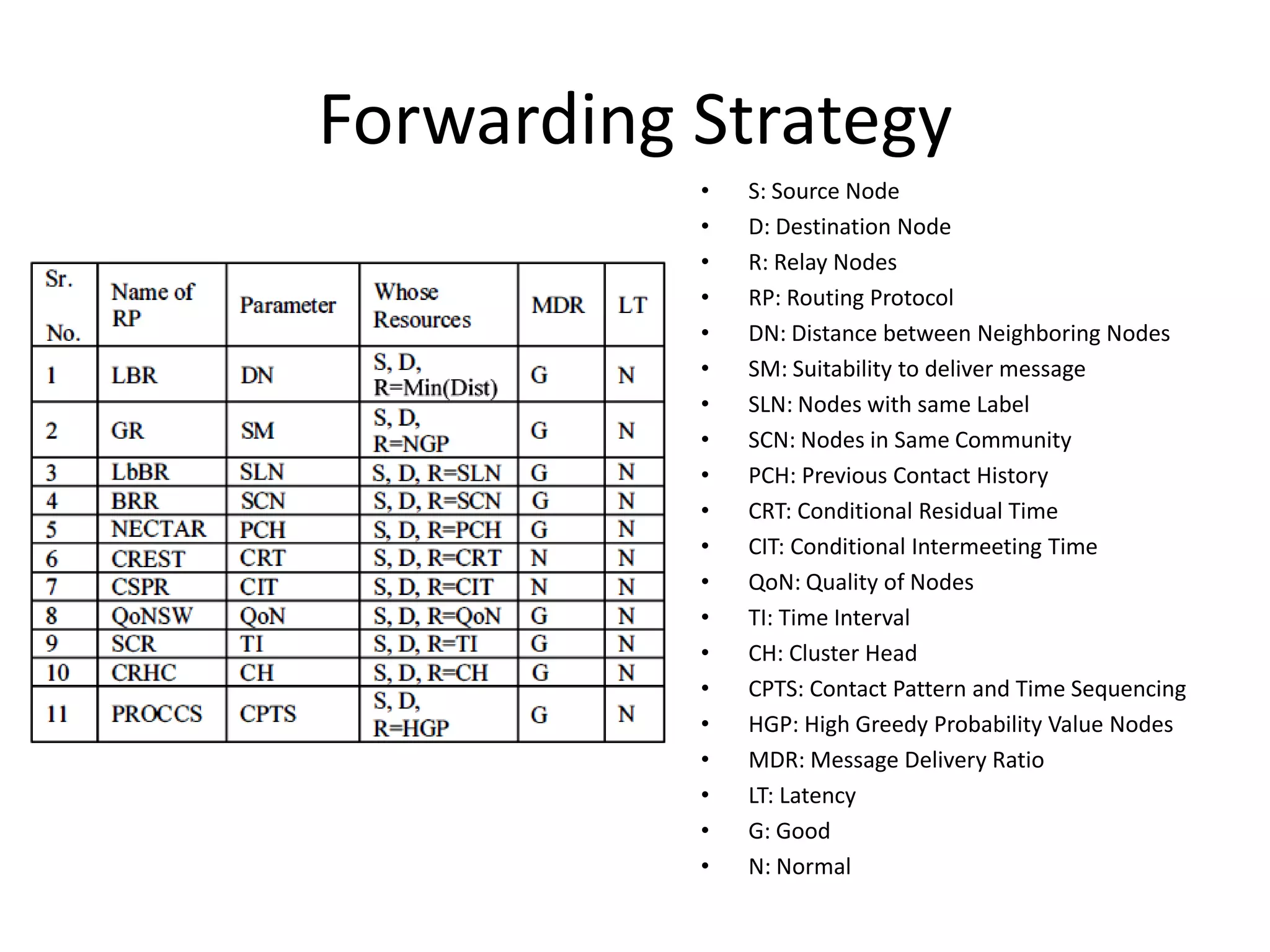
Forwarding Strategy
           •   S: Source Node
           •   D: Destination Node
           •   R: Relay Nodes
           •   RP: Routing Protocol
           •   DN: Distance between Neighboring Nodes
           •   SM: Suitability to deliver message
           •   SLN: Nodes with same Label
           •   SCN: Nodes in Same Community
           •   PCH: Previous Contact History
           •   CRT: Conditional Residual Time
           •   CIT: Conditional Intermeeting Time
           •   QoN: Quality of Nodes
           •   TI: Time Interval
           •   CH: Cluster Head
           •   CPTS: Contact Pattern and Time Sequencing
           •   HGP: High Greedy Probability Value Nodes
           •   MDR: Message Delivery Ratio
           •   LT: Latency
           •   G: Good
           •   N: Normal
Conclusion
• Routing protocols in DTN are classified into two broad categories
    – Flooding
    – Forwarding

• Each protocol has its own advantages and disadvantage

• The DTN based applications suffered from less resources as well as
  bandwidth.

• Suitable routing protocol in DTV depends on the application for
  which Delay Tolerant Network is configured.

• The large delay results in low latency

Routing protocol for delay tolerant network a survey and comparison

  • 1.
    Routing Protocols for DelayTolerant Network: A Survey and Comparison Authors: R. S. Mangrulkar & Dr. Mohammad Atique
  • 2.
    Introduction • DTN evolvesfrom MANET • Main principal for routing message in DTN is “Store and Forward” o Store: Each node in DTN stores incoming message in the buffer. o Forward: Deliver it to the other desirable nodes towards destination whenever contact is initiated.  “Contact” in DTN is the message exchange between two or more nodes when they move in transmission range of each other.
  • 3.
    Introduction • MANET uses2 phase approach to deliver data: 1. Setup the route from source to destination 2. transmit data and maintain route information till transmission is over
  • 4.
    Routing Strategies inDTN • Routing in DTN is mainly categorized into: 1. Flooding strategy: replicates the messages to enough nodes so that the destination nodes must receive it. 2. Forwarding Strategy: uses knowledge about the network to select the best path (shortest one) to the destination.
  • 5.
    Flooding Strategy • Multiplecopies of the same message will be created and delivered to a set of nodes called relay nodes which store the message until they can “contact” with the destination node. • Advantages: o Good chance of bringing the source in contact with destination o High probability of message delivery to succeed o No global or local knowledge about network
  • 6.
    Flooding Strategy 1. SingleHop Transmission • the source and destination come in contact with each other directly • possible when the source and destination are one hop apart or immediate neighbor of each other  no relayed messages  very less resources are required  large delay and less probability of message delivery
  • 7.
    Flooding Strategy 2. Two-HopRelay • Source node along with the nodes coming in contact with source node and working in a cooperative manner to successfully deliver the message to the destination  increases the message delivery probability  increases the bandwidth and storage consumption • same fundamental advantages and limitations as direct transmission
  • 8.
    Flooding Strategy 3. TreeBased Flooding • Distribute copies of messages to other relay nodes which come in contact with the already discovered node • One extra control field added to the message for the information about the number of copies a relay node can make and forward
  • 9.
    Flooding Strategy 4. EpidemicRouting • Assumes that each node has unlimited storage space and bandwidth being able to store all the messages transmitted during "contact" phase • Summary Vector, a list of messages in the database, is exchanged between nodes, so that the absent messages in the vector are synchronized.  Used in sparse(=small) network and small size message  The message continues to propagate even it is successfully delivered to destination
  • 10.
    Flooding Strategy 5. PrioritizedEpidemic Routing • impose a partial ordering of message called bundles • Priority functions are used – transmission or deletion function Parameters are used to evaluate the priorities o current cost to destination o current cost from source o the expiry time and generation time …
  • 11.
    Flooding Strategy 6. Sprayand Wait • In Spray phase, each node will flood (spray) each message to L no. of relay nodes • The L is initialized by source node • If destination is encountered, message transmission is successfully terminated • Wait phase started when destination is not encountered, and relay node can only deliver message during the contact.
  • 12.
    Flooding Strategy 7. Sprayand Focus • Modification of Spray and Wait • In Focus phase, a single copy of message is used to focus limited relay node to route the message to destination • Designed for specific application where mobility of each node is localized (in small area most of the time)
  • 13.
    Flooding Strategy 8. MaxPropstrategy • City environment • Nodes = city buses (high probability to meet) • Order of stored messages: – 1st phase: based on hop count information of each message from low to high – 2nd phase: based on cost from high to low • Buffer is utilized in: – Front end of buffer is used by 1st phase – Back end of buffer is used by 2nd phase
  • 14.
    Flooding Strategy 9. OpportunisticRouting with Window-Aware Replication • Main goal: – Reduce resource utilization – Reduce partial and dropped messages during transmission • Partial messages arises when a node move out of transmission range while message transmission is going on • Number of bytes to be transferred is estimated to help utilize the bandwidth effectively • Nodes need to be able to measure its speed and direction – equipped with GPS-like devices
  • 15.
    Flooding Strategy 10. CostEfficient Erasure Code Routing (CEECR) • Based on erasure based coding • Divides the original message into subsets (=blocks) and transmits individually • Decoding technique is used to obtain the original message • Advantage of Erasure Coding: chances to recover original messages in case of failure in trans.
  • 16.
    Flooding Strategy 11. ConstantCost Quality Routing (CCQR) • Message flooding only within high quality nodes in DTN. • The nodal cost is used as a parameter referring to the total number of messages received by a given node during the entire routing process • Solve nodal imbalance problems
  • 17.
    Flooding Strategy 12. A-SMART: •An Advance Controlled-Flooding Routing with Group Structures • Nodes are called companion nodes forming an ANYCAST group – Periodically broadcast its group identities and hop distance to build routing table • 1st phase: introduce extra phase to route the message to the companion nodes • 2nd phase is same as SMART protocol
  • 18.
    Flooding Strategy • MSN : Message – S: Source Node – D: Destination Node – R: Relay Nodes – EN: Encountered Nodes – EVC: Evolution nodes satisfying evolution criteria – L: Specified nodes in Message – NC: Nodes Encountered during contact – EN: Nodes storing encoded message – QN: Quality Nodes – TCN: Travel Companion Nodes – HPN: High Probability Nodes – DPN: Direction and Byte Predicted Nodes • MDR : Message Delivery Ratio, – Lw: Low – N: Normal – G: Good • LT : Latency – L-Low – N-Normal • RP: Routing Protocol • MV: Message Vector • MPV: Message Probability Vector • DPV: Delivery Probability Vector
  • 19.
    Forwarding Strategy • Makesuse of network topology and local/global knowledge to find the best route path to deliver the message to the destination. • No message replication • Network parameters are required for estimating a single path • Advantages: o No replication -> less bandwidth and consumption o Faster since the best path routing is used
  • 20.
    Forwarding Strategy 1. LocationBased Routing Stategy • Each node in the network is assigned the coordinate – GPS coordinate. • Then distance formula, calculating minimum distance between source and destination, is used to estimate the cost of delivering message • Path estimation – coordinates of source, destination and intermediate node  eliminates the need for storing routing tables and control information transfer management  Obstacles  Mobility of a node changes the physical coordinate
  • 21.
    Forwarding Strategy 2. GradientRouting strategy • Weights are assigned to the nodes representing suitability of message delivery • Relay nodes contact one another to have better metric for message destination, and then pass the message to the next node • Suitable for Sensor Network
  • 22.
    Forwarding Strategy 3. LabelBased Forwarding Strategy • Firstly, create groups, called “labeled group” • Then, the groups are chosen to be the next node or groups to forward the message to destination Efficiently utilize bandwidth and consumption
  • 23.
    Forwarding Strategy 4. BubbleRap Forwarding Strategy • Focus on issues of o Community – divide the nodes in specific communities or groups o Centrality - always becomes centre of attraction • Global ranking: used for a node to bubble the message up to the hierarchical rankings tree until it reaches a node which is in the same community as the destination node • Local ranking: further bubble the message until the message is reached destination or expires
  • 24.
    Forwarding Strategy 5. NECTAR •Based on neighborhood contact history – Neighborhood Index – to determine the most appropriated route • Use heuristic knowledge based on mobility • relay in controlled manner to limit the traffic in the network.  Improve the number of delivered messages  Consume fewer resource in the limited network
  • 25.
    Forwarding Strategy 6. CREAST •An opportunistic forwarding protocol based on conditional residual* time *Residual = remaining after most of sth has gone • Conditional residual time – a parameter estimating the time remaining for a pair of nodes to meet using only local knowledge of the past contacts.  Lower end-to-end delay, since no global knowledge and no future contact schedule is dependent  Better delivery ratio compared to flooding protocols
  • 26.
    Forwarding Strategy 7. ConditionalShortest Path Routing (CSPR) • Based on human mobility traces • Use conditional intermeeting time – As a parameter computing the average intermeeting time between two nodes relative to a meeting with third node using local knowledge of the past contacts. – To estimate best path towards destination in shortest path routing algorithm  Achieve high delivery rate  Lower end-to-end delay compared shortest path routing protocols
  • 27.
    Forwarding Strategy 8. QoNSW(Quality of Node with Spray and Wait) • QoN (Quality of Node) refers to the activity of node, or the number a node meets other different nodes within given interval of time • Node: the more meeting to others, the greater QoN • Find the best suitable relay node to route message  Significant improvements on Binary Spray and Wait and Simple Spray and Wait
  • 28.
    Forwarding Strategy 9. SingleCopy Replication routing protocol (SCR) • duplicate the message to the node selected as best relay node • Time Interval – as a parameter to select the node • Starts message transmission in Critical Transmission Rang(CTR) • Stop transferring out of communication range  Reduces the overhead by decreasing message delivery failure due to node's movement out of transmission range
  • 29.
    Forwarding Strategy 10. CRHC •Based on Hierarchical forwarding and cluster control mechanism • Reduces messages transmission by allowing transmission permission to Cluster Head  higher delivery rate and lower delay  needs to maintain the information regarding partial nodes of the network luster Head
  • 30.
    Forwarding Strategy 11. PROCCS •based on repetitive contact patterns and their time sequencing to improve routing • Greedy path probabilistic approach – to calculate probability of path and then best path is selected as the path for routing message • Contact graph – for particular time issued by PROCCS to calculate best path  high message delivery ratio with no message replication as compared to PROPHET and Epidemic.
  • 31.
    Forwarding Strategy • S: Source Node • D: Destination Node • R: Relay Nodes • RP: Routing Protocol • DN: Distance between Neighboring Nodes • SM: Suitability to deliver message • SLN: Nodes with same Label • SCN: Nodes in Same Community • PCH: Previous Contact History • CRT: Conditional Residual Time • CIT: Conditional Intermeeting Time • QoN: Quality of Nodes • TI: Time Interval • CH: Cluster Head • CPTS: Contact Pattern and Time Sequencing • HGP: High Greedy Probability Value Nodes • MDR: Message Delivery Ratio • LT: Latency • G: Good • N: Normal
  • 32.
    Conclusion • Routing protocolsin DTN are classified into two broad categories – Flooding – Forwarding • Each protocol has its own advantages and disadvantage • The DTN based applications suffered from less resources as well as bandwidth. • Suitable routing protocol in DTV depends on the application for which Delay Tolerant Network is configured. • The large delay results in low latency