“A Development of secure
and optimized
Routing protocol using Ant
Algorithm”
Presented by
Ms. Lina Tukaram Kadam
E & TC DEPARTMENT
1
Outline
• Introduction
• Literature Survey
• Problem Definition
• Taxonomy of network attacks
• System Design Methodology
• Algorithm
• Results
• Applications
• Advantages
• Future Scope
• Conclusions
• Bibliography
2
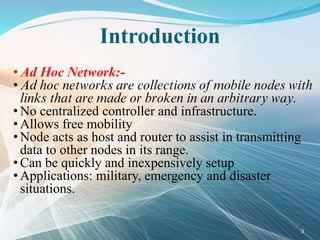
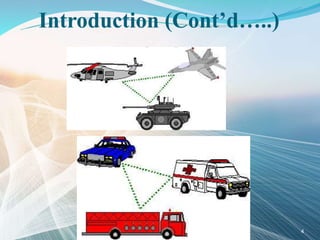
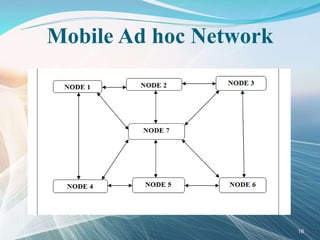
• Ad Hoc Network:-
• Ad hoc networks are collections of mobile nodes with
links that are made or broken in an arbitrary way.
• No centralized controller and infrastructure.
• Allows free mobility
• Node acts as host and router to assist in transmitting
data to other nodes in its range.
• Can be quickly and inexpensively setup
• Applications: military, emergency and disaster
situations.
Introduction
3
Introduction (Cont’d…..)
4
Introduction (Cont’d…..)
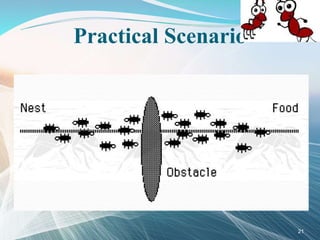
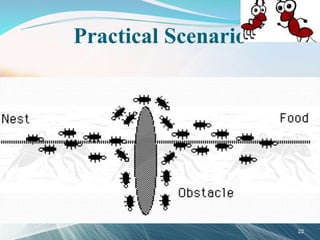
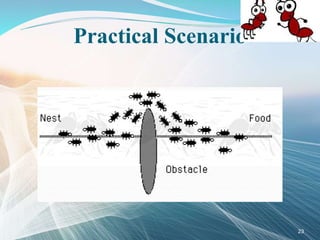
• ANT Algorithm:-
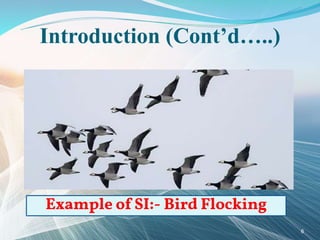
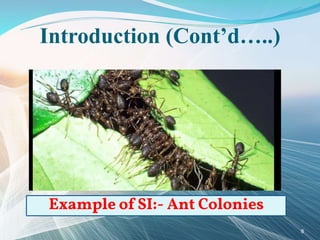
• Swarm Intelligence(SI) is artificial Intelligence based on
the collective behavior of decentralized, Self- organized
systems.
• Swarm based routing algorithm uses the operation of
biological of insects such as ants, honeybees, birds,
termites, fish, fog etc.
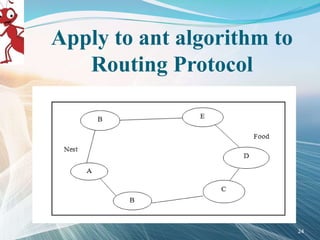
• So we use the Ant algorithm to find out the shortest path
between source to destination.
5
Example of SI:- Bird Flocking
Introduction (Cont’d…..)
6
Example of SI:- Fish Schooling
Introduction (Cont’d…..)
7
Example of SI:- Ant Colonies
Introduction (Cont’d…..)
8
Literature Survey
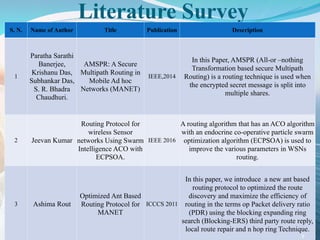
S. N. Name of Author Title Publication Description
1
Paratha Sarathi
Banerjee,
Krishanu Das,
Subhankar Das,
S. R. Bhadra
Chaudhuri.
AMSPR: A Secure
Multipath Routing in
Mobile Ad hoc
Networks (MANET)
IEEE,2014
In this Paper, AMSPR (All-or –nothing
Transformation based secure Multipath
Routing) is a routing technique is used when
the encrypted secret message is split into
multiple shares.
2 Jeevan Kumar
Routing Protocol for
wireless Sensor
networks Using Swarm
Intelligence ACO with
ECPSOA.
IEEE 2016
A routing algorithm that has an ACO algorithm
with an endocrine co-operative particle swarm
optimization algorithm (ECPSOA) is used to
improve the various parameters in WSNs
routing.
3 Ashima Rout
Optimized Ant Based
Routing Protocol for
MANET
ICCCS 2011
In this paper, we introduce a new ant based
routing protocol to optimized the route
discovery and maximize the efficiency of
routing in the terms op Packet delivery ratio
(PDR) using the blocking expanding ring
search (Blocking-ERS) third party route reply,
local route repair and n hop ring Technique.
9
Literature Survey
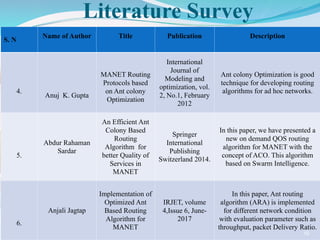
S. N
Name of Author Title Publication Description
4.
Anuj K. Gupta
MANET Routing
Protocols based
on Ant colony
Optimization
International
Journal of
Modeling and
optimization, vol.
2, No.1, February
2012
Ant colony Optimization is good
technique for developing routing
algorithms for ad hoc networks.
5.
Abdur Rahaman
Sardar
An Efficient Ant
Colony Based
Routing
Algorithm for
better Quality of
Services in
MANET
Springer
International
Publishing
Switzerland 2014.
In this paper, we have presented a
new on demand QOS routing
algorithm for MANET with the
concept of ACO. This algorithm
based on Swarm Intelligence.
6.
Anjali Jagtap
Implementation of
Optimized Ant
Based Routing
Algorithm for
MANET
IRJET, volume
4,Issue 6, June-
2017
In this paper, Ant routing
algorithm (ARA) is implemented
for different network condition
with evaluation parameter such as
throughput, packet Delivery Ratio.
10
Problem Definition
• Challenges in mobile ad hoc networks:-
1. Quality of Service (QoS)
2.Scalability
3. Security
4.Security Approach
5.Routing
6.Power control
7.Performance of Measurement of MANET
8.Cooperation between nodes
9.Signal Fading
10.Mobility
11
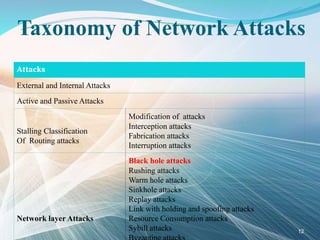
Taxonomy of Network Attacks
Attacks
External and Internal Attacks
Active and Passive Attacks
Stalling Classification
Of Routing attacks
Modification of attacks
Interception attacks
Fabrication attacks
Interruption attacks
Network layer Attacks
Black hole attacks
Rushing attacks
Warm hole attacks
Sinkhole attacks
Replay attacks
Link with holding and spoofing attacks
Resource Consumption attacks
Sybill attacks 12
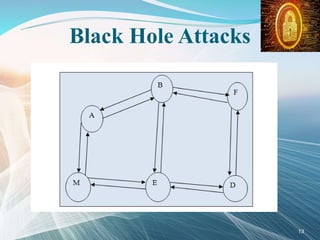
Black Hole Attacks
13
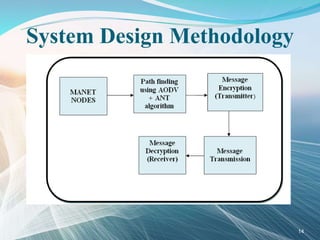
System Design Methodology
14
System Design Methodology
• In this system, the are of the project divides into four parts and they are
following:-
• Mobile Ad hoc Network (MANET)
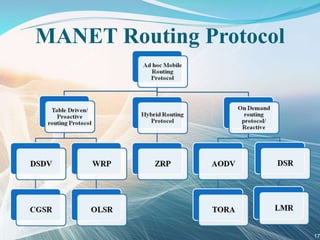
• MANET Routing Protocol
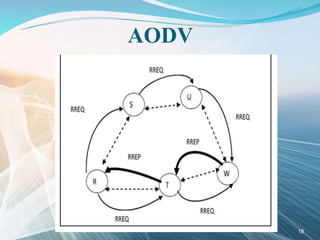
• AODV Routing Protocol
• Ant Colony Optimization (ACO)
15
Mobile Ad hoc Network
16
MANET Routing Protocol
17
AODV
18
Ant Colony Optimization
19
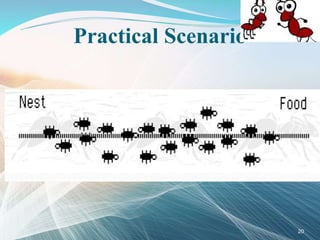
Practical Scenario
20
Practical Scenario
21
Practical Scenario
22
Practical Scenario
23
Apply to ant algorithm to
Routing Protocol
24
Algorithm
2
5
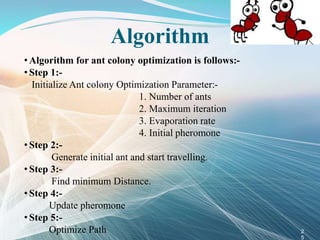
• Algorithm for ant colony optimization is follows:-
• Step 1:-
Initialize Ant colony Optimization Parameter:-
1. Number of ants
2. Maximum iteration
3. Evaporation rate
4. Initial pheromone
• Step 2:-
Generate initial ant and start travelling.
• Step 3:-
Find minimum Distance.
• Step 4:-
Update pheromone
• Step 5:-
Optimize Path
SYSTEM DETAILS
System
Personal Laptop with
core i5 with 2.50 GHz
Environment
(Operating System)
Windows 7
Software MATLAB 2013b
Toolbox Communication Toolbox
RAM 4 GB
26
RESULTS
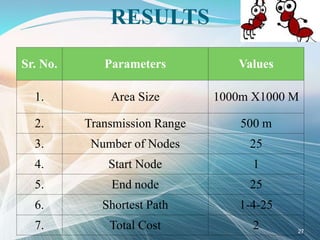
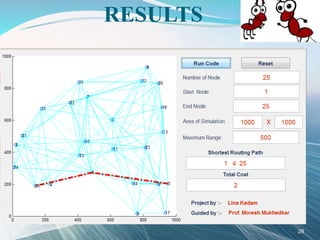
Sr. No. Parameters Values
1. Area Size 1000m X1000 M
2. Transmission Range 500 m
3. Number of Nodes 25
4. Start Node 1
5. End node 25
6. Shortest Path 1-4-25
7. Total Cost 2 27
RESULTS
28
RESULTS
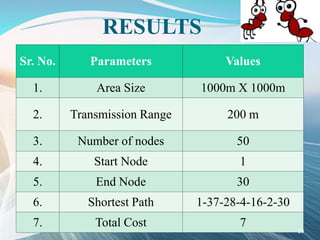
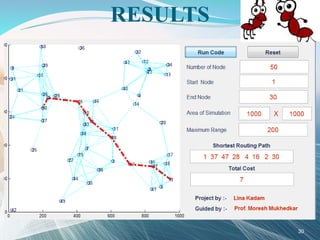
Sr. No. Parameters Values
1. Area Size 1000m X 1000m
2. Transmission Range 200 m
3. Number of nodes 50
4. Start Node 1
5. End Node 30
6. Shortest Path 1-37-28-4-16-2-30
7. Total Cost 7
29
RESULTS
30
RESULTS
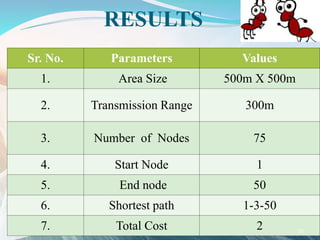
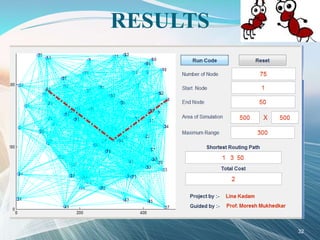
Sr. No. Parameters Values
1. Area Size 500m X 500m
2. Transmission Range 300m
3. Number of Nodes 75
4. Start Node 1
5. End node 50
6. Shortest path 1-3-50
7. Total Cost 2 31
RESULTS
32
RESULTS
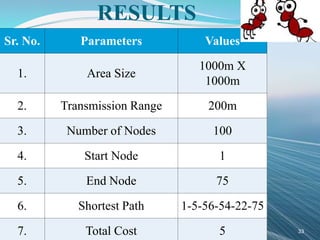
Sr. No. Parameters Values
1. Area Size
1000m X
1000m
2. Transmission Range 200m
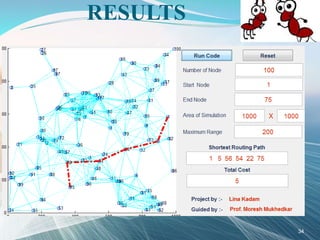
3. Number of Nodes 100
4. Start Node 1
5. End Node 75
6. Shortest Path 1-5-56-54-22-75
7. Total Cost 5 33
RESULTS
34
RESULTS
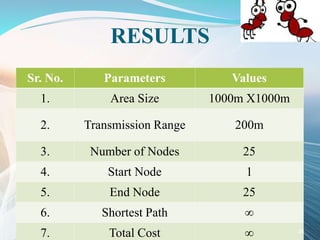
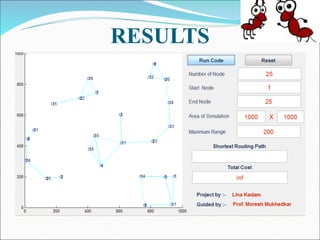
Sr. No. Parameters Values
1. Area Size 1000m X1000m
2. Transmission Range 200m
3. Number of Nodes 25
4. Start Node 1
5. End Node 25
6. Shortest Path ∞
7. Total Cost ∞ 35
RESULTS
36
RESULTS
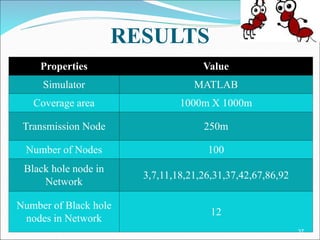
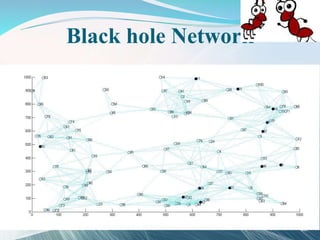
Properties Value
Simulator MATLAB
Coverage area 1000m X 1000m
Transmission Node 250m
Number of Nodes 100
Black hole node in
Network
3,7,11,18,21,26,31,37,42,67,86,92
Number of Black hole
nodes in Network
12
37
Black hole Network
38
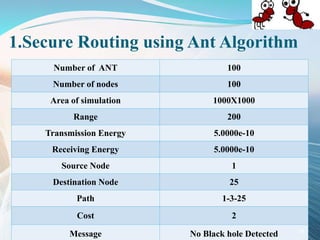
1.Secure Routing using Ant Algorithm
Number of ANT 100
Number of nodes 100
Area of simulation 1000X1000
Range 200
Transmission Energy 5.0000e-10
Receiving Energy 5.0000e-10
Source Node 1
Destination Node 25
Path 1-3-25
Cost 2
Message No Black hole Detected 39
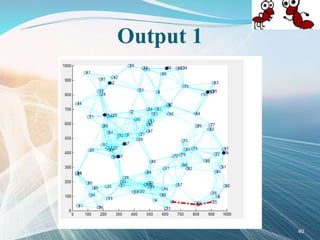
Output 1
40
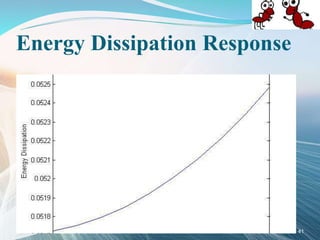
Energy Dissipation Response
41
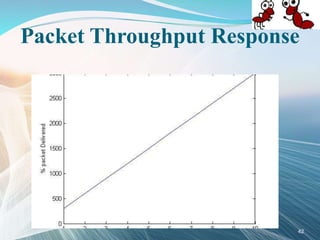
Packet Throughput Response
42
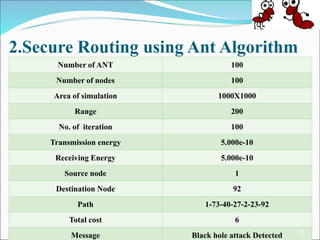
2.Secure Routing using Ant Algorithm
Number of ANT 100
Number of nodes 100
Area of simulation 1000X1000
Range 200
No. of iteration 100
Transmission energy 5.000e-10
Receiving Energy 5.000e-10
Source node 1
Destination Node 92
Path 1-73-40-27-2-23-92
Total cost 6
Message Black hole attack Detected
43
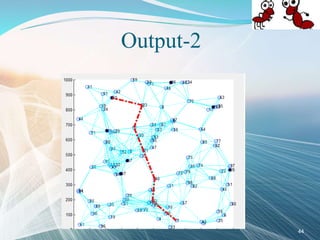
Output-2
44
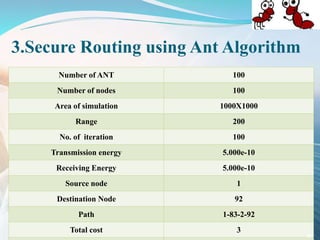
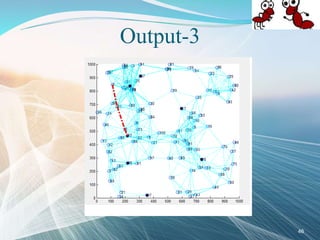
3.Secure Routing using Ant Algorithm
Number of ANT 100
Number of nodes 100
Area of simulation 1000X1000
Range 200
No. of iteration 100
Transmission energy 5.000e-10
Receiving Energy 5.000e-10
Source node 1
Destination Node 92
Path 1-83-2-92
Total cost 3
45
Output-3
46
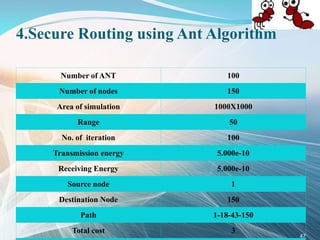
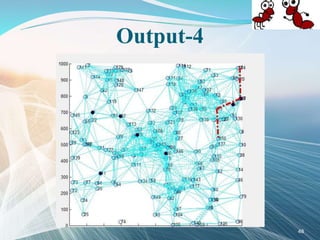
4.Secure Routing using Ant Algorithm
Number of ANT 100
Number of nodes 150
Area of simulation 1000X1000
Range 50
No. of iteration 100
Transmission energy 5.000e-10
Receiving Energy 5.000e-10
Source node 1
Destination Node 150
Path 1-18-43-150
Total cost 3
47
Output-4
48
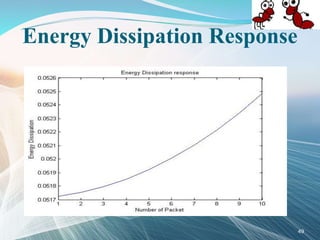
Energy Dissipation Response
49
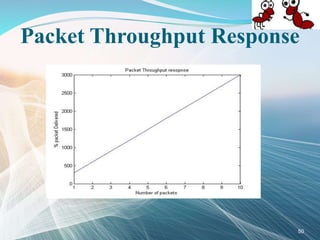
Packet Throughput Response
50
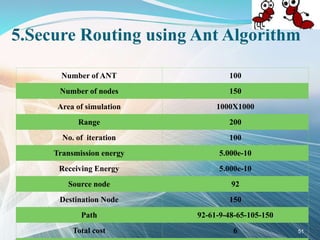
5.Secure Routing using Ant Algorithm
Number of ANT 100
Number of nodes 150
Area of simulation 1000X1000
Range 200
No. of iteration 100
Transmission energy 5.000e-10
Receiving Energy 5.000e-10
Source node 92
Destination Node 150
Path 92-61-9-48-65-105-150
Total cost 6 51
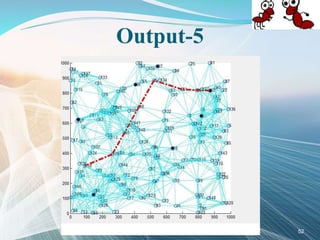
Output-5
52
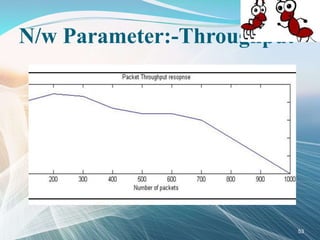
N/w Parameter:-Throughput
53
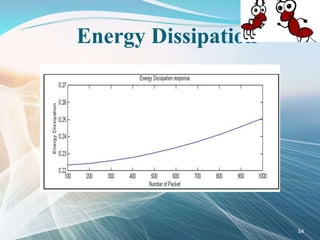
Energy Dissipation
54
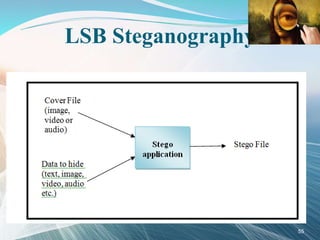
LSB Steganography
55
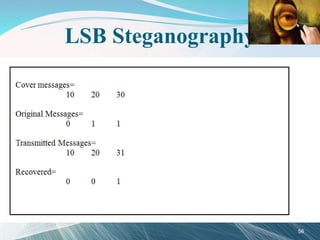
LSB Steganography
56
MANET APPLICATION
• Military Operation
• Emergency Services
• Commercial and civilian
• Home and enterprise
• Education
• Entertainment
• Sensor networks
57
ACO Application
• TSP ( travelling Salesman problem)
• Scheduling Problem
• VRP (vehicle routing problem)
• Telecommunication Network
• Graph coloring
• Water Distribution network
• Set problem
• Power Electronic circuit Design
58
MANET Advantages
• Low cost of deployment
• Fast deployment
• Dynamic Configuration
59
ACO : Advantages
• Positive Feedback accounts for rapid discovery of good
solutions
• Efficient for Travelling Salesman Problem and similar
problems
• Can be used in dynamic applications (adapts to changes
such as new distance, etc)
• The collective interaction of a population agents.
• Distributed computation avoids premature convergence
60
Future Scope
• The compute for pheromone increase and the update of
routing table are important aspects for path setup and
maintain, accordingly, how to use better mathematics model
to update and maintain routing table is our future work.
• We also improve the standard of mobile ad hoc network so as
to overcome the issues and challenges posed by them.
• In future the velocity of each individual must be updated by
taking the best element found in all iteration rather than that
of the current iteration only.
61
Conclusions
• With an ACO algorithm the shortest path, between Source
and Destination is built from a combination of Several
Paths
• Ant mark the best solution and take account of previous
marking to optimize their search.
• ACO is a recently proposed metaheuristic approach for
solving hard combinatorial optimization Problems
approach.
62
Bibliography
• Paratha Sarathi Banerjee, Krishanu Das, Subhankar Das, S.R. Bandra Chaudhuri
“AMSPR: A secure Multipath Routing in Mobile Ad hoc Networks (MANET)” IEEE 2014.
• Jeevan Kumar, Sachin Tripathi, Rajesh Kumar Tiwari “Routing protocols for Wireless
sensor networks using Swarm intelligence- ACO with ECPSOA” IEEE 2016.
• Ashima Rout, Srinivas Sethi, Debajoyti Mishra “Optimized Ant Based Routing Protocol
for MANET” ICCCS 2011.
• Anuj K. Gupta, Harsh Sadawarti, and Anil K. Verma “MANET Routing Protocols Based
on Ant colony Optimization” International Journal of Modeling and optimization, vol.
2, No. 1, February 2012.
• Abdur Rahaman Sardar, Moutushi Singh “An Efficient Ant Colony Based Routing
Algorithm for Better Quality of Services in MANET” Springer International Publishing
Switzerland 2014.
• Anjali Jagtap, Ashok Shinde, Smita Kadam “Implementation of Optimized Ant Based Routing
Algorithm for MANET” International Research Journal of Engineering and Technology
(IRJET), volume 4, Issue 6, June -2017.
63
Bibliography
• Chintan Kanani, Amit Sinhal “Ant Colony Optimization Based Modified AOMDV for
Multipath Routing in MANET” International Journal of Computer Applications, Volume
82- no. 10, November 2013.
• WAN-JUN YU, GUO-MING ZUO, QIANQ-QIAN LI “Ant Colony Optimization for
Routing in Mobile Ad hoc Networks” IEEE 2008.
• B. Nancharaiah, B. Chandra Mohan “Modified Ant Colony Optimization to Enhance
MANET Routing in Ad hoc on Demand Distance vector” Second International Conference
on Business and Information Management (ICBIM), 2014.
• Dr. Madhumita Dash, Mrs. Madhusmita Balabantaray “Routing Problem: MANET And Ant
Colony Algorithm” International Journal of Research in computer and Communication
Technology, Vol 3, Issue 9, September-2014.
• A. M. Oranj, R. M. Alguliev and Farhad Yusifov “Routing Algorithm for Vehicular Ad hoc
Network Based on Dynamic Ant Colony Optimization” International Journal of Electronics
and Electrical Engineering Vol. 4, No.1, February 2016.
64
Thank you!
65

AntColonyOptimizationManetNetworkAODV.pptx

  • 1.
    “A Development ofsecure and optimized Routing protocol using Ant Algorithm” Presented by Ms. Lina Tukaram Kadam E & TC DEPARTMENT 1
  • 2.
    Outline • Introduction • LiteratureSurvey • Problem Definition • Taxonomy of network attacks • System Design Methodology • Algorithm • Results • Applications • Advantages • Future Scope • Conclusions • Bibliography 2
  • 3.
    • Ad HocNetwork:- • Ad hoc networks are collections of mobile nodes with links that are made or broken in an arbitrary way. • No centralized controller and infrastructure. • Allows free mobility • Node acts as host and router to assist in transmitting data to other nodes in its range. • Can be quickly and inexpensively setup • Applications: military, emergency and disaster situations. Introduction 3
  • 4.
  • 5.
    Introduction (Cont’d…..) • ANTAlgorithm:- • Swarm Intelligence(SI) is artificial Intelligence based on the collective behavior of decentralized, Self- organized systems. • Swarm based routing algorithm uses the operation of biological of insects such as ants, honeybees, birds, termites, fish, fog etc. • So we use the Ant algorithm to find out the shortest path between source to destination. 5
  • 6.
    Example of SI:-Bird Flocking Introduction (Cont’d…..) 6
  • 7.
    Example of SI:-Fish Schooling Introduction (Cont’d…..) 7
  • 8.
    Example of SI:-Ant Colonies Introduction (Cont’d…..) 8
  • 9.
    Literature Survey S. N.Name of Author Title Publication Description 1 Paratha Sarathi Banerjee, Krishanu Das, Subhankar Das, S. R. Bhadra Chaudhuri. AMSPR: A Secure Multipath Routing in Mobile Ad hoc Networks (MANET) IEEE,2014 In this Paper, AMSPR (All-or –nothing Transformation based secure Multipath Routing) is a routing technique is used when the encrypted secret message is split into multiple shares. 2 Jeevan Kumar Routing Protocol for wireless Sensor networks Using Swarm Intelligence ACO with ECPSOA. IEEE 2016 A routing algorithm that has an ACO algorithm with an endocrine co-operative particle swarm optimization algorithm (ECPSOA) is used to improve the various parameters in WSNs routing. 3 Ashima Rout Optimized Ant Based Routing Protocol for MANET ICCCS 2011 In this paper, we introduce a new ant based routing protocol to optimized the route discovery and maximize the efficiency of routing in the terms op Packet delivery ratio (PDR) using the blocking expanding ring search (Blocking-ERS) third party route reply, local route repair and n hop ring Technique. 9
  • 10.
    Literature Survey S. N Nameof Author Title Publication Description 4. Anuj K. Gupta MANET Routing Protocols based on Ant colony Optimization International Journal of Modeling and optimization, vol. 2, No.1, February 2012 Ant colony Optimization is good technique for developing routing algorithms for ad hoc networks. 5. Abdur Rahaman Sardar An Efficient Ant Colony Based Routing Algorithm for better Quality of Services in MANET Springer International Publishing Switzerland 2014. In this paper, we have presented a new on demand QOS routing algorithm for MANET with the concept of ACO. This algorithm based on Swarm Intelligence. 6. Anjali Jagtap Implementation of Optimized Ant Based Routing Algorithm for MANET IRJET, volume 4,Issue 6, June- 2017 In this paper, Ant routing algorithm (ARA) is implemented for different network condition with evaluation parameter such as throughput, packet Delivery Ratio. 10
  • 11.
    Problem Definition • Challengesin mobile ad hoc networks:- 1. Quality of Service (QoS) 2.Scalability 3. Security 4.Security Approach 5.Routing 6.Power control 7.Performance of Measurement of MANET 8.Cooperation between nodes 9.Signal Fading 10.Mobility 11
  • 12.
    Taxonomy of NetworkAttacks Attacks External and Internal Attacks Active and Passive Attacks Stalling Classification Of Routing attacks Modification of attacks Interception attacks Fabrication attacks Interruption attacks Network layer Attacks Black hole attacks Rushing attacks Warm hole attacks Sinkhole attacks Replay attacks Link with holding and spoofing attacks Resource Consumption attacks Sybill attacks 12
  • 13.
  • 14.
  • 15.
    System Design Methodology •In this system, the are of the project divides into four parts and they are following:- • Mobile Ad hoc Network (MANET) • MANET Routing Protocol • AODV Routing Protocol • Ant Colony Optimization (ACO) 15
  • 16.
    Mobile Ad hocNetwork 16
  • 17.
  • 18.
  • 19.
  • 20.
  • 21.
  • 22.
  • 23.
  • 24.
    Apply to antalgorithm to Routing Protocol 24
  • 25.
    Algorithm 2 5 • Algorithm forant colony optimization is follows:- • Step 1:- Initialize Ant colony Optimization Parameter:- 1. Number of ants 2. Maximum iteration 3. Evaporation rate 4. Initial pheromone • Step 2:- Generate initial ant and start travelling. • Step 3:- Find minimum Distance. • Step 4:- Update pheromone • Step 5:- Optimize Path
  • 26.
    SYSTEM DETAILS System Personal Laptopwith core i5 with 2.50 GHz Environment (Operating System) Windows 7 Software MATLAB 2013b Toolbox Communication Toolbox RAM 4 GB 26
  • 27.
    RESULTS Sr. No. ParametersValues 1. Area Size 1000m X1000 M 2. Transmission Range 500 m 3. Number of Nodes 25 4. Start Node 1 5. End node 25 6. Shortest Path 1-4-25 7. Total Cost 2 27
  • 28.
  • 29.
    RESULTS Sr. No. ParametersValues 1. Area Size 1000m X 1000m 2. Transmission Range 200 m 3. Number of nodes 50 4. Start Node 1 5. End Node 30 6. Shortest Path 1-37-28-4-16-2-30 7. Total Cost 7 29
  • 30.
  • 31.
    RESULTS Sr. No. ParametersValues 1. Area Size 500m X 500m 2. Transmission Range 300m 3. Number of Nodes 75 4. Start Node 1 5. End node 50 6. Shortest path 1-3-50 7. Total Cost 2 31
  • 32.
  • 33.
    RESULTS Sr. No. ParametersValues 1. Area Size 1000m X 1000m 2. Transmission Range 200m 3. Number of Nodes 100 4. Start Node 1 5. End Node 75 6. Shortest Path 1-5-56-54-22-75 7. Total Cost 5 33
  • 34.
  • 35.
    RESULTS Sr. No. ParametersValues 1. Area Size 1000m X1000m 2. Transmission Range 200m 3. Number of Nodes 25 4. Start Node 1 5. End Node 25 6. Shortest Path ∞ 7. Total Cost ∞ 35
  • 36.
  • 37.
    RESULTS Properties Value Simulator MATLAB Coveragearea 1000m X 1000m Transmission Node 250m Number of Nodes 100 Black hole node in Network 3,7,11,18,21,26,31,37,42,67,86,92 Number of Black hole nodes in Network 12 37
  • 38.
  • 39.
    1.Secure Routing usingAnt Algorithm Number of ANT 100 Number of nodes 100 Area of simulation 1000X1000 Range 200 Transmission Energy 5.0000e-10 Receiving Energy 5.0000e-10 Source Node 1 Destination Node 25 Path 1-3-25 Cost 2 Message No Black hole Detected 39
  • 40.
  • 41.
  • 42.
  • 43.
    2.Secure Routing usingAnt Algorithm Number of ANT 100 Number of nodes 100 Area of simulation 1000X1000 Range 200 No. of iteration 100 Transmission energy 5.000e-10 Receiving Energy 5.000e-10 Source node 1 Destination Node 92 Path 1-73-40-27-2-23-92 Total cost 6 Message Black hole attack Detected 43
  • 44.
  • 45.
    3.Secure Routing usingAnt Algorithm Number of ANT 100 Number of nodes 100 Area of simulation 1000X1000 Range 200 No. of iteration 100 Transmission energy 5.000e-10 Receiving Energy 5.000e-10 Source node 1 Destination Node 92 Path 1-83-2-92 Total cost 3 45
  • 46.
  • 47.
    4.Secure Routing usingAnt Algorithm Number of ANT 100 Number of nodes 150 Area of simulation 1000X1000 Range 50 No. of iteration 100 Transmission energy 5.000e-10 Receiving Energy 5.000e-10 Source node 1 Destination Node 150 Path 1-18-43-150 Total cost 3 47
  • 48.
  • 49.
  • 50.
  • 51.
    5.Secure Routing usingAnt Algorithm Number of ANT 100 Number of nodes 150 Area of simulation 1000X1000 Range 200 No. of iteration 100 Transmission energy 5.000e-10 Receiving Energy 5.000e-10 Source node 92 Destination Node 150 Path 92-61-9-48-65-105-150 Total cost 6 51
  • 52.
  • 53.
  • 54.
  • 55.
  • 56.
  • 57.
    MANET APPLICATION • MilitaryOperation • Emergency Services • Commercial and civilian • Home and enterprise • Education • Entertainment • Sensor networks 57
  • 58.
    ACO Application • TSP( travelling Salesman problem) • Scheduling Problem • VRP (vehicle routing problem) • Telecommunication Network • Graph coloring • Water Distribution network • Set problem • Power Electronic circuit Design 58
  • 59.
    MANET Advantages • Lowcost of deployment • Fast deployment • Dynamic Configuration 59
  • 60.
    ACO : Advantages •Positive Feedback accounts for rapid discovery of good solutions • Efficient for Travelling Salesman Problem and similar problems • Can be used in dynamic applications (adapts to changes such as new distance, etc) • The collective interaction of a population agents. • Distributed computation avoids premature convergence 60
  • 61.
    Future Scope • Thecompute for pheromone increase and the update of routing table are important aspects for path setup and maintain, accordingly, how to use better mathematics model to update and maintain routing table is our future work. • We also improve the standard of mobile ad hoc network so as to overcome the issues and challenges posed by them. • In future the velocity of each individual must be updated by taking the best element found in all iteration rather than that of the current iteration only. 61
  • 62.
    Conclusions • With anACO algorithm the shortest path, between Source and Destination is built from a combination of Several Paths • Ant mark the best solution and take account of previous marking to optimize their search. • ACO is a recently proposed metaheuristic approach for solving hard combinatorial optimization Problems approach. 62
  • 63.
    Bibliography • Paratha SarathiBanerjee, Krishanu Das, Subhankar Das, S.R. Bandra Chaudhuri “AMSPR: A secure Multipath Routing in Mobile Ad hoc Networks (MANET)” IEEE 2014. • Jeevan Kumar, Sachin Tripathi, Rajesh Kumar Tiwari “Routing protocols for Wireless sensor networks using Swarm intelligence- ACO with ECPSOA” IEEE 2016. • Ashima Rout, Srinivas Sethi, Debajoyti Mishra “Optimized Ant Based Routing Protocol for MANET” ICCCS 2011. • Anuj K. Gupta, Harsh Sadawarti, and Anil K. Verma “MANET Routing Protocols Based on Ant colony Optimization” International Journal of Modeling and optimization, vol. 2, No. 1, February 2012. • Abdur Rahaman Sardar, Moutushi Singh “An Efficient Ant Colony Based Routing Algorithm for Better Quality of Services in MANET” Springer International Publishing Switzerland 2014. • Anjali Jagtap, Ashok Shinde, Smita Kadam “Implementation of Optimized Ant Based Routing Algorithm for MANET” International Research Journal of Engineering and Technology (IRJET), volume 4, Issue 6, June -2017. 63
  • 64.
    Bibliography • Chintan Kanani,Amit Sinhal “Ant Colony Optimization Based Modified AOMDV for Multipath Routing in MANET” International Journal of Computer Applications, Volume 82- no. 10, November 2013. • WAN-JUN YU, GUO-MING ZUO, QIANQ-QIAN LI “Ant Colony Optimization for Routing in Mobile Ad hoc Networks” IEEE 2008. • B. Nancharaiah, B. Chandra Mohan “Modified Ant Colony Optimization to Enhance MANET Routing in Ad hoc on Demand Distance vector” Second International Conference on Business and Information Management (ICBIM), 2014. • Dr. Madhumita Dash, Mrs. Madhusmita Balabantaray “Routing Problem: MANET And Ant Colony Algorithm” International Journal of Research in computer and Communication Technology, Vol 3, Issue 9, September-2014. • A. M. Oranj, R. M. Alguliev and Farhad Yusifov “Routing Algorithm for Vehicular Ad hoc Network Based on Dynamic Ant Colony Optimization” International Journal of Electronics and Electrical Engineering Vol. 4, No.1, February 2016. 64
  • 65.