PRESENT PROGRESSIVE
It is the now-happening thing.....
The present progressive is formed
by combining the verb "to be" with
the present participle. (The present
participle is merely the "-ing" form
of a verb.)
I am studying.
I am studying with María.
In English, present progressive
can be used to describe what is
happening now, or what will
happen in the future.
I am studying now.
I am studying with María tonight.
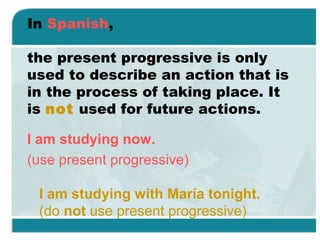
In Spanish,
the present progressive is only
used to describe an action that is
in the process of taking place. It
is not used for future actions.
I am studying now.
(use present progressive)
I am studying with María tonight.
(do not use present progressive)
To form the present progressive
in Spanish,
combine a form of "estar" with the
present participle.
PRESENT PROGRESSIVE
Estoy hablando.
I am speaking.
Juan está comiendo.
John is eating.
María está escribiendo una carta.
Mary is writing a letter.
In order to form the present
progressive,
you must know how to conjugate
the verb estar, and how to form
the present participle.
You already know how to
conjugate the verb estar:
estar
estoy
estás
está
estamos
estáis
están
To form the present participle of
regular -ar verbs,
add -ando to the stem of the verb.
hablar: hablando
(hablar - ar + ando)
trabajar: trabajando
(trabajar - ar + ando)
estudiar: estudiando
(estudiar - ar + ando)
To form the present participle of
regular -er and -ir verbs,
add -iendo to the stem of the verb
comer: comiendo
(comer - er + iendo)
hacer: haciendo
(hacer - er + iendo)
vivir: viviendo
(vivir - ir + iendo)
escribir: escribiendo
(escribir - ir + iendo)
To form the present participle of
-ir stem changing verbs,
change e:i
and
o:u
in the stem
and then add -iendo to the stem
of the verb.
servir: sirviendo
pedir: pidiendo
decir: diciendo
dormir: durmiendo
morir: muriendo
poder: pudiendo
Sometimes when forming the present
participle it is necessary to change
the spelling of a word so that it
agrees with the way it is pronounced.
We call this an "orthographic"
change.
Here are some common
examples:
caer: cayendo
creer: creyendo
huir: huyendo
ir: yendo
influir: influyendo
oír: oyendo
traer: trayendo
leer: leyendo
seguir: siguiendo
The following examples illustrate the rules
for forming the present participle.
hablar: hablando (-ar)
comer: comiendo (-er)
vivir: viviendo (-ir)
decir: diciendo (e:i)
dormir: durmiendo (o:u)
leer: leyendo (orthographic)
seguir: siguiendo (orthographic)
María y Carmen están hablando conmigo.
Remember, only use the present progressive
for actions that are "in progress."

present progressive

  • 1.
    PRESENT PROGRESSIVE It isthe now-happening thing.....
  • 2.
    The present progressiveis formed by combining the verb "to be" with the present participle. (The present participle is merely the "-ing" form of a verb.) I am studying. I am studying with María.
  • 3.
    In English, presentprogressive can be used to describe what is happening now, or what will happen in the future. I am studying now. I am studying with María tonight.
  • 4.
    In Spanish, the presentprogressive is only used to describe an action that is in the process of taking place. It is not used for future actions. I am studying now. (use present progressive) I am studying with María tonight. (do not use present progressive)
  • 5.
    To form thepresent progressive in Spanish, combine a form of "estar" with the present participle.
  • 6.
    PRESENT PROGRESSIVE Estoy hablando. Iam speaking. Juan está comiendo. John is eating. María está escribiendo una carta. Mary is writing a letter.
  • 7.
    In order toform the present progressive, you must know how to conjugate the verb estar, and how to form the present participle.
  • 8.
    You already knowhow to conjugate the verb estar: estar estoy estás está estamos estáis están
  • 9.
    To form thepresent participle of regular -ar verbs, add -ando to the stem of the verb.
  • 10.
    hablar: hablando (hablar -ar + ando) trabajar: trabajando (trabajar - ar + ando) estudiar: estudiando (estudiar - ar + ando)
  • 11.
    To form thepresent participle of regular -er and -ir verbs, add -iendo to the stem of the verb
  • 12.
    comer: comiendo (comer -er + iendo) hacer: haciendo (hacer - er + iendo) vivir: viviendo (vivir - ir + iendo) escribir: escribiendo (escribir - ir + iendo)
  • 13.
    To form thepresent participle of -ir stem changing verbs, change e:i and o:u in the stem and then add -iendo to the stem of the verb.
  • 14.
    servir: sirviendo pedir: pidiendo decir:diciendo dormir: durmiendo morir: muriendo poder: pudiendo
  • 15.
    Sometimes when formingthe present participle it is necessary to change the spelling of a word so that it agrees with the way it is pronounced. We call this an "orthographic" change.
  • 16.
    Here are somecommon examples: caer: cayendo creer: creyendo huir: huyendo ir: yendo influir: influyendo oír: oyendo traer: trayendo leer: leyendo seguir: siguiendo
  • 17.
    The following examplesillustrate the rules for forming the present participle. hablar: hablando (-ar) comer: comiendo (-er) vivir: viviendo (-ir) decir: diciendo (e:i) dormir: durmiendo (o:u) leer: leyendo (orthographic) seguir: siguiendo (orthographic)
  • 18.
    María y Carmenestán hablando conmigo. Remember, only use the present progressive for actions that are "in progress."