Software Project Management
UNIT 1
An Introduction
Software project management (6e) - introduction ©
The McGraw-Hill Companies, 2017 1
Thought of the Day
“Don’t think of anything as difficult...
Know that we have an even greater
power within and according to that we
get tasks to do.”
--Sri Sri Ravi Shankar
Concept to be covered
• Software Project Management
• Difference with other projects
• Jobs, projects, and exploration
• What makes software project planning difficult?
• Project scope
Software project management (6e) - introduction ©
The McGraw-Hill Companies, 2018 3
IT Spending Worldwide (US $): Gartner
4
Software Crisis…
• We have a software crisis!
• What are the symptoms of the software
crisis?
Fail to meet user requirements.
Expensive.
Difficult to alter, debug, and enhance.
Often delivered late.
Software project management (5e) - introduction ©
The McGraw-Hill Companies, 2009 5
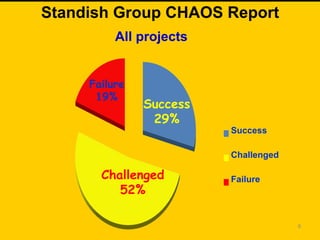
Standish Group CHAOS Report
All projects
Success
Challenged
Failure
6
Failure
19%
Challenged
52%
Success
29%
Software Crisis
(cont.)
Year
Hw cost
Sw cost
Relative Cost of Hardware and Software
7
1960 2019
Laptop or Desktop = Rs.45,000/-
Rational suite node locked =
Rs.3,14,600/-
Rational suite floating license=
Rs.6,03,200/-
Then why not have entirely hardware
systems?
• Virtue of software:
Relatively easy to change…
Consumes no space, weight, or power…
• Otherwise all might as well be hardware.
Software project management (5e) - introduction ©
The McGraw-Hill Companies, 2009 8
Software Characteristics
• Two important characteristics:
The more is the complexity of software, the
harder it is to change --- why?
The more the changes made to a program, the
greater becomes its complexity.
Software project management (5e) - introduction ©
The McGraw-Hill Companies, 2009 9
Which Factors are the Key Contributors to the
Software Crisis?
Larger problems
Poor project management
Lack of adequate training in software engineering
Increasing skill shortage and manpower turnover
Low productivity improvements.
Software project management (5e) - introduction ©
The McGraw-Hill Companies, 2009 10
Why is project management
important?
• Large amounts of money are spent on ICT e.g.
UK government in 2003-4 spent £2.3 billions on
contracts for ICT and only £1.4 billions on road
building
• Project often fail – Standish Group claim only a
third of ICT projects are successful. 82% were
late and 43% exceeded their budget.
• Poor project management a major factor in
these failures
Software project management (6e) - introduction ©
The McGraw-Hill Companies, 2017 11
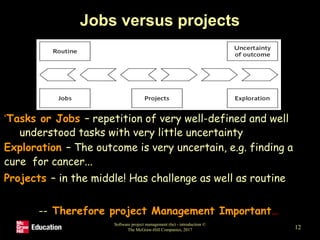
Jobs versus projects
•‘Tasks or Jobs – repetition of very well-defined and well
understood tasks with very little uncertainty
•Exploration – The outcome is very uncertain, e.g. finding a
cure for cancer...
•Projects – in the middle! Has challenge as well as routine
-- Therefore project Management Important…
Software project management (6e) - introduction ©
The McGraw-Hill Companies, 2017 12
What is a project?
Some dictionary definitions:
“A specific plan or design”
“A planned undertaking”
“A large undertaking e.g. a public works scheme”
Longmans dictionary
Key points above are planning and size of task
Software project management (6e) - introduction ©
The McGraw-Hill Companies, 2017 13
What is a Project?
• An endeavor with specific objectives:
• Usually consists of multiple tasks
• With defined precedence relationships
• With a specific time period for completion
• Non-Software Examples:
• A wedding
• An MBA degree
• A house construction project
• A political election campaign
Software project management (6e) - introduction ©
The McGraw-Hill Companies, 2017
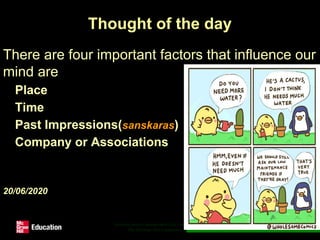
Thought of the day
There are four important factors that influence our
mind are
• Place
• Time
• Past Impressions(sanskaras)
• Company or Associations
20/06/2020
Software project management (5e) - introduction ©
The McGraw-Hill Companies, 2009 15
What is a Task?
• A small piece of work:
• Meant to accomplish a straightforward goal
• Effort of no longer than a few person-hours
• Involves only a few people
• May or may not be a part of some project
• Usually repetition of a previously accomplished task
• Process management may be relevant!
• Non-software Examples:
• Attend a lecture / class
• Buy a chocolate from the market
• Book a railway ticket
Characteristics of projects
A task is more ‘project-like’ if it is:
• Non-routine
• Planned
• Aiming at a specific target
• Carried out for a customer
• Carried out by a temporary work group
• Involving several specialisms
• Made up of several different phases
• Constrained by time and resources
• Large and/or complex
Software project management (6e) - introduction ©
The McGraw-Hill Companies, 2017 17
Project Stakeholders
● Project stakeholders are individuals and organizations that are
actively involved in the project, or whose interests may be
positively or negatively affected as a result of project execution or
project completion; they may also exert influence over the project
and its results.
● Key Stakeholders
Project manager —the individual responsible for managing the
project.
Customer —the individual or organization that will use the project's
product
or service.
Project team members —the group that is performing the work of the
project.
Sponsor—the individual or group that provides the financial
resources for the project.
−
Software project management (5e) - introduction ©
The McGraw-Hill Companies, 2009 18
Project Scope
It is what needs to be achieved and the work that
must be done to deliver a project.
A list of specific goals, deliverables, tasks, deadlines,
and costs.
Software project management (5e) - introduction ©
The McGraw-Hill Companies, 2009 19
Are software projects really different
from other projects?
Not really …but... The factors
• Invisibility
• Complexity
• Conformity
• Flexibility
make software more problematic to
build than other engineered artefacts.
Software project management (6e) - introduction ©
The McGraw-Hill Companies, 2017 20
Contract management versus technical
project management
Projects can be:
• In-house: clients and developers are employed
by the same organization
• Out-sourced: clients and developers employed
by different organizations
• ‘Project manager’ could be:
• a ‘contract manager’ in the client organization
• a technical project manager in the
supplier/services organization
Software project management (6e) - introduction ©
The McGraw-Hill Companies, 2017 21
Activities covered by project management
Feasibility study
Is project technically feasible and worthwhile from a business
point of view?
Planning
Only done if project is feasible
Execution
Implement plan, but plan may be changed as we go along
Software project management (6e) - introduction ©
The McGraw-Hill Companies, 2017 22
Thought of the day
“Do everything happily. Walk, talk, sit
happily; even if you complain against
somebody, do it happily…☺”
-- Sri Sri Ravi Shankar
Software project management (5e) - introduction ©
The McGraw-Hill Companies, 2009 23
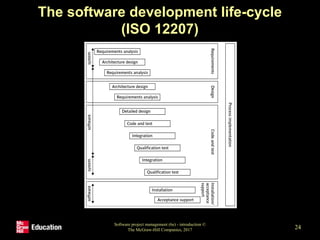
The software development life-cycle
(ISO 12207)
Software project management (6e) - introduction ©
The McGraw-Hill Companies, 2017 24
ISO 12207 life-cycle
• Requirements analysis
• Requirements elicitation: what does the client
need?
• Analysis: converting ‘customer-facing’
requirements into equivalents that developers
can understand
• Requirements will cover
•Functions
•Quality
•Resource constraints i.e. costs
Software project management (6e) - introduction ©
The McGraw-Hill Companies, 2017 25
ISO 12207 life-cycle
• Architecture design
• Based on system requirements
• Defines components of system: hardware,
software, organizational
• Software requirements will come out of this
• Code and test
• Of individual components
• Integration
• Putting the components together
Software project management (6e) - introduction ©
The McGraw-Hill Companies, 2017 26
ISO12207 continued
• Qualification testing
• Testing the system (not just the software)
• Installation
• The process of making the system operational
• Includes setting up standing data, setting system
parameters, installing on operational hardware
platforms, user training etc
• Acceptance support
• Including maintenance and enhancement
Software project management (6e) - introduction ©
The McGraw-Hill Companies, 2017 27
Plans, methods and methodologies
Software project management (6e) - introduction ©
The McGraw-Hill Companies, 2017 28
Methods
Methodology = a set of
methods
Plan
Context
A way of working
+ start and end dates for each activity,
staffing, tools and materials etc
Some ways of categorizing projects
Distinguishing different types of project is important
as different types of task need different project
approaches e.g.
• Voluntary systems (such as computer games)
versus compulsory systems e.g. the order
processing system in an organization
• Information systems versus embedded systems
• Objective-based versus product-based
• Product-development versus outsourced
Software project management (6e) - introduction ©
The McGraw-Hill Companies, 2017 29
A Categorization of Software Projects
Software project management (5e) - introduction ©
The McGraw-Hill Companies, 2009 30
Thought of the day
“There is nothing to worry about. There
will be tough times, nice times, good times
and bad times. They all come in life and
go. Nothing stays.…☺”
-- Sri Sri Ravi Shankar
23/06/2020
31
Software project management (6e) - introduction ©
The McGraw-Hill Companies, 2009
Two Types of Software Projects
• Software product development
projects
• Software services projects
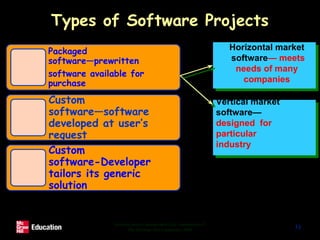
Types of Software Projects
Packaged
software—prewritten
software available for
purchase
Custom
software—software
developed at user’s
request
Custom
software-Developer
tailors its generic
solution
Software project management (5e) - introduction ©
The McGraw-Hill Companies, 2009 33
Horizontal market
software— meets
needs of many
companies
Vertical market
software—
designed for
particular
industry
Another Software Classification
● Information Systems:
− Store data, process data, present data and statistics
− Example: MIS, Hotel Management software, Patient
Management software, etc
− Web-based software versus Stand-alone software
● Embedded software:
− Controls hardware
− Example: Automobile control software, Nuclear plant
control software, robots, toys, TV remote
Software project management (5e) - introduction ©
The McGraw-Hill Companies, 2009 34
Software Services
• Software service is an umbrella term,
includes:
• Software customization
• Software maintenance
• Software testing
• Also contract programmers who carry out
coding or any other assigned activities.
Stakeholders
These are people who have a stake or interest in the project
In general, they could be users/clients or
developers/implementers
They could be:
• Within the project team
• Outside the project team, but within the same
organization
• Outside both the project team and the organization
Different stakeholders may have different objectives – need
to define common project objectives
Software project management (6e) - introduction ©
The McGraw-Hill Companies, 2017 36
Setting objectives
• Answering the question ‘What do we have to do
to have a success?’
• Need for a project authority
• Sets the project scope
• Allocates/approves costs
• Could be one person - or a group
• Project Board
• Project Management Board
• Steering committee
Software project management (6e) - introduction ©
The McGraw-Hill Companies, 2017 37
Objectives
Informally, the objective of a project can be
defined by completing the statement:
The project will be regarded as a success
if……….
…………
Rather like post-conditions for the project
Focus on what will be put in place, rather than
how activities will be carried out
Software project management (6e) - introduction ©
The McGraw-Hill Companies, 2017 38
Objectives should be SMART
S – specific, that is, concrete and well-defined
M – measurable, that is, satisfaction of the objective
can be objectively judged
A – achievable, that is, it is within the power of the
individual or group concerned to meet the target
R – relevant, the objective must relevant to the true
purpose of the project
T – time constrained: there is defined point in time
by which the objective should be achieved
Software project management (6e) - introduction ©
The McGraw-Hill Companies, 2017 39
Thought of the Day
“Never label yourself. Learn from the past and
move on. Feelings come and go. They are never
stationary. Neither blame others nor yourself.”
--Sri Sri Ravi Shankar
25/06/20
Goals/sub-objectives
These are steps along the way to achieving the Objective
informally, these can be defined by completing the sentence
To reach objective X, the following must be in place
A……………
B……………
C…………… etc
Software project management (6e) - introduction ©
The McGraw-Hill Companies, 2017 41
Goals/sub-objectives continued
Often a goal can be allocated to an individual
Individual might have the capability of achieving
goal on their own, but not the overall objective
e.g.
Overall objective – user satisfaction with software
product
Analyst goal – accurate requirements
Developer goal – reliable software
Software project management (6e) - introduction ©
The McGraw-Hill Companies, 2017 42
Measures of effectiveness
How do we know that the goal or objective has been
achieved?
By a practical test, that can be objectively assessed.
e.g. for user satisfaction with software product:
• Repeat business – they buy further products from
us
• Number of complaints – if low etc etc
Software project management (6e) - introduction ©
The McGraw-Hill Companies, 2017 43
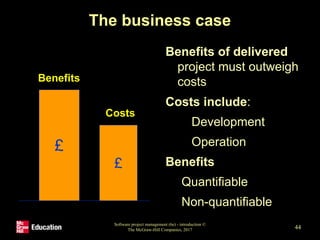
The business case
Benefits of delivered
project must outweigh
costs
Costs include:
- Development
- Operation
Benefits
Quantifiable
Non-quantifiable
Software project management (6e) - introduction ©
The McGraw-Hill Companies, 2017 44
£
£
Benefits
Costs
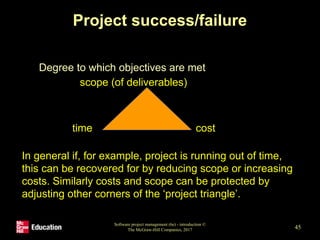
Project success/failure
• Degree to which objectives are met
Software project management (6e) - introduction ©
The McGraw-Hill Companies, 2017 45
scope (of deliverables)
time cost
In general if, for example, project is running out of time,
this can be recovered for by reducing scope or increasing
costs. Similarly costs and scope can be protected by
adjusting other corners of the ‘project triangle’.
Other success criteria
These can relate to longer term, less directly
tangible assets
• Improved skill and knowledge
• Creation of assets that can be used on future
projects e.g. software libraries
• Improved customer relationships that lead to
repeat business
Software project management (6e) - introduction ©
The McGraw-Hill Companies, 2017 46
What is management?
This involves the following activities:
• Planning – deciding what is to be done
• Organizing – making arrangements
• Staffing – selecting the right people for the
job
• Directing – giving instructions
continued…
Software project management (6e) - introduction ©
The McGraw-Hill Companies, 2017 47
What is management?
(continued)
• Monitoring – checking on progress
• Controlling – taking action to remedy
hold-ups
• Innovating – coming up with solutions
when problems emerge
• Representing – liaising with clients,
users, developers and other stakeholders
Software project management (6e) - introduction ©
The McGraw-Hill Companies, 2017 48
Project Planning
• Carried out before development starts.
• Important activities:
• Estimation
• Scheduling
• Staffing
• Risk management
• Miscellaneous plans
Software project management (6e) - introduction ©
The McGraw-Hill Companies, 2017 49
Thought of the Day
“Every moment you spend on this planet,
remember that you are here for a unique purpose
and cause, far greater than to just eat, sleep, and
talk.”
--Sri Sri Ravi Shankar
25/06/20
Traditional versus Modern Project
Management
• Projects are increasingly being based on either
tailoring some existing product or reusing certain
pre-built libraries.
• Facilitating and accommodating client feedbacks
• Facilitating customer participation in project
development work
• Incremental delivery of the product with evolving
functionalities.
Software project management (6e) - introduction ©
The McGraw-Hill Companies, 2017 51
Management control
Software project management (6e) - introduction ©
The McGraw-Hill Companies, 2017 52
Management control
Data – the raw details
e.g. ‘6,000 documents processed at location X’
Information – the data is processed to produce
something that is meaningful and useful
e.g. ‘productivity is 100 documents a day’
Comparison with objectives/goals
e.g. we will not meet target of processing all
documents by 31st
March
continued…..
Software project management (5e) - introduction ©
The McGraw-Hill Companies, 2009 53
Management control - continued
Modelling – working out the probable outcomes of
various decisions
e.g. if we employ two more staff at location X how
quickly can we get the documents processed?
Implementation – carrying out the remedial actions
that have been decided upon
Software project management (5e) - introduction ©
The McGraw-Hill Companies, 2009 54
Project Management Processes
Software project management (5e) - introduction ©
The McGraw-Hill Companies, 2009 55
In the project initiation stage, an initial plan is made.
As the project starts, the project is executed and
controlled to proceed as planned. Finally, the project
is closed.
Project Management Life Cycle Versus
Product Development Life Cycle
Software project management (5e) - introduction ©
The McGraw-Hill Companies, 2009 56
During the software development life cycle, the software
developers carry out several types of development
processes. On the other hand, during the software project
management life cycle, the software project manager carries
out several project management processes
Phases of Project Management Life Cycle
Software project management (5e) - introduction ©
The McGraw-Hill Companies, 2009 57
Project Initiation
• During the project initiation phase it is crucial for
the champions of the project to develop a
thorough understanding of the important
characteristics of the project.
• In his W5HH principle, Barry Boehm summarized
the questions that need to be asked and
answered in order to have an understanding of
these project characteristics.
Software project management (5e) - introduction ©
The McGraw-Hill Companies, 2009 58
W5HH Principle
• A series of questions that lead to a
definition of key project characteristics:
• Why is the software being built?
• What will be done?
• When will it be done?
• Who is responsible for a function?
• Where are they organizationally located?
• How will the job be done technically and managerially?
• How much of each resource is needed?
Project Planning
• Various plans are made:
• Project plan: Assign project resources and time frames
to the tasks.
• Resource plan: List the resources, manpower and
equipment that required to execute the project.
• Financial plan: plan for manpower, equipment and
other costs.
• Quality plan: Plan of quality targets and control.
• Risk plan: Identification of the potential risks, their
prioritization and a plan for the actions that would be
taken to contain the different risks.
Software project management (5e) - introduction ©
The McGraw-Hill Companies, 2009 60
Project Execution
• Tasks are executed as per the project plan
• Monitoring and control processes are
executed to ensure that the tasks are
executed as per plan
• Corrective actions are initiated whenever any
deviations from the plan are noticed.
Software project management (5e) - introduction ©
The McGraw-Hill Companies, 2009 61
Project Closure
• Involves completing the release of all the required
deliverables to the customer along with the
• necessary documentation.
• Subsequently, all the project resources are released
and supply agreements with the vendors are
terminated and all the pending payments are
completed.
• Finally, a post-implementation review is undertaken
to analyze the project performance and to list the
lessons learnt for use in future projects.
Software project management (5e) - introduction ©
The McGraw-Hill Companies, 2009 62
Key points in lecture
• Projects are non-routine - thus uncertain
• The particular problems of projects e.g. lack of
visibility
• Clear objectives which can be objectively
assessed are essential
• Stuff happens. Not usually possible to keep
precisely plan – need for control
• Communicate, communicate, communicate!
Software project management (6e) - introduction ©
The McGraw-Hill Companies, 2017 63

Chapter 01 - Introduction to Software Project Management

  • 1.
    Software Project Management UNIT1 An Introduction Software project management (6e) - introduction © The McGraw-Hill Companies, 2017 1
  • 2.
    Thought of theDay “Don’t think of anything as difficult... Know that we have an even greater power within and according to that we get tasks to do.” --Sri Sri Ravi Shankar
  • 3.
    Concept to becovered • Software Project Management • Difference with other projects • Jobs, projects, and exploration • What makes software project planning difficult? • Project scope Software project management (6e) - introduction © The McGraw-Hill Companies, 2018 3
  • 4.
    IT Spending Worldwide(US $): Gartner 4
  • 5.
    Software Crisis… • Wehave a software crisis! • What are the symptoms of the software crisis? Fail to meet user requirements. Expensive. Difficult to alter, debug, and enhance. Often delivered late. Software project management (5e) - introduction © The McGraw-Hill Companies, 2009 5
  • 6.
    Standish Group CHAOSReport All projects Success Challenged Failure 6 Failure 19% Challenged 52% Success 29%
  • 7.
    Software Crisis (cont.) Year Hw cost Swcost Relative Cost of Hardware and Software 7 1960 2019 Laptop or Desktop = Rs.45,000/- Rational suite node locked = Rs.3,14,600/- Rational suite floating license= Rs.6,03,200/-
  • 8.
    Then why nothave entirely hardware systems? • Virtue of software: Relatively easy to change… Consumes no space, weight, or power… • Otherwise all might as well be hardware. Software project management (5e) - introduction © The McGraw-Hill Companies, 2009 8
  • 9.
    Software Characteristics • Twoimportant characteristics: The more is the complexity of software, the harder it is to change --- why? The more the changes made to a program, the greater becomes its complexity. Software project management (5e) - introduction © The McGraw-Hill Companies, 2009 9
  • 10.
    Which Factors arethe Key Contributors to the Software Crisis? Larger problems Poor project management Lack of adequate training in software engineering Increasing skill shortage and manpower turnover Low productivity improvements. Software project management (5e) - introduction © The McGraw-Hill Companies, 2009 10
  • 11.
    Why is projectmanagement important? • Large amounts of money are spent on ICT e.g. UK government in 2003-4 spent £2.3 billions on contracts for ICT and only £1.4 billions on road building • Project often fail – Standish Group claim only a third of ICT projects are successful. 82% were late and 43% exceeded their budget. • Poor project management a major factor in these failures Software project management (6e) - introduction © The McGraw-Hill Companies, 2017 11
  • 12.
    Jobs versus projects •‘Tasksor Jobs – repetition of very well-defined and well understood tasks with very little uncertainty •Exploration – The outcome is very uncertain, e.g. finding a cure for cancer... •Projects – in the middle! Has challenge as well as routine -- Therefore project Management Important… Software project management (6e) - introduction © The McGraw-Hill Companies, 2017 12
  • 13.
    What is aproject? Some dictionary definitions: “A specific plan or design” “A planned undertaking” “A large undertaking e.g. a public works scheme” Longmans dictionary Key points above are planning and size of task Software project management (6e) - introduction © The McGraw-Hill Companies, 2017 13
  • 14.
    What is aProject? • An endeavor with specific objectives: • Usually consists of multiple tasks • With defined precedence relationships • With a specific time period for completion • Non-Software Examples: • A wedding • An MBA degree • A house construction project • A political election campaign Software project management (6e) - introduction © The McGraw-Hill Companies, 2017
  • 15.
    Thought of theday There are four important factors that influence our mind are • Place • Time • Past Impressions(sanskaras) • Company or Associations 20/06/2020 Software project management (5e) - introduction © The McGraw-Hill Companies, 2009 15
  • 16.
    What is aTask? • A small piece of work: • Meant to accomplish a straightforward goal • Effort of no longer than a few person-hours • Involves only a few people • May or may not be a part of some project • Usually repetition of a previously accomplished task • Process management may be relevant! • Non-software Examples: • Attend a lecture / class • Buy a chocolate from the market • Book a railway ticket
  • 17.
    Characteristics of projects Atask is more ‘project-like’ if it is: • Non-routine • Planned • Aiming at a specific target • Carried out for a customer • Carried out by a temporary work group • Involving several specialisms • Made up of several different phases • Constrained by time and resources • Large and/or complex Software project management (6e) - introduction © The McGraw-Hill Companies, 2017 17
  • 18.
    Project Stakeholders ● Projectstakeholders are individuals and organizations that are actively involved in the project, or whose interests may be positively or negatively affected as a result of project execution or project completion; they may also exert influence over the project and its results. ● Key Stakeholders Project manager —the individual responsible for managing the project. Customer —the individual or organization that will use the project's product or service. Project team members —the group that is performing the work of the project. Sponsor—the individual or group that provides the financial resources for the project. − Software project management (5e) - introduction © The McGraw-Hill Companies, 2009 18
  • 19.
    Project Scope It iswhat needs to be achieved and the work that must be done to deliver a project. A list of specific goals, deliverables, tasks, deadlines, and costs. Software project management (5e) - introduction © The McGraw-Hill Companies, 2009 19
  • 20.
    Are software projectsreally different from other projects? Not really …but... The factors • Invisibility • Complexity • Conformity • Flexibility make software more problematic to build than other engineered artefacts. Software project management (6e) - introduction © The McGraw-Hill Companies, 2017 20
  • 21.
    Contract management versustechnical project management Projects can be: • In-house: clients and developers are employed by the same organization • Out-sourced: clients and developers employed by different organizations • ‘Project manager’ could be: • a ‘contract manager’ in the client organization • a technical project manager in the supplier/services organization Software project management (6e) - introduction © The McGraw-Hill Companies, 2017 21
  • 22.
    Activities covered byproject management Feasibility study Is project technically feasible and worthwhile from a business point of view? Planning Only done if project is feasible Execution Implement plan, but plan may be changed as we go along Software project management (6e) - introduction © The McGraw-Hill Companies, 2017 22
  • 23.
    Thought of theday “Do everything happily. Walk, talk, sit happily; even if you complain against somebody, do it happily…☺” -- Sri Sri Ravi Shankar Software project management (5e) - introduction © The McGraw-Hill Companies, 2009 23
  • 24.
    The software developmentlife-cycle (ISO 12207) Software project management (6e) - introduction © The McGraw-Hill Companies, 2017 24
  • 25.
    ISO 12207 life-cycle •Requirements analysis • Requirements elicitation: what does the client need? • Analysis: converting ‘customer-facing’ requirements into equivalents that developers can understand • Requirements will cover •Functions •Quality •Resource constraints i.e. costs Software project management (6e) - introduction © The McGraw-Hill Companies, 2017 25
  • 26.
    ISO 12207 life-cycle •Architecture design • Based on system requirements • Defines components of system: hardware, software, organizational • Software requirements will come out of this • Code and test • Of individual components • Integration • Putting the components together Software project management (6e) - introduction © The McGraw-Hill Companies, 2017 26
  • 27.
    ISO12207 continued • Qualificationtesting • Testing the system (not just the software) • Installation • The process of making the system operational • Includes setting up standing data, setting system parameters, installing on operational hardware platforms, user training etc • Acceptance support • Including maintenance and enhancement Software project management (6e) - introduction © The McGraw-Hill Companies, 2017 27
  • 28.
    Plans, methods andmethodologies Software project management (6e) - introduction © The McGraw-Hill Companies, 2017 28 Methods Methodology = a set of methods Plan Context A way of working + start and end dates for each activity, staffing, tools and materials etc
  • 29.
    Some ways ofcategorizing projects Distinguishing different types of project is important as different types of task need different project approaches e.g. • Voluntary systems (such as computer games) versus compulsory systems e.g. the order processing system in an organization • Information systems versus embedded systems • Objective-based versus product-based • Product-development versus outsourced Software project management (6e) - introduction © The McGraw-Hill Companies, 2017 29
  • 30.
    A Categorization ofSoftware Projects Software project management (5e) - introduction © The McGraw-Hill Companies, 2009 30
  • 31.
    Thought of theday “There is nothing to worry about. There will be tough times, nice times, good times and bad times. They all come in life and go. Nothing stays.…☺” -- Sri Sri Ravi Shankar 23/06/2020 31
  • 32.
    Software project management(6e) - introduction © The McGraw-Hill Companies, 2009 Two Types of Software Projects • Software product development projects • Software services projects
  • 33.
    Types of SoftwareProjects Packaged software—prewritten software available for purchase Custom software—software developed at user’s request Custom software-Developer tailors its generic solution Software project management (5e) - introduction © The McGraw-Hill Companies, 2009 33 Horizontal market software— meets needs of many companies Vertical market software— designed for particular industry
  • 34.
    Another Software Classification ●Information Systems: − Store data, process data, present data and statistics − Example: MIS, Hotel Management software, Patient Management software, etc − Web-based software versus Stand-alone software ● Embedded software: − Controls hardware − Example: Automobile control software, Nuclear plant control software, robots, toys, TV remote Software project management (5e) - introduction © The McGraw-Hill Companies, 2009 34
  • 35.
    Software Services • Softwareservice is an umbrella term, includes: • Software customization • Software maintenance • Software testing • Also contract programmers who carry out coding or any other assigned activities.
  • 36.
    Stakeholders These are peoplewho have a stake or interest in the project In general, they could be users/clients or developers/implementers They could be: • Within the project team • Outside the project team, but within the same organization • Outside both the project team and the organization Different stakeholders may have different objectives – need to define common project objectives Software project management (6e) - introduction © The McGraw-Hill Companies, 2017 36
  • 37.
    Setting objectives • Answeringthe question ‘What do we have to do to have a success?’ • Need for a project authority • Sets the project scope • Allocates/approves costs • Could be one person - or a group • Project Board • Project Management Board • Steering committee Software project management (6e) - introduction © The McGraw-Hill Companies, 2017 37
  • 38.
    Objectives Informally, the objectiveof a project can be defined by completing the statement: The project will be regarded as a success if………. ………… Rather like post-conditions for the project Focus on what will be put in place, rather than how activities will be carried out Software project management (6e) - introduction © The McGraw-Hill Companies, 2017 38
  • 39.
    Objectives should beSMART S – specific, that is, concrete and well-defined M – measurable, that is, satisfaction of the objective can be objectively judged A – achievable, that is, it is within the power of the individual or group concerned to meet the target R – relevant, the objective must relevant to the true purpose of the project T – time constrained: there is defined point in time by which the objective should be achieved Software project management (6e) - introduction © The McGraw-Hill Companies, 2017 39
  • 40.
    Thought of theDay “Never label yourself. Learn from the past and move on. Feelings come and go. They are never stationary. Neither blame others nor yourself.” --Sri Sri Ravi Shankar 25/06/20
  • 41.
    Goals/sub-objectives These are stepsalong the way to achieving the Objective informally, these can be defined by completing the sentence To reach objective X, the following must be in place A…………… B…………… C…………… etc Software project management (6e) - introduction © The McGraw-Hill Companies, 2017 41
  • 42.
    Goals/sub-objectives continued Often agoal can be allocated to an individual Individual might have the capability of achieving goal on their own, but not the overall objective e.g. Overall objective – user satisfaction with software product Analyst goal – accurate requirements Developer goal – reliable software Software project management (6e) - introduction © The McGraw-Hill Companies, 2017 42
  • 43.
    Measures of effectiveness Howdo we know that the goal or objective has been achieved? By a practical test, that can be objectively assessed. e.g. for user satisfaction with software product: • Repeat business – they buy further products from us • Number of complaints – if low etc etc Software project management (6e) - introduction © The McGraw-Hill Companies, 2017 43
  • 44.
    The business case Benefitsof delivered project must outweigh costs Costs include: - Development - Operation Benefits Quantifiable Non-quantifiable Software project management (6e) - introduction © The McGraw-Hill Companies, 2017 44 £ £ Benefits Costs
  • 45.
    Project success/failure • Degreeto which objectives are met Software project management (6e) - introduction © The McGraw-Hill Companies, 2017 45 scope (of deliverables) time cost In general if, for example, project is running out of time, this can be recovered for by reducing scope or increasing costs. Similarly costs and scope can be protected by adjusting other corners of the ‘project triangle’.
  • 46.
    Other success criteria Thesecan relate to longer term, less directly tangible assets • Improved skill and knowledge • Creation of assets that can be used on future projects e.g. software libraries • Improved customer relationships that lead to repeat business Software project management (6e) - introduction © The McGraw-Hill Companies, 2017 46
  • 47.
    What is management? Thisinvolves the following activities: • Planning – deciding what is to be done • Organizing – making arrangements • Staffing – selecting the right people for the job • Directing – giving instructions continued… Software project management (6e) - introduction © The McGraw-Hill Companies, 2017 47
  • 48.
    What is management? (continued) •Monitoring – checking on progress • Controlling – taking action to remedy hold-ups • Innovating – coming up with solutions when problems emerge • Representing – liaising with clients, users, developers and other stakeholders Software project management (6e) - introduction © The McGraw-Hill Companies, 2017 48
  • 49.
    Project Planning • Carriedout before development starts. • Important activities: • Estimation • Scheduling • Staffing • Risk management • Miscellaneous plans Software project management (6e) - introduction © The McGraw-Hill Companies, 2017 49
  • 50.
    Thought of theDay “Every moment you spend on this planet, remember that you are here for a unique purpose and cause, far greater than to just eat, sleep, and talk.” --Sri Sri Ravi Shankar 25/06/20
  • 51.
    Traditional versus ModernProject Management • Projects are increasingly being based on either tailoring some existing product or reusing certain pre-built libraries. • Facilitating and accommodating client feedbacks • Facilitating customer participation in project development work • Incremental delivery of the product with evolving functionalities. Software project management (6e) - introduction © The McGraw-Hill Companies, 2017 51
  • 52.
    Management control Software projectmanagement (6e) - introduction © The McGraw-Hill Companies, 2017 52
  • 53.
    Management control Data –the raw details e.g. ‘6,000 documents processed at location X’ Information – the data is processed to produce something that is meaningful and useful e.g. ‘productivity is 100 documents a day’ Comparison with objectives/goals e.g. we will not meet target of processing all documents by 31st March continued….. Software project management (5e) - introduction © The McGraw-Hill Companies, 2009 53
  • 54.
    Management control -continued Modelling – working out the probable outcomes of various decisions e.g. if we employ two more staff at location X how quickly can we get the documents processed? Implementation – carrying out the remedial actions that have been decided upon Software project management (5e) - introduction © The McGraw-Hill Companies, 2009 54
  • 55.
    Project Management Processes Softwareproject management (5e) - introduction © The McGraw-Hill Companies, 2009 55 In the project initiation stage, an initial plan is made. As the project starts, the project is executed and controlled to proceed as planned. Finally, the project is closed.
  • 56.
    Project Management LifeCycle Versus Product Development Life Cycle Software project management (5e) - introduction © The McGraw-Hill Companies, 2009 56 During the software development life cycle, the software developers carry out several types of development processes. On the other hand, during the software project management life cycle, the software project manager carries out several project management processes
  • 57.
    Phases of ProjectManagement Life Cycle Software project management (5e) - introduction © The McGraw-Hill Companies, 2009 57
  • 58.
    Project Initiation • Duringthe project initiation phase it is crucial for the champions of the project to develop a thorough understanding of the important characteristics of the project. • In his W5HH principle, Barry Boehm summarized the questions that need to be asked and answered in order to have an understanding of these project characteristics. Software project management (5e) - introduction © The McGraw-Hill Companies, 2009 58
  • 59.
    W5HH Principle • Aseries of questions that lead to a definition of key project characteristics: • Why is the software being built? • What will be done? • When will it be done? • Who is responsible for a function? • Where are they organizationally located? • How will the job be done technically and managerially? • How much of each resource is needed?
  • 60.
    Project Planning • Variousplans are made: • Project plan: Assign project resources and time frames to the tasks. • Resource plan: List the resources, manpower and equipment that required to execute the project. • Financial plan: plan for manpower, equipment and other costs. • Quality plan: Plan of quality targets and control. • Risk plan: Identification of the potential risks, their prioritization and a plan for the actions that would be taken to contain the different risks. Software project management (5e) - introduction © The McGraw-Hill Companies, 2009 60
  • 61.
    Project Execution • Tasksare executed as per the project plan • Monitoring and control processes are executed to ensure that the tasks are executed as per plan • Corrective actions are initiated whenever any deviations from the plan are noticed. Software project management (5e) - introduction © The McGraw-Hill Companies, 2009 61
  • 62.
    Project Closure • Involvescompleting the release of all the required deliverables to the customer along with the • necessary documentation. • Subsequently, all the project resources are released and supply agreements with the vendors are terminated and all the pending payments are completed. • Finally, a post-implementation review is undertaken to analyze the project performance and to list the lessons learnt for use in future projects. Software project management (5e) - introduction © The McGraw-Hill Companies, 2009 62
  • 63.
    Key points inlecture • Projects are non-routine - thus uncertain • The particular problems of projects e.g. lack of visibility • Clear objectives which can be objectively assessed are essential • Stuff happens. Not usually possible to keep precisely plan – need for control • Communicate, communicate, communicate! Software project management (6e) - introduction © The McGraw-Hill Companies, 2017 63