SL NO TOPIC
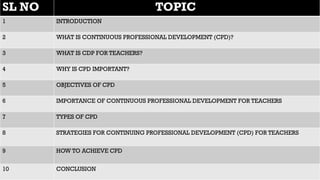
1INTRODUCTION
2 WHAT IS CONTINUOUS PROFESSIONAL DEVELOPMENT (CPD)?
3 WHAT IS CDP FOR TEACHERS?
4 WHY IS CPD IMPORTANT?
5 OBJECTIVES OF CPD
6 IMPORTANCE OF CONTINUOUS PROFESSIONAL DEVELOPMENT FOR TEACHERS
7 TYPES OF CPD
8 STRATEGIES FOR CONTINUING PROFESSIONAL DEVELOPMENT (CPD) FOR TEACHERS
9 HOW TO ACHIEVE CPD
10 CONCLUSION
4.
INTRODUCTION
Encouraging a positivelearning culture at work is
essential for a happy, healthy workplace.That is why
continuous professional development (CPD) is crucial.
Organizations that embrace a CPD culture at the
organizational level foster growth, reflection,
commitment, and dedication.
5.
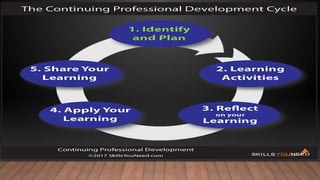
WHAT IS CONTINUOUSPROFESSIONAL DEVELOPMENT (CPD)?
Continuous professional development (CPD) is a planned
process of learning and development that helps you improve
your skills and knowledge in your field. It can include formal
and informal learning experiences.
CPD can help you develop new skills, build on your strengths,
and prepare for more responsibility
It can help you stay relevant in your field and job market
CPD can help you become more creative and make better
decisions
It can help you feel more confident and engaged in your role
6.
WHAT IS CDPFOR
TEACHERS?
• Continuous professional development (CPD) is a lifelong process
that helps teachers improve their skills, knowledge, and teaching
practices. It's an important part of teacher education that helps
ensure quality education .Continuous professional development of
teachers is essential for future teachers to achieve their long-term
goals.
8.
WHY IS CPDIMPORTANT?
UP TO DATE TEACHING PRACTISE:
CPD allows educators to learn about new teaching methods, technologies,
and research findings, which improves their teaching practise. Educators can
improve their teaching practise and better meet the needs of their students
by expanding their knowledge and skills.
BETTER CAREER PERFORMANCE
Participating in CPD activities can assist educators in developing new skills,
gaining new insights, and staying current with the latest trends and
developments in their field.This can lead to increased job satisfaction and
opportunities for advancement.
9.
WHY IS CPDIMPORTANT?
IMPROVE STUDENT OUTCOMES:
Educators who participate in CPD activities are better prepared to meet the
diverse and ever-changing needs of their students.This can result in better
student outcomes, such as increased engagement and higher academic
achievement, and happier students!
ENCOURAGE LIFELONG LEARNING:
Engaging in regular CPD is a great way to adopt the mindset of lifelong learning
and continuous improvement, an attitude that is crucial to have in an ever-
changing educational landscape.
10.
OBJECTIVES OF CPD
•The objectives of continuous professional development (CPD) are to help people
improve their skills and knowledge and to advance their careers.
• Objectives:
• Stay current: Keep up with new research, pedagogical practices, and digital tools
• Improve teaching: Develop new skills and techniques to create more engaging
lessons
• Be more effective: Apply new skills to improve the teaching environment and meet
the needs of all learners
• Be more creative: Become more creative in tackling new challenges
11.
OBJECTIVES OF CPD
•Be more collaborative: Encourage the exchange of good teaching
practices with colleagues
• Be more competitive: Stay competitive and apply for better career
opportunities
• Be more empowered: Develop personal and professional qualities
• Be more confident: Boost confidence and prepare for greater
responsibilities
• Be more open: Be open to new knowledge, skills, and methodologies
12.
BENEFITS OF CPD
KEEPSTEACHERS UP-TO-DATE”
Teachers can learn new teaching techniques and strategies, and how to use digital tools in the
classroom
IMPROVES TEACHING ENVIRONMENT
Teachers can create a more effective teaching environment by learning new skills and applying them
in the classroom
PROMOTES CAREER ADVANCEMENT
Teachers can achieve their goals and expand their opportunities within the teaching industry
BUILDS COLLABORATION
Teachers can share best practices and provide feedback to each other
13.
IMPORTANCE OF CONTINUOUS
PROFESSIONALDEVELOPMENT FOR
TEACHERS:
• The ability to identify one's strengths and weaknesses
• Effective student engagement
• Fostering self-directed learning and curiosity
• Deeper learning capacity
• Creative thinking
• Mindfulness for self-care
• Executing forward integration strategies with industry and higher
educational institutions by engaging in dialogue sessions with university
faculty members after completing their schooling
14.
TYPES OF CPD
ActiveLearning / Structured CPD
Structured CPD often consists of interactive and participation-based research. Attending training
classes, workshops, seminars, conferences, eLearning courses, or CPD-accredited events is frequently
proactive.Teachers taking career-oriented tests can also benefit from CPD active learning; however,
the study and review would be considered self-directed learning.
Passive Learning / Reflective CPD:
Reflective CPD is defined as learning that has a structured format but no participant-based
engagement, making it far more passive and one-directional than structured CPD.Watching training
videos and tutorials, attending non-interactive lectures, industry briefings, podcasts, case studies, and
industry updates are all examples of reflective CPD.
15.
TYPES OF CPD
•Reflective CPD is defined as learning that has a structured format but no
participant-based engagement, making it far more passive and one-
directional than structured CPD. Watching training videos and tutorials,
attending non-interactive lectures, industry briefings, podcasts, case
studies, and industry updates are all examples of reflective CPD.
16.
STRATEGIES FOR CONTINUING
PROFESSIONALDEVELOPMENT (CPD)
FOR TEACHERS
1.Coaching:
Coaching programs and workshops can help teachers develop their skills and contribute to
their school's growth.
2.Action research:
Teachers can engage in action research projects in their classrooms to explore new ideas.
3.Technology integration :
Teachers can learn how to use technology tools and resources to enhance student learning.
17.
4.FEEDBACK:
Teachers can receiveactionable feedback on their teaching and discuss strategies with colleagues.
5.TRAINING:
Teachers can participate in training courses and programs that are based on their needs.
6.CLASSROOM MANAGEMENT
Teachers can learn best practices for classroom management and student engagement.
7.SUBJECT AREA DEVELOPMENT
Teachers can stay informed about the latest developments in their subject areas.
18.
8.SELF-DIRECTED LEARNING
• Teacherscan foster self-directed learning and curiosity in their students.
9.CREATIVE THINKING
• Teachers can develop their creative thinking skills.
10. MINDFULNESS
• Teachers can practice mindfulness for self-care.
11. INDUSTRY INTEGRATION
• Teachers can engage with industry and higher educational institutions to integrate strategies into
their teaching.
19.
HOW TO ACHIEVECPD
Participate in workshops, webinars, conferences, online courses, and
peer collaboration
Participate in mentor programs, internships, and on-site programs
Create your own CPD plan
Work in a team and get feedback from colleagues, supervisors, or
mentors
20.
CONCLUSION
• If youprovide opportunities and rewards, it is simple to inspire people to
take responsibility for their ongoing learning and professional growth.
Schools may consider employing CPD training providers to teach certain
skills to their employees.These could range from an hour or two to a full
training program lasting several weeks. As part of formal learning and
development (L&D) efforts, educational institutions can also construct
valuable staff training programs or invest in upskilling training. All of
these can be used to fulfill CPD requirements.

![CONTINUOUS
PROFESSIONAL
DEVELOPMENT OF
TEACHERS
SUBMITTED BY
JESSENA BEEVI
[ENGLISH DEPT]](https://image.slidesharecdn.com/continuousprofessionaldevelopmentofteachers-260121080215-7cf17dfd/85/Continuous-Professional-Development-of-Teachers-2-320.jpg)