Professional Practices
SS-301
Ehtesham Raza,
Assistant Professor,
Govt. Murray College,
Sialkot.
Professionalism
• Professionalism is an attitude. Also, the way
in which an individual conducts oneself in
certain situations …the way you speak, the
way you dress, the way you are organized,
etc.
• It is setting standards and complying with
them.
• Values are the most effective way to
differentiate an individual or organization.
• Professionalism is not just about adhering to
codes of practice, rules and laws but also
having your individual ethical and moral
beliefs consistent with societal expectations.
Professionalism is Key to Career
Success
• Professionals agree to organization-
wide shared values
• Teamwork is a mandatory part of the
organizational culture
• Focus on relationship building
• Trust is the glue that holds the
organization together
Investing in
Professionalism...
• Explore new technologies
• Ask for assignments
• Take charge of your own learning
• Enhance your communication skills
• Master people skills
• Use downtime to acquire knowledge
• Pursue work that builds your assets
Professionalism in Teamwork
• Take responsibility rather than
making excuses or blaming each
other.
• Openly share information
• Collaborate on important issues
• Focus on a common purpose-
don’t get sidetracked by details
• Value each other’s background
• Openly and respectfully voice
concerns & criticisms
• Be positive about the team members
and their work
What is Individual Professionalism?
• An attitude
• Pride
• Responsibility
• Being a team player
• Honesty,
trustworthiness,
and loyalty
• Openness to critique
• Care about people &
goals
• Accountability
• Investment
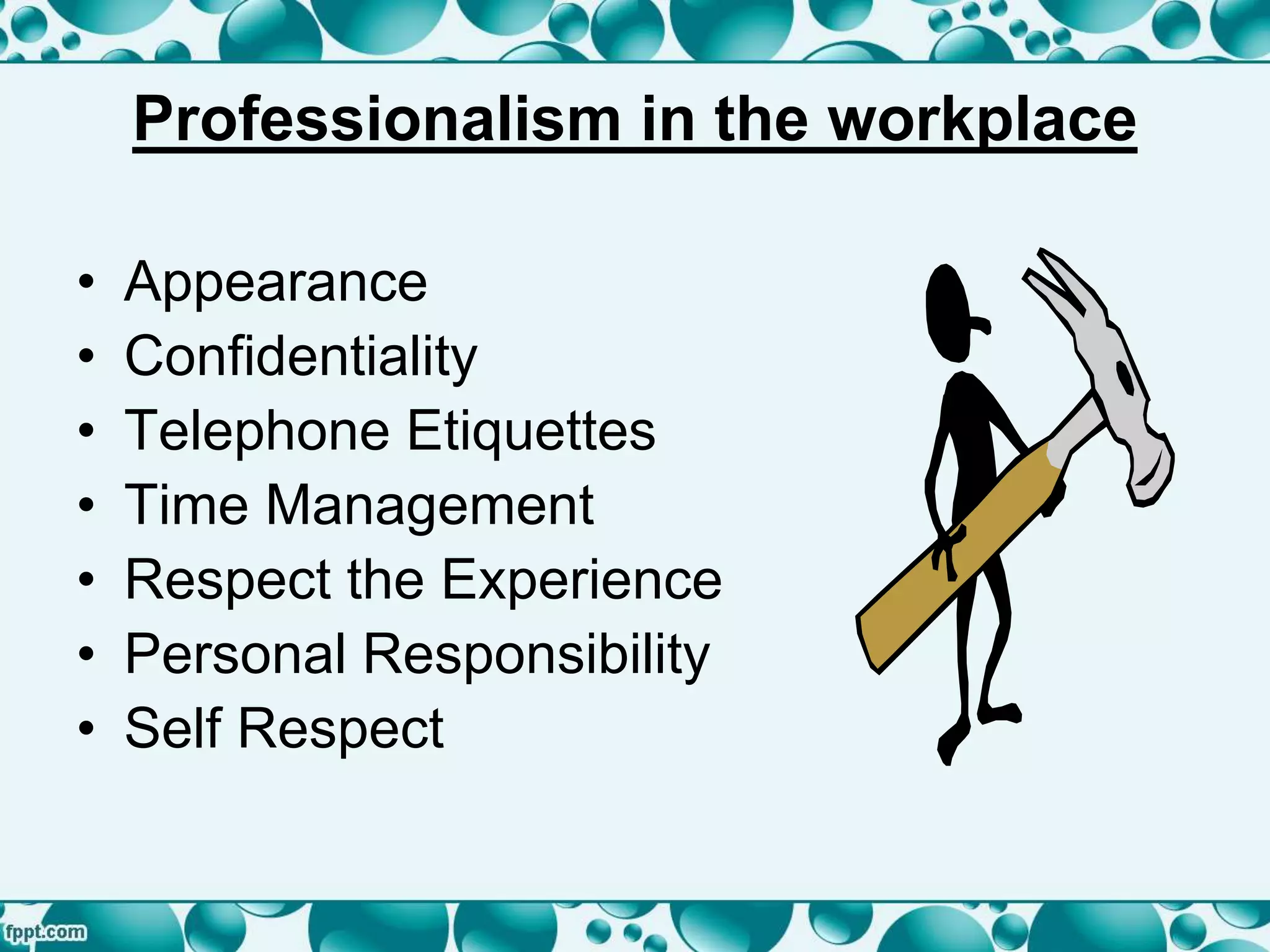
Professionalism in the workplace
• Appearance
• Confidentiality
• Telephone Etiquettes
• Time Management
• Respect the Experience
• Personal Responsibility
• Self Respect
Professional Context of ICT
• The terms profession and professional are often
used to refer to strongly differentiated professions.
• The role of computer professional is not strongly
differentiated.
• You acquire powers and responsibilities by virtue of
being an employee of an organisation, not by virtue
of being a computer professional.
• The efficacy of individual acting in employment role
is another factor have to be taken into account in
ethical analysis.
Is Computing a Profession?
Are Computer Professionals “Professional”?
• Most computer professionals must master an
esoteric body of knowledge to do what they do.
• Computer professional are not allowed to do or
required to do any thing that an ordinary person
cannot do.
• There is no single organisation to which all members
of the profession must belong.
• Computing supports a variety of social functions but
is not itself a social function.
Professional Relationships
 Employer – employee
– Contractual relationship fulfils the requirements of the categorical imperative
 Client – professional
– Contractual
– Disparity of knowledge/expertise
– Agency – do what is requested
– Paternalism – all decision transferred to the professional
– Fiduciary – client makes decisions on the basis of information provided by
the professional
 Society – professional
– To a certain extent governed by law and a “social contract”
– Right to practice on the basis that such practice will serve society
 Professional – professional
– Adherence to standards
Professional Ethics in Computing
What are Professional Ethics?
• Professional ethics are a code of conduct
that govern how members of a profession
deal with each other and with third parties.
Why should we have a Professional Code of Ethics?
• A Professional Code of Ethics serves several functions:
– Symbolises the professionalism of the group.
– Defines and promotes a standard for external relations with clients and
employers.
– Protects the group’s interests.
– Codifies members’ rights.
– Expresses ideals to aspire to.
– Offers guidelines in “gray areas”.
• Software has the potential to do good or cause harm, or to
enable or influence others to do good or cause harm.
• We have pride in our work and want the work that we do to be
given recognition and respect.
• We want to protect our livelihood.
Joint IEEE-CS/ACM Code of
Ethics and Professional Practice
• Built on 8 principles
– Public Interest
– Client and Employer
– Product
– Judgement
– Management
– Profession
– Colleagues
– Self
• The principle of Public Interest is central to the code.
1. Public Interest
• Software engineers shall act consistently with the
public interest.
– Approve software only if they have a well-founded belief
that it is safe, meets standards, passes tests and does
not diminish quality of life, privacy or harm the
environment.
– Disclose any actual or potential danger to the user.
– Be fair and avoid deception in all statements concerning
software.
2. Client and Employer
• Software engineers shall act in a manner that is in
the best interests of their client and employer,
consistent with the public interest.
– Be honest about any limitation of their experience and
education.
– Keep private any confidential information consistent with
the public interest and the law.
– Not knowingly use software that is obtained or retained
either illegally or unethically.
3. Product
• Software engineers shall ensure that their products
and related modifications meet the highest
professional standards possible.
– Strive for high quality, acceptable cost, and a
reasonable schedule, ensuring significant tradeoffs are
clear.
– Ensure adequate testing, debugging, and review of
software and related documents on which they work.
– Treat all forms of software maintenance with the same
professionalism as new development.
4. Judgement
• Software engineers shall maintain integrity
and independence in their professional
judgment.
– Not engage in deceptive financial practices.
– Disclose to all concerned parties those conflicts
of interest that cannot reasonably be avoided or
escaped.
5. Management
• Software engineering managers and leaders
shall subscribe to and promote an ethical
approach to the management of software
development and maintenance.
– Ensure that software engineers are informed of
standards before being held to them.
– Offer fair and just remuneration.
– Not punish anyone for expressing ethical
concerns about a project.
6. Profession
• Software engineers shall advance the integrity and
reputation of the profession consistent with the
public interest.
– Promote public knowledge of software engineering.
– Be accurate in stating the characteristics of software on
which they work.
– Take responsibility for detecting, correcting, and
reporting errors in software and associated documents
on which they work.
7. Colleagues
• Software engineers shall be fair to and supportive
of their colleagues.
– Credit fully the work of others and refrain from taking
undue credit.
– Give a fair hearing to the opinions, concerns, or
complaints of a colleague.
– In situations outside of their own areas of competence,
call upon the opinions of other professionals who have
competence in that area.
8. Self
• Software engineers shall participate in lifelong
learning regarding the practice of their
profession and shall promote an ethical
approach to the practice of the profession.
– Further their knowledge
– Improve their ability to create safe, reliable, and
useful quality software
– Improve their ability to produce accurate,
informative, and well-written documentation.
Questions

profession and it professionalism

  • 1.
    Professional Practices SS-301 Ehtesham Raza, AssistantProfessor, Govt. Murray College, Sialkot.
  • 2.
    Professionalism • Professionalism isan attitude. Also, the way in which an individual conducts oneself in certain situations …the way you speak, the way you dress, the way you are organized, etc. • It is setting standards and complying with them. • Values are the most effective way to differentiate an individual or organization. • Professionalism is not just about adhering to codes of practice, rules and laws but also having your individual ethical and moral beliefs consistent with societal expectations.
  • 3.
    Professionalism is Keyto Career Success • Professionals agree to organization- wide shared values • Teamwork is a mandatory part of the organizational culture • Focus on relationship building • Trust is the glue that holds the organization together
  • 4.
    Investing in Professionalism... • Explorenew technologies • Ask for assignments • Take charge of your own learning • Enhance your communication skills • Master people skills • Use downtime to acquire knowledge • Pursue work that builds your assets
  • 5.
    Professionalism in Teamwork •Take responsibility rather than making excuses or blaming each other. • Openly share information • Collaborate on important issues • Focus on a common purpose- don’t get sidetracked by details • Value each other’s background • Openly and respectfully voice concerns & criticisms • Be positive about the team members and their work
  • 6.
    What is IndividualProfessionalism? • An attitude • Pride • Responsibility • Being a team player • Honesty, trustworthiness, and loyalty • Openness to critique • Care about people & goals • Accountability • Investment
  • 7.
    Professionalism in theworkplace • Appearance • Confidentiality • Telephone Etiquettes • Time Management • Respect the Experience • Personal Responsibility • Self Respect
  • 8.
    Professional Context ofICT • The terms profession and professional are often used to refer to strongly differentiated professions. • The role of computer professional is not strongly differentiated. • You acquire powers and responsibilities by virtue of being an employee of an organisation, not by virtue of being a computer professional. • The efficacy of individual acting in employment role is another factor have to be taken into account in ethical analysis.
  • 9.
    Is Computing aProfession? Are Computer Professionals “Professional”? • Most computer professionals must master an esoteric body of knowledge to do what they do. • Computer professional are not allowed to do or required to do any thing that an ordinary person cannot do. • There is no single organisation to which all members of the profession must belong. • Computing supports a variety of social functions but is not itself a social function.
  • 10.
    Professional Relationships  Employer– employee – Contractual relationship fulfils the requirements of the categorical imperative  Client – professional – Contractual – Disparity of knowledge/expertise – Agency – do what is requested – Paternalism – all decision transferred to the professional – Fiduciary – client makes decisions on the basis of information provided by the professional  Society – professional – To a certain extent governed by law and a “social contract” – Right to practice on the basis that such practice will serve society  Professional – professional – Adherence to standards
  • 11.
    Professional Ethics inComputing What are Professional Ethics? • Professional ethics are a code of conduct that govern how members of a profession deal with each other and with third parties.
  • 12.
    Why should wehave a Professional Code of Ethics? • A Professional Code of Ethics serves several functions: – Symbolises the professionalism of the group. – Defines and promotes a standard for external relations with clients and employers. – Protects the group’s interests. – Codifies members’ rights. – Expresses ideals to aspire to. – Offers guidelines in “gray areas”. • Software has the potential to do good or cause harm, or to enable or influence others to do good or cause harm. • We have pride in our work and want the work that we do to be given recognition and respect. • We want to protect our livelihood.
  • 13.
    Joint IEEE-CS/ACM Codeof Ethics and Professional Practice • Built on 8 principles – Public Interest – Client and Employer – Product – Judgement – Management – Profession – Colleagues – Self • The principle of Public Interest is central to the code.
  • 14.
    1. Public Interest •Software engineers shall act consistently with the public interest. – Approve software only if they have a well-founded belief that it is safe, meets standards, passes tests and does not diminish quality of life, privacy or harm the environment. – Disclose any actual or potential danger to the user. – Be fair and avoid deception in all statements concerning software.
  • 15.
    2. Client andEmployer • Software engineers shall act in a manner that is in the best interests of their client and employer, consistent with the public interest. – Be honest about any limitation of their experience and education. – Keep private any confidential information consistent with the public interest and the law. – Not knowingly use software that is obtained or retained either illegally or unethically.
  • 16.
    3. Product • Softwareengineers shall ensure that their products and related modifications meet the highest professional standards possible. – Strive for high quality, acceptable cost, and a reasonable schedule, ensuring significant tradeoffs are clear. – Ensure adequate testing, debugging, and review of software and related documents on which they work. – Treat all forms of software maintenance with the same professionalism as new development.
  • 17.
    4. Judgement • Softwareengineers shall maintain integrity and independence in their professional judgment. – Not engage in deceptive financial practices. – Disclose to all concerned parties those conflicts of interest that cannot reasonably be avoided or escaped.
  • 18.
    5. Management • Softwareengineering managers and leaders shall subscribe to and promote an ethical approach to the management of software development and maintenance. – Ensure that software engineers are informed of standards before being held to them. – Offer fair and just remuneration. – Not punish anyone for expressing ethical concerns about a project.
  • 19.
    6. Profession • Softwareengineers shall advance the integrity and reputation of the profession consistent with the public interest. – Promote public knowledge of software engineering. – Be accurate in stating the characteristics of software on which they work. – Take responsibility for detecting, correcting, and reporting errors in software and associated documents on which they work.
  • 20.
    7. Colleagues • Softwareengineers shall be fair to and supportive of their colleagues. – Credit fully the work of others and refrain from taking undue credit. – Give a fair hearing to the opinions, concerns, or complaints of a colleague. – In situations outside of their own areas of competence, call upon the opinions of other professionals who have competence in that area.
  • 21.
    8. Self • Softwareengineers shall participate in lifelong learning regarding the practice of their profession and shall promote an ethical approach to the practice of the profession. – Further their knowledge – Improve their ability to create safe, reliable, and useful quality software – Improve their ability to produce accurate, informative, and well-written documentation.
  • 22.

Editor's Notes

  • #5 PEOPLE SKILLS: A set of skills enabling a person to get along with others, to communicate ideas effectively, to resolve conflicts, and to achieve personal or business goals.
  • #8 APPEARANCE Well-groomed Neat Proper attire No jeans, shorts, revealing tops, sleeveless tops, etc SELF RESPECT Be conscious that your work reflects your inner character Strive for excellence Do not view it as just “a job” Be task-oriented and service-oriented RESPECT THE EXPERIENCE Learn from it Improve yourself and skills Seek out advise PERSONAL RESPONSIBILITY Respect others rights Know your boundaries/limits Do not meddle in others affairs No gossip Do not handle personal interests at “work” No drinking on the “job” No foul language No sexual harassment Turn off cell phones and pagers TIME MANAGEMENT SHOW UP ON TIME (Be Punctual) Leave enough time for traffic Arrive early Call immediately if you cannot make-it Make efficient use of resources and time Ask questions Take notes Meet all deadlines TELEPHONE ETIQUETTE Speak with a normal, pleasant, courteous voice Identify yourself Leave brief, clear messages Return phone calls promptly No personal calls CONFIDENTIALITY All cases and files are to be kept strictly confidential if you have access Do not discuss project status/well-being with others (friends, family, etc) Make sure you ask about the confidentiality policies within the facility
  • #11 A fiduciary is a person who holds a legal or ethical relationship of trust with one or more other parties (person or group of persons). Typically, a fiduciary prudently takes care of money or other assets for another person.