














Professional Accountability
Presenter :
Pratibha
MSc.N 2nd yr
NINE, PGIMER
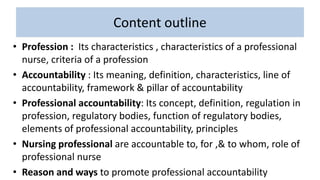
Content outline
• Profession : Its characteristics , characteristics of a professional
nurse, criteria of a profession
• Accountability : Its meaning, definition, characteristics, line of
accountability, framework & pillar of accountability
• Professional accountability: Its concept, definition, regulation in
profession, regulatory bodies, function of regulatory bodies,
elements of professional accountability, principles
• Nursing professional are accountable to, for ,& to whom, role of
professional nurse
• Reason and ways to promote professional accountability
Profession
• A profession is a group of
vocational, occupational and
educational that requires
specialized education and
intellectual knowledge
Characteristic of a profession
• A body of special knowledge
• Specialized training in applying special knowledge
• The standards of practice
• The sense of responsibility towards the public , clients and
other team members
According to Southern Illinois University (2004),
a profession has :
General characteristics of a profession
• Autonomy
• Regulation
• Legitimacy
• Status
• Theoretical knowledge based skill
• Licensed practitioners
• Code of ethics and professional conduct
Characteristics of a professional nurse
• Personal characteristics
• Commitment
• Knowledgeable
• Technical skills
• Patient centeredness
• Communication skills
• Advocacy
• Emotionally strong
Characteristics of a professional nurse Cont..
• Empathetic
• Critical thinking
• Interpersonal skills
• Problem solving skills
Criteria of a profession
Rationalized and distinguished by an important body of
knowledge
Provision of unique service to society
An expanding body of knowledge
Personal responsibility to the public for service provided
A long period of education including theory and practice
Criteria of a profession Cont..
Autonomy and ability to develop policy about the
discipline and control of the activity of one's members
Members shares a common identity, value and
attitudes
A code of ethics to which its members follow
MEANING :
• Accountability involves assuring only the responsibility that are
within one's scope of practice and not assuming responsibility for
activities in which competencies has not been achieved
• Accountability involves admitting mistakes rather than blaming
others and evaluating the outcomes of one's own actions
Accountability Cont..
• Accountability includes a responsibility to the client to
competent to render nursing services in accordance with
standards of nursing practice and to adhere to the professional
ethics code
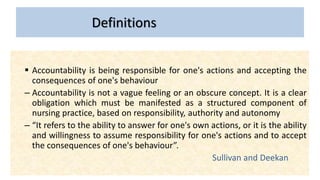
Definitions
 Accountability is being responsible for one's actions and accepting the
consequences of one's behaviour
– Accountability is not a vague feeling or an obscure concept. It is a clear
obligation which must be manifested as a structured component of
nursing practice, based on responsibility, authority and autonomy
– “It refers to the ability to answer for one's own actions, or it is the ability
and willingness to assume responsibility for one's actions and to accept
the consequences of one's behaviour”.
Sullivan and Deekan
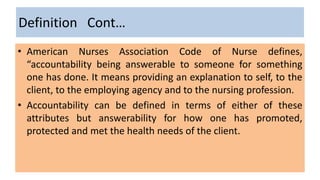
Definition Cont…
• American Nurses Association Code of Nurse defines,
“accountability being answerable to someone for something
one has done. It means providing an explanation to self, to the
client, to the employing agency and to the nursing profession.
• Accountability can be defined in terms of either of these
attributes but answerability for how one has promoted,
protected and met the health needs of the client.
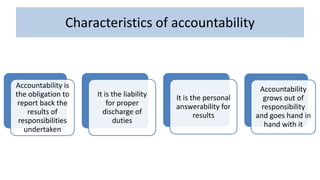
Characteristics of accountability
Accountability is
the obligation to
report back the
results of
responsibilities
undertaken
It is the liability
for proper
discharge of
duties
It is the personal
answerability for
results
Accountability
grows out of
responsibility
and goes hand in
hand with it
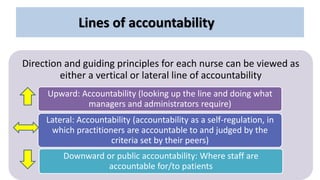
Lines of accountability
Direction and guiding principles for each nurse can be viewed as
either a vertical or lateral line of accountability
Upward: Accountability (looking up the line and doing what
managers and administrators require)
Lateral: Accountability (accountability as a self-regulation, in
which practitioners are accountable to and judged by the
criteria set by their peers)
Downward or public accountability: Where staff are
accountable for/to patients
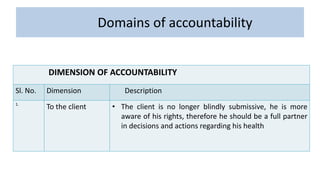
Domains of accountability
DIMENSION OF ACCOUNTABILITY
Sl. No. Dimension Description
1.
To the client • The client is no longer blindly submissive, he is more
aware of his rights, therefore he should be a full partner
in decisions and actions regarding his health
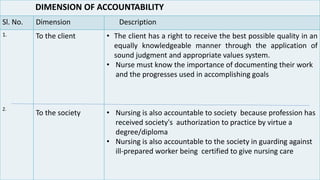
DIMENSION OF ACCOUNTABILITY
Sl. No. Dimension Description
1.
2.
To the client
To the society
• The client has a right to receive the best possible quality in an
equally knowledgeable manner through the application of
sound judgment and appropriate values system.
• Nurse must know the importance of documenting their work
and the progresses used in accomplishing goals
• Nursing is also accountable to society because profession has
received society's authorization to practice by virtue a
degree/diploma
• Nursing is also accountable to the society in guarding against
ill-prepared worker being certified to give nursing care
DIMENSION OF ACCOUNTABILITY
Sl. No. Dimension Description
3.
4.
To the
profession
To self
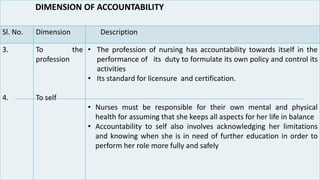
• The profession of nursing has accountability towards itself in the
performance of its duty to formulate its own policy and control its
activities
• Its standard for licensure and certification.
• Nurses must be responsible for their own mental and physical
health for assuming that she keeps all aspects for her life in balance
• Accountability to self also involves acknowledging her limitations
and knowing when she is in need of further education in order to
perform her role more fully and safely
DIMENSION OF ACCOUNTABILITY
Sl. No. Dimension Description
5. To the
employing
agency
/Institution
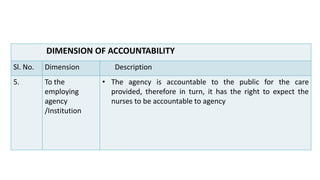
• The agency is accountable to the public for the care
provided, therefore in turn, it has the right to expect the
nurses to be accountable to agency
Framework of accountability
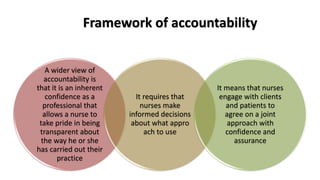
A wider view of
accountability is
that it is an inherent
confidence as a
professional that
allows a nurse to
take pride in being
transparent about
the way he or she
has carried out their
practice
It requires that
nurses make
informed decisions
about what appro
ach to use
It means that nurses
engage with clients
and patients to
agree on a joint
approach with
confidence and
assurance
Four pillars of accountability
The first pillar of
accountability:
Professional accountability
The second pillar of
accountability: Ethical
accountability
The third pillar of
accountability: Legal
accountability
The fourth pillar of
accountability:
Employment accountability
Professional accountability
INTRODUCTION
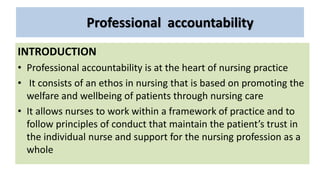
• Professional accountability is at the heart of nursing practice
• It consists of an ethos in nursing that is based on promoting the
welfare and wellbeing of patients through nursing care
• It allows nurses to work within a framework of practice and to
follow principles of conduct that maintain the patient’s trust in
the individual nurse and support for the nursing profession as a
whole
Professional Accountability Cont..
• It drives to demonstrate professional accountability led to the
creation of a body which is responsible for setting the
standards of conduct and practice for nurses i.e the regulatory
body for nurses and midwives
• Manifesting accountability in nursing practice provides the
opportunity to evaluate nursing contribution within health care
and is a means of clarifying the significance of nursing to
society
Development of Nursing as an Accountable Profession
• Susan McGann traces the development of nursing as an
accountable profession in 1919
• Achieving professional status was a struggle for nurses
• With the passing of the Nurses’ Registration Acts, in 1919, nurses
in Britain achieved the status of an accountable profession
Concept of professional accountability
• The concepts have two major attributes :
- Answerability
- Responsibility
• The modern concept of professional accountability, applied
to nursing, assumes that the nurse is a member of a
profession
• It depends on individual nurses being aware of their
membership of a profession and accepting that status, with
the rights and responsibilities that go with it
Concept of professional accountability Cont…
• With the passing of the Nurses Registration Act, in 1919,
nurses in Britain achieved the status of an accountable
profession, which meant that registered nurses were legally
accountable for their work and can be struck off the register
for unprofessional behaviour (Tilley and Watson 2004).
Definition
• Professional accountability means that each individual nurse
is answerable for her/his conduct and actions, and is
responsible for the decisions she/he makes and how these
affect the people to whom she/he owes a duty of care.
• The responsibility that this brings is to ensure that all
reasonable actions are taken to ensure patient safety.
Definition cont...
• This implies that all nurses should be:
• Aware of the professional standards described in the regulatory body’s Code
• Confident that all decision-making is appropriately informed
• Able to justify all clinical actions or omissions
• Able to communicate appropriately and effectively with people, families,
and other members of the healthcare team, whether in verbal, written,
digital, or electronic formats
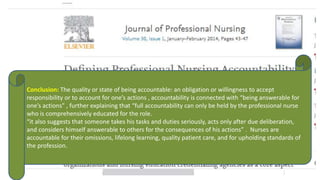
Conclusion: The quality or state of being accountable: an obligation or willingness to accept
responsibility or to account for one’s actions , accountability is connected with “being answerable for
one’s actions” , further explaining that “full accountability can only be held by the professional nurse
who is comprehensively educated for the role.
“it also suggests that someone takes his tasks and duties seriously, acts only after due deliberation,
and considers himself answerable to others for the consequences of his actions” . Nurses are
accountable for their omissions, lifelong learning, quality patient care, and for upholding standards of
the profession.
Regulations in professional accountability
Regulation is the mechanism by which the government can influence activity
over :
– People
– Setting
– Products
– Services
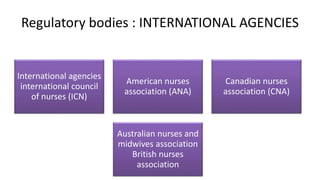
Regulatory bodies : INTERNATIONAL AGENCIES
International agencies
international council
of nurses (ICN)
American nurses
association (ANA)
Canadian nurses
association (CNA)
Australian nurses and
midwives association
British nurses
association
Regulatory body : international agencies cont...
• The International Council of Nurses (ICN) is a federation of more
than 130 national nurses associations
• It was founded in 1899 and was the first international
organization for health care professionals
The organization's goals are:
– To bring nurses' organizations together in a worldwide body
– To advance the socio-economic status of nurses and the profession
of nursing worldwide
–To influence global and domestic health policy
Regulatory bodies : National agencies
Nurses are governed by code of Ethics adopted by :
• Indian nursing council
• State nursing council
• Trained nurses association of India
• Rules of a particular hospital / Institution
Therefore, an individual nurse is governed for her
professional conduct at central, state, hospital/institution, existing
laws and regulation, judicial rulings
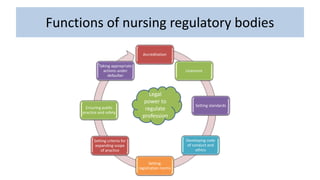
Functions of nursing regulatory bodies
Accreditation
Licensure
Setting standards
Developing code
of conduct and
ethics
Setting
registration norms
Setting criteria for
expanding scope
of practice
Ensuring public
practice and safety
Taking appropriate
actions under
defaulter
Legal
power to
regulate
profession
Elements of professional accountability
Three
elements:
Clarity
Commitment
Consequences
ELEMENTS OF PROFESSIONAL ACCOUNTABILITY Cont...
• The public holds nursing accountable for safe nursing care and proper
judgment in the provision of nursing services
• The profession is held accountable by the public to ensure that only
qualified individuals are granted the rights to practice and those who
fail to uphold professional standards are denied the future rights to
practice
• Professional accountability within nursing is adopted through the
mechanisms by which nurses obtain the right to practice
• These mechanisms include rights and responsibilities, organizational
accountability, individual accountability and students accountability.
ELEMENTS OF PROFESSIONAL ACCOUNTABILITY Cont...
Rights and responsibilities:
• The nurse have responsibility to the client to be competent, to
render nursing services in accordance with standards of nursing
practice, and to follow to the profession’s ethical code
Organizational Accountability:
• Organization is mean by which members of profession, such as
nurses, join together to promote and protect the profession
• Legislative accountability for nurses to be recognizes as professional
nursing must have legislation that clearly defines the role and scope
of nursing practice
ELEMENTS OF PROFESSIONAL ACCOUNTABILITY
Cont…
Individual Accountability
• The nurses must understand the method by which the board of
nursing adopts rule and regulations in their state of licensure so
that they can be active participant in the development of such
regulations
Students Accountability
• For nursing students, accountability for competency being the
first clinical day and continues throughout their career.
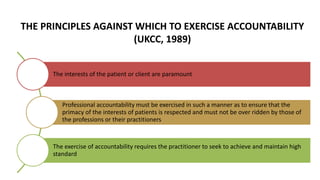
THE PRINCIPLES AGAINST WHICH TO EXERCISE ACCOUNTABILITY
(UKCC, 1989)
The interests of the patient or client are paramount
Professional accountability must be exercised in such a manner as to ensure that the
primacy of the interests of patients is respected and must not be over ridden by those of
the professions or their practitioners
The exercise of accountability requires the practitioner to seek to achieve and maintain high
standard
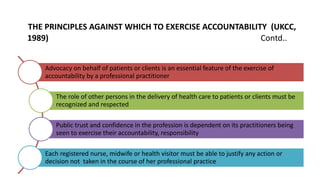
THE PRINCIPLES AGAINST WHICH TO EXERCISE ACCOUNTABILITY (UKCC,
1989) Contd..
Advocacy on behalf of patients or clients is an essential feature of the exercise of
accountability by a professional practitioner
The role of other persons in the delivery of health care to patients or clients must be
recognized and respected
Public trust and confidence in the profession is dependent on its practitioners being
seen to exercise their accountability, responsibility
Each registered nurse, midwife or health visitor must be able to justify any action or
decision not taken in the course of her professional practice
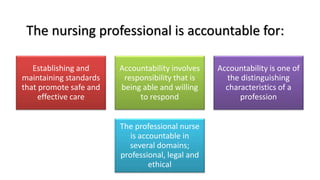
The nursing professional is accountable for:
Establishing and
maintaining standards
that promote safe and
effective care
Accountability involves
responsibility that is
being able and willing
to respond
Accountability is one of
the distinguishing
characteristics of a
profession
The professional nurse
is accountable in
several domains;
professional, legal and
ethical
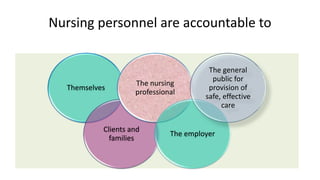
Nursing personnel are accountable to
Themselves
Clients and
families
The nursing
professional
The employer
The general
public for
provision of
safe, effective
care
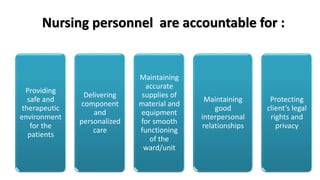
Nursing personnel are accountable for :
Providing
safe and
therapeutic
environment
for the
patients
Delivering
component
and
personalized
care
Maintaining
accurate
supplies of
material and
equipment
for smooth
functioning
of the
ward/unit
Maintaining
good
interpersonal
relationships
Protecting
client’s legal
rights and
privacy
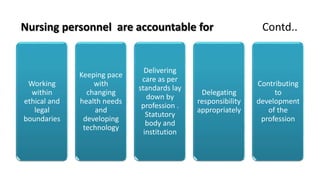
Nursing personnel are accountable for Contd..
Working
within
ethical and
legal
boundaries
Keeping pace
with
changing
health needs
and
developing
technology
Delivering
care as per
standards lay
down by
profession .
Statutory
body and
institution
Delegating
responsibility
appropriately
Contributing
to
development
of the
profession
Accountable to whom
Nurses, physicians and institutions are
equally accountable for their specific
functions, within healthcare delivery and
there is a sharing accountability to
society and the recipients of care
Ultimate accountability for nursing
practice and its outcomes must be
provided to its recipients within society.
All nurses are accountable for the proper
use of their knowledge and skills in the
provision of care
Accountable to whom Cont...
Nurses are accountable to nursing
council. This relates to practicing
within the scope of practice, according
to register in which the name has
been entered, and being accountable
for the professional conduct
The nursing council's code of conduct
for nurses and midwives further
outlines professional accountability in
terms of ethics, standards of practice,
rights of patients/clients and justifying
public trust and confidence
Accountable to whom
Contd..
Professional actions are
explainable to the clients and the
employer
Healthcare institutions also play a
role in accountability by
monitoring individual and
institutional compliance with
national standards
Conclusion : The most prevalent language found in the literature, ties accountability
with responsibility for nursing actions. The second-most prevalent appearing eight
times , associates accountability with being answerable to self and those who are
influenced by one's actions. The other areas were described by the following
language: nurses are accountable for lifelong learning, quality patient care, and for
upholding standards of the profession
Role of professional accountability in nursing
• The registered nurse is accountable to the public for competent,
safe and ethical practice. It helps:
1. Each registered nurse: Practices in accordance with:
o The Registered Nurses Act, Regulation and by-laws
o The standards for nursing practice
o The code of ethics for registered nurses
o Other relevant acts and legislation
Role of professional accountability in nursing
Contd…
2. Makes nurses responsible for own actions and decisions at all
the times
3. Recognizes and reports errors and takes all necessary action to
prevent and minimize harm arising from an adverse event
4. Takes action in situations where client safety and well-being is
potentially or actually compromised
5. Exercises reasonable judgment in practice
Role of professional accountability in nursing
Contd…
6. Seeks assistance appropriately and in a timely manner
7. Supports policies and practices consistent with the college's standards for
nursing practice and questions those in conflict with the standards
8. Understands, promotes and complies with the values and beliefs in the code
of ethics for registered nurses
9. Contributes to a safe, supportive and professional practice environment
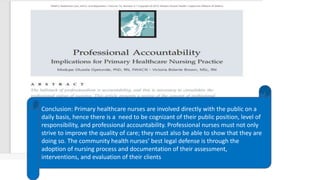
Conclusion: Primary healthcare nurses are involved directly with the public on a
daily basis, hence there is a need to be cognizant of their public position, level of
responsibility, and professional accountability. Professional nurses must not only
strive to improve the quality of care; they must also be able to show that they are
doing so. The community health nurses’ best legal defense is through the
adoption of nursing process and documentation of their assessment,
interventions, and evaluation of their clients
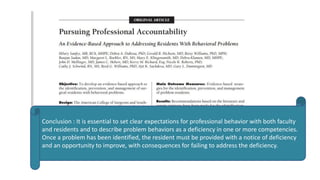
Conclusion : It is essential to set clear expectations for professional behavior with both faculty
and residents and to describe problem behaviors as a deficiency in one or more competencies.
Once a problem has been identified, the resident must be provided with a notice of deficiency
and an opportunity to improve, with consequences for failing to address the deficiency.
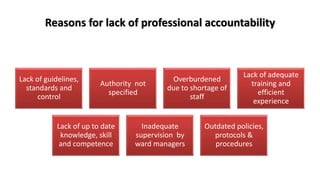
Reasons for lack of professional accountability
Lack of guidelines,
standards and
control
Authority not
specified
Overburdened
due to shortage of
staff
Lack of adequate
training and
efficient
experience
Lack of up to date
knowledge, skill
and competence
Inadequate
supervision by
ward managers
Outdated policies,
protocols &
procedures
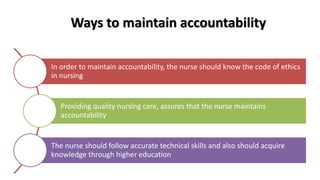
Ways to maintain accountability
In order to maintain accountability, the nurse should know the code of ethics
in nursing
Providing quality nursing care, assures that the nurse maintains
accountability
The nurse should follow accurate technical skills and also should acquire
knowledge through higher education
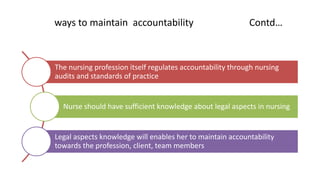
ways to maintain accountability Contd…
The nursing profession itself regulates accountability through nursing
audits and standards of practice
Nurse should have sufficient knowledge about legal aspects in nursing
Legal aspects knowledge will enables her to maintain accountability
towards the profession, client, team members
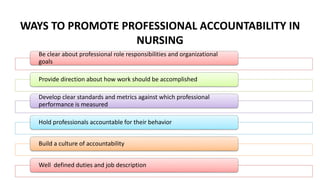
WAYS TO PROMOTE PROFESSIONAL ACCOUNTABILITY IN
NURSING
Be clear about professional role responsibilities and organizational
goals
Provide direction about how work should be accomplished
Develop clear standards and metrics against which professional
performance is measured
Hold professionals accountable for their behavior
Build a culture of accountability
Well defined duties and job description
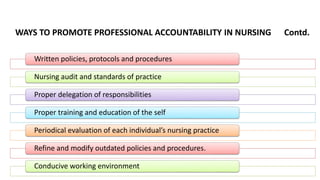
WAYS TO PROMOTE PROFESSIONAL ACCOUNTABILITY IN NURSING Contd.
Written policies, protocols and procedures
Nursing audit and standards of practice
Proper delegation of responsibilities
Proper training and education of the self
Periodical evaluation of each individual’s nursing practice
Refine and modify outdated policies and procedures.
Conducive working environment
ACCOUNTABILITY PYRAMID TO PROMOTE PROFESSIONAL
PERFORMANCE
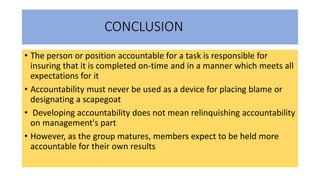
CONCLUSION
• The person or position accountable for a task is responsible for
insuring that it is completed on-time and in a manner which meets all
expectations for it
• Accountability must never be used as a device for placing blame or
designating a scapegoat
• Developing accountability does not mean relinquishing accountability
on management's part
• However, as the group matures, members expect to be held more
accountable for their own results
References
• Clement I. Textbook on professional trends and adjustments in nursing. 1st
edition. Jaypee Brothers Medical Publishers ; New Delhi : 2016. Pp 116-17
• Basavanthapa B T. Nursing administration. 3rd edition . Jaypee Brothers
Medical Publishers; New Delhi: 2014 . pp 88-89
• Rawat HC. Brar NK. Textbook of Advanced Nursing Practice. 1st edition.
Jaypee Brothers Medical Publishers. New Delhi.2014 . pp 13-16
• Krautscheid LC. Defining professional nursing accountability: a literature
review. Journal of Professional Nursing. 2014 Jan 1;30(1):43-7
References
• Basvanthapa BT. Nursing administration. 2nd edition .Jaypee Brothers Medical
Publishers: New Delhi;2014. pp 664-74.
• Basvanthapa BT. Nursing education, 1st edition 2003, Jaypee Brothers Medical
Publishers, New Delhi, p 77-9.
• Chitty KK. Professional Nursing. Elsevier, 4th edition, p 31, 63, 197, 579.
• Loretta EH. Teaching and learning in school of nursing, 3rd edition 2005,
Konark Publishers. p 187-90.
• Perry P. Fundamentals of Nursing, Elsevier, 7th edition, p 3-4.
• Suzanne SC, Brenda BG. Medical Surgical Nursing, Lippioncott. Jaypee Brothers
Medical Publishers, New Delhi, 10th edition, 2004; Volume-1, p 125-41.
• Www.Currentnursing.Com
• Www.Indiannursing.Com
Professional accountability

Professional accountability

  • 1.
  • 2.
    Content outline • Profession: Its characteristics , characteristics of a professional nurse, criteria of a profession • Accountability : Its meaning, definition, characteristics, line of accountability, framework & pillar of accountability • Professional accountability: Its concept, definition, regulation in profession, regulatory bodies, function of regulatory bodies, elements of professional accountability, principles • Nursing professional are accountable to, for ,& to whom, role of professional nurse • Reason and ways to promote professional accountability
  • 3.
    Profession • A professionis a group of vocational, occupational and educational that requires specialized education and intellectual knowledge
  • 4.
    Characteristic of aprofession • A body of special knowledge • Specialized training in applying special knowledge • The standards of practice • The sense of responsibility towards the public , clients and other team members According to Southern Illinois University (2004), a profession has :
  • 5.
    General characteristics ofa profession • Autonomy • Regulation • Legitimacy • Status • Theoretical knowledge based skill • Licensed practitioners • Code of ethics and professional conduct
  • 6.
    Characteristics of aprofessional nurse • Personal characteristics • Commitment • Knowledgeable • Technical skills • Patient centeredness • Communication skills • Advocacy • Emotionally strong
  • 7.
    Characteristics of aprofessional nurse Cont.. • Empathetic • Critical thinking • Interpersonal skills • Problem solving skills
  • 8.
    Criteria of aprofession Rationalized and distinguished by an important body of knowledge Provision of unique service to society An expanding body of knowledge Personal responsibility to the public for service provided A long period of education including theory and practice
  • 9.
    Criteria of aprofession Cont.. Autonomy and ability to develop policy about the discipline and control of the activity of one's members Members shares a common identity, value and attitudes A code of ethics to which its members follow
  • 10.
    MEANING : • Accountabilityinvolves assuring only the responsibility that are within one's scope of practice and not assuming responsibility for activities in which competencies has not been achieved • Accountability involves admitting mistakes rather than blaming others and evaluating the outcomes of one's own actions
  • 11.
    Accountability Cont.. • Accountabilityincludes a responsibility to the client to competent to render nursing services in accordance with standards of nursing practice and to adhere to the professional ethics code
  • 12.
    Definitions  Accountability isbeing responsible for one's actions and accepting the consequences of one's behaviour – Accountability is not a vague feeling or an obscure concept. It is a clear obligation which must be manifested as a structured component of nursing practice, based on responsibility, authority and autonomy – “It refers to the ability to answer for one's own actions, or it is the ability and willingness to assume responsibility for one's actions and to accept the consequences of one's behaviour”. Sullivan and Deekan
  • 13.
    Definition Cont… • AmericanNurses Association Code of Nurse defines, “accountability being answerable to someone for something one has done. It means providing an explanation to self, to the client, to the employing agency and to the nursing profession. • Accountability can be defined in terms of either of these attributes but answerability for how one has promoted, protected and met the health needs of the client.
  • 14.
    Characteristics of accountability Accountabilityis the obligation to report back the results of responsibilities undertaken It is the liability for proper discharge of duties It is the personal answerability for results Accountability grows out of responsibility and goes hand in hand with it
  • 15.
    Lines of accountability Directionand guiding principles for each nurse can be viewed as either a vertical or lateral line of accountability Upward: Accountability (looking up the line and doing what managers and administrators require) Lateral: Accountability (accountability as a self-regulation, in which practitioners are accountable to and judged by the criteria set by their peers) Downward or public accountability: Where staff are accountable for/to patients
  • 16.
    Domains of accountability DIMENSIONOF ACCOUNTABILITY Sl. No. Dimension Description 1. To the client • The client is no longer blindly submissive, he is more aware of his rights, therefore he should be a full partner in decisions and actions regarding his health
  • 17.
    DIMENSION OF ACCOUNTABILITY Sl.No. Dimension Description 1. 2. To the client To the society • The client has a right to receive the best possible quality in an equally knowledgeable manner through the application of sound judgment and appropriate values system. • Nurse must know the importance of documenting their work and the progresses used in accomplishing goals • Nursing is also accountable to society because profession has received society's authorization to practice by virtue a degree/diploma • Nursing is also accountable to the society in guarding against ill-prepared worker being certified to give nursing care
  • 18.
    DIMENSION OF ACCOUNTABILITY Sl.No. Dimension Description 3. 4. To the profession To self • The profession of nursing has accountability towards itself in the performance of its duty to formulate its own policy and control its activities • Its standard for licensure and certification. • Nurses must be responsible for their own mental and physical health for assuming that she keeps all aspects for her life in balance • Accountability to self also involves acknowledging her limitations and knowing when she is in need of further education in order to perform her role more fully and safely
  • 19.
    DIMENSION OF ACCOUNTABILITY Sl.No. Dimension Description 5. To the employing agency /Institution • The agency is accountable to the public for the care provided, therefore in turn, it has the right to expect the nurses to be accountable to agency
  • 20.
    Framework of accountability Awider view of accountability is that it is an inherent confidence as a professional that allows a nurse to take pride in being transparent about the way he or she has carried out their practice It requires that nurses make informed decisions about what appro ach to use It means that nurses engage with clients and patients to agree on a joint approach with confidence and assurance
  • 21.
    Four pillars ofaccountability The first pillar of accountability: Professional accountability The second pillar of accountability: Ethical accountability The third pillar of accountability: Legal accountability The fourth pillar of accountability: Employment accountability
  • 22.
    Professional accountability INTRODUCTION • Professionalaccountability is at the heart of nursing practice • It consists of an ethos in nursing that is based on promoting the welfare and wellbeing of patients through nursing care • It allows nurses to work within a framework of practice and to follow principles of conduct that maintain the patient’s trust in the individual nurse and support for the nursing profession as a whole
  • 23.
    Professional Accountability Cont.. •It drives to demonstrate professional accountability led to the creation of a body which is responsible for setting the standards of conduct and practice for nurses i.e the regulatory body for nurses and midwives • Manifesting accountability in nursing practice provides the opportunity to evaluate nursing contribution within health care and is a means of clarifying the significance of nursing to society
  • 24.
    Development of Nursingas an Accountable Profession • Susan McGann traces the development of nursing as an accountable profession in 1919 • Achieving professional status was a struggle for nurses • With the passing of the Nurses’ Registration Acts, in 1919, nurses in Britain achieved the status of an accountable profession
  • 25.
    Concept of professionalaccountability • The concepts have two major attributes : - Answerability - Responsibility • The modern concept of professional accountability, applied to nursing, assumes that the nurse is a member of a profession • It depends on individual nurses being aware of their membership of a profession and accepting that status, with the rights and responsibilities that go with it
  • 26.
    Concept of professionalaccountability Cont… • With the passing of the Nurses Registration Act, in 1919, nurses in Britain achieved the status of an accountable profession, which meant that registered nurses were legally accountable for their work and can be struck off the register for unprofessional behaviour (Tilley and Watson 2004).
  • 27.
    Definition • Professional accountabilitymeans that each individual nurse is answerable for her/his conduct and actions, and is responsible for the decisions she/he makes and how these affect the people to whom she/he owes a duty of care. • The responsibility that this brings is to ensure that all reasonable actions are taken to ensure patient safety.
  • 28.
    Definition cont... • Thisimplies that all nurses should be: • Aware of the professional standards described in the regulatory body’s Code • Confident that all decision-making is appropriately informed • Able to justify all clinical actions or omissions • Able to communicate appropriately and effectively with people, families, and other members of the healthcare team, whether in verbal, written, digital, or electronic formats
  • 29.
    Conclusion: The qualityor state of being accountable: an obligation or willingness to accept responsibility or to account for one’s actions , accountability is connected with “being answerable for one’s actions” , further explaining that “full accountability can only be held by the professional nurse who is comprehensively educated for the role. “it also suggests that someone takes his tasks and duties seriously, acts only after due deliberation, and considers himself answerable to others for the consequences of his actions” . Nurses are accountable for their omissions, lifelong learning, quality patient care, and for upholding standards of the profession.
  • 30.
    Regulations in professionalaccountability Regulation is the mechanism by which the government can influence activity over : – People – Setting – Products – Services
  • 31.
    Regulatory bodies :INTERNATIONAL AGENCIES International agencies international council of nurses (ICN) American nurses association (ANA) Canadian nurses association (CNA) Australian nurses and midwives association British nurses association
  • 32.
    Regulatory body :international agencies cont... • The International Council of Nurses (ICN) is a federation of more than 130 national nurses associations • It was founded in 1899 and was the first international organization for health care professionals The organization's goals are: – To bring nurses' organizations together in a worldwide body – To advance the socio-economic status of nurses and the profession of nursing worldwide –To influence global and domestic health policy
  • 33.
    Regulatory bodies :National agencies Nurses are governed by code of Ethics adopted by : • Indian nursing council • State nursing council • Trained nurses association of India • Rules of a particular hospital / Institution Therefore, an individual nurse is governed for her professional conduct at central, state, hospital/institution, existing laws and regulation, judicial rulings
  • 34.
    Functions of nursingregulatory bodies Accreditation Licensure Setting standards Developing code of conduct and ethics Setting registration norms Setting criteria for expanding scope of practice Ensuring public practice and safety Taking appropriate actions under defaulter Legal power to regulate profession
  • 35.
    Elements of professionalaccountability Three elements: Clarity Commitment Consequences
  • 36.
    ELEMENTS OF PROFESSIONALACCOUNTABILITY Cont... • The public holds nursing accountable for safe nursing care and proper judgment in the provision of nursing services • The profession is held accountable by the public to ensure that only qualified individuals are granted the rights to practice and those who fail to uphold professional standards are denied the future rights to practice • Professional accountability within nursing is adopted through the mechanisms by which nurses obtain the right to practice • These mechanisms include rights and responsibilities, organizational accountability, individual accountability and students accountability.
  • 37.
    ELEMENTS OF PROFESSIONALACCOUNTABILITY Cont... Rights and responsibilities: • The nurse have responsibility to the client to be competent, to render nursing services in accordance with standards of nursing practice, and to follow to the profession’s ethical code Organizational Accountability: • Organization is mean by which members of profession, such as nurses, join together to promote and protect the profession • Legislative accountability for nurses to be recognizes as professional nursing must have legislation that clearly defines the role and scope of nursing practice
  • 38.
    ELEMENTS OF PROFESSIONALACCOUNTABILITY Cont… Individual Accountability • The nurses must understand the method by which the board of nursing adopts rule and regulations in their state of licensure so that they can be active participant in the development of such regulations Students Accountability • For nursing students, accountability for competency being the first clinical day and continues throughout their career.
  • 39.
    THE PRINCIPLES AGAINSTWHICH TO EXERCISE ACCOUNTABILITY (UKCC, 1989) The interests of the patient or client are paramount Professional accountability must be exercised in such a manner as to ensure that the primacy of the interests of patients is respected and must not be over ridden by those of the professions or their practitioners The exercise of accountability requires the practitioner to seek to achieve and maintain high standard
  • 40.
    THE PRINCIPLES AGAINSTWHICH TO EXERCISE ACCOUNTABILITY (UKCC, 1989) Contd.. Advocacy on behalf of patients or clients is an essential feature of the exercise of accountability by a professional practitioner The role of other persons in the delivery of health care to patients or clients must be recognized and respected Public trust and confidence in the profession is dependent on its practitioners being seen to exercise their accountability, responsibility Each registered nurse, midwife or health visitor must be able to justify any action or decision not taken in the course of her professional practice
  • 41.
    The nursing professionalis accountable for: Establishing and maintaining standards that promote safe and effective care Accountability involves responsibility that is being able and willing to respond Accountability is one of the distinguishing characteristics of a profession The professional nurse is accountable in several domains; professional, legal and ethical
  • 42.
    Nursing personnel areaccountable to Themselves Clients and families The nursing professional The employer The general public for provision of safe, effective care
  • 43.
    Nursing personnel areaccountable for : Providing safe and therapeutic environment for the patients Delivering component and personalized care Maintaining accurate supplies of material and equipment for smooth functioning of the ward/unit Maintaining good interpersonal relationships Protecting client’s legal rights and privacy
  • 44.
    Nursing personnel areaccountable for Contd.. Working within ethical and legal boundaries Keeping pace with changing health needs and developing technology Delivering care as per standards lay down by profession . Statutory body and institution Delegating responsibility appropriately Contributing to development of the profession
  • 45.
    Accountable to whom Nurses,physicians and institutions are equally accountable for their specific functions, within healthcare delivery and there is a sharing accountability to society and the recipients of care Ultimate accountability for nursing practice and its outcomes must be provided to its recipients within society. All nurses are accountable for the proper use of their knowledge and skills in the provision of care
  • 46.
    Accountable to whomCont... Nurses are accountable to nursing council. This relates to practicing within the scope of practice, according to register in which the name has been entered, and being accountable for the professional conduct The nursing council's code of conduct for nurses and midwives further outlines professional accountability in terms of ethics, standards of practice, rights of patients/clients and justifying public trust and confidence
  • 47.
    Accountable to whom Contd.. Professionalactions are explainable to the clients and the employer Healthcare institutions also play a role in accountability by monitoring individual and institutional compliance with national standards
  • 48.
    Conclusion : Themost prevalent language found in the literature, ties accountability with responsibility for nursing actions. The second-most prevalent appearing eight times , associates accountability with being answerable to self and those who are influenced by one's actions. The other areas were described by the following language: nurses are accountable for lifelong learning, quality patient care, and for upholding standards of the profession
  • 49.
    Role of professionalaccountability in nursing • The registered nurse is accountable to the public for competent, safe and ethical practice. It helps: 1. Each registered nurse: Practices in accordance with: o The Registered Nurses Act, Regulation and by-laws o The standards for nursing practice o The code of ethics for registered nurses o Other relevant acts and legislation
  • 50.
    Role of professionalaccountability in nursing Contd… 2. Makes nurses responsible for own actions and decisions at all the times 3. Recognizes and reports errors and takes all necessary action to prevent and minimize harm arising from an adverse event 4. Takes action in situations where client safety and well-being is potentially or actually compromised 5. Exercises reasonable judgment in practice
  • 51.
    Role of professionalaccountability in nursing Contd… 6. Seeks assistance appropriately and in a timely manner 7. Supports policies and practices consistent with the college's standards for nursing practice and questions those in conflict with the standards 8. Understands, promotes and complies with the values and beliefs in the code of ethics for registered nurses 9. Contributes to a safe, supportive and professional practice environment
  • 52.
    Conclusion: Primary healthcarenurses are involved directly with the public on a daily basis, hence there is a need to be cognizant of their public position, level of responsibility, and professional accountability. Professional nurses must not only strive to improve the quality of care; they must also be able to show that they are doing so. The community health nurses’ best legal defense is through the adoption of nursing process and documentation of their assessment, interventions, and evaluation of their clients
  • 53.
    Conclusion : Itis essential to set clear expectations for professional behavior with both faculty and residents and to describe problem behaviors as a deficiency in one or more competencies. Once a problem has been identified, the resident must be provided with a notice of deficiency and an opportunity to improve, with consequences for failing to address the deficiency.
  • 54.
    Reasons for lackof professional accountability Lack of guidelines, standards and control Authority not specified Overburdened due to shortage of staff Lack of adequate training and efficient experience Lack of up to date knowledge, skill and competence Inadequate supervision by ward managers Outdated policies, protocols & procedures
  • 55.
    Ways to maintainaccountability In order to maintain accountability, the nurse should know the code of ethics in nursing Providing quality nursing care, assures that the nurse maintains accountability The nurse should follow accurate technical skills and also should acquire knowledge through higher education
  • 56.
    ways to maintainaccountability Contd… The nursing profession itself regulates accountability through nursing audits and standards of practice Nurse should have sufficient knowledge about legal aspects in nursing Legal aspects knowledge will enables her to maintain accountability towards the profession, client, team members
  • 57.
    WAYS TO PROMOTEPROFESSIONAL ACCOUNTABILITY IN NURSING Be clear about professional role responsibilities and organizational goals Provide direction about how work should be accomplished Develop clear standards and metrics against which professional performance is measured Hold professionals accountable for their behavior Build a culture of accountability Well defined duties and job description
  • 58.
    WAYS TO PROMOTEPROFESSIONAL ACCOUNTABILITY IN NURSING Contd. Written policies, protocols and procedures Nursing audit and standards of practice Proper delegation of responsibilities Proper training and education of the self Periodical evaluation of each individual’s nursing practice Refine and modify outdated policies and procedures. Conducive working environment
  • 59.
    ACCOUNTABILITY PYRAMID TOPROMOTE PROFESSIONAL PERFORMANCE
  • 60.
    CONCLUSION • The personor position accountable for a task is responsible for insuring that it is completed on-time and in a manner which meets all expectations for it • Accountability must never be used as a device for placing blame or designating a scapegoat • Developing accountability does not mean relinquishing accountability on management's part • However, as the group matures, members expect to be held more accountable for their own results
  • 61.
    References • Clement I.Textbook on professional trends and adjustments in nursing. 1st edition. Jaypee Brothers Medical Publishers ; New Delhi : 2016. Pp 116-17 • Basavanthapa B T. Nursing administration. 3rd edition . Jaypee Brothers Medical Publishers; New Delhi: 2014 . pp 88-89 • Rawat HC. Brar NK. Textbook of Advanced Nursing Practice. 1st edition. Jaypee Brothers Medical Publishers. New Delhi.2014 . pp 13-16 • Krautscheid LC. Defining professional nursing accountability: a literature review. Journal of Professional Nursing. 2014 Jan 1;30(1):43-7
  • 62.
    References • Basvanthapa BT.Nursing administration. 2nd edition .Jaypee Brothers Medical Publishers: New Delhi;2014. pp 664-74. • Basvanthapa BT. Nursing education, 1st edition 2003, Jaypee Brothers Medical Publishers, New Delhi, p 77-9. • Chitty KK. Professional Nursing. Elsevier, 4th edition, p 31, 63, 197, 579. • Loretta EH. Teaching and learning in school of nursing, 3rd edition 2005, Konark Publishers. p 187-90. • Perry P. Fundamentals of Nursing, Elsevier, 7th edition, p 3-4. • Suzanne SC, Brenda BG. Medical Surgical Nursing, Lippioncott. Jaypee Brothers Medical Publishers, New Delhi, 10th edition, 2004; Volume-1, p 125-41. • Www.Currentnursing.Com • Www.Indiannursing.Com