PROFESSION
VS
PROFESSIONALISM
By
M.Dhilsath Fathima
Profession
• Profession is a noun describing a job
type, usually reserved for a recognized
specific career, i.e. Doctors, Lawyers,
Engineers, Psychologists, Social Workers,
Teachers, Military Officers.
• It conveys expertise and/or education.
Professionalism
• Professionalism is an adverb.
• Set of attitudes and behaviors believed to be
appropriate to a particular occupation.
• It used to describe / type of behavior
expertise in a career .
• Professionalism can be applied to almost any
job.
• It can be a description of a single momentous
act or used as a description of job
performance.
DIFFERENCE BETWEEN PROFESSION VS PROFESSIONALISM
• Profession = a field of study, a career, a
job path. Examples: medicine, law, and
accounting.
• Professionalism = proper or accepted
behaviors and attitudes.
Examples: showing respect, showing up
for work on-time, doing good work, and
dressing appropriately.
Example - PROFESSION VS PROFESSIONALISM
• As a computer Programmer, I write Program -
Profession. I write without any errors -
Professionalism
• As a singer - I sing songs - Profession I sing so that
everyone wish to hear me - Professionalism
• As a professional Killer - I Kill people - Profession I
kill without any trace to track me - Professionalism
(Not a apt example).
Who is a professional engineer?
• Has a bachelor’s degree in engineering
from an accredited school
• Performs engineering work
• Is a registered and licensed Professional
Engineer
• Acts in a morally responsible way while
practicing engineering
MOTIVES FOR PROFESSIONALISM
• A desire for interesting and challenging work
and the pleasure in the act of changing the
world.
• The joy of creative efforts. Where a scientist’s
interest is in discovering new technology,
engineers interest is derived from creatively
solving practical problems.
• Strong sense of helping, of directing efforts
towards easing the lot of one’s fellows.
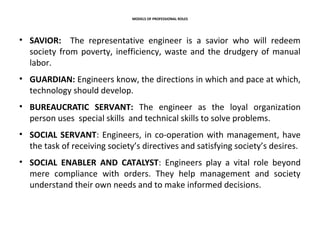
MODELS OF PROFESSIONAL ROLES
• SAVIOR: The representative engineer is a savior who will redeem
society from poverty, inefficiency, waste and the drudgery of manual
labor.
• GUARDIAN: Engineers know, the directions in which and pace at which,
technology should develop.
• BUREAUCRATIC SERVANT: The engineer as the loyal organization
person uses special skills and technical skills to solve problems.
• SOCIAL SERVANT: Engineers, in co-operation with management, have
the task of receiving society’s directives and satisfying society’s desires.
• SOCIAL ENABLER AND CATALYST: Engineers play a vital role beyond
mere compliance with orders. They help management and society
understand their own needs and to make informed decisions.
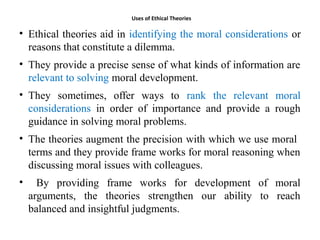
Uses of Ethical Theories
• Ethical theories aid in identifying the moral considerations or
reasons that constitute a dilemma.
• They provide a precise sense of what kinds of information are
relevant to solving moral development.
• They sometimes, offer ways to rank the relevant moral
considerations in order of importance and provide a rough
guidance in solving moral problems.
• The theories augment the precision with which we use moral
terms and they provide frame works for moral reasoning when
discussing moral issues with colleagues.
• By providing frame works for development of moral
arguments, the theories strengthen our ability to reach
balanced and insightful judgments.
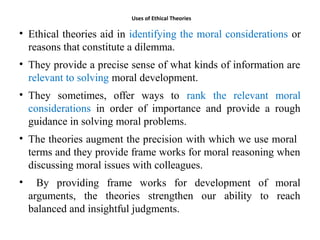
Uses of Ethical Theories
• Ethical theories aid in identifying the moral considerations or
reasons that constitute a dilemma.
• They provide a precise sense of what kinds of information are
relevant to solving moral development.
• They sometimes, offer ways to rank the relevant moral
considerations in order of importance and provide a rough
guidance in solving moral problems.
• The theories augment the precision with which we use moral
terms and they provide frame works for moral reasoning when
discussing moral issues with colleagues.
• By providing frame works for development of moral
arguments, the theories strengthen our ability to reach
balanced and insightful judgments.

Profession & professionalism

  • 1.
  • 2.
    Profession • Profession isa noun describing a job type, usually reserved for a recognized specific career, i.e. Doctors, Lawyers, Engineers, Psychologists, Social Workers, Teachers, Military Officers. • It conveys expertise and/or education.
  • 3.
    Professionalism • Professionalism isan adverb. • Set of attitudes and behaviors believed to be appropriate to a particular occupation. • It used to describe / type of behavior expertise in a career . • Professionalism can be applied to almost any job. • It can be a description of a single momentous act or used as a description of job performance.
  • 4.
    DIFFERENCE BETWEEN PROFESSIONVS PROFESSIONALISM • Profession = a field of study, a career, a job path. Examples: medicine, law, and accounting. • Professionalism = proper or accepted behaviors and attitudes. Examples: showing respect, showing up for work on-time, doing good work, and dressing appropriately.
  • 5.
    Example - PROFESSIONVS PROFESSIONALISM • As a computer Programmer, I write Program - Profession. I write without any errors - Professionalism • As a singer - I sing songs - Profession I sing so that everyone wish to hear me - Professionalism • As a professional Killer - I Kill people - Profession I kill without any trace to track me - Professionalism (Not a apt example).
  • 6.
    Who is aprofessional engineer? • Has a bachelor’s degree in engineering from an accredited school • Performs engineering work • Is a registered and licensed Professional Engineer • Acts in a morally responsible way while practicing engineering
  • 7.
    MOTIVES FOR PROFESSIONALISM •A desire for interesting and challenging work and the pleasure in the act of changing the world. • The joy of creative efforts. Where a scientist’s interest is in discovering new technology, engineers interest is derived from creatively solving practical problems. • Strong sense of helping, of directing efforts towards easing the lot of one’s fellows.
  • 8.
    MODELS OF PROFESSIONALROLES • SAVIOR: The representative engineer is a savior who will redeem society from poverty, inefficiency, waste and the drudgery of manual labor. • GUARDIAN: Engineers know, the directions in which and pace at which, technology should develop. • BUREAUCRATIC SERVANT: The engineer as the loyal organization person uses special skills and technical skills to solve problems. • SOCIAL SERVANT: Engineers, in co-operation with management, have the task of receiving society’s directives and satisfying society’s desires. • SOCIAL ENABLER AND CATALYST: Engineers play a vital role beyond mere compliance with orders. They help management and society understand their own needs and to make informed decisions.
  • 9.
    Uses of EthicalTheories • Ethical theories aid in identifying the moral considerations or reasons that constitute a dilemma. • They provide a precise sense of what kinds of information are relevant to solving moral development. • They sometimes, offer ways to rank the relevant moral considerations in order of importance and provide a rough guidance in solving moral problems. • The theories augment the precision with which we use moral terms and they provide frame works for moral reasoning when discussing moral issues with colleagues. • By providing frame works for development of moral arguments, the theories strengthen our ability to reach balanced and insightful judgments.
  • 10.
    Uses of EthicalTheories • Ethical theories aid in identifying the moral considerations or reasons that constitute a dilemma. • They provide a precise sense of what kinds of information are relevant to solving moral development. • They sometimes, offer ways to rank the relevant moral considerations in order of importance and provide a rough guidance in solving moral problems. • The theories augment the precision with which we use moral terms and they provide frame works for moral reasoning when discussing moral issues with colleagues. • By providing frame works for development of moral arguments, the theories strengthen our ability to reach balanced and insightful judgments.