Ethics &
Professional
Responsibilities
Course Title: Social, Professional and Ethical Issues in Computing
Course Code: CSE-4805
Presented by: Tasnim
ID: C191267
Semesters: 7th Section: 8BF
Department of CSE, IIUC
Outcome
▪ What is Ethics.
▪ What is Computer ethics
▪ Some ethical guidelines for computer professionals
▪ Examine and discuss professional codes of ethics
▪ Conduct
▪ Practice (IEEE, ACM, SE, AITP, and so forth).
Ethics is concerned with:
▪ The values and guidelines by which we live, and how they are justified n
▪ Standards of right and wrong
▪ Identification with cultural norms or customs
What is Ethics?
What is Computer ethics
▪ Computer ethics is a part of practical philosophy concerned with how
computing professionals should make decisions regarding professional and
social conduct.
According to Margaret Anne Pierce, three primary influences:
▪ 1.The individual's own personal code.
▪ 2.Any informal code of ethical conduct that exists in the work place.
▪ 3.Exposure to formal codes of ethics.
The scope of Computer ethics
The scope of the term “computer ethics” varies considerably.
▪ It can include such social and political issues as the impact of computers on
employment, the environmental.
▪ Impact of computers, whether or not to sell computers to totalitarian
governments, use of
▪ Computer systems by the military, and the impact of new applications on
privacy.
▪ It can include personal dilemmas about what to post on the Internet and
what to download.
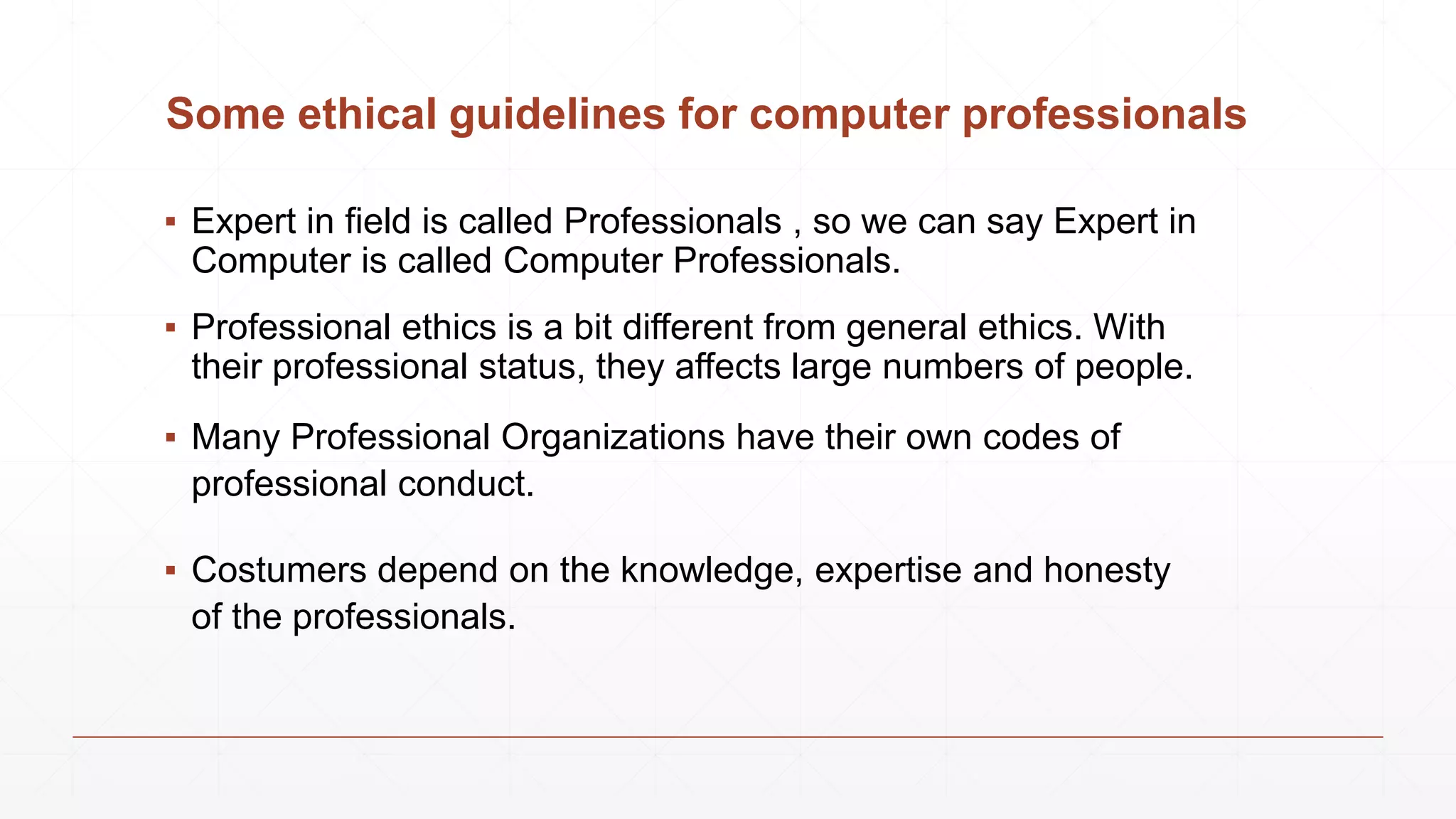
Some ethical guidelines for computer professionals
▪ Expert in field is called Professionals , so we can say Expert in
Computer is called Computer Professionals.
▪ Professional ethics is a bit different from general ethics. With
their professional status, they affects large numbers of people.
▪ Many Professional Organizations have their own codes of
professional conduct.
▪ Costumers depend on the knowledge, expertise and honesty
of the professionals.
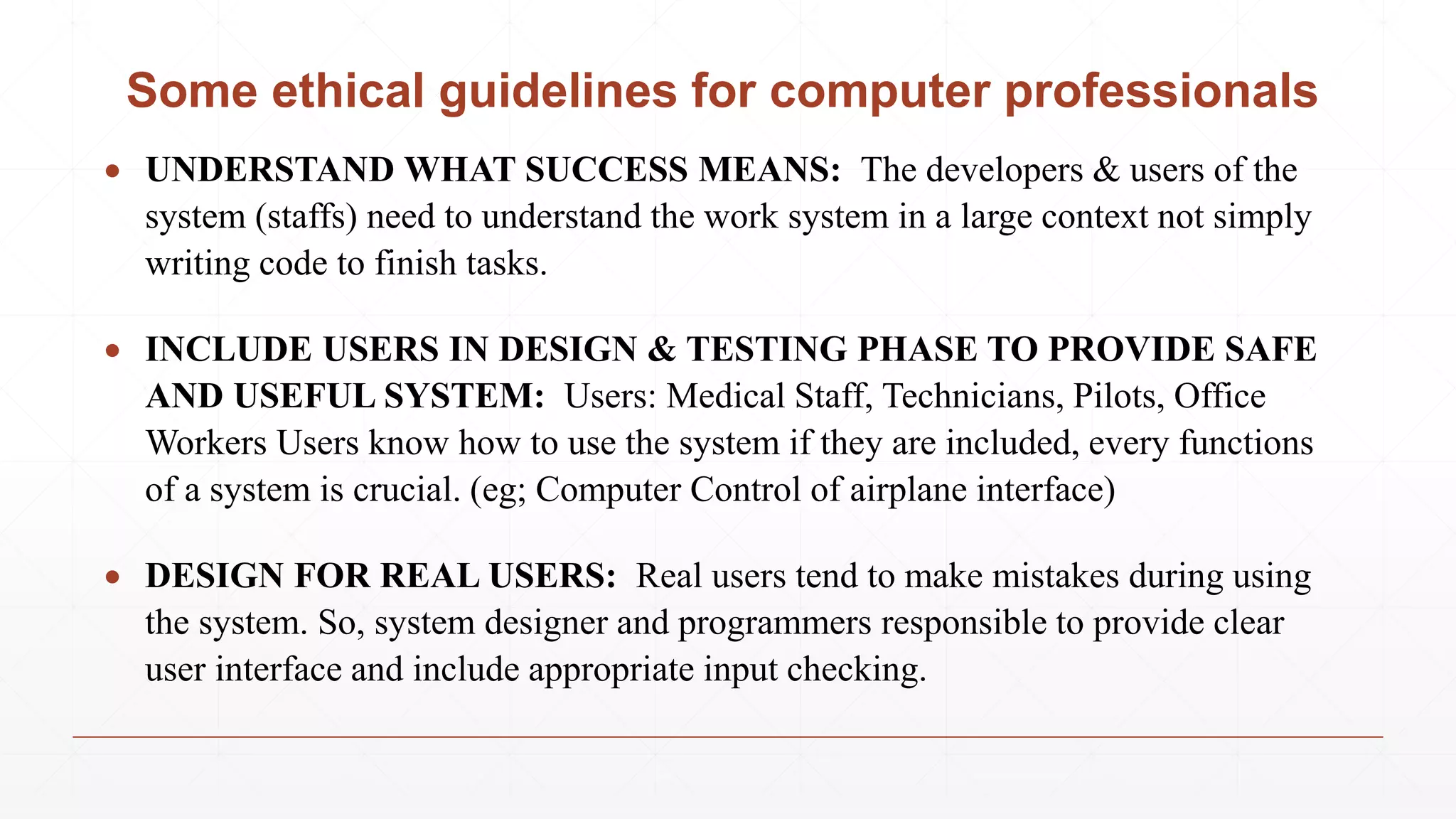
Some ethical guidelines for computer professionals
 UNDERSTAND WHAT SUCCESS MEANS: The developers & users of the
system (staffs) need to understand the work system in a large context not simply
writing code to finish tasks.
 INCLUDE USERS IN DESIGN & TESTING PHASE TO PROVIDE SAFE
AND USEFUL SYSTEM: Users: Medical Staff, Technicians, Pilots, Office
Workers Users know how to use the system if they are included, every functions
of a system is crucial. (eg; Computer Control of airplane interface)
 DESIGN FOR REAL USERS: Real users tend to make mistakes during using
the system. So, system designer and programmers responsible to provide clear
user interface and include appropriate input checking.
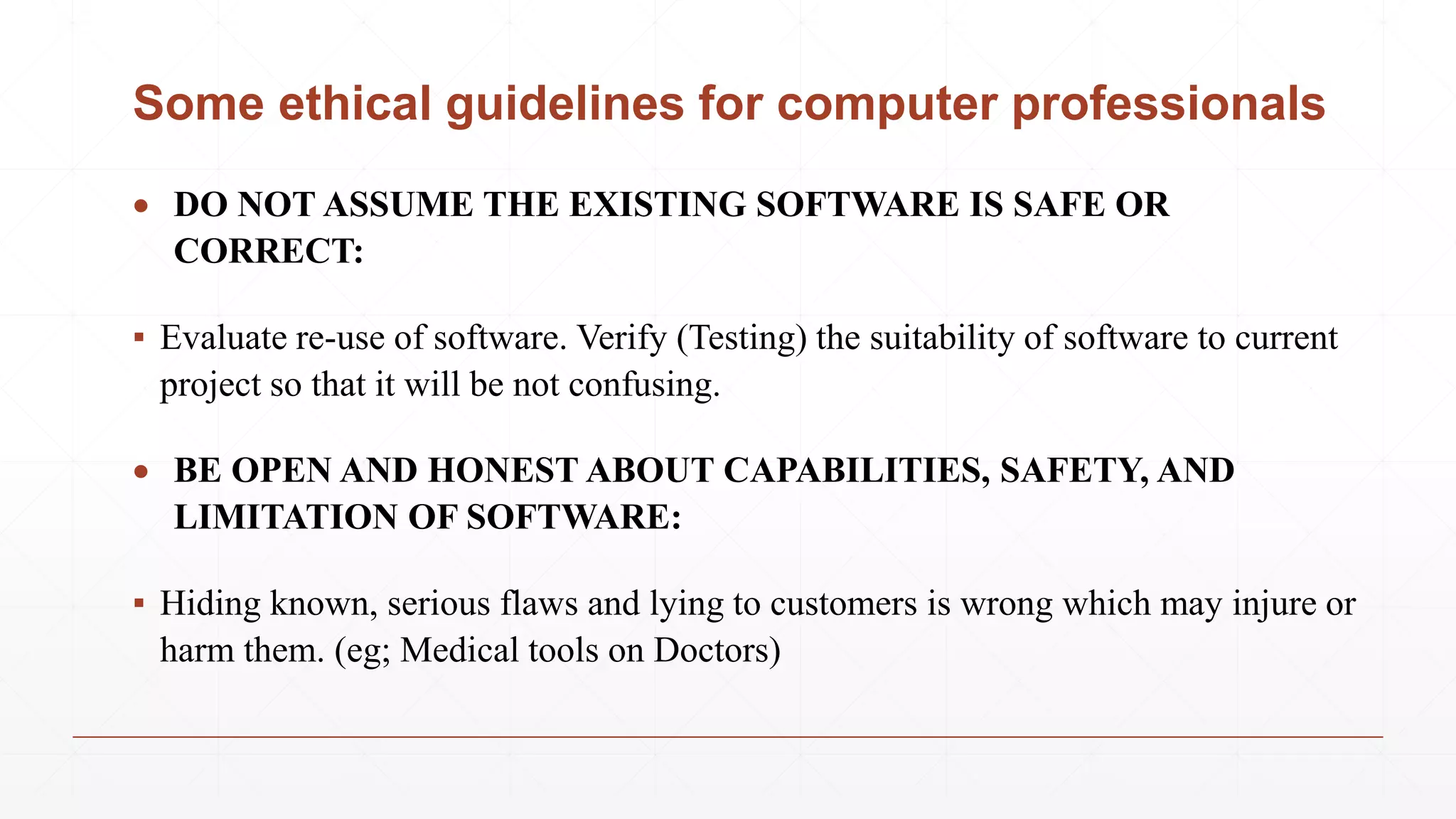
Some ethical guidelines for computer professionals
 DO NOT ASSUME THE EXISTING SOFTWARE IS SAFE OR
CORRECT:
▪ Evaluate re-use of software. Verify (Testing) the suitability of software to current
project so that it will be not confusing.
 BE OPEN AND HONEST ABOUT CAPABILITIES, SAFETY, AND
LIMITATION OF SOFTWARE:
▪ Hiding known, serious flaws and lying to customers is wrong which may injure or
harm them. (eg; Medical tools on Doctors)
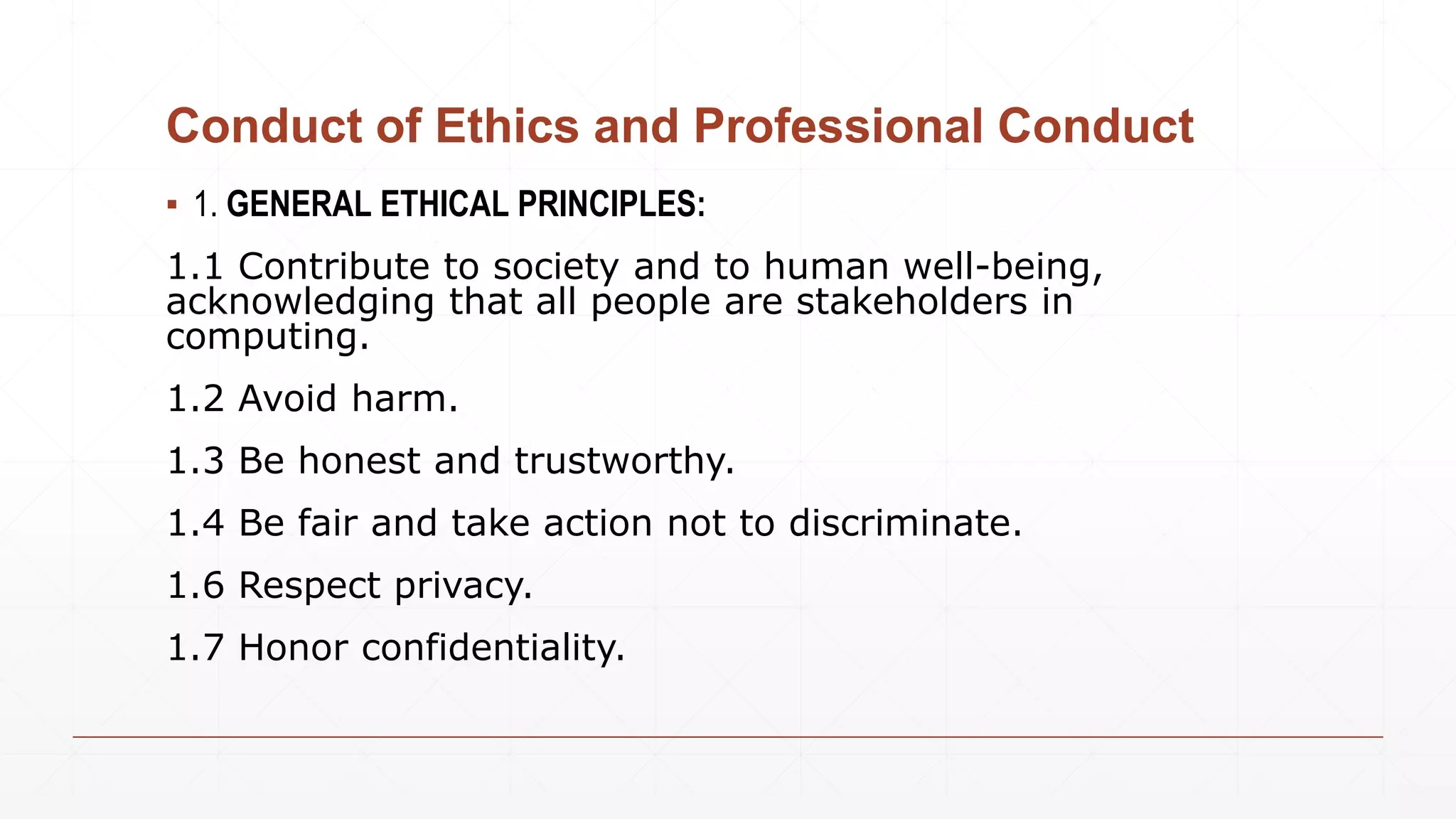
Conduct of Ethics and Professional Conduct
▪ 1. GENERAL ETHICAL PRINCIPLES:
1.1 Contribute to society and to human well-being,
acknowledging that all people are stakeholders in
computing.
1.2 Avoid harm.
1.3 Be honest and trustworthy.
1.4 Be fair and take action not to discriminate.
1.6 Respect privacy.
1.7 Honor confidentiality.
Conduct of Ethics and Professional Conduct
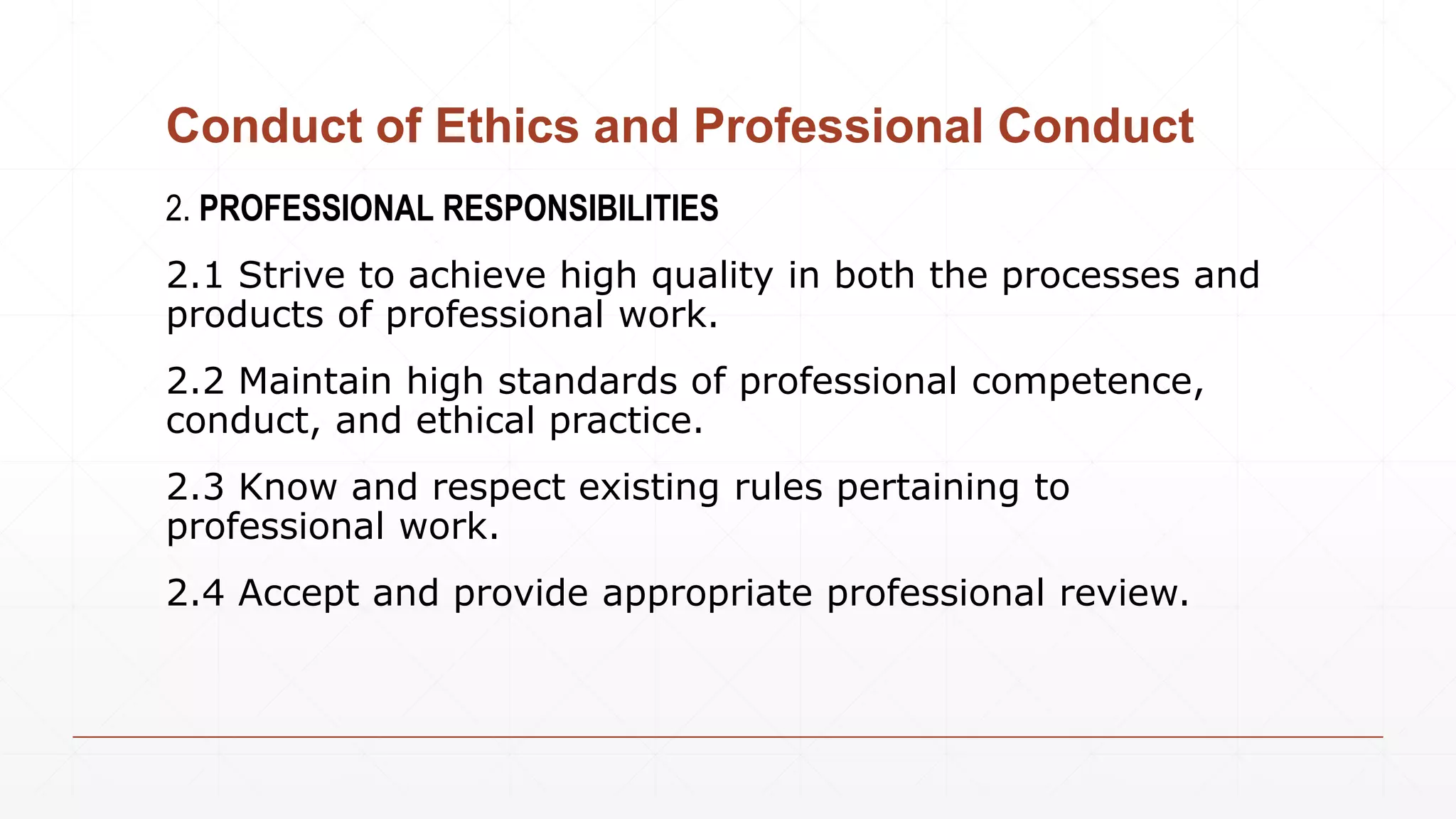
2. PROFESSIONAL RESPONSIBILITIES
2.1 Strive to achieve high quality in both the processes and
products of professional work.
2.2 Maintain high standards of professional competence,
conduct, and ethical practice.
2.3 Know and respect existing rules pertaining to
professional work.
2.4 Accept and provide appropriate professional review.
Conduct of Ethics and Professional Conduct
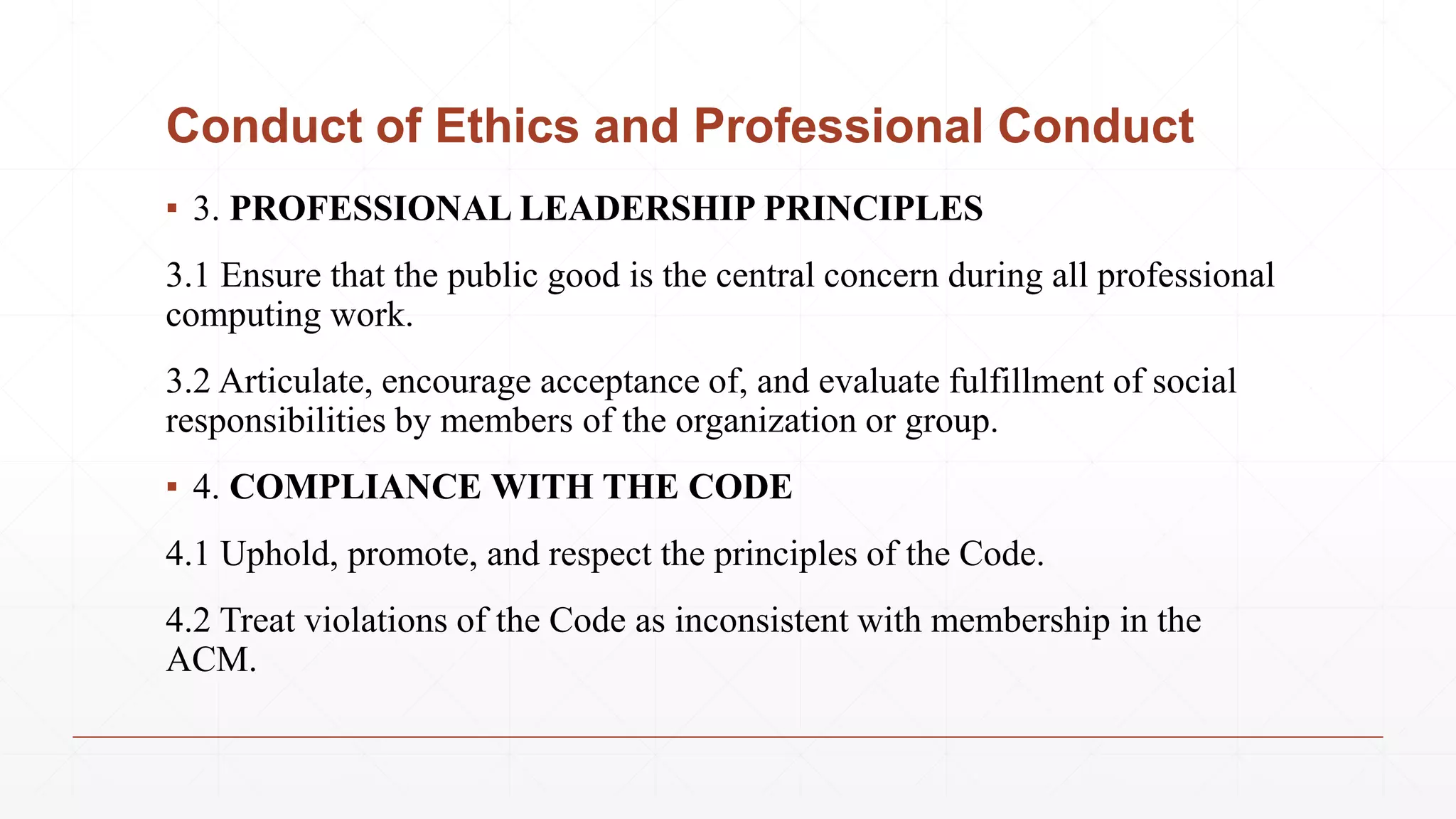
▪ 3. PROFESSIONAL LEADERSHIP PRINCIPLES
3.1 Ensure that the public good is the central concern during all professional
computing work.
3.2 Articulate, encourage acceptance of, and evaluate fulfillment of social
responsibilities by members of the organization or group.
▪ 4. COMPLIANCE WITH THE CODE
4.1 Uphold, promote, and respect the principles of the Code.
4.2 Treat violations of the Code as inconsistent with membership in the
ACM.
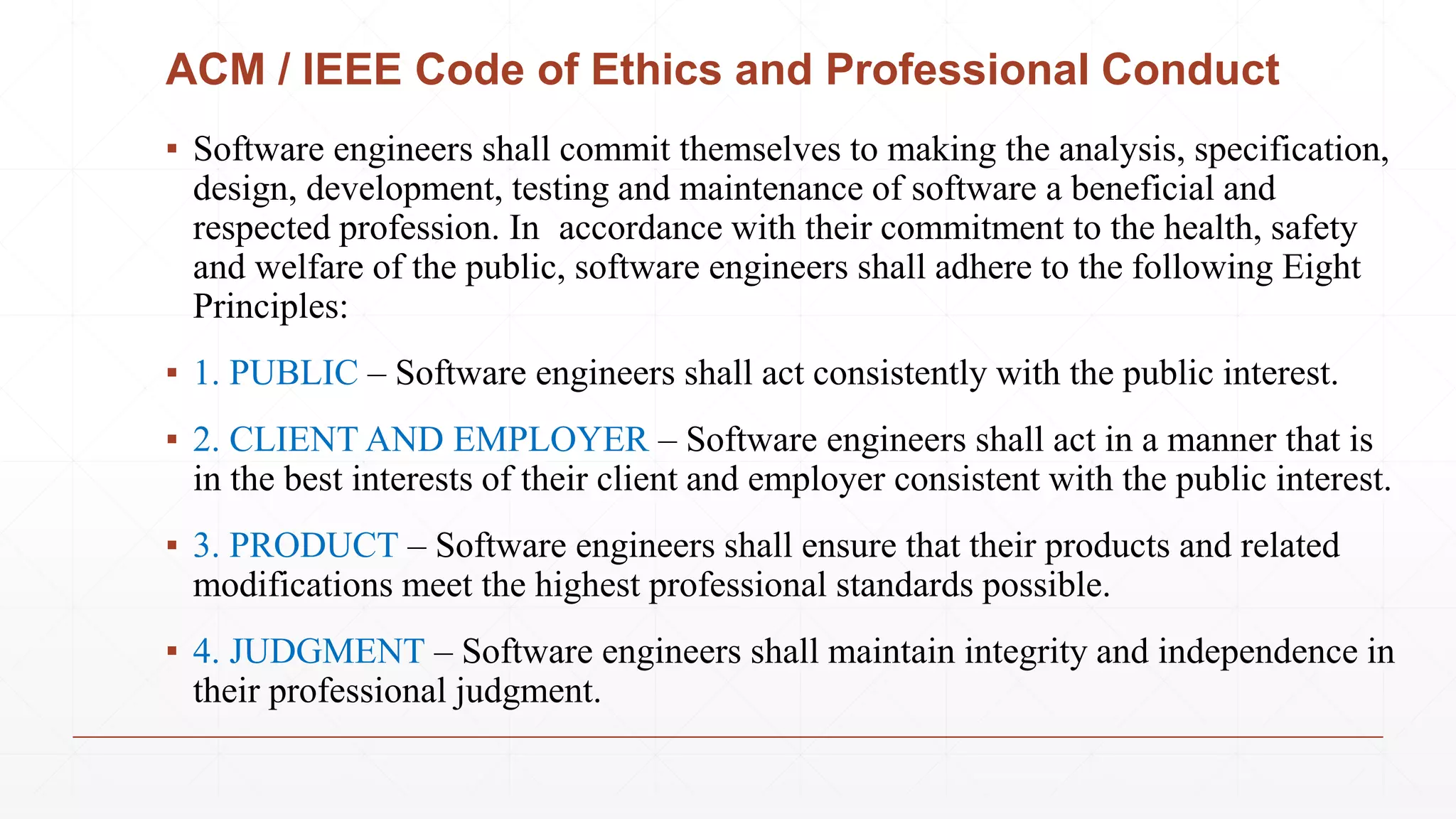
ACM / IEEE Code of Ethics and Professional Conduct
▪ Software engineers shall commit themselves to making the analysis, specification,
design, development, testing and maintenance of software a beneficial and
respected profession. In accordance with their commitment to the health, safety
and welfare of the public, software engineers shall adhere to the following Eight
Principles:
▪ 1. PUBLIC – Software engineers shall act consistently with the public interest.
▪ 2. CLIENT AND EMPLOYER – Software engineers shall act in a manner that is
in the best interests of their client and employer consistent with the public interest.
▪ 3. PRODUCT – Software engineers shall ensure that their products and related
modifications meet the highest professional standards possible.
▪ 4. JUDGMENT – Software engineers shall maintain integrity and independence in
their professional judgment.
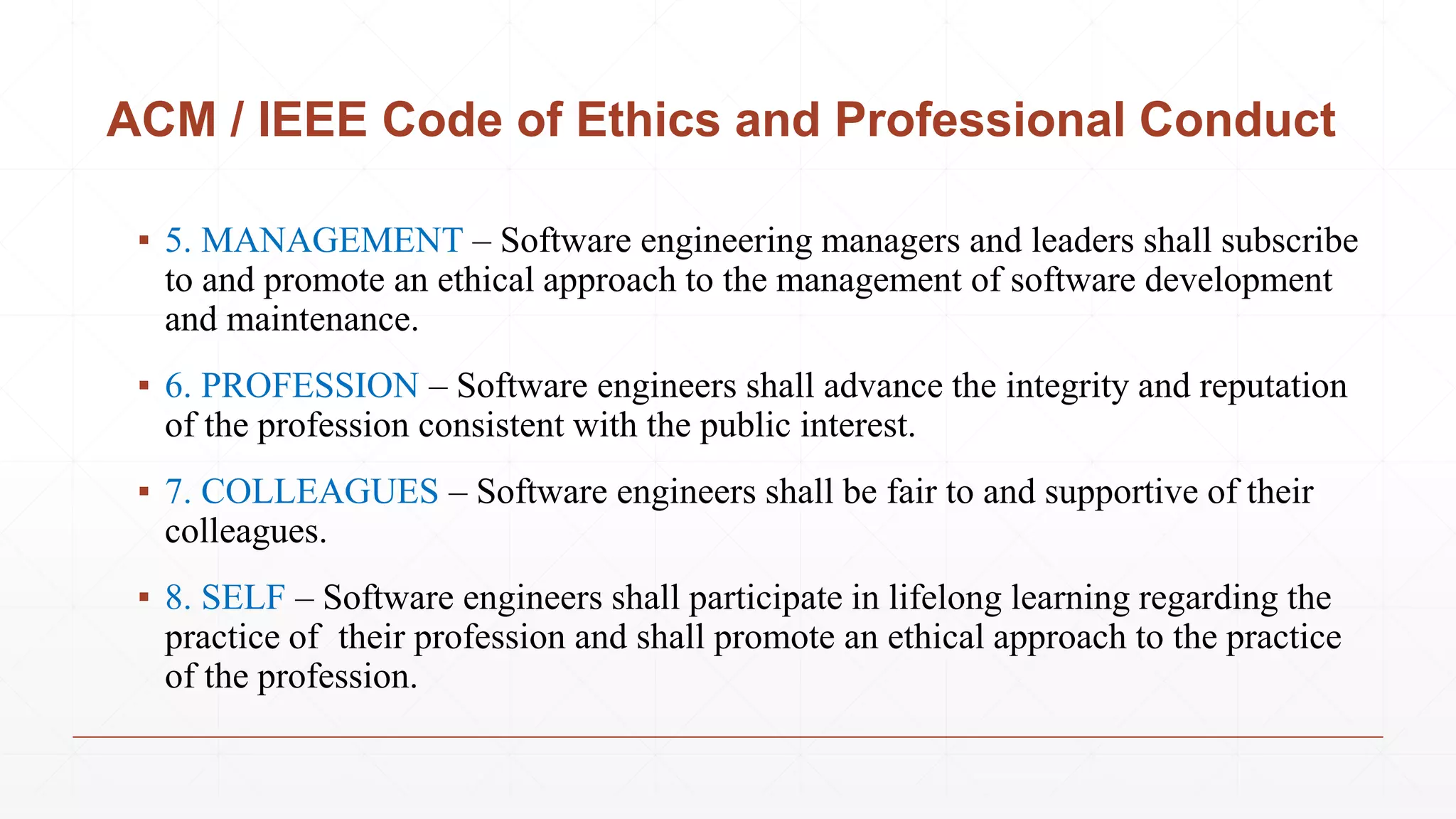
ACM / IEEE Code of Ethics and Professional Conduct
▪ 5. MANAGEMENT – Software engineering managers and leaders shall subscribe
to and promote an ethical approach to the management of software development
and maintenance.
▪ 6. PROFESSION – Software engineers shall advance the integrity and reputation
of the profession consistent with the public interest.
▪ 7. COLLEAGUES – Software engineers shall be fair to and supportive of their
colleagues.
▪ 8. SELF – Software engineers shall participate in lifelong learning regarding the
practice of their profession and shall promote an ethical approach to the practice
of the profession.
REFERENCE
▪ https://slideplayer.com/slide/4914533/
▪ Sara Baase: A gift of fire, 2/e, Pearson Education Inc., 2003.
▪ https://www.acm.org/code-of-ethics
▪ https://www.youtube.com/watch?v=cz6SVmErSBk
Thank You

Ethical Issues in Computing.pptx

  • 1.
    Ethics & Professional Responsibilities Course Title:Social, Professional and Ethical Issues in Computing Course Code: CSE-4805 Presented by: Tasnim ID: C191267 Semesters: 7th Section: 8BF Department of CSE, IIUC
  • 2.
    Outcome ▪ What isEthics. ▪ What is Computer ethics ▪ Some ethical guidelines for computer professionals ▪ Examine and discuss professional codes of ethics ▪ Conduct ▪ Practice (IEEE, ACM, SE, AITP, and so forth).
  • 3.
    Ethics is concernedwith: ▪ The values and guidelines by which we live, and how they are justified n ▪ Standards of right and wrong ▪ Identification with cultural norms or customs What is Ethics?
  • 4.
    What is Computerethics ▪ Computer ethics is a part of practical philosophy concerned with how computing professionals should make decisions regarding professional and social conduct. According to Margaret Anne Pierce, three primary influences: ▪ 1.The individual's own personal code. ▪ 2.Any informal code of ethical conduct that exists in the work place. ▪ 3.Exposure to formal codes of ethics.
  • 5.
    The scope ofComputer ethics The scope of the term “computer ethics” varies considerably. ▪ It can include such social and political issues as the impact of computers on employment, the environmental. ▪ Impact of computers, whether or not to sell computers to totalitarian governments, use of ▪ Computer systems by the military, and the impact of new applications on privacy. ▪ It can include personal dilemmas about what to post on the Internet and what to download.
  • 6.
    Some ethical guidelinesfor computer professionals ▪ Expert in field is called Professionals , so we can say Expert in Computer is called Computer Professionals. ▪ Professional ethics is a bit different from general ethics. With their professional status, they affects large numbers of people. ▪ Many Professional Organizations have their own codes of professional conduct. ▪ Costumers depend on the knowledge, expertise and honesty of the professionals.
  • 7.
    Some ethical guidelinesfor computer professionals  UNDERSTAND WHAT SUCCESS MEANS: The developers & users of the system (staffs) need to understand the work system in a large context not simply writing code to finish tasks.  INCLUDE USERS IN DESIGN & TESTING PHASE TO PROVIDE SAFE AND USEFUL SYSTEM: Users: Medical Staff, Technicians, Pilots, Office Workers Users know how to use the system if they are included, every functions of a system is crucial. (eg; Computer Control of airplane interface)  DESIGN FOR REAL USERS: Real users tend to make mistakes during using the system. So, system designer and programmers responsible to provide clear user interface and include appropriate input checking.
  • 8.
    Some ethical guidelinesfor computer professionals  DO NOT ASSUME THE EXISTING SOFTWARE IS SAFE OR CORRECT: ▪ Evaluate re-use of software. Verify (Testing) the suitability of software to current project so that it will be not confusing.  BE OPEN AND HONEST ABOUT CAPABILITIES, SAFETY, AND LIMITATION OF SOFTWARE: ▪ Hiding known, serious flaws and lying to customers is wrong which may injure or harm them. (eg; Medical tools on Doctors)
  • 9.
    Conduct of Ethicsand Professional Conduct ▪ 1. GENERAL ETHICAL PRINCIPLES: 1.1 Contribute to society and to human well-being, acknowledging that all people are stakeholders in computing. 1.2 Avoid harm. 1.3 Be honest and trustworthy. 1.4 Be fair and take action not to discriminate. 1.6 Respect privacy. 1.7 Honor confidentiality.
  • 10.
    Conduct of Ethicsand Professional Conduct 2. PROFESSIONAL RESPONSIBILITIES 2.1 Strive to achieve high quality in both the processes and products of professional work. 2.2 Maintain high standards of professional competence, conduct, and ethical practice. 2.3 Know and respect existing rules pertaining to professional work. 2.4 Accept and provide appropriate professional review.
  • 11.
    Conduct of Ethicsand Professional Conduct ▪ 3. PROFESSIONAL LEADERSHIP PRINCIPLES 3.1 Ensure that the public good is the central concern during all professional computing work. 3.2 Articulate, encourage acceptance of, and evaluate fulfillment of social responsibilities by members of the organization or group. ▪ 4. COMPLIANCE WITH THE CODE 4.1 Uphold, promote, and respect the principles of the Code. 4.2 Treat violations of the Code as inconsistent with membership in the ACM.
  • 12.
    ACM / IEEECode of Ethics and Professional Conduct ▪ Software engineers shall commit themselves to making the analysis, specification, design, development, testing and maintenance of software a beneficial and respected profession. In accordance with their commitment to the health, safety and welfare of the public, software engineers shall adhere to the following Eight Principles: ▪ 1. PUBLIC – Software engineers shall act consistently with the public interest. ▪ 2. CLIENT AND EMPLOYER – Software engineers shall act in a manner that is in the best interests of their client and employer consistent with the public interest. ▪ 3. PRODUCT – Software engineers shall ensure that their products and related modifications meet the highest professional standards possible. ▪ 4. JUDGMENT – Software engineers shall maintain integrity and independence in their professional judgment.
  • 13.
    ACM / IEEECode of Ethics and Professional Conduct ▪ 5. MANAGEMENT – Software engineering managers and leaders shall subscribe to and promote an ethical approach to the management of software development and maintenance. ▪ 6. PROFESSION – Software engineers shall advance the integrity and reputation of the profession consistent with the public interest. ▪ 7. COLLEAGUES – Software engineers shall be fair to and supportive of their colleagues. ▪ 8. SELF – Software engineers shall participate in lifelong learning regarding the practice of their profession and shall promote an ethical approach to the practice of the profession.
  • 14.
    REFERENCE ▪ https://slideplayer.com/slide/4914533/ ▪ SaraBaase: A gift of fire, 2/e, Pearson Education Inc., 2003. ▪ https://www.acm.org/code-of-ethics ▪ https://www.youtube.com/watch?v=cz6SVmErSBk
  • 15.