


CODE OF CONDUCT
PROFESSIONAL ETHICS
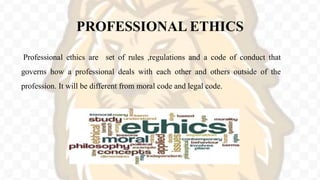
Professional ethics are set of rules ,regulations and a code of conduct that
governs how a professional deals with each other and others outside of the
profession. It will be different from moral code and legal code.
CODE OF CONDUCT
A code of business conduct, sometimes called a code of ethics, is a management tool
for setting out an organization's values, responsibilities and ethical obligations.
The code of conduct provides employees with guidance for handling difficult ethical
situations related to the business.
Businesses develop their own codes, based on their core values, and no two codes are
the same.
To be truly effective, the code of conduct must also be embedded in the business, so
employees know how it applies to them
CODE OF CONDUCT VIOLATIONS
An act that violates the rules written in the code of conduct
Conduct cases are those where an employee fails to comply with work rules,
policies, and procedures such as arriving for work on time; treating co-workers
respect; being honest; maintaining a good attendance record; using company
time, supplies and property in a responsible manner; and other similar
behavior-related areas.
Violations of these work rules, policies and procedures can form the basis for
corrective, and disciplinary action.
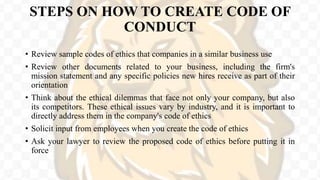
STEPS ON HOW TO CREATE CODE OF
CONDUCT
• Review sample codes of ethics that companies in a similar business use
• Review other documents related to your business, including the firm's
mission statement and any specific policies new hires receive as part of their
orientation
• Think about the ethical dilemmas that face not only your company, but also
its competitors. These ethical issues vary by industry, and it is important to
directly address them in the company's code of ethics
• Solicit input from employees when you create the code of ethics
• Ask your lawyer to review the proposed code of ethics before putting it in
force
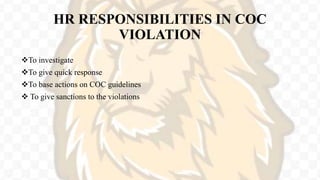
HR RESPONSIBILITIES IN COC
VIOLATION
To investigate
To give quick response
To base actions on COC guidelines
 To give sanctions to the violations
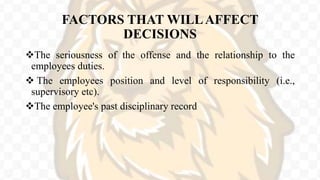
FACTORS THAT WILLAFFECT
DECISIONS
The seriousness of the offense and the relationship to the
employees duties.
 The employees position and level of responsibility (i.e.,
supervisory etc).
The employee's past disciplinary record
CONT..
The employee's past work record and years ofService.
 The effect of the offense on the supervisor's confidence in the employee
 The consistency of the penalty with that imposed on other employees
The clarity with which the employee was placed onnotice
 The potential for rehabilitation
 Any mitigating circumstances (provocation by others, etc.)
STEPS IN PROGRESSIVE DISCIPLINE
Verbal Warning
Written Warning
Suspension
Termination
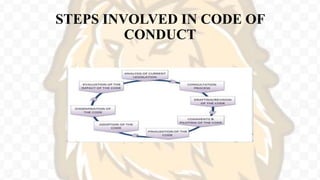
STEPS INVOLVED IN CODE OF
CONDUCT
COC SECTIONS
Company Vision, Mission and Philosophy
COC Purpose
Scope
Responsibility/Accountability
Implementation
Types of Disciplinary Action/Penalty
 Compliance of Labor Code
Common Table of Offenses
Against Company/Interest & Policy
Against Persons
Against Property
Against Work environment, Safety, Security &
Public Order
Against Medical Rules
REAL TIME EXAMPLE
FACEBOOK:
Facebook’s Code of Conduct is published on the company’s investor relations
website and available for download as a PDF. Though it does not contain
images or visuals, the code is simple, straightforward and easy to understand.
It covers important topics including conflicts of interest, harassment,
confidentiality and protection of user data.
Facebook also highlights that employees can report violations anonymously to
sources that they feel comfortable speaking to, including their managers, the
HR department, or the Legal Department. The code of conduct also includes
links to the company’s whistleblower and complaint policy.
✓ Concise
✓ Well Organized
IBM:
The Business Conduct Guidelines created by IBM provide employees with a
clear understanding of the expectations of their employer. This code of
conduct is grounded in the company’s guiding principles and provides detailed
explanations with examples.
IBM also includes several “Integrity Tips” to help employees make the right
decisions in a variety of situations. Additionally, the company provides links to
several additional resources and policies that may be helpful to employees and
investors.
✓ Well Organized
✓ Visually Appealing
JOHNSON & JOHNSON:
Johnson & Johnson has a detailed and easy-to-follow Code of Business Conduct for
employees. The code outlines the expectations that employees must meet and even
provides a checklist of responsibilities that can be used as a reference. Additionally,
the company’s code of conduct provides examples of situations that require decision-
making to help employees do the right thing when faced with problems that could
result in misconduct.
Johnson & Johnson’s comprehensive code of conduct includes information on anti-
bribery laws, anti-trust laws, global trade compliance, fair purchasing, animal welfare,
non-discrimination and even use of social media.
✓ Visually Appealing
✓ Great Situational Examples
CONCLUSION
The implementation of these code shall create positive motivation rather than
punitive control, hereby penalties shall apply only when necessary and only the
extent required by the circumstances.
Code of conduct

Code of conduct

  • 1.
  • 2.
    PROFESSIONAL ETHICS Professional ethicsare set of rules ,regulations and a code of conduct that governs how a professional deals with each other and others outside of the profession. It will be different from moral code and legal code.
  • 3.
    CODE OF CONDUCT Acode of business conduct, sometimes called a code of ethics, is a management tool for setting out an organization's values, responsibilities and ethical obligations. The code of conduct provides employees with guidance for handling difficult ethical situations related to the business. Businesses develop their own codes, based on their core values, and no two codes are the same. To be truly effective, the code of conduct must also be embedded in the business, so employees know how it applies to them
  • 4.
    CODE OF CONDUCTVIOLATIONS An act that violates the rules written in the code of conduct Conduct cases are those where an employee fails to comply with work rules, policies, and procedures such as arriving for work on time; treating co-workers respect; being honest; maintaining a good attendance record; using company time, supplies and property in a responsible manner; and other similar behavior-related areas. Violations of these work rules, policies and procedures can form the basis for corrective, and disciplinary action.
  • 5.
    STEPS ON HOWTO CREATE CODE OF CONDUCT • Review sample codes of ethics that companies in a similar business use • Review other documents related to your business, including the firm's mission statement and any specific policies new hires receive as part of their orientation • Think about the ethical dilemmas that face not only your company, but also its competitors. These ethical issues vary by industry, and it is important to directly address them in the company's code of ethics • Solicit input from employees when you create the code of ethics • Ask your lawyer to review the proposed code of ethics before putting it in force
  • 7.
    HR RESPONSIBILITIES INCOC VIOLATION To investigate To give quick response To base actions on COC guidelines  To give sanctions to the violations
  • 8.
    FACTORS THAT WILLAFFECT DECISIONS Theseriousness of the offense and the relationship to the employees duties.  The employees position and level of responsibility (i.e., supervisory etc). The employee's past disciplinary record
  • 9.
    CONT.. The employee's pastwork record and years ofService.  The effect of the offense on the supervisor's confidence in the employee  The consistency of the penalty with that imposed on other employees The clarity with which the employee was placed onnotice  The potential for rehabilitation  Any mitigating circumstances (provocation by others, etc.)
  • 10.
    STEPS IN PROGRESSIVEDISCIPLINE Verbal Warning Written Warning Suspension Termination
  • 11.
    STEPS INVOLVED INCODE OF CONDUCT
  • 12.
    COC SECTIONS Company Vision,Mission and Philosophy COC Purpose Scope Responsibility/Accountability Implementation Types of Disciplinary Action/Penalty  Compliance of Labor Code
  • 13.
    Common Table ofOffenses Against Company/Interest & Policy Against Persons Against Property Against Work environment, Safety, Security & Public Order Against Medical Rules
  • 14.
    REAL TIME EXAMPLE FACEBOOK: Facebook’sCode of Conduct is published on the company’s investor relations website and available for download as a PDF. Though it does not contain images or visuals, the code is simple, straightforward and easy to understand. It covers important topics including conflicts of interest, harassment, confidentiality and protection of user data. Facebook also highlights that employees can report violations anonymously to sources that they feel comfortable speaking to, including their managers, the HR department, or the Legal Department. The code of conduct also includes links to the company’s whistleblower and complaint policy. ✓ Concise ✓ Well Organized
  • 15.
    IBM: The Business ConductGuidelines created by IBM provide employees with a clear understanding of the expectations of their employer. This code of conduct is grounded in the company’s guiding principles and provides detailed explanations with examples. IBM also includes several “Integrity Tips” to help employees make the right decisions in a variety of situations. Additionally, the company provides links to several additional resources and policies that may be helpful to employees and investors. ✓ Well Organized ✓ Visually Appealing
  • 16.
    JOHNSON & JOHNSON: Johnson& Johnson has a detailed and easy-to-follow Code of Business Conduct for employees. The code outlines the expectations that employees must meet and even provides a checklist of responsibilities that can be used as a reference. Additionally, the company’s code of conduct provides examples of situations that require decision- making to help employees do the right thing when faced with problems that could result in misconduct. Johnson & Johnson’s comprehensive code of conduct includes information on anti- bribery laws, anti-trust laws, global trade compliance, fair purchasing, animal welfare, non-discrimination and even use of social media. ✓ Visually Appealing ✓ Great Situational Examples
  • 17.
    CONCLUSION The implementation ofthese code shall create positive motivation rather than punitive control, hereby penalties shall apply only when necessary and only the extent required by the circumstances.