Professional Ethics in Computing
What are Professional Ethics?
• Professional ethics are a code of conduct
that govern how members of a profession
deal with each other and with third parties.
Why should we have a
Professional Code of Ethics?
• A Professional Code of Ethics serves several
functions:
– Symbolises the professionalism of the group.
– Defines and promotes a standard for external relations
with clients and employers.
– Protects the group’s interests.
– Codifies members’ rights.
– Expresses ideals to aspire to.
– Offers guidelines in “gray areas”.
Why have a Professional Code of
Ethics in Computing?
• Software has the potential to do good or
cause harm, or to enable or influence others
to do good or cause harm.
• We have pride in our work and want the
work that we do to be given recognition and
respect.
• We want to protect our livelihood.
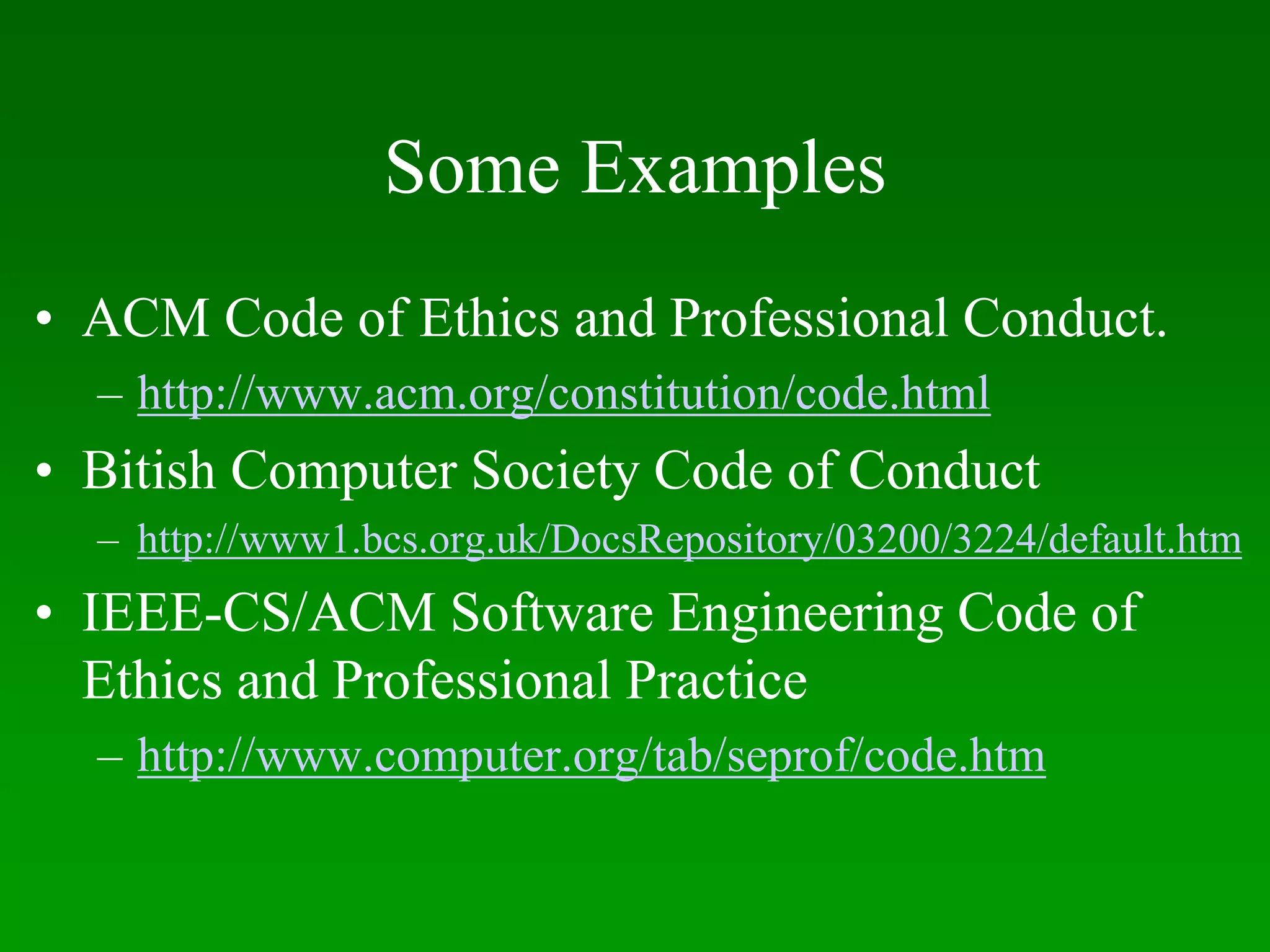
Some Examples
• ACM Code of Ethics and Professional Conduct.
– http://www.acm.org/constitution/code.html
• Bitish Computer Society Code of Conduct
– http://www1.bcs.org.uk/DocsRepository/03200/3224/default.htm
• IEEE-CS/ACM Software Engineering Code of
Ethics and Professional Practice
– http://www.computer.org/tab/seprof/code.htm
Characteristics of a Code of
Ethics
• They are not simple ethical algorithms that
generate ethical decisions.
• Sometimes elements of the code may be intension
with each other or other sources.
– Requires the software engineer to use ethical judgement
to act in the spirit of the code of ethics.
• A good code of ethics will enunciate fundamental
principles that require thought rather than blind
allegiance.
Joint IEEE-CS/ACM Code of
Ethics and Professional Practice
• Built on 8 principles
– Public Interest
– Client and Employer
– Product
– Judgement
– Management
– Profession
– Colleagues
– Self
• The principle of Public Interest is central to the
code.
Public Interest
• Software engineers shall act consistently with the
public interest.
– Approve software only if they have a well-founded
belief that it is safe, meets standards, passes tests and
does not diminish quality of life, privacy or harm the
environment.
– Disclose any actual or potential danger to the user.
– Be fair and avoid deception in all statements concerning
software.
Client and Employer
• Software engineers shall act in a manner that is in
the best interests of their client and employer,
consistent with the public interest.
– Be honest about any limitation of their experience and
education.
– Keep private any confidential information consistent
with the public interest and the law.
– Not knowingly use software that is obtained or retained
either illegally or unethically.
Product
• Software engineers shall ensure that their products
and related modifications meet the highest
professional standards possible.
– Strive for high quality, acceptable cost, and a
reasonable schedule, ensuring significant tradeoffs are
clear.
– Ensure adequate testing, debugging, and review of
software and related documents on which they work.
– Treat all forms of software maintenance with the same
professionalism as new development.
Judgement
• Software engineers shall maintain integrity
and independence in their professional
judgment.
– Not engage in deceptive financial practices.
– Disclose to all concerned parties those
conflicts of interest that cannot reasonably be
avoided or escaped.
Management
• Software engineering managers and leaders
shall subscribe to and promote an ethical
approach to the management of software
development and maintenance.
– Ensure that software engineers are informed of
standards before being held to them.
– Offer fair and just remuneration.
– Not punish anyone for expressing ethical
concerns about a project.
Profession
• Software engineers shall advance the integrity and
reputation of the profession consistent with the
public interest.
– Promote public knowledge of software engineering.
– Be accurate in stating the characteristics of software on
which they work.
– Take responsibility for detecting, correcting, and
reporting errors in software and associated documents
on which they work.
Colleagues
• Software engineers shall be fair to and supportive
of their colleagues.
– Credit fully the work of others and refrain from taking
undue credit.
– Give a fair hearing to the opinions, concerns, or
complaints of a colleague.
– In situations outside of their own areas of competence,
call upon the opinions of other professionals who have
competence in that area.
Self
• Software engineers shall participate in
lifelong learning regarding the practice of
their profession and shall promote an ethical
approach to the practice of the profession.
– Further their knowledge
– Improve their ability to create safe, reliable, and
useful quality software
– Improve their ability to produce accurate,
informative, and well-written documentation.
Problems with codes of conduct
• They don’t cover every case (nor should
they).
• Can a list of rules define a behaviour that
everyone considers right?
• Little penalty for non-compliance
– Requires a Personal Code of Ethics that is
broadly in line with the Professional Code.

professional ethics in_computing

  • 1.
  • 2.
    What are ProfessionalEthics? • Professional ethics are a code of conduct that govern how members of a profession deal with each other and with third parties.
  • 3.
    Why should wehave a Professional Code of Ethics? • A Professional Code of Ethics serves several functions: – Symbolises the professionalism of the group. – Defines and promotes a standard for external relations with clients and employers. – Protects the group’s interests. – Codifies members’ rights. – Expresses ideals to aspire to. – Offers guidelines in “gray areas”.
  • 4.
    Why have aProfessional Code of Ethics in Computing? • Software has the potential to do good or cause harm, or to enable or influence others to do good or cause harm. • We have pride in our work and want the work that we do to be given recognition and respect. • We want to protect our livelihood.
  • 5.
    Some Examples • ACMCode of Ethics and Professional Conduct. – http://www.acm.org/constitution/code.html • Bitish Computer Society Code of Conduct – http://www1.bcs.org.uk/DocsRepository/03200/3224/default.htm • IEEE-CS/ACM Software Engineering Code of Ethics and Professional Practice – http://www.computer.org/tab/seprof/code.htm
  • 6.
    Characteristics of aCode of Ethics • They are not simple ethical algorithms that generate ethical decisions. • Sometimes elements of the code may be intension with each other or other sources. – Requires the software engineer to use ethical judgement to act in the spirit of the code of ethics. • A good code of ethics will enunciate fundamental principles that require thought rather than blind allegiance.
  • 7.
    Joint IEEE-CS/ACM Codeof Ethics and Professional Practice • Built on 8 principles – Public Interest – Client and Employer – Product – Judgement – Management – Profession – Colleagues – Self • The principle of Public Interest is central to the code.
  • 8.
    Public Interest • Softwareengineers shall act consistently with the public interest. – Approve software only if they have a well-founded belief that it is safe, meets standards, passes tests and does not diminish quality of life, privacy or harm the environment. – Disclose any actual or potential danger to the user. – Be fair and avoid deception in all statements concerning software.
  • 9.
    Client and Employer •Software engineers shall act in a manner that is in the best interests of their client and employer, consistent with the public interest. – Be honest about any limitation of their experience and education. – Keep private any confidential information consistent with the public interest and the law. – Not knowingly use software that is obtained or retained either illegally or unethically.
  • 10.
    Product • Software engineersshall ensure that their products and related modifications meet the highest professional standards possible. – Strive for high quality, acceptable cost, and a reasonable schedule, ensuring significant tradeoffs are clear. – Ensure adequate testing, debugging, and review of software and related documents on which they work. – Treat all forms of software maintenance with the same professionalism as new development.
  • 11.
    Judgement • Software engineersshall maintain integrity and independence in their professional judgment. – Not engage in deceptive financial practices. – Disclose to all concerned parties those conflicts of interest that cannot reasonably be avoided or escaped.
  • 12.
    Management • Software engineeringmanagers and leaders shall subscribe to and promote an ethical approach to the management of software development and maintenance. – Ensure that software engineers are informed of standards before being held to them. – Offer fair and just remuneration. – Not punish anyone for expressing ethical concerns about a project.
  • 13.
    Profession • Software engineersshall advance the integrity and reputation of the profession consistent with the public interest. – Promote public knowledge of software engineering. – Be accurate in stating the characteristics of software on which they work. – Take responsibility for detecting, correcting, and reporting errors in software and associated documents on which they work.
  • 14.
    Colleagues • Software engineersshall be fair to and supportive of their colleagues. – Credit fully the work of others and refrain from taking undue credit. – Give a fair hearing to the opinions, concerns, or complaints of a colleague. – In situations outside of their own areas of competence, call upon the opinions of other professionals who have competence in that area.
  • 15.
    Self • Software engineersshall participate in lifelong learning regarding the practice of their profession and shall promote an ethical approach to the practice of the profession. – Further their knowledge – Improve their ability to create safe, reliable, and useful quality software – Improve their ability to produce accurate, informative, and well-written documentation.
  • 16.
    Problems with codesof conduct • They don’t cover every case (nor should they). • Can a list of rules define a behaviour that everyone considers right? • Little penalty for non-compliance – Requires a Personal Code of Ethics that is broadly in line with the Professional Code.