Professional Practices
Ehtesham Raza,
Assistant Professor,
Govt. Murray College, Sialkot.
7 Habits of Highly Effective People
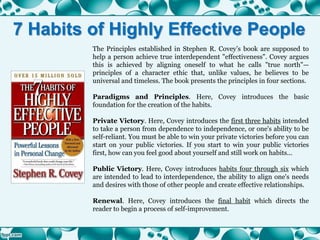
The Principles established in Stephen R. Covey’s book are supposed to
help a person achieve true interdependent "effectiveness". Covey argues
this is achieved by aligning oneself to what he calls "true north"—
principles of a character ethic that, unlike values, he believes to be
universal and timeless. The book presents the principles in four sections.
Paradigms and Principles. Here, Covey introduces the basic
foundation for the creation of the habits.
Private Victory. Here, Covey introduces the first three habits intended
to take a person from dependence to independence, or one's ability to be
self-reliant. You must be able to win your private victories before you can
start on your public victories. If you start to win your public victories
first, how can you feel good about yourself and still work on habits...
Public Victory. Here, Covey introduces habits four through six which
are intended to lead to interdependence, the ability to align one's needs
and desires with those of other people and create effective relationships.
Renewal. Here, Covey introduces the final habit which directs the
reader to begin a process of self-improvement.
Principles of Personal Vision
The word proactive means that we are
responsible for our own lives. Our behavior is a
function of our decisions, not our conditions.
We can subordinate feelings to values. We have
the initiative and the responsibility to make
things happen. Highly proactive people
recognize that responsibility. They do not
blame circumstances, conditions, or social
conditioning for their behavior. Their behavior
is a product of their own conscious choice,
based on values, rather than a product of their
conditions, based on feeling. Proactive people
are still influenced by external stimuli but their
response, conscious or unconscious, is a value
based choice or response.
Be Proactive
Principles of Personal Leadership
Begin today with the image, picture, or paradigm of
the end of your life as your frame of reference of the
criterion by which everything else is examined.
Each part of your life—today’s behavior, tomorrow’s
behavior, next week’s behavior, next month’s
behavior—can be examined in the context of the
whole, of what really matters most to you. By
keeping that end clearly in mind, you can make
certain that whatever you do on any particular day
does not violate the criteria you have defined as
supremely important, and that each day of your life
contributes in a meaningful way to the vision you
have of your life as a whole. To begin with the end
in mind means to start with a clear understanding of
your destination. It means to know where you’re
going so that you better understand where you are
now and so that the steps you take are always in the
right direction.
Begin with the End in Mind
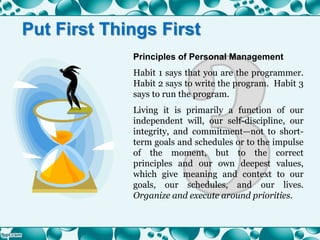
Principles of Personal Management
Habit 1 says that you are the programmer.
Habit 2 says to write the program. Habit 3
says to run the program.
Living it is primarily a function of our
independent will, our self-discipline, our
integrity, and commitment—not to short-
term goals and schedules or to the impulse
of the moment, but to the correct
principles and our own deepest values,
which give meaning and context to our
goals, our schedules, and our lives.
Organize and execute around priorities.
Put First Things First
Principles of Interpersonal Leadership
Win/Win is a frame of mind and heart that
constantly seeks mutual benefit in all human
interactions. Win/Win means that agreements or
solutions are mutually beneficial, mutually
satisfying. With a Win/Win solution all parties feel
good about the decision and feel committed to the
action plan. Win/Win is a belief in a Third
Alternative. It’s not your way or my way; it’s a
better way. And if a solution can’t be found to
benefit both parties they agree to disagree
agreeably—No Deal. Anything less than Win/Win
in and interdependent reality is a poor second best
that will have impact in the long-term relationship.
The cost of that impact needs to be carefully
considered. If you can’t reach a true Win/Win,
you’re very often better off to go for No Deal.
Think Win/Win
Seek First to
Understand,
Then to Be
Understood
Principles of Empathic Communication
Listening with the intent to understand is called
empathic listening. Empathic listening gets inside
another person’s frame of reference. You look out
through it, you see the world the way they see the
world, you understand their paradigm, you
understand how they feel. Empathy is not
sympathy. Empathic listening involves much
more than registering, reflecting, or even
understanding the words that are said. You aren’t
just listening with your ears, but also with you eyes
and your heart. Empathic listening is so powerful
because it gives you accurate data to work with.
When you present your own ideas be clear,
specific, visual, and most important, contextual—
in the context of a deep understanding of the other
person’s paradigms and concerns. You will
significantly increase the credibility of your ideas.
What you’re presenting may even be different
form what you had originally thought because in
you effort to understand, you learned.
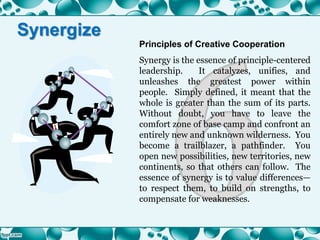
Principles of Creative Cooperation
Synergy is the essence of principle-centered
leadership. It catalyzes, unifies, and
unleashes the greatest power within
people. Simply defined, it meant that the
whole is greater than the sum of its parts.
Without doubt, you have to leave the
comfort zone of base camp and confront an
entirely new and unknown wilderness. You
become a trailblazer, a pathfinder. You
open new possibilities, new territories, new
continents, so that others can follow. The
essence of synergy is to value differences—
to respect them, to build on strengths, to
compensate for weaknesses.
Synergize
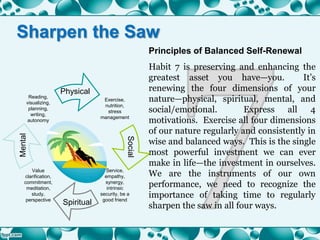
Principles of Balanced Self-Renewal
Habit 7 is preserving and enhancing the
greatest asset you have—you. It’s
renewing the four dimensions of your
nature—physical, spiritual, mental, and
social/emotional. Express all 4
motivations. Exercise all four dimensions
of our nature regularly and consistently in
wise and balanced ways. This is the single
most powerful investment we can ever
make in life—the investment in ourselves.
We are the instruments of our own
performance, we need to recognize the
importance of taking time to regularly
sharpen the saw in all four ways.
Exercise,
nutrition,
stress
management
Value
clarification,
commitment,
meditation,
study,
perspective
Reading,
visualizing,
planning,
writing,
autonomy
Service,
empathy,
synergy,
intrinsic
security, be a
good friend
Physical
Social
Spiritual
Mental
Sharpen the Saw
Questions

seven habits

  • 1.
    Professional Practices Ehtesham Raza, AssistantProfessor, Govt. Murray College, Sialkot.
  • 2.
    7 Habits ofHighly Effective People The Principles established in Stephen R. Covey’s book are supposed to help a person achieve true interdependent "effectiveness". Covey argues this is achieved by aligning oneself to what he calls "true north"— principles of a character ethic that, unlike values, he believes to be universal and timeless. The book presents the principles in four sections. Paradigms and Principles. Here, Covey introduces the basic foundation for the creation of the habits. Private Victory. Here, Covey introduces the first three habits intended to take a person from dependence to independence, or one's ability to be self-reliant. You must be able to win your private victories before you can start on your public victories. If you start to win your public victories first, how can you feel good about yourself and still work on habits... Public Victory. Here, Covey introduces habits four through six which are intended to lead to interdependence, the ability to align one's needs and desires with those of other people and create effective relationships. Renewal. Here, Covey introduces the final habit which directs the reader to begin a process of self-improvement.
  • 3.
    Principles of PersonalVision The word proactive means that we are responsible for our own lives. Our behavior is a function of our decisions, not our conditions. We can subordinate feelings to values. We have the initiative and the responsibility to make things happen. Highly proactive people recognize that responsibility. They do not blame circumstances, conditions, or social conditioning for their behavior. Their behavior is a product of their own conscious choice, based on values, rather than a product of their conditions, based on feeling. Proactive people are still influenced by external stimuli but their response, conscious or unconscious, is a value based choice or response. Be Proactive
  • 4.
    Principles of PersonalLeadership Begin today with the image, picture, or paradigm of the end of your life as your frame of reference of the criterion by which everything else is examined. Each part of your life—today’s behavior, tomorrow’s behavior, next week’s behavior, next month’s behavior—can be examined in the context of the whole, of what really matters most to you. By keeping that end clearly in mind, you can make certain that whatever you do on any particular day does not violate the criteria you have defined as supremely important, and that each day of your life contributes in a meaningful way to the vision you have of your life as a whole. To begin with the end in mind means to start with a clear understanding of your destination. It means to know where you’re going so that you better understand where you are now and so that the steps you take are always in the right direction. Begin with the End in Mind
  • 5.
    Principles of PersonalManagement Habit 1 says that you are the programmer. Habit 2 says to write the program. Habit 3 says to run the program. Living it is primarily a function of our independent will, our self-discipline, our integrity, and commitment—not to short- term goals and schedules or to the impulse of the moment, but to the correct principles and our own deepest values, which give meaning and context to our goals, our schedules, and our lives. Organize and execute around priorities. Put First Things First
  • 6.
    Principles of InterpersonalLeadership Win/Win is a frame of mind and heart that constantly seeks mutual benefit in all human interactions. Win/Win means that agreements or solutions are mutually beneficial, mutually satisfying. With a Win/Win solution all parties feel good about the decision and feel committed to the action plan. Win/Win is a belief in a Third Alternative. It’s not your way or my way; it’s a better way. And if a solution can’t be found to benefit both parties they agree to disagree agreeably—No Deal. Anything less than Win/Win in and interdependent reality is a poor second best that will have impact in the long-term relationship. The cost of that impact needs to be carefully considered. If you can’t reach a true Win/Win, you’re very often better off to go for No Deal. Think Win/Win
  • 7.
    Seek First to Understand, Thento Be Understood Principles of Empathic Communication Listening with the intent to understand is called empathic listening. Empathic listening gets inside another person’s frame of reference. You look out through it, you see the world the way they see the world, you understand their paradigm, you understand how they feel. Empathy is not sympathy. Empathic listening involves much more than registering, reflecting, or even understanding the words that are said. You aren’t just listening with your ears, but also with you eyes and your heart. Empathic listening is so powerful because it gives you accurate data to work with. When you present your own ideas be clear, specific, visual, and most important, contextual— in the context of a deep understanding of the other person’s paradigms and concerns. You will significantly increase the credibility of your ideas. What you’re presenting may even be different form what you had originally thought because in you effort to understand, you learned.
  • 8.
    Principles of CreativeCooperation Synergy is the essence of principle-centered leadership. It catalyzes, unifies, and unleashes the greatest power within people. Simply defined, it meant that the whole is greater than the sum of its parts. Without doubt, you have to leave the comfort zone of base camp and confront an entirely new and unknown wilderness. You become a trailblazer, a pathfinder. You open new possibilities, new territories, new continents, so that others can follow. The essence of synergy is to value differences— to respect them, to build on strengths, to compensate for weaknesses. Synergize
  • 9.
    Principles of BalancedSelf-Renewal Habit 7 is preserving and enhancing the greatest asset you have—you. It’s renewing the four dimensions of your nature—physical, spiritual, mental, and social/emotional. Express all 4 motivations. Exercise all four dimensions of our nature regularly and consistently in wise and balanced ways. This is the single most powerful investment we can ever make in life—the investment in ourselves. We are the instruments of our own performance, we need to recognize the importance of taking time to regularly sharpen the saw in all four ways. Exercise, nutrition, stress management Value clarification, commitment, meditation, study, perspective Reading, visualizing, planning, writing, autonomy Service, empathy, synergy, intrinsic security, be a good friend Physical Social Spiritual Mental Sharpen the Saw
  • 10.