Impact of computer use by
        patients: rapid review


                    Ray Jones
          Professor of Health Informatics
                Faculty of Health
              University of Plymouth

            ray.jones@plymouth.ac.uk
9:07 PM
Aiming to make this as
                                    interactive as possible so
                                    that you , to some degree,
                                    get to choose what I talk
                                    about

9:07 PM   Great great grandmother from family tree; Eggs borrowed from Mark Scott flikr
How do patients use
             computers?
• ‘On their own’ (for information or peer
  support)

• As an adjunct or replacement to a face to
  face consultation

• These, of course, can both happen

9:07 PM
A ‘rapid review’ for NHS Choices
          (Aug-Oct 2009)

• Report available: Google "nhs choices"
  report plymouth jones

• Terminology: NHS Choices use ‘digital
  health services’, today I will use ‘e-health’


9:07 PM
A ‘rapid review’ for NHS Choices
          (Aug-Oct 2009)
Tender in July 2009 for ‘Rapid Review’ of:
      1. improvement of access to care and
         supporting choice;
      2. improving health literacy and enabling
         healthy living;
      3. increasing the efficiency of GP
         consultations;
      4. helping those with Long Term Conditions
         better manage their care;
      5. increasing the uptake of preventative
9:07 PM
         services such as screening and vaccination.
A ‘rapid review’ for NHS Choices
          (Aug-Oct 2009)
Tender in July 2009 for ‘Rapid Review’ of:
     1. improvement of access to care and supporting
        choice;
     2. improving health literacy and enabling healthy
        living;
     3. increasing the efficiency of GP
        consultations;
     4. helping those with Long Term Conditions better
        manage their care;
     5. increasing the uptake of preventative services
        such as screening and vaccination.
9:07 PM
A ‘rapid review’ for NHS Choices
          (Aug-Oct 2009)
Tender in July 2009 for ‘Rapid Review’ of:
     1. improvement of access to care and supporting
        choice;
     2. improving health literacy and enabling
        healthy living;
     3. increasing the efficiency of GP
        consultations;
     4. helping those with Long Term Conditions better
        manage their care;
     5. increasing the uptake of preventative services
        such as screening and vaccination.
9:07 PM
What do you want to hear
about just now?

Evidence on....
1. E-health on changing ‘lifestyle’

2. Computer-patient interviewing


9:07 PM
Is there evidence that people
     using e-health have an
  improved understanding of
important health determinants
  such as calorific intake, fat,
alcohol units, smoking, five-a-
              day?
1. Yes, quite a bit       0%
2. Some, but not a lot   33%
3. Very little, if any   67%
9:07 PM
Knowledge

• Yes, quite a bit. For example, meta-analysis by
  Portnoy 2008......


 9:07 PM
Portnoy (2008)
          Meta-analysis of 75 studies
• Nutrition, weight loss, physical activity,
  sexual health, tobacco use, substance use,
  bingeing and general health maintenance.

• All included health information (eg diet,
  weight, alcohol), 88% included a
  motivational component, 89% included a
  skills training component.

9:07 PM
Examples in Portnoy meta-analysis
• Kypri (2004).
   • 10-15 minutes of web-based assessment
   • Personalized feedback on their drinking.

• Swartz (2006).
   • Video presented strategies for smoking cessation
   • Motivational materials tailored to user’s race/ethnicity, sex, age.

• Winzelberg (2000).
   • Structured 8-week intervention.
   • Explanation and definition of eating disorders.
   • Text, audio, video, on-line self-monitoring journals, and
     behaviour change exercises.
   • Linked discussion forum.
 9:07 PM
• Portnoy et el concluded that CDIs can lead
  to “immediate post-intervention
  improvements in health-related
  knowledge, attitudes, and intentions ......


9:07 PM
Is there evidence of e-health
bringing about healthy lifestyle
changes such as improved diet,
 reduced tobacco and alcohol
abuse, safer sexual behaviour?
1. Yes, quite a bit        0%
2. Some, but not a lot     0%
3. Very little, if any     0%


9:07 PM
• Yes, there is evidence that at least in the
  short term people’s health behaviours
  improve.

• Take one example. Kyp Kypri et al
  Archives of Internal Medicine 2009


9:07 PM
4. Primary healthcare setting has potential to reach
             large number of students


University of Otago Student Health Service - 42,000 consultations with
>10,000 students per year (2/3 of population)
9:07 PM
•   Students: 2435 scored in harmful range and were randomized, and 2050
    (84%) completed at least 1 follow-up assessment.

•   Intervention: 10 minutes of Web-based motivational assessment and
    personalized feedback.

•   Follow-up assessments at 1 and 6 months


•   After 1 month, participants receiving intervention drank less often,
    smaller quantities per occasion, and less alcohol overall.

•   At 6 months, intervention effects persisted for drinking frequency, and
    overall volume

•   Conclusion: Proactive Web-based screening and intervention reduces
    drinking in undergraduates
    9:07 PM
Portnoy (2008)
• .........as well as modifying health
  behaviours such as dietary intake, tobacco
  use, substance use, safer sexual behavior,
  binge/purging behaviors, and general
  health maintenance


9:07 PM
Is there evidence of
          improved and sustained
             health outcomes?


1. Yes, quite a bit                0%
2. Some, but not a lot             0%
3. Very little, if any             0%


9:07 PM
Very little if any
• Most studies are on too short a timescale
  to show improved health outcomes, and
  there is less evidence on maintenance of
  changes in lifestyle.
• However, there is enough epidemiological
  evidence about lifestyle and health that
  would allow modelling of health impact.
• The marginal cost of patient participation
  in an e-health ‘health promotion’
  intervention is very small.
9:07 PM
Do you want to hear about
     methodological issues in this
     research or shall I move on?


1.    Hear more about methods            0%
2.    Conclusions on lifestyle changes   0%
3.    Computer patient interviewing      0%
4.    Finish                             0%
9:07 PM
What is the biggest problem in
  evaluating e-health promotion
 interventions and the literature?
1. Attrition of participants                 0%
2. Projects reported but not implemented     0%
3. What is the control group?                0%
4. In ITT how have missing values been       0%
   dealt with (eg carry forward, imputed?)
5. Knowing exactly what the intervention     0%
   was and if it was time/place specific

9:07 PM
Yes, any/all of those!


9:07 PM
Caution about interpretation and
           reading of studies
• Attrition can be high.

• For example, Linke, Murray et al have
  been conducting an ongoing randomised
  trial of a web-based promotion of sensible
  drinking.


9:07 PM
9:07 PM
Caution about interpretation and
           reading of studies
• Attrition can be high.

• For example, Linke, Murray et al have been conducting an
  ongoing randomised trial of a web-based promotion of
  sensible drinking.

• Down Your Drink is a web-based 6 week intervention aimed
  at heavy drinkers. Intervention is an on-line psychologically
  enhanced interactive computer-based intervention and the
  control a flat, text-based information web-site.

• Only 17% of registrants completed the whole 6 weeks but for
  those who did the final outcome measures, measures of
  dependency, alcohol-related problems, and mental health
  symptoms were all reduced (compared to baseline not to
  controls).
9:07 PM
Conclusion: lifestyle changes
There is evidence that e-health interventions in
 lifestyle changes can result in:

• improved understanding
• at least in the short term people have improved
  diet, tobacco and alcohol abuse, sexual
  behaviour
• most studies are on too short a timescale to
  show improved health outcomes, and there is
  less evidence on maintenance of changes in
  lifestyle.
 9:07 PM
What are you thinking
                   at the moment?

1. Referring or facilitating e-health      0%
   promotion could be/is something
   that I do.
2. What is all this got to do with me, I   0%
   am a clinician dealing with
   consulting patients?
3. What time is coffee?                    0%
9:07 PM
Integrating patient computer
        user with the consultation
• Jones RB, Cawsey A, Al-Barwani F, Reynolds J, Knill-
  Jones R: Researching a patient workstation. In: HC96
  Current perspectives in Healthcare Computing. Edited by
  Richards B. Weybridge, Surrey: BJHC Boks; 1996: 678-
  686.

• Jones R: Consumer health informatics: the need to
  integrate with clinical practice. Invited paper. In:
  Primary Health Care Group of the British Computer
  Society: September 10, 1999; Cambridge: Primary
  Health Care Group of the BCS; 1999: 4-9.

9:07 PM
Evidence on computer patient
        interviewing
• A branching series of questions is
  developed to assist the medical history
  taking of the clinician. Standard, carefully
  worded questions are used to collect a
  history, with systems having hundreds if
  not thousands of questions, but patients
  only answering those relevant.


9:07 PM
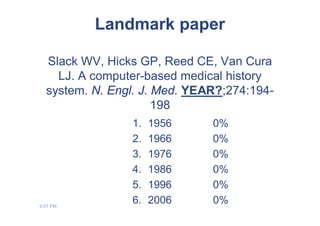
Landmark paper

  Slack WV, Hicks GP, Reed CE, Van Cura
    LJ. A computer-based medical history
  system. N. Engl. J. Med. YEAR?;274:194-
                      198
                1.   1956     0%
                2.   1966     0%
                3.   1976     0%
                4.   1986     0%
                5.   1996     0%
9:07 PM
                6.   2006     0%
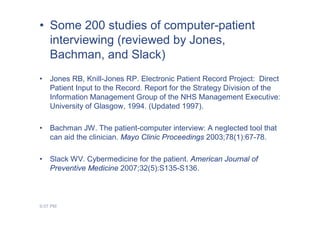
• Some 200 studies of computer-patient
  interviewing (reviewed by Jones,
  Bachman, and Slack)
•   Jones RB, Knill-Jones RP. Electronic Patient Record Project: Direct
    Patient Input to the Record. Report for the Strategy Division of the
    Information Management Group of the NHS Management Executive:
    University of Glasgow, 1994. (Updated 1997).

•   Bachman JW. The patient-computer interview: A neglected tool that
    can aid the clinician. Mayo Clinic Proceedings 2003;78(1):67-78.

•   Slack WV. Cybermedicine for the patient. American Journal of
    Preventive Medicine 2007;32(5):S135-S136.


9:07 PM
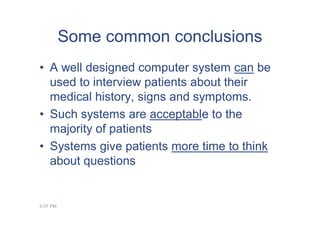
Some common conclusions
• A well designed computer system can be
  used to interview patients about their
  medical history, signs and symptoms.
• Such systems are acceptable to the
  majority of patients
• Systems give patients more time to think
  about questions


9:07 PM
A quick personal question.....do
 you have urological problems?

1. Yes                      0%
2. No                       0%
3. Not prepared to answer   0%


9:07 PM
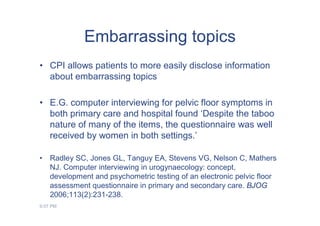
Embarrassing topics
• CPI allows patients to more easily disclose information
  about embarrassing topics

• E.G. computer interviewing for pelvic floor symptoms in
  both primary care and hospital found ‘Despite the taboo
  nature of many of the items, the questionnaire was well
  received by women in both settings.’

•   Radley SC, Jones GL, Tanguy EA, Stevens VG, Nelson C, Mathers
    NJ. Computer interviewing in urogynaecology: concept,
    development and psychometric testing of an electronic pelvic floor
    assessment questionnaire in primary and secondary care. BJOG
    2006;113(2):231-238.
9:07 PM
Completeness
• CPI ensures that lines of investigation are not
  forgotten, leading to more complete data and
  fewer errors in diagnosis and better agreement
  between patient and doctor.

•   For example, a recent German hospital study found that computer
    histories reported an additional average of 3.5 problems per patient
    which were not recorded in corresponding physician histories. The
    authors recommended a combination of computer and physician
    histories as the best method.

•   Zakim D, Braun N, Fritz P, Alscher MD. Underutilization of information and knowledge
    in everyday medical practice: Evaluation of a computer-based solution. BMC Medical
    Informatics and Decision Making 2008;8:12.

9:07 PM
Completeness
• A further study in Canadian emergency care, reported
  that the computer history asked 90%, and the
  emergency physician 55%, of important historical
  elements.


•   Benaroia M, Elinson R, Zarnke K. Patient-directed intelligent an interactive
    computer medical history-gathering systems: A utility and feasibility study in
    the emergency department. International Journal of Medical Informatics
    2007;76(4):283-288.


9:07 PM
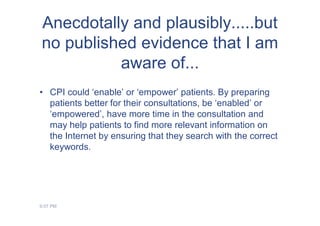
Anecdotally and plausibly.....but
no published evidence that I am
          aware of...
• CPI could ‘enable’ or ‘empower’ patients. By preparing
  patients better for their consultations, be ‘enabled’ or
  ‘empowered’, have more time in the consultation and
  may help patients to find more relevant information on
  the Internet by ensuring that they search with the correct
  keywords.


9:07 PM
Historical perspective and
               implementation
• When I produced the report for the Information
  Management Group of the NHS in 1997 I concluded that
  “Computer interviewing of patients has been successful
  in those specialties such as psychiatry and common
  clinical conditions such as dyspepsia, backache,
  headache, where data collection relies heavily on patient
  reporting. .........<but>.... The majority of research has not
  been taken forward to routine use. .....<snip> .......there
  are just a few systems in routine use.”
• Systems failed because they were not adopted by
  mainstream IT support systems of the time.

9:07 PM
Where to now?

• Evidence on e-health and ‘lifestyle’   0%
• Finish with questions                  0%


9:07 PM
Impact of computer use by
        patients: rapid review


                    Ray Jones
          Professor of Health Informatics
                Faculty of Health
              University of Plymouth

            ray.jones@plymouth.ac.uk
9:07 PM
Some extra points for
              discussion


9:07 PM
Some medical/health curricula
      tend only to consider


9:07 PM

Prof ray jones

  • 1.
    Impact of computeruse by patients: rapid review Ray Jones Professor of Health Informatics Faculty of Health University of Plymouth ray.jones@plymouth.ac.uk 9:07 PM
  • 2.
    Aiming to makethis as interactive as possible so that you , to some degree, get to choose what I talk about 9:07 PM Great great grandmother from family tree; Eggs borrowed from Mark Scott flikr
  • 3.
    How do patientsuse computers? • ‘On their own’ (for information or peer support) • As an adjunct or replacement to a face to face consultation • These, of course, can both happen 9:07 PM
  • 4.
    A ‘rapid review’for NHS Choices (Aug-Oct 2009) • Report available: Google "nhs choices" report plymouth jones • Terminology: NHS Choices use ‘digital health services’, today I will use ‘e-health’ 9:07 PM
  • 5.
    A ‘rapid review’for NHS Choices (Aug-Oct 2009) Tender in July 2009 for ‘Rapid Review’ of: 1. improvement of access to care and supporting choice; 2. improving health literacy and enabling healthy living; 3. increasing the efficiency of GP consultations; 4. helping those with Long Term Conditions better manage their care; 5. increasing the uptake of preventative 9:07 PM services such as screening and vaccination.
  • 6.
    A ‘rapid review’for NHS Choices (Aug-Oct 2009) Tender in July 2009 for ‘Rapid Review’ of: 1. improvement of access to care and supporting choice; 2. improving health literacy and enabling healthy living; 3. increasing the efficiency of GP consultations; 4. helping those with Long Term Conditions better manage their care; 5. increasing the uptake of preventative services such as screening and vaccination. 9:07 PM
  • 7.
    A ‘rapid review’for NHS Choices (Aug-Oct 2009) Tender in July 2009 for ‘Rapid Review’ of: 1. improvement of access to care and supporting choice; 2. improving health literacy and enabling healthy living; 3. increasing the efficiency of GP consultations; 4. helping those with Long Term Conditions better manage their care; 5. increasing the uptake of preventative services such as screening and vaccination. 9:07 PM
  • 8.
    What do youwant to hear about just now? Evidence on.... 1. E-health on changing ‘lifestyle’ 2. Computer-patient interviewing 9:07 PM
  • 9.
    Is there evidencethat people using e-health have an improved understanding of important health determinants such as calorific intake, fat, alcohol units, smoking, five-a- day? 1. Yes, quite a bit 0% 2. Some, but not a lot 33% 3. Very little, if any 67% 9:07 PM
  • 10.
    Knowledge • Yes, quitea bit. For example, meta-analysis by Portnoy 2008...... 9:07 PM
  • 11.
    Portnoy (2008) Meta-analysis of 75 studies • Nutrition, weight loss, physical activity, sexual health, tobacco use, substance use, bingeing and general health maintenance. • All included health information (eg diet, weight, alcohol), 88% included a motivational component, 89% included a skills training component. 9:07 PM
  • 12.
    Examples in Portnoymeta-analysis • Kypri (2004). • 10-15 minutes of web-based assessment • Personalized feedback on their drinking. • Swartz (2006). • Video presented strategies for smoking cessation • Motivational materials tailored to user’s race/ethnicity, sex, age. • Winzelberg (2000). • Structured 8-week intervention. • Explanation and definition of eating disorders. • Text, audio, video, on-line self-monitoring journals, and behaviour change exercises. • Linked discussion forum. 9:07 PM
  • 13.
    • Portnoy etel concluded that CDIs can lead to “immediate post-intervention improvements in health-related knowledge, attitudes, and intentions ...... 9:07 PM
  • 14.
    Is there evidenceof e-health bringing about healthy lifestyle changes such as improved diet, reduced tobacco and alcohol abuse, safer sexual behaviour? 1. Yes, quite a bit 0% 2. Some, but not a lot 0% 3. Very little, if any 0% 9:07 PM
  • 15.
    • Yes, thereis evidence that at least in the short term people’s health behaviours improve. • Take one example. Kyp Kypri et al Archives of Internal Medicine 2009 9:07 PM
  • 16.
    4. Primary healthcaresetting has potential to reach large number of students University of Otago Student Health Service - 42,000 consultations with >10,000 students per year (2/3 of population) 9:07 PM
  • 17.
    Students: 2435 scored in harmful range and were randomized, and 2050 (84%) completed at least 1 follow-up assessment. • Intervention: 10 minutes of Web-based motivational assessment and personalized feedback. • Follow-up assessments at 1 and 6 months • After 1 month, participants receiving intervention drank less often, smaller quantities per occasion, and less alcohol overall. • At 6 months, intervention effects persisted for drinking frequency, and overall volume • Conclusion: Proactive Web-based screening and intervention reduces drinking in undergraduates 9:07 PM
  • 18.
    Portnoy (2008) • .........aswell as modifying health behaviours such as dietary intake, tobacco use, substance use, safer sexual behavior, binge/purging behaviors, and general health maintenance 9:07 PM
  • 19.
    Is there evidenceof improved and sustained health outcomes? 1. Yes, quite a bit 0% 2. Some, but not a lot 0% 3. Very little, if any 0% 9:07 PM
  • 20.
    Very little ifany • Most studies are on too short a timescale to show improved health outcomes, and there is less evidence on maintenance of changes in lifestyle. • However, there is enough epidemiological evidence about lifestyle and health that would allow modelling of health impact. • The marginal cost of patient participation in an e-health ‘health promotion’ intervention is very small. 9:07 PM
  • 21.
    Do you wantto hear about methodological issues in this research or shall I move on? 1. Hear more about methods 0% 2. Conclusions on lifestyle changes 0% 3. Computer patient interviewing 0% 4. Finish 0% 9:07 PM
  • 22.
    What is thebiggest problem in evaluating e-health promotion interventions and the literature? 1. Attrition of participants 0% 2. Projects reported but not implemented 0% 3. What is the control group? 0% 4. In ITT how have missing values been 0% dealt with (eg carry forward, imputed?) 5. Knowing exactly what the intervention 0% was and if it was time/place specific 9:07 PM
  • 23.
    Yes, any/all ofthose! 9:07 PM
  • 24.
    Caution about interpretationand reading of studies • Attrition can be high. • For example, Linke, Murray et al have been conducting an ongoing randomised trial of a web-based promotion of sensible drinking. 9:07 PM
  • 25.
  • 26.
    Caution about interpretationand reading of studies • Attrition can be high. • For example, Linke, Murray et al have been conducting an ongoing randomised trial of a web-based promotion of sensible drinking. • Down Your Drink is a web-based 6 week intervention aimed at heavy drinkers. Intervention is an on-line psychologically enhanced interactive computer-based intervention and the control a flat, text-based information web-site. • Only 17% of registrants completed the whole 6 weeks but for those who did the final outcome measures, measures of dependency, alcohol-related problems, and mental health symptoms were all reduced (compared to baseline not to controls). 9:07 PM
  • 27.
    Conclusion: lifestyle changes Thereis evidence that e-health interventions in lifestyle changes can result in: • improved understanding • at least in the short term people have improved diet, tobacco and alcohol abuse, sexual behaviour • most studies are on too short a timescale to show improved health outcomes, and there is less evidence on maintenance of changes in lifestyle. 9:07 PM
  • 28.
    What are youthinking at the moment? 1. Referring or facilitating e-health 0% promotion could be/is something that I do. 2. What is all this got to do with me, I 0% am a clinician dealing with consulting patients? 3. What time is coffee? 0% 9:07 PM
  • 29.
    Integrating patient computer user with the consultation • Jones RB, Cawsey A, Al-Barwani F, Reynolds J, Knill- Jones R: Researching a patient workstation. In: HC96 Current perspectives in Healthcare Computing. Edited by Richards B. Weybridge, Surrey: BJHC Boks; 1996: 678- 686. • Jones R: Consumer health informatics: the need to integrate with clinical practice. Invited paper. In: Primary Health Care Group of the British Computer Society: September 10, 1999; Cambridge: Primary Health Care Group of the BCS; 1999: 4-9. 9:07 PM
  • 30.
    Evidence on computerpatient interviewing • A branching series of questions is developed to assist the medical history taking of the clinician. Standard, carefully worded questions are used to collect a history, with systems having hundreds if not thousands of questions, but patients only answering those relevant. 9:07 PM
  • 31.
    Landmark paper Slack WV, Hicks GP, Reed CE, Van Cura LJ. A computer-based medical history system. N. Engl. J. Med. YEAR?;274:194- 198 1. 1956 0% 2. 1966 0% 3. 1976 0% 4. 1986 0% 5. 1996 0% 9:07 PM 6. 2006 0%
  • 32.
    • Some 200studies of computer-patient interviewing (reviewed by Jones, Bachman, and Slack) • Jones RB, Knill-Jones RP. Electronic Patient Record Project: Direct Patient Input to the Record. Report for the Strategy Division of the Information Management Group of the NHS Management Executive: University of Glasgow, 1994. (Updated 1997). • Bachman JW. The patient-computer interview: A neglected tool that can aid the clinician. Mayo Clinic Proceedings 2003;78(1):67-78. • Slack WV. Cybermedicine for the patient. American Journal of Preventive Medicine 2007;32(5):S135-S136. 9:07 PM
  • 33.
    Some common conclusions •A well designed computer system can be used to interview patients about their medical history, signs and symptoms. • Such systems are acceptable to the majority of patients • Systems give patients more time to think about questions 9:07 PM
  • 34.
    A quick personalquestion.....do you have urological problems? 1. Yes 0% 2. No 0% 3. Not prepared to answer 0% 9:07 PM
  • 35.
    Embarrassing topics • CPIallows patients to more easily disclose information about embarrassing topics • E.G. computer interviewing for pelvic floor symptoms in both primary care and hospital found ‘Despite the taboo nature of many of the items, the questionnaire was well received by women in both settings.’ • Radley SC, Jones GL, Tanguy EA, Stevens VG, Nelson C, Mathers NJ. Computer interviewing in urogynaecology: concept, development and psychometric testing of an electronic pelvic floor assessment questionnaire in primary and secondary care. BJOG 2006;113(2):231-238. 9:07 PM
  • 36.
    Completeness • CPI ensuresthat lines of investigation are not forgotten, leading to more complete data and fewer errors in diagnosis and better agreement between patient and doctor. • For example, a recent German hospital study found that computer histories reported an additional average of 3.5 problems per patient which were not recorded in corresponding physician histories. The authors recommended a combination of computer and physician histories as the best method. • Zakim D, Braun N, Fritz P, Alscher MD. Underutilization of information and knowledge in everyday medical practice: Evaluation of a computer-based solution. BMC Medical Informatics and Decision Making 2008;8:12. 9:07 PM
  • 37.
    Completeness • A furtherstudy in Canadian emergency care, reported that the computer history asked 90%, and the emergency physician 55%, of important historical elements. • Benaroia M, Elinson R, Zarnke K. Patient-directed intelligent an interactive computer medical history-gathering systems: A utility and feasibility study in the emergency department. International Journal of Medical Informatics 2007;76(4):283-288. 9:07 PM
  • 38.
    Anecdotally and plausibly.....but nopublished evidence that I am aware of... • CPI could ‘enable’ or ‘empower’ patients. By preparing patients better for their consultations, be ‘enabled’ or ‘empowered’, have more time in the consultation and may help patients to find more relevant information on the Internet by ensuring that they search with the correct keywords. 9:07 PM
  • 39.
    Historical perspective and implementation • When I produced the report for the Information Management Group of the NHS in 1997 I concluded that “Computer interviewing of patients has been successful in those specialties such as psychiatry and common clinical conditions such as dyspepsia, backache, headache, where data collection relies heavily on patient reporting. .........<but>.... The majority of research has not been taken forward to routine use. .....<snip> .......there are just a few systems in routine use.” • Systems failed because they were not adopted by mainstream IT support systems of the time. 9:07 PM
  • 40.
    Where to now? •Evidence on e-health and ‘lifestyle’ 0% • Finish with questions 0% 9:07 PM
  • 41.
    Impact of computeruse by patients: rapid review Ray Jones Professor of Health Informatics Faculty of Health University of Plymouth ray.jones@plymouth.ac.uk 9:07 PM
  • 42.
    Some extra pointsfor discussion 9:07 PM
  • 43.
    Some medical/health curricula tend only to consider 9:07 PM