





mHealth: Beyond 
Consumer Apps 
Jill Freyne, CSIRO 
jill.freyne@csiro.au 
1
Introduction 
• Jill Freyne 
• PhD Computer Science, University 
College Dublin 
• IBM Research, Cambridge, MA, USA 
• Commonwealth Scientific and Industrial 
Research Organisation (CSIRO), Sydney 
2
3
4
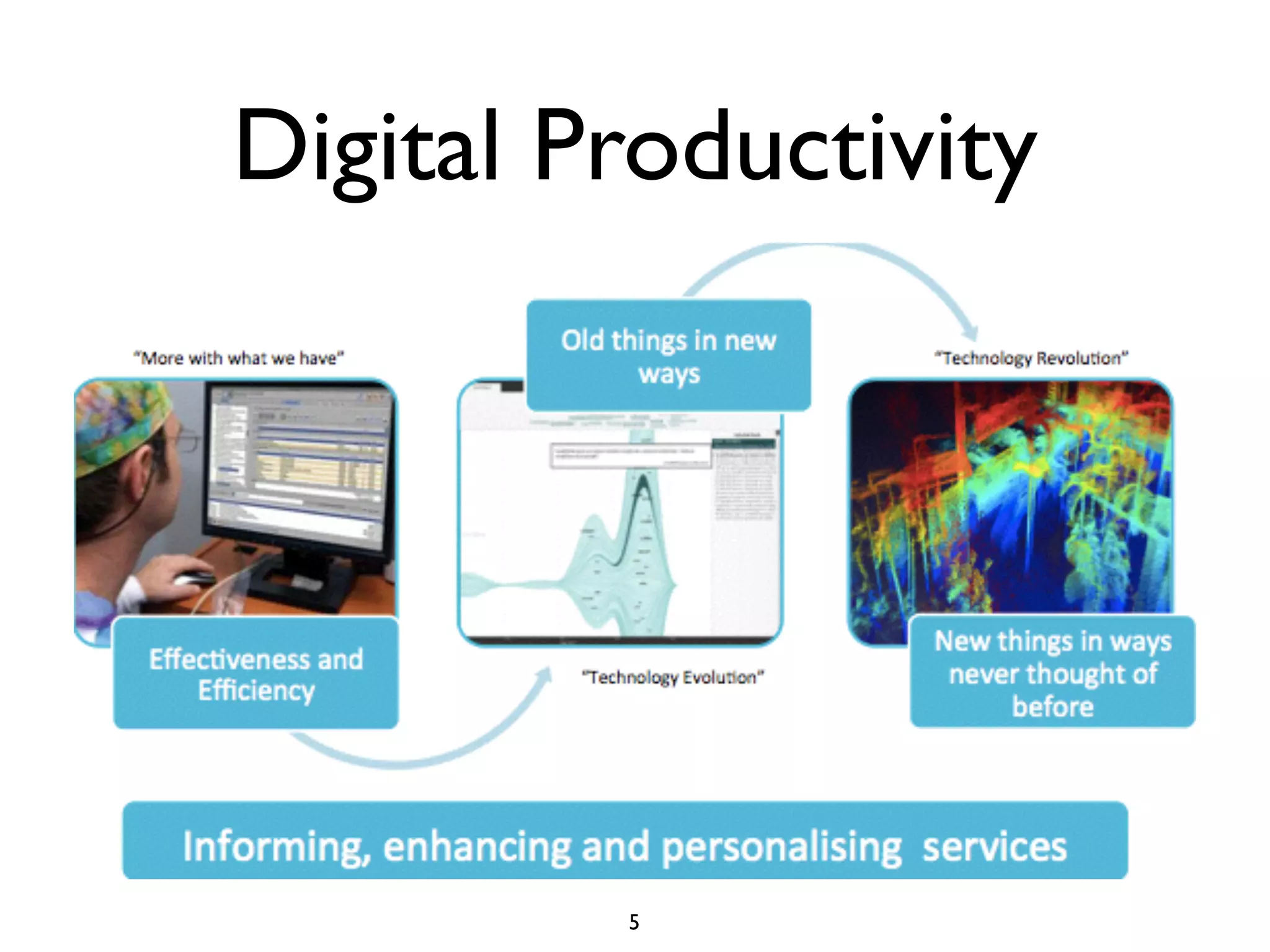
Digital Productivity 
5
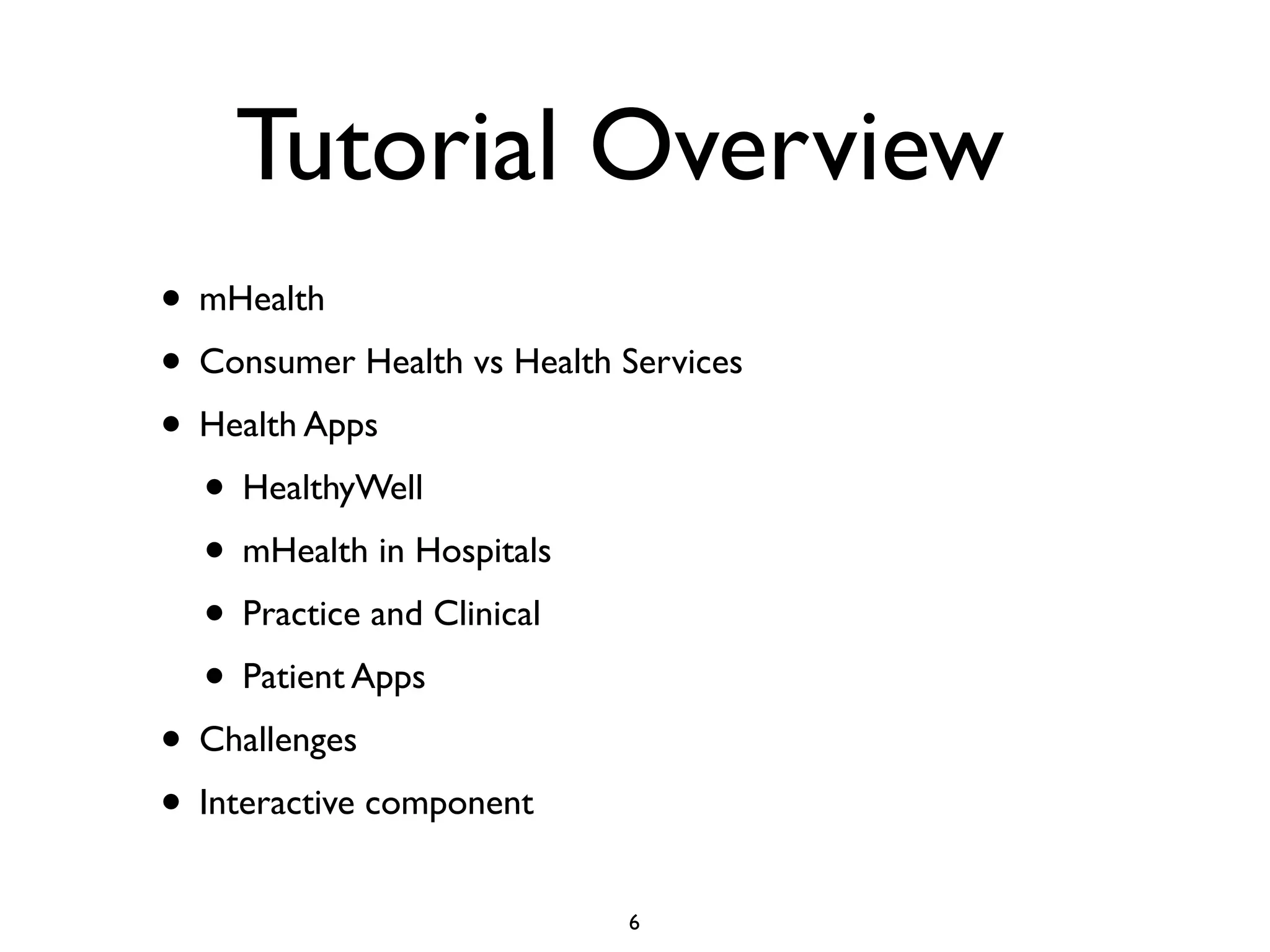
Tutorial Overview 
• mHealth 
• Consumer Health vs Health Services 
• Health Apps 
• HealthyWell 
• mHealth in Hospitals 
• Practice and Clinical 
• Patient Apps 
• Challenges 
• Interactive component 
6
Global Health Challenge 
7
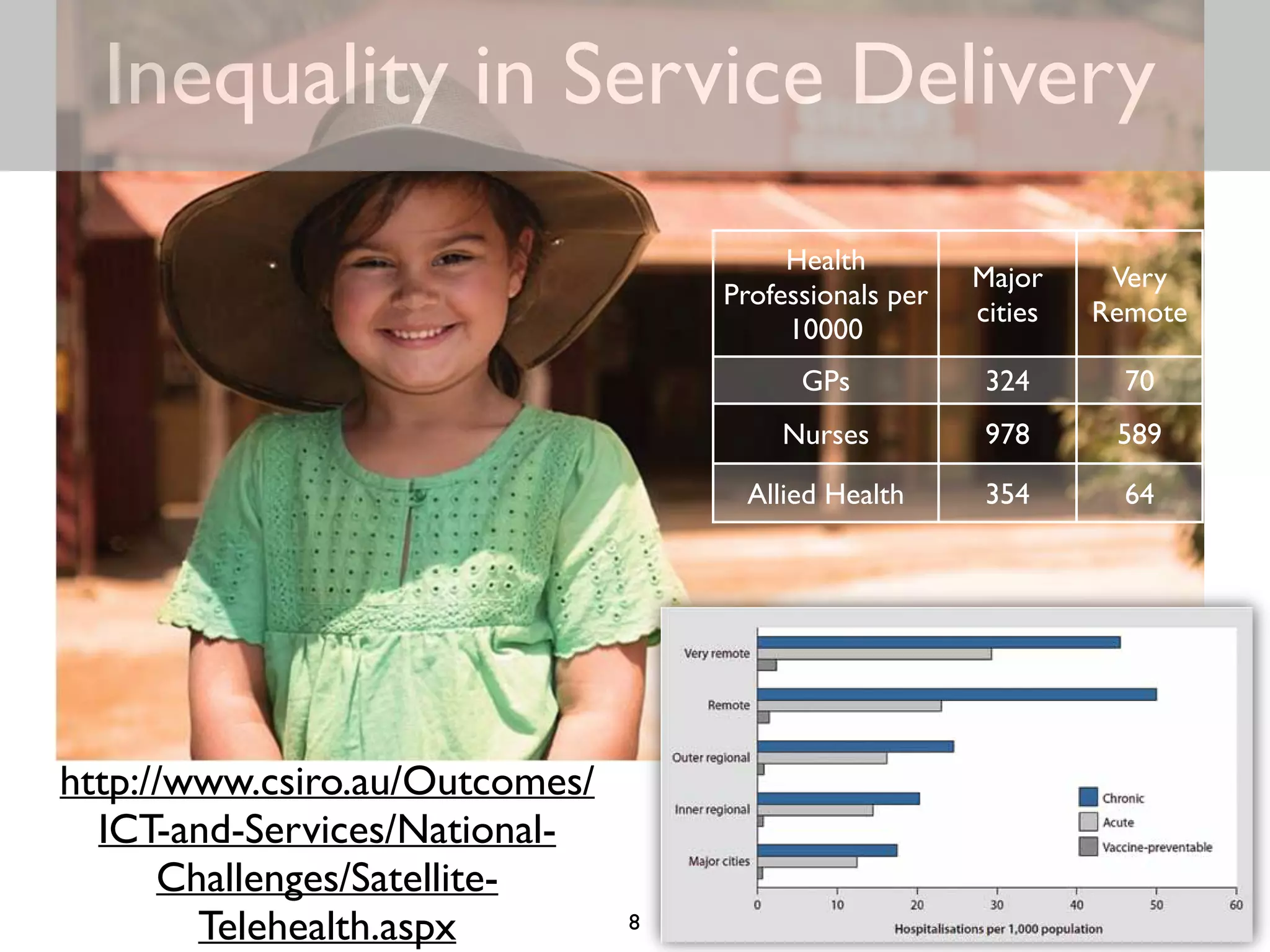
Inequality in Service Delivery 
Health 
Professionals per 
10000 
Major 
cities 
Very 
Remote 
GPs 324 70 
Nurses 978 589 
Allied Health 354 64 
8 
http://www.csiro.au/Outcomes/ 
ICT-and-Services/National- 
Challenges/Satellite- 
Telehealth.aspx
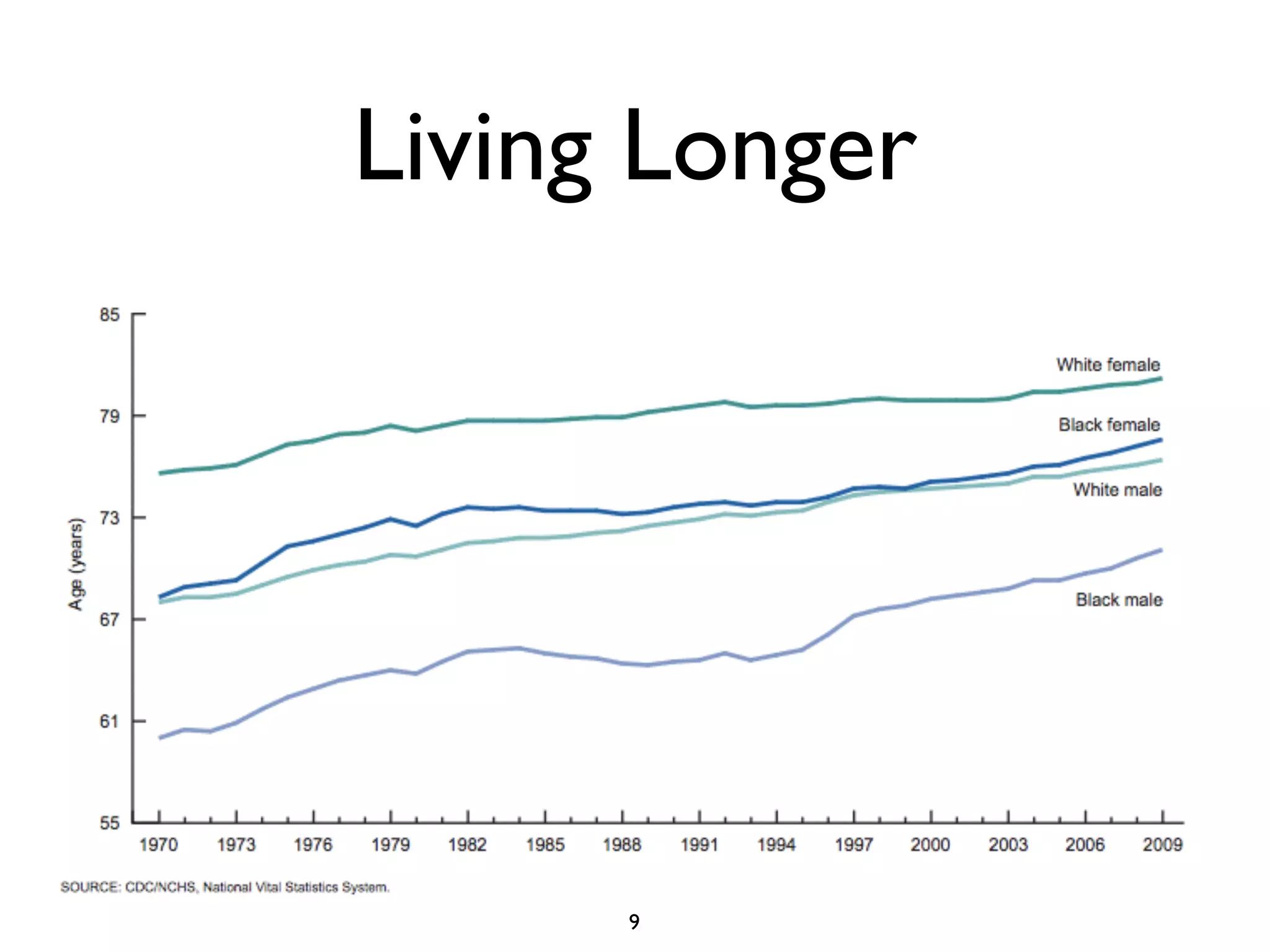
Living Longer 
9
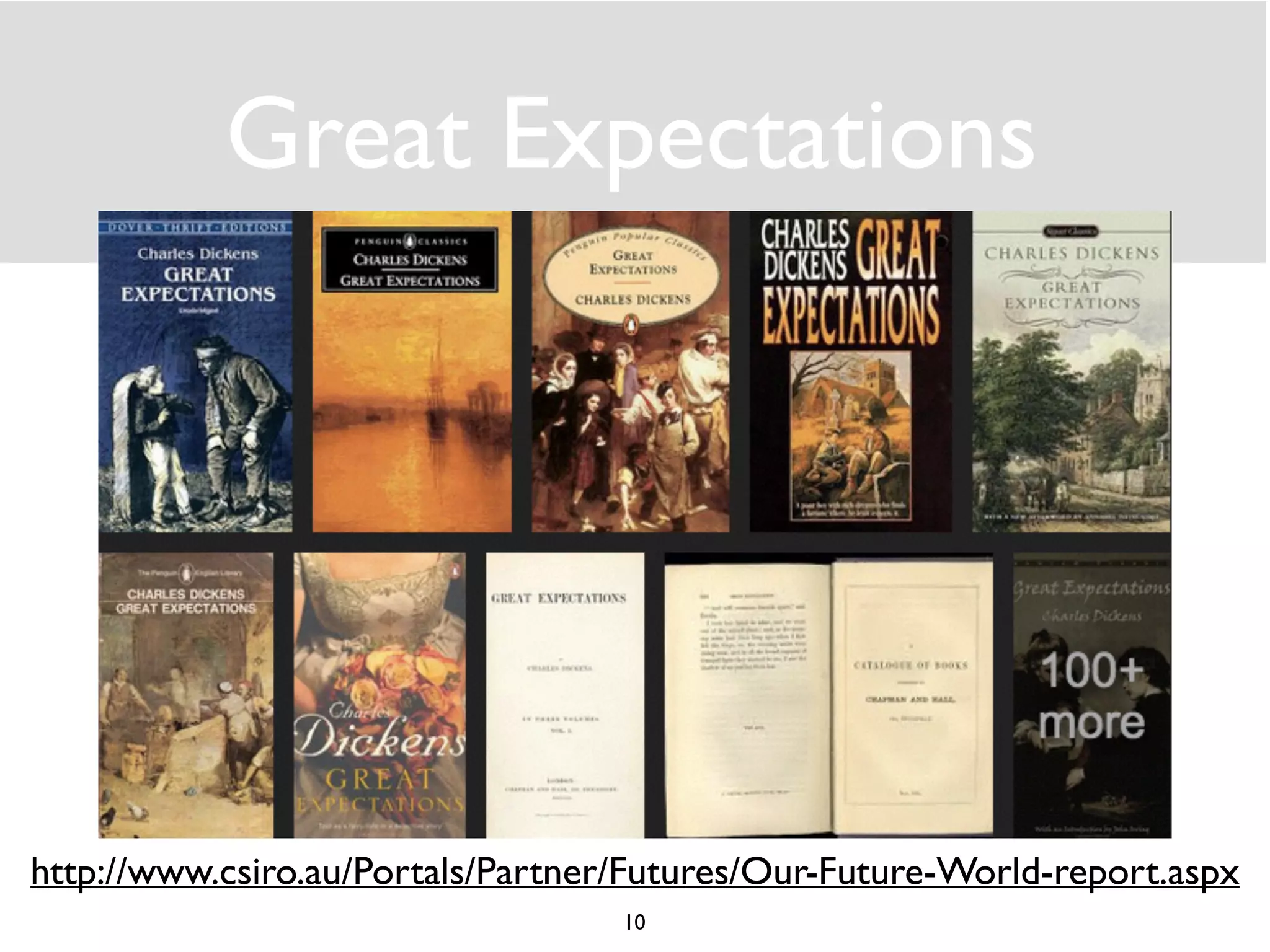
Great Expectations 
http://www.csiro.au/Portals/Partner/Futures/Our-Future-World-report.aspx 
10
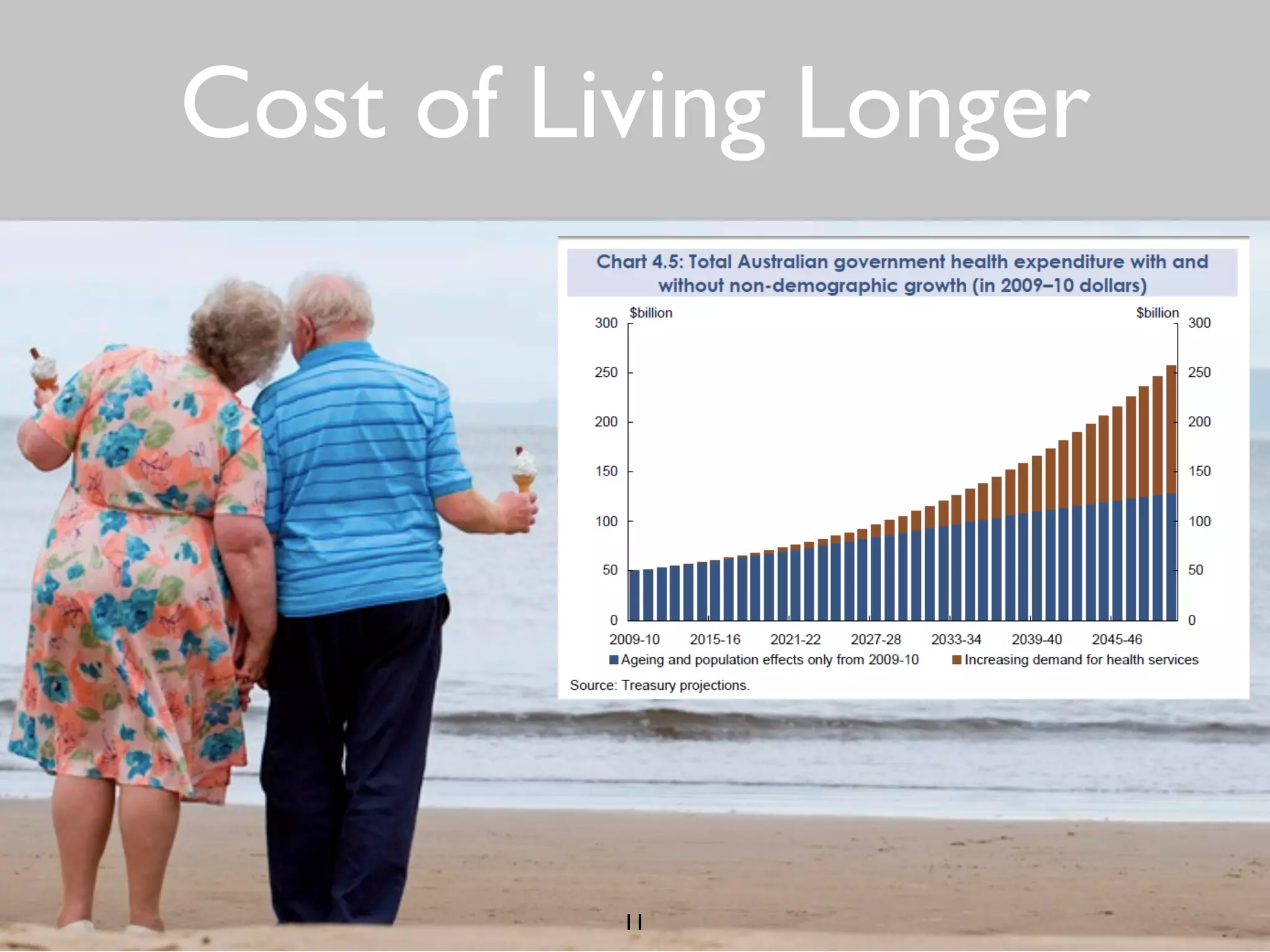
Cost of Living Longer 
11
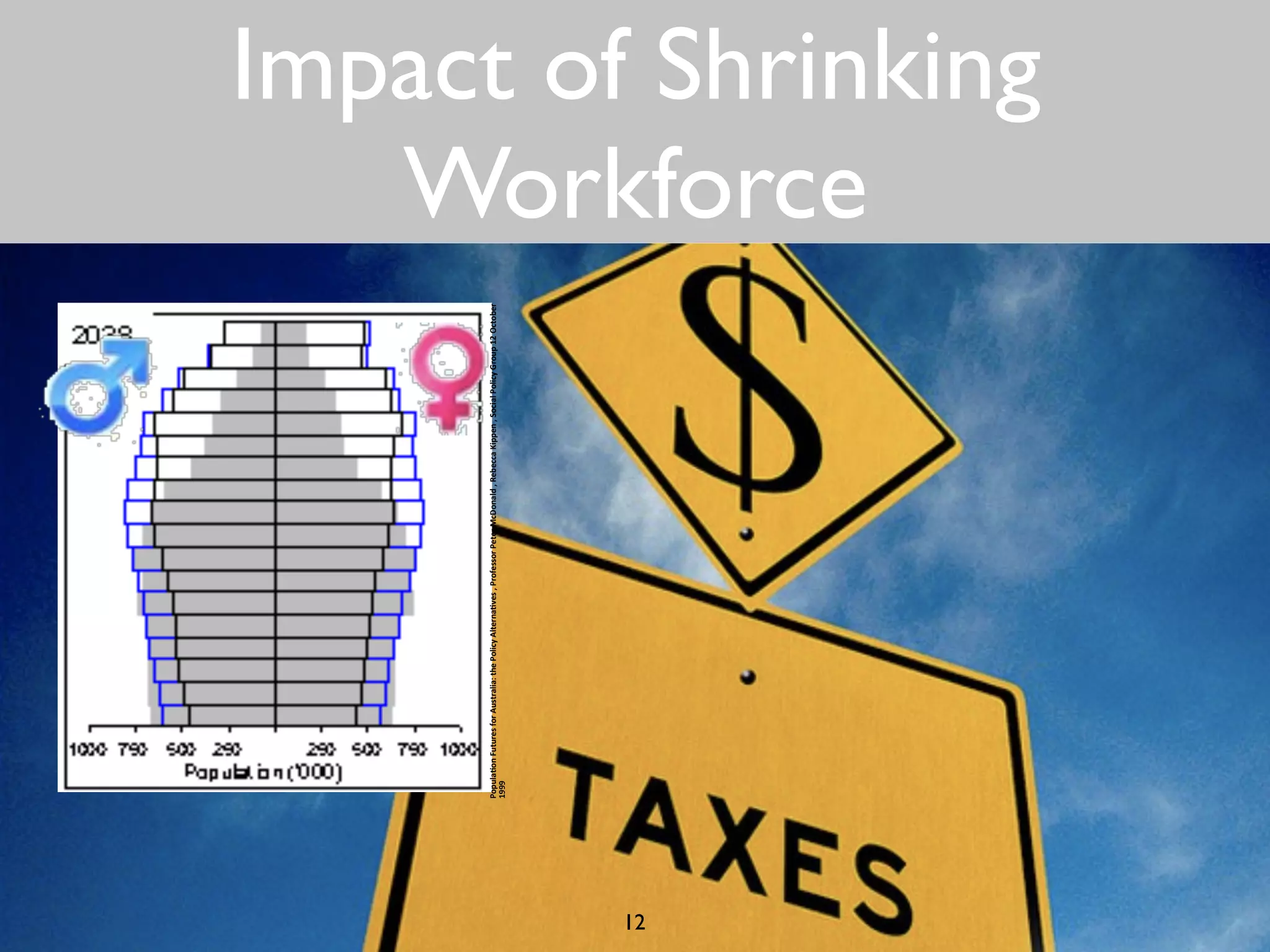
Impact of Shrinking 
Workforce 
Popula'on)Futures)for)Australia:)the)Policy)Alterna'ves),)Professor)Peter)McDonald),)Rebecca)Kippen),)Social)Policy)Group)12)October) 
1999)) 
12
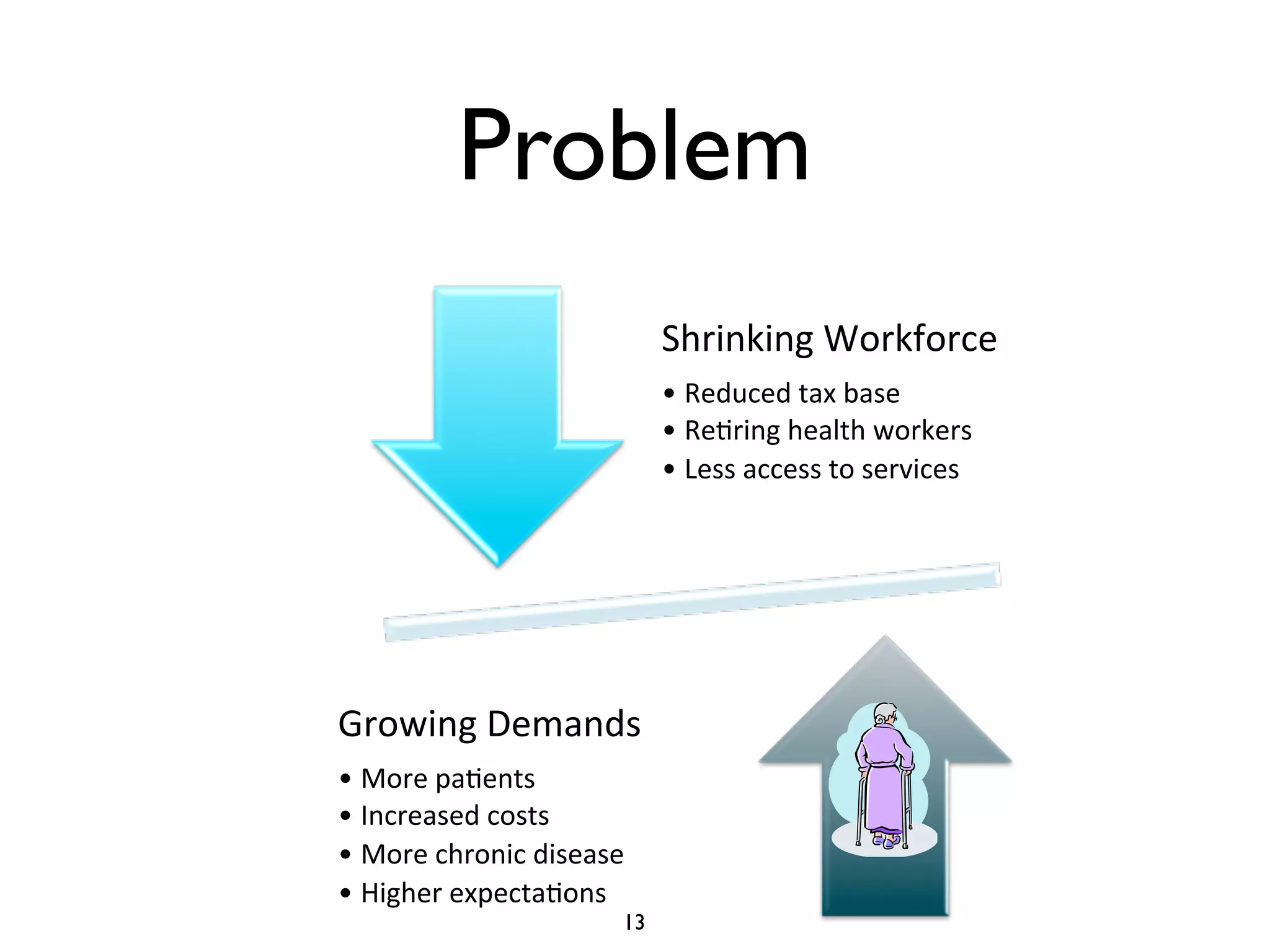
Problem 
13 
Shrinking(Workforce( 
• Reduced(tax(base( 
• Re7ring(health(workers( 
• Less(access(to(services( 
Growing(Demands( 
• More(pa7ents( 
• Increased(costs( 
• More(chronic(disease( 
• Higher(expecta7ons(
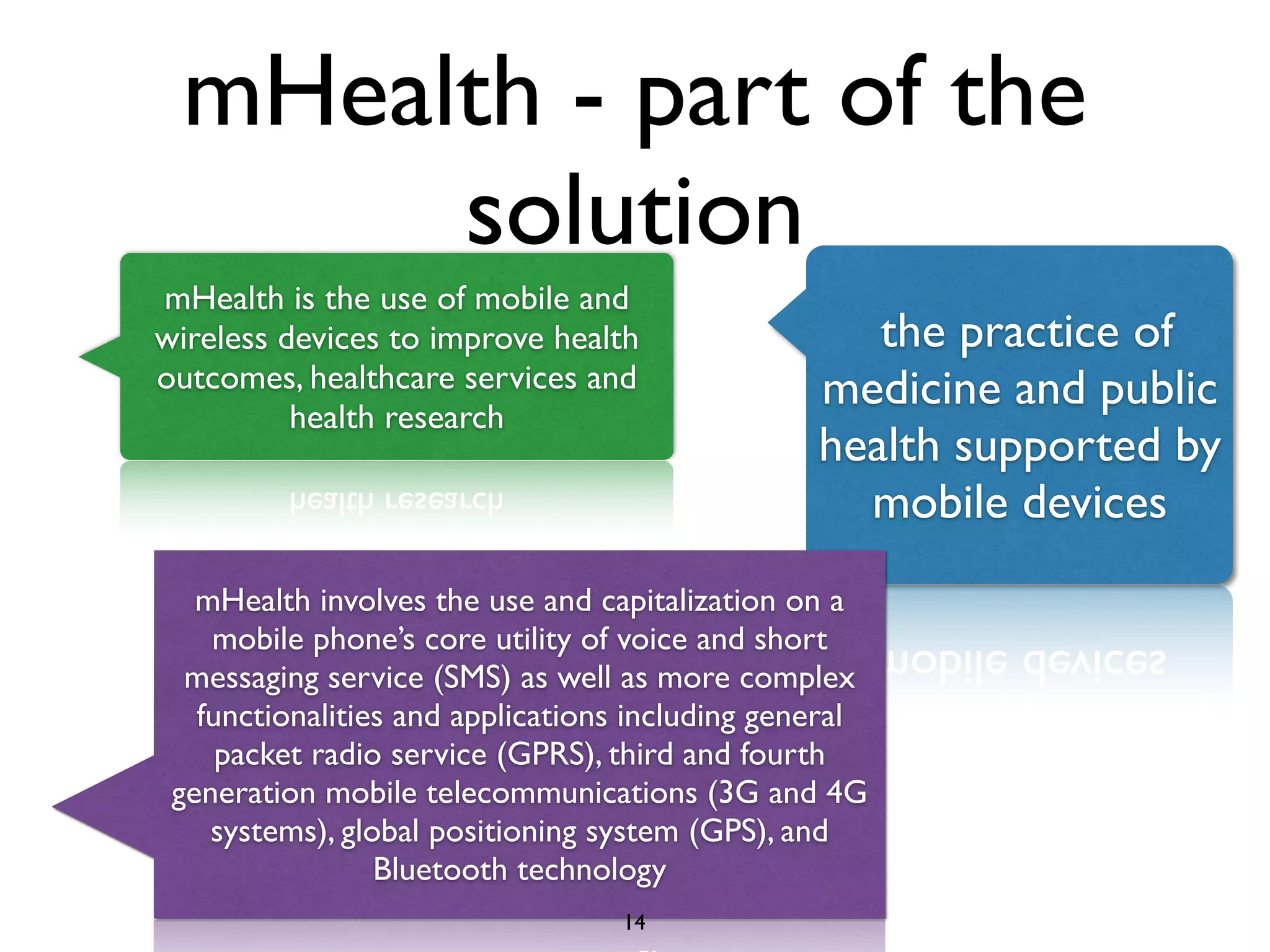
mHealth - part of the 
solution 
the practice of 
medicine and public 
health supported by 
mobile devices 
mHealth is the use of mobile and 
wireless devices to improve health 
outcomes, healthcare services and 
health research 
mHealth involves the use and capitalization on a 
mobile phone’s core utility of voice and short 
messaging service (SMS) as well as more complex 
functionalities and applications including general 
packet radio service (GPRS), third and fourth 
generation mobile telecommunications (3G and 4G 
systems), global positioning system (GPS), and 
Bluetooth technology 
14
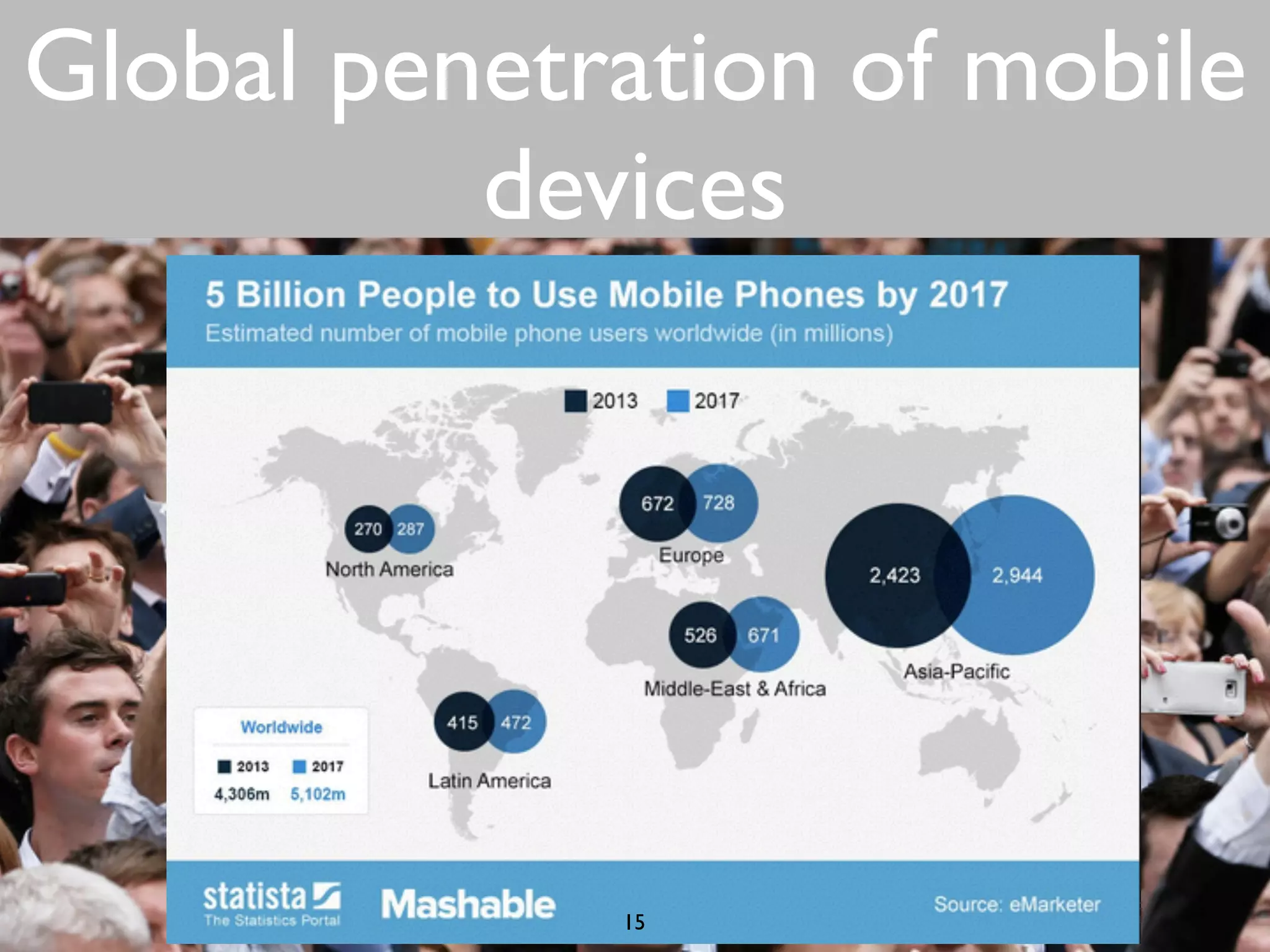
Global penetration of mobile 
devices 
15
Tip of the iceberg 
16
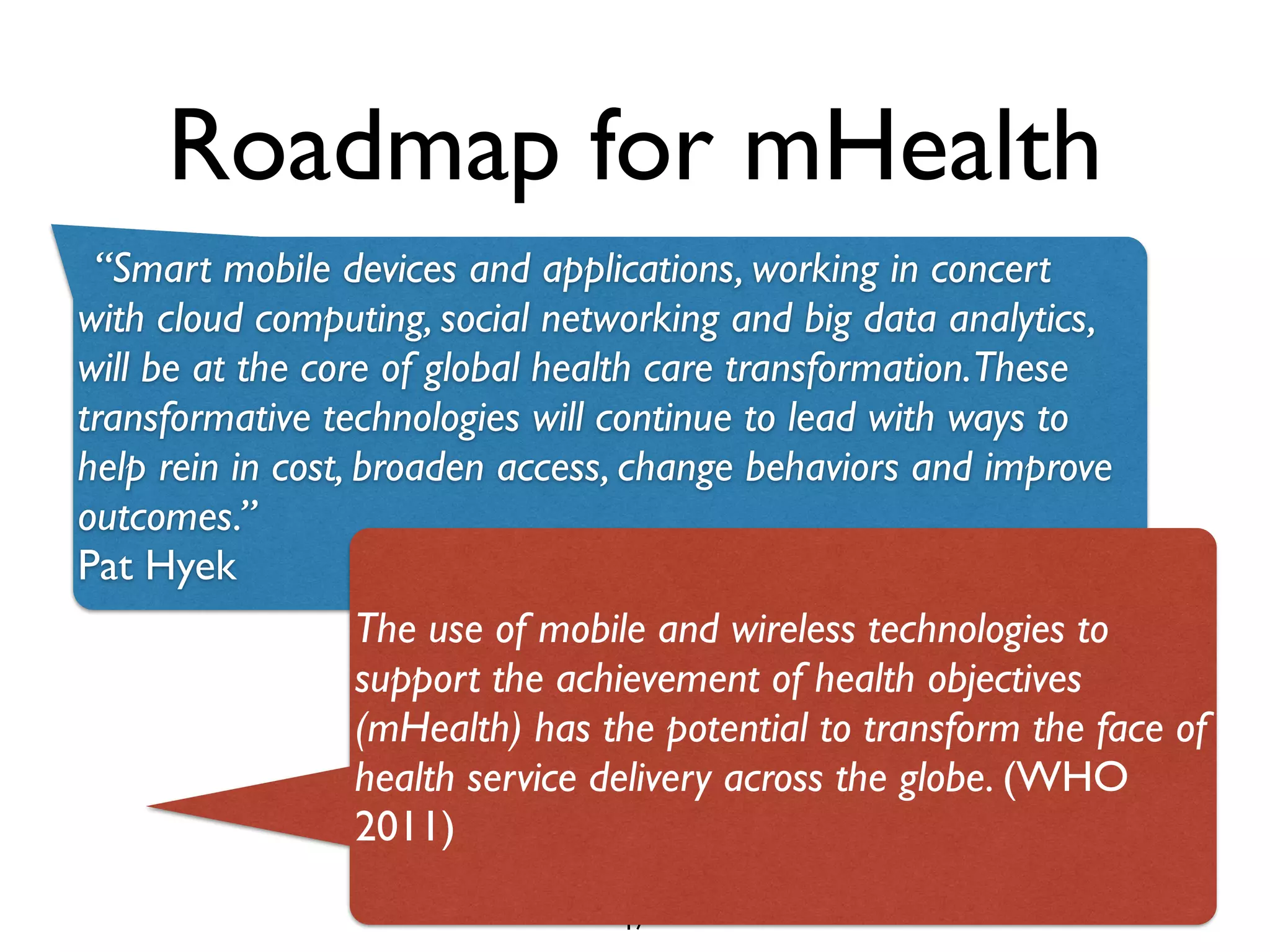
Roadmap for mHealth 
“Smart mobile devices and applications, working in concert 
with cloud computing, social networking and big data analytics, 
will be at the core of global health care transformation. These 
transformative technologies will continue to lead with ways to 
help rein in cost, broaden access, change behaviors and improve 
outcomes.” 
Pat Hyek 
The use of mobile and wireless technologies to 
support the achievement of health objectives 
(mHealth) has the potential to transform the face of 
health service delivery across the globe. (WHO 
2011) 
17
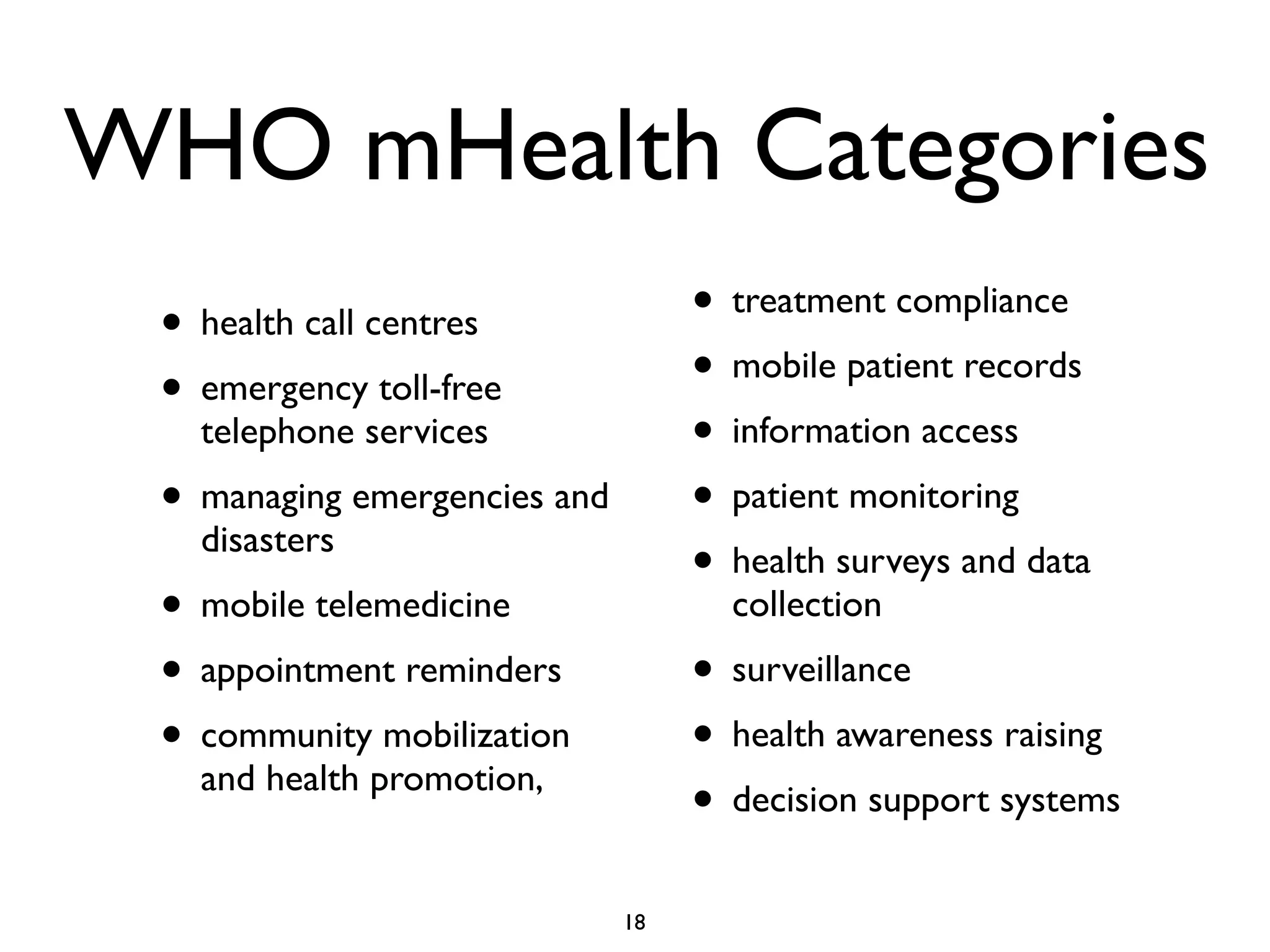
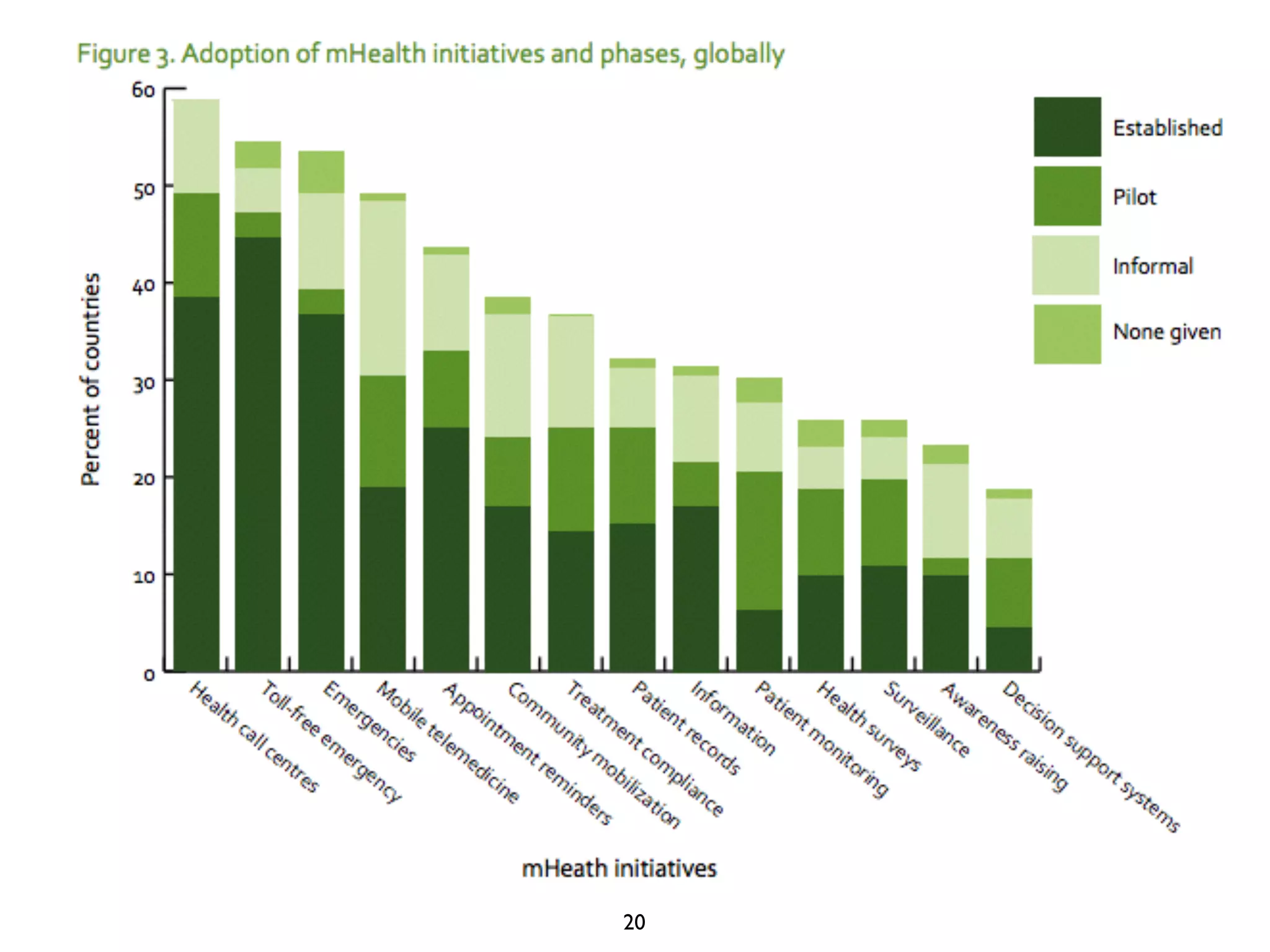
WHO mHealth Categories 
• health call centres 
• emergency toll-free 
telephone services 
• managing emergencies and 
disasters 
• mobile telemedicine 
• appointment reminders 
• community mobilization 
and health promotion, 
• treatment compliance 
• mobile patient records 
• information access 
• patient monitoring 
• health surveys and data 
collection 
• surveillance 
• health awareness raising 
• decision support systems 
18
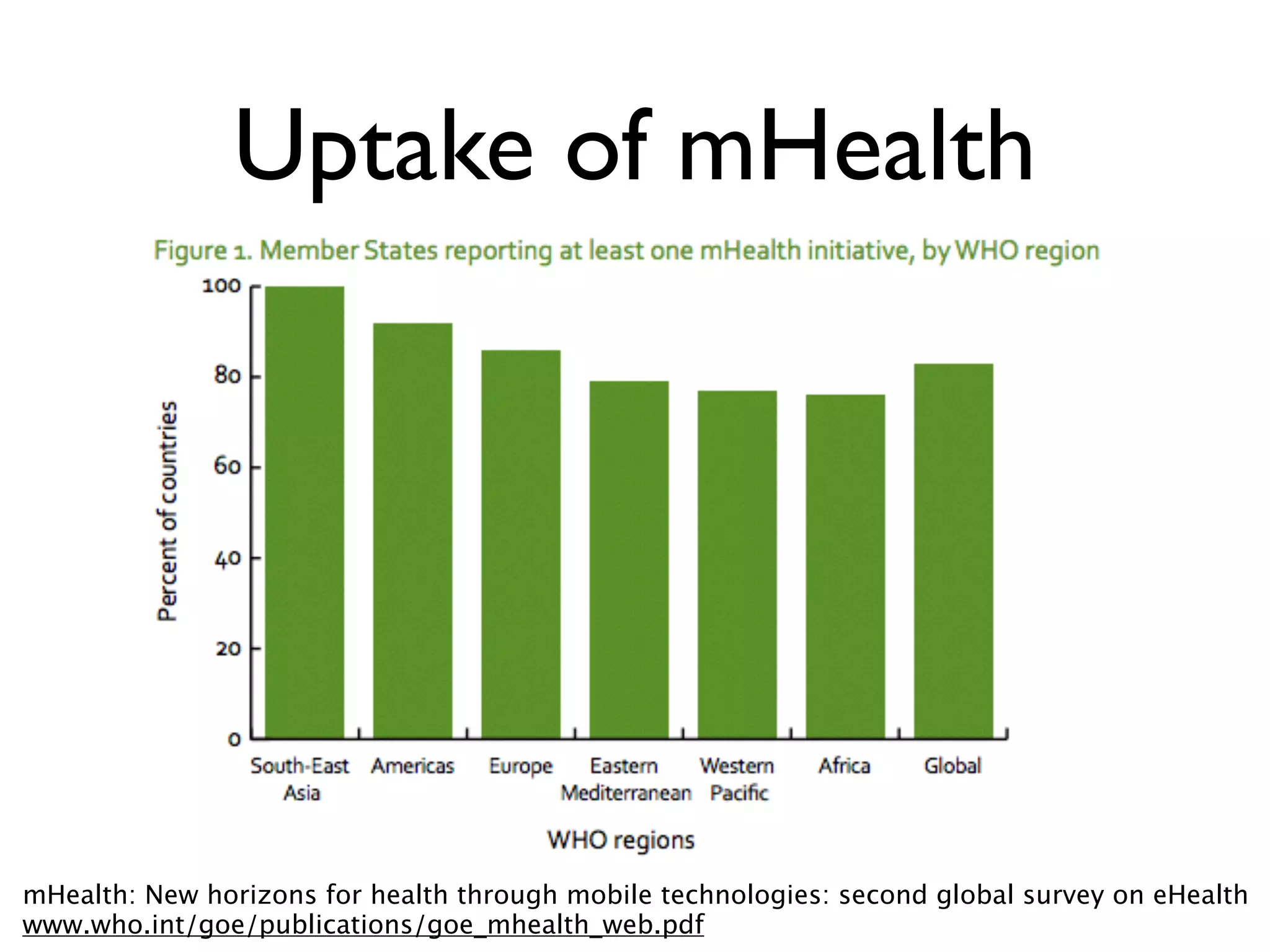
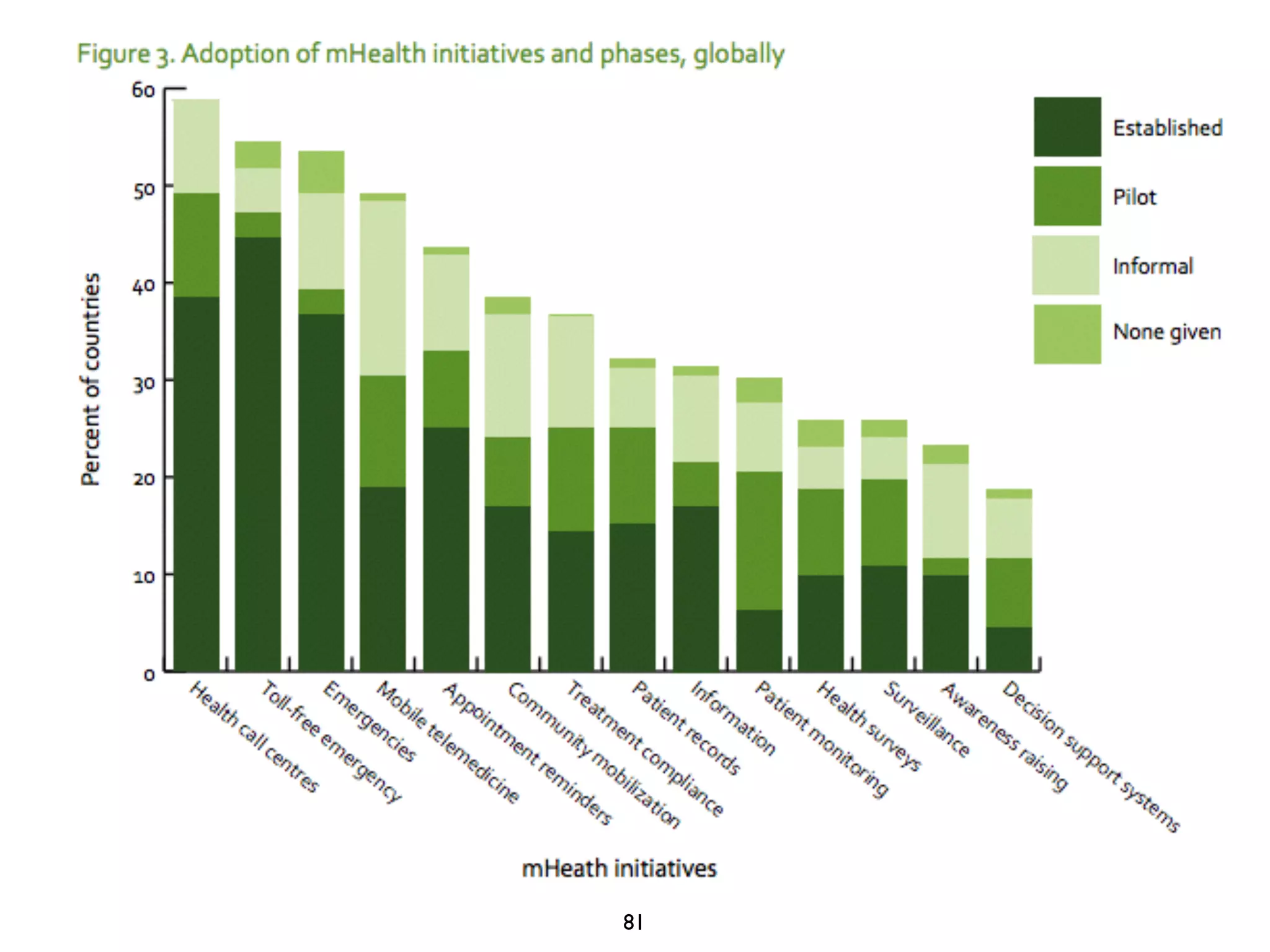
Uptake of mHealth 
mHealth: New horizons for health through mobile technologies: second global survey on eHealth 
www.who.int/goe/publications/goe_mhealth_web.19 
pdf
20
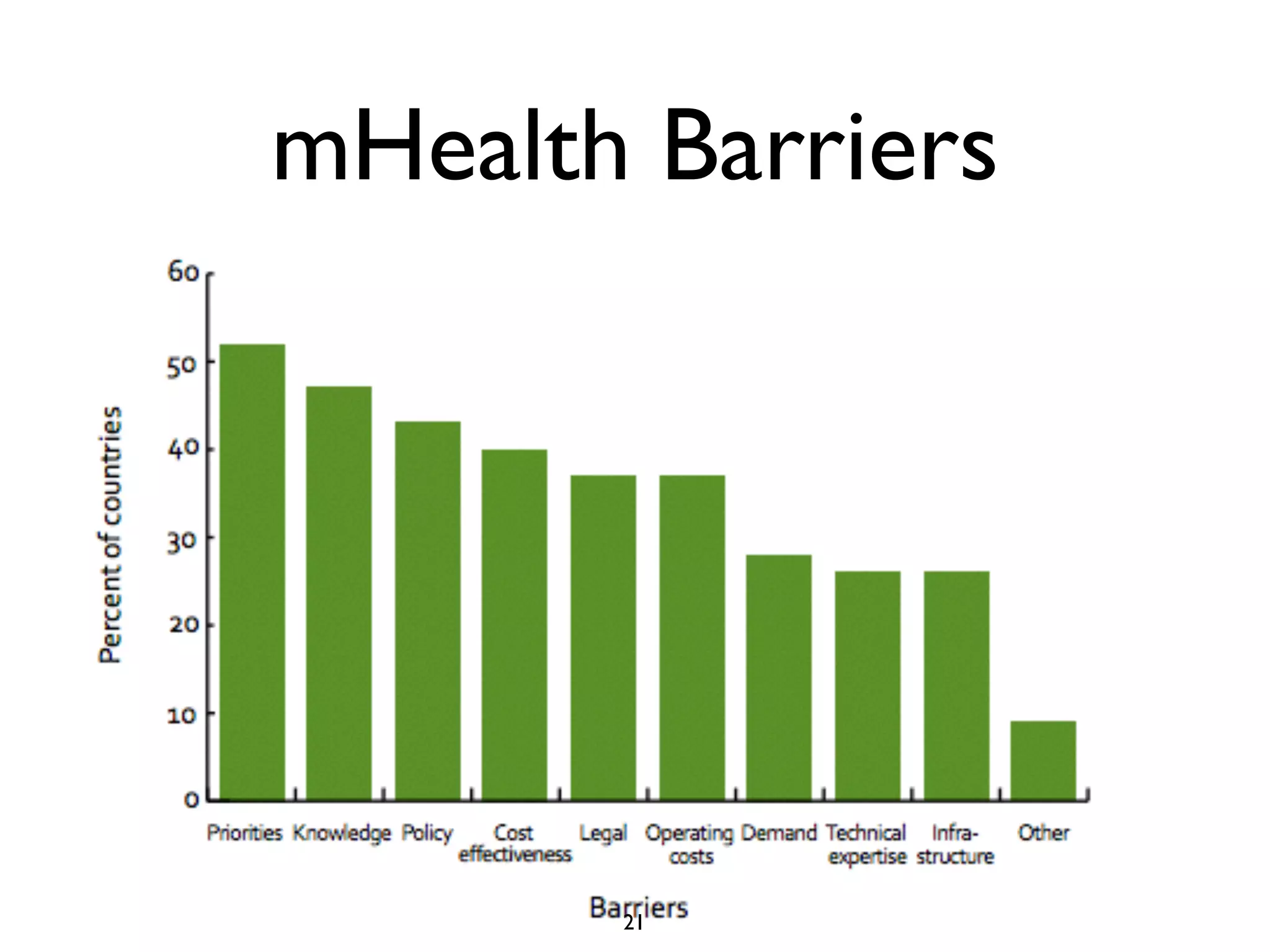
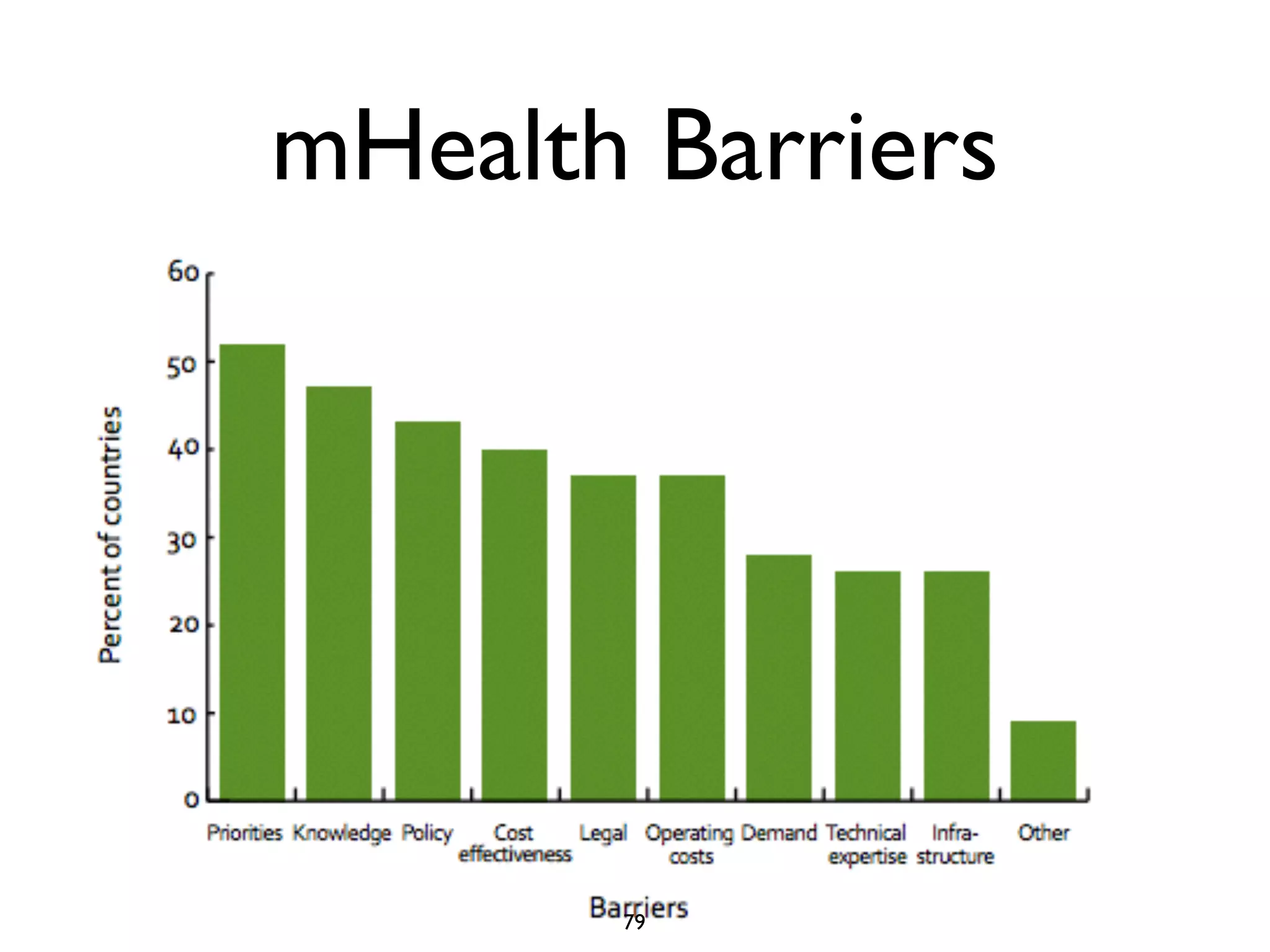
mHealth Barriers 
21
Take up the challenge 
• mHealth programmes require evaluation. This is the 
foundation from which mHealth (and eHealth) can be 
measured (WHO 2011) 
• “Based on these results, we posit that the field is entering a 
new ‘era’ where a body of rigorous evaluation of mHealth 
strategies is rapidly accumulating. The transition into an era 
of evidence-based mHealth supports our position that 
innovation in this domain can be evaluated with the same 
rigor as other public health strategies, attenuating some of 
the hype previously associated with mHealth.” - Alain 
Labrique, Johns Hopkins University Global mHealth Initiative 
22
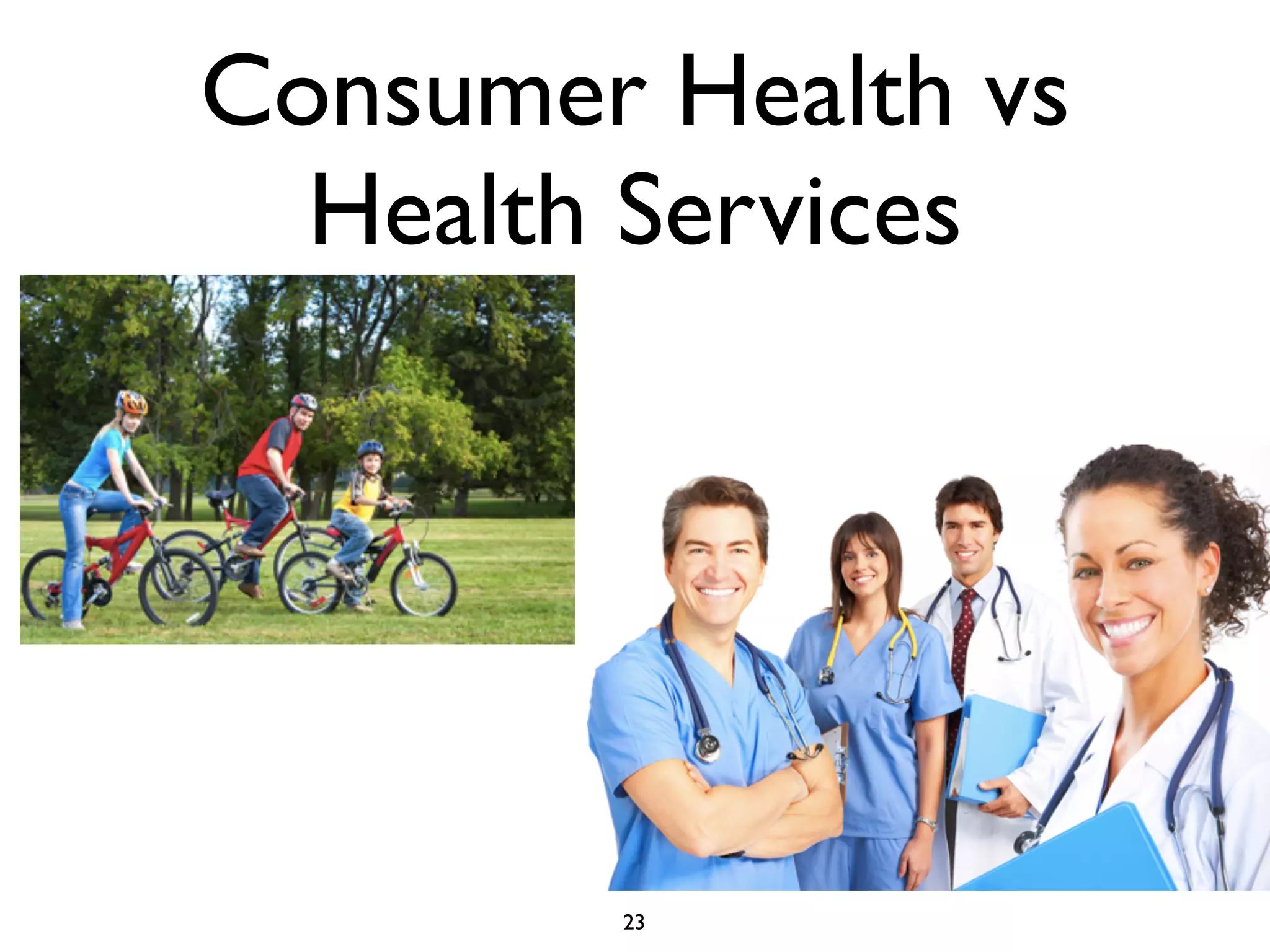
Consumer Health vs 
Health Services 
23
Healthy Well 
• Focus on Individual 
• Encourage Behaviour Change 
• Self awareness/monitoring 
• Gamification/Competition 
• Social support 
• Education 
• Persuasive 
24
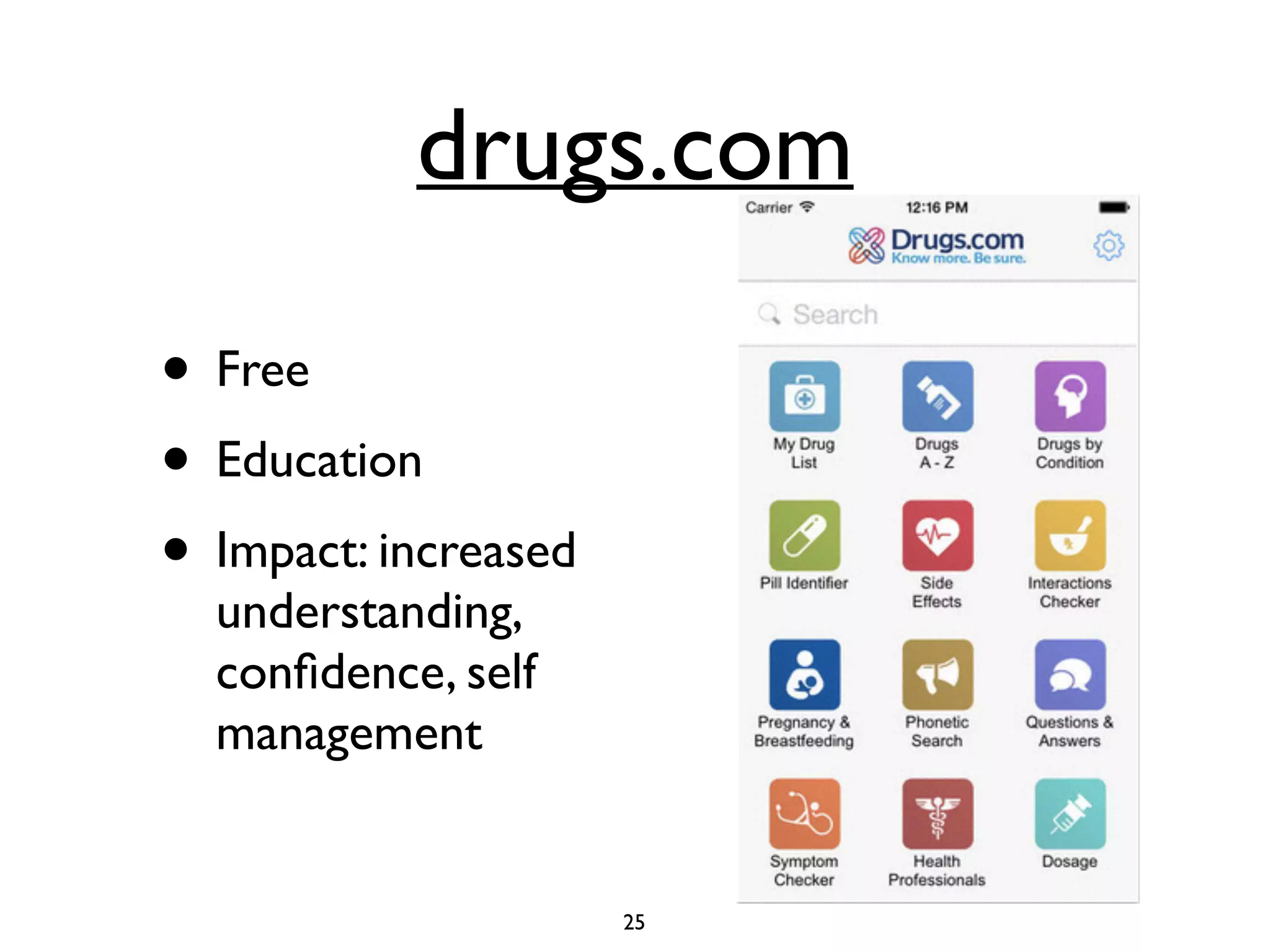
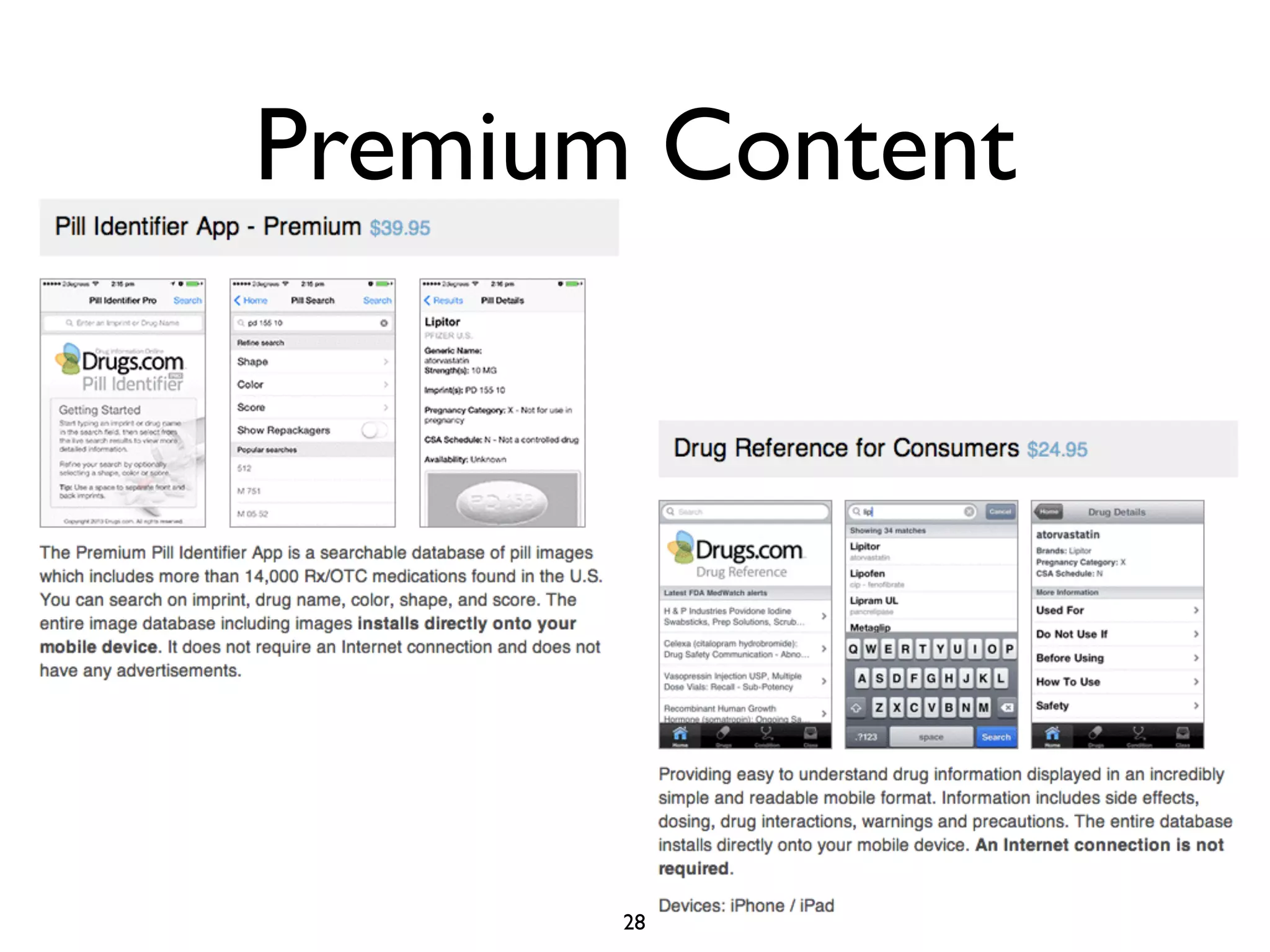
drugs.com 
• Free 
• Education 
• Impact: increased 
understanding, 
confidence, self 
management 
25
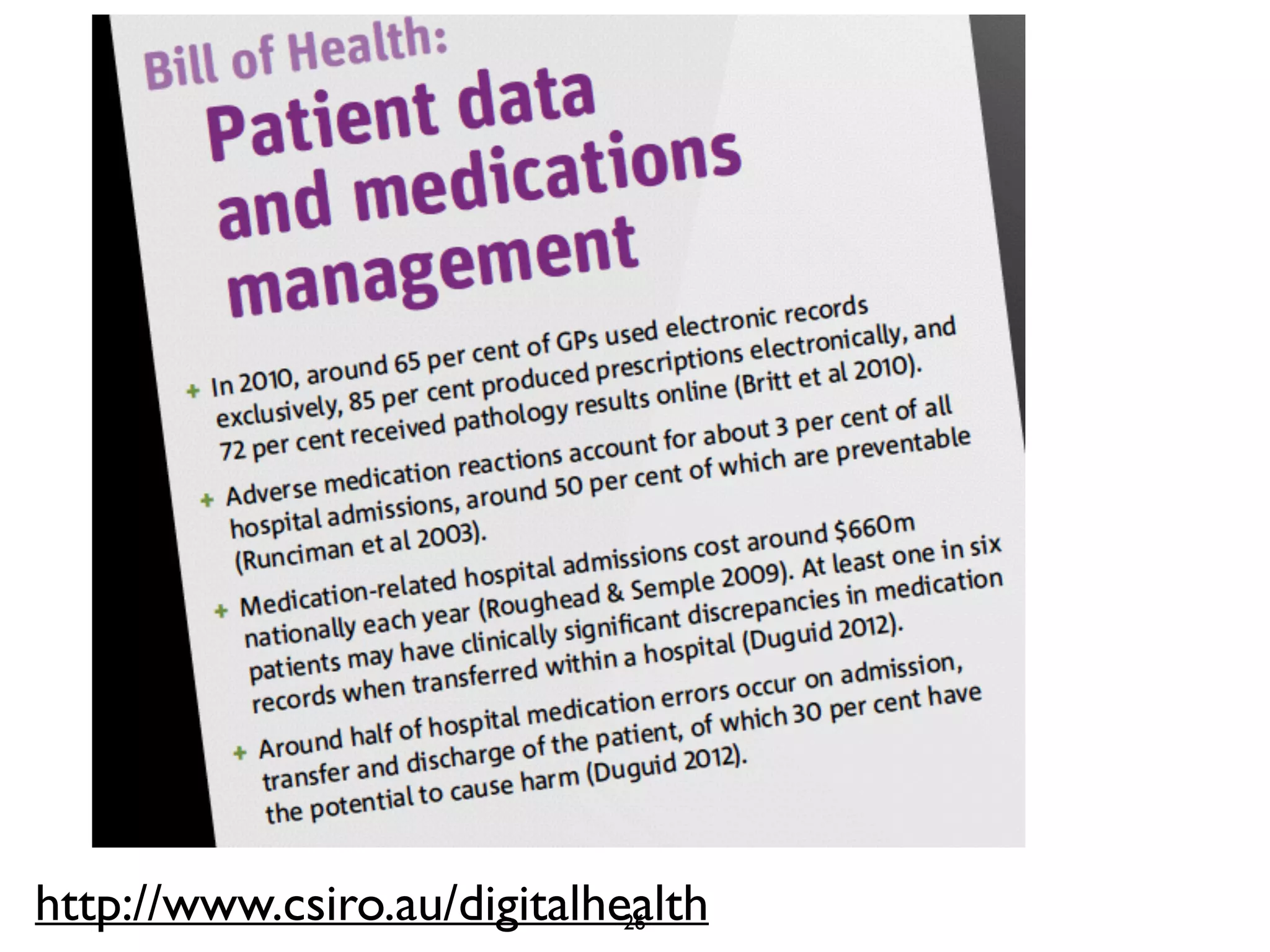
26 http://www.csiro.au/digitalhealth
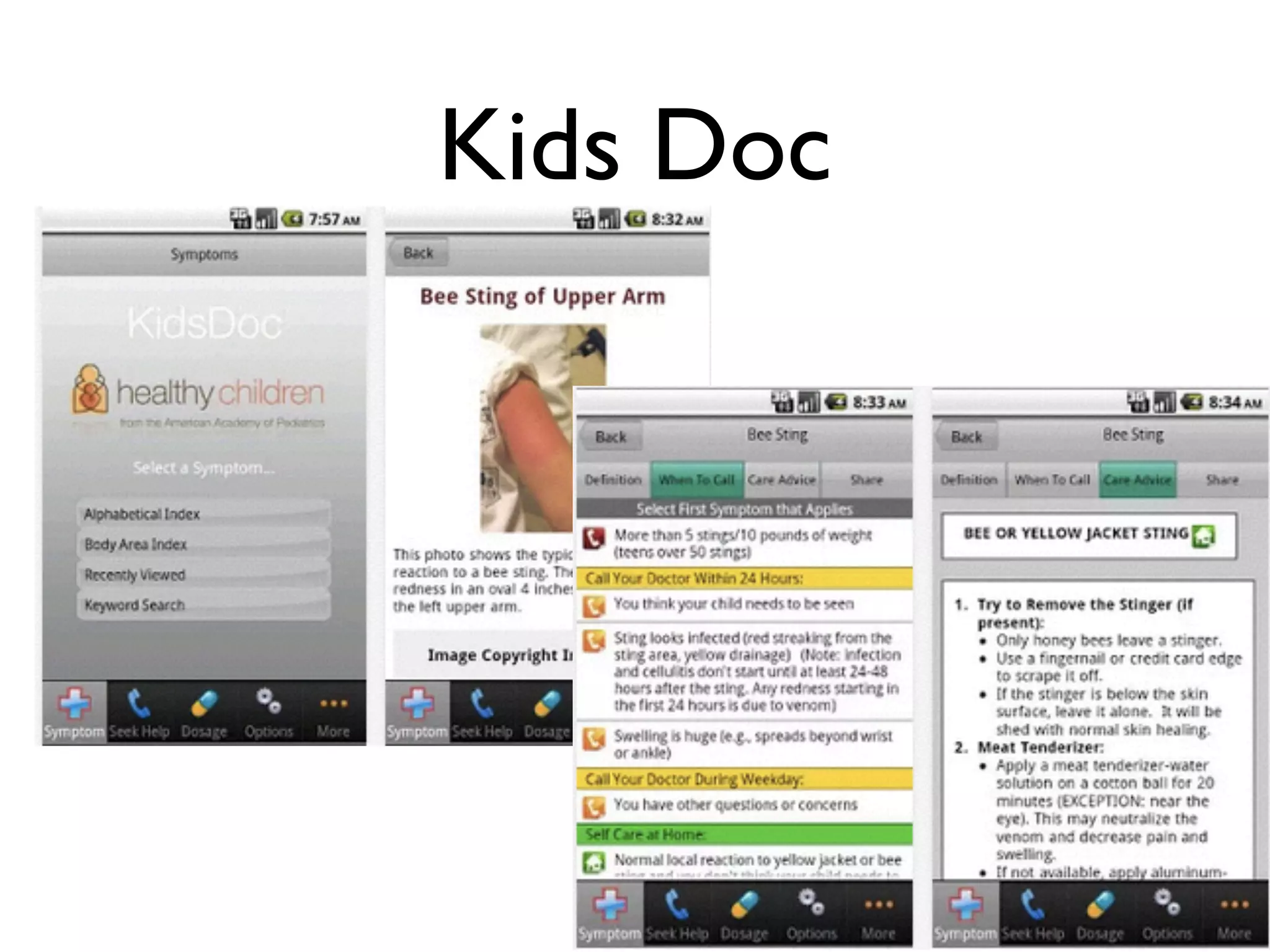
Kids Doc 
27
Premium Content 
28
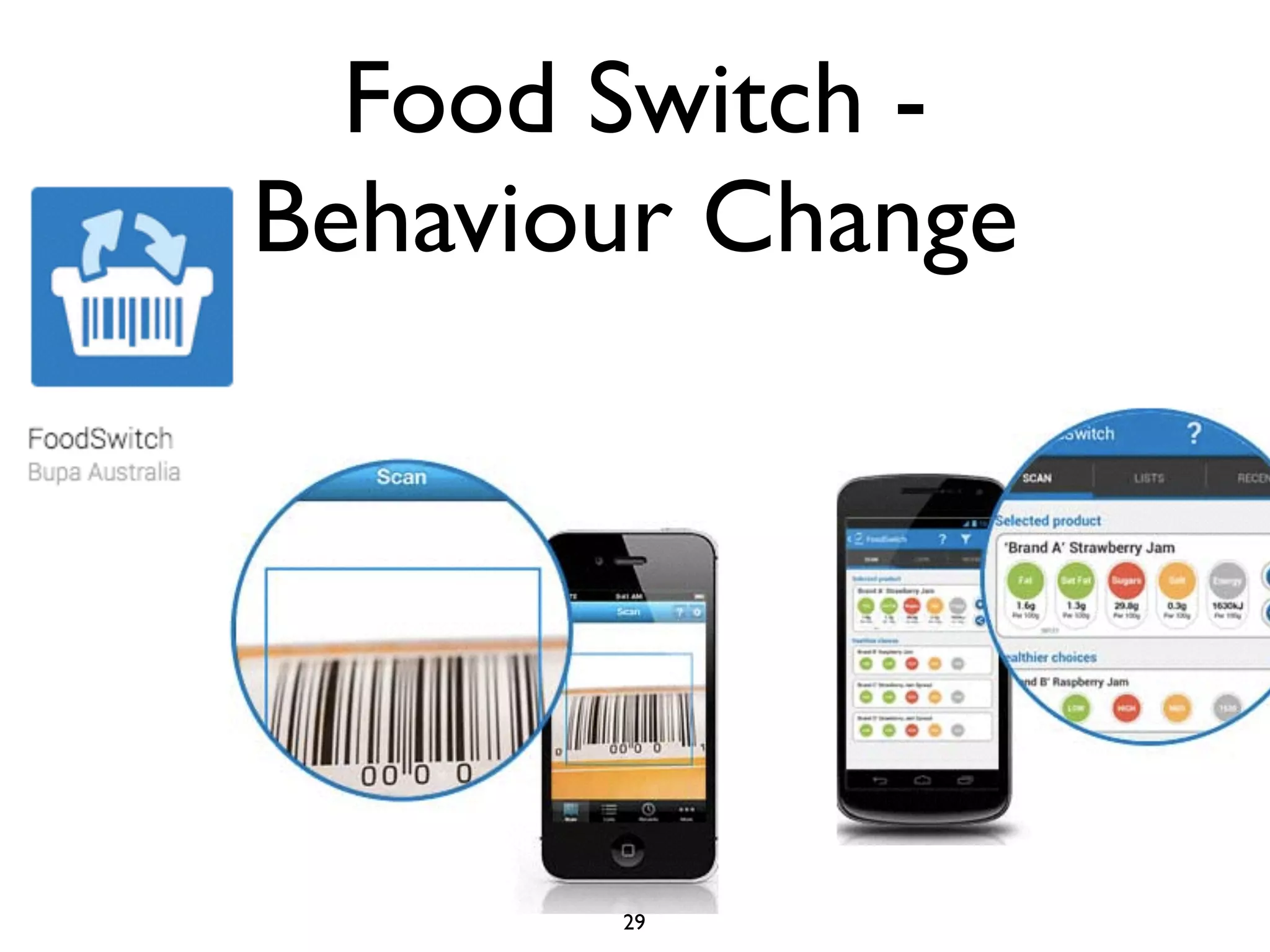
Food Switch - 
Behaviour Change 
29
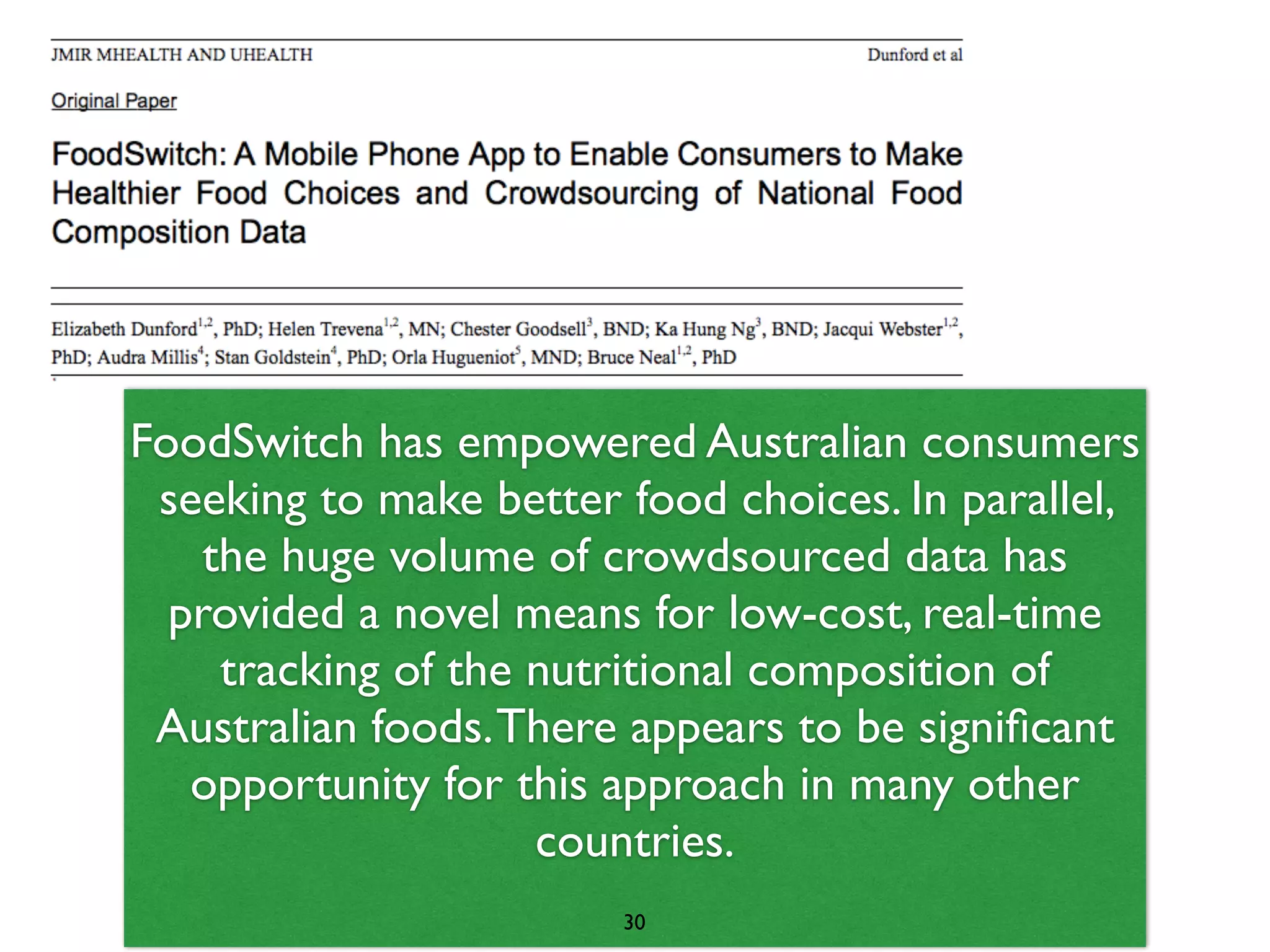
FoodSwitch has empowered Australian consumers 
seeking to make better food choices. In parallel, 
the huge volume of crowdsourced data has 
provided a novel means for low-cost, real-time 
tracking of the nutritional composition of 
Australian foods. There appears to be significant 
opportunity for this approach in many other 
countries. 
30
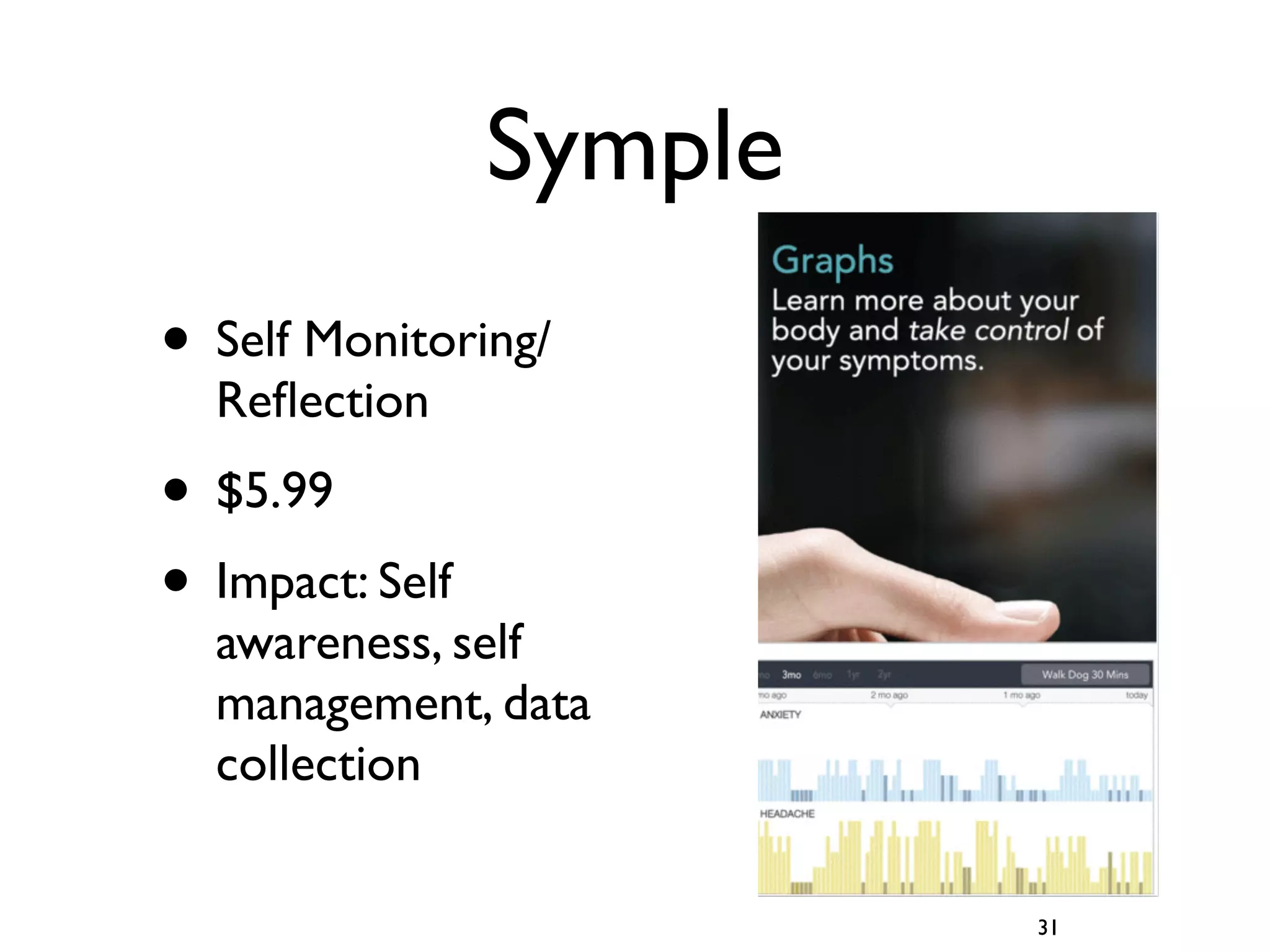
Symple 
• Self Monitoring/ 
Reflection 
• $5.99 
• Impact: Self 
awareness, self 
management, data 
collection 
31
Education Apps 
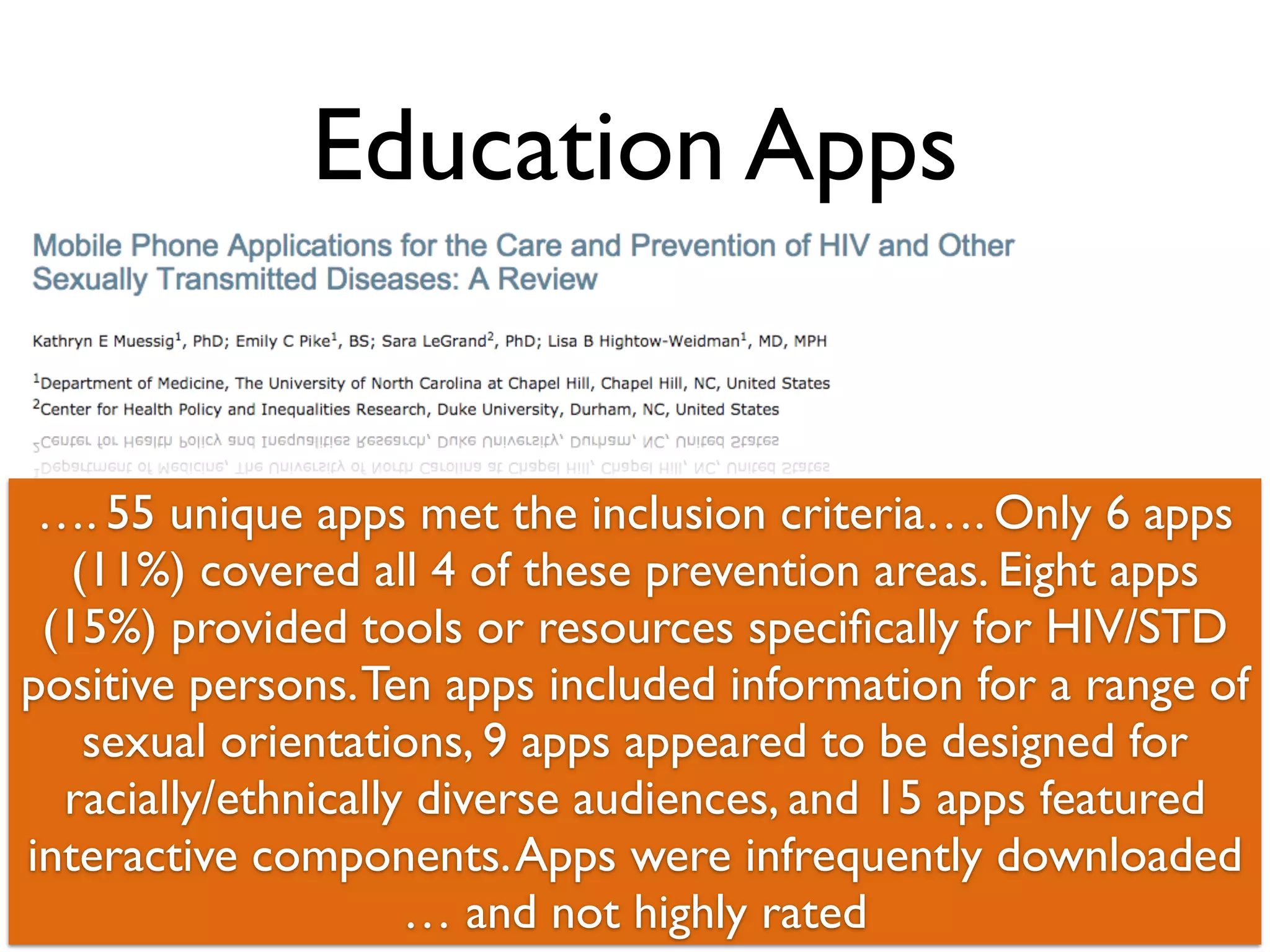
…. 55 unique apps met the inclusion criteria…. Only 6 apps 
(11%) covered all 4 of these prevention areas. Eight apps 
(15%) provided tools or resources specifically for HIV/STD 
positive persons. Ten apps included information for a range of 
sexual orientations, 9 apps appeared to be designed for 
racially/ethnically diverse audiences, and 15 apps featured 
interactive components. Apps were infrequently downloaded 
… and not 32 
highly rated
Fitness 
33
Designed for Impact 
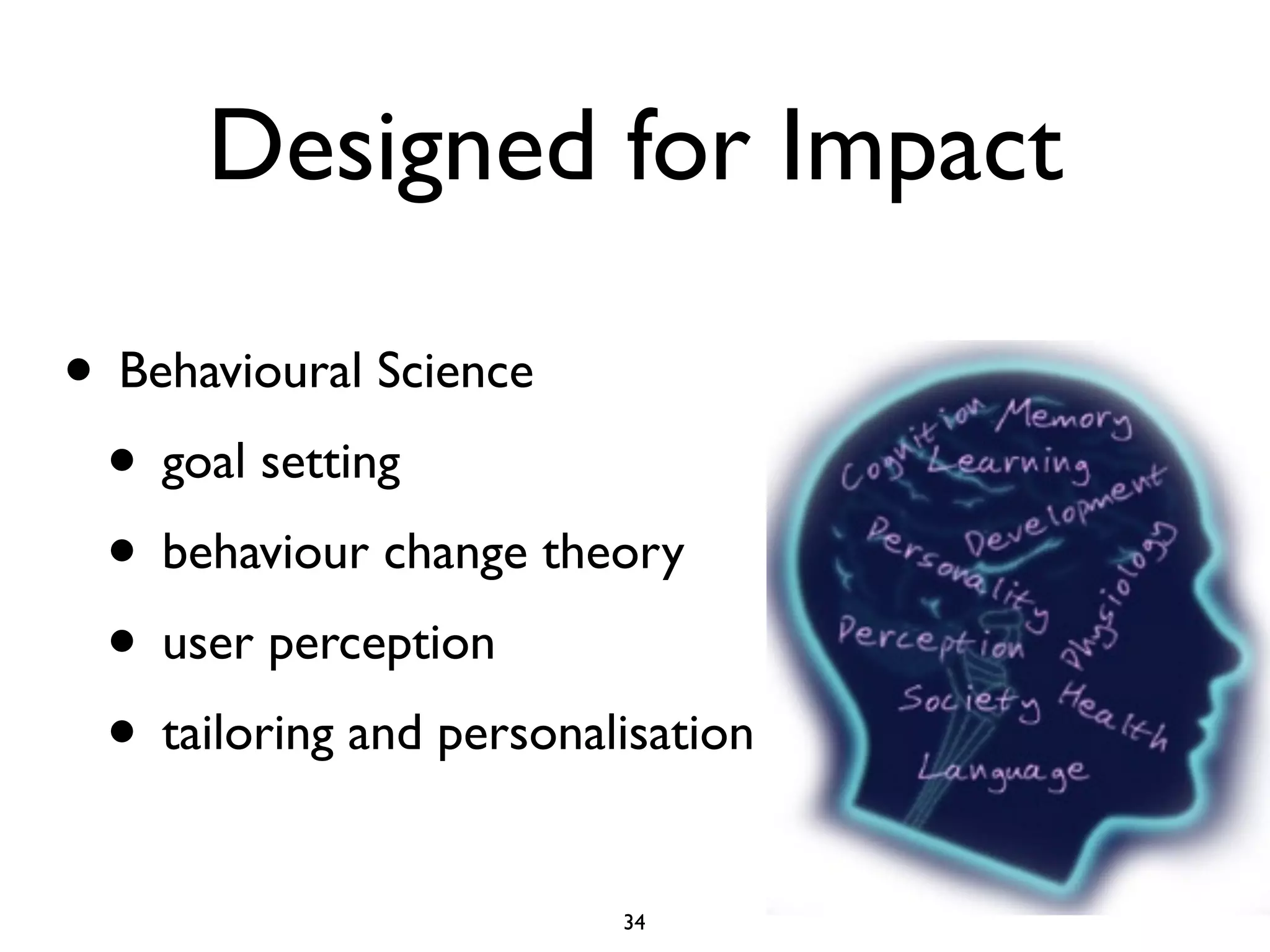
• Behavioural Science 
• goal setting 
• behaviour change theory 
• user perception 
• tailoring and personalisation 
34
! 
! 
! 
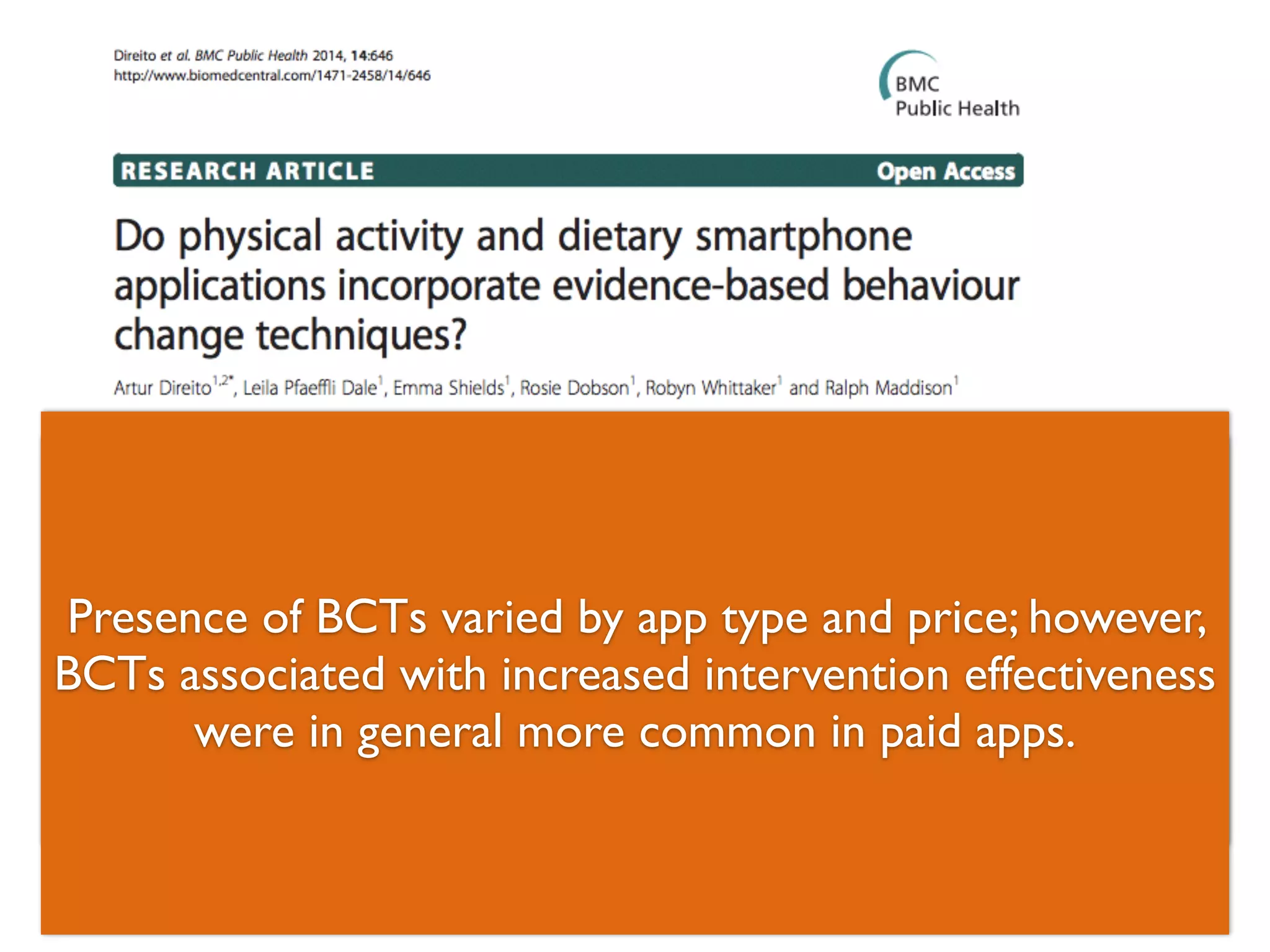
40 Apps - 20 free, 20 paid. The most frequently included 
BCTs were “provide instruction” (83% of the apps), “set 
graded tasks” (70%), and “prompt self-monitoring” (60%). 
Techniques Presence of such BCTs as “varied teach by to use app prompts/type and cues”, price; “however, 
agree on 
BCTs behavioural associated contract”, with increased “relapse intervention prevention” effectiveness 
and “time 
management” were in general were not more present common in the in apps paid apps. 
reviewed. 
! 
! 
35
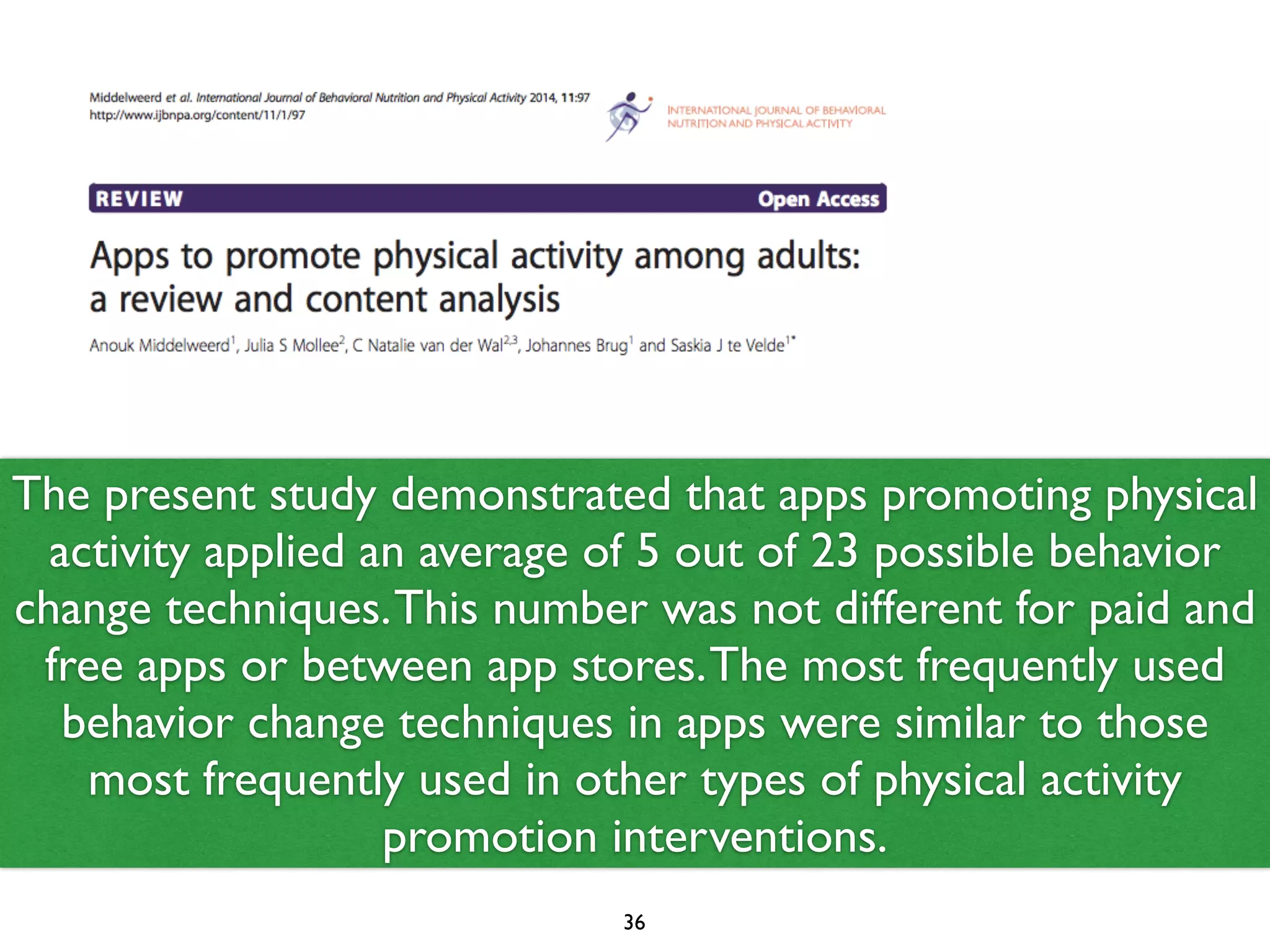
The present study demonstrated that apps promoting physical 
activity applied an average of 5 out of 23 possible behavior 
change techniques. This number was not different for paid and 
free apps or between app stores. The most frequently used 
behavior change techniques in apps were similar to those 
most frequently used in other types of physical activity 
promotion interventions. 
36
Diets 
37
Obesity is common, 
serious and costly 
• More than one-third (or 78.6 million) of U.S. 
adults are obese (JAMA. 2014;311(8):806-814.) 
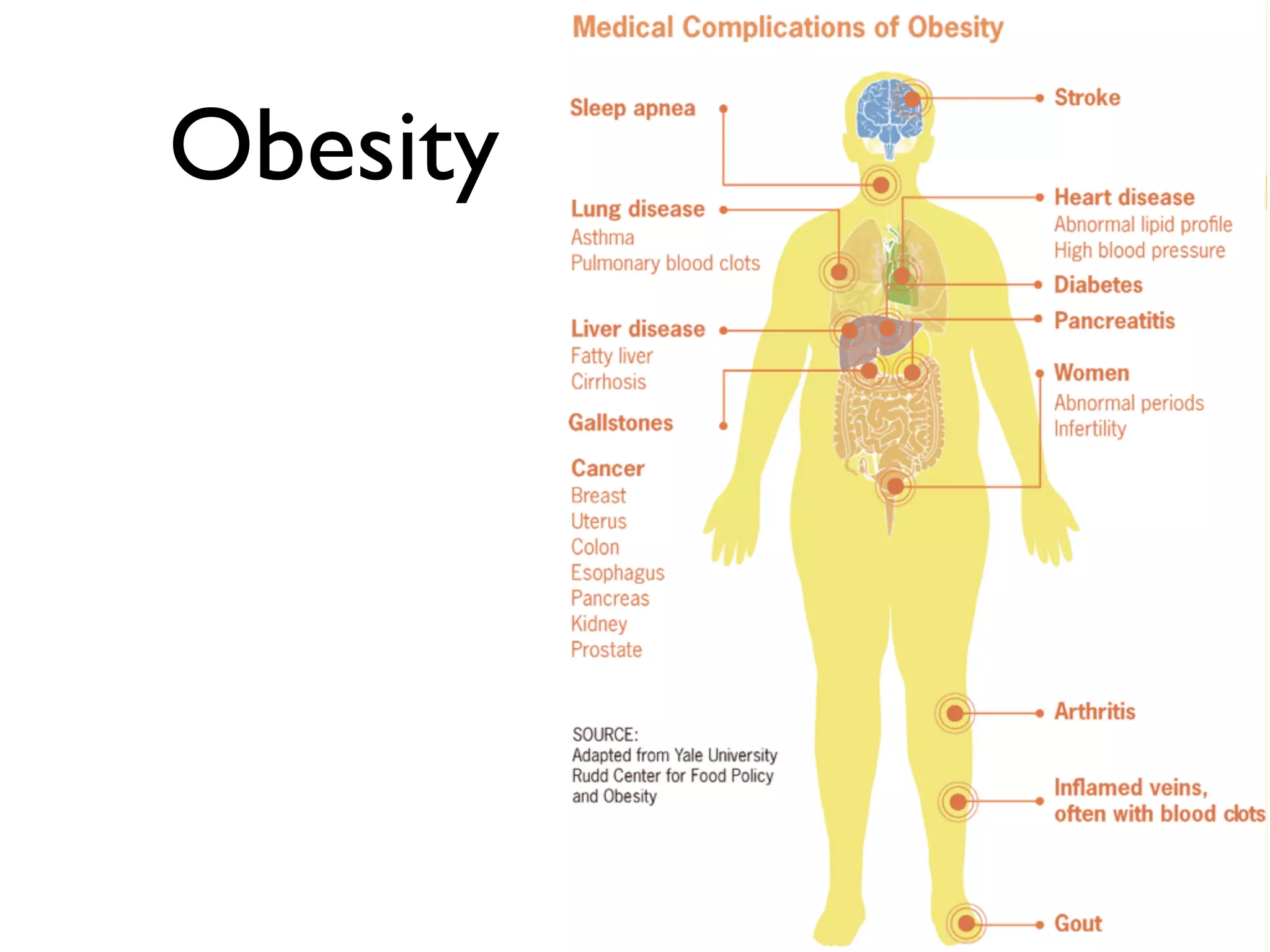
• Obesity-related conditions include heart disease, 
stroke, type 2 diabetes and certain types of cancer, 
some of the leading causes of preventable death. 
• The estimated annual medical cost of obesity in 
the U.S. was $147 billion in 2008 U.S. dollars; the 
medical costs for people who are obese were 
$1,429 higher than those of normal weight. 
38
Obesity 
39
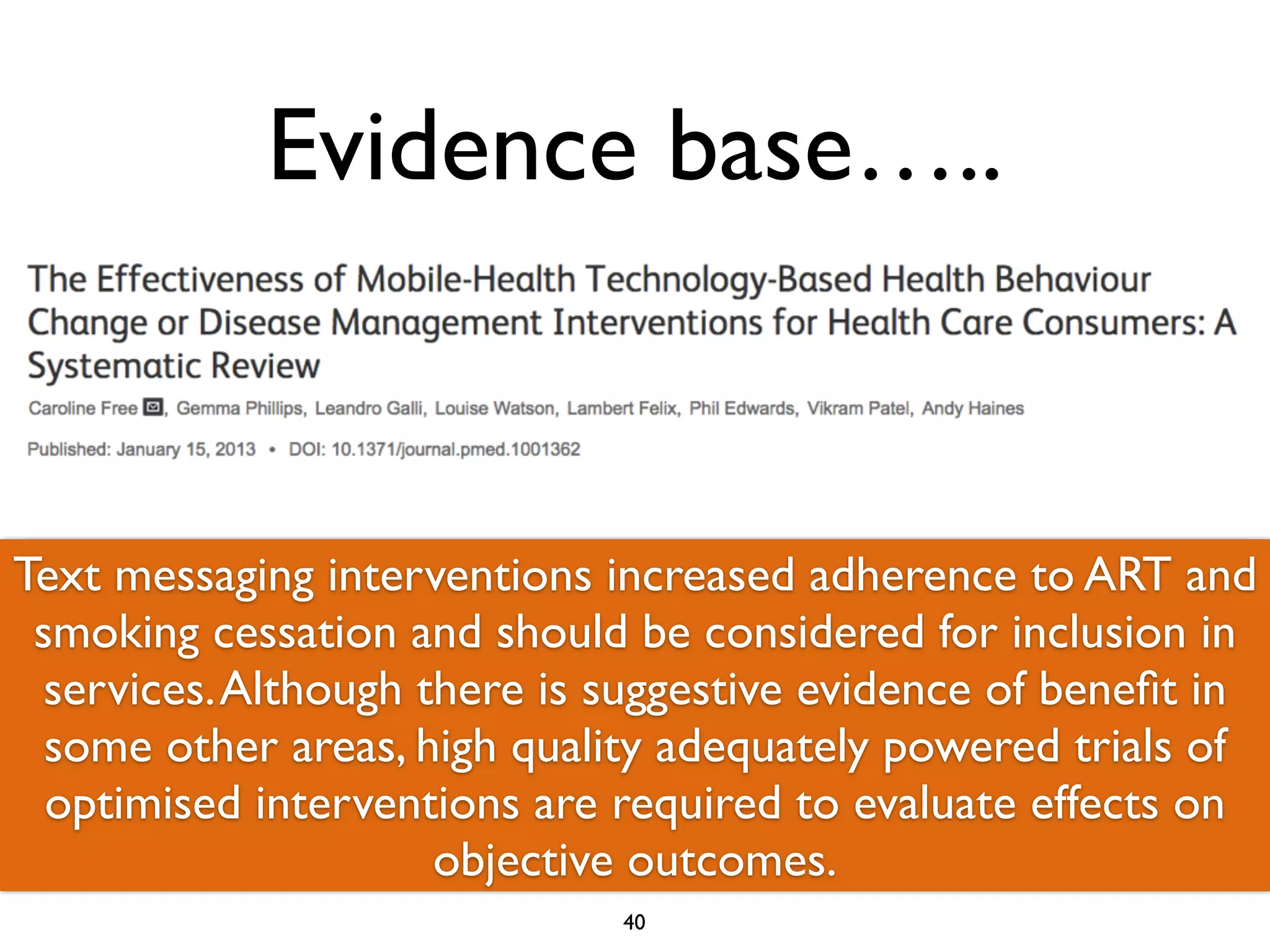
Evidence base….. 
Text ……messaging We identified interventions 75 trials. Fifty-increased nine trials adherence investigated to ART the 
and 
smoking use of mobile cessation technologies and should to be improve considered disease for management 
inclusion in 
services. and 26 Although trials investigated there is suggestive their use evidence to change of health 
benefit in 
behaviours. some other Nearly areas, high all trials quality were adequately conducted powered in high-trials income 
of 
optimised interventions are required to evaluate effects on 
countries…… 
objective outcomes. 
40
Impromy 
41
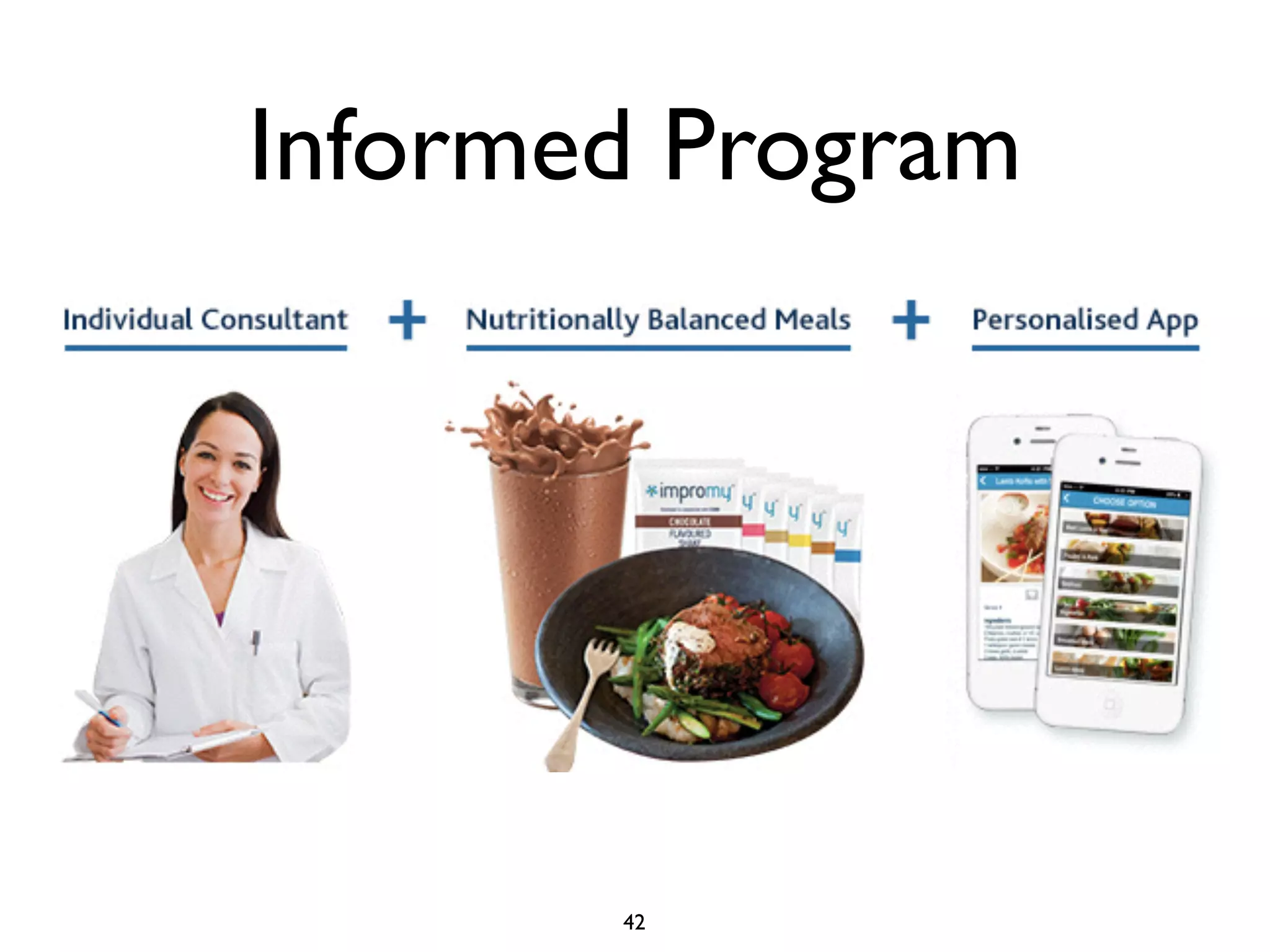
Informed Program 
42
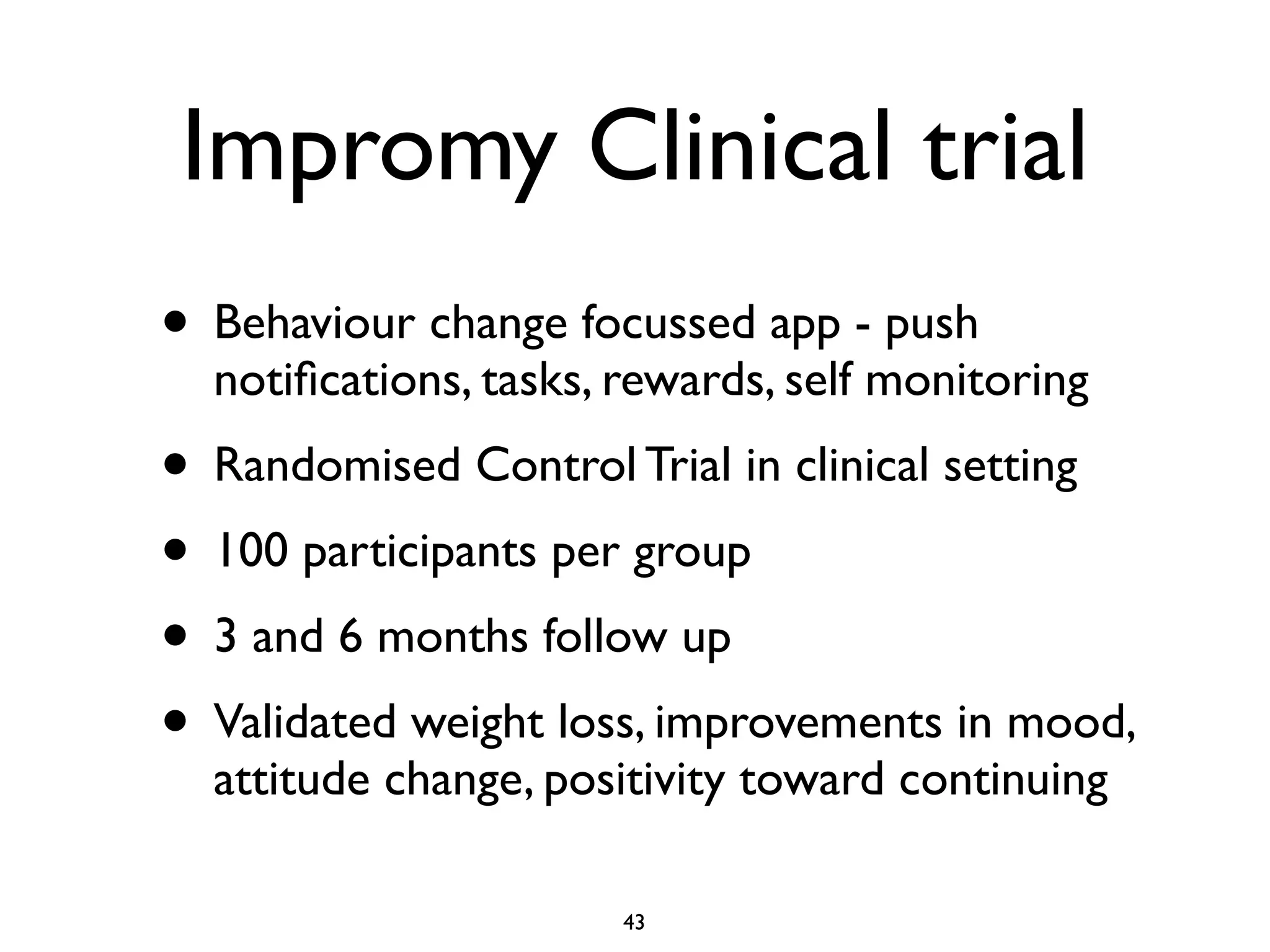
Impromy Clinical trial 
• Behaviour change focussed app - push 
notifications, tasks, rewards, self monitoring 
• Randomised Control Trial in clinical setting 
• 100 participants per group 
• 3 and 6 months follow up 
• Validated weight loss, improvements in mood, 
attitude change, positivity toward continuing 
43
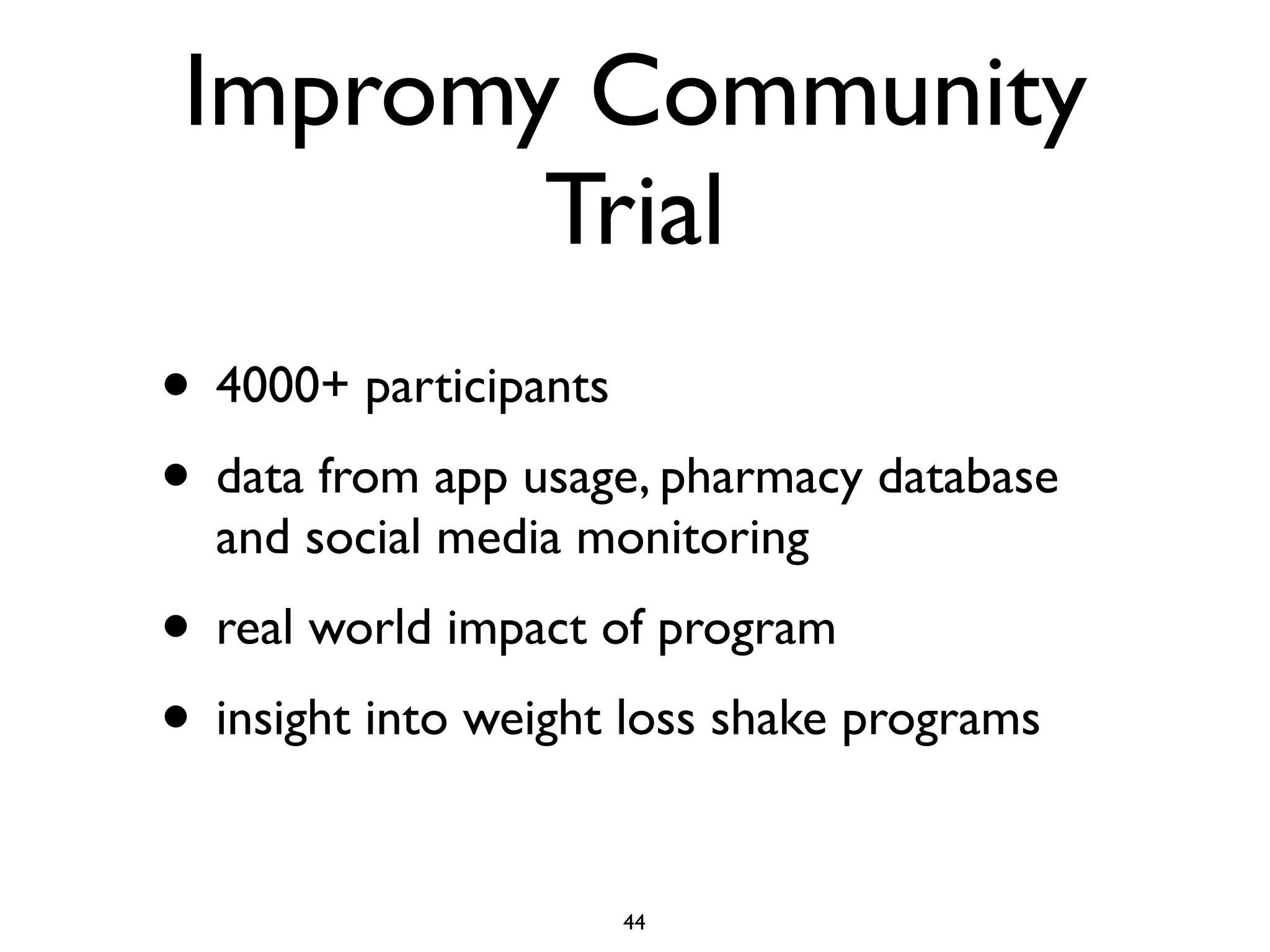
Impromy Community 
Trial 
• 4000+ participants 
• data from app usage, pharmacy database 
and social media monitoring 
• real world impact of program 
• insight into weight loss shake programs 
44
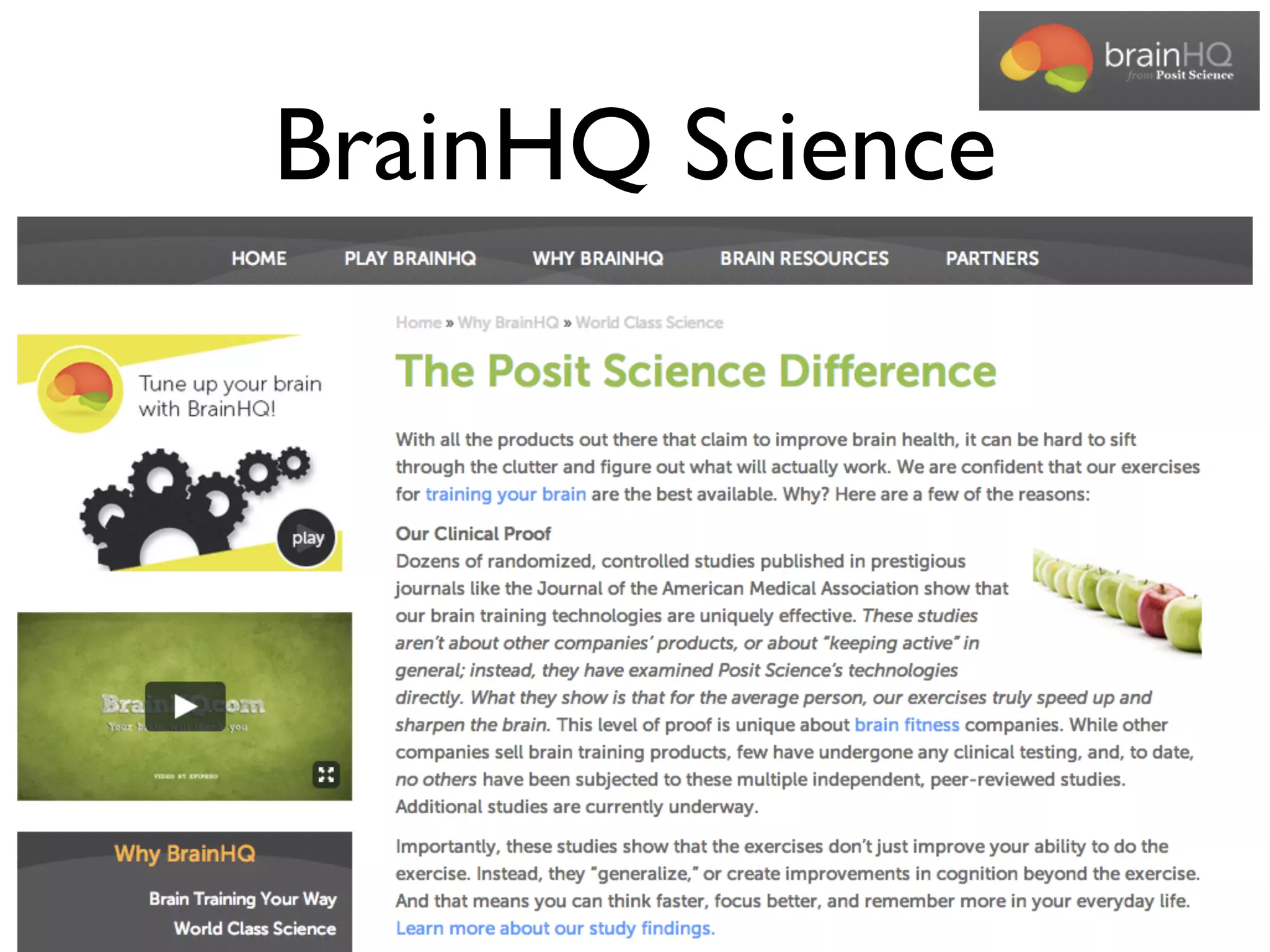
BrainHQ Science 
• Posit Science 
45
46 
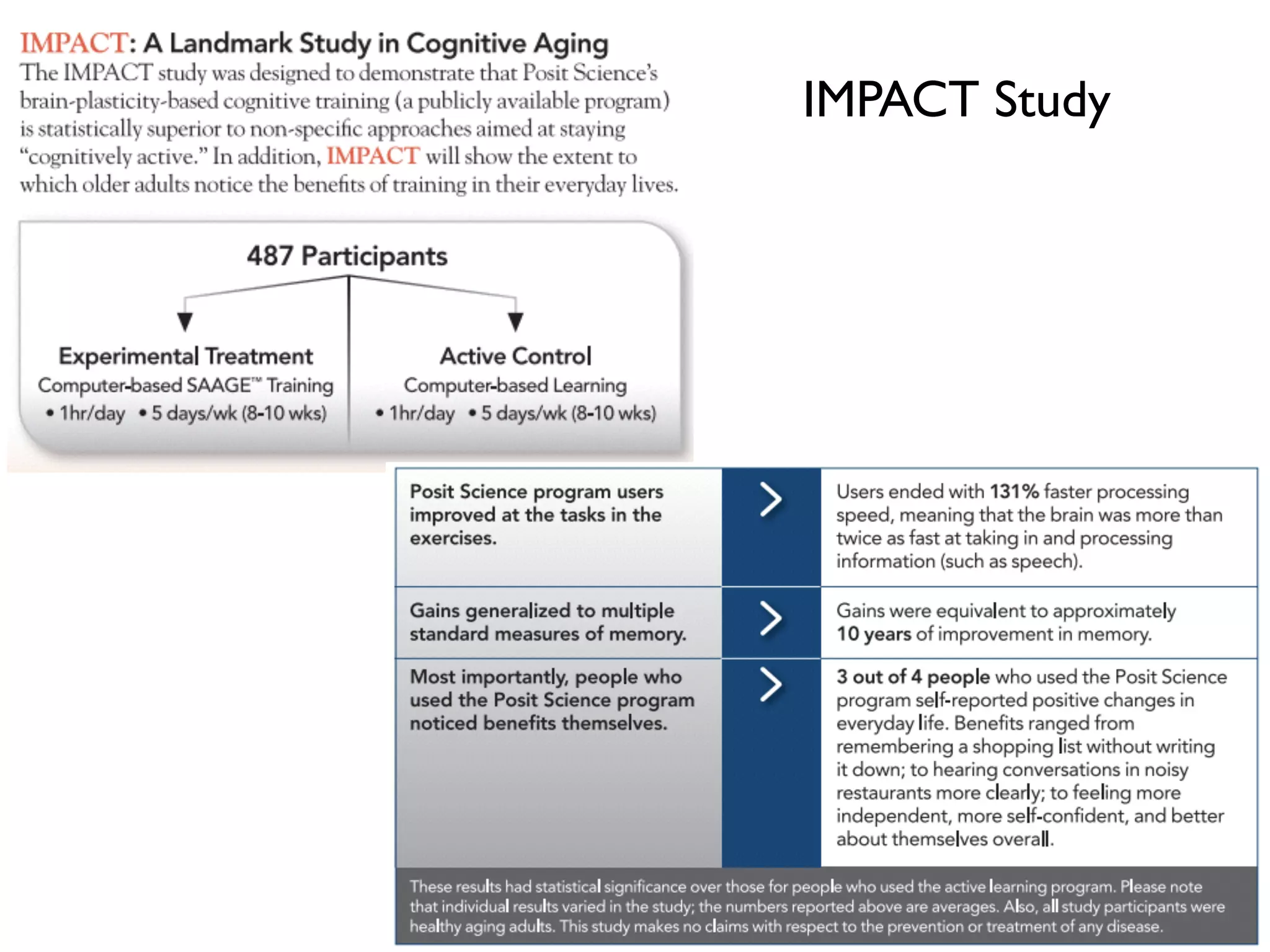
IMPACT Study
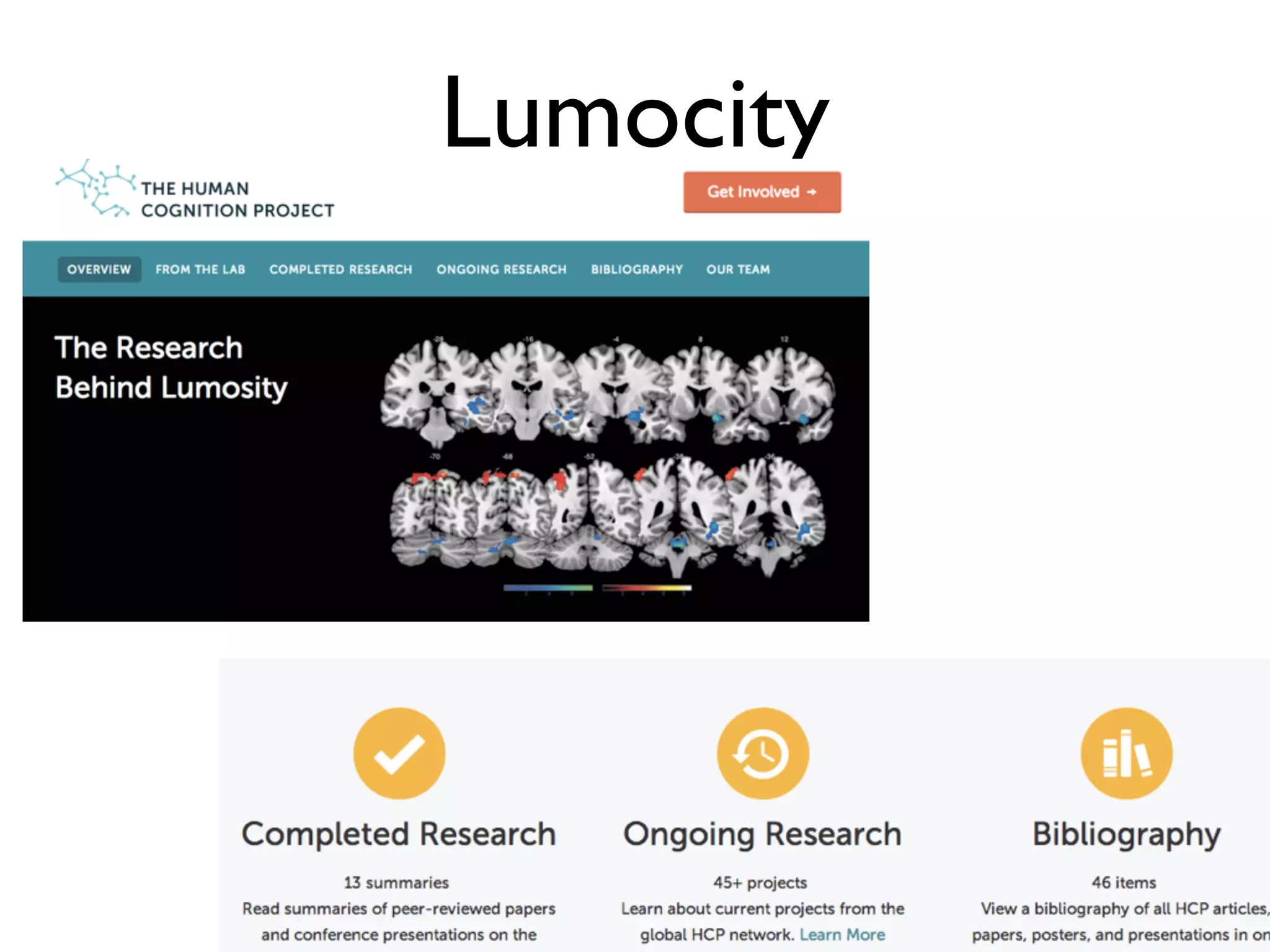
Lumocity 
47
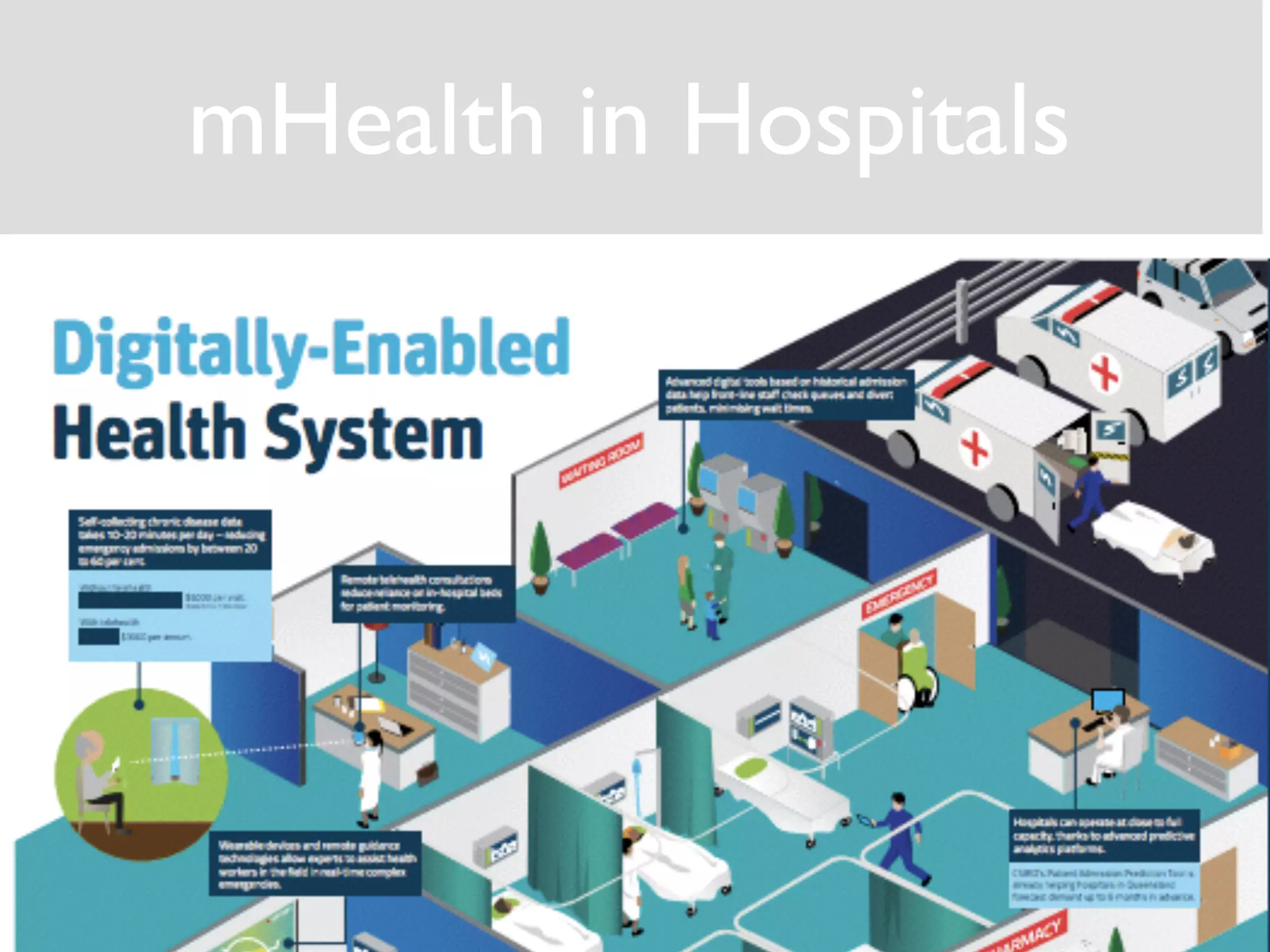
mHealth in Hospitals 
48
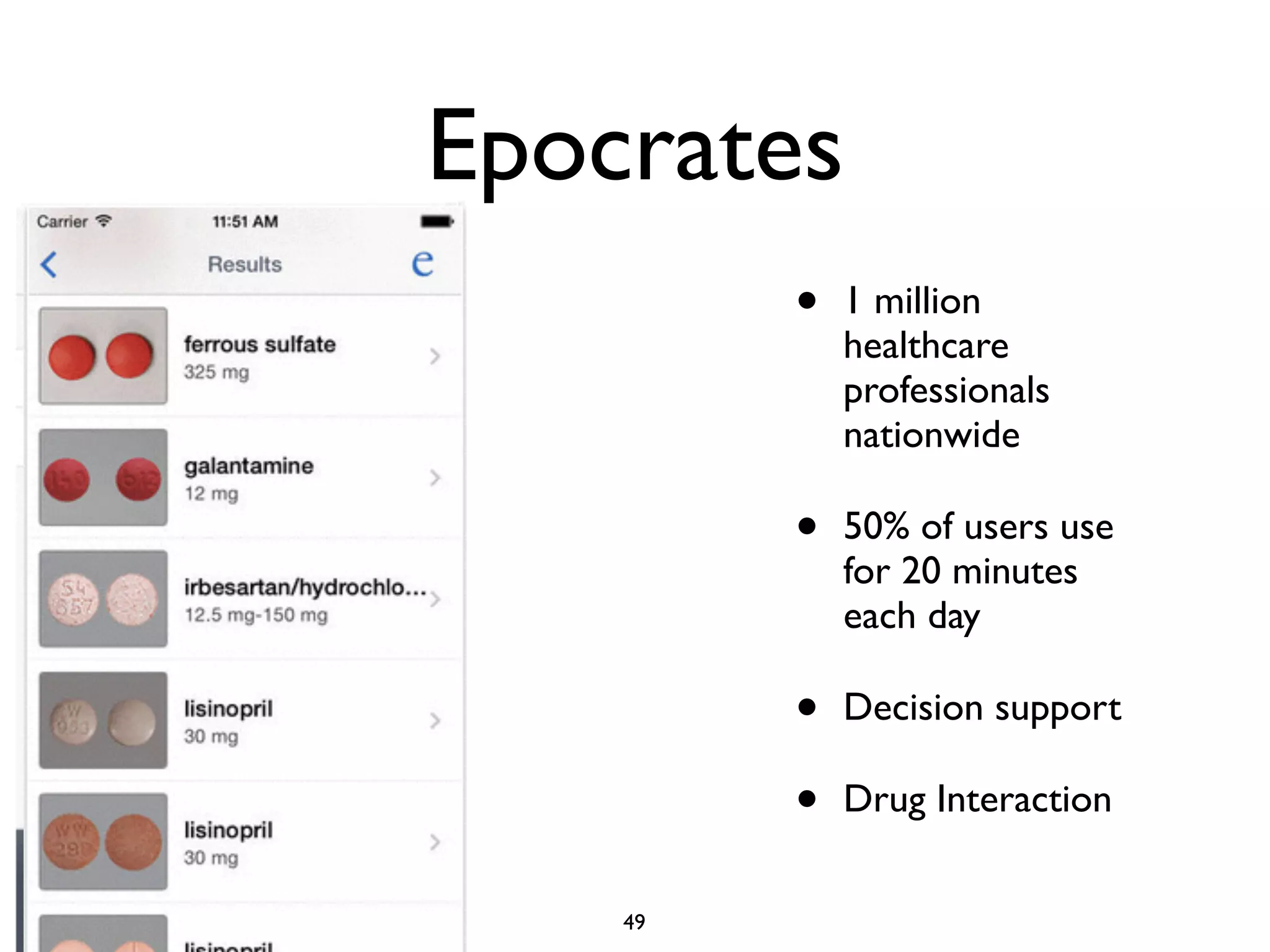
Epocrates 
• 1 million 
healthcare 
professionals 
nationwide 
• 50% of users use 
for 20 minutes 
each day 
• Decision support 
• Drug Interaction 
49
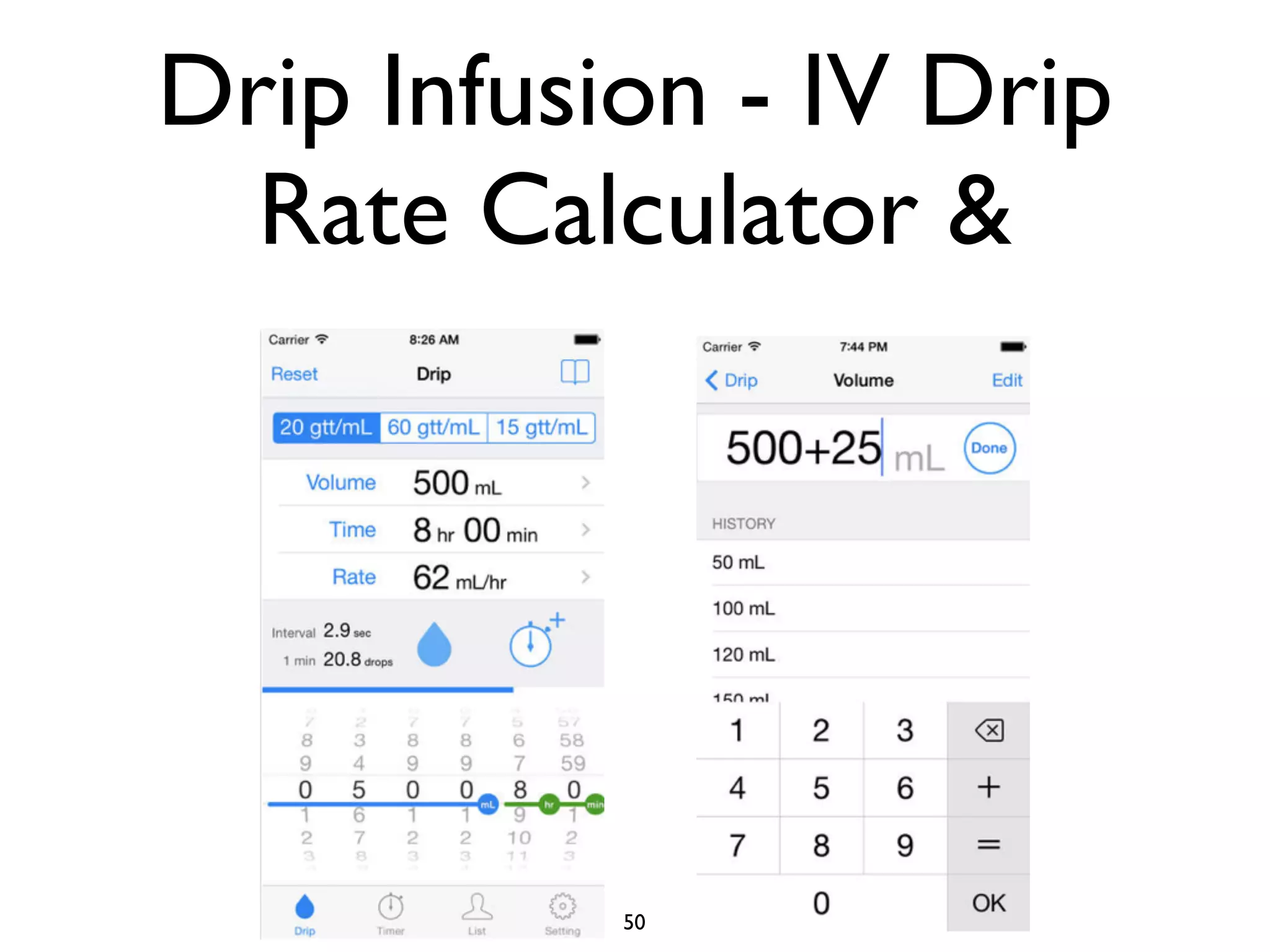
Drip Infusion - IV Drip 
Rate Calculator & 
50
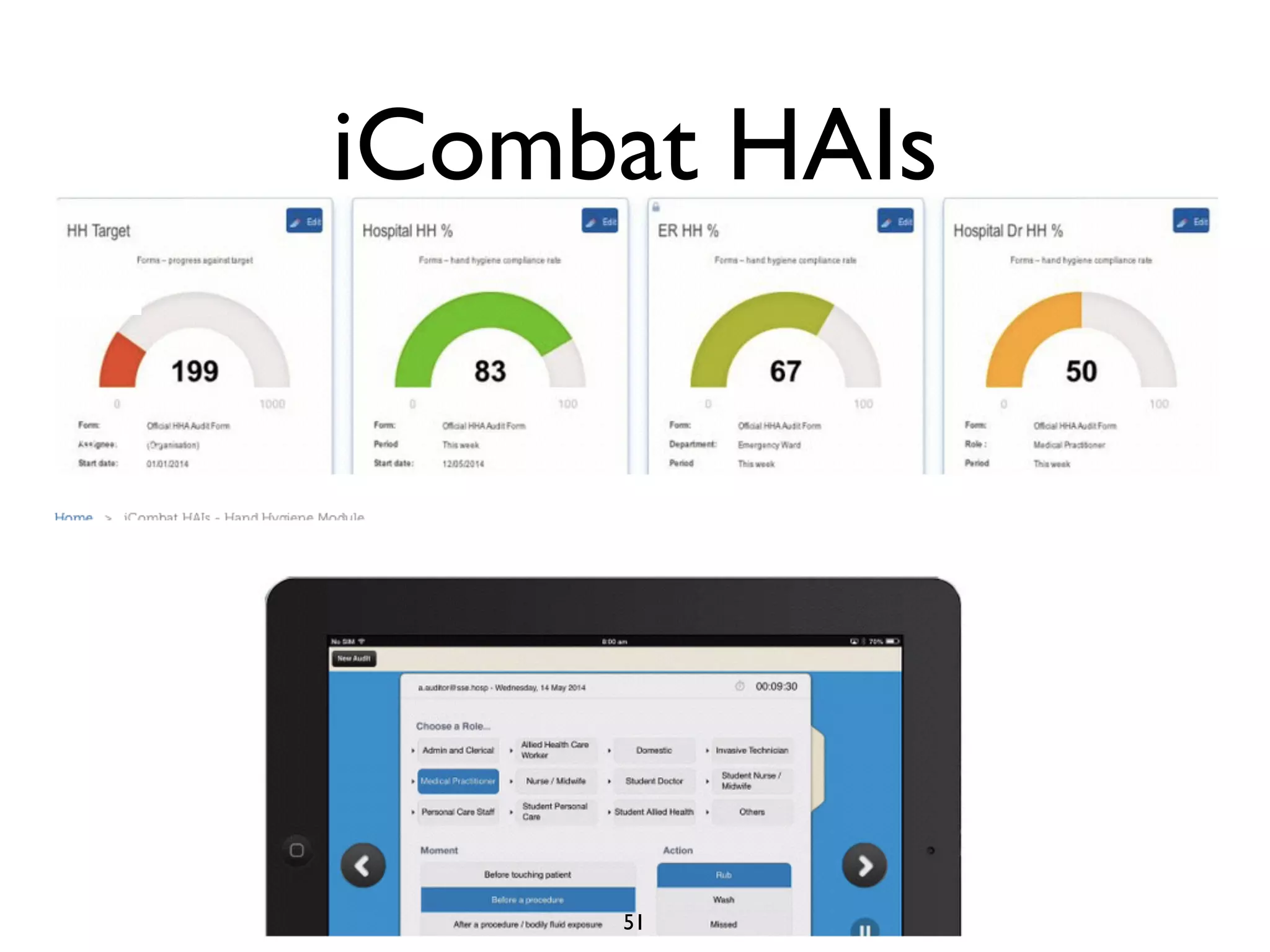
iCombat HAIs 
51
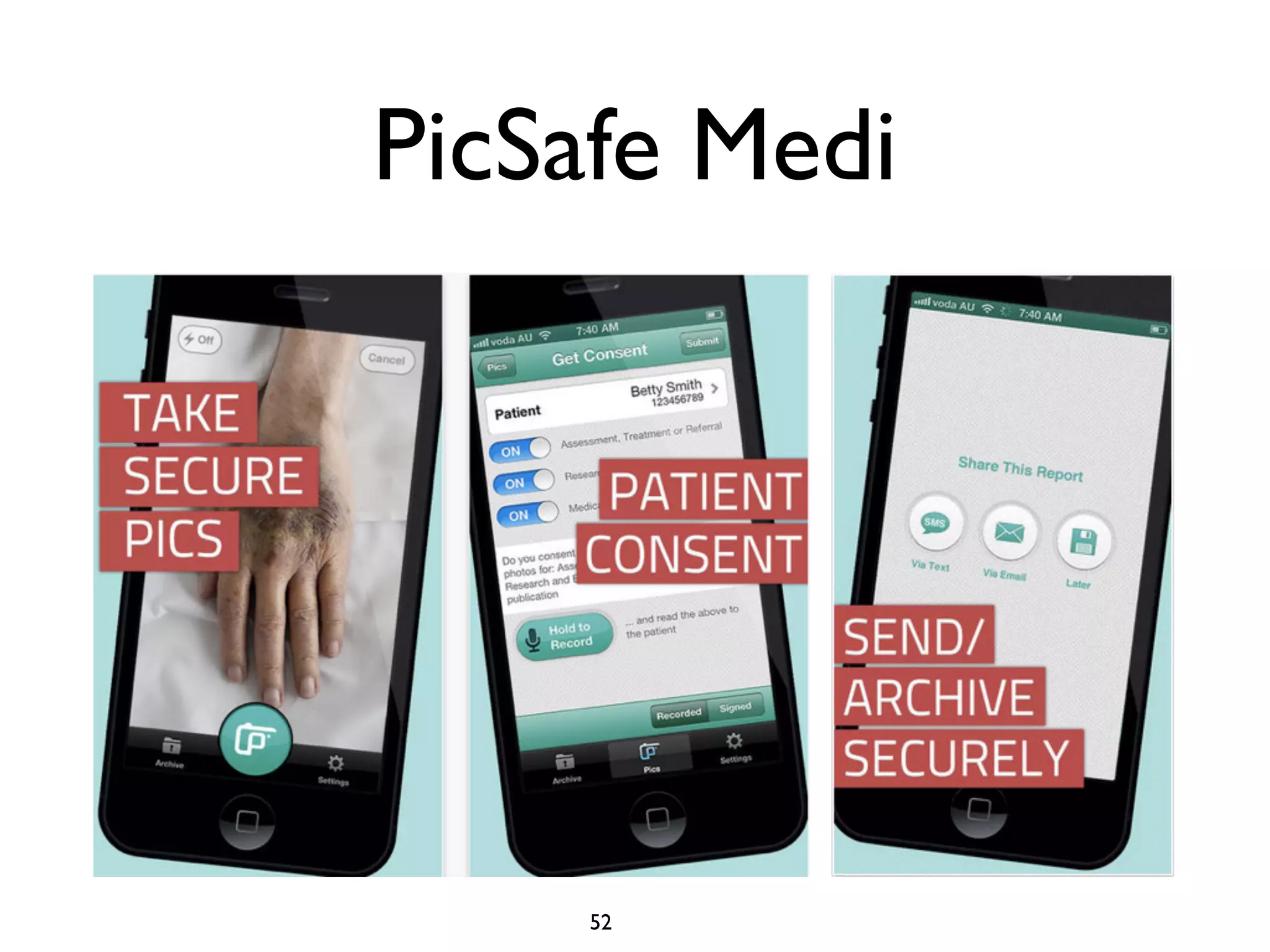
PicSafe Medi 
52
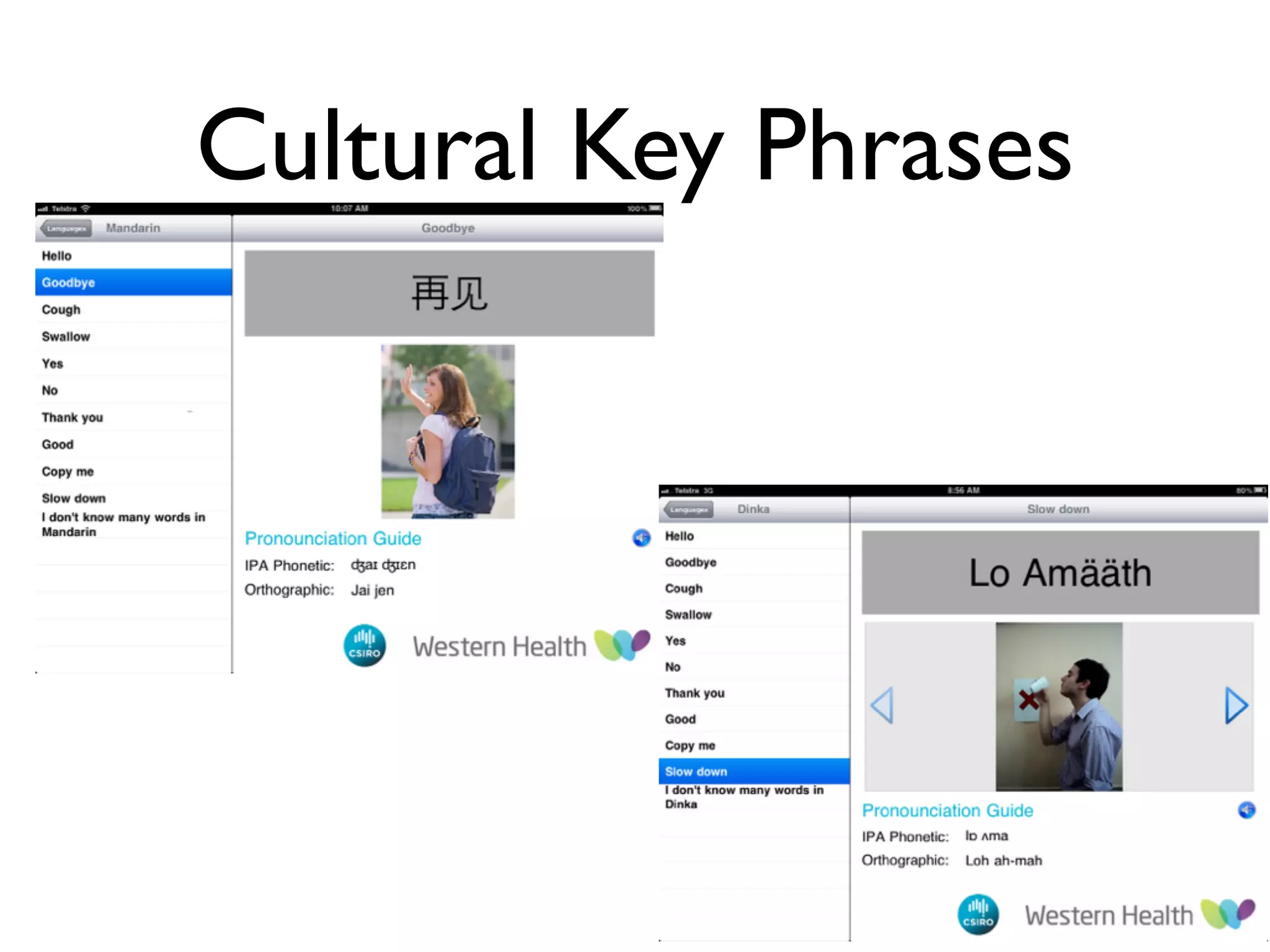
Cultural Key Phrases 
53
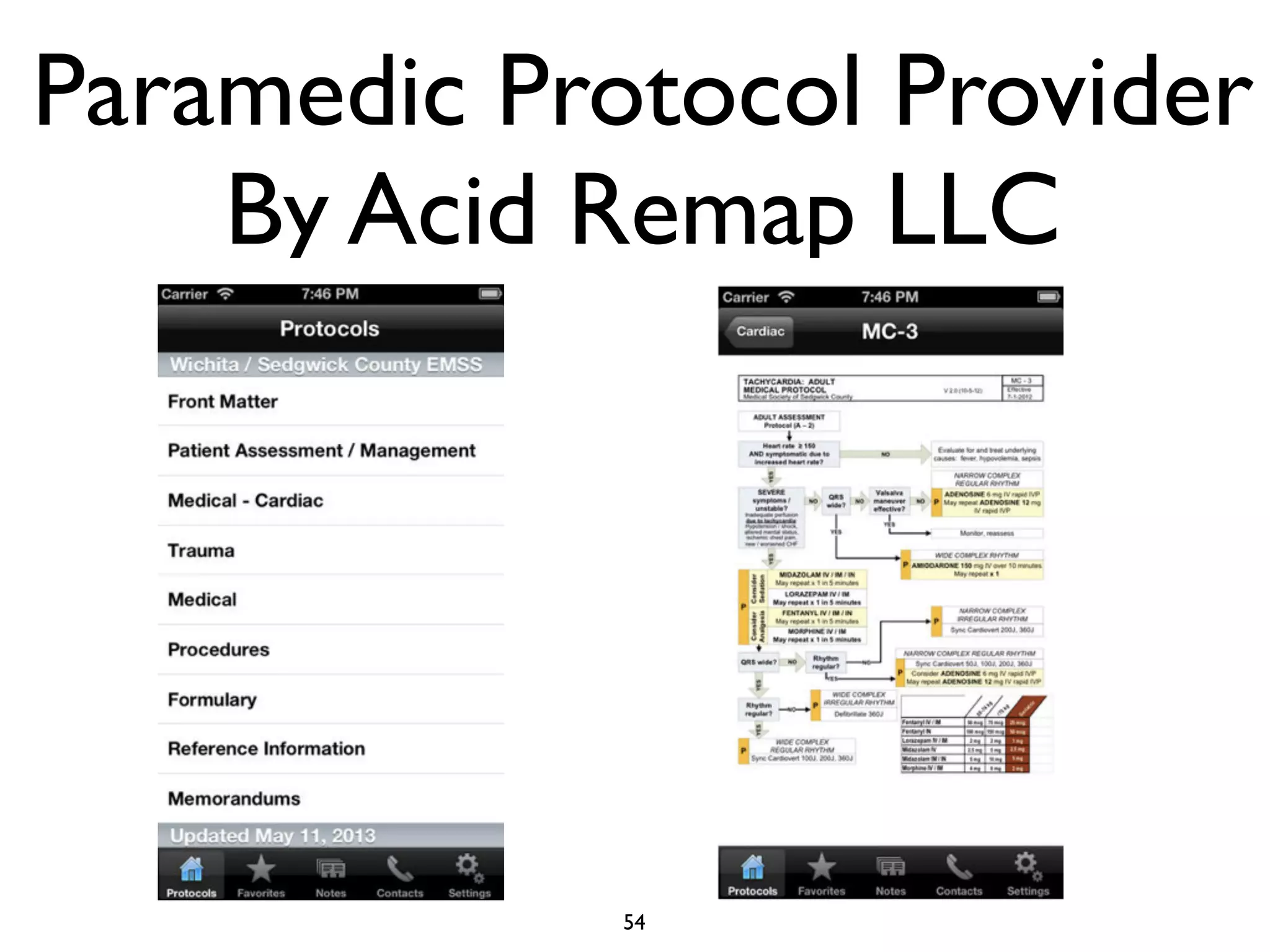
Paramedic Protocol Provider 
By Acid Remap LLC 
54
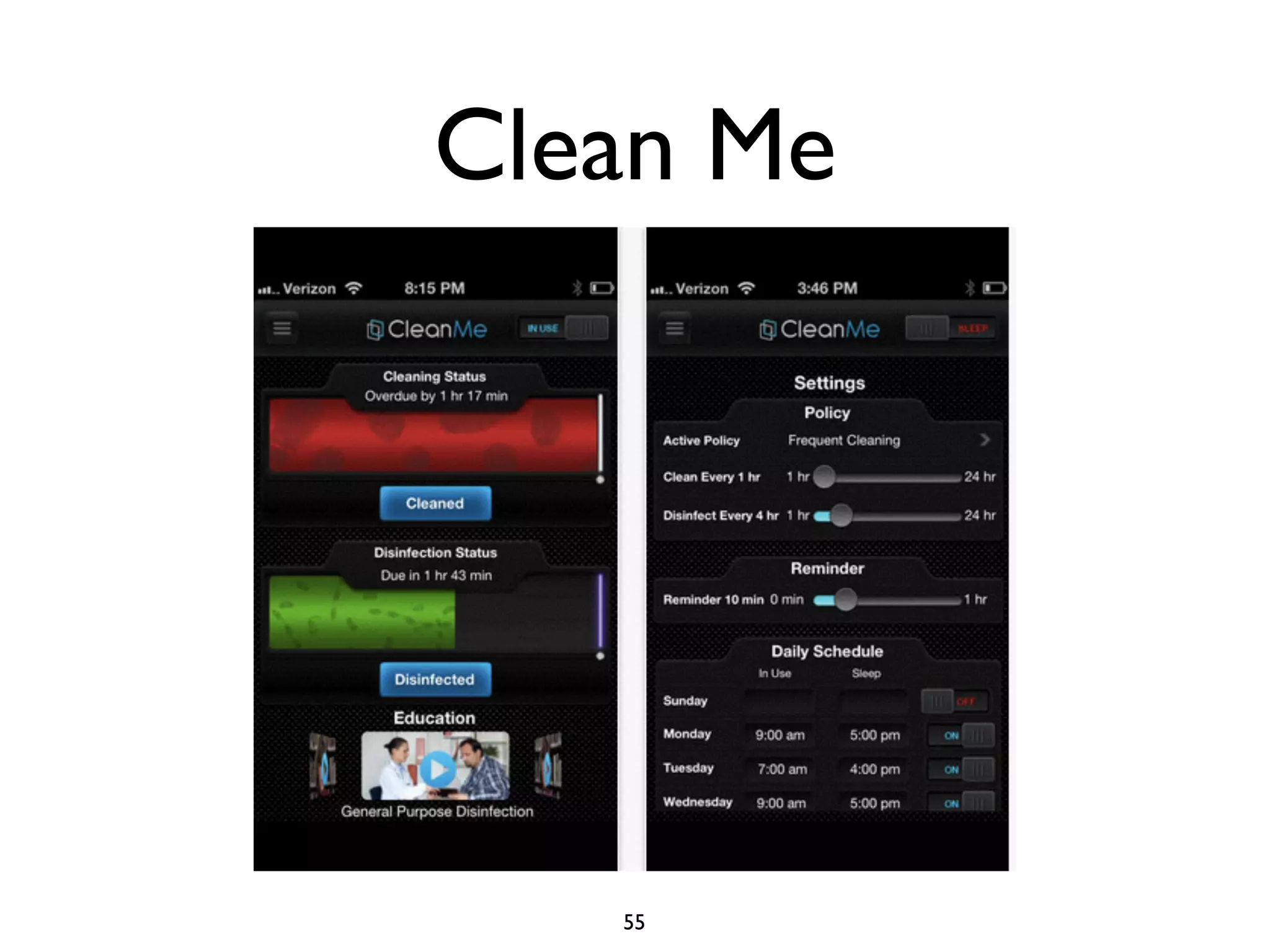
Clean Me 
55
mHealth for Patients 
56
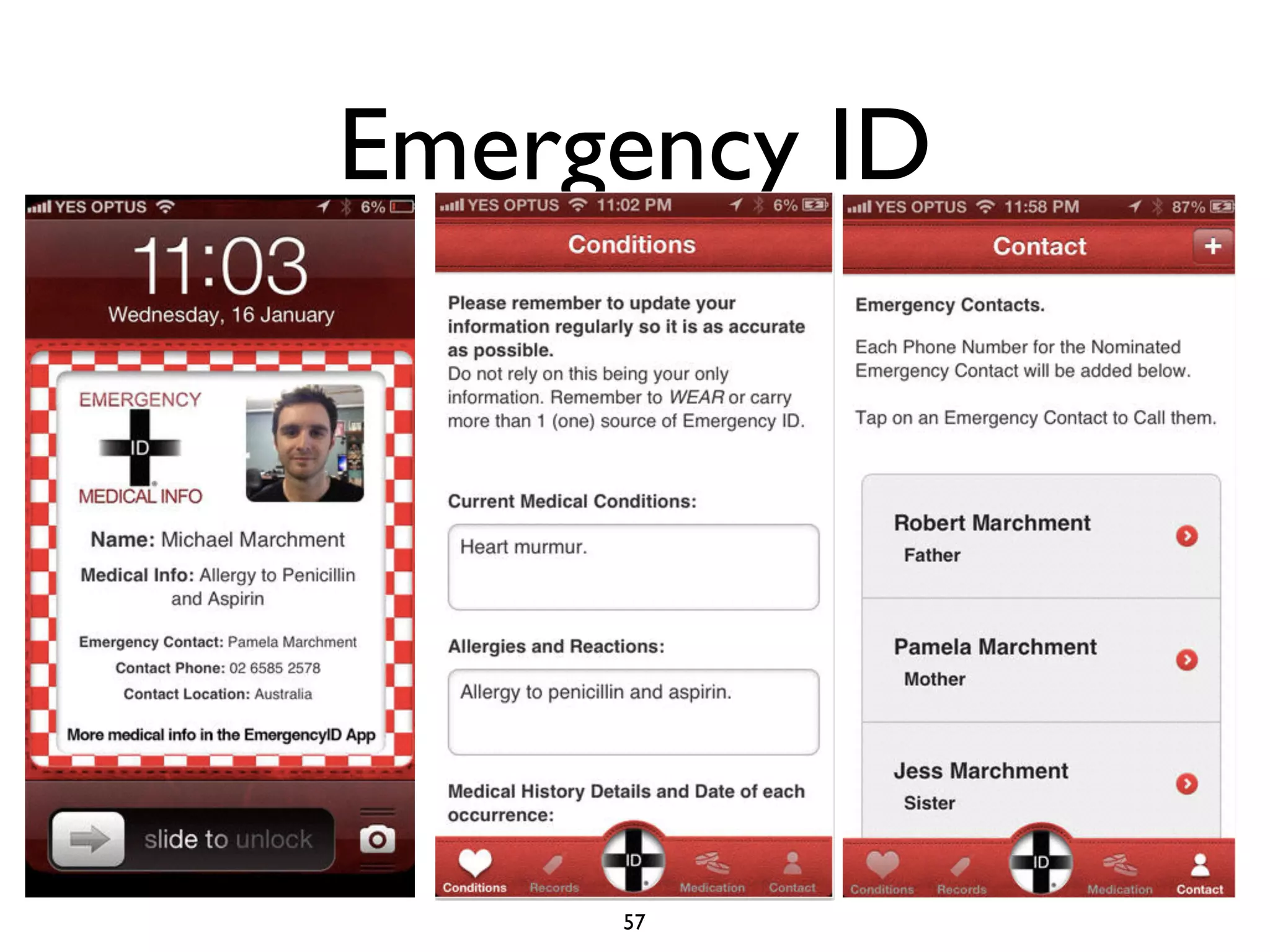
Emergency ID 
57
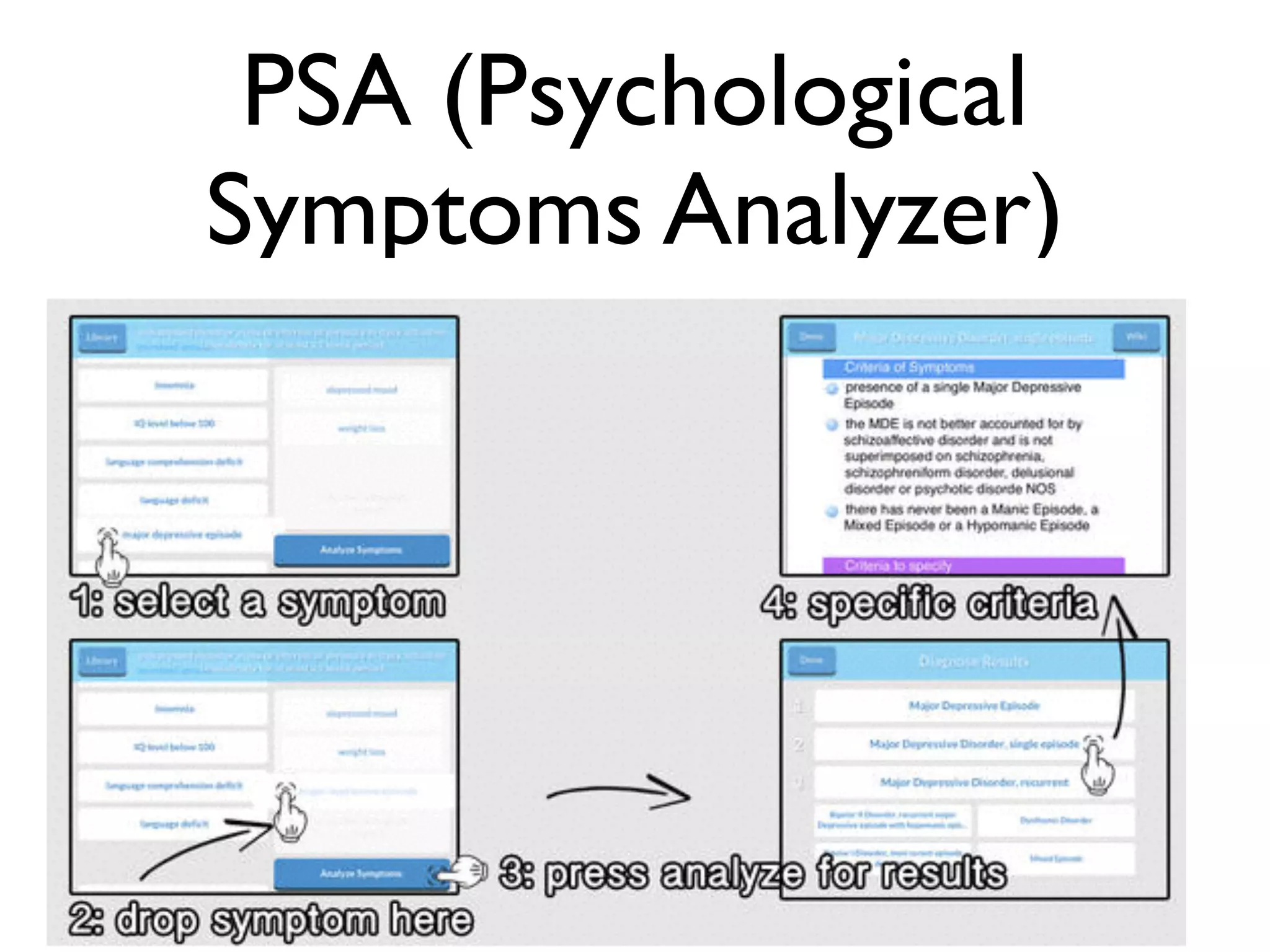
PSA (Psychological 
Symptoms Analyzer) 
58
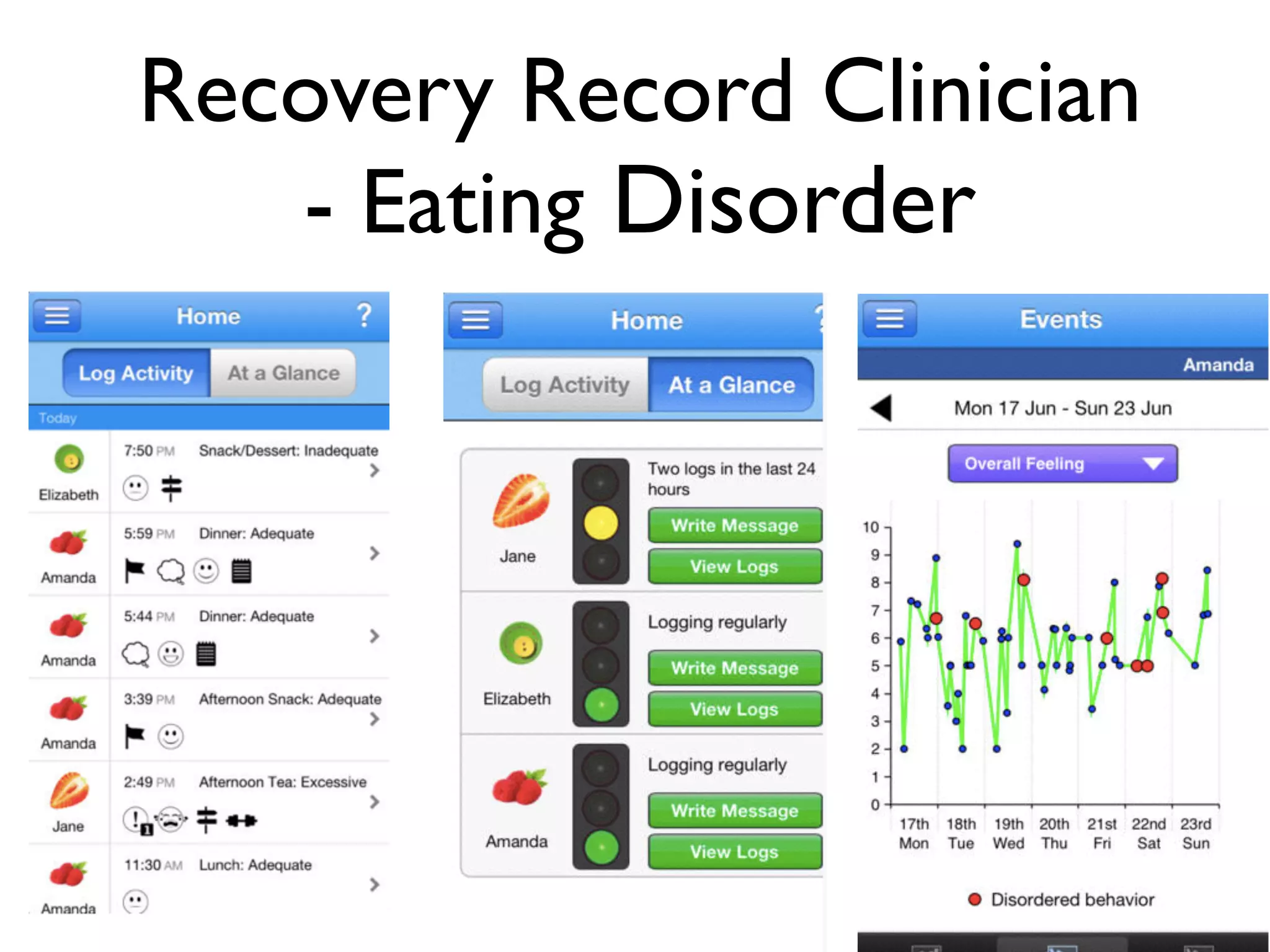
Recovery Record Clinician 
- Eating Disorder 
59
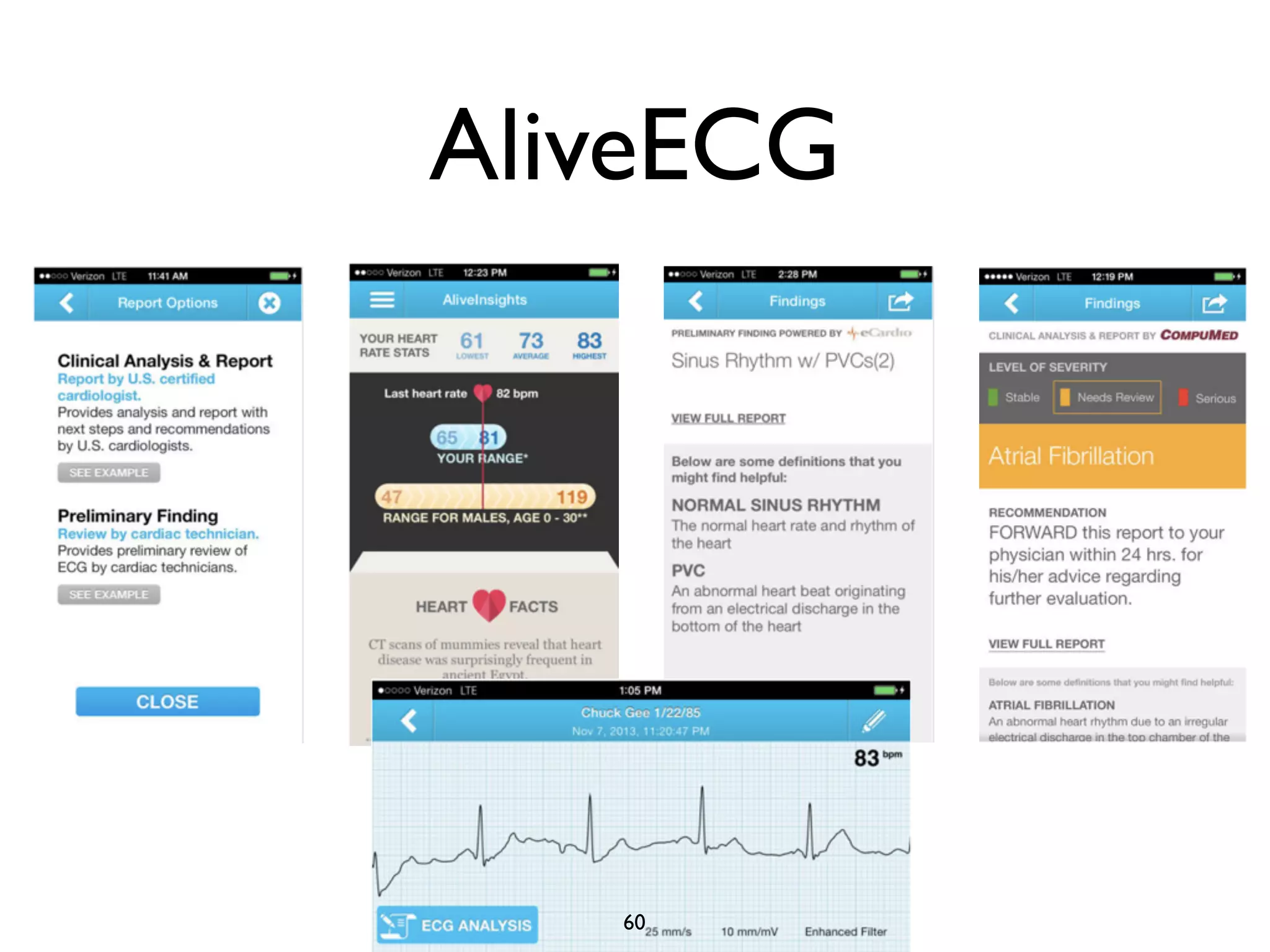
AliveECG 
60
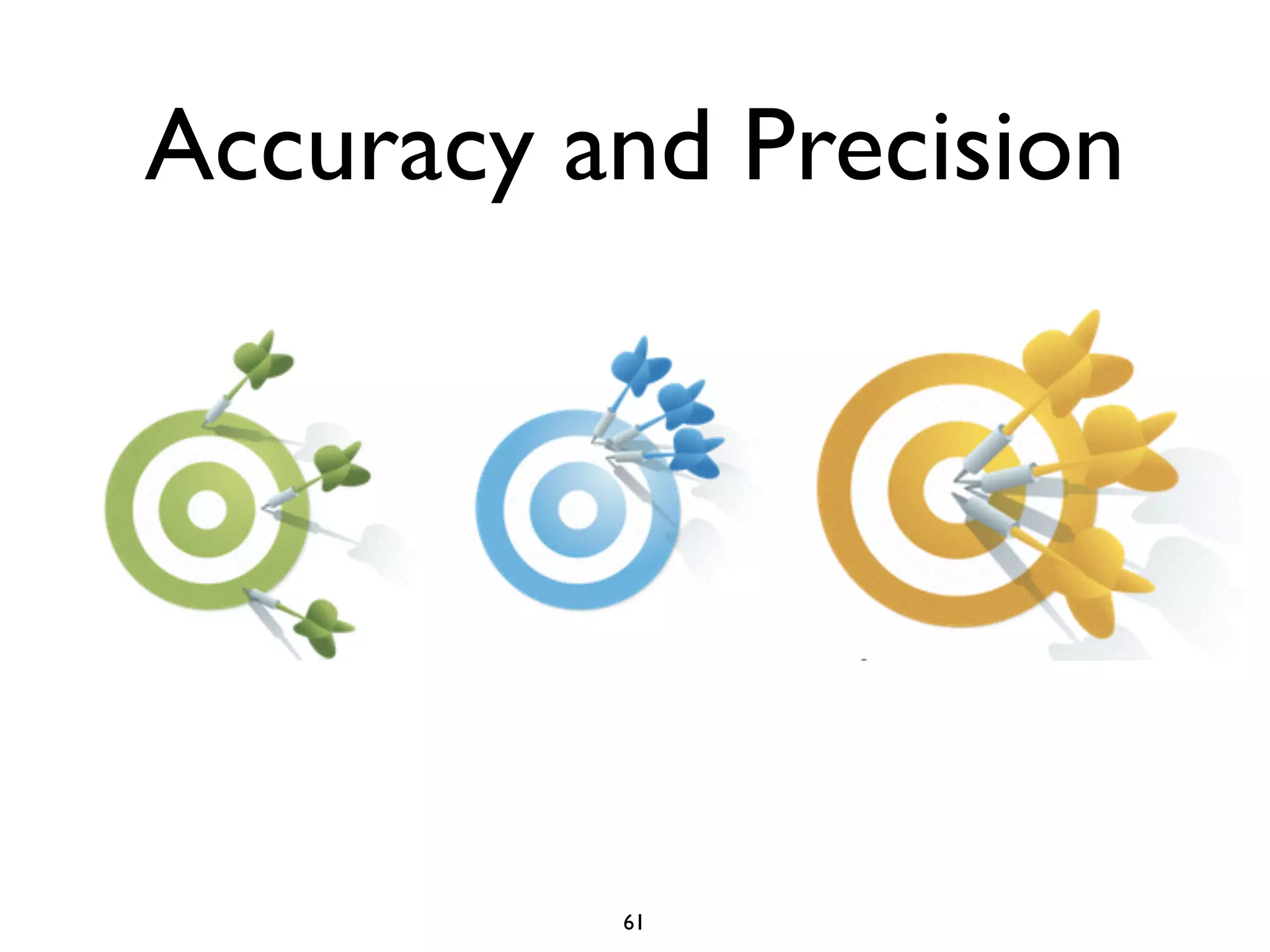
Accuracy and Precision 
61
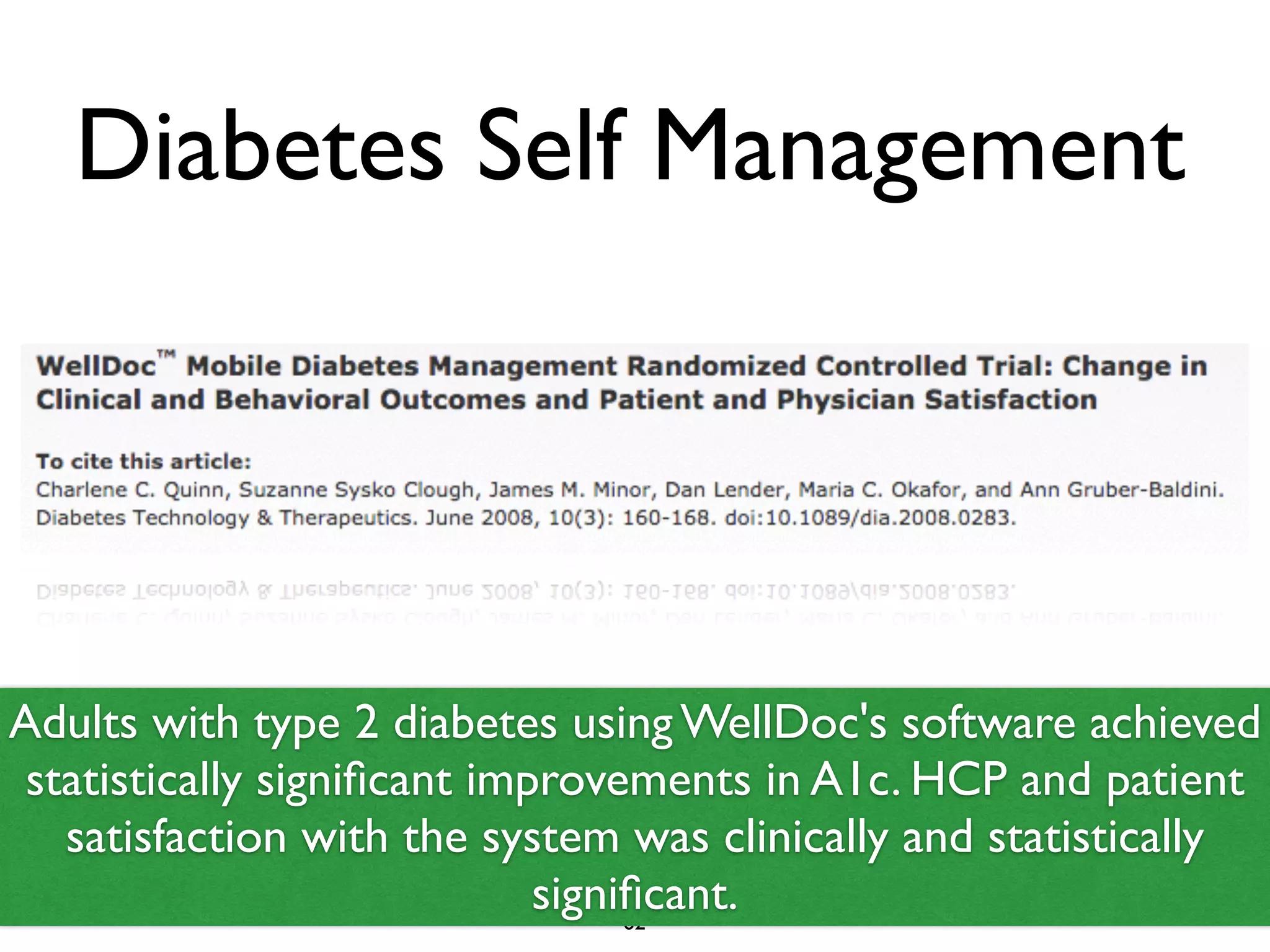
Diabetes Self Management 
Adults with type 2 diabetes using WellDoc's software achieved 
statistically significant improvements in A1c. HCP and patient 
satisfaction with the system was clinically and statistically 
significant. 
62
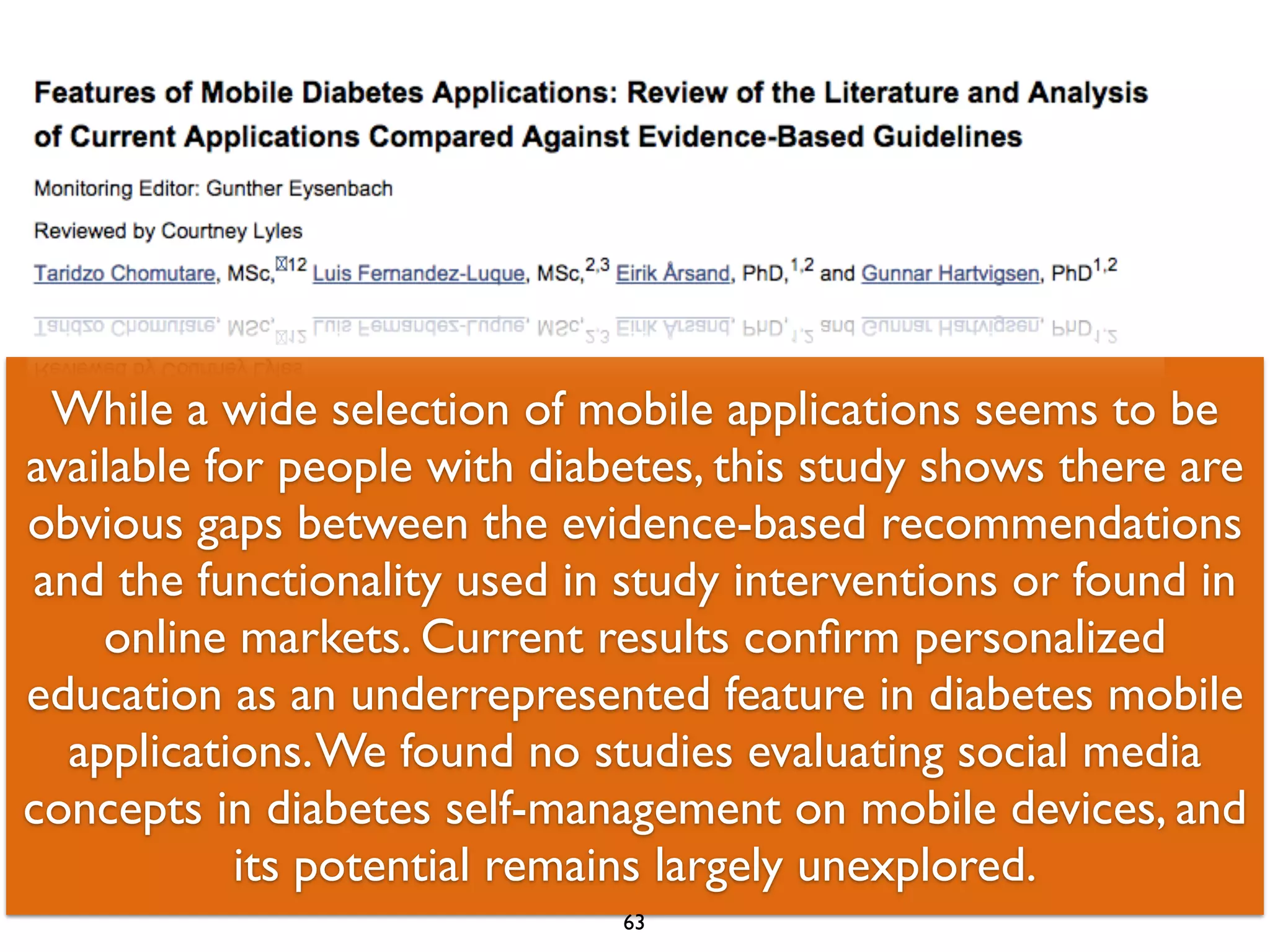
While a wide selection of mobile applications seems to be 
available for people with diabetes, this study shows there are 
obvious gaps between the evidence-based recommendations 
and the functionality used in study interventions or found in 
online markets. Current results confirm personalized 
education as an underrepresented feature in diabetes mobile 
applications. We found no studies evaluating social media 
concepts in diabetes self-management on mobile devices, and 
its potential remains largely unexplored. 
63
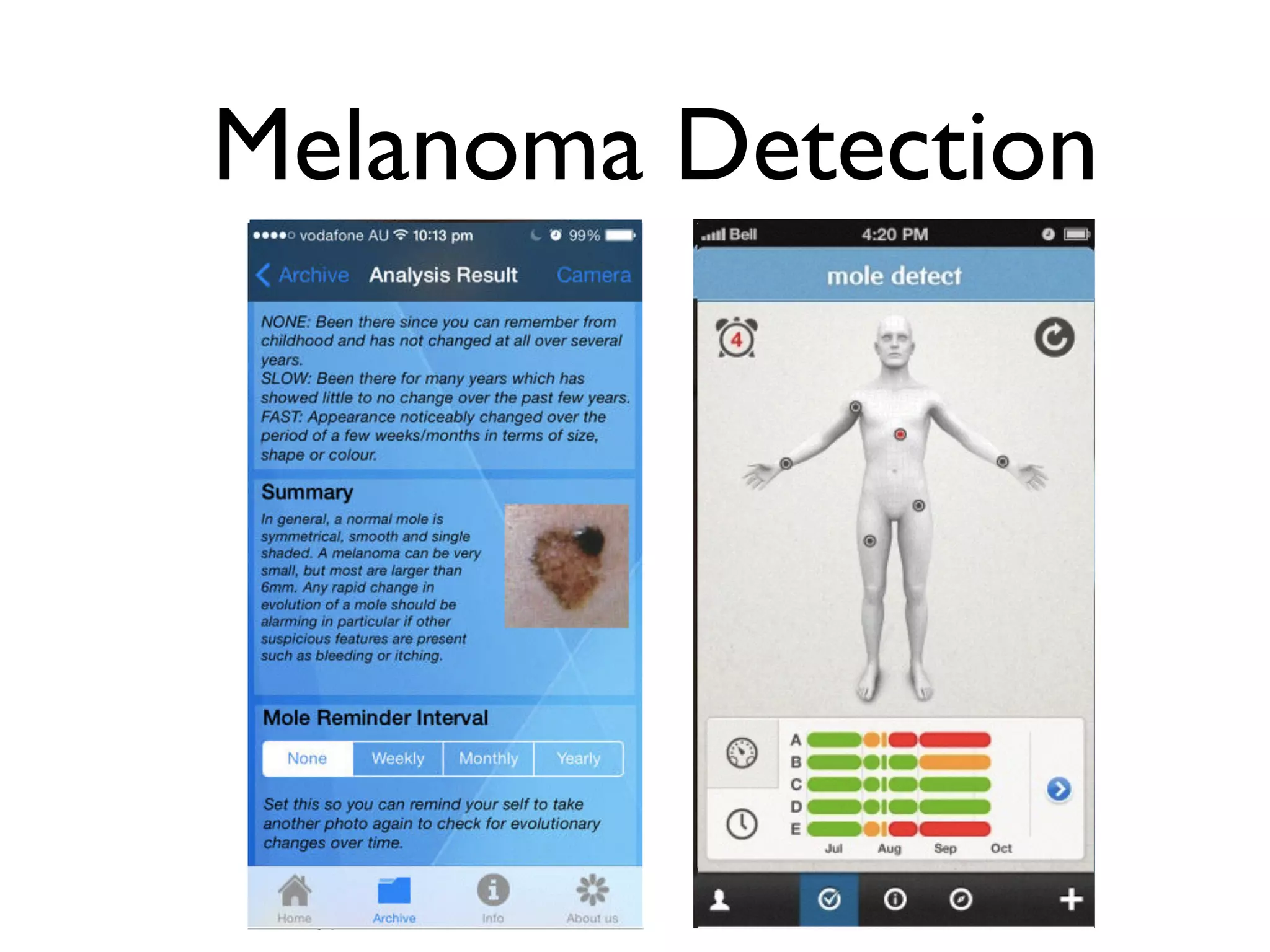
Melanoma Detection 
64
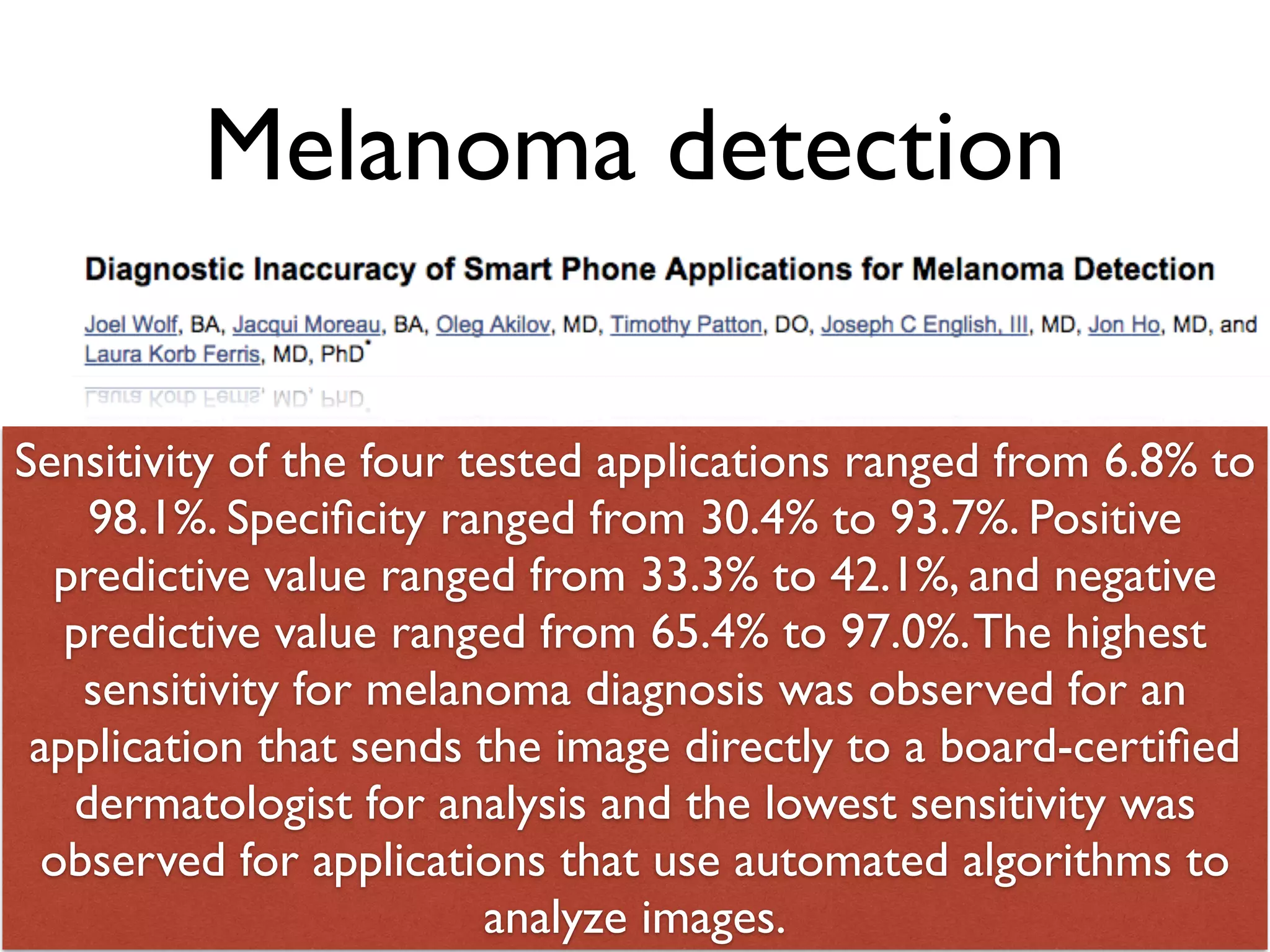
Melanoma detection 
Sensitivity of the four tested applications ranged from 6.8% to 
98.1%. Specificity ranged from 30.4% to 93.7%. Positive 
predictive value ranged from 33.3% to 42.1%, and negative 
predictive value ranged from 65.4% to 97.0%. The highest 
sensitivity for melanoma diagnosis was observed for an 
application that sends the image directly to a board-certified 
dermatologist for analysis and the lowest sensitivity was 
observed for applications that use automated algorithms to 
analyze 65 
images.
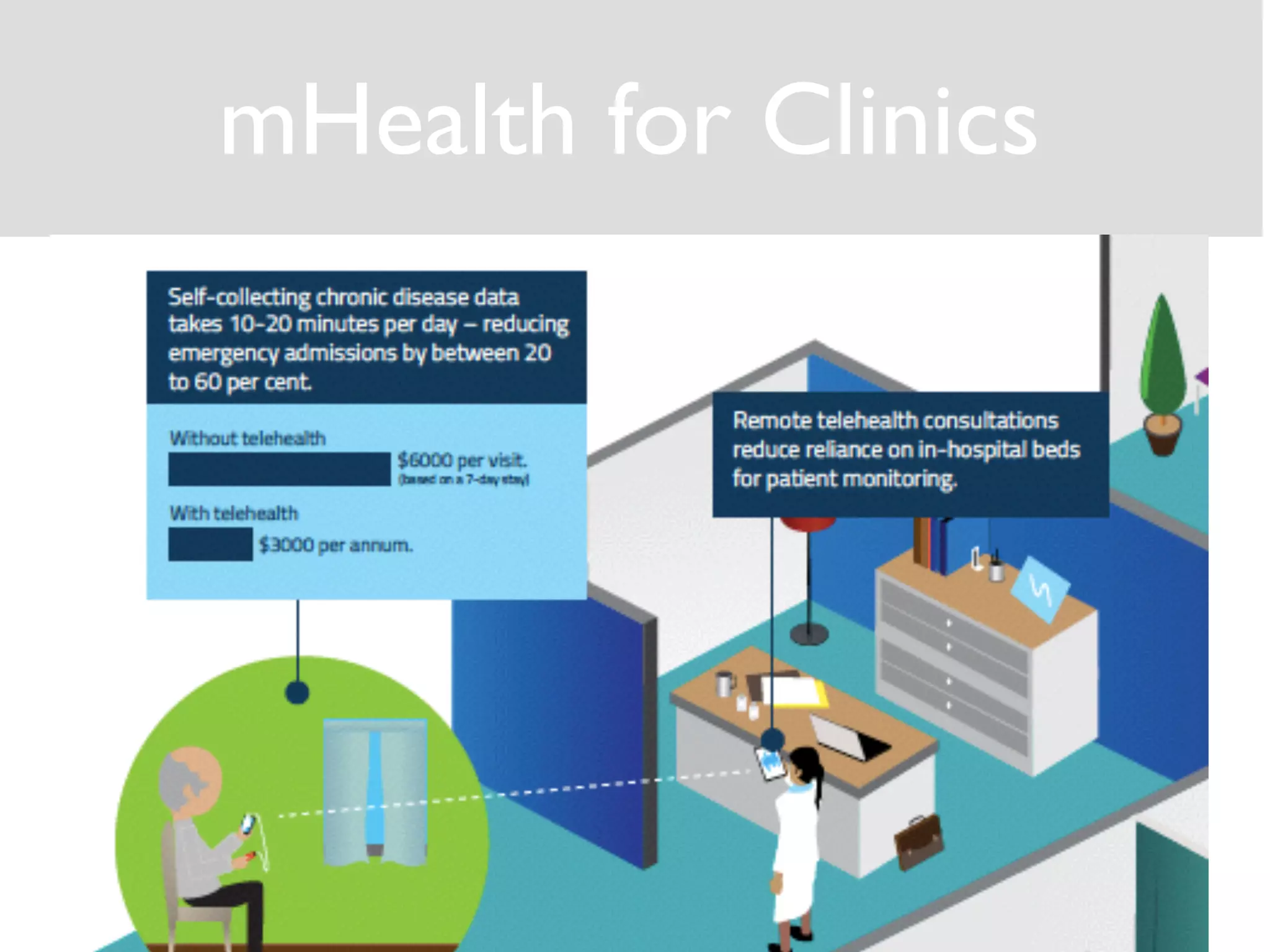
mHealth for Clinics 
66
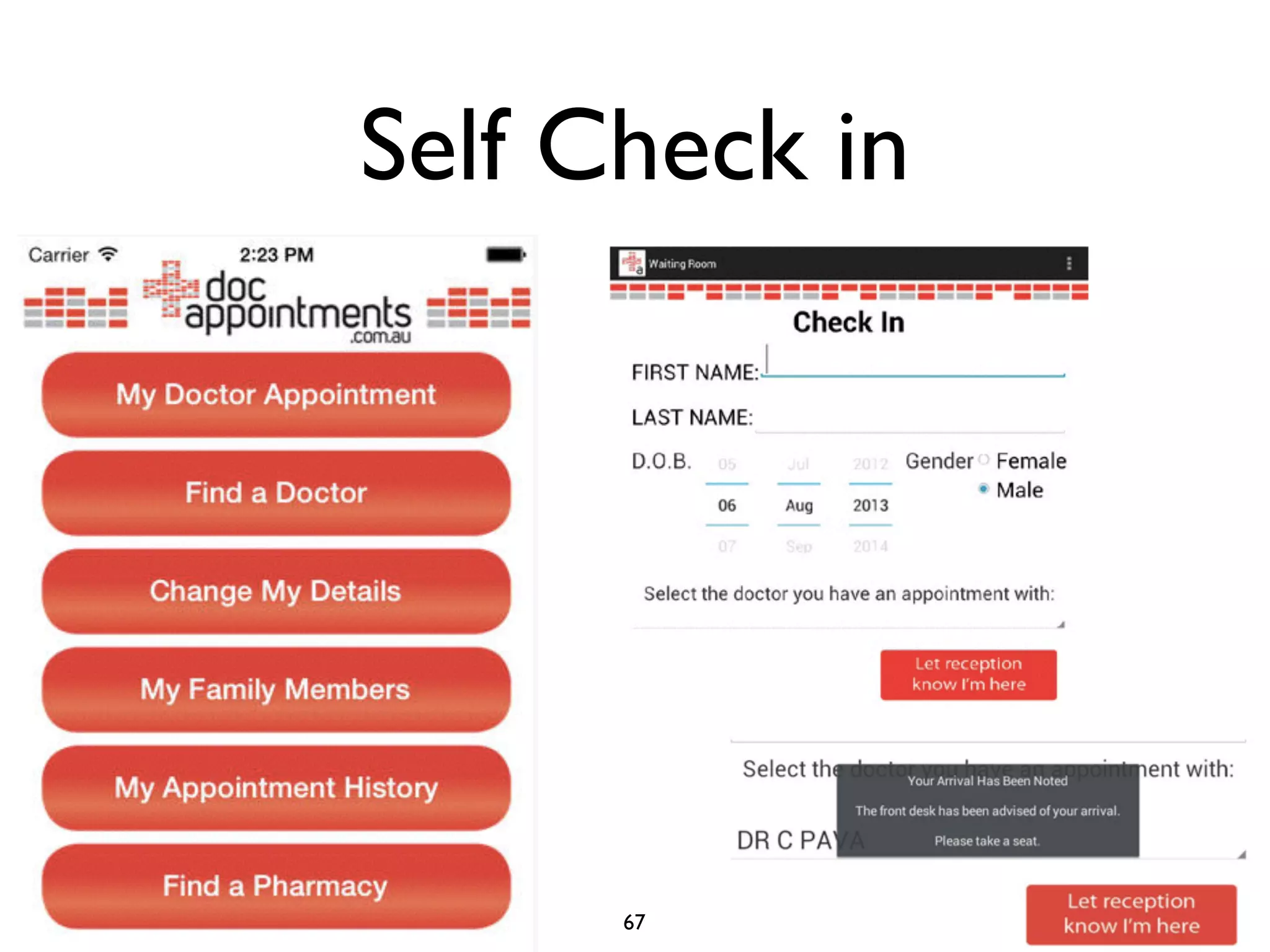
Self Check in 
67
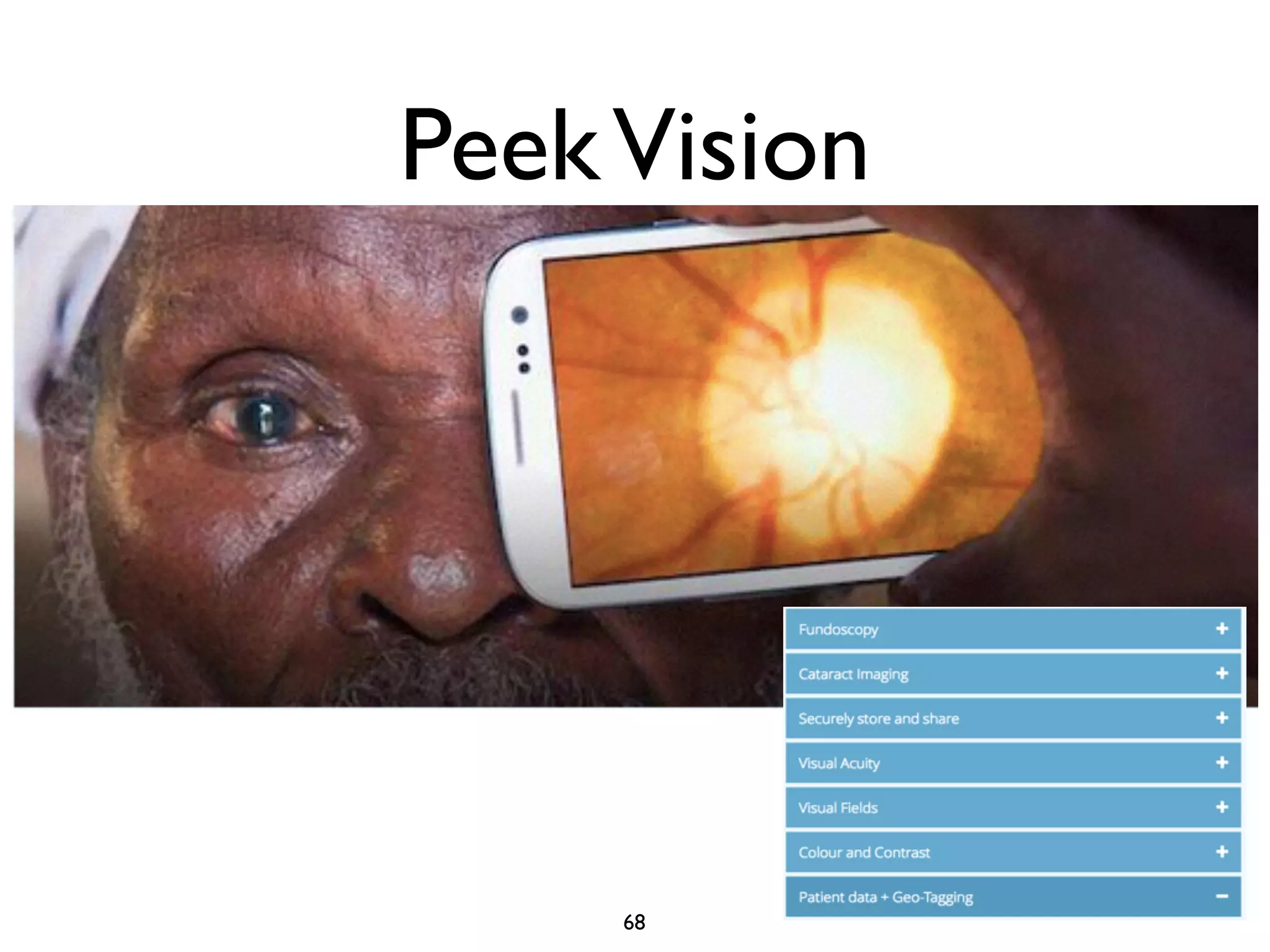
Peek Vision 
68
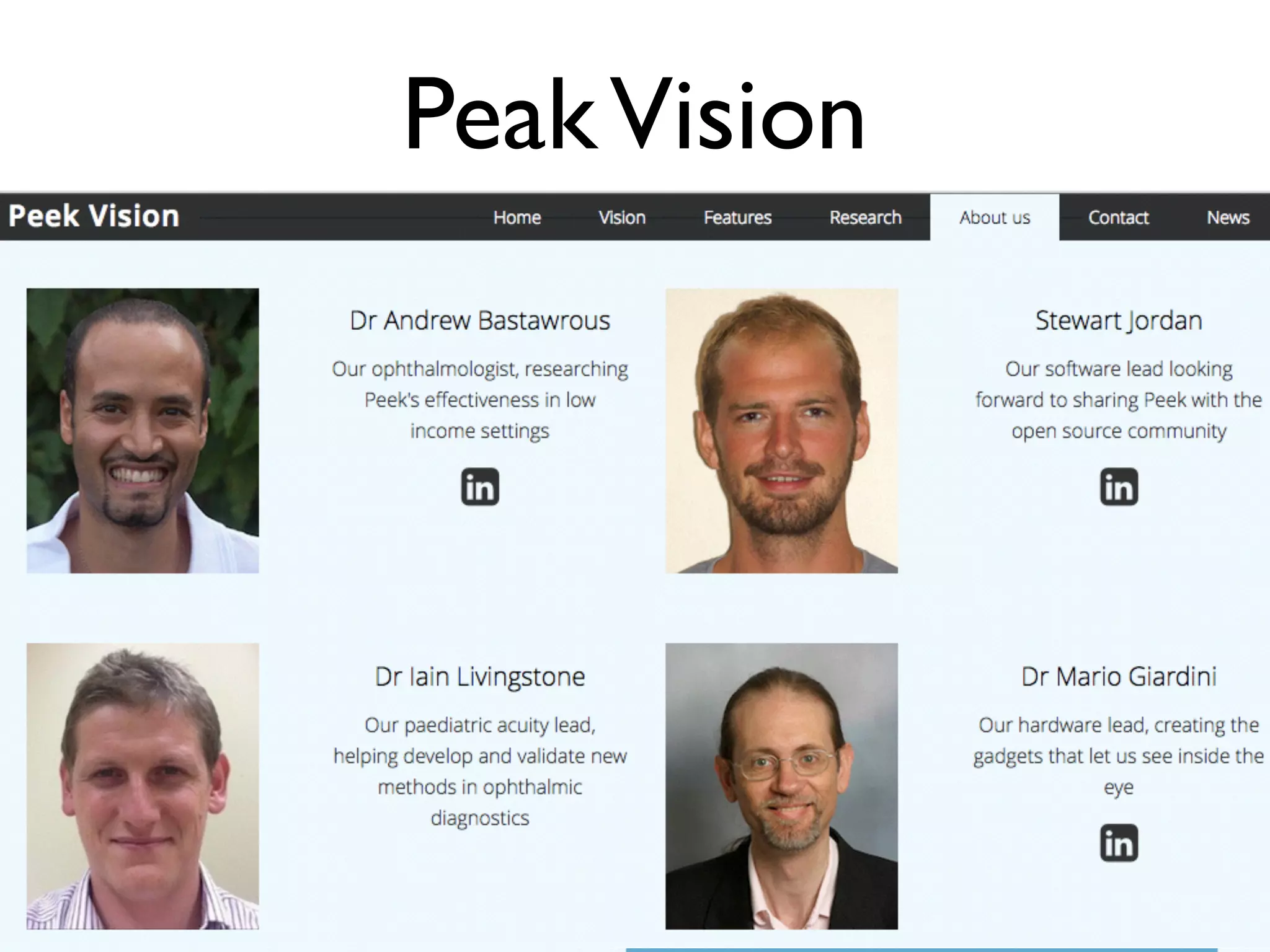
Peak Vision 
69
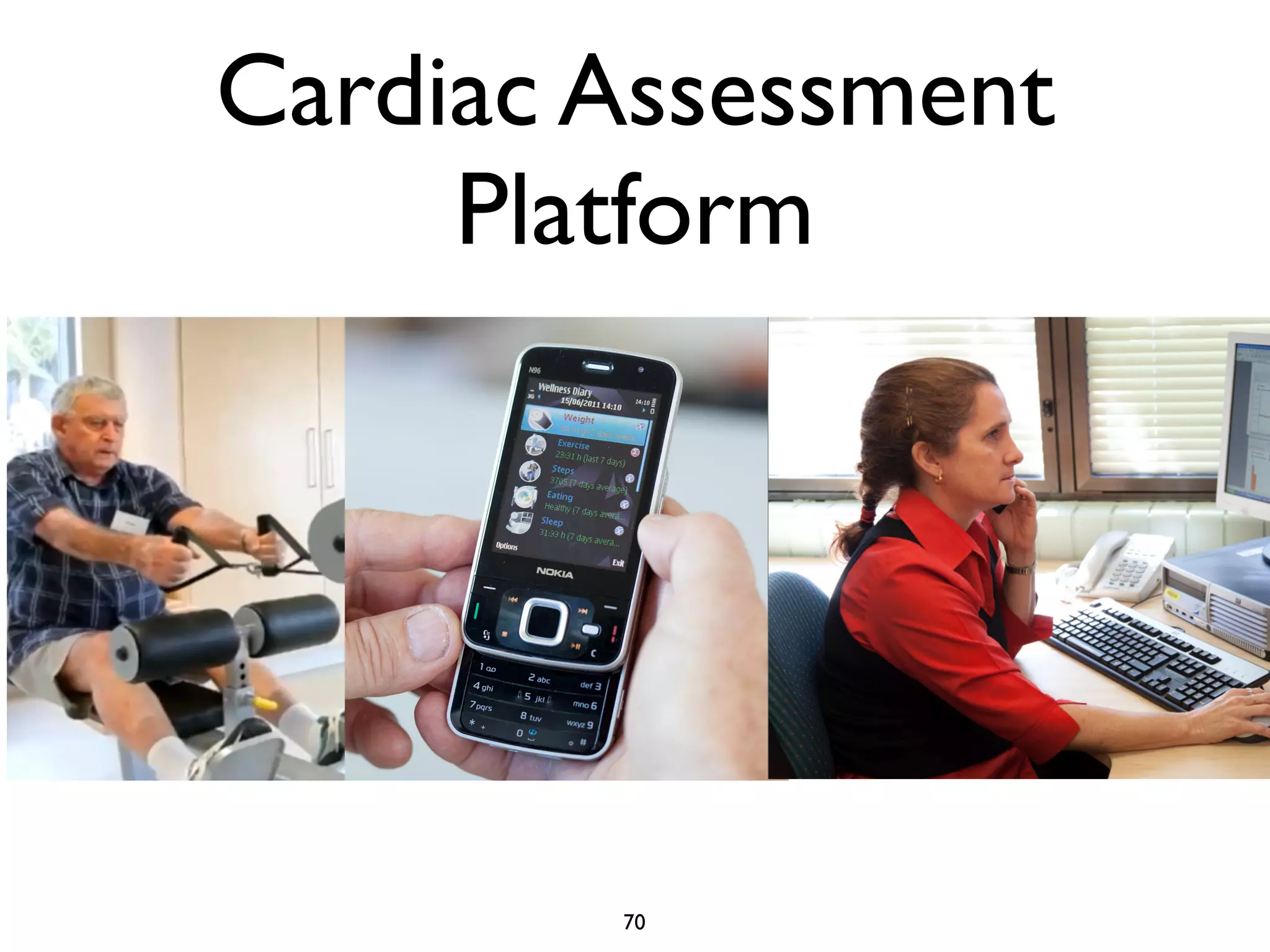
Cardiac Assessment 
Platform 
70
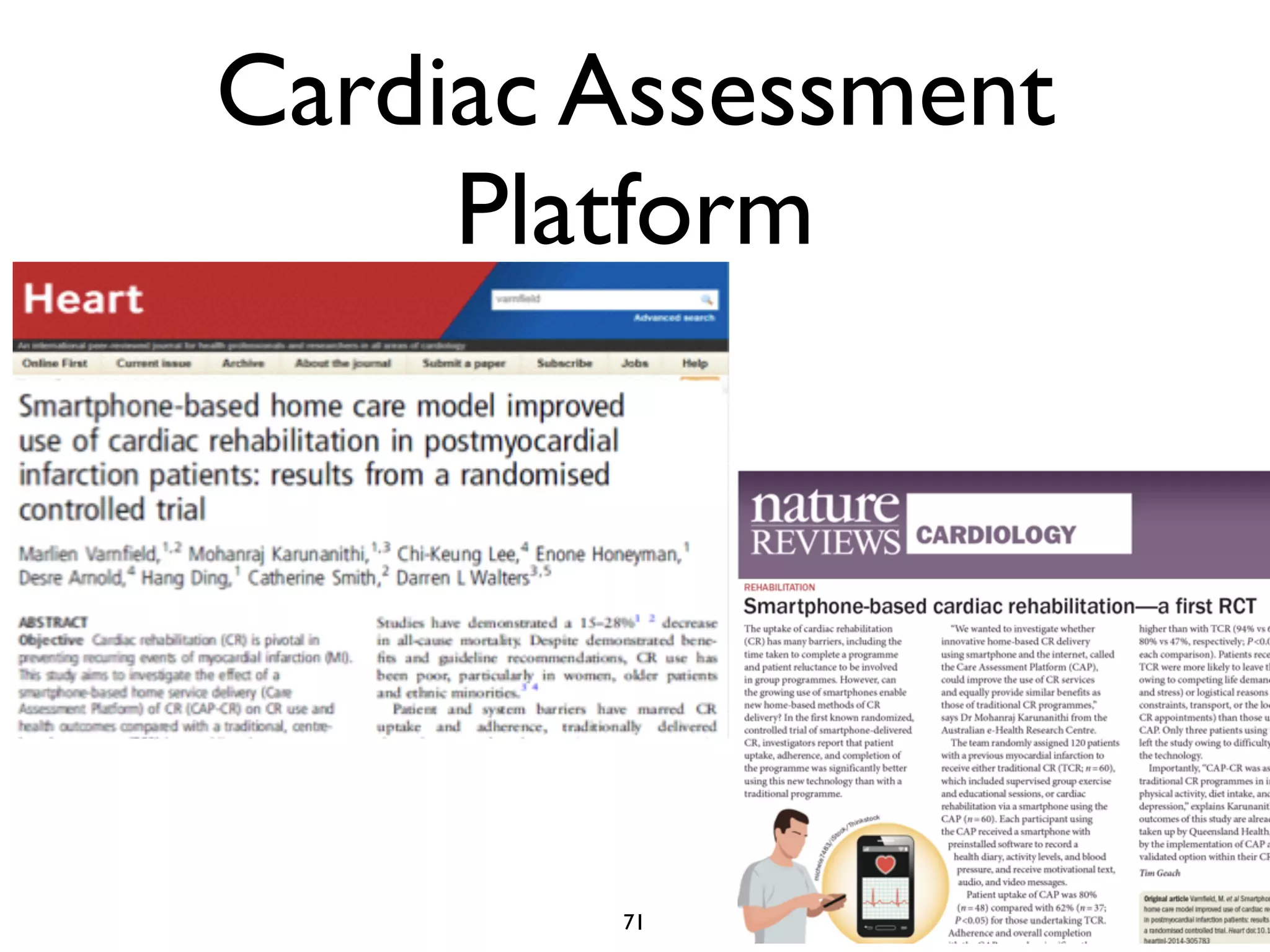
Cardiac Assessment 
Platform 
71
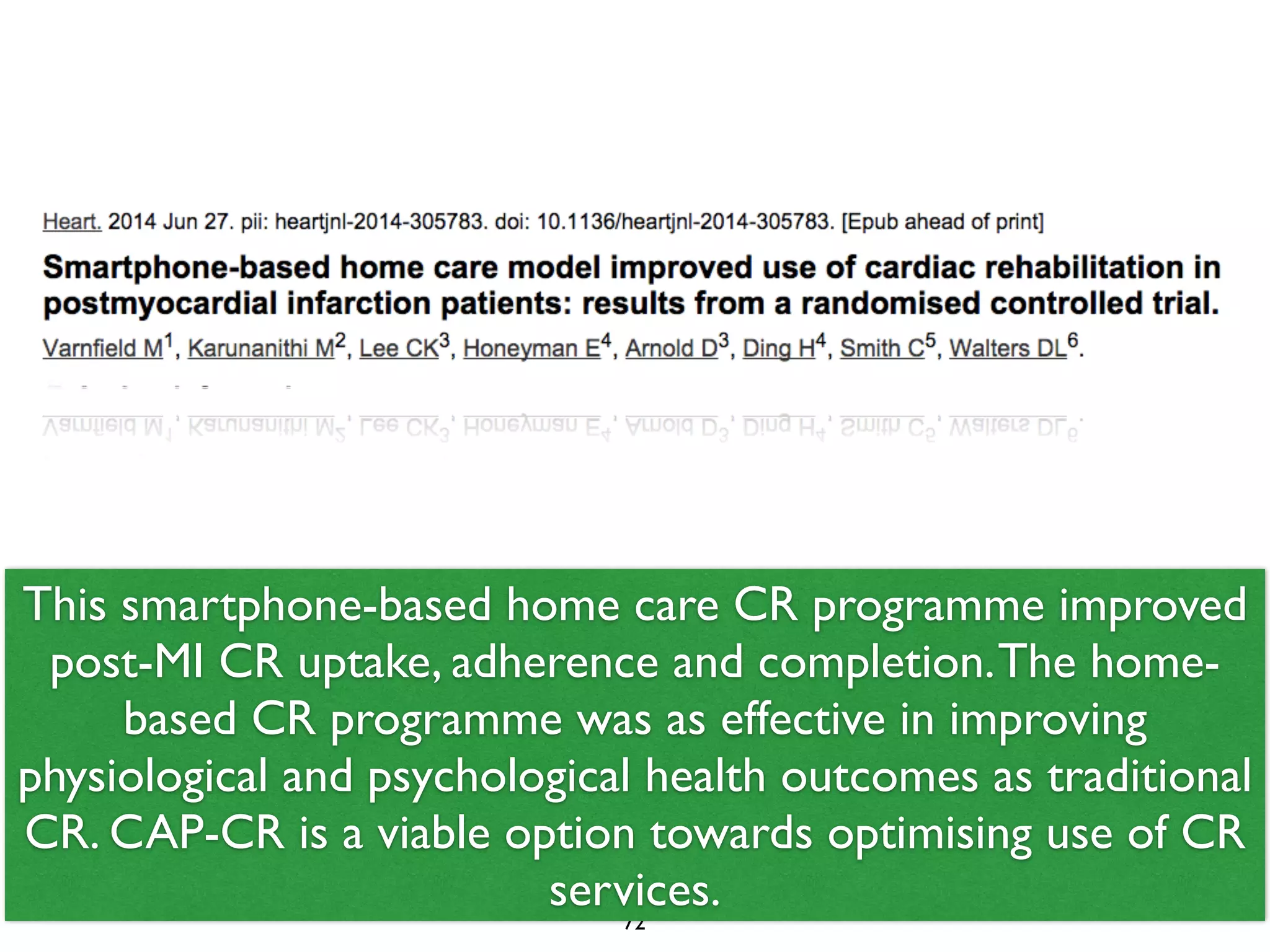
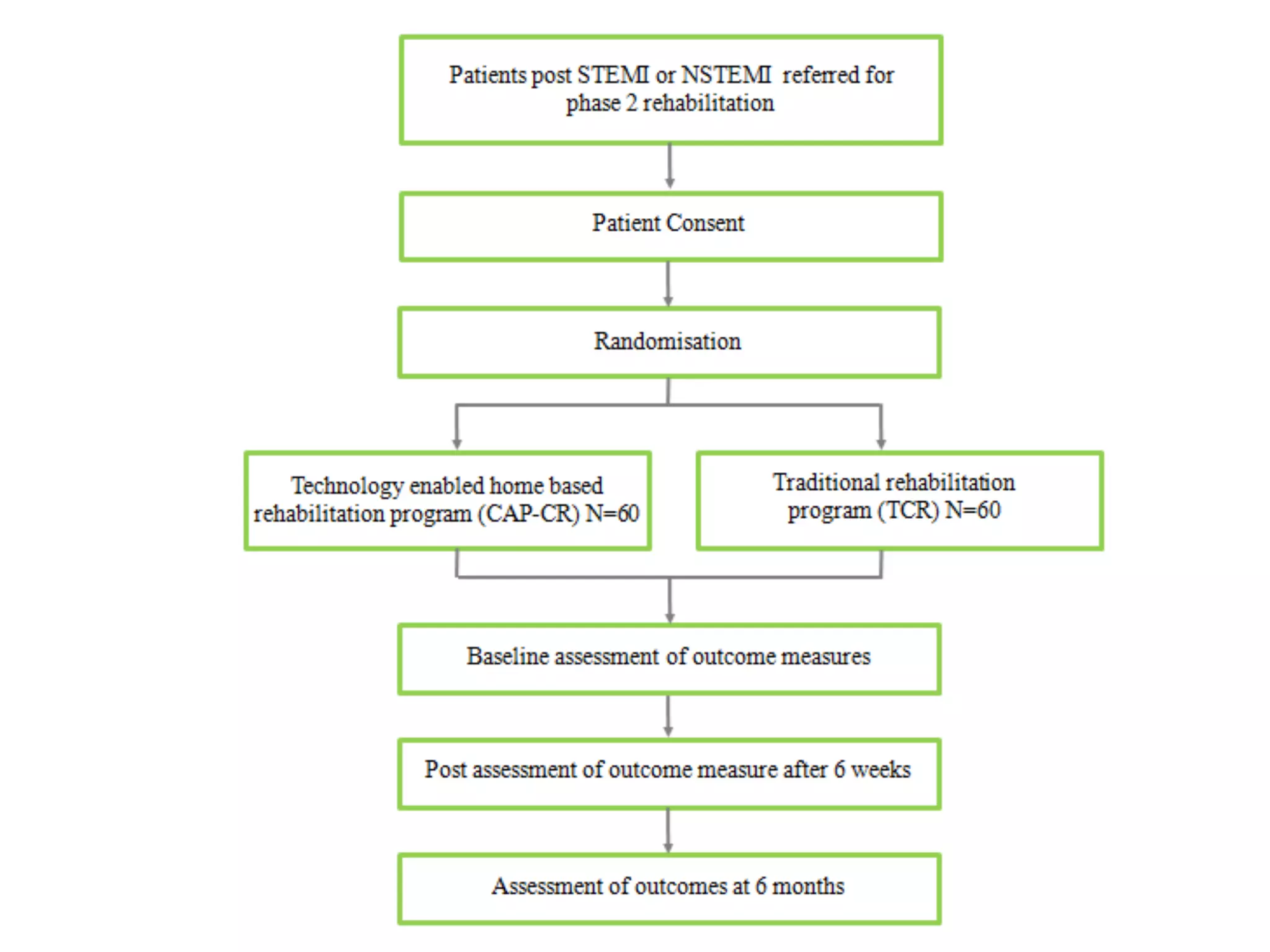
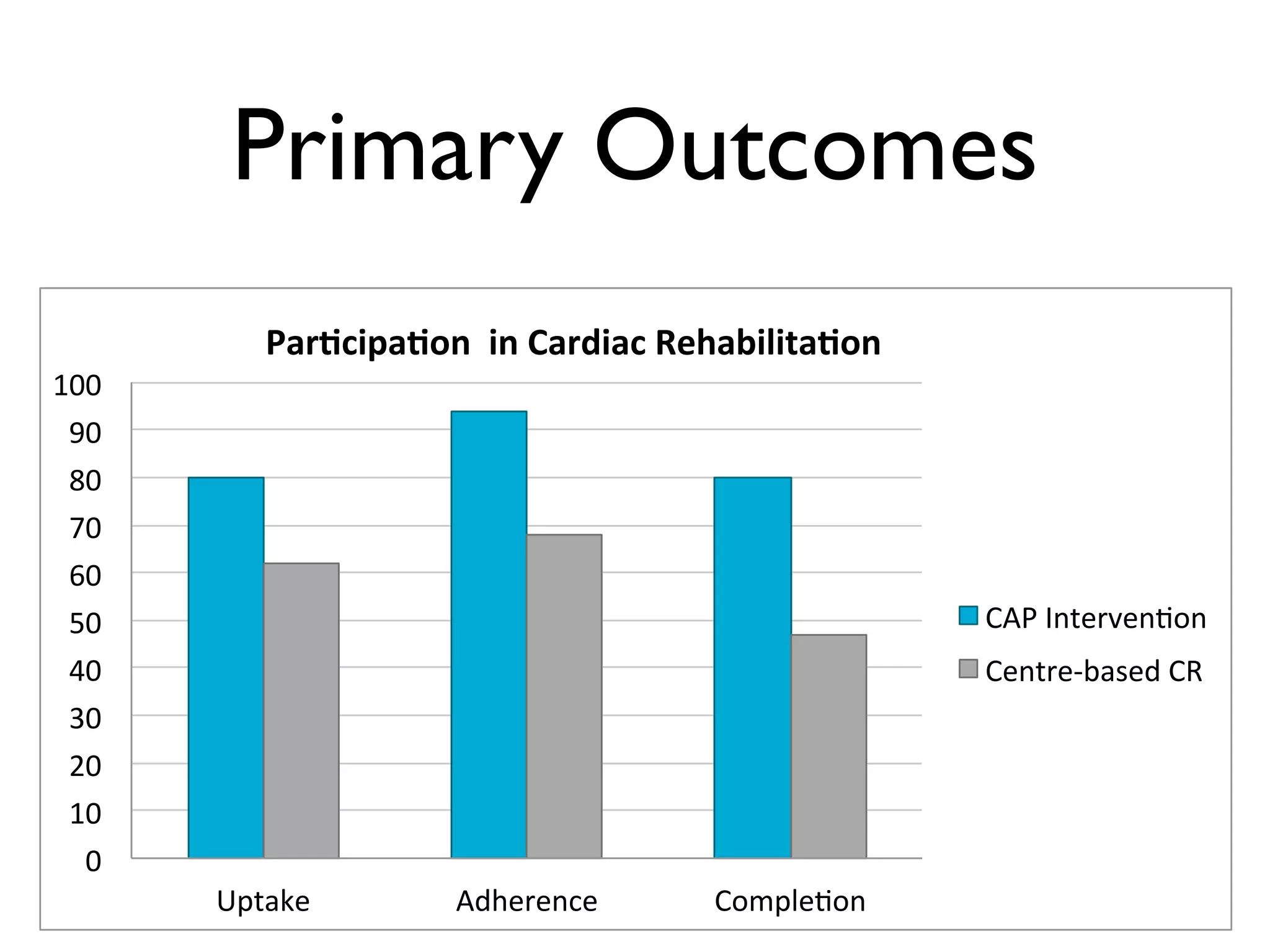
This smartphone-based home care CR programme improved 
post-MI CR uptake, adherence and completion. The home-based 
CR programme was as effective in improving 
physiological and psychological health outcomes as traditional 
CR. CAP-CR is a viable option towards optimising use of CR 
services. 
72
73
Primary Outcomes 
Par$cipa$on**in*Cardiac*Rehabilita$on* 
74 
100" 
90" 
80" 
70" 
60" 
50" 
40" 
30" 
20" 
10" 
0" 
Uptake" Adherence" Comple<on" 
CAP"Interven<on" 
Centre@based"CR"
iMims 
75
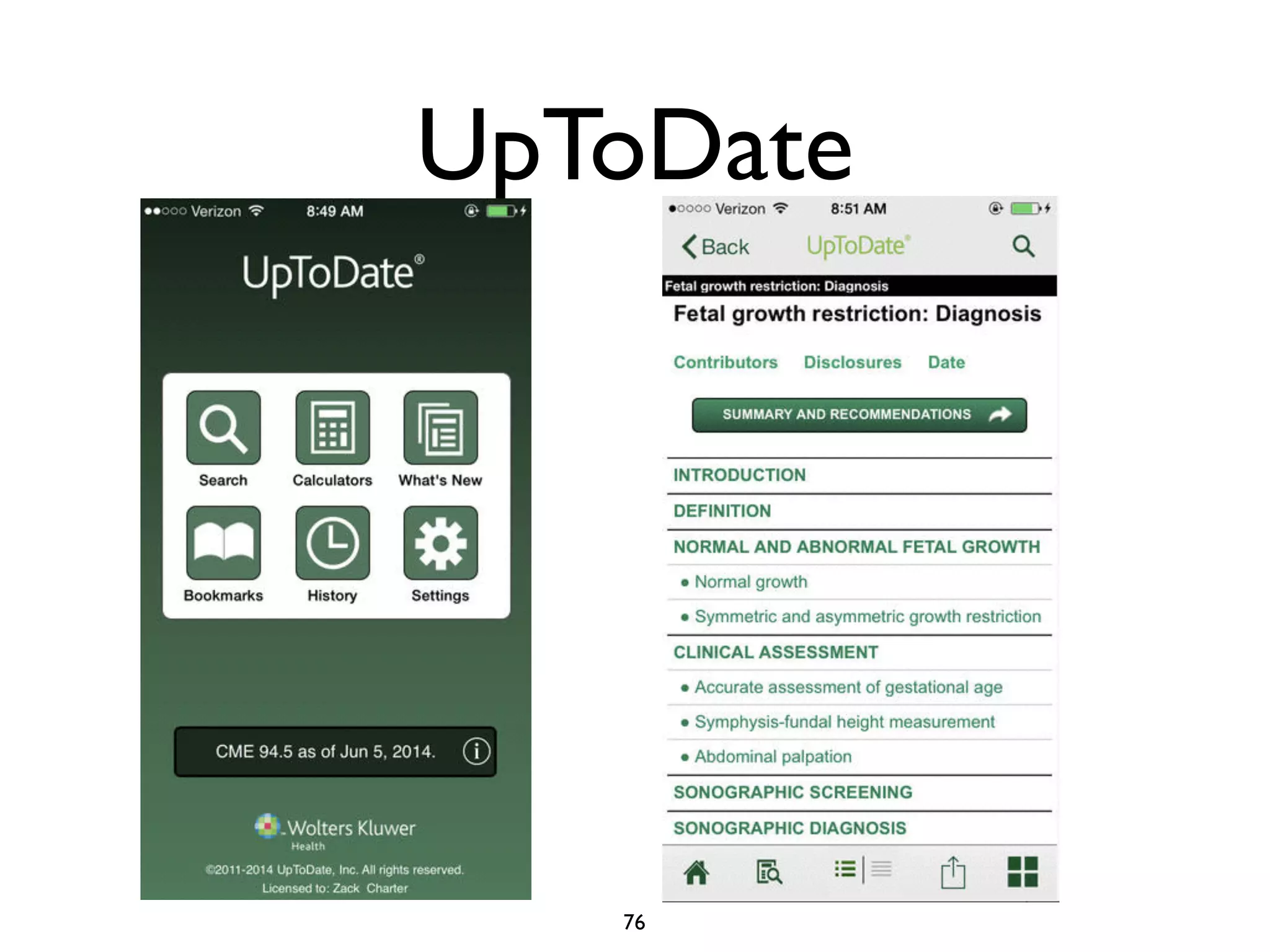
UpToDate 
76
77
78
mHealth Barriers 
79
More pilots than an 
airline 
80
81
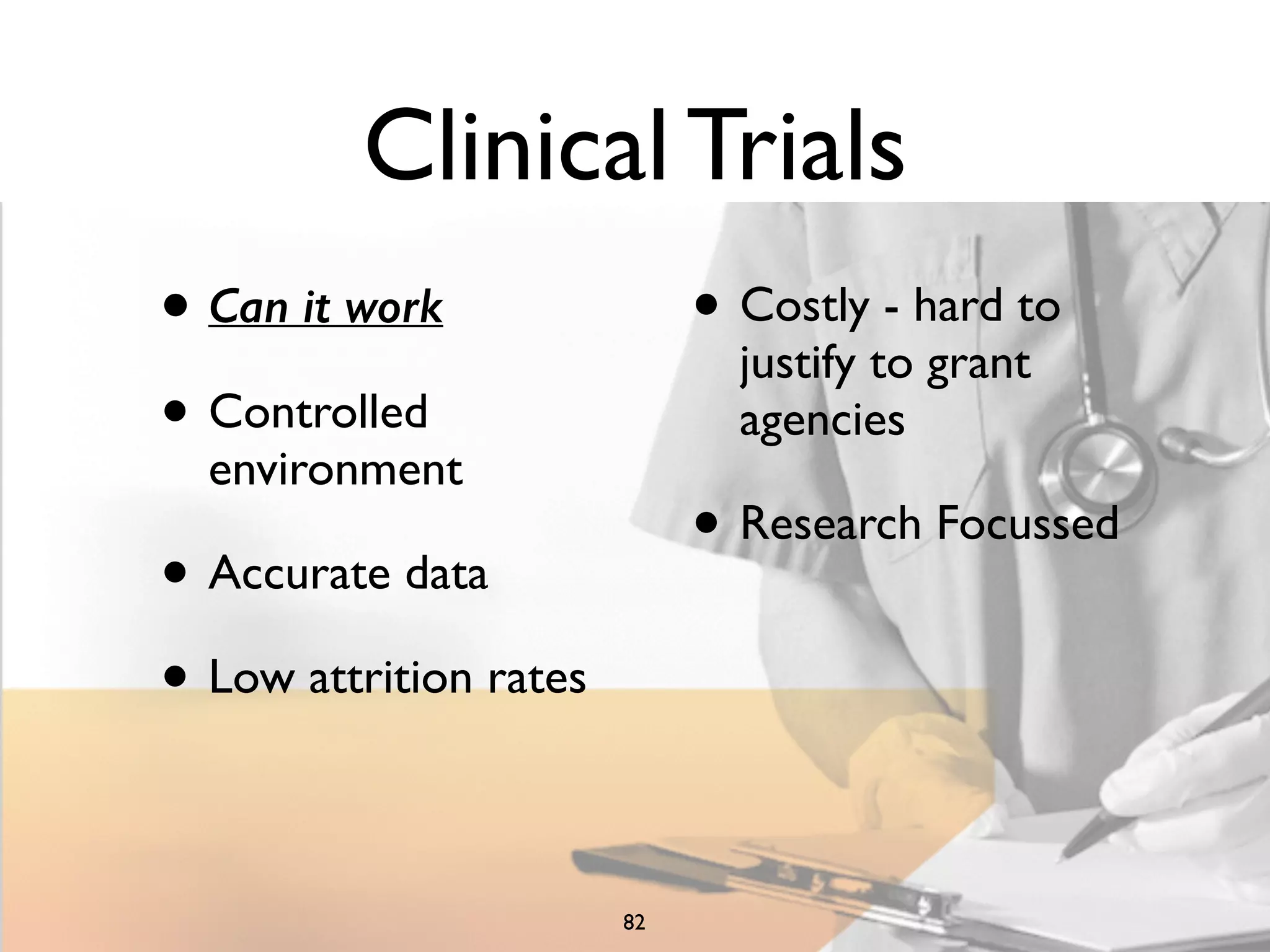
Clinical Trials 
• Can it work 
• Controlled 
environment 
• Accurate data 
• Low attrition rates 
• Costly - hard to 
justify to grant 
agencies 
• Research Focussed 
82
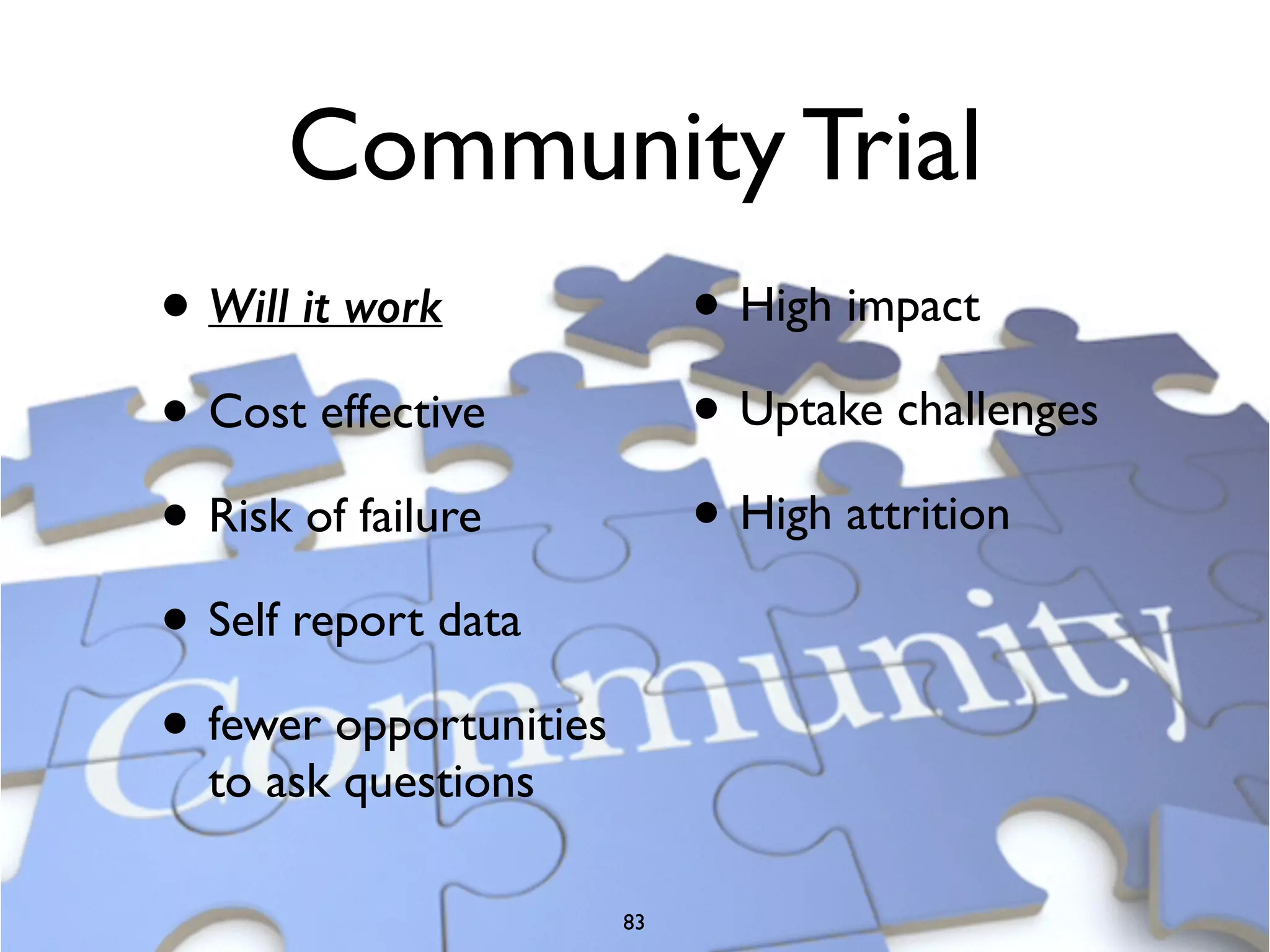
Community Trial 
• Will it work 
• Cost effective 
• Risk of failure 
• Self report data 
• fewer opportunities 
to ask questions 
• High impact 
• Uptake challenges 
• High attrition 
83
[Health Data is] the 
most valuable 
information in the 
digital age, bar none. Deborah 
Peel, Patient Privacy Rights 
84
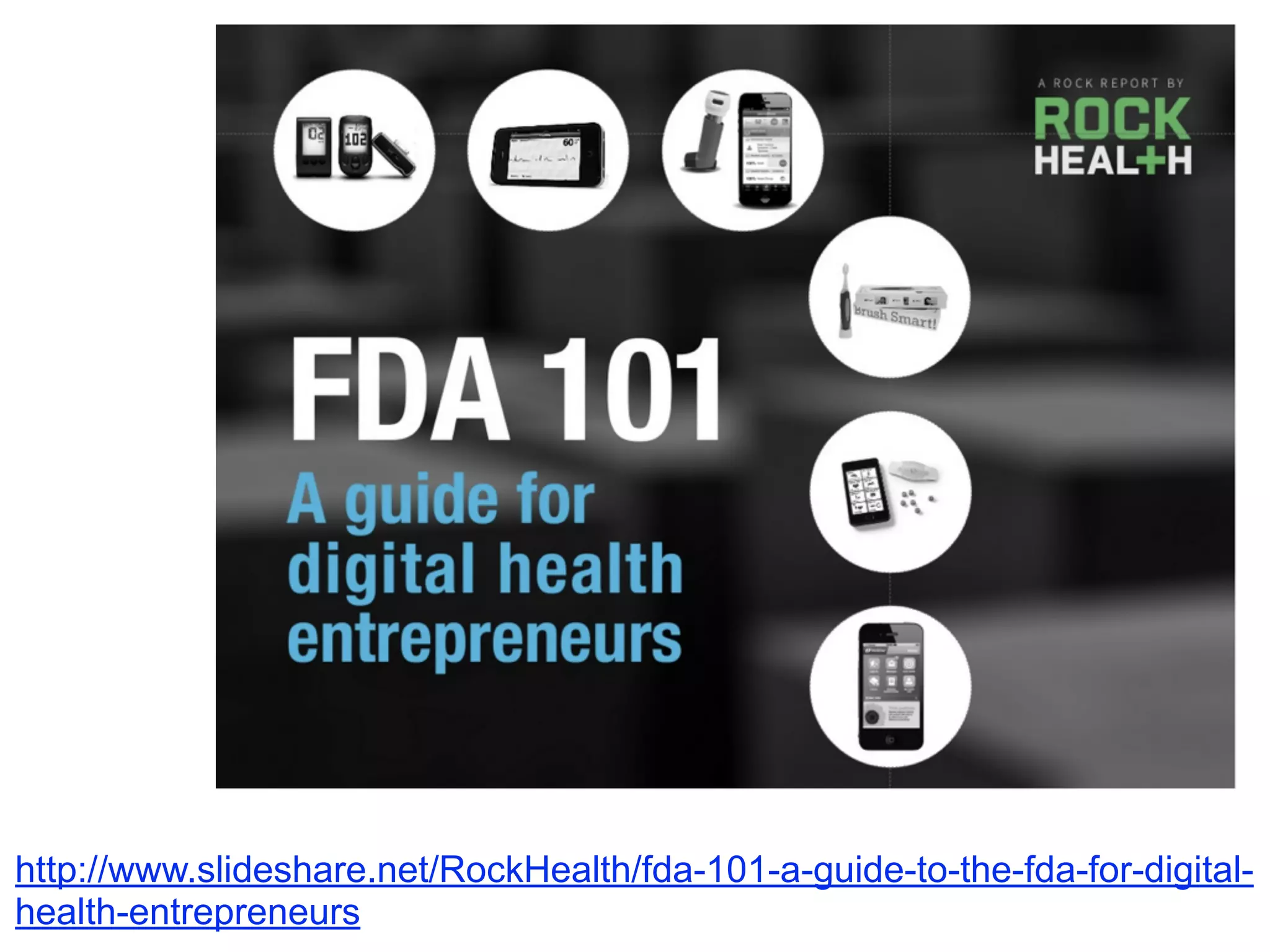
Regulation 
85
http://www.slideshare.net/RockHealth/fda-101-a-guide-to-the-fda-for-digital-health- 
entrepreneurs
Return on Investment 
87
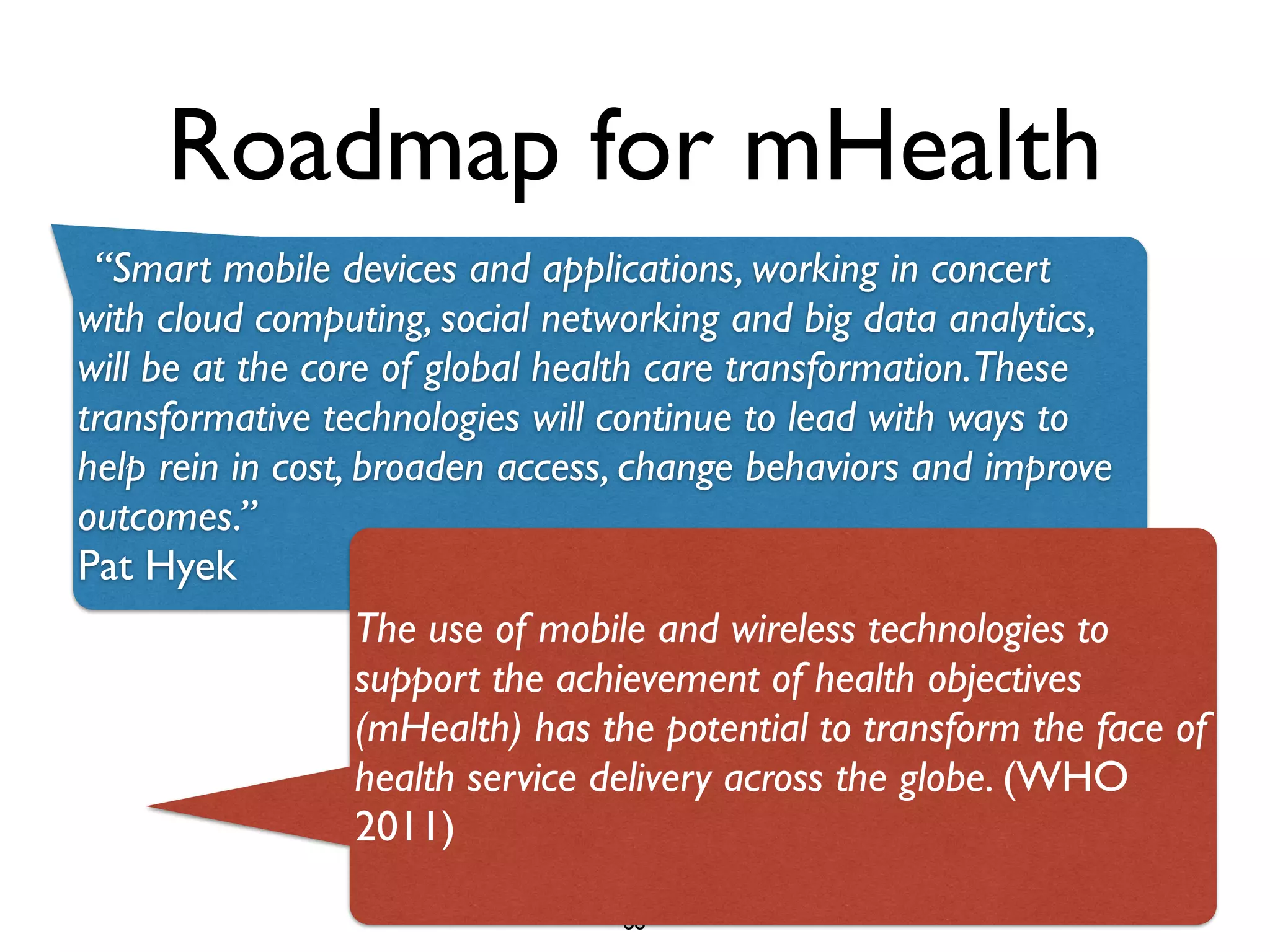
Roadmap for mHealth 
“Smart mobile devices and applications, working in concert 
with cloud computing, social networking and big data analytics, 
will be at the core of global health care transformation. These 
transformative technologies will continue to lead with ways to 
help rein in cost, broaden access, change behaviors and improve 
outcomes.” 
Pat Hyek 
The use of mobile and wireless technologies to 
support the achievement of health objectives 
(mHealth) has the potential to transform the face of 
health service delivery across the globe. (WHO 
2011) 
88
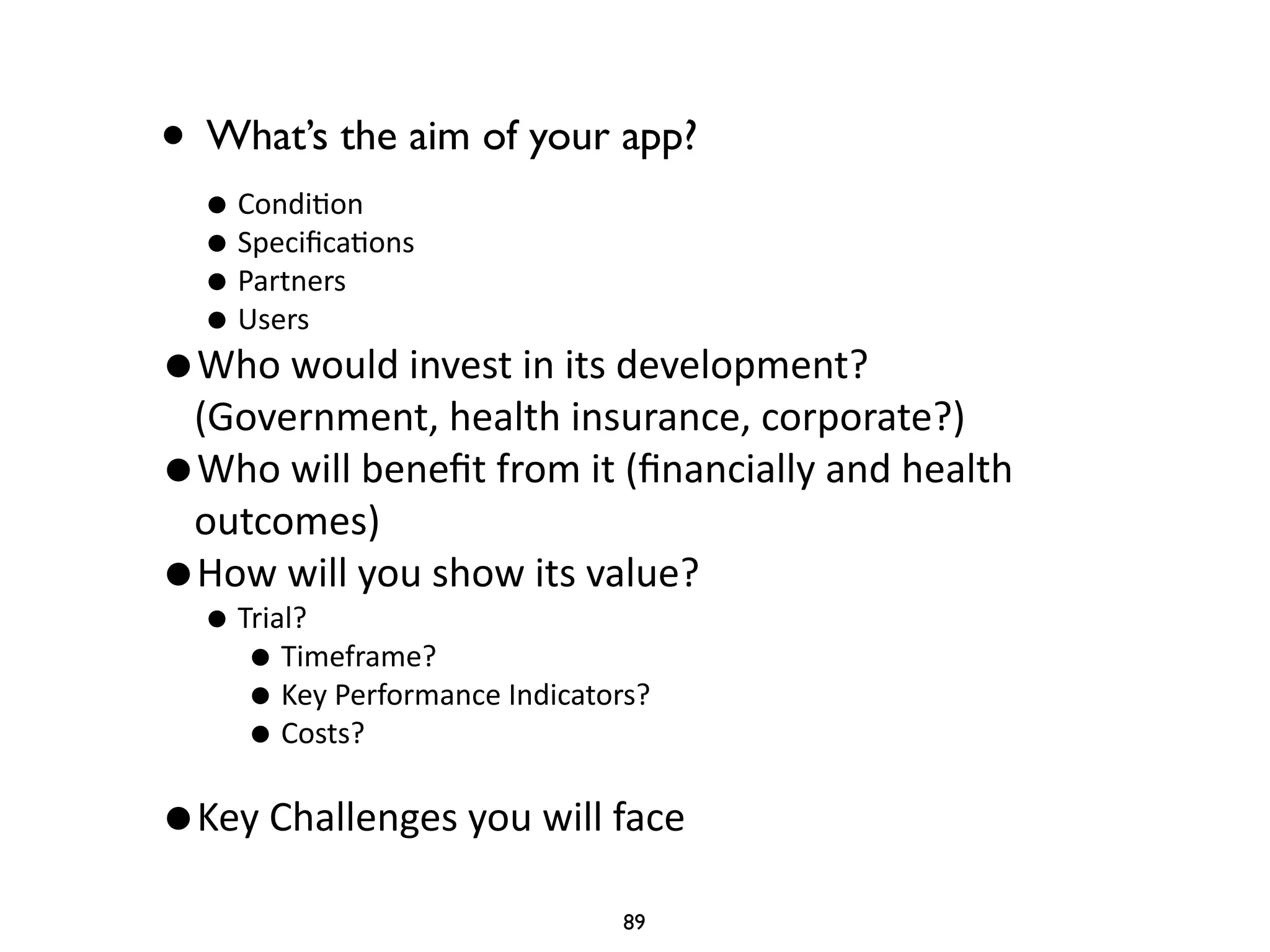
• What’s the aim of your app? 
• Condi'on 
• Specifica'ons 
• Partners 
• Users 
•Who 
would 
invest 
in 
its 
development? 
(Government, 
health 
insurance, 
corporate?) 
•Who 
will 
benefit 
from 
it 
(financially 
and 
health 
outcomes) 
•How 
will 
you 
show 
its 
value? 
• Trial? 
• Timeframe? 
• Key 
Performance 
Indicators? 
• Costs? 
! •Key 
Challenges 
you 
will 
face 
89

mHealth Beyond Consumer Apps Tutorial MobileHCI

  • 1.
    mHealth: Beyond ConsumerApps Jill Freyne, CSIRO jill.freyne@csiro.au 1
  • 2.
    Introduction • JillFreyne • PhD Computer Science, University College Dublin • IBM Research, Cambridge, MA, USA • Commonwealth Scientific and Industrial Research Organisation (CSIRO), Sydney 2
  • 3.
  • 4.
  • 5.
  • 6.
    Tutorial Overview •mHealth • Consumer Health vs Health Services • Health Apps • HealthyWell • mHealth in Hospitals • Practice and Clinical • Patient Apps • Challenges • Interactive component 6
  • 7.
  • 8.
    Inequality in ServiceDelivery Health Professionals per 10000 Major cities Very Remote GPs 324 70 Nurses 978 589 Allied Health 354 64 8 http://www.csiro.au/Outcomes/ ICT-and-Services/National- Challenges/Satellite- Telehealth.aspx
  • 9.
  • 10.
  • 11.
    Cost of LivingLonger 11
  • 12.
    Impact of Shrinking Workforce Popula'on)Futures)for)Australia:)the)Policy)Alterna'ves),)Professor)Peter)McDonald),)Rebecca)Kippen),)Social)Policy)Group)12)October) 1999)) 12
  • 13.
    Problem 13 Shrinking(Workforce( • Reduced(tax(base( • Re7ring(health(workers( • Less(access(to(services( Growing(Demands( • More(pa7ents( • Increased(costs( • More(chronic(disease( • Higher(expecta7ons(
  • 14.
    mHealth - partof the solution the practice of medicine and public health supported by mobile devices mHealth is the use of mobile and wireless devices to improve health outcomes, healthcare services and health research mHealth involves the use and capitalization on a mobile phone’s core utility of voice and short messaging service (SMS) as well as more complex functionalities and applications including general packet radio service (GPRS), third and fourth generation mobile telecommunications (3G and 4G systems), global positioning system (GPS), and Bluetooth technology 14
  • 15.
    Global penetration ofmobile devices 15
  • 16.
    Tip of theiceberg 16
  • 17.
    Roadmap for mHealth “Smart mobile devices and applications, working in concert with cloud computing, social networking and big data analytics, will be at the core of global health care transformation. These transformative technologies will continue to lead with ways to help rein in cost, broaden access, change behaviors and improve outcomes.” Pat Hyek The use of mobile and wireless technologies to support the achievement of health objectives (mHealth) has the potential to transform the face of health service delivery across the globe. (WHO 2011) 17
  • 18.
    WHO mHealth Categories • health call centres • emergency toll-free telephone services • managing emergencies and disasters • mobile telemedicine • appointment reminders • community mobilization and health promotion, • treatment compliance • mobile patient records • information access • patient monitoring • health surveys and data collection • surveillance • health awareness raising • decision support systems 18
  • 19.
    Uptake of mHealth mHealth: New horizons for health through mobile technologies: second global survey on eHealth www.who.int/goe/publications/goe_mhealth_web.19 pdf
  • 20.
  • 21.
  • 22.
    Take up thechallenge • mHealth programmes require evaluation. This is the foundation from which mHealth (and eHealth) can be measured (WHO 2011) • “Based on these results, we posit that the field is entering a new ‘era’ where a body of rigorous evaluation of mHealth strategies is rapidly accumulating. The transition into an era of evidence-based mHealth supports our position that innovation in this domain can be evaluated with the same rigor as other public health strategies, attenuating some of the hype previously associated with mHealth.” - Alain Labrique, Johns Hopkins University Global mHealth Initiative 22
  • 23.
    Consumer Health vs Health Services 23
  • 24.
    Healthy Well •Focus on Individual • Encourage Behaviour Change • Self awareness/monitoring • Gamification/Competition • Social support • Education • Persuasive 24
  • 25.
    drugs.com • Free • Education • Impact: increased understanding, confidence, self management 25
  • 26.
  • 27.
  • 28.
  • 29.
    Food Switch - Behaviour Change 29
  • 30.
    FoodSwitch has empoweredAustralian consumers seeking to make better food choices. In parallel, the huge volume of crowdsourced data has provided a novel means for low-cost, real-time tracking of the nutritional composition of Australian foods. There appears to be significant opportunity for this approach in many other countries. 30
  • 31.
    Symple • SelfMonitoring/ Reflection • $5.99 • Impact: Self awareness, self management, data collection 31
  • 32.
    Education Apps ….55 unique apps met the inclusion criteria…. Only 6 apps (11%) covered all 4 of these prevention areas. Eight apps (15%) provided tools or resources specifically for HIV/STD positive persons. Ten apps included information for a range of sexual orientations, 9 apps appeared to be designed for racially/ethnically diverse audiences, and 15 apps featured interactive components. Apps were infrequently downloaded … and not 32 highly rated
  • 33.
  • 34.
    Designed for Impact • Behavioural Science • goal setting • behaviour change theory • user perception • tailoring and personalisation 34
  • 35.
    ! ! ! 40 Apps - 20 free, 20 paid. The most frequently included BCTs were “provide instruction” (83% of the apps), “set graded tasks” (70%), and “prompt self-monitoring” (60%). Techniques Presence of such BCTs as “varied teach by to use app prompts/type and cues”, price; “however, agree on BCTs behavioural associated contract”, with increased “relapse intervention prevention” effectiveness and “time management” were in general were not more present common in the in apps paid apps. reviewed. ! ! 35
  • 36.
    The present studydemonstrated that apps promoting physical activity applied an average of 5 out of 23 possible behavior change techniques. This number was not different for paid and free apps or between app stores. The most frequently used behavior change techniques in apps were similar to those most frequently used in other types of physical activity promotion interventions. 36
  • 37.
  • 38.
    Obesity is common, serious and costly • More than one-third (or 78.6 million) of U.S. adults are obese (JAMA. 2014;311(8):806-814.) • Obesity-related conditions include heart disease, stroke, type 2 diabetes and certain types of cancer, some of the leading causes of preventable death. • The estimated annual medical cost of obesity in the U.S. was $147 billion in 2008 U.S. dollars; the medical costs for people who are obese were $1,429 higher than those of normal weight. 38
  • 39.
  • 40.
    Evidence base….. Text……messaging We identified interventions 75 trials. Fifty-increased nine trials adherence investigated to ART the and smoking use of mobile cessation technologies and should to be improve considered disease for management inclusion in services. and 26 Although trials investigated there is suggestive their use evidence to change of health benefit in behaviours. some other Nearly areas, high all trials quality were adequately conducted powered in high-trials income of optimised interventions are required to evaluate effects on countries…… objective outcomes. 40
  • 41.
  • 42.
  • 43.
    Impromy Clinical trial • Behaviour change focussed app - push notifications, tasks, rewards, self monitoring • Randomised Control Trial in clinical setting • 100 participants per group • 3 and 6 months follow up • Validated weight loss, improvements in mood, attitude change, positivity toward continuing 43
  • 44.
    Impromy Community Trial • 4000+ participants • data from app usage, pharmacy database and social media monitoring • real world impact of program • insight into weight loss shake programs 44
  • 45.
    BrainHQ Science •Posit Science 45
  • 46.
  • 47.
  • 48.
  • 49.
    Epocrates • 1million healthcare professionals nationwide • 50% of users use for 20 minutes each day • Decision support • Drug Interaction 49
  • 50.
    Drip Infusion -IV Drip Rate Calculator & 50
  • 51.
  • 52.
  • 53.
  • 54.
    Paramedic Protocol Provider By Acid Remap LLC 54
  • 55.
  • 56.
  • 57.
  • 58.
  • 59.
    Recovery Record Clinician - Eating Disorder 59
  • 60.
  • 61.
  • 62.
    Diabetes Self Management Adults with type 2 diabetes using WellDoc's software achieved statistically significant improvements in A1c. HCP and patient satisfaction with the system was clinically and statistically significant. 62
  • 63.
    While a wideselection of mobile applications seems to be available for people with diabetes, this study shows there are obvious gaps between the evidence-based recommendations and the functionality used in study interventions or found in online markets. Current results confirm personalized education as an underrepresented feature in diabetes mobile applications. We found no studies evaluating social media concepts in diabetes self-management on mobile devices, and its potential remains largely unexplored. 63
  • 64.
  • 65.
    Melanoma detection Sensitivityof the four tested applications ranged from 6.8% to 98.1%. Specificity ranged from 30.4% to 93.7%. Positive predictive value ranged from 33.3% to 42.1%, and negative predictive value ranged from 65.4% to 97.0%. The highest sensitivity for melanoma diagnosis was observed for an application that sends the image directly to a board-certified dermatologist for analysis and the lowest sensitivity was observed for applications that use automated algorithms to analyze 65 images.
  • 66.
  • 67.
  • 68.
  • 69.
  • 70.
  • 71.
  • 72.
    This smartphone-based homecare CR programme improved post-MI CR uptake, adherence and completion. The home-based CR programme was as effective in improving physiological and psychological health outcomes as traditional CR. CAP-CR is a viable option towards optimising use of CR services. 72
  • 73.
  • 74.
    Primary Outcomes Par$cipa$on**in*Cardiac*Rehabilita$on* 74 100" 90" 80" 70" 60" 50" 40" 30" 20" 10" 0" Uptake" Adherence" Comple<on" CAP"Interven<on" Centre@based"CR"
  • 75.
  • 76.
  • 77.
  • 78.
  • 79.
  • 80.
    More pilots thanan airline 80
  • 81.
  • 82.
    Clinical Trials •Can it work • Controlled environment • Accurate data • Low attrition rates • Costly - hard to justify to grant agencies • Research Focussed 82
  • 83.
    Community Trial •Will it work • Cost effective • Risk of failure • Self report data • fewer opportunities to ask questions • High impact • Uptake challenges • High attrition 83
  • 84.
    [Health Data is]the most valuable information in the digital age, bar none. Deborah Peel, Patient Privacy Rights 84
  • 85.
  • 86.
  • 87.
  • 88.
    Roadmap for mHealth “Smart mobile devices and applications, working in concert with cloud computing, social networking and big data analytics, will be at the core of global health care transformation. These transformative technologies will continue to lead with ways to help rein in cost, broaden access, change behaviors and improve outcomes.” Pat Hyek The use of mobile and wireless technologies to support the achievement of health objectives (mHealth) has the potential to transform the face of health service delivery across the globe. (WHO 2011) 88
  • 89.
    • What’s theaim of your app? • Condi'on • Specifica'ons • Partners • Users •Who would invest in its development? (Government, health insurance, corporate?) •Who will benefit from it (financially and health outcomes) •How will you show its value? • Trial? • Timeframe? • Key Performance Indicators? • Costs? ! •Key Challenges you will face 89