Three Dimensions of Care for Diabetes
(3DFD) – diabetes management for people
with psychological/social needs
Dr Carol Gayle, Consultant Diabetologist
Dr Anne Doherty, Consultant Liaison Psychiatrist
27th January 2016
The cost of diabetes to the NHS
1/10th of NHS budget/yr: ~ £10 billion
£1 million per hour
Amputations from diabetic foot disease most
common reason for amputation
Inpatient admissions twice as long
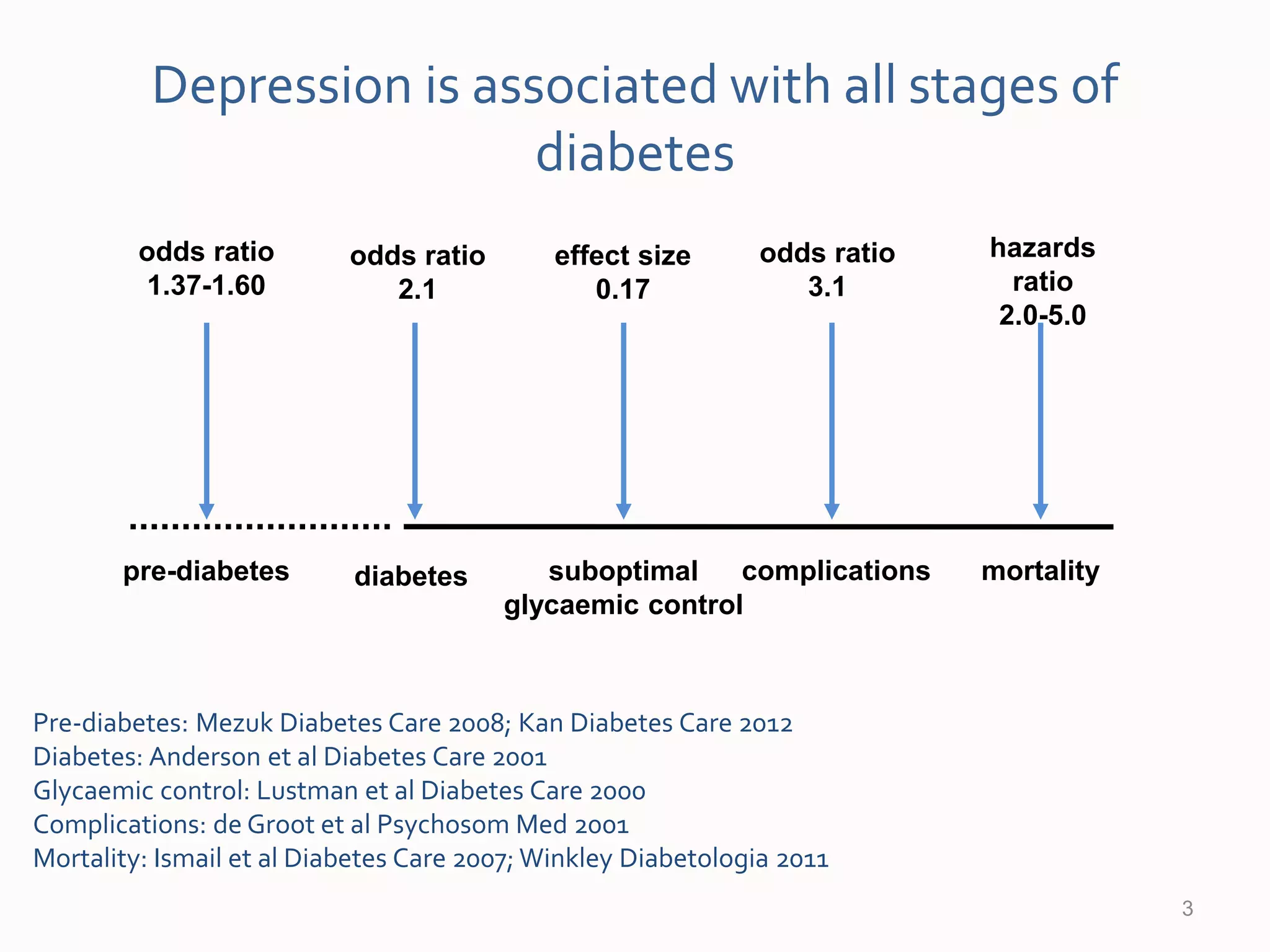
Depression is associated with all stages of
diabetes
odds ratio
1.37-1.60
Pre-diabetes: Mezuk Diabetes Care 2008; Kan Diabetes Care 2012
Diabetes: Anderson et al Diabetes Care 2001
Glycaemic control: Lustman et al Diabetes Care 2000
Complications: de Groot et al Psychosom Med 2001
Mortality: Ismail et al Diabetes Care 2007; Winkley Diabetologia 2011
odds ratio
2.1
effect size
0.17
odds ratio
3.1
hazards
ratio
2.0-5.0
pre-diabetes diabetes suboptimal
glycaemic control
complications mortality
3
Depressive disorder and mortality in people with
their first diabetic foot ulcer (n=253).65.7.75.8.85.9.951
3 6 9 12 15 18
Observation time (months)
Major depressive disorder
Minor depressive disorder
No/minimal depression
Ismail et al DiabetesCare 2007
Adjusted hazard ratio 3.23 (1.39 to 7.5)
Adjusted hazard ratio 2.73 (1.38 to 5.40)
Cumulativesurvival
4
0
Other psychiatric conditions
Anxiety disorders - 14% anxiety disorder (Grigsby 2002)
Psychosis 7.3% vs 5.2% (Nuevo 2011, de Hert 2006)
Eating disorder – 6-10% x2 general population (Young 2013)
Cognitive impairment - x2 decline (Rouch 2012)
2013 estimated prevalence of diabetes
by local authority
2030 estimate of diabetes, assuming obesity
continues to rise at the current rate
Contains Ordnance Survey data
© Crown copyright and database right 2013Source: Diabetes Prevalence Model for local authorities in England
Social problems
Standards
Psychologica
l care
Diabetes
care
Social care
But services don’t reflect this…
Diabetes
care
Psychologica
l care
Social care
But services don’t reflect this…
Diabetes
care
Psychologica
l care
Social care
Secondary
Community/
Intermediate
Primary
Teamcare
• RCT of 214 participants with
poorly controlled diabetes +/-
coronary heart disease, and
coexisting depression
• Intervention: a medically
supervised nurse, working with
each patient's primary care
physician, provided guideline-
based, collaborative care
management, with the goal of
controlling risk factors
• Reduction in HbA1c of 0.6%
• Katon 2010
ADaPT
• RCT of 344 participants with
T1DM
• Motivational interviewing +/-
Cognitive behaviour therapy v
usual care
• Reduction in HbA1c
• 0.5% MET + CBT v usual care
(p = 0.008)
• 0.2% MET v usual care
• 0.3% MET + CBT v MET
• Greater reduction in HbA1c
associated with higher HbA1c,
and younger age at baseline
• Ismail 2010
Complex care models
• Most research in diabetes
• Meta-analysis (Atlantis 2014) found 7 RCTs, and concluded
that collaborative or integrated care significantly improved
depression and glycaemic control in individuals with
diabetes and depression.
– However the overall weighted mean difference was small, and
the authors noted that most of these studies were conducted in
the US and may not be generalizable to other healthcare
settings.
• Clustered RCT (Coventry 2015)
– modest improvement in depressive symptoms at 4 months
– did not examine glycaemic control or physical health
outcomes, and it
STEP 1: All known and suspected presentations of
depression
STEP 2: Persistent subthreshold depressive symptoms;
mild to moderate depression
STEP 3: Persistent subthreshold depressive
symptoms or mild to moderate depression with
inadequate response to initial interventions;
moderate and severe depression
STEP 4: Severe and complex1
depression; risk to life; severe self-
neglect
Low-intensity psychosocial interventions, psychological
interventions, medication and referral for further
assessment and interventions
Medication, high-intensity psychological interventions,
combined treatments, collaborative care2, and referral
for further assessment and interventions
Medication, high-intensity psychological
interventions, electroconvulsive therapy, crisis
service, combined treatments,
multiprofessional and inpatient care
Focus of the
intervention
Nature of the
intervention
Assessment, support, psycho-education, active monitoring and
referral for further assessment and interventions
NICE stepped-care model
• debt management
• housing support
• occupational rehabilitation
• literacy
• advocacy
• medication support
• biomedical monitoring
• diabetes education
• technology
• complications
• increased self efficacy
towards diabetes
• patient reported outcomes
• patient led case meetings
• diagnostic assessment
• risk management
• psychotropic medications
• brief psychological
treatments
The model
Psychiatry/
Psychology
Diabetes
Social
interventions
Patient
Mental Health
Diabetes &
physical
health
Social
interventions
Patient
Patient testimonial
My name is Rochelle, I am a
single parent with two children. I
had difficulties controlling my
diabetes. I became very
depressed. 3DFD has managed
to help me to overcome my fears
of dealing with diabetes. I now
use my insulins better.....
Rochelle:(T1DM) HbA1c 15.2 to 8.7%
Quality in Care Awards
2011
BMJ Awards 2014
DiabetesTeam of theYear
Mary McKinnon Lecture
DUK 2015
NHS Innovation
Challenge Prize 2015
Impact & Dissemination
Other Services
Hillingdon, Oxford
Hull, NHS Lothian,
CNWL
Service commissioned by Lambeth and Southwark CCGs from 2014
Timelines
Phase I
• Sept2010
• March2011
Phase II
• Oct2012
• Sept2013
Service
• Sept2013
• present
Methods
Time 1
Time 2
Control3DFD
Lambeth &
Southwark
Lambeth &
Southwark
Lewisham
Lewisham
Inclusion criteria
HbA1c >= 75mmol/mol
Mental or social problem
Resident in borough
Methods
Time 1
Time 2
Control3DFD
Lambeth &
Southwark
Lambeth &
Southwark
Lewisham
Lewisham
Methods
Time 1
Time 2
Control3DFD
Lambeth &
Southwark
Lambeth &
Southwark
Lewisham
Lewisham
Inclusion Criteria
• 3DFD
– HbA1c >=
75mmol/mol
– Mental health or
social problems
– Resident L/S
• Control
– HbA1c >=
75mmol/mol
– Mental health or
social problems
– Resident Lewisham
Measures
Main outcome measures HbA1c
Cost
Baseline demographics Age, gender, ethnicity, education,
employment
Baseline clinical T1/T2, insulin, duration, complications
Physical health measures BMI, BP, Cholesterol,ACR
Psychological measures Depression PHQ-9
Anxiety GAD-7
Diabetes distress scale
Social measures Outcome/Recovery star
SF12
Demographics: age
46.95 57.24
0
10
20
30
40
50
60
70
3DFD (n= 275) Control (n=292)
mean age
mean age
p<0.001
Demographics: gender
40%
60%
3DFD
n=275
Male
Female 52%
48%
Control
n=292
Male
Female
p=0.001
Demographics: ethnicity
35%
51%
7%
6%
1%
3DFD
n=231
White
Black
Asian
Mixed
Other
46%
36%
6%
12%
0%
Control
n=292
White
Black
Asian
Mixed
Other
p=0.002
Clinical characteristics: diabetesT1/T2
32%
68%
3DFD
n=275
T1DM
T2DM
8%
92%
Control
n=281
T1DM
T2DM
p<0.001
Duration of diabetes
11.47 9.33
0
2
4
6
8
10
12
14
3DFD (n=206) Control (n=273)
Mean duration of diagnosis (years)
years
p=0.005
Clinical characteristics : on insulin
77%
23%
3DFD
n=238
on insulin
not on
insulin
42%
58%
Control
n=287
on insulin
not on
insulin
p<0.001
% with complications at baseline
0
10
20
30
40
50
60
70
80
90
100
3DFD (n=193) Control (n=264)
Total Complications
Macro
Micro
p=ns
HbA1c at baseline (mmol/mol)
113 92
0
20
40
60
80
100
120
3DFD (n=268) Control (n=288)
HbA1c
HbA1c
p<0.001
HbA1c at 1 year (mmol/mol)
99 9282 86
0
20
40
60
80
100
120
3DFD (n=202) Control (n=274)
baseline
1 year
p<0.001p<0.001
16.2 6
0
2
4
6
8
10
12
14
16
18
3DFD (n=202) Control (n=274)
Reduction HbA1c
change (mmol/mol)
Decrease in HbA1c
Cholesterol at 1 year
4.2
4.3
4.4
4.5
4.6
4.7
4.8
4.9
5
5.1
5.2
3DFD (n=101) Control (n=268)
baseline
1 year
P=0.02 P=0.54
MeanACR at 1 year
0
2
4
6
8
10
12
14
16
3DFD (n=75) Control (n=224)
baseline
1 year
P=0.56 p<0.001
BMI at 1 year
30.6
30.7
30.8
30.9
31
31.1
31.2
31.3
31.4
31.5
31.6
31.7
3DFD (n=121) Control (n=247)
baseline
1 year
P=0.4 P=0.5
Unmet need
0
20
40
60
80
100
120
Nil Known
diagnosis
New
diagnosis
New relapse
N
Psychiatric Diagnosis
Psychiatric diagnosis: new, known or relapse
Depression (PHQ-9)
0
2
4
6
8
10
12
baseline year 1
mean score, n=77
mean score
P<0.001
Anxiety (GAD-7)
0
2
4
6
8
10
baseline 1 year
mean score, n=77
mean score
P<0.001
Diabetes specific distress (DDS)
40
42
44
46
48
50
52
baseline 1 year
mean score, n=77
mean score
p=0.005
Social functioning
(Recovery/Outcome Star)
Social functioning
(Recovery/Outcome Star)
50
51
52
53
54
55
56
57
58
Baseline 1 year
mean score, n=76
mean score
p<0.001
0
200
400
600
800
1000
1200
3DFD Control
Year before (£,000)
Year after (£,000)
Cost of 3DFD and Intervention group:
baseline and follow up
0
5
10
15
20
25
30
35
40
45
50
3DFD Control
% increase in cost
% change
Proportion increase per group
Multivariate analysis
B p Confidence Interval
Age 26.003 0.23 -16.551 - 68.557
Gender 1.349 0.625 -4.072 - 6.770
Ethnicity -1260.744 0.009 -2199.929 - -321.559
Baseline Costs 0.356 <0.001 0.305 - 0.407
Change in HbA1c (mmol/mol) -14.157 0.046 -28.071 - -0.242
Type of diabetes -1825.054 0.038 -3551.480 - -98.629
Intervention or control group 785.316 0.179 -362.007 - 1932.639
Multivariate analysis
Type 1 diabetes Type 2 diabetes
B p Confidence Interval B p Confidence Interval
Age -46.781 0.473 -176.400 - 82.837 37.056 0.1 -7.188 - 81.301
Gender -1226.996 0.458 -4513.166 - 2059.174 1.502 0.565 -3.632 - 6.636
Ethnicity -1231.235 0.374 -3980.141 - 1517.671 -1421.943 0.004 -2399.155 - -444.732
Baseline Costs 0.656 <0.001 0.463 - 0.849 0.318 <0.001 0.268 - 0.369
Change in HbA1c (mmol/mol) -10.332 0.316 -30.777- 10.113 -20.619 0.089 -44.391 - 3.153
Intervention or control group 1500.399 0.491 -2834.036 - 5834.834 603.162 0.302 -545.528 – 1751.852
Reduction in HbA1c
0
2
4
6
8
10
12
14
16
18
3DFD Control Usual
care
Glicazide Gliptin SGLT2
HbA1c (mmol/mol)
HbA1c (mmol/mol)
HbA1c at 2years
n=60
98
87
82 82
70
75
80
85
90
95
100
Baseline 6 months 1 year 2 years
HbA1c,mmol/mol
Time
Maintenance of HbA1c
Implications
• Integrated mental and physical healthcare is
effective in improving outcomes: glycaemic
control, psychological health, social
functioning
• Costs for patients rise, but the proportion by
which they rise may be reduced by integrated
care
Additional Areas
• “reverse model” – diabetes care integrated
with CMHT for SMI (PODS study)
• Model cost of avoidance of complications
based on UKPDS and health economics
• What will be the models of funding for the
future for integrated services?
Regional
Innovation
Fund

Three Dimensions of Care for Diabetes (3DFD) – diabetes management for people with psychological / social needs

  • 1.
    Three Dimensions ofCare for Diabetes (3DFD) – diabetes management for people with psychological/social needs Dr Carol Gayle, Consultant Diabetologist Dr Anne Doherty, Consultant Liaison Psychiatrist 27th January 2016
  • 2.
    The cost ofdiabetes to the NHS 1/10th of NHS budget/yr: ~ £10 billion £1 million per hour Amputations from diabetic foot disease most common reason for amputation Inpatient admissions twice as long
  • 3.
    Depression is associatedwith all stages of diabetes odds ratio 1.37-1.60 Pre-diabetes: Mezuk Diabetes Care 2008; Kan Diabetes Care 2012 Diabetes: Anderson et al Diabetes Care 2001 Glycaemic control: Lustman et al Diabetes Care 2000 Complications: de Groot et al Psychosom Med 2001 Mortality: Ismail et al Diabetes Care 2007; Winkley Diabetologia 2011 odds ratio 2.1 effect size 0.17 odds ratio 3.1 hazards ratio 2.0-5.0 pre-diabetes diabetes suboptimal glycaemic control complications mortality 3
  • 4.
    Depressive disorder andmortality in people with their first diabetic foot ulcer (n=253).65.7.75.8.85.9.951 3 6 9 12 15 18 Observation time (months) Major depressive disorder Minor depressive disorder No/minimal depression Ismail et al DiabetesCare 2007 Adjusted hazard ratio 3.23 (1.39 to 7.5) Adjusted hazard ratio 2.73 (1.38 to 5.40) Cumulativesurvival 4 0
  • 5.
    Other psychiatric conditions Anxietydisorders - 14% anxiety disorder (Grigsby 2002) Psychosis 7.3% vs 5.2% (Nuevo 2011, de Hert 2006) Eating disorder – 6-10% x2 general population (Young 2013) Cognitive impairment - x2 decline (Rouch 2012)
  • 6.
    2013 estimated prevalenceof diabetes by local authority 2030 estimate of diabetes, assuming obesity continues to rise at the current rate Contains Ordnance Survey data © Crown copyright and database right 2013Source: Diabetes Prevalence Model for local authorities in England
  • 7.
  • 8.
  • 9.
    Psychologica l care Diabetes care Social care Butservices don’t reflect this… Diabetes care Psychologica l care Social care
  • 10.
    But services don’treflect this… Diabetes care Psychologica l care Social care Secondary Community/ Intermediate Primary
  • 11.
    Teamcare • RCT of214 participants with poorly controlled diabetes +/- coronary heart disease, and coexisting depression • Intervention: a medically supervised nurse, working with each patient's primary care physician, provided guideline- based, collaborative care management, with the goal of controlling risk factors • Reduction in HbA1c of 0.6% • Katon 2010 ADaPT • RCT of 344 participants with T1DM • Motivational interviewing +/- Cognitive behaviour therapy v usual care • Reduction in HbA1c • 0.5% MET + CBT v usual care (p = 0.008) • 0.2% MET v usual care • 0.3% MET + CBT v MET • Greater reduction in HbA1c associated with higher HbA1c, and younger age at baseline • Ismail 2010
  • 12.
    Complex care models •Most research in diabetes • Meta-analysis (Atlantis 2014) found 7 RCTs, and concluded that collaborative or integrated care significantly improved depression and glycaemic control in individuals with diabetes and depression. – However the overall weighted mean difference was small, and the authors noted that most of these studies were conducted in the US and may not be generalizable to other healthcare settings. • Clustered RCT (Coventry 2015) – modest improvement in depressive symptoms at 4 months – did not examine glycaemic control or physical health outcomes, and it
  • 13.
    STEP 1: Allknown and suspected presentations of depression STEP 2: Persistent subthreshold depressive symptoms; mild to moderate depression STEP 3: Persistent subthreshold depressive symptoms or mild to moderate depression with inadequate response to initial interventions; moderate and severe depression STEP 4: Severe and complex1 depression; risk to life; severe self- neglect Low-intensity psychosocial interventions, psychological interventions, medication and referral for further assessment and interventions Medication, high-intensity psychological interventions, combined treatments, collaborative care2, and referral for further assessment and interventions Medication, high-intensity psychological interventions, electroconvulsive therapy, crisis service, combined treatments, multiprofessional and inpatient care Focus of the intervention Nature of the intervention Assessment, support, psycho-education, active monitoring and referral for further assessment and interventions NICE stepped-care model
  • 14.
    • debt management •housing support • occupational rehabilitation • literacy • advocacy • medication support • biomedical monitoring • diabetes education • technology • complications • increased self efficacy towards diabetes • patient reported outcomes • patient led case meetings • diagnostic assessment • risk management • psychotropic medications • brief psychological treatments The model Psychiatry/ Psychology Diabetes Social interventions Patient
  • 15.
  • 16.
    Patient testimonial My nameis Rochelle, I am a single parent with two children. I had difficulties controlling my diabetes. I became very depressed. 3DFD has managed to help me to overcome my fears of dealing with diabetes. I now use my insulins better..... Rochelle:(T1DM) HbA1c 15.2 to 8.7%
  • 17.
    Quality in CareAwards 2011 BMJ Awards 2014 DiabetesTeam of theYear Mary McKinnon Lecture DUK 2015 NHS Innovation Challenge Prize 2015
  • 18.
    Impact & Dissemination OtherServices Hillingdon, Oxford Hull, NHS Lothian, CNWL Service commissioned by Lambeth and Southwark CCGs from 2014
  • 19.
    Timelines Phase I • Sept2010 •March2011 Phase II • Oct2012 • Sept2013 Service • Sept2013 • present
  • 20.
    Methods Time 1 Time 2 Control3DFD Lambeth& Southwark Lambeth & Southwark Lewisham Lewisham Inclusion criteria HbA1c >= 75mmol/mol Mental or social problem Resident in borough
  • 21.
    Methods Time 1 Time 2 Control3DFD Lambeth& Southwark Lambeth & Southwark Lewisham Lewisham
  • 22.
    Methods Time 1 Time 2 Control3DFD Lambeth& Southwark Lambeth & Southwark Lewisham Lewisham
  • 23.
    Inclusion Criteria • 3DFD –HbA1c >= 75mmol/mol – Mental health or social problems – Resident L/S • Control – HbA1c >= 75mmol/mol – Mental health or social problems – Resident Lewisham
  • 24.
    Measures Main outcome measuresHbA1c Cost Baseline demographics Age, gender, ethnicity, education, employment Baseline clinical T1/T2, insulin, duration, complications Physical health measures BMI, BP, Cholesterol,ACR Psychological measures Depression PHQ-9 Anxiety GAD-7 Diabetes distress scale Social measures Outcome/Recovery star SF12
  • 25.
    Demographics: age 46.95 57.24 0 10 20 30 40 50 60 70 3DFD(n= 275) Control (n=292) mean age mean age p<0.001
  • 26.
  • 27.
  • 28.
  • 29.
    Duration of diabetes 11.479.33 0 2 4 6 8 10 12 14 3DFD (n=206) Control (n=273) Mean duration of diagnosis (years) years p=0.005
  • 30.
    Clinical characteristics :on insulin 77% 23% 3DFD n=238 on insulin not on insulin 42% 58% Control n=287 on insulin not on insulin p<0.001
  • 31.
    % with complicationsat baseline 0 10 20 30 40 50 60 70 80 90 100 3DFD (n=193) Control (n=264) Total Complications Macro Micro p=ns
  • 32.
    HbA1c at baseline(mmol/mol) 113 92 0 20 40 60 80 100 120 3DFD (n=268) Control (n=288) HbA1c HbA1c p<0.001
  • 33.
    HbA1c at 1year (mmol/mol) 99 9282 86 0 20 40 60 80 100 120 3DFD (n=202) Control (n=274) baseline 1 year p<0.001p<0.001
  • 34.
    16.2 6 0 2 4 6 8 10 12 14 16 18 3DFD (n=202)Control (n=274) Reduction HbA1c change (mmol/mol) Decrease in HbA1c
  • 35.
    Cholesterol at 1year 4.2 4.3 4.4 4.5 4.6 4.7 4.8 4.9 5 5.1 5.2 3DFD (n=101) Control (n=268) baseline 1 year P=0.02 P=0.54
  • 36.
    MeanACR at 1year 0 2 4 6 8 10 12 14 16 3DFD (n=75) Control (n=224) baseline 1 year P=0.56 p<0.001
  • 37.
    BMI at 1year 30.6 30.7 30.8 30.9 31 31.1 31.2 31.3 31.4 31.5 31.6 31.7 3DFD (n=121) Control (n=247) baseline 1 year P=0.4 P=0.5
  • 38.
    Unmet need 0 20 40 60 80 100 120 Nil Known diagnosis New diagnosis Newrelapse N Psychiatric Diagnosis Psychiatric diagnosis: new, known or relapse
  • 39.
    Depression (PHQ-9) 0 2 4 6 8 10 12 baseline year1 mean score, n=77 mean score P<0.001
  • 40.
    Anxiety (GAD-7) 0 2 4 6 8 10 baseline 1year mean score, n=77 mean score P<0.001
  • 41.
    Diabetes specific distress(DDS) 40 42 44 46 48 50 52 baseline 1 year mean score, n=77 mean score p=0.005
  • 42.
  • 43.
  • 44.
    0 200 400 600 800 1000 1200 3DFD Control Year before(£,000) Year after (£,000) Cost of 3DFD and Intervention group: baseline and follow up
  • 45.
    0 5 10 15 20 25 30 35 40 45 50 3DFD Control % increasein cost % change Proportion increase per group
  • 46.
    Multivariate analysis B pConfidence Interval Age 26.003 0.23 -16.551 - 68.557 Gender 1.349 0.625 -4.072 - 6.770 Ethnicity -1260.744 0.009 -2199.929 - -321.559 Baseline Costs 0.356 <0.001 0.305 - 0.407 Change in HbA1c (mmol/mol) -14.157 0.046 -28.071 - -0.242 Type of diabetes -1825.054 0.038 -3551.480 - -98.629 Intervention or control group 785.316 0.179 -362.007 - 1932.639
  • 47.
    Multivariate analysis Type 1diabetes Type 2 diabetes B p Confidence Interval B p Confidence Interval Age -46.781 0.473 -176.400 - 82.837 37.056 0.1 -7.188 - 81.301 Gender -1226.996 0.458 -4513.166 - 2059.174 1.502 0.565 -3.632 - 6.636 Ethnicity -1231.235 0.374 -3980.141 - 1517.671 -1421.943 0.004 -2399.155 - -444.732 Baseline Costs 0.656 <0.001 0.463 - 0.849 0.318 <0.001 0.268 - 0.369 Change in HbA1c (mmol/mol) -10.332 0.316 -30.777- 10.113 -20.619 0.089 -44.391 - 3.153 Intervention or control group 1500.399 0.491 -2834.036 - 5834.834 603.162 0.302 -545.528 – 1751.852
  • 48.
    Reduction in HbA1c 0 2 4 6 8 10 12 14 16 18 3DFDControl Usual care Glicazide Gliptin SGLT2 HbA1c (mmol/mol) HbA1c (mmol/mol)
  • 49.
    HbA1c at 2years n=60 98 87 8282 70 75 80 85 90 95 100 Baseline 6 months 1 year 2 years HbA1c,mmol/mol Time Maintenance of HbA1c
  • 50.
    Implications • Integrated mentaland physical healthcare is effective in improving outcomes: glycaemic control, psychological health, social functioning • Costs for patients rise, but the proportion by which they rise may be reduced by integrated care
  • 51.
    Additional Areas • “reversemodel” – diabetes care integrated with CMHT for SMI (PODS study) • Model cost of avoidance of complications based on UKPDS and health economics • What will be the models of funding for the future for integrated services?
  • 52.