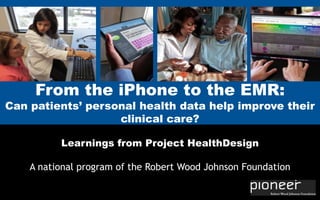
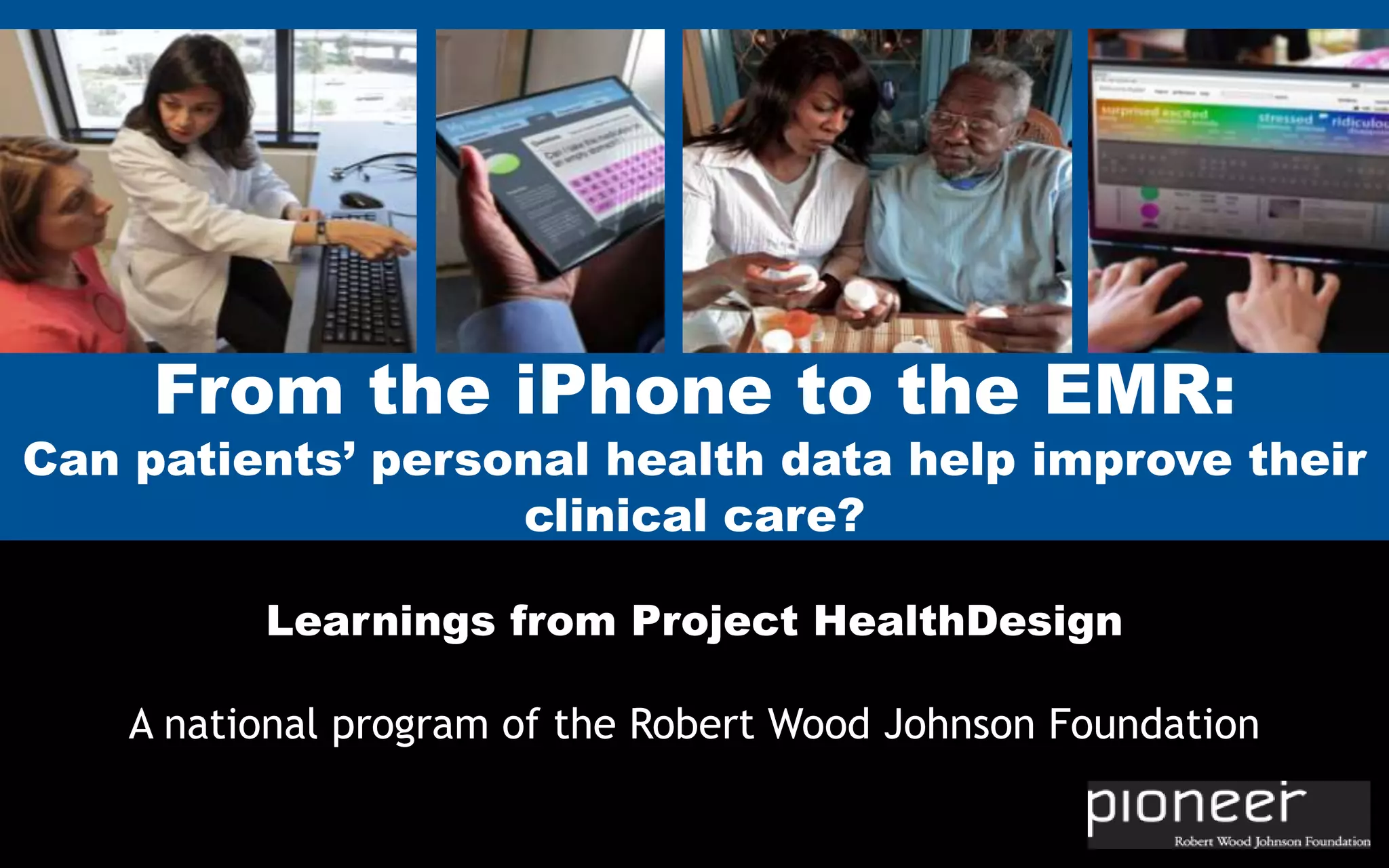
From the iPhone to the EMR:
Can patients’ personal health data help improve their
                   clinical care?

          Learnings from Project HealthDesign

    A national program of the Robert Wood Johnson Foundation
Stephen Downs,
    SM, FACMI


 Chief Technology and
  Information Officer

Robert Wood Johnson
    Foundation
Project HealthDesign
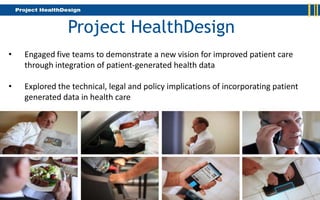
•   Engaged five teams to demonstrate a new vision for improved patient care
    through integration of patient-generated health data

•   Explored the technical, legal and policy implications of incorporating patient
    generated data in health care
• BreathEasy
  Adults with asthma

• Chronology.MD
  Young adults with Crohn’s Disease

• dwellSense
  Elders at risk of cognitive decline

• Estrellita
  High-risk infants and their caregivers

• iN Touch
  Low-income teens and young adults managing obesity
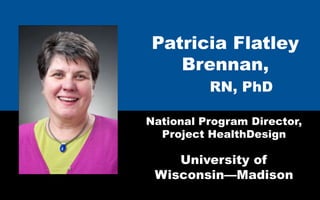
Patricia Flatley
   Brennan,
          RN, PhD

National Program Director,
  Project HealthDesign

    University of
 Wisconsin—Madison
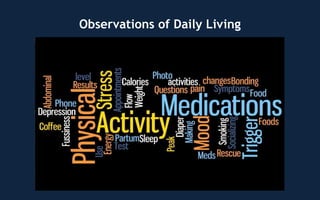
Observations of Daily Living
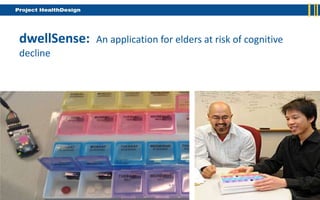
dwellSense:   An application for elders at risk of cognitive
decline
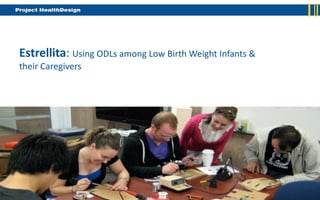
Estrellita: Using ODLs among Low Birth Weight Infants &
their Caregivers
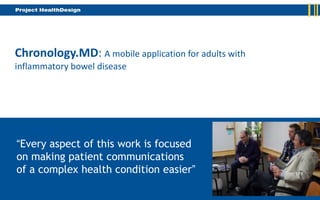
Chronology.MD: A mobile application for adults with
inflammatory bowel disease


“Every aspect of this work is focused
on making patient communications
of a complex health condition easier”
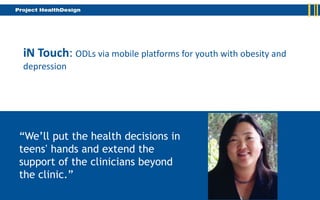
iN Touch: ODLs via mobile platforms for youth with obesity and
depression


“We’ll put the health decisions in
teens’ hands and extend the
support of the clinicians beyond
the clinic.”
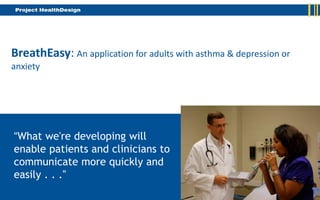
BreathEasy: An application for adults with asthma & depression or
anxiety


“What we're developing will
enable patients and clinicians to
communicate more quickly and
easily . . .”
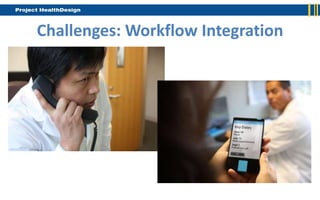
Challenges: Workflow Integration
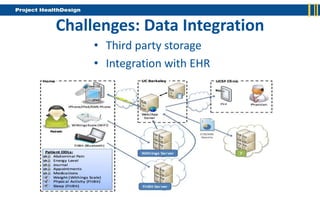
Challenges: Data Integration
     • Third party storage
     • Integration with EHR
Why we should go forward – Patient View
• ‘I don’t feel so alone’ (patient w/ Crohn’s)
• ‘My quality of life has gone way up’. . . ‘my weight is up’ . . .
        ‘I’m not vomiting every day’
• ‘It’s easier to summarize and share between-visit health
        events and health status’
• ‘good intentions to use the app, but not enough energy at
        the end of the day’ (parents of twin at-risk infants and two pre-
        school kids)
• ‘I charge the study phone before my personal cell’
• ‘missed more medication doses than I expected’ (elder at risk)
Why we should go forward – Provider View

• Patient visits and prescriptions decreased
• Able to identify when medications weren’t being
  taken or were taken incorrectly
• Adjusted medication regimens
• Motivated patients to adhere to treatment plan
• Provided a measure of cognitive and functional
  performance over time
Project HealthDesign


A brief video about the project’s latest
   round of design and evaluation
Katherine Kim,
    MPH, MBA,
   PhD Candidate

Co-Principal Investigator,
        iN Touch

San Francisco State
     University
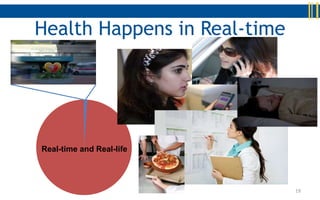
Health Happens in Real-time


Real-time and Real-life


                              19
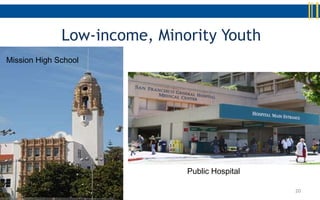
Low-income, Minority Youth
Mission High School


                              Public Hospital

                                                20
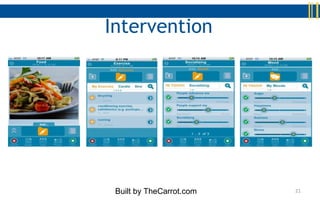
Intervention


 Built by TheCarrot.com   21
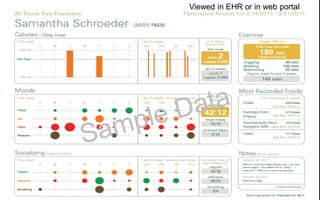
Viewed in EHR or in web portal


                            22
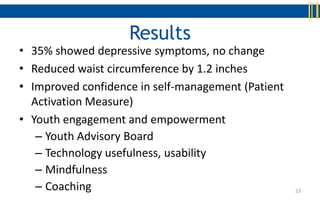
Results
• 35% showed depressive symptoms, no change
• Reduced waist circumference by 1.2 inches
• Improved confidence in self-management (Patient
  Activation Measure)
• Youth engagement and empowerment
   – Youth Advisory Board
   – Technology usefulness, usability
   – Mindfulness
   – Coaching                                       23
Stephen
    Rothemich,
           MD

       Co-Principal
 Investigator, BreathEasy

Virginia Commonwealth
       University
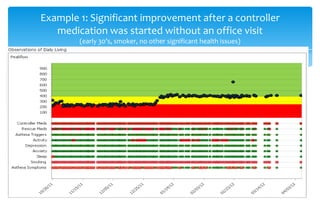
Example 1: Significant improvement after a controller
   medication was started without an office visit
        (early 30’s, smoker, no other significant health issues)
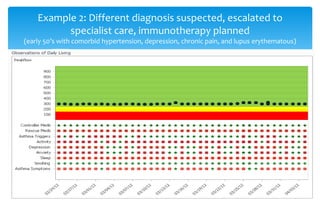
Example 2: Different diagnosis suspected, escalated to
          specialist care, immunotherapy planned
(early 50’s with comorbid hypertension, depression, chronic pain, and lupus erythematous)
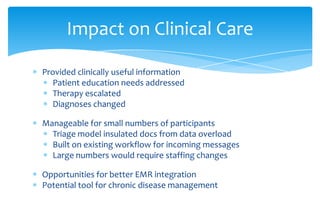
Impact on Clinical Care

Provided clinically useful information
  Patient education needs addressed
  Therapy escalated
  Diagnoses changed

Manageable for small numbers of participants
  Triage model insulated docs from data overload
  Built on existing workflow for incoming messages
  Large numbers would require staffing changes

Opportunities for better EMR integration
Potential tool for chronic disease management
Michael
  Christopher
   Gibbons,
      MD, MPH
National Advisory Council,
  Project HealthDesign

Johns Hopkins Medical
     Institutions
Rapidly Evolving Society


• Prevalence of Chronic Disease
• Burgeoning of the Senior population
• Increasing Longevity
• Rising Healthcare Costs
• Growing population of Minorities,
    immigrants & underserved
Personal Health Records
 Early Innovators
 •   Google Health
 •   Microsoft Health Vault
• Patient Portals
 •   Kaiser Permanente
 •   Practice Fusion
 •   My Personal Health Record
• Technical Innovators (collaboration)
 •   Patients Like Me
 •   Cure Together
RWJF Contribution to the PHR evolution


 Functional Innovation
 •   Many types of data
 •   Variety of platforms


• Knowledge Innovation
 •   Observations of Daily living
Future PHR Opportunities

 Businesses & Developers
 •   Technically Enhanced Solutions
 •   Functionally Superior Solutions
 •   User Focused Solutions

• Improved health outcomes through
 •   Improved Usability
 •   Higher User satisfaction
 •   Better User Experiences
Questions?
projecthealthdesign.org
    Twitter: @PrjHealthDesign
Phd webinar 25sep2012

Phd webinar 25sep2012

  • 1.
    From the iPhoneto the EMR: Can patients’ personal health data help improve their clinical care? Learnings from Project HealthDesign A national program of the Robert Wood Johnson Foundation
  • 2.
    Stephen Downs, SM, FACMI Chief Technology and Information Officer Robert Wood Johnson Foundation
  • 4.
    Project HealthDesign • Engaged five teams to demonstrate a new vision for improved patient care through integration of patient-generated health data • Explored the technical, legal and policy implications of incorporating patient generated data in health care
  • 5.
    • BreathEasy Adults with asthma • Chronology.MD Young adults with Crohn’s Disease • dwellSense Elders at risk of cognitive decline • Estrellita High-risk infants and their caregivers • iN Touch Low-income teens and young adults managing obesity
  • 6.
    Patricia Flatley Brennan, RN, PhD National Program Director, Project HealthDesign University of Wisconsin—Madison
  • 7.
  • 8.
    dwellSense: An application for elders at risk of cognitive decline
  • 9.
    Estrellita: Using ODLsamong Low Birth Weight Infants & their Caregivers
  • 10.
    Chronology.MD: A mobileapplication for adults with inflammatory bowel disease “Every aspect of this work is focused on making patient communications of a complex health condition easier”
  • 11.
    iN Touch: ODLsvia mobile platforms for youth with obesity and depression “We’ll put the health decisions in teens’ hands and extend the support of the clinicians beyond the clinic.”
  • 12.
    BreathEasy: An applicationfor adults with asthma & depression or anxiety “What we're developing will enable patients and clinicians to communicate more quickly and easily . . .”
  • 13.
  • 14.
    Challenges: Data Integration • Third party storage • Integration with EHR
  • 15.
    Why we shouldgo forward – Patient View • ‘I don’t feel so alone’ (patient w/ Crohn’s) • ‘My quality of life has gone way up’. . . ‘my weight is up’ . . . ‘I’m not vomiting every day’ • ‘It’s easier to summarize and share between-visit health events and health status’ • ‘good intentions to use the app, but not enough energy at the end of the day’ (parents of twin at-risk infants and two pre- school kids) • ‘I charge the study phone before my personal cell’ • ‘missed more medication doses than I expected’ (elder at risk)
  • 16.
    Why we shouldgo forward – Provider View • Patient visits and prescriptions decreased • Able to identify when medications weren’t being taken or were taken incorrectly • Adjusted medication regimens • Motivated patients to adhere to treatment plan • Provided a measure of cognitive and functional performance over time
  • 17.
    Project HealthDesign A briefvideo about the project’s latest round of design and evaluation
  • 18.
    Katherine Kim, MPH, MBA, PhD Candidate Co-Principal Investigator, iN Touch San Francisco State University
  • 19.
    Health Happens inReal-time Real-time and Real-life 19
  • 20.
    Low-income, Minority Youth MissionHigh School Public Hospital 20
  • 21.
    Intervention Built byTheCarrot.com 21
  • 22.
    Viewed in EHRor in web portal 22
  • 23.
    Results • 35% showeddepressive symptoms, no change • Reduced waist circumference by 1.2 inches • Improved confidence in self-management (Patient Activation Measure) • Youth engagement and empowerment – Youth Advisory Board – Technology usefulness, usability – Mindfulness – Coaching 23
  • 24.
    Stephen Rothemich, MD Co-Principal Investigator, BreathEasy Virginia Commonwealth University
  • 26.
    Example 1: Significantimprovement after a controller medication was started without an office visit (early 30’s, smoker, no other significant health issues)
  • 27.
    Example 2: Differentdiagnosis suspected, escalated to specialist care, immunotherapy planned (early 50’s with comorbid hypertension, depression, chronic pain, and lupus erythematous)
  • 28.
    Impact on ClinicalCare Provided clinically useful information Patient education needs addressed Therapy escalated Diagnoses changed Manageable for small numbers of participants Triage model insulated docs from data overload Built on existing workflow for incoming messages Large numbers would require staffing changes Opportunities for better EMR integration Potential tool for chronic disease management
  • 29.
    Michael Christopher Gibbons, MD, MPH National Advisory Council, Project HealthDesign Johns Hopkins Medical Institutions
  • 30.
    Rapidly Evolving Society •Prevalence of Chronic Disease • Burgeoning of the Senior population • Increasing Longevity • Rising Healthcare Costs • Growing population of Minorities, immigrants & underserved
  • 31.
    Personal Health Records Early Innovators • Google Health • Microsoft Health Vault • Patient Portals • Kaiser Permanente • Practice Fusion • My Personal Health Record • Technical Innovators (collaboration) • Patients Like Me • Cure Together
  • 32.
    RWJF Contribution tothe PHR evolution  Functional Innovation • Many types of data • Variety of platforms • Knowledge Innovation • Observations of Daily living
  • 33.
    Future PHR Opportunities Businesses & Developers • Technically Enhanced Solutions • Functionally Superior Solutions • User Focused Solutions • Improved health outcomes through • Improved Usability • Higher User satisfaction • Better User Experiences
  • 34.
    Questions? projecthealthdesign.org Twitter: @PrjHealthDesign

Editor's Notes

  • #5 What we have done through Project HealthDesign is piloted how data about observations of daily living – or ODLs – can be collected, interpreted, and acted upon by patients and clinicians. ODLs can include information about things that are personally meaningful to people and that indicate how they feel – such as mood, pain, appetite, sleeping patterns, energy levels, exercise, etc.
  • #6 The five Round 2 Project HealthDesign teams worked with real patients to use new technologies such as smartphones and iPads to collect observations of daily living and share selected ODL data with clinicians in order to improve care.My project involved [provide one-sentence description of your project]. I’m going to talk more about it in a minute.
  • #8 Out of curiosity, I entered the ODLs that the five Round 2 teams will collect into Wordle.What I see is a mix of qualitative (subjective) and quantitative (objective) data.It also points out how important the grantees attention to analysis, interpretation of the raw data is; as well as the display of the analyzed or trended data.
  • #9 Photo: Anind Dey, Associate Professor, and PhD student Matthew Lee, both of the Human Computer Interaction department at Carnegie Mellon, with their smart pill boxCredit: Pittsburgh Post-Gazzette It is often hard to detect subtle changes in everyday activities – such as the loss of the ability to make a sandwich, dial a phone, or take medications correctly – that could indicate the onset of dementia or physical decline in adults who live alone. Carnegie Mellon Universitywill develop and evaluate new technology that will monitor the routine of older individuals who have arthritis and are at risk for cognitive decline, providing trustworthy data for long-term functional assessment and treatment. The technology will monitor routine tasks such as taking medication, movement around the home and cooking. It will then present the information to key stakeholders including participants, caregivers and clinicians, so that they can detect and better understand the individual’s changing cognitive and physical abilities. By identifying decline at an early stage, caregivers will have a chance to halt or even reverse deterioration that might otherwise result in an unsafe living situation and ultimately require the person to be institutionalized.
  • #10 Photo: The FitBaby team constructing sensors to place in cribs to observe flatus Early-life health decisions for pre-term, low birth weight babies can make a big difference in how well they do down the road. The University of California, Irvine and Charles Drew University will create a mobile device for collecting information from pre-term low birth weight infants and their primary caregivers that will allow them to more easily interface with their health care providers to improve care and communication. Caregivers will use a specially designed mobile device, FitBaby, to record observations of daily living (ODLs) such as the baby’s temperament, exercise, feeding and sleeping schedules, as well as the caregiver’s stress level and attitude swings. Providing nearly real-time data to clinicians will help alert them to early signs of health problems, which is crucial in treating low birth weight infants. The project is unique both in its goals of incorporating patient-generated information into a clinical setting and also because it collects information about the primary patients and their caregivers.
  • #11 Quote: “easier…by weaving together innovative technologies that enhance and extend the patient voice.”Nikolai Kirienko, Project Director, University of California, BerkeleyThere are 600,000 people in the United States who suffer from the digestive disorder Crohn’s disease. The disease is most prevalent in young adults ages 18 to 35 and can not only be complicated and expensive to treat but also has significant social and emotional implications. The University of California, Berkeley in partnership with The Healthy Communities Foundation and the University of California, San Francisco will help young adults who suffer from the disease create visual narratives of their condition and treatment to provide concrete feedback to providers about how they feel from day to day. The project will include patients tracking observations of daily living (ODLs) such as physical symptoms like diarrhea, bleeding and profound weight loss, along with more complex social and emotional observations. The information will then be shared with the provider and discussed during their clinical appointments to help the patient and clinician get a more accurate picture of what’s happening between appointments with the goal of being able to reduce exacerbation of symptoms and undesired consequences of treatment, ultimately increasing the quality of the patient’s life and care.
  • #12 Quote: Katherine Kim, Co-Principal Investigator, San Francisco State UniversityYouth from low-income backgrounds suffer disproportionately high rates of obesity. San Francisco State University will examine the potential of collecting observations of daily living (ODLs) via smartphones for low-income teens that are simultaneously managing obesity and depression. Partnering with San Francisco General Hospital's Teen Clinic the project will utilize smartphone technology – wildly popular among young people – to make monitoring ODLs such as physical activity, food intake and mood easier and more convenient, thus making it more likely that they will enter the requested data at the appropriate times. In addition, the technology will allow the teens to easily share the data with their care team in order to help set health goals, track their progress and ultimately improve their physical and mental health.
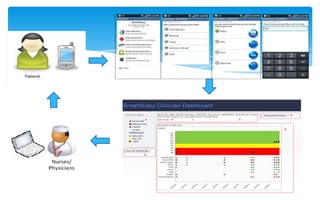
  • #13 Quote: “easily…and more accurately track environmental and behavioral effects on our health.“Barbara L. Massoudi, Principal Investigator, RTI InternationalAsthma is a common, chronic illness, affecting over 23 million adults in this country. In addition to respiratory symptoms associated with the disease, individuals with asthma are also more likely to experience depression and anxiety. RTI International and Virginia Commonwealth University will design a personal health record application, BreathEasy, building on the latest clinical guidelines for treatment and self-monitoring for patients with asthma and depression. Patients will interact with the application through smartphone mobile devices and biomonitors to capture and report observations of daily living (ODLs) such as use of controller and rescue medications, symptom levels, quality of life and smoking. Clinicians will utilize a Web-based dashboard providing simple analysis and visualization tools that allow them to quickly view their patients’ data, evaluate their health status and communicate any changes in treatment or monitoring. By providing a clearer picture of their health in everyday life, the ODLs will be used by both the patients and their clinicians to make lifestyle and treatment adjustments that will better manage their asthma and depression.
  • #21 Cohort 150% Hispanic/Latino21% African American12% Asian/Pacific Islander3% Native (1)3% Multi (1)74% FemaleCohort 2:11 52% Hispanic5 24% African American5% Asian5% Multi (1)57%
  • #22 iPod Touch ODL trackers, journaling, picturesiMessage, Wifi finderMotivational inteviewing-based health coaching
  • #23 Providers: 4 physicians, 1 school nurseWeekly summaries in the EHR or through web portal