Corporate
Developing a
smokefree
organisation
Jane
Beenstock,
Public
health
consultant
Developing a smokefree
organisation
 Why?
 How?
 The challenges
Corporate
Lancashire Care NHS
Foundation Trust (LCFT)
LCFT provides health and wellbeing services
for a population of around 1.5 million people
within the Lancashire and South Cumbria
footprint, including specialist commissioned
services for the wider population of the North
West region.
Our range of services includes a portfolio of
integrated physical and mental health
services, with both inpatient and community
provision, across children and adults.
We currently employ around 7,000 staff
across more than 400 sites.
The map shows the footprint of LCFT and the
CCG boundaries along with the local authority
boundaries.
CCG Key
Lancashire North
East Lancashire
Greater Preston
Fylde & Wyre
Blackpool
Chorley & South Ribble
West Lancashire
Blackburn with Darwen
Corporate
Major causes of death in England
Corporate
Corporate
Why?
Corporate
Source: Public Health England
44,000 fewer deaths
would occur if people
with SMIs had the
same mortality rate as
the general
population
(1) Chang C-K, Hayes RD, Perera G, Broadbent MTM, Fernandes AC, et al. (2011) Life Expectancy at Birth for People with Serious Mental Illness and Other Major Disorders
from a Secondary Mental Health Care Case Register in London. PLoS ONE 6(5): e19590. doi:10.1371/journal.pone.0019590
(2) Brown S, Kim M, Mitchell C et al (2010) Twenty-five year mortality of a community cohort with schizophrenia. British Journal of Psychiatry 196:116-21.
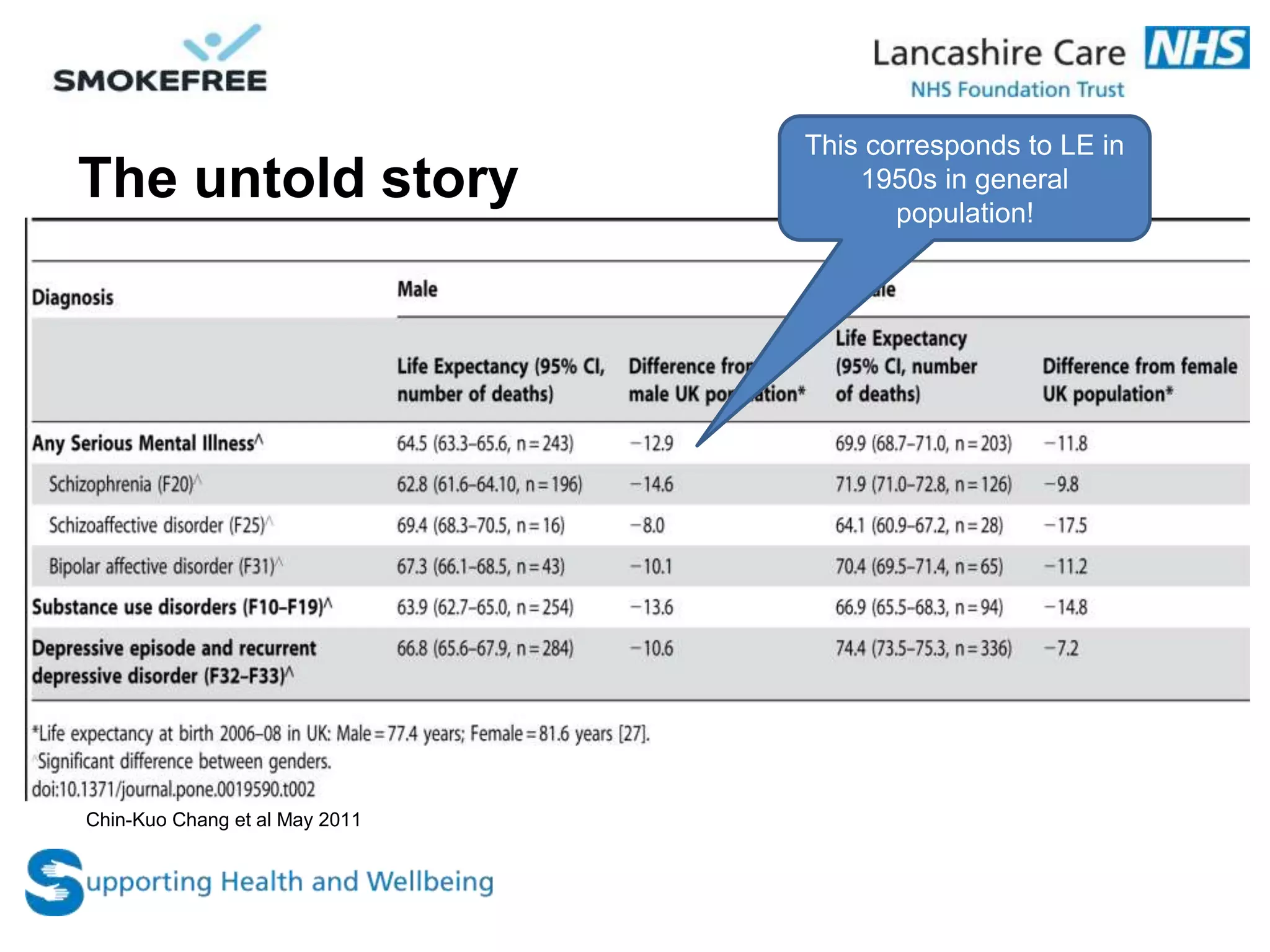
The untold story
This corresponds to LE in
1950s in general
population!
Chin-Kuo Chang et al May 2011
Corporate
Source: Public Health England
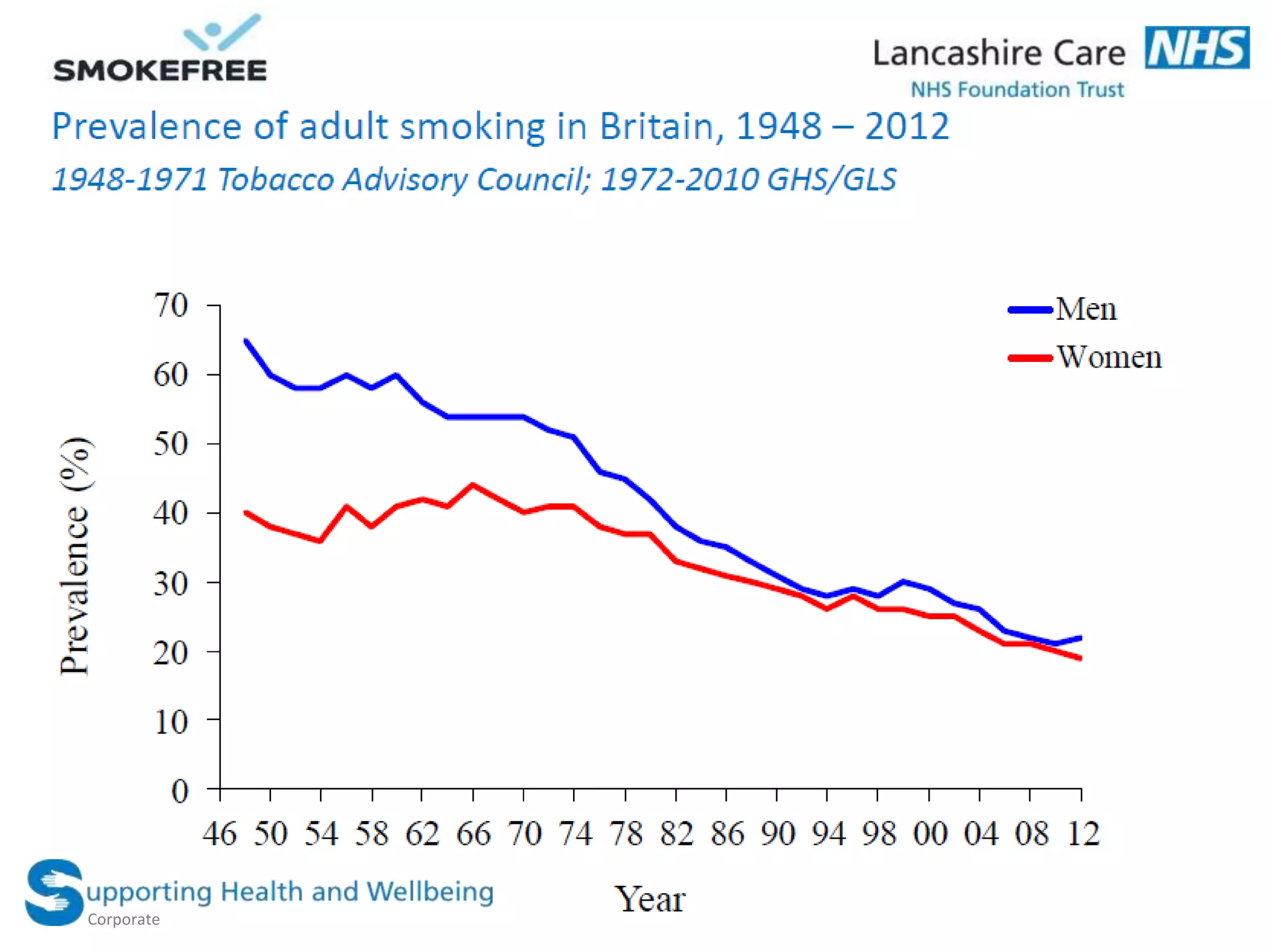
Smoking prevalence
20
Mins
Your blood pressure and pulse rate return to normal
8
Hours
Nicotine and carbon monoxide levels in your blood half,
oxygen levels return to normal
24
Hours
Your lungs start to clear out mucus and carbon
monoxide is eliminated.
48
Hours
There is no nicotine in the body. Ability to taste and
smell is greatly improved
72
Hours
Your breathing becomes easier and energy levels
increase
3-9
Months
Improvement with coughing, wheezing and breathing,
lung function is increased by up to 10%
5
Years
Risk of stroke falls to about the same as a non-smoker
10
Years
Risk of lung cancer falls to half that of a smoker and risk
of heart attack falls to the same as a non-smoker
Corporate
Corporate
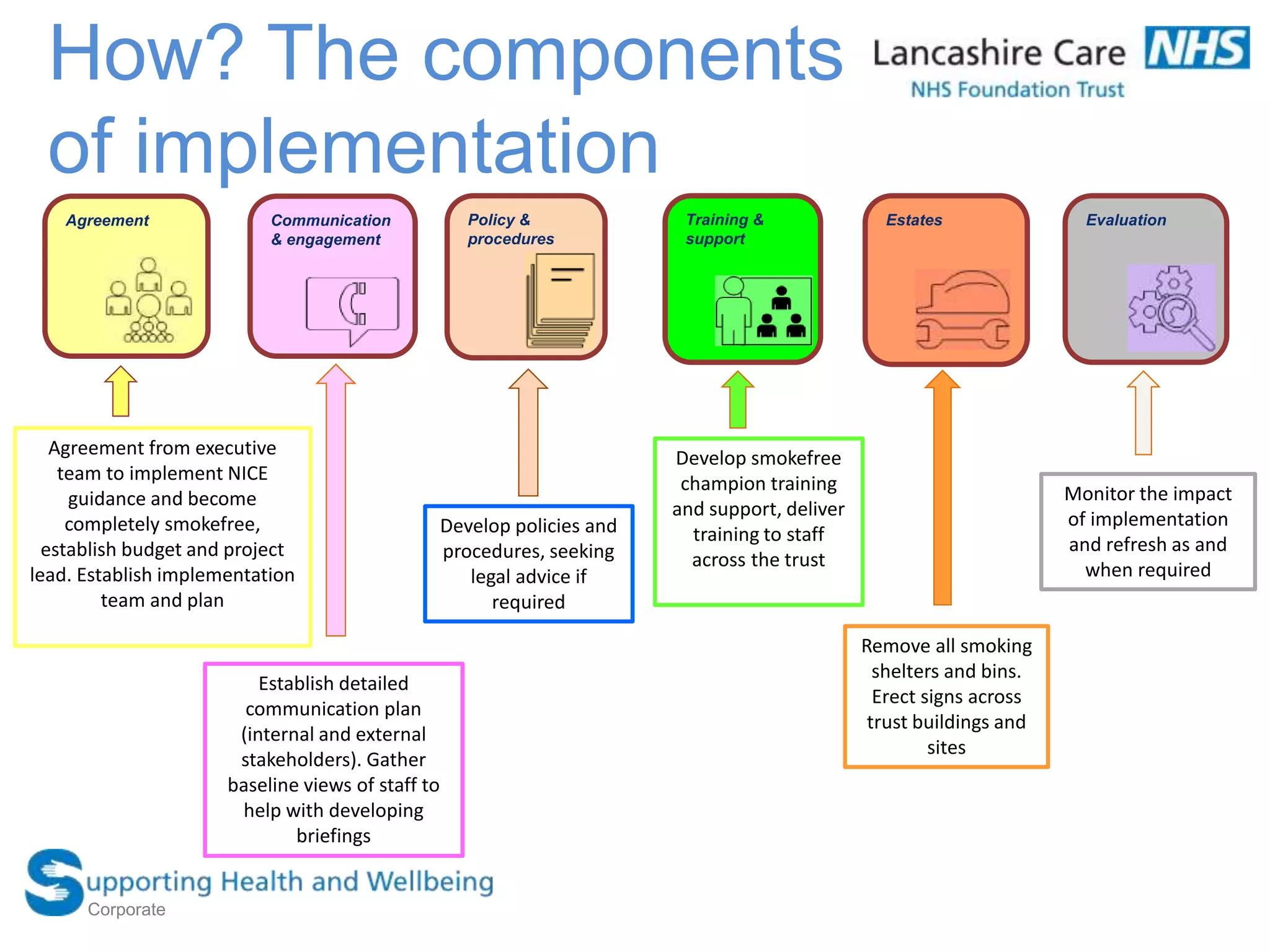
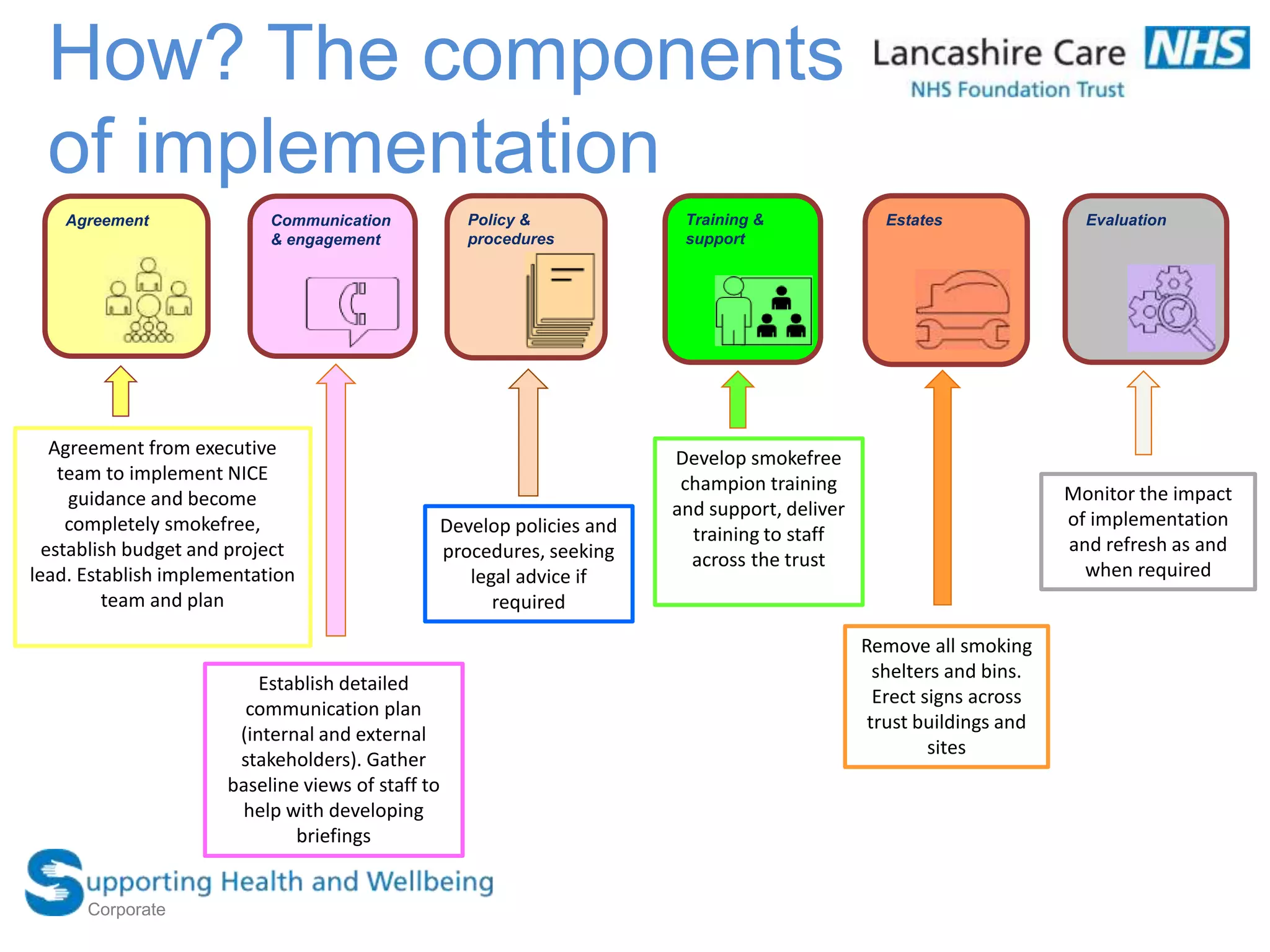
How? The components
of implementation
Corporate
EvaluationAgreement Communication
& engagement
Training &
support
EstatesPolicy &
procedures
Agreement from executive
team to implement NICE
guidance and become
completely smokefree,
establish budget and project
lead. Establish implementation
team and plan
Establish detailed
communication plan
(internal and external
stakeholders). Gather
baseline views of staff to
help with developing
briefings
Monitor the impact
of implementation
and refresh as and
when required
Develop policies and
procedures, seeking
legal advice if
required
Develop smokefree
champion training
and support, deliver
training to staff
across the trust
Remove all smoking
shelters and bins.
Erect signs across
trust buildings and
sites
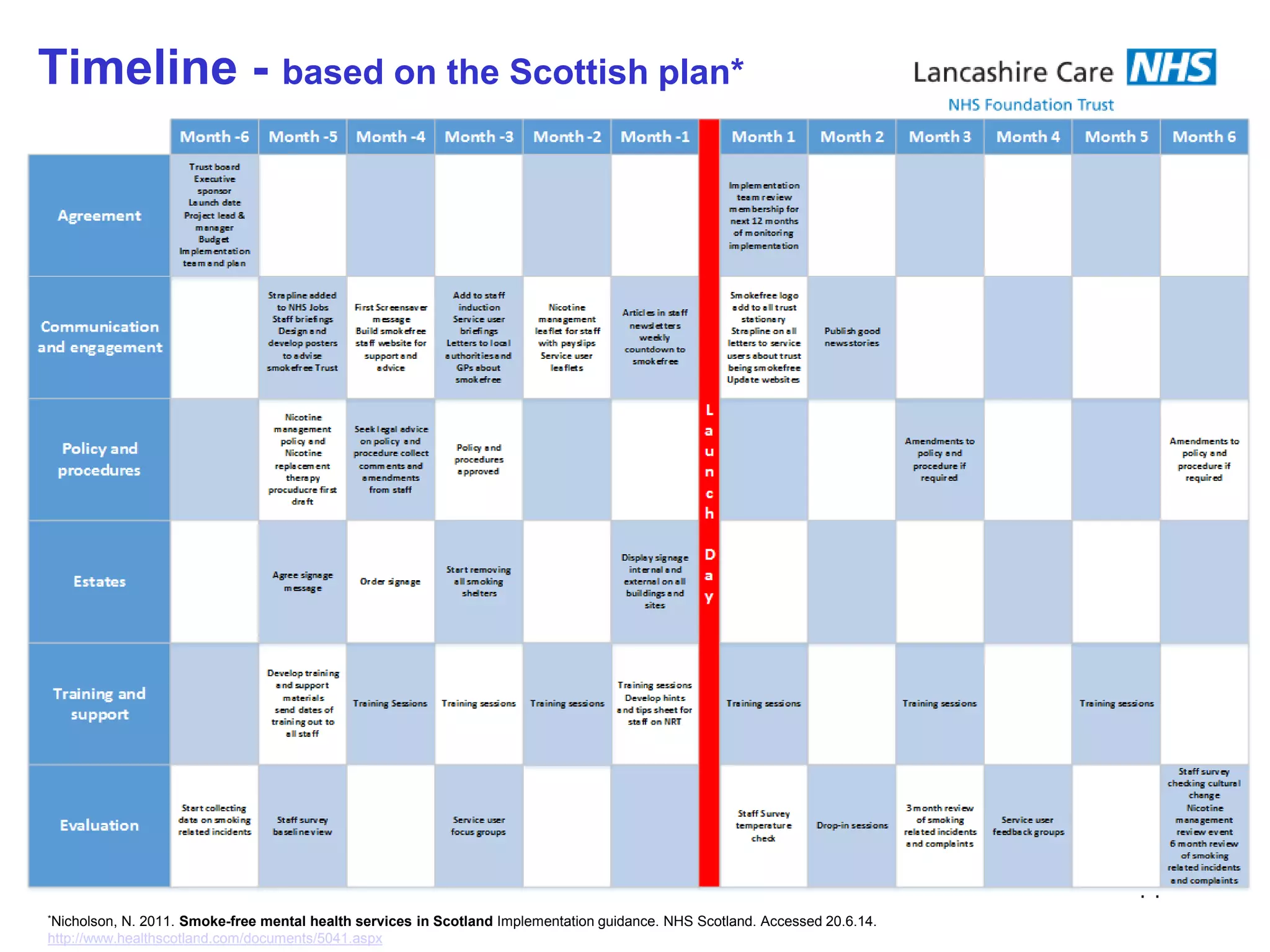
Timeline - based on the Scottish plan*
14
*Nicholson, N. 2011. Smoke-free mental health services in Scotland Implementation guidance. NHS Scotland. Accessed 20.6.14.
http://www.healthscotland.com/documents/5041.aspx
Challenges
 Training and NRT
 Culture - mixed views among staff
and service users
 The media
 Relations with neighbours
 Reframe smoking
 e-cigarettes
Corporate
Challenges: training and NRT
 Time to release staff
 Knowledge and skills to use NRT
Corporate
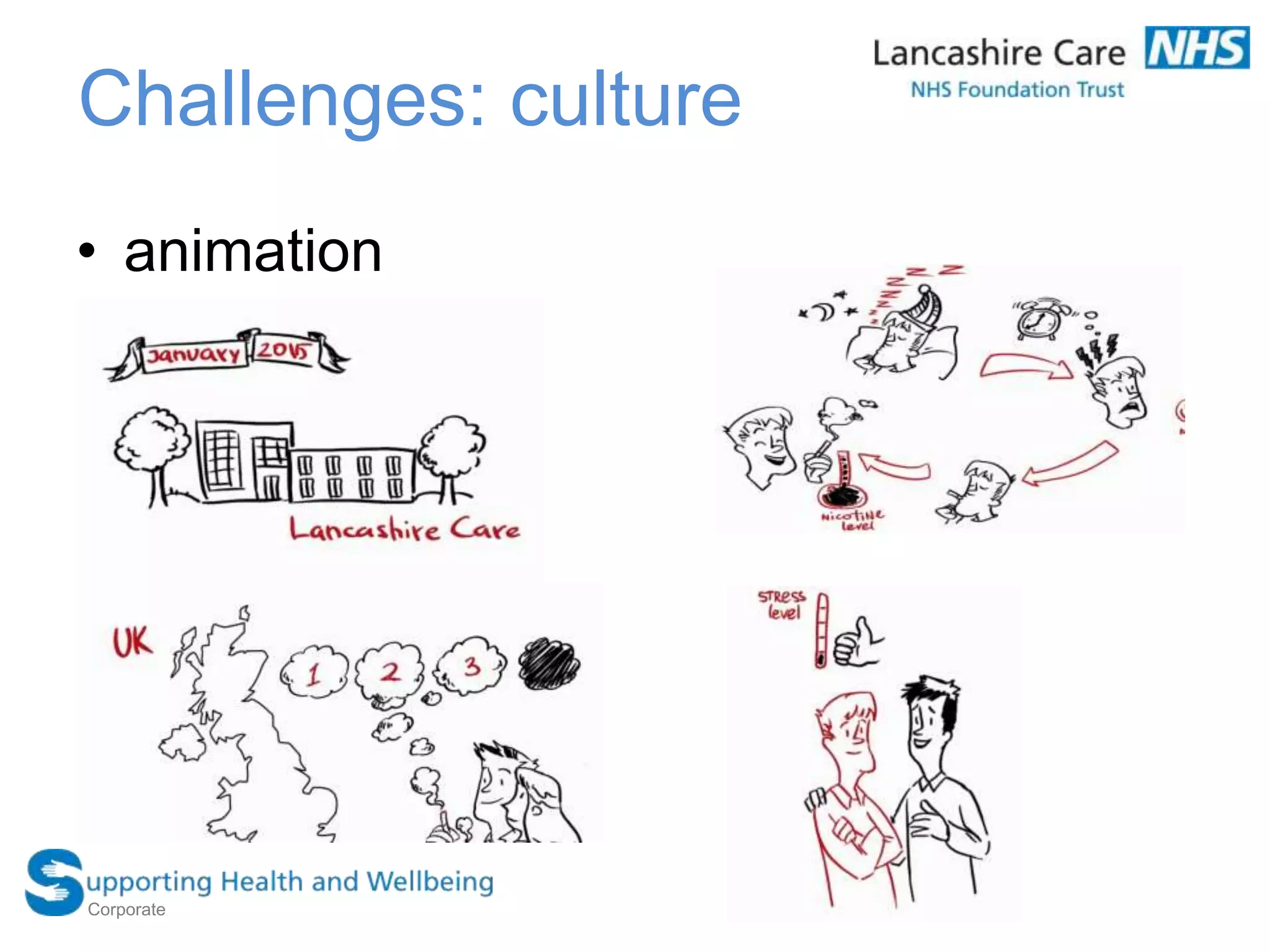
Challenges: culture
• animation
Corporate
Corporate
http://www.youtube.com/embed/-5yYbVDw_dw
Challenges: the media
Corporate
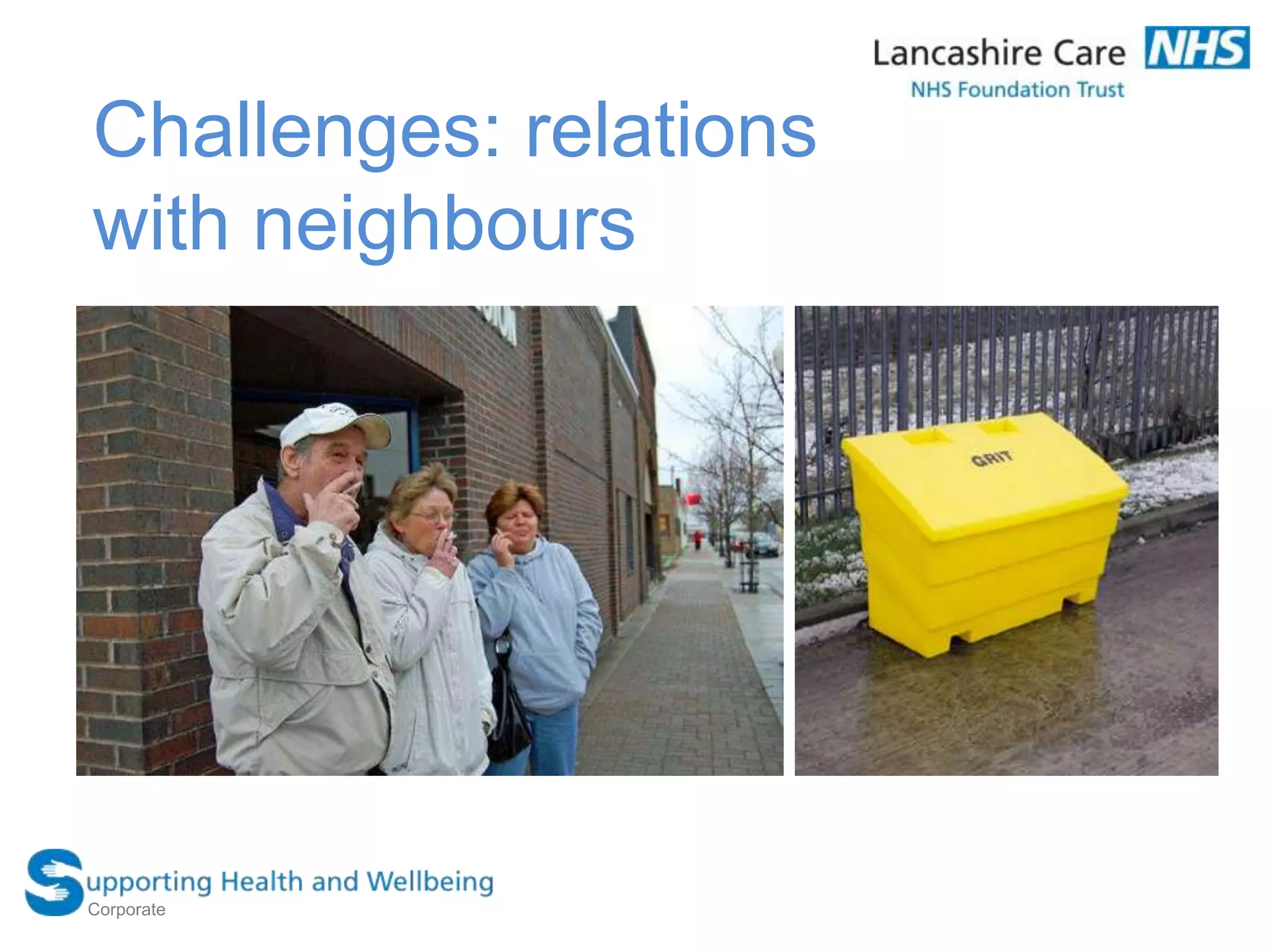
Challenges: relations
with neighbours
Corporate
Challenges: reframing
Corporate
Corporate
An addiction is not a choice
Corporate
Corporate
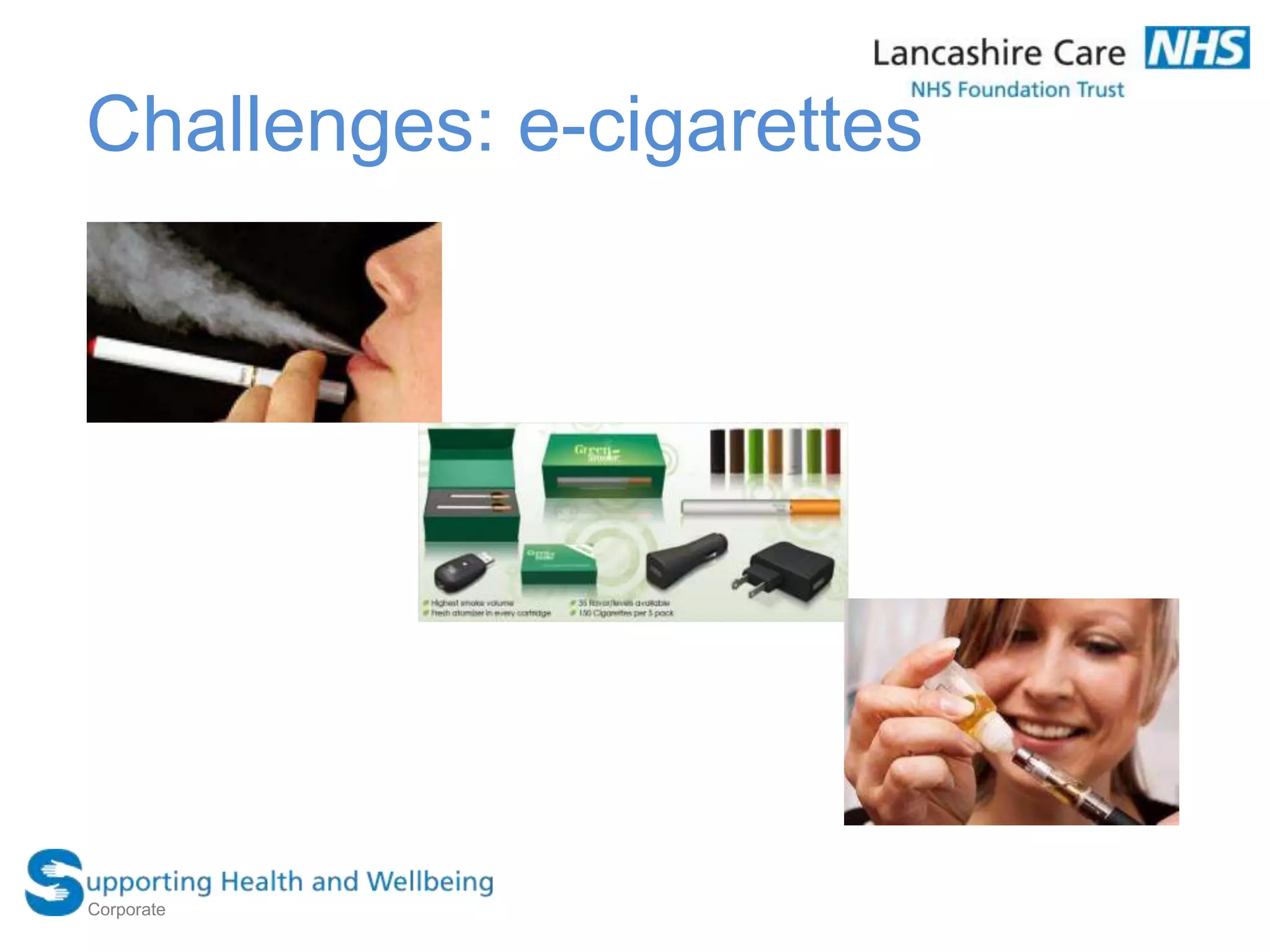
Challenges: e-cigarettes
Corporate
Successes
 Service user engagement
 New ways to communicate
Corporate
Service user involvement
• Focus groups held to discuss the policy
• Animation designed by service users
for service users
• Posters designed by service users
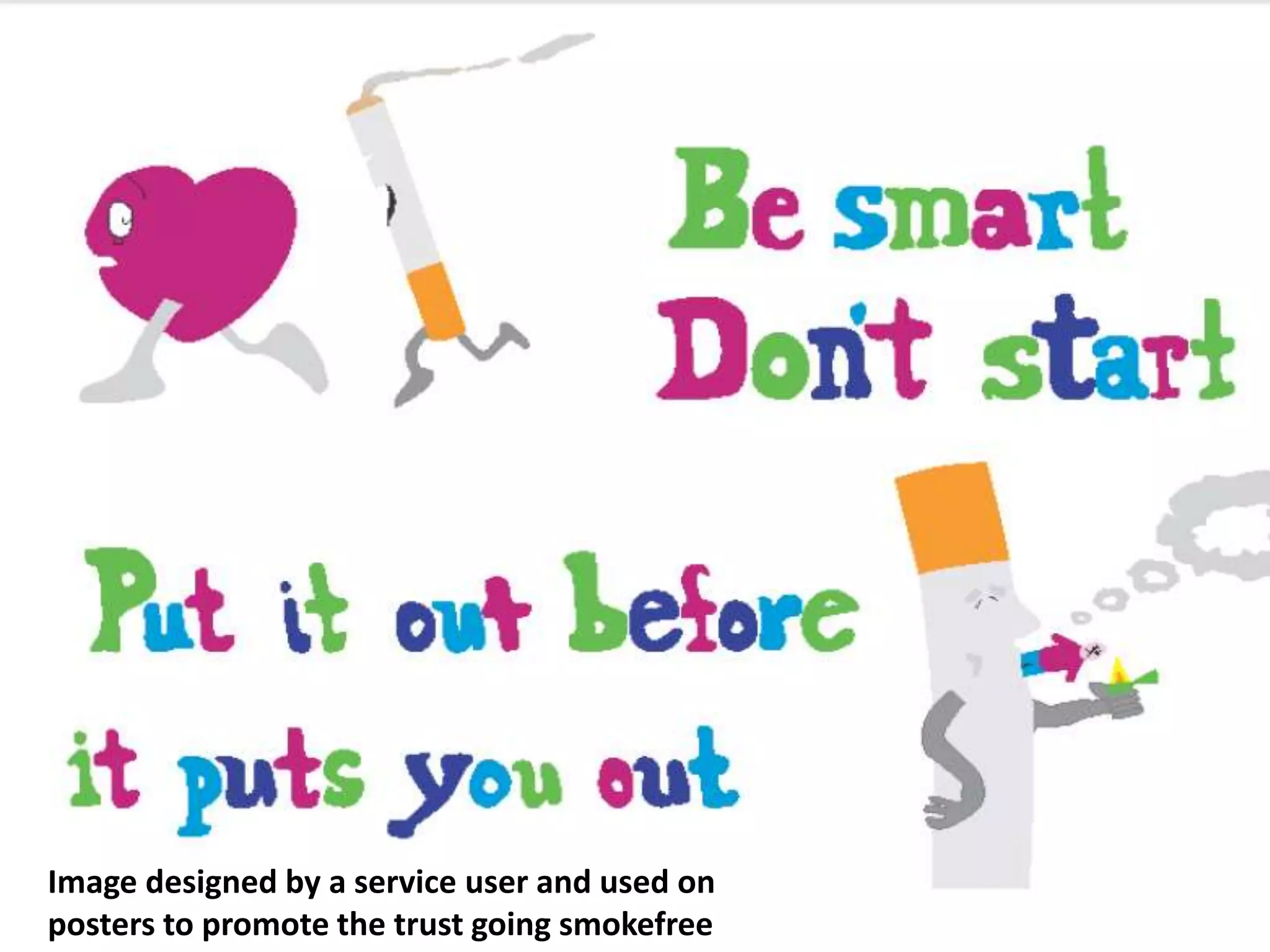
Image designed by a service user and used on
posters to promote the trust going smokefree
5th January 2015 Nicotine
Management Policy introduced
“Staff and other service users supported and helped me first give up
cigarettes and then reduce my addiction to nicotine. They believed in me
and eventually so did I. I say “I can beat cigarettes they no longer own
me!” (Guild service user)
Feedback from service
users has resulted in policy
updates
Quit rate = 26% of (95) service users
at Guild Lodge who were seen in
clinic as attempting to quit
Service users who had quit smoking were
presented with a certificate and vouchers
by the Trust’s Chief Executive Heather
Tierney-Moore, who said:
“It was a delight to be able to present the
service users with their awards and mark
such a fantastic achievement. To be able
to stop smoking is a great achievement. It
was good to hear about their stop
smoking journeys and the reasons behind
wanting to quit, which included both
health and financial benefits.”
Acknowledgments
 Andy Hesketh, Human Resources Advisor
 Barbara Hummer, Brian Lawson, Staff Side Lead Rep, Staff Governor
 Caroline Waterworth, Deputy Clinical Director, Children and Families
 Dawn Kenyon, Quality Improvement and Experience Senior Officer
 Gareth Lewis, Clinical Specialist Nurse
 Gillian Penson, Psychologist
 Heather Harrison, Stop Smoking Service Lead
 Jacquetta Hardacre, now Tania Derbyshire, Project Manager for Medical Directorate
 John Pascoe, Programme manager for fire, H&S, estates and facilities
 Tracy Topham, Stop Smoking Service Lead
 Julie Trezise, Stop Smoking Service Manager
 Lorna McGlynn, Physical Health Care Lead
 Nafisa Motora, Administration Support to Consultants in Public Health
 Pam Tester, NICE Implementation Lead
 Paul Morris, Risk Manager and Staff Governor
 Sarah Regan, Communications Officer
 Catherine Harding, Lead Pharmacist
 Yvonne Guilfoyle, Practice & Quality Development Lead, Adult Mental Health Network
Corporate
Service user animation
https://youtu.be/sPq6Z9yWP3Y
32
How? The components
of implementation
Corporate
EvaluationAgreement Communication
& engagement
Training &
support
EstatesPolicy &
procedures
Agreement from executive
team to implement NICE
guidance and become
completely smokefree,
establish budget and project
lead. Establish implementation
team and plan
Establish detailed
communication plan
(internal and external
stakeholders). Gather
baseline views of staff to
help with developing
briefings
Monitor the impact
of implementation
and refresh as and
when required
Develop policies and
procedures, seeking
legal advice if
required
Develop smokefree
champion training
and support, deliver
training to staff
across the trust
Remove all smoking
shelters and bins.
Erect signs across
trust buildings and
sites

Developing a smoke free organisation (1 of 2)

  • 1.
  • 2.
    Developing a smokefree organisation Why?  How?  The challenges Corporate
  • 3.
    Lancashire Care NHS FoundationTrust (LCFT) LCFT provides health and wellbeing services for a population of around 1.5 million people within the Lancashire and South Cumbria footprint, including specialist commissioned services for the wider population of the North West region. Our range of services includes a portfolio of integrated physical and mental health services, with both inpatient and community provision, across children and adults. We currently employ around 7,000 staff across more than 400 sites. The map shows the footprint of LCFT and the CCG boundaries along with the local authority boundaries. CCG Key Lancashire North East Lancashire Greater Preston Fylde & Wyre Blackpool Chorley & South Ribble West Lancashire Blackburn with Darwen
  • 4.
  • 6.
    Major causes ofdeath in England Corporate
  • 7.
  • 8.
    Why? Corporate Source: Public HealthEngland 44,000 fewer deaths would occur if people with SMIs had the same mortality rate as the general population (1) Chang C-K, Hayes RD, Perera G, Broadbent MTM, Fernandes AC, et al. (2011) Life Expectancy at Birth for People with Serious Mental Illness and Other Major Disorders from a Secondary Mental Health Care Case Register in London. PLoS ONE 6(5): e19590. doi:10.1371/journal.pone.0019590 (2) Brown S, Kim M, Mitchell C et al (2010) Twenty-five year mortality of a community cohort with schizophrenia. British Journal of Psychiatry 196:116-21.
  • 9.
    The untold story Thiscorresponds to LE in 1950s in general population! Chin-Kuo Chang et al May 2011
  • 10.
    Corporate Source: Public HealthEngland Smoking prevalence
  • 11.
    20 Mins Your blood pressureand pulse rate return to normal 8 Hours Nicotine and carbon monoxide levels in your blood half, oxygen levels return to normal 24 Hours Your lungs start to clear out mucus and carbon monoxide is eliminated. 48 Hours There is no nicotine in the body. Ability to taste and smell is greatly improved 72 Hours Your breathing becomes easier and energy levels increase 3-9 Months Improvement with coughing, wheezing and breathing, lung function is increased by up to 10% 5 Years Risk of stroke falls to about the same as a non-smoker 10 Years Risk of lung cancer falls to half that of a smoker and risk of heart attack falls to the same as a non-smoker Corporate
  • 12.
  • 13.
    How? The components ofimplementation Corporate EvaluationAgreement Communication & engagement Training & support EstatesPolicy & procedures Agreement from executive team to implement NICE guidance and become completely smokefree, establish budget and project lead. Establish implementation team and plan Establish detailed communication plan (internal and external stakeholders). Gather baseline views of staff to help with developing briefings Monitor the impact of implementation and refresh as and when required Develop policies and procedures, seeking legal advice if required Develop smokefree champion training and support, deliver training to staff across the trust Remove all smoking shelters and bins. Erect signs across trust buildings and sites
  • 14.
    Timeline - basedon the Scottish plan* 14 *Nicholson, N. 2011. Smoke-free mental health services in Scotland Implementation guidance. NHS Scotland. Accessed 20.6.14. http://www.healthscotland.com/documents/5041.aspx
  • 15.
    Challenges  Training andNRT  Culture - mixed views among staff and service users  The media  Relations with neighbours  Reframe smoking  e-cigarettes Corporate
  • 16.
    Challenges: training andNRT  Time to release staff  Knowledge and skills to use NRT Corporate
  • 17.
  • 18.
  • 19.
  • 20.
  • 21.
  • 22.
  • 23.
  • 24.
  • 25.
  • 26.
    Successes  Service userengagement  New ways to communicate Corporate
  • 27.
    Service user involvement •Focus groups held to discuss the policy • Animation designed by service users for service users • Posters designed by service users
  • 28.
    Image designed bya service user and used on posters to promote the trust going smokefree
  • 30.
    5th January 2015Nicotine Management Policy introduced “Staff and other service users supported and helped me first give up cigarettes and then reduce my addiction to nicotine. They believed in me and eventually so did I. I say “I can beat cigarettes they no longer own me!” (Guild service user) Feedback from service users has resulted in policy updates Quit rate = 26% of (95) service users at Guild Lodge who were seen in clinic as attempting to quit Service users who had quit smoking were presented with a certificate and vouchers by the Trust’s Chief Executive Heather Tierney-Moore, who said: “It was a delight to be able to present the service users with their awards and mark such a fantastic achievement. To be able to stop smoking is a great achievement. It was good to hear about their stop smoking journeys and the reasons behind wanting to quit, which included both health and financial benefits.”
  • 31.
    Acknowledgments  Andy Hesketh,Human Resources Advisor  Barbara Hummer, Brian Lawson, Staff Side Lead Rep, Staff Governor  Caroline Waterworth, Deputy Clinical Director, Children and Families  Dawn Kenyon, Quality Improvement and Experience Senior Officer  Gareth Lewis, Clinical Specialist Nurse  Gillian Penson, Psychologist  Heather Harrison, Stop Smoking Service Lead  Jacquetta Hardacre, now Tania Derbyshire, Project Manager for Medical Directorate  John Pascoe, Programme manager for fire, H&S, estates and facilities  Tracy Topham, Stop Smoking Service Lead  Julie Trezise, Stop Smoking Service Manager  Lorna McGlynn, Physical Health Care Lead  Nafisa Motora, Administration Support to Consultants in Public Health  Pam Tester, NICE Implementation Lead  Paul Morris, Risk Manager and Staff Governor  Sarah Regan, Communications Officer  Catherine Harding, Lead Pharmacist  Yvonne Guilfoyle, Practice & Quality Development Lead, Adult Mental Health Network Corporate
  • 32.
  • 33.
    How? The components ofimplementation Corporate EvaluationAgreement Communication & engagement Training & support EstatesPolicy & procedures Agreement from executive team to implement NICE guidance and become completely smokefree, establish budget and project lead. Establish implementation team and plan Establish detailed communication plan (internal and external stakeholders). Gather baseline views of staff to help with developing briefings Monitor the impact of implementation and refresh as and when required Develop policies and procedures, seeking legal advice if required Develop smokefree champion training and support, deliver training to staff across the trust Remove all smoking shelters and bins. Erect signs across trust buildings and sites