Process Improvement Workshop Scott Miller [email_address] 937-781-1068 Dan Dupree [email_address] 937-781-1061 Learn. Perform. Succeed.
Workshop Objectives Philosophies Tools  Applications Soft Skills
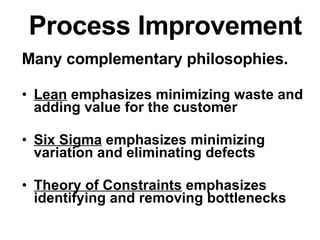
Process Improvement Many complementary philosophies. Lean  emphasizes minimizing waste and adding value for the customer Six Sigma  emphasizes minimizing variation and eliminating defects Theory of Constraints  emphasizes identifying and removing bottlenecks
Keys to Successful Implementation Journey Mindset Visible Leadership Support Mutual Trust Aligned Reward System This is a Culture Change
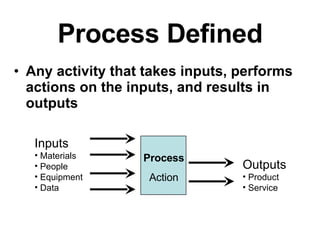
Process Defined Any activity that takes inputs, performs actions on the inputs, and results in outputs Process Action Inputs Materials People Equipment Data Outputs Product Service
Three Views of a Process Policy (documented) Leadership View as applied What is really happening
Value Stream Analysis (a useful tool)
Define the Boundaries What is the process? Where does it start? Where does it end? What do you control? What can you influence? What do you need to adapt to? Depends on your perspective
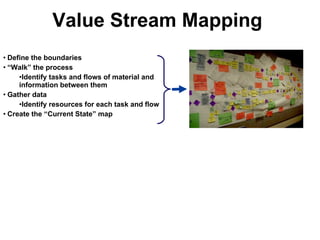
Value Stream Mapping Define the boundaries “ Walk” the process Identify tasks and flows of material and information between them Gather data Identify resources for each task and flow Create the “Current State” map
Analyze Current Conditions Identify value added  Identify waste
Voice of the Customer What does the customer want? What will the customer trade resources to get? Money Time People Not what we say we can deliver because of our current approach
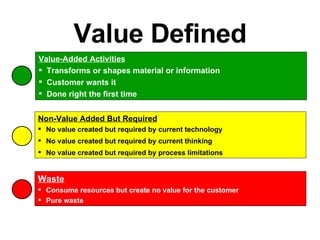
Value Defined Value-Added Activities Transforms or shapes material or information Customer wants it Done right the first time Non-Value Added But Required No value created but required by current technology No value created but required by current thinking No value created but required by process limitations Waste Consume resources but create no value for the customer Pure waste
Eliminate Waste  Types of Waste Defects Over Production Transportation Movement Waiting Inventory Over Processing Lost Creativity
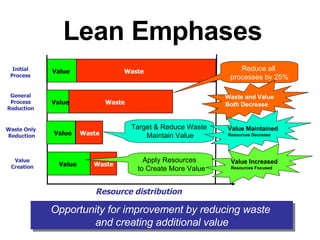
Lean Emphases Resource distribution Opportunity for improvement by reducing waste  and creating additional value Value Waste Initial Process Value Waste General Process Reduction Reduce all  processes by 25% Waste and Value  Both Decrease Waste Only  Reduction Value Waste Target & Reduce Waste  Maintain Value Value Maintained Resources Decrease Value Creation Value Waste Apply Resources  to Create More Value Value Increased Resources Focused
Visualize “Ideal State” What if there were no restrictions?
Doing what you’ve always done and expecting different results INSANITY
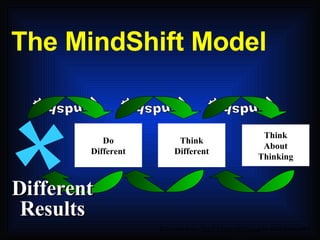
The MindShift Model Extracted from  The 7 Levels of Change  by Rolf Smith1997 Do Different Mindshift Different Results Think Different Mindshift Think About Thinking Mindshift
Create “Future State” Map Change the process  Eliminate waste  Maximize value
Change Up ‘Til Now….  From Now On….
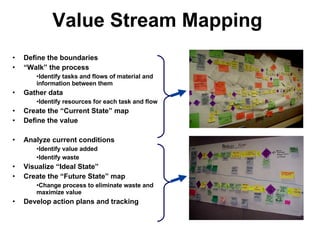
Value Stream Mapping Define the boundaries “ Walk” the process Identify tasks and flows of material and information between them Gather data Identify resources for each task and flow Create the “Current State” map Define the value Analyze current conditions Identify value added  Identify waste Visualize “Ideal State” Create the “Future State” map Change process to eliminate waste and maximize value Develop action plans and tracking
ositive nteresting hallenges P I C
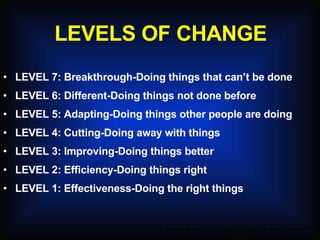
LEVELS OF CHANGE LEVEL 7: Breakthrough-Doing things that can’t be done LEVEL 6: Different-Doing things not done before  LEVEL 5: Adapting-Doing things other people are doing LEVEL 4: Cutting-Doing away with things LEVEL 3: Improving-Doing things better LEVEL 2: Efficiency-Doing things right LEVEL 1: Effectiveness-Doing the right things Extracted from  The 7 Levels of Change  by Rolf Smith1997
Lean and Six Sigma Lean and Six Sigma are complementary process improvement philosophies. Lean emphasizes minimizing waste and adding value for the customer Six Sigma emphasizes minimizing variation and eliminating defects
Statistically Speaking… Variation is the difference between the actual value and what that value was expected (or desired) to be. The Standard Deviation (Sigma (  )) is a quantitative measure of the variation of individual data items about the mean (expected value) of those items. People notice variation.
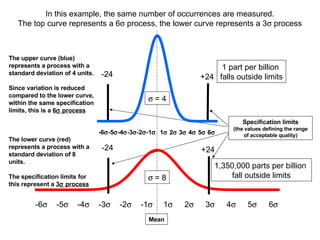
1 part per billion  falls outside limits 1,350,000 parts per billion  fall outside limits In this example, the same number of occurrences are measured. The top curve represents a 6   process, the lower curve represents a 3   process The lower curve (red) represents a process with a standard deviation of 8 units.  The specification   limits for this represent a  3   process The upper curve (blue) represents a process with a standard deviation of 4 units. Since variation is reduced  compared to the lower curve, within the same specification limits, this is a  6   process Specification limits (the values defining the range of acceptable quality)  = 4 -24 +24  = 8 2  1  3  4  5  6  -5  -6  -4  -3  -2  -1  2  1  3  4  5  6  -5  -6  -4  -3  -2  -1  -24 +24 Mean
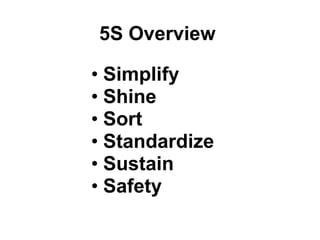
5S Overview Simplify Shine Sort Standardize Sustain Safety
DAU Continuous Learning Center https://learn.dau.mil/html/clc/Clc.jsp select the "Course Information & Access" link.  CLE 004, Introduction to Lean Enterprise Concepts CLE 008, Six Sigma: Concepts and Process CLE 007, Lean-Six Sigma CLE 001, Value Engineering.  CLE 015,  Continuous Process Improvement Familiarization.
Thank you for Participating Scott Miller [email_address] 937-781-1068 Dan Dupree [email_address] 937-781-1061 Learn. Perform. Succeed.

Process Improvement Workshop

  • 1.
    Process Improvement WorkshopScott Miller [email_address] 937-781-1068 Dan Dupree [email_address] 937-781-1061 Learn. Perform. Succeed.
  • 2.
    Workshop Objectives PhilosophiesTools Applications Soft Skills
  • 3.
    Process Improvement Manycomplementary philosophies. Lean emphasizes minimizing waste and adding value for the customer Six Sigma emphasizes minimizing variation and eliminating defects Theory of Constraints emphasizes identifying and removing bottlenecks
  • 4.
    Keys to SuccessfulImplementation Journey Mindset Visible Leadership Support Mutual Trust Aligned Reward System This is a Culture Change
  • 5.
    Process Defined Anyactivity that takes inputs, performs actions on the inputs, and results in outputs Process Action Inputs Materials People Equipment Data Outputs Product Service
  • 6.
    Three Views ofa Process Policy (documented) Leadership View as applied What is really happening
  • 7.
    Value Stream Analysis(a useful tool)
  • 8.
    Define the BoundariesWhat is the process? Where does it start? Where does it end? What do you control? What can you influence? What do you need to adapt to? Depends on your perspective
  • 9.
    Value Stream MappingDefine the boundaries “ Walk” the process Identify tasks and flows of material and information between them Gather data Identify resources for each task and flow Create the “Current State” map
  • 10.
    Analyze Current ConditionsIdentify value added Identify waste
  • 11.
    Voice of theCustomer What does the customer want? What will the customer trade resources to get? Money Time People Not what we say we can deliver because of our current approach
  • 12.
    Value Defined Value-AddedActivities Transforms or shapes material or information Customer wants it Done right the first time Non-Value Added But Required No value created but required by current technology No value created but required by current thinking No value created but required by process limitations Waste Consume resources but create no value for the customer Pure waste
  • 13.
    Eliminate Waste Types of Waste Defects Over Production Transportation Movement Waiting Inventory Over Processing Lost Creativity
  • 14.
    Lean Emphases Resourcedistribution Opportunity for improvement by reducing waste and creating additional value Value Waste Initial Process Value Waste General Process Reduction Reduce all processes by 25% Waste and Value Both Decrease Waste Only Reduction Value Waste Target & Reduce Waste Maintain Value Value Maintained Resources Decrease Value Creation Value Waste Apply Resources to Create More Value Value Increased Resources Focused
  • 15.
    Visualize “Ideal State”What if there were no restrictions?
  • 16.
    Doing what you’vealways done and expecting different results INSANITY
  • 17.
    The MindShift ModelExtracted from The 7 Levels of Change by Rolf Smith1997 Do Different Mindshift Different Results Think Different Mindshift Think About Thinking Mindshift
  • 18.
    Create “Future State”Map Change the process Eliminate waste Maximize value
  • 19.
    Change Up ‘TilNow…. From Now On….
  • 20.
    Value Stream MappingDefine the boundaries “ Walk” the process Identify tasks and flows of material and information between them Gather data Identify resources for each task and flow Create the “Current State” map Define the value Analyze current conditions Identify value added Identify waste Visualize “Ideal State” Create the “Future State” map Change process to eliminate waste and maximize value Develop action plans and tracking
  • 21.
  • 22.
    LEVELS OF CHANGELEVEL 7: Breakthrough-Doing things that can’t be done LEVEL 6: Different-Doing things not done before LEVEL 5: Adapting-Doing things other people are doing LEVEL 4: Cutting-Doing away with things LEVEL 3: Improving-Doing things better LEVEL 2: Efficiency-Doing things right LEVEL 1: Effectiveness-Doing the right things Extracted from The 7 Levels of Change by Rolf Smith1997
  • 23.
    Lean and SixSigma Lean and Six Sigma are complementary process improvement philosophies. Lean emphasizes minimizing waste and adding value for the customer Six Sigma emphasizes minimizing variation and eliminating defects
  • 24.
    Statistically Speaking… Variationis the difference between the actual value and what that value was expected (or desired) to be. The Standard Deviation (Sigma (  )) is a quantitative measure of the variation of individual data items about the mean (expected value) of those items. People notice variation.
  • 25.
    1 part perbillion falls outside limits 1,350,000 parts per billion fall outside limits In this example, the same number of occurrences are measured. The top curve represents a 6  process, the lower curve represents a 3  process The lower curve (red) represents a process with a standard deviation of 8 units. The specification limits for this represent a 3  process The upper curve (blue) represents a process with a standard deviation of 4 units. Since variation is reduced compared to the lower curve, within the same specification limits, this is a 6  process Specification limits (the values defining the range of acceptable quality)  = 4 -24 +24  = 8 2  1  3  4  5  6  -5  -6  -4  -3  -2  -1  2  1  3  4  5  6  -5  -6  -4  -3  -2  -1  -24 +24 Mean
  • 26.
    5S Overview SimplifyShine Sort Standardize Sustain Safety
  • 27.
    DAU Continuous LearningCenter https://learn.dau.mil/html/clc/Clc.jsp select the "Course Information & Access" link. CLE 004, Introduction to Lean Enterprise Concepts CLE 008, Six Sigma: Concepts and Process CLE 007, Lean-Six Sigma CLE 001, Value Engineering. CLE 015, Continuous Process Improvement Familiarization.
  • 28.
    Thank you forParticipating Scott Miller [email_address] 937-781-1068 Dan Dupree [email_address] 937-781-1061 Learn. Perform. Succeed.