INDUSTRIAL MICROBIOLOGY
(2) Bioprocessing and Fermentation
Prepared by
Prof. Dr. Waiel Farghaly
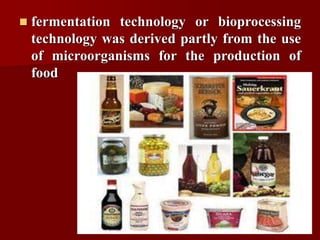
 fermentation technology or bioprocessing
technology was derived partly from the use
of microorganisms for the production of
food
 Now, there are many modern technologies that are
derived from microbial fermentation such as:
- The production of primary metabolites including
acetic acid, glycerol, lactic acid, acetone, organic
and amino acids, vitamins and polysaccharides.
- The production of secondary metabolites such as
penicillin, streptomycin, cephalosporin, etc.
- The production of many industrially useful
enzymes, e. g. extracellular such as amylases,
pectinases and proteinases, and intracellular
enzymes such as invertase, restriction
endonuleases, etc.
 More recently, bioprocessing technology is using
higher plant and animal cells to produce many
important products.
 Plant cell culture is used for secondary product
fermentation such as flavours, perfumes and
drugs.
 Mammalian cell culture techniques are concerned
with vaccines, antibody formation and the
production of protein molecules such as
interferon, etc
 It is possible to make further economic production
by genetically engineered organisms
 The organisms must be cultivated and motivated to
form the desired product by physical/ technical
containment system (bioreactor), and the correct
medium composition and environmental growth
conditions. Optimizing the bioprocess involves both
the biosystem and the technical system
 In the simplest form, the bioprocess can be seen as
mixing the appropriate microorganism with nutrient
broth and allowing the components to react (e. g.
yeast cell with sugar solution to form alcohol).
 All bioprocesses are performed within containment
systems or bioreactors. The main function of
bioreactors is to minimize the cost of producing a
product or service
THE BIOREACTOR/ FERMENTOR
Year*
Development
5000 BC
Fermented beverages
1857
Pasteur’s discovery of yeast
1860
First medium designed for culturing bacteria
1928
Production of penicillin in a Petri dish
1942
Production of penicillin in small flasks
1970
Advances in instrumentation and computer control
1973
Progress in airlift bioreactor design
1973
Recombinant DNA technology
1980
Large-scale cell culture to produce interferon
1982
Insulin produced using bacteria
1996
Textbook on protein engineering
1997
Textbook on tissue engineering
Bioreactors
 Bioreactors range from simple
(stirred or non- stirred) open
containers to complex, aseptic,
integrated systems involving
varying levels of advanced
computer inputs.
 Bioreactors are of two distinct types:
1) non- aseptic systems where it is not absolutely essential
to operate with entirely pure cultures (e. g. brewing,
effluent disposal systems).
2) aseptic conditions is essential for successful productivity
(e. g. vitamins, polysaccharides). This type is more
difficult to operate, maintain and design.
 Fermentation reactions are multiphase, involving a
gas phase (containing N2, O2, and CO2), one or
more liquid phases (aqueous medium and liquid
substrate) and solid microphase (the microorganisms
and possibly solid substrates).
 All phases must be kept in close homogenous contact
to achieve rapid mass and heat transfer.
 In a perfectly mixed bioreactor all reactants entering
the system must be immediately mixed and
uniformly distributed to ensure homogeneity inside
the bioreactor.
The essential guidelines for optimizing a bioreactor
1- The bioreactor should be designed to exclude
entrance of contaminating microorganisms as
well as containing the desired organisms.
2- The culture volume should remain constant (no
leaking or evaporation).
3- The dissolved oxygen level must be maintained
above critical levels of aeration and culture
agitation for aerobic organisms.
4- Environmental parameters such as temperature,
pH, etc., must be controlled; and the culture
volume must be well mixed
 Still there is a great lack of true
understanding of just what environmental
conditions will produce an optimal yield of
organism or product.
 There is also a lack of good sensor probes
that will allow on- line analysis to be made
on the chemical components of the
fermentation process
 Two design solutions for the problems of
aeration and agitation have been developed:
 The first approach uses mechanical aeration and
agitation devices, with high power requirements; the
standard example is the continuously stirred tank
reactor (CSTR).
 Such bioreactors ensure good gas/ liquid mass
transfer, reasonable heat transfer, and good mixing of
the bioreactor contents.
 The second main approach to aerobic bioreactor
design uses air distribution (with low power
consumption) to create forced and controlled liquid
flow in a recycle or loop bioreactor.
 In this way the contents are subjected to a controlled
recycle flow, either within the bioreactor or an
external recycle loop. Thus, stirring has been
replaced by pumping, which may be mechanical or
pneumatic (using compressed air).
 In almost all fermentation processes, performed
in a bioreactor, there is a need to measure specific
growth- related and environmental parameters,
record them and then use the information to
improve and optimize the process.
 Bioreactor control measurements are made in
either an on- line or an off- line manner.
1) In on- line measurement, the sensor is placed
directly with the process stream.
2) In an off- line measurement, a sample is removed
aseptically from the process stream and
transferred to laboratory to be analyzed.
Scaling- up
 This process is the important step for transferring
bench- top fermentations to mass production (the
most important factors in scale- up is power
consumption)
 Fermentation is normally developed in three stages or
scales:
(1) Initial stage: basic screening procedures are carried out
using simple microbiological techniques, such as Petri
dishes, Erlenmayer flasks, etc.
(2) Pilot investigation: to determine the optimal operating
conditions in a volume of 5 to 200 liters.
(3) Final stage: application of the pilot study to the plant
(production and final economic realization).
 Throughout these stages or scales,
environmental conditions should be kept at
optimum all the time.
 These environmental conditions involve both
chemical (e.g. substrate concentration) and
physical factors (e.g. mass transfer ability,
mixing ability, power).
 In particular, the physical factors create
problems when the process is moving from
one scale to another.
Downstream processing
 Extraction and purification of the end product
 Downstream processing will be primarily
concerned with initial separation of the
bioreactor broth into a liquid phase and a
solids phase and subsequent concentration
and purification of the product (normally
more than one stage)
 Final product of the downstream purification stages
should have some degree of stability for commercial
distribution. Stability is best achieved for most
products by using some form of drying.
 Practically, drying is achieved by spray- drying,
fluidized- bed drying or by freeze drying or simply by
heating. The method of choice is product and cost
dependent.
 Care must be taken to avoid microbial contamination
and deterioration and, for proteinaceous products, to
avoid denaturation. This is why the storage
conditions are very important for each product
 Purity and stability of the end- product of the
downstream processes are the hallmarks of most
valuable biotechnological products.

2 Fermentation.ppt

  • 1.
    INDUSTRIAL MICROBIOLOGY (2) Bioprocessingand Fermentation Prepared by Prof. Dr. Waiel Farghaly
  • 2.
     fermentation technologyor bioprocessing technology was derived partly from the use of microorganisms for the production of food
  • 3.
     Now, thereare many modern technologies that are derived from microbial fermentation such as: - The production of primary metabolites including acetic acid, glycerol, lactic acid, acetone, organic and amino acids, vitamins and polysaccharides. - The production of secondary metabolites such as penicillin, streptomycin, cephalosporin, etc. - The production of many industrially useful enzymes, e. g. extracellular such as amylases, pectinases and proteinases, and intracellular enzymes such as invertase, restriction endonuleases, etc.
  • 4.
     More recently,bioprocessing technology is using higher plant and animal cells to produce many important products.  Plant cell culture is used for secondary product fermentation such as flavours, perfumes and drugs.  Mammalian cell culture techniques are concerned with vaccines, antibody formation and the production of protein molecules such as interferon, etc  It is possible to make further economic production by genetically engineered organisms
  • 5.
     The organismsmust be cultivated and motivated to form the desired product by physical/ technical containment system (bioreactor), and the correct medium composition and environmental growth conditions. Optimizing the bioprocess involves both the biosystem and the technical system  In the simplest form, the bioprocess can be seen as mixing the appropriate microorganism with nutrient broth and allowing the components to react (e. g. yeast cell with sugar solution to form alcohol).  All bioprocesses are performed within containment systems or bioreactors. The main function of bioreactors is to minimize the cost of producing a product or service
  • 6.
    THE BIOREACTOR/ FERMENTOR Year* Development 5000BC Fermented beverages 1857 Pasteur’s discovery of yeast 1860 First medium designed for culturing bacteria 1928 Production of penicillin in a Petri dish 1942 Production of penicillin in small flasks 1970 Advances in instrumentation and computer control 1973 Progress in airlift bioreactor design 1973 Recombinant DNA technology 1980 Large-scale cell culture to produce interferon 1982 Insulin produced using bacteria 1996 Textbook on protein engineering 1997 Textbook on tissue engineering
  • 7.
    Bioreactors  Bioreactors rangefrom simple (stirred or non- stirred) open containers to complex, aseptic, integrated systems involving varying levels of advanced computer inputs.  Bioreactors are of two distinct types: 1) non- aseptic systems where it is not absolutely essential to operate with entirely pure cultures (e. g. brewing, effluent disposal systems). 2) aseptic conditions is essential for successful productivity (e. g. vitamins, polysaccharides). This type is more difficult to operate, maintain and design.
  • 9.
     Fermentation reactionsare multiphase, involving a gas phase (containing N2, O2, and CO2), one or more liquid phases (aqueous medium and liquid substrate) and solid microphase (the microorganisms and possibly solid substrates).  All phases must be kept in close homogenous contact to achieve rapid mass and heat transfer.  In a perfectly mixed bioreactor all reactants entering the system must be immediately mixed and uniformly distributed to ensure homogeneity inside the bioreactor.
  • 10.
    The essential guidelinesfor optimizing a bioreactor 1- The bioreactor should be designed to exclude entrance of contaminating microorganisms as well as containing the desired organisms. 2- The culture volume should remain constant (no leaking or evaporation). 3- The dissolved oxygen level must be maintained above critical levels of aeration and culture agitation for aerobic organisms. 4- Environmental parameters such as temperature, pH, etc., must be controlled; and the culture volume must be well mixed
  • 11.
     Still thereis a great lack of true understanding of just what environmental conditions will produce an optimal yield of organism or product.  There is also a lack of good sensor probes that will allow on- line analysis to be made on the chemical components of the fermentation process  Two design solutions for the problems of aeration and agitation have been developed:
  • 12.
     The firstapproach uses mechanical aeration and agitation devices, with high power requirements; the standard example is the continuously stirred tank reactor (CSTR).  Such bioreactors ensure good gas/ liquid mass transfer, reasonable heat transfer, and good mixing of the bioreactor contents.  The second main approach to aerobic bioreactor design uses air distribution (with low power consumption) to create forced and controlled liquid flow in a recycle or loop bioreactor.  In this way the contents are subjected to a controlled recycle flow, either within the bioreactor or an external recycle loop. Thus, stirring has been replaced by pumping, which may be mechanical or pneumatic (using compressed air).
  • 14.
     In almostall fermentation processes, performed in a bioreactor, there is a need to measure specific growth- related and environmental parameters, record them and then use the information to improve and optimize the process.  Bioreactor control measurements are made in either an on- line or an off- line manner. 1) In on- line measurement, the sensor is placed directly with the process stream. 2) In an off- line measurement, a sample is removed aseptically from the process stream and transferred to laboratory to be analyzed.
  • 15.
    Scaling- up  Thisprocess is the important step for transferring bench- top fermentations to mass production (the most important factors in scale- up is power consumption)  Fermentation is normally developed in three stages or scales: (1) Initial stage: basic screening procedures are carried out using simple microbiological techniques, such as Petri dishes, Erlenmayer flasks, etc. (2) Pilot investigation: to determine the optimal operating conditions in a volume of 5 to 200 liters. (3) Final stage: application of the pilot study to the plant (production and final economic realization).
  • 16.
     Throughout thesestages or scales, environmental conditions should be kept at optimum all the time.  These environmental conditions involve both chemical (e.g. substrate concentration) and physical factors (e.g. mass transfer ability, mixing ability, power).  In particular, the physical factors create problems when the process is moving from one scale to another.
  • 17.
    Downstream processing  Extractionand purification of the end product  Downstream processing will be primarily concerned with initial separation of the bioreactor broth into a liquid phase and a solids phase and subsequent concentration and purification of the product (normally more than one stage)
  • 19.
     Final productof the downstream purification stages should have some degree of stability for commercial distribution. Stability is best achieved for most products by using some form of drying.  Practically, drying is achieved by spray- drying, fluidized- bed drying or by freeze drying or simply by heating. The method of choice is product and cost dependent.  Care must be taken to avoid microbial contamination and deterioration and, for proteinaceous products, to avoid denaturation. This is why the storage conditions are very important for each product  Purity and stability of the end- product of the downstream processes are the hallmarks of most valuable biotechnological products.