Production Function
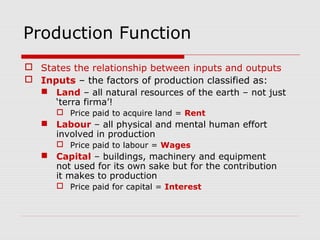
 States the relationship between inputs and outputs
 Inputs – the factors of production classified as:
 Land – all natural resources of the earth – not just
‘terra firma’!
 Price paid to acquire land = Rent
 Labour – all physical and mental human effort
involved in production
 Price paid to labour = Wages
 Capital – buildings, machinery and equipment
not used for its own sake but for the contribution
it makes to production
 Price paid for capital = Interest
Production Function
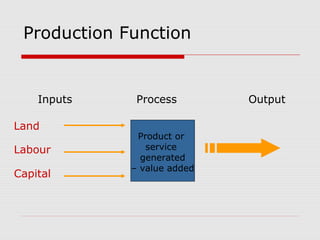
Inputs Process Output
Land
Labour
Capital
Product or
service
generated
– value added
Production Function
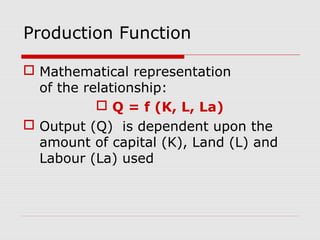
 Mathematical representation
of the relationship:
 Q = f (K, L, La)
 Output (Q) is dependent upon the
amount of capital (K), Land (L) and
Labour (La) used
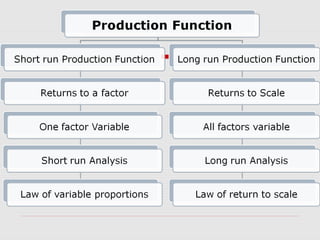
Types of Production Function
1. Short Run Production Function
2. Long Run Production Function
Short Run Production Function:
 In the short run all other factors
are fixed in supply but at least one
factor is capable of being changed
to have more output.
 This aspect of production function
is known as Law of variable
proportions.
 Proportional relationship between
Production and factors of
production is referred to as Law of
Returns to a Factor
Long Run Production Function:
 In the long run it is possible for a firm to change all
inputs up and down in accordance with its scale. This is
known as Return to scale.
 When a producer changes all the factors of production
in the same proportion, the Proportional
relationship between Production and factors
of production is referred to as Law of Returns
to Scale
 By doing this, the firm is able to increase its total
capacity – not just short term capacity
 Associated with a change in the scale of
production
Laws of Returns
1. Law of variable proportions.
2. Law of Returns to Scale
Law of variable proportions
 Law of variable proportions stats that as
we increase quantity of only one input
keeping other inputs fixed, Total product
initially increases at an increasing rate,
then at a decreasing rate and finally at a
negative rate.
Law of Returns to Scale
 Law of returns to scale refers to
increase in output as a result of
increase in all factors in the same
proportion.
Stages of Returns to Scale
1. Increasing Return to Scale
( Due to many type of internal economies)
1. Constant Return to Scale
(After reaching certain level of production internal and
external economies are balanced)
1. Diminishing Return to Scale
( Due to emerging diseconomies, Large company
creates difficulties of control)

Production function final

  • 1.
    Production Function  Statesthe relationship between inputs and outputs  Inputs – the factors of production classified as:  Land – all natural resources of the earth – not just ‘terra firma’!  Price paid to acquire land = Rent  Labour – all physical and mental human effort involved in production  Price paid to labour = Wages  Capital – buildings, machinery and equipment not used for its own sake but for the contribution it makes to production  Price paid for capital = Interest
  • 2.
    Production Function Inputs ProcessOutput Land Labour Capital Product or service generated – value added
  • 3.
    Production Function  Mathematicalrepresentation of the relationship:  Q = f (K, L, La)  Output (Q) is dependent upon the amount of capital (K), Land (L) and Labour (La) used
  • 4.
    Types of ProductionFunction 1. Short Run Production Function 2. Long Run Production Function
  • 5.
    Short Run ProductionFunction:  In the short run all other factors are fixed in supply but at least one factor is capable of being changed to have more output.  This aspect of production function is known as Law of variable proportions.  Proportional relationship between Production and factors of production is referred to as Law of Returns to a Factor
  • 6.
    Long Run ProductionFunction:  In the long run it is possible for a firm to change all inputs up and down in accordance with its scale. This is known as Return to scale.  When a producer changes all the factors of production in the same proportion, the Proportional relationship between Production and factors of production is referred to as Law of Returns to Scale  By doing this, the firm is able to increase its total capacity – not just short term capacity  Associated with a change in the scale of production
  • 8.
    Laws of Returns 1.Law of variable proportions. 2. Law of Returns to Scale
  • 9.
    Law of variableproportions  Law of variable proportions stats that as we increase quantity of only one input keeping other inputs fixed, Total product initially increases at an increasing rate, then at a decreasing rate and finally at a negative rate.
  • 10.
    Law of Returnsto Scale  Law of returns to scale refers to increase in output as a result of increase in all factors in the same proportion.
  • 11.
    Stages of Returnsto Scale 1. Increasing Return to Scale ( Due to many type of internal economies) 1. Constant Return to Scale (After reaching certain level of production internal and external economies are balanced) 1. Diminishing Return to Scale ( Due to emerging diseconomies, Large company creates difficulties of control)