Product Life Cycle
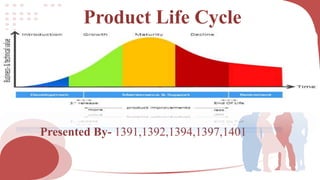
Presented By- 1391,1392,1394,1397,1401
Product Life Cycle
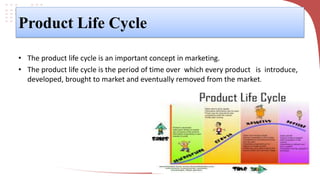
• The product life cycle is an important concept in marketing.
• The product life cycle is the period of time over which every product is introduce,
developed, brought to market and eventually removed from the market.
History
• The theory of a product life cycle was first introduced in the 1950s to explain the
expected life cycle of a typical product from design to obsolescence, a period
divided into the phases of product introduction, product growth, maturity, and
decline. The goal of managing a product's life cycle is to maximize its value and
profitability at each stage. Life cycle is primarily associated with marketing theory.
Product Life Cycle Stages
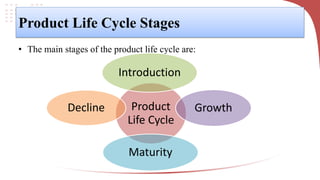
• The main stages of the product life cycle are:
Product
Life Cycle
Introduction
Growth
Maturity
Decline
Introduction Stage
• In this stage of the cycle could be the most expensive for a company launching a new
product.
• When the product is introduced, sales will be low until customers become aware of
the product and its benefits. Some firms may announce their product before it is
introduced, but such announcements also alert competitors and remove the element
of surprise. Advertising costs typically are high during this stage in order to rapidly
increase customer .
• The goal of any new product introduction is to meet consumers' needs with a quality
product.
Introduction Stage
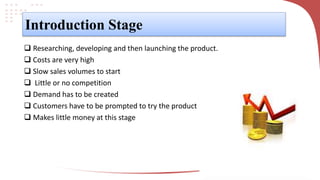
 Researching, developing and then launching the product.
 Costs are very high
 Slow sales volumes to start
 Little or no competition
 Demand has to be created
 Customers have to be prompted to try the product
 Makes little money at this stage
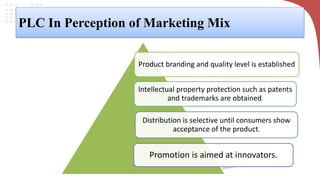
PLC In Perception of Marketing Mix
Product branding and quality level is established
Intellectual property protection such as patents
and trademarks are obtained.
Distribution is selective until consumers show
acceptance of the product.
Promotion is aimed at innovators.
Growth Stage
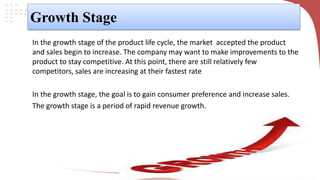
In the growth stage of the product life cycle, the market accepted the product
and sales begin to increase. The company may want to make improvements to the
product to stay competitive. At this point, there are still relatively few
competitors, sales are increasing at their fastest rate
In the growth stage, the goal is to gain consumer preference and increase sales.
The growth stage is a period of rapid revenue growth.
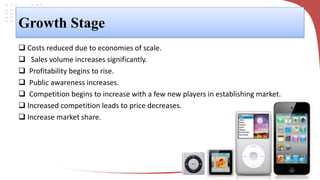
Growth Stage
 Costs reduced due to economies of scale.
 Sales volume increases significantly.
 Profitability begins to rise.
 Public awareness increases.
 Competition begins to increase with a few new players in establishing market.
 Increased competition leads to price decreases.
 Increase market share.
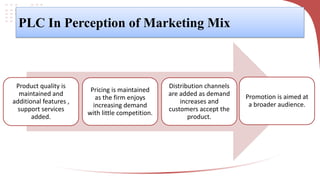
PLC In Perception of Marketing Mix
Product quality is
maintained and
additional features ,
support services
added.
Pricing is maintained
as the firm enjoys
increasing demand
with little competition.
Distribution channels
are added as demand
increases and
customers accept the
product.
Promotion is aimed at
a broader audience.
Maturity Stage
At maturity, the strong growth in sales diminishes. Competition may appear with
similar products. It is at this time that repeat business and purchases take the place of
new customer buying. So, during the maturity stage, the following occurs:
• Costs are lowered as production volumes increasing
• Highest sales & low growth
• Increasing of competitors entering the market
• Drop in product’s price.
• Brand differentiation and feature diversification to maintained.
• Industrial profits go down
Maturity Stage
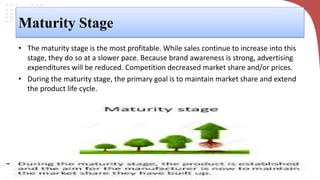
• The maturity stage is the most profitable. While sales continue to increase into this
stage, they do so at a slower pace. Because brand awareness is strong, advertising
expenditures will be reduced. Competition decreased market share and/or prices.
• During the maturity stage, the primary goal is to maintain market share and extend
the product life cycle.
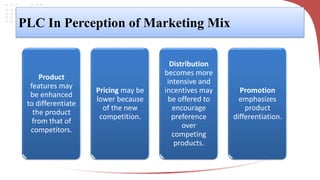
PLC In Perception of Marketing Mix
Product
features may
be enhanced
to differentiate
the product
from that of
competitors.
Pricing may be
lower because
of the new
competition.
Distribution
becomes more
intensive and
incentives may
be offered to
encourage
preference
over
competing
products.
Promotion
emphasizes
product
differentiation.
Decline Stage
In the decline stage of the product life cycle, sales will begin to decline as the product
reaches its saturation point. Most products are phased out of the market at this point
due to the decrease in sales and because of competitive pressure. The market will see
the product as old and no longer in demand.
• In this stage sales begin to fall.
• Costs become counter-optimal.
• Sales volume decline.
• Prices, profitability diminish.
• Profit becomes more a challenge of production/distribution efficiency than
increased sales.
Decline Stage
 During the decline phase, the firm generally has three options:
Maintain the product in hopes that competitors will exit. Reduce costs and find new
uses for the product.
Harvest it, reducing marketing support and coasting along until no more profit can
be made.
Discontinue the product when no more profit can be made or there is a successor
production.
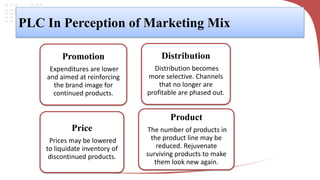
PLC In Perception of Marketing Mix
Product
The number of products in
the product line may be
reduced. Rejuvenate
surviving products to make
them look new again.
Price
Prices may be lowered
to liquidate inventory of
discontinued products.
Distribution
Distribution becomes
more selective. Channels
that no longer are
profitable are phased out.
Promotion
Expenditures are lower
and aimed at reinforcing
the brand image for
continued products.
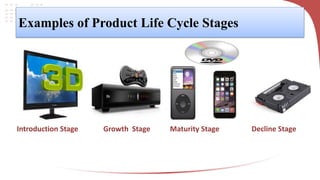
Examples of Product Life Cycle Stages
Introduction Stage Growth Stage Maturity Stage Decline Stage
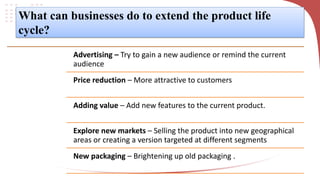
What can businesses do to extend the product life
cycle?
Advertising – Try to gain a new audience or remind the current
audience
Price reduction – More attractive to customers
Adding value – Add new features to the current product.
Explore new markets – Selling the product into new geographical
areas or creating a version targeted at different segments
New packaging – Brightening up old packaging .
Conclusion
• Products do not have such a predictable life and the specific life cycle curves
followed by different products vary substantially. Critics have argued that the
product life cycle may become self-fulfilling. Like, if sales peak and then decline,
managers may conclude that the product is in the decline phase and therefore cut
the advertising budget, thus precipitating a further decline.
• The product life cycle concept helps marketing managers to plan alternate
marketing strategies to address the challenges that their products are likely to face.
It also is useful for monitoring sales results over time .
Product life cycle

Product life cycle

  • 1.
    Product Life Cycle PresentedBy- 1391,1392,1394,1397,1401
  • 2.
    Product Life Cycle •The product life cycle is an important concept in marketing. • The product life cycle is the period of time over which every product is introduce, developed, brought to market and eventually removed from the market.
  • 3.
    History • The theoryof a product life cycle was first introduced in the 1950s to explain the expected life cycle of a typical product from design to obsolescence, a period divided into the phases of product introduction, product growth, maturity, and decline. The goal of managing a product's life cycle is to maximize its value and profitability at each stage. Life cycle is primarily associated with marketing theory.
  • 4.
    Product Life CycleStages • The main stages of the product life cycle are: Product Life Cycle Introduction Growth Maturity Decline
  • 5.
    Introduction Stage • Inthis stage of the cycle could be the most expensive for a company launching a new product. • When the product is introduced, sales will be low until customers become aware of the product and its benefits. Some firms may announce their product before it is introduced, but such announcements also alert competitors and remove the element of surprise. Advertising costs typically are high during this stage in order to rapidly increase customer . • The goal of any new product introduction is to meet consumers' needs with a quality product.
  • 6.
    Introduction Stage  Researching,developing and then launching the product.  Costs are very high  Slow sales volumes to start  Little or no competition  Demand has to be created  Customers have to be prompted to try the product  Makes little money at this stage
  • 7.
    PLC In Perceptionof Marketing Mix Product branding and quality level is established Intellectual property protection such as patents and trademarks are obtained. Distribution is selective until consumers show acceptance of the product. Promotion is aimed at innovators.
  • 8.
    Growth Stage In thegrowth stage of the product life cycle, the market accepted the product and sales begin to increase. The company may want to make improvements to the product to stay competitive. At this point, there are still relatively few competitors, sales are increasing at their fastest rate In the growth stage, the goal is to gain consumer preference and increase sales. The growth stage is a period of rapid revenue growth.
  • 9.
    Growth Stage  Costsreduced due to economies of scale.  Sales volume increases significantly.  Profitability begins to rise.  Public awareness increases.  Competition begins to increase with a few new players in establishing market.  Increased competition leads to price decreases.  Increase market share.
  • 10.
    PLC In Perceptionof Marketing Mix Product quality is maintained and additional features , support services added. Pricing is maintained as the firm enjoys increasing demand with little competition. Distribution channels are added as demand increases and customers accept the product. Promotion is aimed at a broader audience.
  • 11.
    Maturity Stage At maturity,the strong growth in sales diminishes. Competition may appear with similar products. It is at this time that repeat business and purchases take the place of new customer buying. So, during the maturity stage, the following occurs: • Costs are lowered as production volumes increasing • Highest sales & low growth • Increasing of competitors entering the market • Drop in product’s price. • Brand differentiation and feature diversification to maintained. • Industrial profits go down
  • 12.
    Maturity Stage • Thematurity stage is the most profitable. While sales continue to increase into this stage, they do so at a slower pace. Because brand awareness is strong, advertising expenditures will be reduced. Competition decreased market share and/or prices. • During the maturity stage, the primary goal is to maintain market share and extend the product life cycle.
  • 13.
    PLC In Perceptionof Marketing Mix Product features may be enhanced to differentiate the product from that of competitors. Pricing may be lower because of the new competition. Distribution becomes more intensive and incentives may be offered to encourage preference over competing products. Promotion emphasizes product differentiation.
  • 14.
    Decline Stage In thedecline stage of the product life cycle, sales will begin to decline as the product reaches its saturation point. Most products are phased out of the market at this point due to the decrease in sales and because of competitive pressure. The market will see the product as old and no longer in demand. • In this stage sales begin to fall. • Costs become counter-optimal. • Sales volume decline. • Prices, profitability diminish. • Profit becomes more a challenge of production/distribution efficiency than increased sales.
  • 15.
    Decline Stage  Duringthe decline phase, the firm generally has three options: Maintain the product in hopes that competitors will exit. Reduce costs and find new uses for the product. Harvest it, reducing marketing support and coasting along until no more profit can be made. Discontinue the product when no more profit can be made or there is a successor production.
  • 16.
    PLC In Perceptionof Marketing Mix Product The number of products in the product line may be reduced. Rejuvenate surviving products to make them look new again. Price Prices may be lowered to liquidate inventory of discontinued products. Distribution Distribution becomes more selective. Channels that no longer are profitable are phased out. Promotion Expenditures are lower and aimed at reinforcing the brand image for continued products.
  • 17.
    Examples of ProductLife Cycle Stages Introduction Stage Growth Stage Maturity Stage Decline Stage
  • 18.
    What can businessesdo to extend the product life cycle? Advertising – Try to gain a new audience or remind the current audience Price reduction – More attractive to customers Adding value – Add new features to the current product. Explore new markets – Selling the product into new geographical areas or creating a version targeted at different segments New packaging – Brightening up old packaging .
  • 19.
    Conclusion • Products donot have such a predictable life and the specific life cycle curves followed by different products vary substantially. Critics have argued that the product life cycle may become self-fulfilling. Like, if sales peak and then decline, managers may conclude that the product is in the decline phase and therefore cut the advertising budget, thus precipitating a further decline. • The product life cycle concept helps marketing managers to plan alternate marketing strategies to address the challenges that their products are likely to face. It also is useful for monitoring sales results over time .