Mini-Presentation Describe an example of product or service design from your experience 3 to 4 minutes presentation Great opportunity to secure your participation grade!
Outlines: Design of Goods and Services Trend in New Product/Service Design and Development Product Life Cycles, Life Cycle and Strategy Product Design and Development System Sequential Design and Concurrent Engineering Application of Decision Tree to Product Design Quality Function Deployment (QFD):  Translating Customer Attributes into Product Characteristics: Organizing for Product Development
Trends in New Product/Service Design and Development SHIFT TOWARD A SERVICE ECONOMY New product design and innovation has been shifting away from manufacturing and toward the service sector. SHIFT TOWARD INFORMATION AND COMMUNICATIONS TECHNOLOGY Information revolution demanded new product and service design and development. GLOBALIZATION OF MARKETS A firm needs a product design robust enough to sell vigorously in foreign markets.
Trends in New Product/Service Design and Development RISE OF CONSUMERISM Sellers of goods and services must now listen to customers before deciding what to offer. CRITICAL IMPORTANCE OF TIME Time has come to dominate the product/service design and development process. QUALITY RULES A poor understanding of customers’ needs almost guarantees failures in design quality in addition to potential  failures in quality of conformance.
Product Life Cycles Introduction Growth Maturity Decline Standardization Less rapid product changes - more minor changes Optimum  capacity Increasing stability of process Long production runs Product improvement and cost cutting Little product differentiation Cost minimization Over capacity in the industry Prune line to eliminate items not returning good margin Reduce capacity Forecasting critical Product and process reliability Competitive product improvements and options Increase capacity Shift toward product focused Enhance distribution Product design and development critical Frequent product and process design changes Short production runs High production costs Limited models Attention to quality Best period to increase market share R&D product engineering critical Practical to change price or quality image Strengthen niche Cost control critical Poor time to change image, price, or quality Competitive costs become critical Defend market position OM Strategy/Issues Company Strategy/Issues HDTV CD-ROM Color copiers Drive-thru restaurants Fax machines Station wagons Sales 3 1/2” Floppy disks Internet
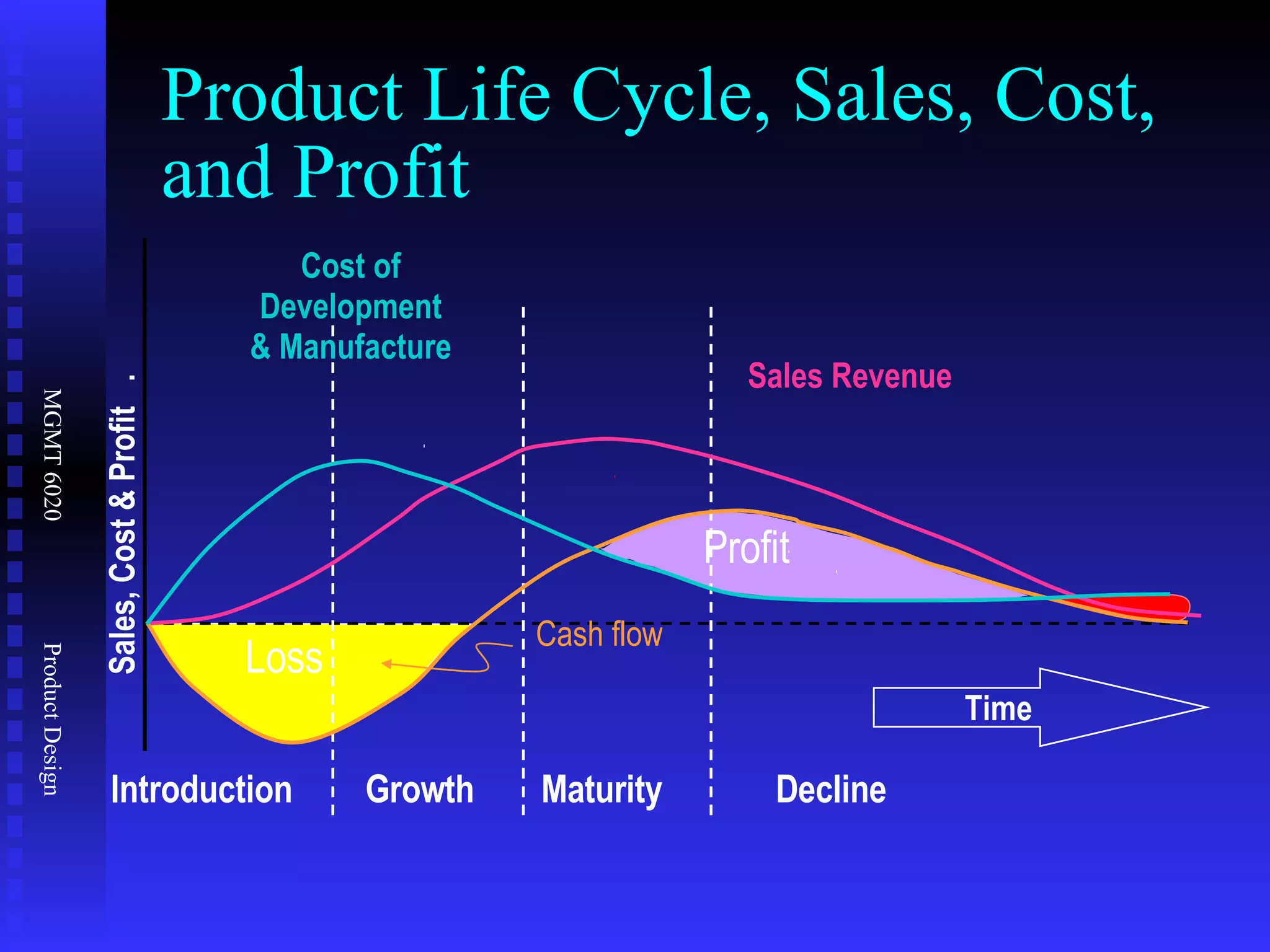
Product Life Cycle, Sales, Cost, and Profit Sales, Cost & Profit  .   Introduction Maturity Decline Growth Cost of Development & Manufacture Sales Revenue Time Cash flow Loss Profit
Product Life Cycle Introduction Fine tuning research product development process modification and enhancement supplier development
Product Life Cycle Growth Product design begins to stabilize Effective forecasting of capacity becomes necessary Adding or enhancing capacity may be necessary
Product Life Cycle Maturity Competitors now established High volume, innovative production may be needed Improved cost control, reduction in options, paring down of product line
Product Life Cycle Decline Unless product makes a special contribution, must plan to terminate offering Successful example of reviving product’s profitability in the decline stage: Tamagochi, simple-function camera
Percent of Sales From New Product
Design and Development Criteria PRODUCT/SERVICE QUALITY Design-measured customer satisfaction Conformance--Actual results versus specifications Features Durability Serviceability and others TIME TO MARKET (DEVELOPMENT SPEED) Elapsed time from conception to launch Time required to recover investments
Design and Development Criteria DESIGN AND DEVELOPMENT COSTS One-time development costs Total costs to the customer (design, development, and manufacturing) GENERAL Percentage of sale from new products Market share (new and sustaining) REGULATION AND STANDARDS ISO 9000 UL, CCIB, FAC, IEEE
Product Development Stages Idea generation Assessment of firm’s ability to carry out (Form Product Development Team) Customer Requirements Functional Specification Product Specifications Design Review Test Market Introduction to Market Evaluation Scope of design for manufacturability and value engineering
Product Development without Coordination As Marketing  interpreted  it. © 1984-1994 T/Maker Co . As  the  customer wanted it. © 1984-1994 T/Maker Co . As  Engineering  designed it. © 1984-1994 T/Maker Co. As Operations made it. © 1984-1994 T/Maker Co.
Managing Design and Development Process Planning, organizing, staffing, leading, and controlling the limited resources SEQUENTIAL DESIGN AND DEVELOPMENT Before 1985, most American firms have organized their product design and development process sequentially. The sequence typically emerges as each functional area completes its part of the project before passing on the results to the next operation.
Managing Design and Development Process SHORTCOMINGS: Frequent engineering changes (before and after product launch) Ineffective communication  Lack of prospective thinking. Longer design and development lead time
Managing Design and Development Process CONCURRENT DESIGN AND DEVELOPMENT (CONCURRENT ENGINEERING) This method sets up a comprehensive process for completing the steps in design and development through a continuing involvement of cross-functional teams of organization members.
Managing Design and Development Process MAIN BENEFITS: Shorter development cycle Better cross-functional communication Teamwork Clear perspective. In practice, concurrent engineering and sequential process are both important
72-Seat Regional Propeller Aircraft: Q400 Project
Snapshot of Aircraft Development Beginning in spring 1996, about 380 engineers and professionals from Bombardier and its major suppliers work together in a football-size design department for the Joint Definition Phase of Q400. In this phase, all major disciplines involved in aircraft design are represented. They included engineering, design, tooling, manufacturing, marketing, sales, procurement, customer/field support, spare parts, training, publications and many more. This phase also involved refining project objectives and further negotiations. Such a co-location of company engineers and suppliers benefits both parties. It facilitates superior communication among all functions and leverages suppliers' knowledge so that new process technology can be incorporated into product development.
Snapshot of Aircraft Development Milestones in this 6-month JDP, including different Deign Reviews, were to determine specific targets for delivering the commitments. These iterative and interactive loops are to drive and check the detailed timing and specs from all areas. When this process was completed, it was subject to a series of Participant Exit Reviews to freeze every interface design of different structures and systems. When the Project Director accepted that review, the representatives and suppliers involved could then exit the JDP process to complete their detailed design of items under their responsibility and prepare for production.
Activities and Responsibilities of Concurrent Engineering CONCEPTUAL DESIGN Marketing:  Proposes and investigates product concept Engineering:  Proposes new technologies and simulates performance Operations:  Proposes and investigates manufacturing /delivery process PRODUCT DESIGN Marketing:  Defines market’s and specific objectives Engineering:  Provides design, chooses components  Operations:  Coordinates process structure with key suppliers; estimates costs
Activities and Responsibilities of Concurrent Engineering PRODUCT AND PROCESS ENGINEERING Marketing:  Conducts customer tests on prototypes Engineering:  Builds full scale prototypes for evaluation and refinement Operations:  Builds system to manufacture prototype, test tooling and new procedures PILOT PRODUCTION AND TESTING  Marketing:  Prepares for market roll out, trains sales force Engineering:  Evaluates and tests pilot data Operations:  Builds pilot units in processes, refines the system, trains personnel, checks suppliers
Activities and Responsibilities of Concurrent Engineering VOLUME PRODUCTION AND LAUNCH Marketing:  Control distribution channel, sells and promotes Engineering:  Evaluates customers’ experience with product Operations:  Builds up plant volume targets, refines quality, yield, and cost performance POST-SALE SERVICE Marketing:  Gains customer feedback Engineering and Operations:  Study warranty data
Quality Function Deployment Suitable for product design process using  cross-functional teams e.g. marketing, engineering, manufacturing Translates customer preferences into specific product characteristics Involves creating 4 tabular ‘Matrices’ or ‘Houses’ Breakdown product design into increasing levels of detail
In each House of Quality Identify customer  wants Identify  how  the good/service will satisfy customer wants . Relate the customer’s  wants  to the product’s  how s . Identify relationships between the firm’s  how s . Develop importance ratings Evaluate competing products
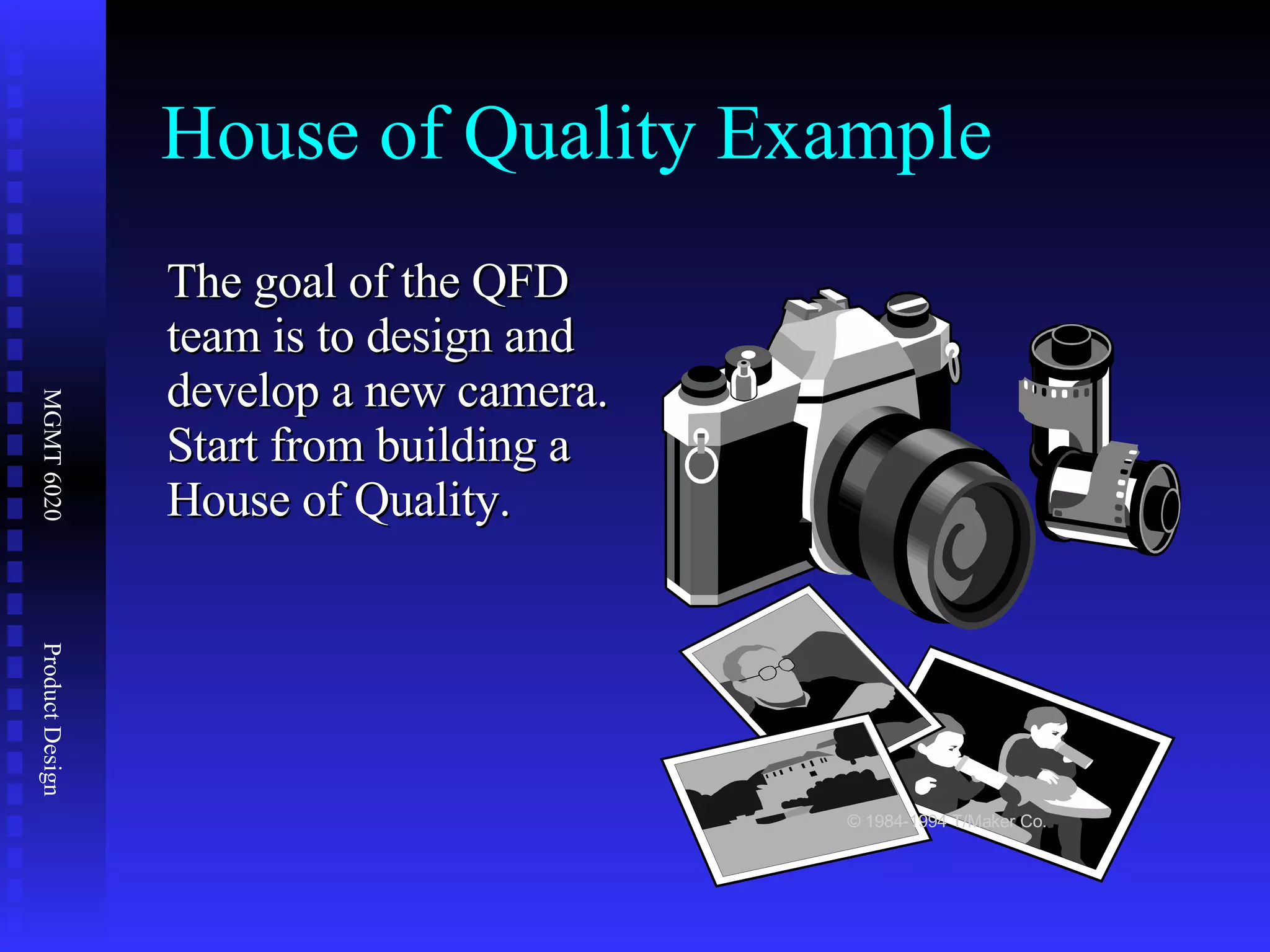
The goal of the QFD team is to design and develop a new camera.  Start from building a House of Quality. House of Quality Example © 1984-1994 T/Maker Co.
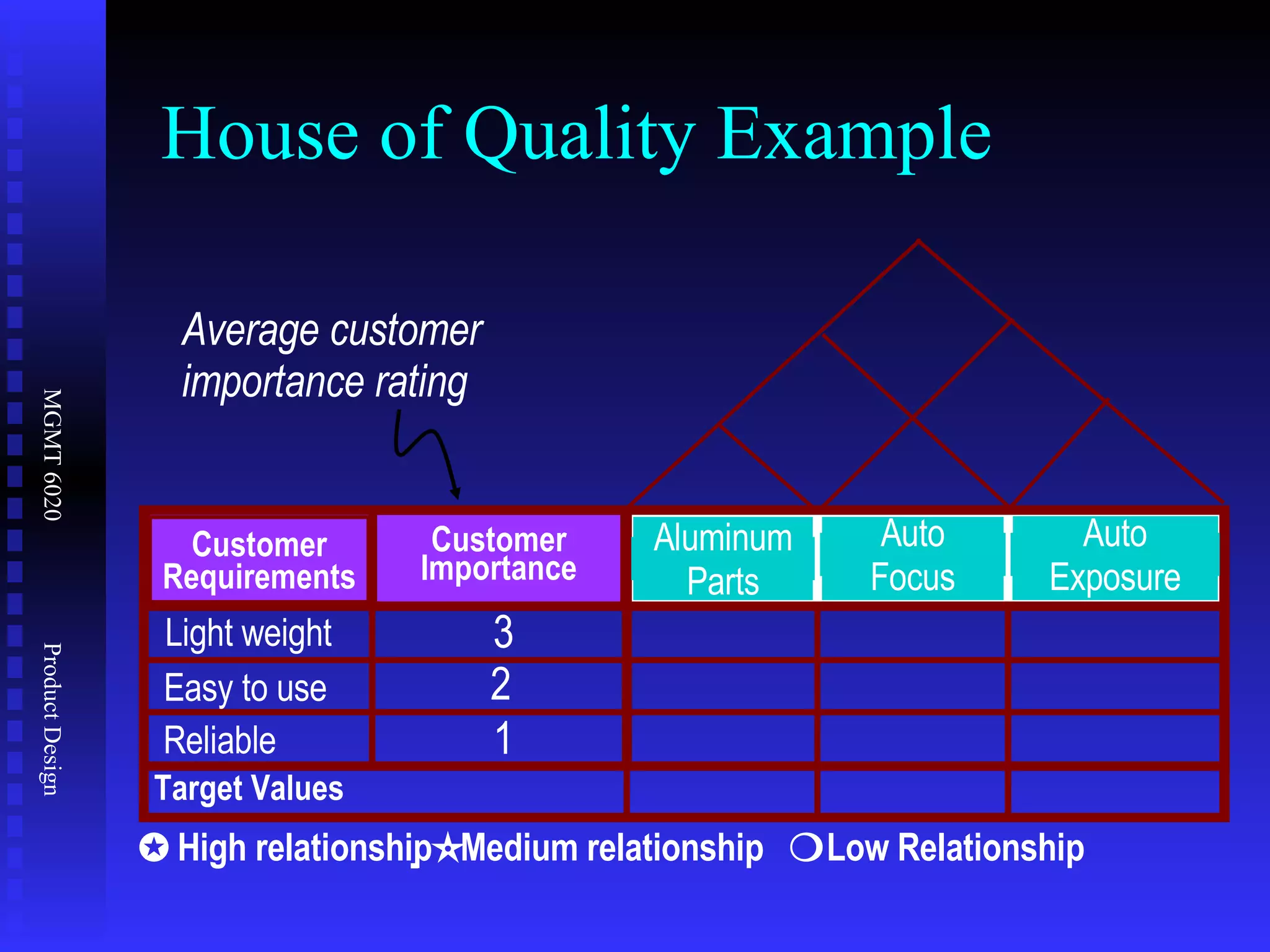
House of Quality Example  High relationship   Medium relationship     Low Relationship Customer Requirements Customer Importance Target Values
House of Quality Example  High relationship   Medium relationship     Low Relationship Customer Requirements Customer Importance Target Values Light weight Easy to use Reliable What the customer desires (‘wall’) Aluminum Parts Auto Focus Auto Exposure
House of Quality Example  High relationship   Medium relationship     Low Relationship Customer Requirements Customer Importance Target Values Light weight Easy to use Reliable Aluminum Parts Auto Focus Auto Exposure 3 1 2 Average customer importance rating
House of Quality Example  High relationship   Medium relationship     Low Relationship Customer Requirements Customer Importance Target Values Light weight Easy to use Reliable Aluminum Parts Auto Focus Auto Exposure      3 2 1 Relationship between customer attributes & engineering characteristics (‘rooms’)
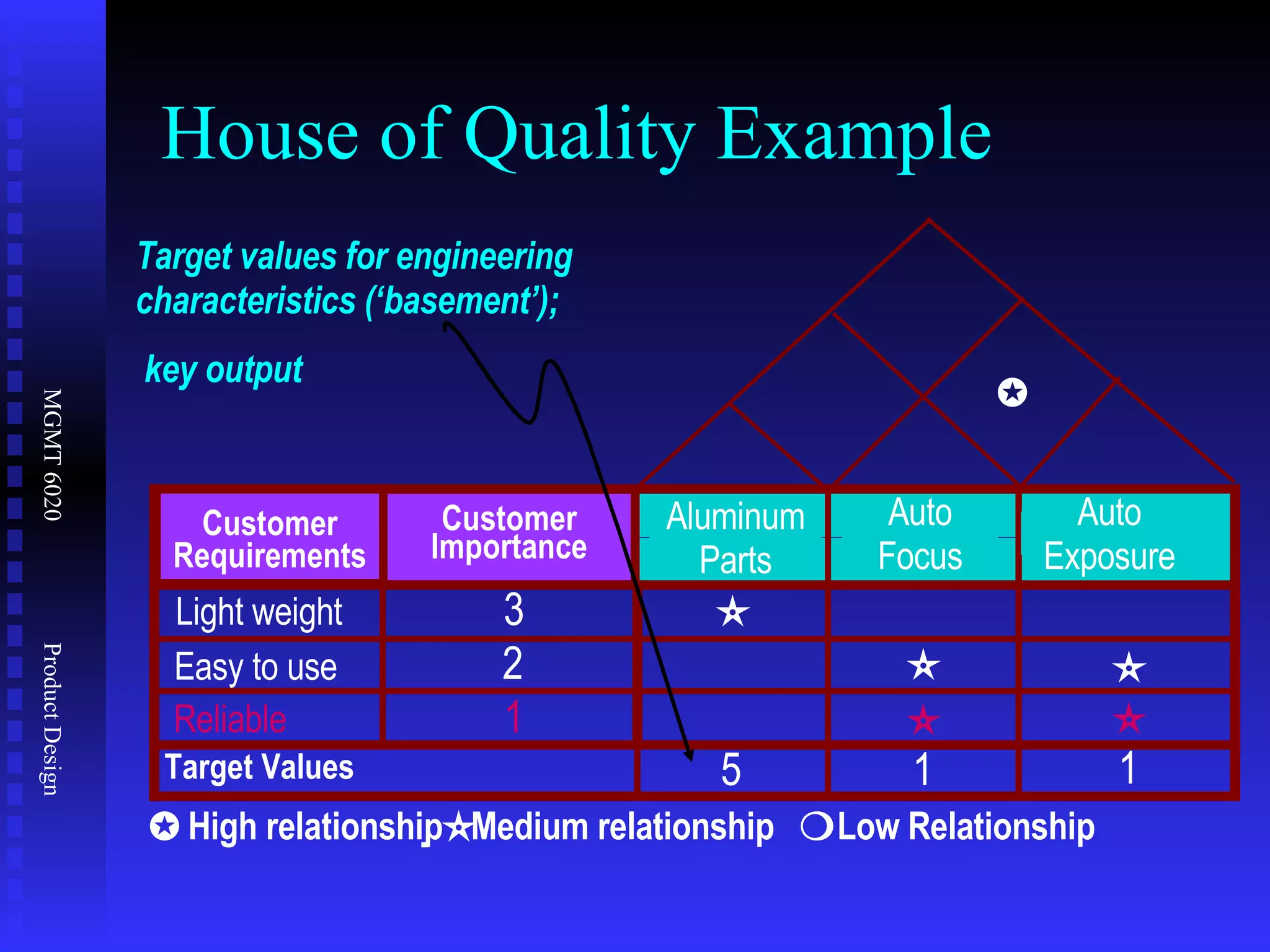
House of Quality Example  High relationship   Medium relationship     Low Relationship Customer Requirements Customer Importance Target Values Light weight Easy to use Reliable Aluminum Parts Auto Focus Auto Exposure      3 2 1 5 1 1 Target values for engineering characteristics (‘basement’); key output 
House of Quality Example  High relationship   Medium relationship     Low Relationship Customer Requirements Customer Importance Target Values Light weight Easy to use Reliable Aluminum Parts Auto Focus Auto Exposure      3 2 1 5 1 1 
Figure 5.5
Quality Function Deployment The  Quality Function Deployment (QFD)  tool is used to meet customers’ requirements throughout the design process and also in the design of production systems. It is a  customer-driven quality planning process  to guide design, manufacturing, and marketing of goods. QFD was developed in 1972 at  Mitsubishi’s  Kobe shipyard site.  Xerox  and  Ford  initiated the use of QFD in the United States in 1986.
Quality Function Deployment Chrysler  also employed the QFD methodology in 1986 in the design and development of its LH-platform cars (Chrysler Concord, Eagle Vision, Dodge Intrepid). It used QFD along with concurrent engineering and utilization of design-for-manufacturing principles and design-of-experiments methods. The overall results were quite impressive: the design cycle took 36 months versus 54 to 62 months before; prototype cars were ready 95 days before the production lunch. Customer approval rating and sales have been very good.
Manufacturability and  Value Engineering Main goals: reduce complexity of products Increase level of standardization among products improve key functions of each product improved job design and job safety improved maintainability of the product Green and ethical products
Uncertainty in Product Design Cost for develop a new product is high The associated results, such as demand, competition, performance remain uncertain at the time decisions have to be made Require OM tools to facilitate decision making in the early stage of product development Decision Tree is one of the most popular tool
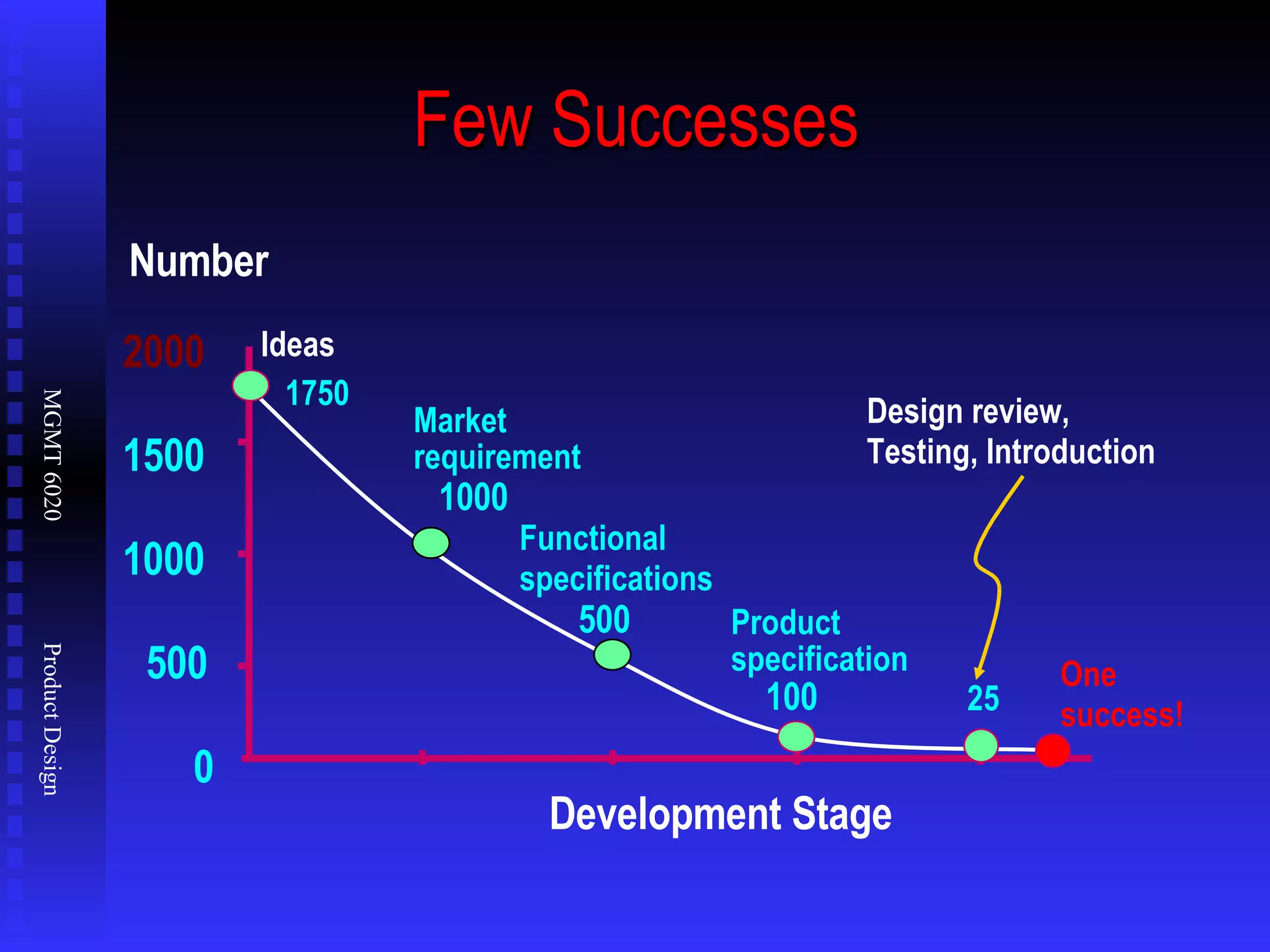
Few Successes 0 500 1000 1500 2000 Development Stage Number 1000 Market requirement Design review, Testing, Introduction 25 Ideas 1750 Product specification 100 Functional specifications One success! 500
Decision Tree Analysis Decision tree analysis may be effectively used for strategic product decisions. A decision tree contains: Decision Nodes : from which one or several decisions alternatives can be chosen Chance Nodes  (state of nature): out of which one or several states of nature (events, outcomes) will occur End Nodes : at the end of the decision tree, where payoffs are being developed Arrows : that connect nodes and identify the sequence of decisions on the tree.
Group Exercise: Introducing New Product Construct the decision tree in detail Identify the value of each node Explain your decision making process
Decision Tree Analysis Analyzing new product introduction with decision trees involves following steps: Define the problem. Structure or draw the decision tree. Assign probabilities to the Chance Nodes (states of nature). Payoffs are calculated at the End Nodes
Decision Tree Analysis Estimate payoffs for each Chance Node by calculating the expected value over all alternatives and associated probability. Solve the problem by working backwards, that is, starting at the right of the tree and working back to decision nodes on the left. Identify the best alternative (decision) with the highest expected value.
AgeTree Inc AgeTree, Inc. has developed a promising new product. The company’s management faces three choices: It can sell the idea of the new product to a company for $40,000, it can hire a consultant to study the market and then make a decision, or it can arrange financing for directly manufacturing the product.  The study will cost AgeTree $25,000, and its management believes that there is about 2/3 of chances that a favorable market will be found. If the study is favorable, the company can sell the idea for $40,000, or it can manufacture the product.  But even if a favorable market is found and the company manufactures the product, the chance of an ultimately successful production is about 60%. In this case, the company plans to sell 10,000 units of the product with a price of $50 each. The estimated fixed cost will be $190,000 and the variable cost will be $10 per unit. In case of unsuccessful results, the company will be able to sell approximately a half of its original number of units with the same price and costs. If the study is unfavorable, the management figures that it can still sell the idea for $40,000. Even with an unfavorable study, the company can still manufacture the product, but a successful product can be expected about once in every ten new-product introductions with the same results as those in case of the favorable study.  If the AgeTree’s management decides to manufacture the product without the study, there is only a 1-in-4 chances of its being successful. The results will be exactly the same as previously mentioned.
Agetree Inc Sell idea Study Manufacture directly (0.67) favorable (0.33) unfavorable Sell idea Sell idea Manufacture Manufacture (0.6) success (0.4) fail (0.1) success (0.9) fail (50-10)*10,000-190,000=210,000 (50-10)*5,000-190,000=10,000 (0.25) success (0.75) fail 40,000 40,000-25,000=15,000 40,000-25,000=15,000 (50-10)*10,000-190,000 -25,000=185,000 (50-10)*5,000-190,000 -25,000=-15,000 (50-10)*10,000-190,000 -25,000=185,000 (50-10)*5,000-190,000 -25,000=-15,000 1 4 3 2 7 16 15 6 5 10 12 8 9 14 13 11
Important Issues for Achieving the Goals Robust design Time-based competition Modular design Computer-aided design Value analysis Environmentally friendly design
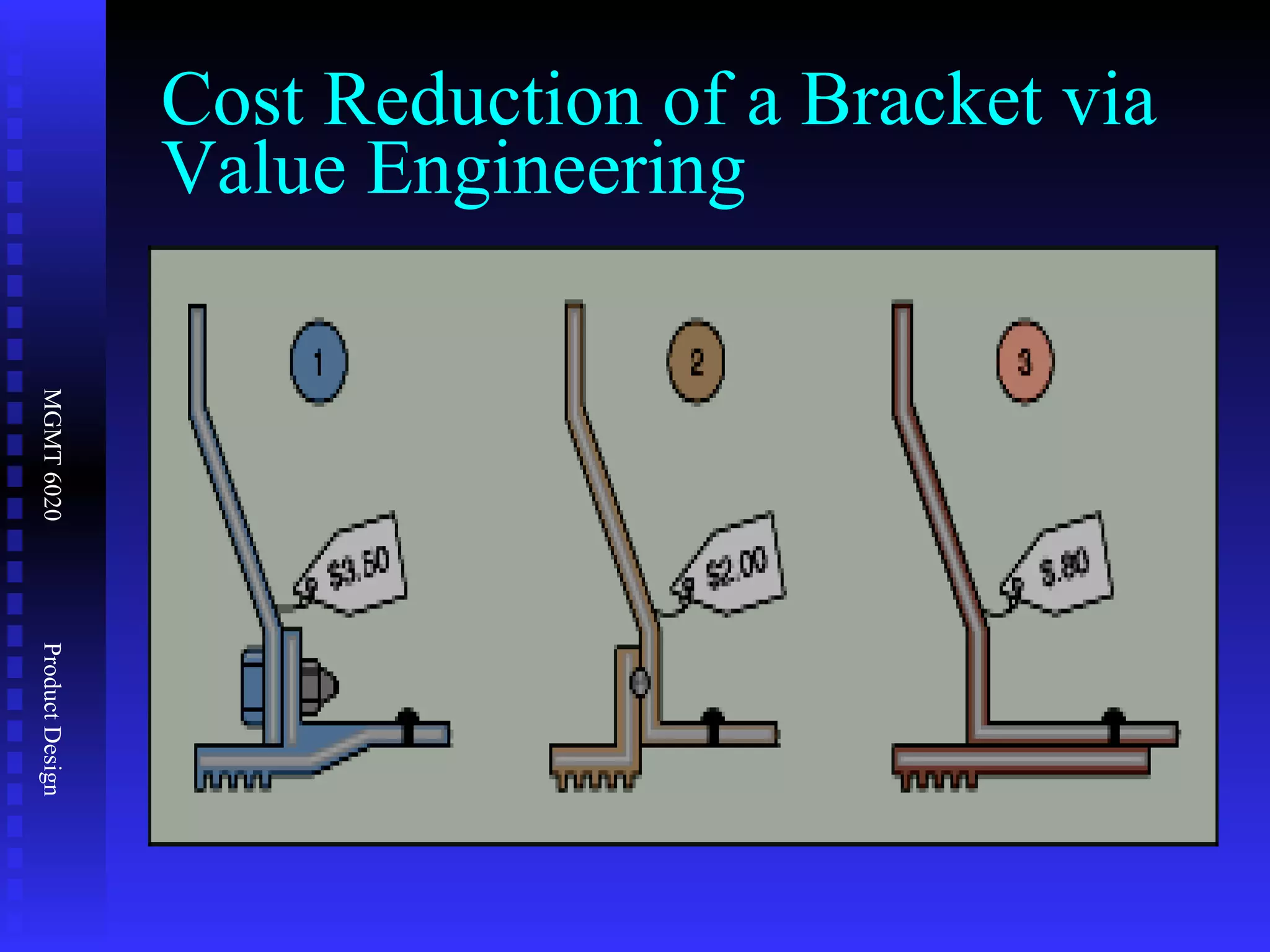
Cost Reduction of a Bracket via Value Engineering

Design Goods Slides

  • 1.
    Mini-Presentation Describe anexample of product or service design from your experience 3 to 4 minutes presentation Great opportunity to secure your participation grade!
  • 2.
    Outlines: Design ofGoods and Services Trend in New Product/Service Design and Development Product Life Cycles, Life Cycle and Strategy Product Design and Development System Sequential Design and Concurrent Engineering Application of Decision Tree to Product Design Quality Function Deployment (QFD): Translating Customer Attributes into Product Characteristics: Organizing for Product Development
  • 3.
    Trends in NewProduct/Service Design and Development SHIFT TOWARD A SERVICE ECONOMY New product design and innovation has been shifting away from manufacturing and toward the service sector. SHIFT TOWARD INFORMATION AND COMMUNICATIONS TECHNOLOGY Information revolution demanded new product and service design and development. GLOBALIZATION OF MARKETS A firm needs a product design robust enough to sell vigorously in foreign markets.
  • 4.
    Trends in NewProduct/Service Design and Development RISE OF CONSUMERISM Sellers of goods and services must now listen to customers before deciding what to offer. CRITICAL IMPORTANCE OF TIME Time has come to dominate the product/service design and development process. QUALITY RULES A poor understanding of customers’ needs almost guarantees failures in design quality in addition to potential failures in quality of conformance.
  • 5.
    Product Life CyclesIntroduction Growth Maturity Decline Standardization Less rapid product changes - more minor changes Optimum capacity Increasing stability of process Long production runs Product improvement and cost cutting Little product differentiation Cost minimization Over capacity in the industry Prune line to eliminate items not returning good margin Reduce capacity Forecasting critical Product and process reliability Competitive product improvements and options Increase capacity Shift toward product focused Enhance distribution Product design and development critical Frequent product and process design changes Short production runs High production costs Limited models Attention to quality Best period to increase market share R&D product engineering critical Practical to change price or quality image Strengthen niche Cost control critical Poor time to change image, price, or quality Competitive costs become critical Defend market position OM Strategy/Issues Company Strategy/Issues HDTV CD-ROM Color copiers Drive-thru restaurants Fax machines Station wagons Sales 3 1/2” Floppy disks Internet
  • 6.
    Product Life Cycle,Sales, Cost, and Profit Sales, Cost & Profit . Introduction Maturity Decline Growth Cost of Development & Manufacture Sales Revenue Time Cash flow Loss Profit
  • 7.
    Product Life CycleIntroduction Fine tuning research product development process modification and enhancement supplier development
  • 8.
    Product Life CycleGrowth Product design begins to stabilize Effective forecasting of capacity becomes necessary Adding or enhancing capacity may be necessary
  • 9.
    Product Life CycleMaturity Competitors now established High volume, innovative production may be needed Improved cost control, reduction in options, paring down of product line
  • 10.
    Product Life CycleDecline Unless product makes a special contribution, must plan to terminate offering Successful example of reviving product’s profitability in the decline stage: Tamagochi, simple-function camera
  • 11.
    Percent of SalesFrom New Product
  • 12.
    Design and DevelopmentCriteria PRODUCT/SERVICE QUALITY Design-measured customer satisfaction Conformance--Actual results versus specifications Features Durability Serviceability and others TIME TO MARKET (DEVELOPMENT SPEED) Elapsed time from conception to launch Time required to recover investments
  • 13.
    Design and DevelopmentCriteria DESIGN AND DEVELOPMENT COSTS One-time development costs Total costs to the customer (design, development, and manufacturing) GENERAL Percentage of sale from new products Market share (new and sustaining) REGULATION AND STANDARDS ISO 9000 UL, CCIB, FAC, IEEE
  • 14.
    Product Development StagesIdea generation Assessment of firm’s ability to carry out (Form Product Development Team) Customer Requirements Functional Specification Product Specifications Design Review Test Market Introduction to Market Evaluation Scope of design for manufacturability and value engineering
  • 15.
    Product Development withoutCoordination As Marketing interpreted it. © 1984-1994 T/Maker Co . As the customer wanted it. © 1984-1994 T/Maker Co . As Engineering designed it. © 1984-1994 T/Maker Co. As Operations made it. © 1984-1994 T/Maker Co.
  • 16.
    Managing Design andDevelopment Process Planning, organizing, staffing, leading, and controlling the limited resources SEQUENTIAL DESIGN AND DEVELOPMENT Before 1985, most American firms have organized their product design and development process sequentially. The sequence typically emerges as each functional area completes its part of the project before passing on the results to the next operation.
  • 17.
    Managing Design andDevelopment Process SHORTCOMINGS: Frequent engineering changes (before and after product launch) Ineffective communication Lack of prospective thinking. Longer design and development lead time
  • 18.
    Managing Design andDevelopment Process CONCURRENT DESIGN AND DEVELOPMENT (CONCURRENT ENGINEERING) This method sets up a comprehensive process for completing the steps in design and development through a continuing involvement of cross-functional teams of organization members.
  • 19.
    Managing Design andDevelopment Process MAIN BENEFITS: Shorter development cycle Better cross-functional communication Teamwork Clear perspective. In practice, concurrent engineering and sequential process are both important
  • 20.
    72-Seat Regional PropellerAircraft: Q400 Project
  • 21.
    Snapshot of AircraftDevelopment Beginning in spring 1996, about 380 engineers and professionals from Bombardier and its major suppliers work together in a football-size design department for the Joint Definition Phase of Q400. In this phase, all major disciplines involved in aircraft design are represented. They included engineering, design, tooling, manufacturing, marketing, sales, procurement, customer/field support, spare parts, training, publications and many more. This phase also involved refining project objectives and further negotiations. Such a co-location of company engineers and suppliers benefits both parties. It facilitates superior communication among all functions and leverages suppliers' knowledge so that new process technology can be incorporated into product development.
  • 22.
    Snapshot of AircraftDevelopment Milestones in this 6-month JDP, including different Deign Reviews, were to determine specific targets for delivering the commitments. These iterative and interactive loops are to drive and check the detailed timing and specs from all areas. When this process was completed, it was subject to a series of Participant Exit Reviews to freeze every interface design of different structures and systems. When the Project Director accepted that review, the representatives and suppliers involved could then exit the JDP process to complete their detailed design of items under their responsibility and prepare for production.
  • 23.
    Activities and Responsibilitiesof Concurrent Engineering CONCEPTUAL DESIGN Marketing: Proposes and investigates product concept Engineering: Proposes new technologies and simulates performance Operations: Proposes and investigates manufacturing /delivery process PRODUCT DESIGN Marketing: Defines market’s and specific objectives Engineering: Provides design, chooses components Operations: Coordinates process structure with key suppliers; estimates costs
  • 24.
    Activities and Responsibilitiesof Concurrent Engineering PRODUCT AND PROCESS ENGINEERING Marketing: Conducts customer tests on prototypes Engineering: Builds full scale prototypes for evaluation and refinement Operations: Builds system to manufacture prototype, test tooling and new procedures PILOT PRODUCTION AND TESTING Marketing: Prepares for market roll out, trains sales force Engineering: Evaluates and tests pilot data Operations: Builds pilot units in processes, refines the system, trains personnel, checks suppliers
  • 25.
    Activities and Responsibilitiesof Concurrent Engineering VOLUME PRODUCTION AND LAUNCH Marketing: Control distribution channel, sells and promotes Engineering: Evaluates customers’ experience with product Operations: Builds up plant volume targets, refines quality, yield, and cost performance POST-SALE SERVICE Marketing: Gains customer feedback Engineering and Operations: Study warranty data
  • 26.
    Quality Function DeploymentSuitable for product design process using cross-functional teams e.g. marketing, engineering, manufacturing Translates customer preferences into specific product characteristics Involves creating 4 tabular ‘Matrices’ or ‘Houses’ Breakdown product design into increasing levels of detail
  • 27.
    In each Houseof Quality Identify customer wants Identify how the good/service will satisfy customer wants . Relate the customer’s wants to the product’s how s . Identify relationships between the firm’s how s . Develop importance ratings Evaluate competing products
  • 28.
    The goal ofthe QFD team is to design and develop a new camera. Start from building a House of Quality. House of Quality Example © 1984-1994 T/Maker Co.
  • 29.
    House of QualityExample  High relationship  Medium relationship  Low Relationship Customer Requirements Customer Importance Target Values
  • 30.
    House of QualityExample  High relationship  Medium relationship  Low Relationship Customer Requirements Customer Importance Target Values Light weight Easy to use Reliable What the customer desires (‘wall’) Aluminum Parts Auto Focus Auto Exposure
  • 31.
    House of QualityExample  High relationship  Medium relationship  Low Relationship Customer Requirements Customer Importance Target Values Light weight Easy to use Reliable Aluminum Parts Auto Focus Auto Exposure 3 1 2 Average customer importance rating
  • 32.
    House of QualityExample  High relationship  Medium relationship  Low Relationship Customer Requirements Customer Importance Target Values Light weight Easy to use Reliable Aluminum Parts Auto Focus Auto Exposure      3 2 1 Relationship between customer attributes & engineering characteristics (‘rooms’)
  • 33.
    House of QualityExample  High relationship  Medium relationship  Low Relationship Customer Requirements Customer Importance Target Values Light weight Easy to use Reliable Aluminum Parts Auto Focus Auto Exposure      3 2 1 5 1 1 Target values for engineering characteristics (‘basement’); key output 
  • 34.
    House of QualityExample  High relationship  Medium relationship  Low Relationship Customer Requirements Customer Importance Target Values Light weight Easy to use Reliable Aluminum Parts Auto Focus Auto Exposure      3 2 1 5 1 1 
  • 35.
  • 36.
    Quality Function DeploymentThe Quality Function Deployment (QFD) tool is used to meet customers’ requirements throughout the design process and also in the design of production systems. It is a customer-driven quality planning process to guide design, manufacturing, and marketing of goods. QFD was developed in 1972 at Mitsubishi’s Kobe shipyard site. Xerox and Ford initiated the use of QFD in the United States in 1986.
  • 37.
    Quality Function DeploymentChrysler also employed the QFD methodology in 1986 in the design and development of its LH-platform cars (Chrysler Concord, Eagle Vision, Dodge Intrepid). It used QFD along with concurrent engineering and utilization of design-for-manufacturing principles and design-of-experiments methods. The overall results were quite impressive: the design cycle took 36 months versus 54 to 62 months before; prototype cars were ready 95 days before the production lunch. Customer approval rating and sales have been very good.
  • 38.
    Manufacturability and Value Engineering Main goals: reduce complexity of products Increase level of standardization among products improve key functions of each product improved job design and job safety improved maintainability of the product Green and ethical products
  • 39.
    Uncertainty in ProductDesign Cost for develop a new product is high The associated results, such as demand, competition, performance remain uncertain at the time decisions have to be made Require OM tools to facilitate decision making in the early stage of product development Decision Tree is one of the most popular tool
  • 40.
    Few Successes 0500 1000 1500 2000 Development Stage Number 1000 Market requirement Design review, Testing, Introduction 25 Ideas 1750 Product specification 100 Functional specifications One success! 500
  • 41.
    Decision Tree AnalysisDecision tree analysis may be effectively used for strategic product decisions. A decision tree contains: Decision Nodes : from which one or several decisions alternatives can be chosen Chance Nodes (state of nature): out of which one or several states of nature (events, outcomes) will occur End Nodes : at the end of the decision tree, where payoffs are being developed Arrows : that connect nodes and identify the sequence of decisions on the tree.
  • 42.
    Group Exercise: IntroducingNew Product Construct the decision tree in detail Identify the value of each node Explain your decision making process
  • 43.
    Decision Tree AnalysisAnalyzing new product introduction with decision trees involves following steps: Define the problem. Structure or draw the decision tree. Assign probabilities to the Chance Nodes (states of nature). Payoffs are calculated at the End Nodes
  • 44.
    Decision Tree AnalysisEstimate payoffs for each Chance Node by calculating the expected value over all alternatives and associated probability. Solve the problem by working backwards, that is, starting at the right of the tree and working back to decision nodes on the left. Identify the best alternative (decision) with the highest expected value.
  • 45.
    AgeTree Inc AgeTree,Inc. has developed a promising new product. The company’s management faces three choices: It can sell the idea of the new product to a company for $40,000, it can hire a consultant to study the market and then make a decision, or it can arrange financing for directly manufacturing the product. The study will cost AgeTree $25,000, and its management believes that there is about 2/3 of chances that a favorable market will be found. If the study is favorable, the company can sell the idea for $40,000, or it can manufacture the product. But even if a favorable market is found and the company manufactures the product, the chance of an ultimately successful production is about 60%. In this case, the company plans to sell 10,000 units of the product with a price of $50 each. The estimated fixed cost will be $190,000 and the variable cost will be $10 per unit. In case of unsuccessful results, the company will be able to sell approximately a half of its original number of units with the same price and costs. If the study is unfavorable, the management figures that it can still sell the idea for $40,000. Even with an unfavorable study, the company can still manufacture the product, but a successful product can be expected about once in every ten new-product introductions with the same results as those in case of the favorable study. If the AgeTree’s management decides to manufacture the product without the study, there is only a 1-in-4 chances of its being successful. The results will be exactly the same as previously mentioned.
  • 46.
    Agetree Inc Sellidea Study Manufacture directly (0.67) favorable (0.33) unfavorable Sell idea Sell idea Manufacture Manufacture (0.6) success (0.4) fail (0.1) success (0.9) fail (50-10)*10,000-190,000=210,000 (50-10)*5,000-190,000=10,000 (0.25) success (0.75) fail 40,000 40,000-25,000=15,000 40,000-25,000=15,000 (50-10)*10,000-190,000 -25,000=185,000 (50-10)*5,000-190,000 -25,000=-15,000 (50-10)*10,000-190,000 -25,000=185,000 (50-10)*5,000-190,000 -25,000=-15,000 1 4 3 2 7 16 15 6 5 10 12 8 9 14 13 11
  • 47.
    Important Issues forAchieving the Goals Robust design Time-based competition Modular design Computer-aided design Value analysis Environmentally friendly design
  • 48.
    Cost Reduction ofa Bracket via Value Engineering