CHAPTER NO :11
THE PRODUCT DEVELOPMENT PROCESS
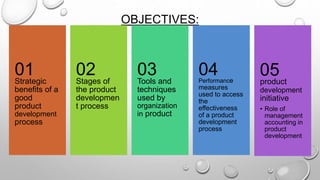
OBJECTIVES:
Strategic
benefits of a
good
product
development
process
01 Stages of
the product
developmen
t process
02 Tools and
techniques
used by
organization
in product
03 Performance
measures
used to access
the
effectiveness
of a product
development
process
04
product
development
initiative
• Role of
management
accounting in
product
development
05
PRODUCT DEVELOPMENT: THE KEY TO
COMPETITIVE ADVANTAGE
The product development process provides a
Broad set of tools, techniques and concepts
That enables an organization to provide
Distinctiveness in its offerings by rolling
Out new products and services faster and
At a lower cost.
Product development is an important aspect
of operations management .An organization focuses
on product development process will be in a better position to
bring new products and services in the market and will be able to
retain its customers and increase the market share through
competitive advantage.
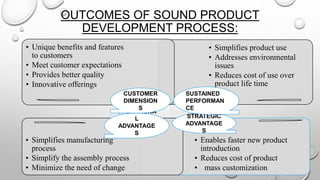
OUTCOMES OF SOUND PRODUCT
DEVELOPMENT PROCESS:
• Enables faster new product
introduction
• Reduces cost of product
• mass customization
• Simplifies manufacturing
process
• Simplify the assembly process
• Minimize the need of change
• Simplifies product use
• Addresses environmental
issues
• Reduces cost of use over
product life time
• Unique benefits and features
to customers
• Meet customer expectations
• Provides better quality
• Innovative offerings
OPERATIONA
L
ADVANTAGE
S
STRATEGIC
ADVANTAGE
S
CUSTOMER
DIMENSION
S
SUSTAINED
PERFORMAN
CE
STAGES IN THE PRODUCT DEVELOPMENT
PROCESS
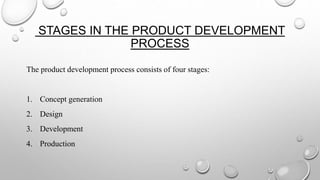
The product development process consists of four stages:
1. Concept generation
2. Design
3. Development
4. Production
CONCEPT GENERATION:
• The first stage in product development process is concept generation.
• It include the analysis of customer needs.(Quality, price, service)
• Customer needs are compared with current portfolio and gaps are
analysed.
• The idea is generated and the needs of customers is translated into
New products design
• After idea generation the next step is feasible study (technology ,
DESIGN:
• The second stage in the product development process is to incorporate
more details in the design.
• The physical attributes of product are analysed.
• Detailed specification of the product is drawn.
• The product planning activity provides details of the product
being designed
• The feasibility of design is analysed again.
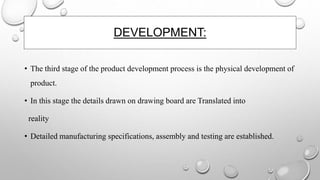
DEVELOPMENT:
• The third stage of the product development process is the physical development of
product.
• In this stage the details drawn on drawing board are Translated into
reality
• Detailed manufacturing specifications, assembly and testing are established.
PRODUCTION:
• It is the last stage of product development process
• It involves the establishment of a system for volume production.
• The dedicated equipment and assured sources of supply are
established.
• The product is manufactured in large quantity.
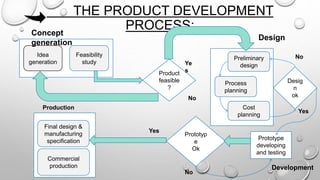
THE PRODUCT DEVELOPMENT
PROCESS:
-
Desig
n
ok
Prototype
developing
and testing
Prototyp
e
Ok
Product
feasible
?
Idea
generation
Feasibility
study
Preliminary
design
Process
planning
Cost
planning
Final design &
manufacturing
specification
Commercial
production
Concept
generation
Design
No
Yes
Development
Yes
No
Ye
s
No
Production
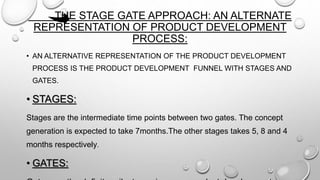
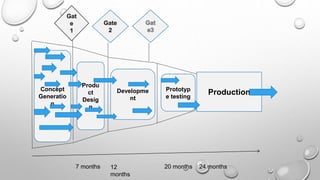
THE STAGE GATE APPROACH: AN ALTERNATE
REPRESENTATION OF PRODUCT DEVELOPMENT
PROCESS:
• AN ALTERNATIVE REPRESENTATION OF THE PRODUCT DEVELOPMENT
PROCESS IS THE PRODUCT DEVELOPMENT FUNNEL WITH STAGES AND
GATES.
• STAGES:
Stages are the intermediate time points between two gates. The concept
generation is expected to take 7months.The other stages takes 5, 8 and 4
months respectively.
• GATES:
ProductionConcept
Generatio
n
Produ
ct
Desig
n
Developme
nt
Prototyp
e testing
7 months 12
months
20 months 24 months
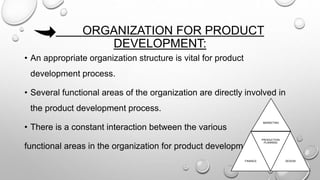
ORGANIZATION FOR PRODUCT
DEVELOPMENT:
• An appropriate organization structure is vital for product
development process.
• Several functional areas of the organization are directly involved in
the product development process.
• There is a constant interaction between the various
functional areas in the organization for product development .
MARKETING
FINANCE
PRODUCTION
PLANNING
DESIGN
TRADITIONAL APPROACH:
• In traditional approach of product development process the functional areas of
the organization perform their function One by one .At a time one functional area
performs its function .
DRAWBACK:
As it is the longer process so the cost of development would be greater.
The process takes 48 months to bring the product in the market
and the chances of change in demand of product increases.
CONCURRENT ENGINEERING:
• Concurrent engineering is a process of putting together a team of
Cross functional professionals and providing them with required
Resources and mandate for the product development process.
BENEFITS:
The development lead time will reduced.
The chances of change in demand will decrease.
A team structure promotes consensus based decision making.
Marketin
g
Design Planning
Procureme
nt
Productio
n
Finance
Custome
rs
Supplier
s
Plannin
g
supplie
rs
Concurren
t
engineerin
g team
structure
TOOLS FOR EFFICIENT PRODUCT
DEVELOPMENT:
• Several tools and techniques can be used for efficient new product development.
• These tools address various stages of the product development process. Such as:
Understanding customer needs
Quality function deployment
Value engineering
Design for manufacturability
Tools for mass customization
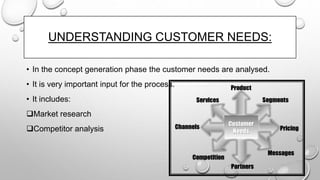
UNDERSTANDING CUSTOMER NEEDS:
• In the concept generation phase the customer needs are analysed.
• It is very important input for the process.
• It includes:
Market research
Competitor analysis
MARKET RESEARCH
• QUANTITATIVE ANALYSIS: target group is identified
and appropriate sampling is done within the target
group by using structured data collection method such
as questionnaire surveys and interviews
• FOCUS GROUPS: several individuals from the target
group are simultaneously met and interviewed together.
• IN DEPTH QUALITATIVE INTERVIEWS: in depth
interviews can be collected from potential customers on
individual basis
COMPETITOR ANALYSIS
• Understanding of what the existing offers are and how gaps can
be eliminated offer value to concept generation.
• This method is a proxy for understanding customer needs ,it
includes
REVERSE ENGINEERING: The competitor’s products
are dismantled down to the individual components and
detailed studies are conducted on them.
PERCEPTUAL MAPS: Perceptual maps are graphical
representation of the various competitor offerings and that of
the proposed product and service.
QUALITY FUNCTION DEPLOYMENT
Quality function deployment (QFD) is a Japanese tool that helps
organizations translate customer requirements into design, process,
planning and manufacturing specifications using a four stage process.
Each stage is known as house of quality
• Linkage between customer needs and design attributes.
• Design attributes form the basis of action.
• Specific decisions are made
• Implementation of decision
TYPES OF DATA USED IN THE HOUSE OF
QUALITY:
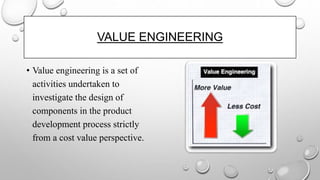
• Value engineering is a set of
activities undertaken to
investigate the design of
components in the product
development process strictly
from a cost value perspective.
VALUE ENGINEERING
DESIGN FOR MANUFACTURABILITY
• Design for manufacturability(dfm) is a
structured approach to ensure that
manufacturing requirements and
preferences are considered fairly early in the
design process without the need for
extensive coordination between the two.
• Dfm addresses three sets of requirements:
i. Reducing the variety
ii. Considering operational convenience
iii. Reducing cost
• Mass customization provides a structured set of ideas and tools to
provide high level of customization without increasing the complexity of
planning and control of operations
• Techniques for mass customization:
Variety reducing technique
Modular design
Product platform
Tools for mass customization
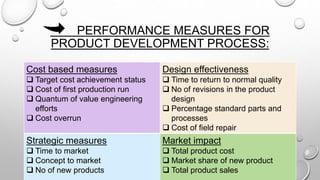
PERFORMANCE MEASURES FOR
PRODUCT DEVELOPMENT PROCESS:
Cost based measures
 Target cost achievement status
 Cost of first production run
 Quantum of value engineering
efforts
 Cost overrun
Design effectiveness
 Time to return to normal quality
 No of revisions in the product
design
 Percentage standard parts and
processes
 Cost of field repair
Strategic measures
 Time to market
 Concept to market
 No of new products
Market impact
 Total product cost
 Market share of new product
 Total product sales
MANAGEMENT ACCOUNTING TOOLS
FOR PRODUCT DEVELOPMENT:
• Management accounting helped
the product development
process
• Management accounting
proposed advocated ways and
means of controlling the final
cost of product and service
• Two concepts of management
accounting are:
i. Life cycle costing
ii. Target costing
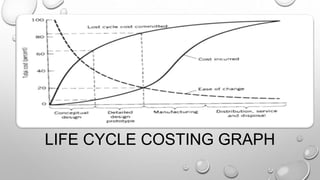
LIFE CYCLE COSTING
• LIFE CYCLE COSTING IS A METHODOLOGY THAT FOCUSES ON
THE COST AND CONTROL ASPECTS OF A PRODUCT OR A SERVICE
THROUGHOUT ITS LIFE CYCLE.
LIFE CYCLE COSTING GRAPH
TARGET COSTING
• TARGET COSTING IS A METHODOLOGY TO IDENTIFY COST
REDUCTION METHODS AND PURSUE THEM RELENTLESSLY SO
THAT AS THE PRODUCT IS DESIGNED AND MANUFACTURED ,IT IS
WITHIN THE SET TARGET.
SOFTWARE PRODUCT DEVELOPMENT:
• A software development process consists of four stages:
1. Requirement analysis
2. Design
3. Development
4. Testing
product development process chapter 11

product development process chapter 11

  • 2.
    CHAPTER NO :11 THEPRODUCT DEVELOPMENT PROCESS
  • 3.
    OBJECTIVES: Strategic benefits of a good product development process 01Stages of the product developmen t process 02 Tools and techniques used by organization in product 03 Performance measures used to access the effectiveness of a product development process 04 product development initiative • Role of management accounting in product development 05
  • 4.
    PRODUCT DEVELOPMENT: THEKEY TO COMPETITIVE ADVANTAGE The product development process provides a Broad set of tools, techniques and concepts That enables an organization to provide Distinctiveness in its offerings by rolling Out new products and services faster and At a lower cost.
  • 5.
    Product development isan important aspect of operations management .An organization focuses on product development process will be in a better position to bring new products and services in the market and will be able to retain its customers and increase the market share through competitive advantage.
  • 6.
    OUTCOMES OF SOUNDPRODUCT DEVELOPMENT PROCESS: • Enables faster new product introduction • Reduces cost of product • mass customization • Simplifies manufacturing process • Simplify the assembly process • Minimize the need of change • Simplifies product use • Addresses environmental issues • Reduces cost of use over product life time • Unique benefits and features to customers • Meet customer expectations • Provides better quality • Innovative offerings OPERATIONA L ADVANTAGE S STRATEGIC ADVANTAGE S CUSTOMER DIMENSION S SUSTAINED PERFORMAN CE
  • 7.
    STAGES IN THEPRODUCT DEVELOPMENT PROCESS The product development process consists of four stages: 1. Concept generation 2. Design 3. Development 4. Production
  • 8.
    CONCEPT GENERATION: • Thefirst stage in product development process is concept generation. • It include the analysis of customer needs.(Quality, price, service) • Customer needs are compared with current portfolio and gaps are analysed. • The idea is generated and the needs of customers is translated into New products design • After idea generation the next step is feasible study (technology ,
  • 9.
    DESIGN: • The secondstage in the product development process is to incorporate more details in the design. • The physical attributes of product are analysed. • Detailed specification of the product is drawn. • The product planning activity provides details of the product being designed • The feasibility of design is analysed again.
  • 10.
    DEVELOPMENT: • The thirdstage of the product development process is the physical development of product. • In this stage the details drawn on drawing board are Translated into reality • Detailed manufacturing specifications, assembly and testing are established.
  • 11.
    PRODUCTION: • It isthe last stage of product development process • It involves the establishment of a system for volume production. • The dedicated equipment and assured sources of supply are established. • The product is manufactured in large quantity.
  • 12.
    THE PRODUCT DEVELOPMENT PROCESS: - Desig n ok Prototype developing andtesting Prototyp e Ok Product feasible ? Idea generation Feasibility study Preliminary design Process planning Cost planning Final design & manufacturing specification Commercial production Concept generation Design No Yes Development Yes No Ye s No Production
  • 13.
    THE STAGE GATEAPPROACH: AN ALTERNATE REPRESENTATION OF PRODUCT DEVELOPMENT PROCESS: • AN ALTERNATIVE REPRESENTATION OF THE PRODUCT DEVELOPMENT PROCESS IS THE PRODUCT DEVELOPMENT FUNNEL WITH STAGES AND GATES. • STAGES: Stages are the intermediate time points between two gates. The concept generation is expected to take 7months.The other stages takes 5, 8 and 4 months respectively. • GATES:
  • 14.
  • 15.
    ORGANIZATION FOR PRODUCT DEVELOPMENT: •An appropriate organization structure is vital for product development process. • Several functional areas of the organization are directly involved in the product development process. • There is a constant interaction between the various functional areas in the organization for product development . MARKETING FINANCE PRODUCTION PLANNING DESIGN
  • 16.
    TRADITIONAL APPROACH: • Intraditional approach of product development process the functional areas of the organization perform their function One by one .At a time one functional area performs its function . DRAWBACK: As it is the longer process so the cost of development would be greater. The process takes 48 months to bring the product in the market and the chances of change in demand of product increases.
  • 17.
    CONCURRENT ENGINEERING: • Concurrentengineering is a process of putting together a team of Cross functional professionals and providing them with required Resources and mandate for the product development process. BENEFITS: The development lead time will reduced. The chances of change in demand will decrease. A team structure promotes consensus based decision making.
  • 18.
  • 19.
    TOOLS FOR EFFICIENTPRODUCT DEVELOPMENT: • Several tools and techniques can be used for efficient new product development. • These tools address various stages of the product development process. Such as: Understanding customer needs Quality function deployment Value engineering Design for manufacturability Tools for mass customization
  • 20.
    UNDERSTANDING CUSTOMER NEEDS: •In the concept generation phase the customer needs are analysed. • It is very important input for the process. • It includes: Market research Competitor analysis
  • 21.
    MARKET RESEARCH • QUANTITATIVEANALYSIS: target group is identified and appropriate sampling is done within the target group by using structured data collection method such as questionnaire surveys and interviews • FOCUS GROUPS: several individuals from the target group are simultaneously met and interviewed together. • IN DEPTH QUALITATIVE INTERVIEWS: in depth interviews can be collected from potential customers on individual basis
  • 22.
    COMPETITOR ANALYSIS • Understandingof what the existing offers are and how gaps can be eliminated offer value to concept generation. • This method is a proxy for understanding customer needs ,it includes REVERSE ENGINEERING: The competitor’s products are dismantled down to the individual components and detailed studies are conducted on them. PERCEPTUAL MAPS: Perceptual maps are graphical representation of the various competitor offerings and that of the proposed product and service.
  • 23.
    QUALITY FUNCTION DEPLOYMENT Qualityfunction deployment (QFD) is a Japanese tool that helps organizations translate customer requirements into design, process, planning and manufacturing specifications using a four stage process. Each stage is known as house of quality • Linkage between customer needs and design attributes. • Design attributes form the basis of action. • Specific decisions are made • Implementation of decision
  • 24.
    TYPES OF DATAUSED IN THE HOUSE OF QUALITY:
  • 25.
    • Value engineeringis a set of activities undertaken to investigate the design of components in the product development process strictly from a cost value perspective. VALUE ENGINEERING
  • 26.
    DESIGN FOR MANUFACTURABILITY •Design for manufacturability(dfm) is a structured approach to ensure that manufacturing requirements and preferences are considered fairly early in the design process without the need for extensive coordination between the two. • Dfm addresses three sets of requirements: i. Reducing the variety ii. Considering operational convenience iii. Reducing cost
  • 27.
    • Mass customizationprovides a structured set of ideas and tools to provide high level of customization without increasing the complexity of planning and control of operations • Techniques for mass customization: Variety reducing technique Modular design Product platform Tools for mass customization
  • 28.
    PERFORMANCE MEASURES FOR PRODUCTDEVELOPMENT PROCESS: Cost based measures  Target cost achievement status  Cost of first production run  Quantum of value engineering efforts  Cost overrun Design effectiveness  Time to return to normal quality  No of revisions in the product design  Percentage standard parts and processes  Cost of field repair Strategic measures  Time to market  Concept to market  No of new products Market impact  Total product cost  Market share of new product  Total product sales
  • 29.
    MANAGEMENT ACCOUNTING TOOLS FORPRODUCT DEVELOPMENT: • Management accounting helped the product development process • Management accounting proposed advocated ways and means of controlling the final cost of product and service • Two concepts of management accounting are: i. Life cycle costing ii. Target costing
  • 30.
    LIFE CYCLE COSTING •LIFE CYCLE COSTING IS A METHODOLOGY THAT FOCUSES ON THE COST AND CONTROL ASPECTS OF A PRODUCT OR A SERVICE THROUGHOUT ITS LIFE CYCLE.
  • 31.
  • 32.
    TARGET COSTING • TARGETCOSTING IS A METHODOLOGY TO IDENTIFY COST REDUCTION METHODS AND PURSUE THEM RELENTLESSLY SO THAT AS THE PRODUCT IS DESIGNED AND MANUFACTURED ,IT IS WITHIN THE SET TARGET.
  • 33.
    SOFTWARE PRODUCT DEVELOPMENT: •A software development process consists of four stages: 1. Requirement analysis 2. Design 3. Development 4. Testing