Product Concept
- Aradhana Nair
Product Concept – creation process
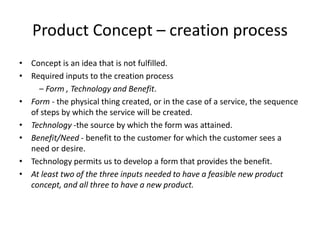
• Concept is an idea that is not fulfilled.
• Required inputs to the creation process
– Form , Technology and Benefit.
• Form - the physical thing created, or in the case of a service, the sequence
of steps by which the service will be created.
• Technology -the source by which the form was attained.
• Benefit/Need - benefit to the customer for which the customer sees a
need or desire.
• Technology permits us to develop a form that provides the benefit.
• At least two of the three inputs needed to have a feasible new product
concept, and all three to have a new product.
Product Concept- creation process ways
• The innovation process can start with any of the three inputs.
• If any of these three are missing then product innovation cannot be done.
• Putting benefit last is very risky since it comprises a solution trying to find
a problem.
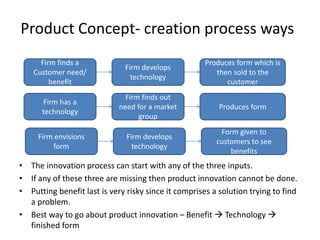
• Best way to go about product innovation – Benefit  Technology 
finished form
Firm finds a
Customer need/
benefit
Firm develops
technology
Produces form which is
then sold to the
customer
Firm has a
technology
Firm finds out
need for a market
group
Produces form
Firm envisions
form
Firm develops
technology
Form given to
customers to see
benefits
Product Concept
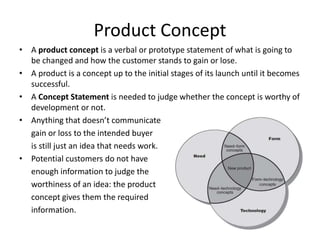
• A product concept is a verbal or prototype statement of what is going to
be changed and how the customer stands to gain or lose.
• A product is a concept up to the initial stages of its launch until it becomes
successful.
• A Concept Statement is needed to judge whether the concept is worthy of
development or not.
• Anything that doesn’t communicate
gain or loss to the intended buyer
is still just an idea that needs work.
• Potential customers do not have
enough information to judge the
worthiness of an idea: the product
concept gives them the required
information.
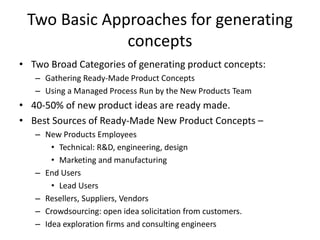
Two Basic Approaches for generating
concepts
• Two Broad Categories of generating product concepts:
– Gathering Ready-Made Product Concepts
– Using a Managed Process Run by the New Products Team
• 40-50% of new product ideas are ready made.
• Best Sources of Ready-Made New Product Concepts –
– New Products Employees
• Technical: R&D, engineering, design
• Marketing and manufacturing
– End Users
• Lead Users
– Resellers, Suppliers, Vendors
– Crowdsourcing: open idea solicitation from customers.
– Idea exploration firms and consulting engineers
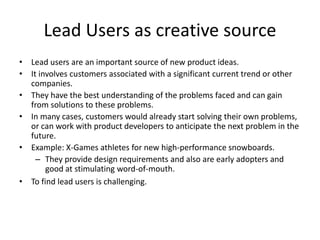
Lead Users as creative source
• Lead users are an important source of new product ideas.
• It involves customers associated with a significant current trend or other
companies.
• They have the best understanding of the problems faced and can gain
from solutions to these problems.
• In many cases, customers would already start solving their own problems,
or can work with product developers to anticipate the next problem in the
future.
• Example: X-Games athletes for new high-performance snowboards.
– They provide design requirements and also are early adopters and
good at stimulating word-of-mouth.
• To find lead users is challenging.
THANK YOU

Product Concept

  • 1.
  • 2.
    Product Concept –creation process • Concept is an idea that is not fulfilled. • Required inputs to the creation process – Form , Technology and Benefit. • Form - the physical thing created, or in the case of a service, the sequence of steps by which the service will be created. • Technology -the source by which the form was attained. • Benefit/Need - benefit to the customer for which the customer sees a need or desire. • Technology permits us to develop a form that provides the benefit. • At least two of the three inputs needed to have a feasible new product concept, and all three to have a new product.
  • 3.
    Product Concept- creationprocess ways • The innovation process can start with any of the three inputs. • If any of these three are missing then product innovation cannot be done. • Putting benefit last is very risky since it comprises a solution trying to find a problem. • Best way to go about product innovation – Benefit  Technology  finished form Firm finds a Customer need/ benefit Firm develops technology Produces form which is then sold to the customer Firm has a technology Firm finds out need for a market group Produces form Firm envisions form Firm develops technology Form given to customers to see benefits
  • 4.
    Product Concept • Aproduct concept is a verbal or prototype statement of what is going to be changed and how the customer stands to gain or lose. • A product is a concept up to the initial stages of its launch until it becomes successful. • A Concept Statement is needed to judge whether the concept is worthy of development or not. • Anything that doesn’t communicate gain or loss to the intended buyer is still just an idea that needs work. • Potential customers do not have enough information to judge the worthiness of an idea: the product concept gives them the required information.
  • 5.
    Two Basic Approachesfor generating concepts • Two Broad Categories of generating product concepts: – Gathering Ready-Made Product Concepts – Using a Managed Process Run by the New Products Team • 40-50% of new product ideas are ready made. • Best Sources of Ready-Made New Product Concepts – – New Products Employees • Technical: R&D, engineering, design • Marketing and manufacturing – End Users • Lead Users – Resellers, Suppliers, Vendors – Crowdsourcing: open idea solicitation from customers. – Idea exploration firms and consulting engineers
  • 6.
    Lead Users ascreative source • Lead users are an important source of new product ideas. • It involves customers associated with a significant current trend or other companies. • They have the best understanding of the problems faced and can gain from solutions to these problems. • In many cases, customers would already start solving their own problems, or can work with product developers to anticipate the next problem in the future. • Example: X-Games athletes for new high-performance snowboards. – They provide design requirements and also are early adopters and good at stimulating word-of-mouth. • To find lead users is challenging.
  • 7.