Good Food, Good Life
Nestle
• Nestlé was founded in 1867 by Henri Nestlé in Switzerland
• Merged with the Anglo-Swiss Condensed Milk Company in
1905
• Today it is the world's largest and most diversified food
Company, and is about twice the size of its nearest competitor
in the food and beverages sector.
• Nestlé employ around 250,000 people from more than 70
countries and have factories or operations in almost every
country in the world
Nestlé Principle
• Nestlé is based on the principle of decentralization, which
means each country is responsible for the efficient running of
its business - including the recruitment of its staff.
Nestle India Products
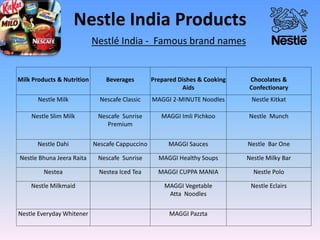
Nestlé India - Famous brand names
Milk Products & Nutrition Beverages Prepared Dishes & Cooking
Aids
Chocolates &
Confectionary
Nestle Milk Nescafe Classic MAGGI 2-MINUTE Noodles Nestle Kitkat
Nestle Slim Milk Nescafe Sunrise
Premium
MAGGI Imli Pichkoo Nestle Munch
Nestle Dahi Nescafe Cappuccino MAGGI Sauces Nestle Bar One
Nestle Bhuna Jeera Raita Nescafe Sunrise MAGGI Healthy Soups Nestle Milky Bar
Nestea Nestea Iced Tea MAGGI CUPPA MANIA Nestle Polo
Nestle Milkmaid MAGGI Vegetable
Atta Noodles
Nestle Eclairs
Nestle Everyday Whitener MAGGI Pazzta
Distribution System
• Competitive edge over its existing rivals.
• Nestlé has its own distribution networks equipped with all
necessary transportation facilities.
• They transport their products at major regional sales offices,
which are situated at different cities of India.
• These sales offices (distribution centres) have their
own vans with sales people who sell and transport goods to
the small retailers.
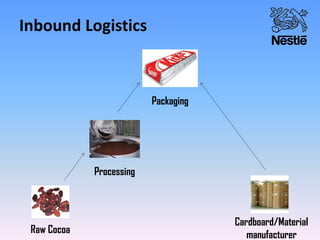
Inbound Logistics
Raw Cocoa
Processing
Cardboard/Material
manufacturer
Packaging
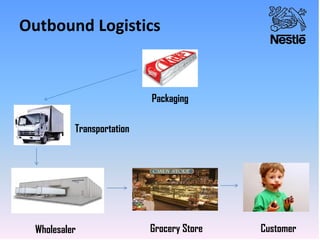
Outbound Logistics
Packaging
Transportation
Wholesaler Grocery Store Customer
Mother Godown
Carriage and Forwarding Agent
Distributor Super-Stockist
WholesalerRetailer Re-distributor
Retailer
Nestle Distribution Channel
End Customer
Nestle Distribution Channel
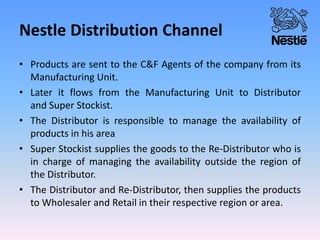
• Products are sent to the C&F Agents of the company from its
Manufacturing Unit.
• Later it flows from the Manufacturing Unit to Distributor
and Super Stockist.
• The Distributor is responsible to manage the availability of
products in his area
• Super Stockist supplies the goods to the Re-Distributor who is
in charge of managing the availability outside the region of
the Distributor.
• The Distributor and Re-Distributor, then supplies the products
to Wholesaler and Retail in their respective region or area.
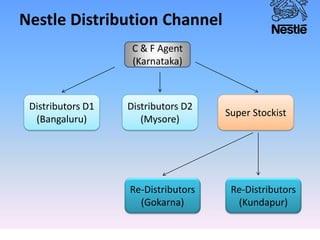
Nestle Distribution Channel
C & F Agent
(Karnataka)
Distributors D1
(Bangaluru)
Distributors D2
(Mysore)
Super Stockist
Re-Distributors
(Gokarna)
Re-Distributors
(Kundapur)
Selection of Distributors
• The Criteria followed are:
1. Capital Investment
 Depends on both present and future capital investments by distributors
 Amount vary from Area-wise to marketwise
2. Relevant experience
 Prior experience in FMCG sector is preferred to save on training expenses
 Distributor should not be dealing in Competitor’s product
 Should handle entire range of Nestle products (Both fast and slow moving SKU’s)
3. Infrastructure
 Godowns / Storage space with appropriate refrigeration as per product needs
 Delivery vehicles
 Salesmen
4. Company’s discretion based on markets served
Terms of Operation
• Sales force of distributor is divided into 3 heads namely:
1. Milk Products
2. Chocolates
3. Other products
• All the 3 teams visit the retailers once in a week on different
days
• Sales force is complimented by a weekly visit to the district by
the sales executive of the company
• Idea is to supplement the lags in the distribution by
wholesaler and in certain specific cases to push extra stock in
the market
Terms of Operation
• Company policies
1. Credit Policy
• Distributors are termed as Cash Distributors because
the company charges the distributors before the stock
is delivered
• Company has connected the distributor online and
the transactions happen online
• The distributor sells goods on credit; the period of
credit ranges from 1-2 week
• The wholesaler allows discount of 1% on cash
payment (policy followed by the wholesaler)
Terms of Operation
2. Stock Policy
 As per the company regulations the distributor is supposed to
maintain a stock of 3 weeks which in monetary terms equals to
Rs. 30 lakh for the distributor.
 Stock is formalized by the company; the dealer can negotiate on
3-4 end days, the stock policy is formed for the month
 Distributor to push in slow moving SKU’s clubs them with fast
moving SKU’s for the retailers
 Company DUMPS significantly on the distributors, the distributor
has to mange the supply by the company
Terms of Operation
3. Lead period
 Lead periods in providing stocks to the dealers differs from the
SKU and quantity ordered
 Some SKU’s like dairy products are delivered correspondingly
with taking order but some are sent from the warehouses
 A higher quantity ordered has to be replenished from the
warehouse
4. Return Policy
 Company follows a policy of return when the product has past its
expiry date, damaged or has a defect
 Replenishment is done with cash and happens at the end of
every six months
5. Return on Investment
 Company does not give any guarantee to the distributor
Terms of Operation
6. Storage policy
 Distributor maintains Cold Storages and Deep Freezers for the
storage of the products
 Distributor has to bear all expenses pertaining to Infrastructure
requirements
7. Sales Force
 The remuneration and all other expenses for sales force are
borne by the distributor.
Incentives - Margins
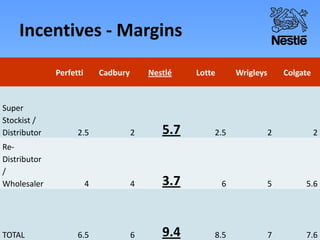
Perfetti Cadbury Nestlé Lotte Wrigleys Colgate
Super
Stockist /
Distributor 2.5 2 5.7 2.5 2 2
Re-
Distributor
/
Wholesaler 4 4 3.7 6 5 5.6
TOTAL 6.5 6 9.4 8.5 7 7.6
Incentives - Schemes
• Specific schemes which spread over 2 ~ 3 months
• Encourage specific target achievements
• Targets are given as indexed growth rates based on weights
• For e.g.
– 10% growth for distributor having sales of Rs. 20000 will different from
distributor having sales of Rs. 1 lakh
• Prizes in form of additional margins
• Certificate of acknowledgement for achieving the target
Motivation of Channel Partners
• “Proud to be Nestle – Super awards for super achievers”
– Open to
• Area Sales Managers
• Sales Officers
• Cash Distributors
• Distributor Salesman
• Merchandisers
• How does it Work?
1. Qualifying Criteria
1. 100% achievement of internal target for 3rd quarter (Invoicing)
2. Min. 10% RDBN turnover growth over last year 2nd quarter
Motivation of Channel Partners
2. Ranking
 All ASM’s who fulfil above criteria are ranked on the basis of
Index.
 Top ASM’s(as fixed by the branch) win prizes
INDEX = %RD turnover growth * absolute value increase
 The winning team comprise of;
 All SOs in the ASM team
 Two top ranked CDs in each SO Zone
(Index = %RD growth * absolute turnover increase)
 Two distributor salesmen in each of the top two CD
 One Merchandiser in each of the top two points ( Performance will
be assessed by S.O. on quality of merchandising achieved)
 The Top ranked ASM team also wins a TEAM TROPHY and
certificates
Dealership in Practice (DIP) training
 Training programs for C&F agents which includes modules on:
 Nestle Quality System
 Good Warehousing Practices (GWP)
 Good Distribution Practices
 Major aspects of the training program are;
1. Stacking as per norms
2. Good Warehousing practices
3. Accounting
4. Handling of Bad goods
5. Temperature control for chocolates and dairy products
Target setting
 Target setting is a result of negotiation between Distributor and
Company
 Mid month targets for next month are set around 5th-10th of that
month
 Targets are set for Sales officers, ASM’s and branch managers which
are driven down the hierarchy
 Distributors can negotiate this targets in range of +/-10% by end of
month
 Confirmed sales are set as weekly targets
Target setting
 Responsibility
1. Branch manager : Co-ordinating targets of factories and individual
product managers
2. Sales officer : Focus is on the redistribution targets, also called
as secondary invoicing (from cash
distributor to the redistributors)
3. ASM : Primary invoicing ( From C&S to cash distributor)
is more relevant
4. Company : Primary as well as secondary invoicing
Channel conflicts
• Conflicts due to:
1. Wholesalers
 Wholesalers are not a part of the formal structure of Nestle
India’s distribution network
 Make bulk purchases from the distributors directly thereby
leveraging on the margins
 Typically the wholesaler gets a margin of about 2%-3% from the
distributor , of this he retains 1 % and passes on the remaining
2% as discount to the retailer
 This discount induces the retailers to buy from wholesalers
2. Sales Officers
 Account of invasion of another’s sales area by a company’s sales
officer under pressure of sales target
Physical distribution system
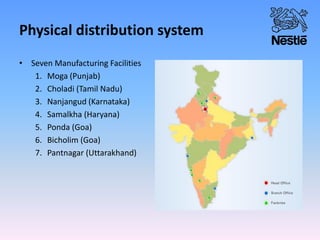
• Seven Manufacturing Facilities
1. Moga (Punjab)
2. Choladi (Tamil Nadu)
3. Nanjangud (Karnataka)
4. Samalkha (Haryana)
5. Ponda (Goa)
6. Bicholim (Goa)
7. Pantnagar (Uttarakhand)
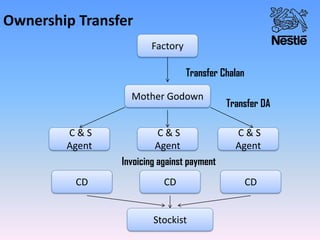
Ownership Transfer
Factory
Mother Godown
C & S
Agent
C & S
Agent
C & S
Agent
CD CD CD
Stockist
Transfer Chalan
Transfer DA
Invoicing against payment
Logistics Structure
• Logistics comprise of Road Transportation through Container trucks
• Distribution from point of Distributor warehouse to Retailer shops /
Modern trade shops is handled by Distributor
• Distributor has fleet of mix of transport vehicles right from refrigerated
vans to small tempos to supply to Pan shops
• Company is connected to Distributor / Super Stockist through SAP for
online order booking and processing
• “Stock in Transit” module is installed at Distributors network systemsf or
tracking the supply of goods
Thank you

01 nestle sales and distribution

  • 1.
  • 2.
    Nestle • Nestlé wasfounded in 1867 by Henri Nestlé in Switzerland • Merged with the Anglo-Swiss Condensed Milk Company in 1905 • Today it is the world's largest and most diversified food Company, and is about twice the size of its nearest competitor in the food and beverages sector. • Nestlé employ around 250,000 people from more than 70 countries and have factories or operations in almost every country in the world
  • 3.
    Nestlé Principle • Nestléis based on the principle of decentralization, which means each country is responsible for the efficient running of its business - including the recruitment of its staff.
  • 4.
    Nestle India Products NestléIndia - Famous brand names Milk Products & Nutrition Beverages Prepared Dishes & Cooking Aids Chocolates & Confectionary Nestle Milk Nescafe Classic MAGGI 2-MINUTE Noodles Nestle Kitkat Nestle Slim Milk Nescafe Sunrise Premium MAGGI Imli Pichkoo Nestle Munch Nestle Dahi Nescafe Cappuccino MAGGI Sauces Nestle Bar One Nestle Bhuna Jeera Raita Nescafe Sunrise MAGGI Healthy Soups Nestle Milky Bar Nestea Nestea Iced Tea MAGGI CUPPA MANIA Nestle Polo Nestle Milkmaid MAGGI Vegetable Atta Noodles Nestle Eclairs Nestle Everyday Whitener MAGGI Pazzta
  • 5.
    Distribution System • Competitiveedge over its existing rivals. • Nestlé has its own distribution networks equipped with all necessary transportation facilities. • They transport their products at major regional sales offices, which are situated at different cities of India. • These sales offices (distribution centres) have their own vans with sales people who sell and transport goods to the small retailers.
  • 6.
  • 7.
  • 8.
    Mother Godown Carriage andForwarding Agent Distributor Super-Stockist WholesalerRetailer Re-distributor Retailer Nestle Distribution Channel End Customer
  • 9.
    Nestle Distribution Channel •Products are sent to the C&F Agents of the company from its Manufacturing Unit. • Later it flows from the Manufacturing Unit to Distributor and Super Stockist. • The Distributor is responsible to manage the availability of products in his area • Super Stockist supplies the goods to the Re-Distributor who is in charge of managing the availability outside the region of the Distributor. • The Distributor and Re-Distributor, then supplies the products to Wholesaler and Retail in their respective region or area.
  • 10.
    Nestle Distribution Channel C& F Agent (Karnataka) Distributors D1 (Bangaluru) Distributors D2 (Mysore) Super Stockist Re-Distributors (Gokarna) Re-Distributors (Kundapur)
  • 11.
    Selection of Distributors •The Criteria followed are: 1. Capital Investment  Depends on both present and future capital investments by distributors  Amount vary from Area-wise to marketwise 2. Relevant experience  Prior experience in FMCG sector is preferred to save on training expenses  Distributor should not be dealing in Competitor’s product  Should handle entire range of Nestle products (Both fast and slow moving SKU’s) 3. Infrastructure  Godowns / Storage space with appropriate refrigeration as per product needs  Delivery vehicles  Salesmen 4. Company’s discretion based on markets served
  • 12.
    Terms of Operation •Sales force of distributor is divided into 3 heads namely: 1. Milk Products 2. Chocolates 3. Other products • All the 3 teams visit the retailers once in a week on different days • Sales force is complimented by a weekly visit to the district by the sales executive of the company • Idea is to supplement the lags in the distribution by wholesaler and in certain specific cases to push extra stock in the market
  • 13.
    Terms of Operation •Company policies 1. Credit Policy • Distributors are termed as Cash Distributors because the company charges the distributors before the stock is delivered • Company has connected the distributor online and the transactions happen online • The distributor sells goods on credit; the period of credit ranges from 1-2 week • The wholesaler allows discount of 1% on cash payment (policy followed by the wholesaler)
  • 14.
    Terms of Operation 2.Stock Policy  As per the company regulations the distributor is supposed to maintain a stock of 3 weeks which in monetary terms equals to Rs. 30 lakh for the distributor.  Stock is formalized by the company; the dealer can negotiate on 3-4 end days, the stock policy is formed for the month  Distributor to push in slow moving SKU’s clubs them with fast moving SKU’s for the retailers  Company DUMPS significantly on the distributors, the distributor has to mange the supply by the company
  • 15.
    Terms of Operation 3.Lead period  Lead periods in providing stocks to the dealers differs from the SKU and quantity ordered  Some SKU’s like dairy products are delivered correspondingly with taking order but some are sent from the warehouses  A higher quantity ordered has to be replenished from the warehouse 4. Return Policy  Company follows a policy of return when the product has past its expiry date, damaged or has a defect  Replenishment is done with cash and happens at the end of every six months 5. Return on Investment  Company does not give any guarantee to the distributor
  • 16.
    Terms of Operation 6.Storage policy  Distributor maintains Cold Storages and Deep Freezers for the storage of the products  Distributor has to bear all expenses pertaining to Infrastructure requirements 7. Sales Force  The remuneration and all other expenses for sales force are borne by the distributor.
  • 17.
    Incentives - Margins PerfettiCadbury Nestlé Lotte Wrigleys Colgate Super Stockist / Distributor 2.5 2 5.7 2.5 2 2 Re- Distributor / Wholesaler 4 4 3.7 6 5 5.6 TOTAL 6.5 6 9.4 8.5 7 7.6
  • 18.
    Incentives - Schemes •Specific schemes which spread over 2 ~ 3 months • Encourage specific target achievements • Targets are given as indexed growth rates based on weights • For e.g. – 10% growth for distributor having sales of Rs. 20000 will different from distributor having sales of Rs. 1 lakh • Prizes in form of additional margins • Certificate of acknowledgement for achieving the target
  • 19.
    Motivation of ChannelPartners • “Proud to be Nestle – Super awards for super achievers” – Open to • Area Sales Managers • Sales Officers • Cash Distributors • Distributor Salesman • Merchandisers • How does it Work? 1. Qualifying Criteria 1. 100% achievement of internal target for 3rd quarter (Invoicing) 2. Min. 10% RDBN turnover growth over last year 2nd quarter
  • 20.
    Motivation of ChannelPartners 2. Ranking  All ASM’s who fulfil above criteria are ranked on the basis of Index.  Top ASM’s(as fixed by the branch) win prizes INDEX = %RD turnover growth * absolute value increase  The winning team comprise of;  All SOs in the ASM team  Two top ranked CDs in each SO Zone (Index = %RD growth * absolute turnover increase)  Two distributor salesmen in each of the top two CD  One Merchandiser in each of the top two points ( Performance will be assessed by S.O. on quality of merchandising achieved)  The Top ranked ASM team also wins a TEAM TROPHY and certificates
  • 21.
    Dealership in Practice(DIP) training  Training programs for C&F agents which includes modules on:  Nestle Quality System  Good Warehousing Practices (GWP)  Good Distribution Practices  Major aspects of the training program are; 1. Stacking as per norms 2. Good Warehousing practices 3. Accounting 4. Handling of Bad goods 5. Temperature control for chocolates and dairy products
  • 22.
    Target setting  Targetsetting is a result of negotiation between Distributor and Company  Mid month targets for next month are set around 5th-10th of that month  Targets are set for Sales officers, ASM’s and branch managers which are driven down the hierarchy  Distributors can negotiate this targets in range of +/-10% by end of month  Confirmed sales are set as weekly targets
  • 23.
    Target setting  Responsibility 1.Branch manager : Co-ordinating targets of factories and individual product managers 2. Sales officer : Focus is on the redistribution targets, also called as secondary invoicing (from cash distributor to the redistributors) 3. ASM : Primary invoicing ( From C&S to cash distributor) is more relevant 4. Company : Primary as well as secondary invoicing
  • 24.
    Channel conflicts • Conflictsdue to: 1. Wholesalers  Wholesalers are not a part of the formal structure of Nestle India’s distribution network  Make bulk purchases from the distributors directly thereby leveraging on the margins  Typically the wholesaler gets a margin of about 2%-3% from the distributor , of this he retains 1 % and passes on the remaining 2% as discount to the retailer  This discount induces the retailers to buy from wholesalers 2. Sales Officers  Account of invasion of another’s sales area by a company’s sales officer under pressure of sales target
  • 25.
    Physical distribution system •Seven Manufacturing Facilities 1. Moga (Punjab) 2. Choladi (Tamil Nadu) 3. Nanjangud (Karnataka) 4. Samalkha (Haryana) 5. Ponda (Goa) 6. Bicholim (Goa) 7. Pantnagar (Uttarakhand)
  • 26.
    Ownership Transfer Factory Mother Godown C& S Agent C & S Agent C & S Agent CD CD CD Stockist Transfer Chalan Transfer DA Invoicing against payment
  • 27.
    Logistics Structure • Logisticscomprise of Road Transportation through Container trucks • Distribution from point of Distributor warehouse to Retailer shops / Modern trade shops is handled by Distributor • Distributor has fleet of mix of transport vehicles right from refrigerated vans to small tempos to supply to Pan shops • Company is connected to Distributor / Super Stockist through SAP for online order booking and processing • “Stock in Transit” module is installed at Distributors network systemsf or tracking the supply of goods
  • 28.