Mohsin Bashir Aga
 A product is a set of tangible and intangible
attributes, which include packaging, color,
price, quality, brand name and manufactures
and retailers services , all these that buyer
accept as a want/satisfaction.
 It is process that describes the basic steps
needed to design a product. This process
represents the basic sequence of steps or
activities that a firm employs to conceive,
design and bring a product to market which
suits the customer demand.
 A new product is a product which is totally
new in concept. Any product which is
perceived by the customer as being new.
 A new product can be categorize into :
✔Truly new product.
✔Innovated product from the existing one.
 Technology: Technology that in the favors to
develop or to take the risk of new product
development
 Good Image: Company good image in the
Market ( in the mind of customer) to take the
risk of new product development.
 Computation: To maintain or to gain the
competitive image in the market.
 Change of consumer needs: To brings the
changes in the consumer needs
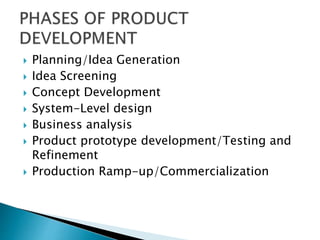
 Planning/Idea Generation
 Idea Screening
 Concept Development
 System-Level design
 Business analysis
 Product prototype development/Testing and
Refinement
 Production Ramp-up/Commercialization
 The starting stage for new product development in
which typically an organization develop a number of
ideas for new product
 Such types of alternatives idea are develop into a
meeting called brain storming session.
 Idea generation is continuous, systematic search for
new product opportunities. It involves delineating
sources of new ideas and methods for generating
them.
 Ideas for new products can be obtained from basic
research using a SWOT analysis (OPPORTUNITY
ANALYSIS), Market and consumer trends, company's
R&D department, competitors, focus groups,
employees, salespeople, corporate spies.
 The object is to eliminate unsound concepts prior to
devoting resources to them.
 The screeners must ask these questions:
• Will the customer in the target market benefit from the
product ?
• What is the size and growth forecasts of the market
segment/target market?
• What is the current or expected competitive pressure for
the product idea?
• What are the industry sales and market trends the
product idea is based on?
• Is it technically feasible to manufacture the product?
• Will the product be profitable when manufactured and
delivered to the customer at the target price?
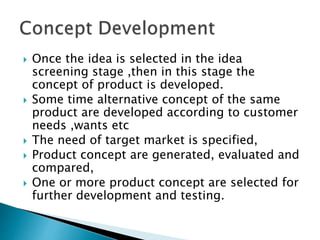
 Once the idea is selected in the idea
screening stage ,then in this stage the
concept of product is developed.
 Some time alternative concept of the same
product are developed according to customer
needs ,wants etc
 The need of target market is specified,
 Product concept are generated, evaluated and
compared,
 One or more product concept are selected for
further development and testing.
 Product architecture.
 The decomposition of the product into
subsystem and components.
 Geometric layout of the product,
 Functional specification of each of the
product subsystem,
 Preliminary process flow diagram for the final
assembly process.
Assess economic viability of the concept.
Business Analysis
Review of Product Sales, Costs, and
Profits Projections to See if They Meet
Company Objectives
If No, Eliminate Product
Concept
If Yes, Move to Product
Development/Testing
 In this stage the product concept is came into its
physical form, then this product is presented to
the market for testing.
 Testing Marketing help the organization in
creating financial decision about whether to
launch that product in the market or not.
 Construction & evaluation of multiple
preproduction versions of the products,
 Prototypes are made with same geometry and
material properties as per the final product but
not necessary the same fabrication.
 Prototypes are tested whether the product will
work as designed and satisfy consumer demand.
 After successful passing the product from the “
testing market” then the firm properly introduce that
product into market.
 Product is made by using the intended production
system.
Commercialization
 Commercialization involves implementing a total
marketing plan and full production
 Launch the product
 Produce and place advertisements and other
promotions
 Fill the distribution pipeline with product
 Critical path analysis is most useful at this stage
 Purpose of the ramp up is to train the
workforce and to work out any remaining
problems to the production process.
 Products produced during product ramp up
are send to preferred customers and careful
evaluation is done to checkout remaining
flaws.

New Food Product Developnment process.

  • 1.
  • 2.
     A productis a set of tangible and intangible attributes, which include packaging, color, price, quality, brand name and manufactures and retailers services , all these that buyer accept as a want/satisfaction.  It is process that describes the basic steps needed to design a product. This process represents the basic sequence of steps or activities that a firm employs to conceive, design and bring a product to market which suits the customer demand.
  • 3.
     A newproduct is a product which is totally new in concept. Any product which is perceived by the customer as being new.  A new product can be categorize into : ✔Truly new product. ✔Innovated product from the existing one.
  • 4.
     Technology: Technologythat in the favors to develop or to take the risk of new product development  Good Image: Company good image in the Market ( in the mind of customer) to take the risk of new product development.  Computation: To maintain or to gain the competitive image in the market.  Change of consumer needs: To brings the changes in the consumer needs
  • 5.
     Planning/Idea Generation Idea Screening  Concept Development  System-Level design  Business analysis  Product prototype development/Testing and Refinement  Production Ramp-up/Commercialization
  • 6.
     The startingstage for new product development in which typically an organization develop a number of ideas for new product  Such types of alternatives idea are develop into a meeting called brain storming session.  Idea generation is continuous, systematic search for new product opportunities. It involves delineating sources of new ideas and methods for generating them.  Ideas for new products can be obtained from basic research using a SWOT analysis (OPPORTUNITY ANALYSIS), Market and consumer trends, company's R&D department, competitors, focus groups, employees, salespeople, corporate spies.
  • 7.
     The objectis to eliminate unsound concepts prior to devoting resources to them.  The screeners must ask these questions: • Will the customer in the target market benefit from the product ? • What is the size and growth forecasts of the market segment/target market? • What is the current or expected competitive pressure for the product idea? • What are the industry sales and market trends the product idea is based on? • Is it technically feasible to manufacture the product? • Will the product be profitable when manufactured and delivered to the customer at the target price?
  • 8.
     Once theidea is selected in the idea screening stage ,then in this stage the concept of product is developed.  Some time alternative concept of the same product are developed according to customer needs ,wants etc  The need of target market is specified,  Product concept are generated, evaluated and compared,  One or more product concept are selected for further development and testing.
  • 9.
     Product architecture. The decomposition of the product into subsystem and components.  Geometric layout of the product,  Functional specification of each of the product subsystem,  Preliminary process flow diagram for the final assembly process.
  • 10.
    Assess economic viabilityof the concept. Business Analysis Review of Product Sales, Costs, and Profits Projections to See if They Meet Company Objectives If No, Eliminate Product Concept If Yes, Move to Product Development/Testing
  • 11.
     In thisstage the product concept is came into its physical form, then this product is presented to the market for testing.  Testing Marketing help the organization in creating financial decision about whether to launch that product in the market or not.  Construction & evaluation of multiple preproduction versions of the products,  Prototypes are made with same geometry and material properties as per the final product but not necessary the same fabrication.  Prototypes are tested whether the product will work as designed and satisfy consumer demand.
  • 12.
     After successfulpassing the product from the “ testing market” then the firm properly introduce that product into market.  Product is made by using the intended production system. Commercialization  Commercialization involves implementing a total marketing plan and full production  Launch the product  Produce and place advertisements and other promotions  Fill the distribution pipeline with product  Critical path analysis is most useful at this stage
  • 13.
     Purpose ofthe ramp up is to train the workforce and to work out any remaining problems to the production process.  Products produced during product ramp up are send to preferred customers and careful evaluation is done to checkout remaining flaws.