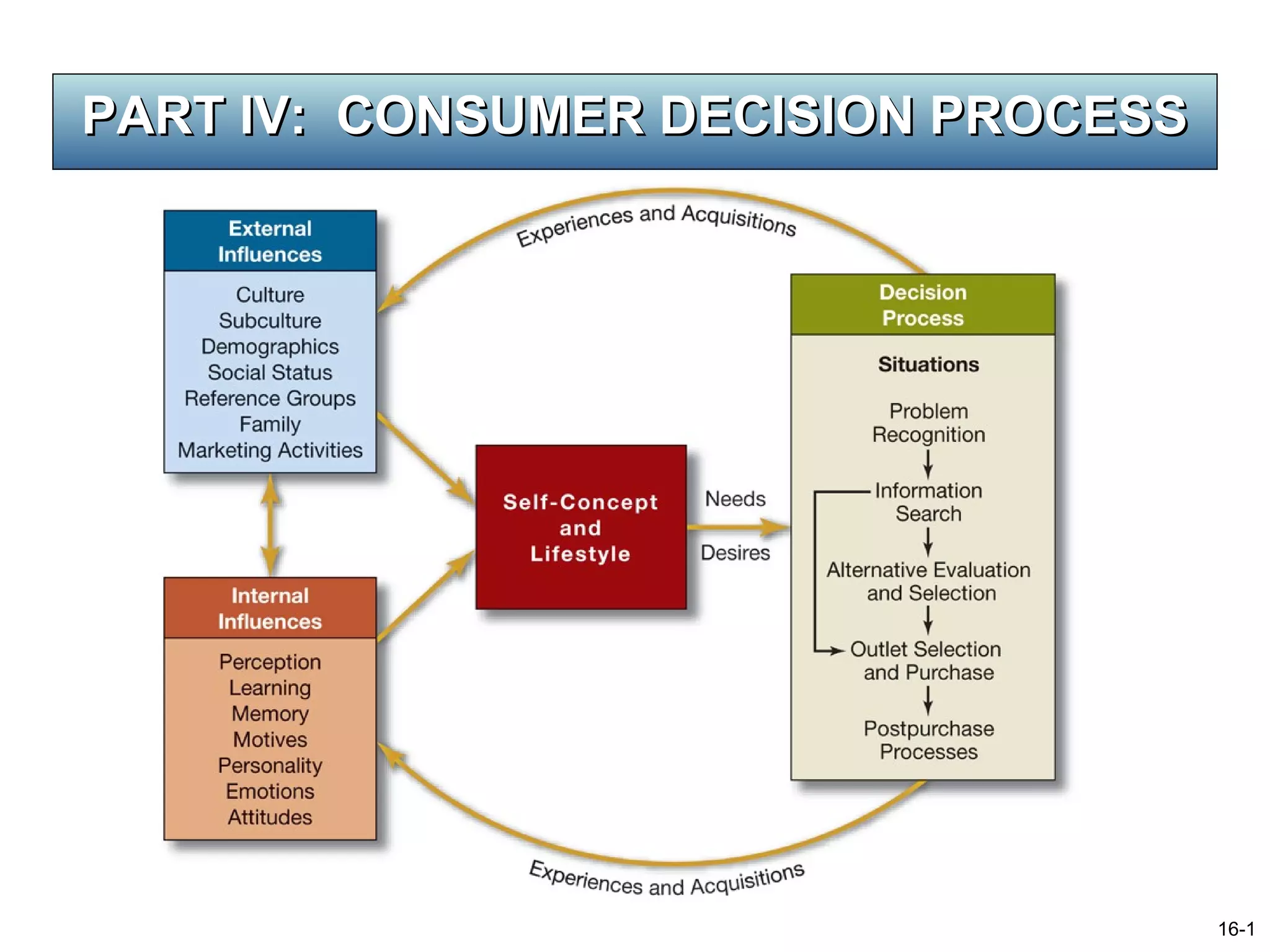
PART IV: CONSUMER DECISION PROCESS


                                     16-1
CHAPTER   16
ALTERNATIVE
EVALUATION
    AND
 SELECTION


                16-2
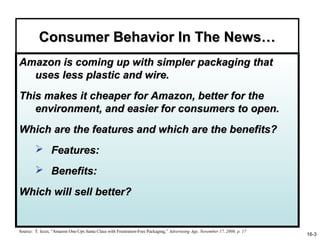
Consumer Behavior In The News…
Amazon is coming up with simpler packaging that
  uses less plastic and wire.
This makes it cheaper for Amazon, better for the
   environment, and easier for consumers to open.
Which are the features and which are the benefits?
         Features:
         Benefits:

Which will sell better?


Source: T. Iezzi, “Amazon One-Ups Santa Claus with Frustration-Free Packaging,” Advertising Age, November 17, 2008, p. 17
                                                                                                                            16-3
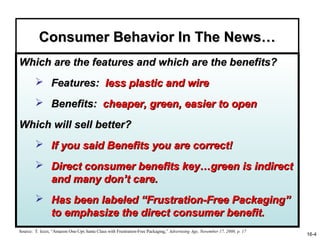
Consumer Behavior In The News…
Which are the features and which are the benefits?
         Features: less plastic and wire
         Benefits: cheaper, green, easier to open

Which will sell better?
         If you said Benefits you are correct!
         Direct consumer benefits key…green is indirect
          and many don’t care.
         Has been labeled “Frustration-Free Packaging”
          to emphasize the direct consumer benefit.
Source: T. Iezzi, “Amazon One-Ups Santa Claus with Frustration-Free Packaging,” Advertising Age, November 17, 2008, p. 17
                                                                                                                            16-4
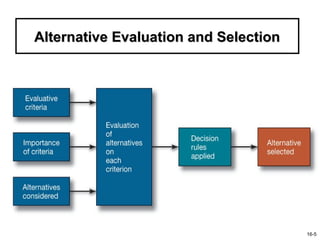
Alternative Evaluation and Selection


                                       16-5
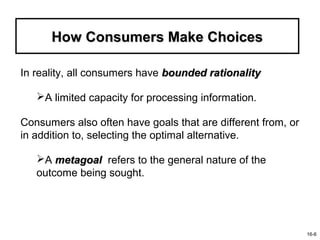
How Consumers Make Choices

In reality, all consumers have bounded rationality

   A limited capacity for processing information.

Consumers also often have goals that are different from, or
in addition to, selecting the optimal alternative.

   A metagoal refers to the general nature of the
   outcome being sought.


                                                              16-6
How Consumers Make Choices

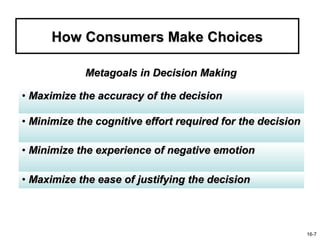
            Metagoals in Decision Making

• Maximize the accuracy of the decision

• Minimize the cognitive effort required for the decision

• Minimize the experience of negative emotion

• Maximize the ease of justifying the decision


                                                            16-7
How Consumers Make Choices
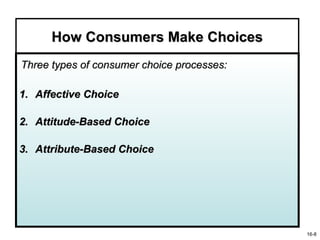
Three types of consumer choice processes:

1. Affective Choice

2. Attitude-Based Choice

3. Attribute-Based Choice


                                            16-8
How Consumers Make Choices
                         Affective Choice
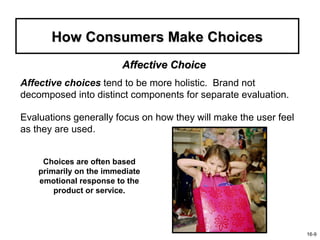
Affective choices tend to be more holistic. Brand not
decomposed into distinct components for separate evaluation.

Evaluations generally focus on how they will make the user feel
as they are used.


     Choices are often based
    primarily on the immediate
    emotional response to the
        product or service.


                                                                  16-9
How Consumers Make Choices
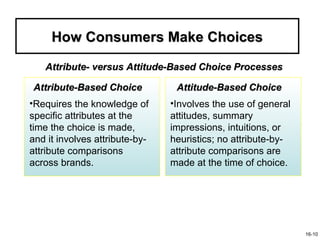
   Attribute- versus Attitude-Based Choice Processes

Attribute-Based Choice           Attitude-Based Choice
•Requires the knowledge of      •Involves the use of general
specific attributes at the      attitudes, summary
time the choice is made,        impressions, intuitions, or
and it involves attribute-by-   heuristics; no attribute-by-
attribute comparisons           attribute comparisons are
across brands.                  made at the time of choice.


                                                               16-10
How Consumers Make Choices


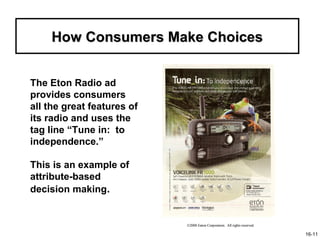
The Eton Radio ad
provides consumers
all the great features of
its radio and uses the
tag line “Tune in: to
independence.”

This is an example of
attribute-based
decision making.


                            ©2008 Eaton Corporation. All rights reserved.

                                                                            16-11
Evaluative Criteria
           Nature of Evaluative Criteria

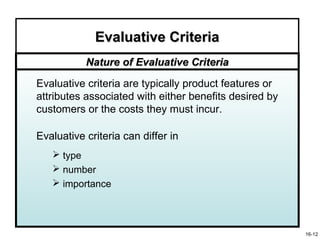
Evaluative criteria are typically product features or
attributes associated with either benefits desired by
customers or the costs they must incur.

Evaluative criteria can differ in
    type
    number
    importance


                                                        16-12
Evaluative Criteria
          Measurement of Evaluative Criteria

Involves a determination of:

 The Evaluative Criteria Used

 Judgments of Brand Performance on Specific Criteria

 The Relative Importance of Evaluative Criteria


                                                        16-13
Evaluative Criteria
Determination of Which Evaluative Criteria Are Used
1. Direct methods include asking consumers what criteria
   they use in a particular purchase.
2. Indirect techniques assume consumers will not or cannot
   state their evaluative criteria.
   •   Projective techniques - allow the respondent to
       indicate the criteria someone else might use.
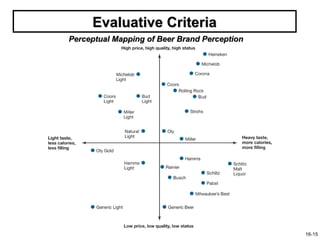
   •   Perceptual mapping - researcher uses judgment to
       determine dimensions underlying consumer
       evaluations of brand similarity.


                                                             16-14
Evaluative Criteria
Perceptual Mapping of Beer Brand Perception


                                              16-15
Evaluative Criteria
Determination of Consumers’ Judgments of Brand
    Performance on Specific Evaluative Criteria

Measuring consumer judgments of brand performance on
specific attributes can include:

Rank ordering scales

Semantic Differential Scales

Likert Scales


                                                       16-16
Evaluative Criteria
        Determination of the Relative Importance of
                    Evaluative Criteria
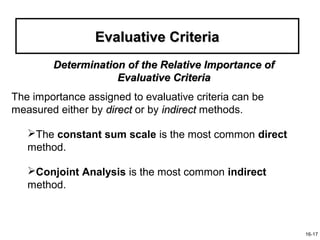
The importance assigned to evaluative criteria can be
measured either by direct or by indirect methods.

   The constant sum scale is the most common direct
   method.

   Conjoint Analysis is the most common indirect
   method.


                                                        16-17
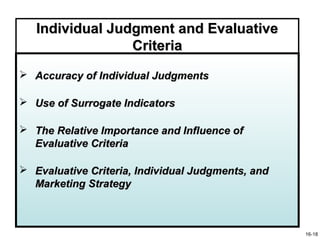
Individual Judgment and Evaluative
                 Criteria
 Accuracy of Individual Judgments

 Use of Surrogate Indicators

 The Relative Importance and Influence of
  Evaluative Criteria

 Evaluative Criteria, Individual Judgments, and
  Marketing Strategy


                                                   16-18
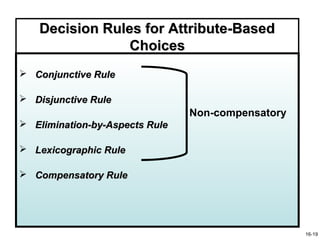
Decision Rules for Attribute-Based
                Choices
 Conjunctive Rule

 Disjunctive Rule
                                Non-compensatory
 Elimination-by-Aspects Rule

 Lexicographic Rule

 Compensatory Rule


                                                   16-19
Decision Rules for Attribute-Based
                  Choices

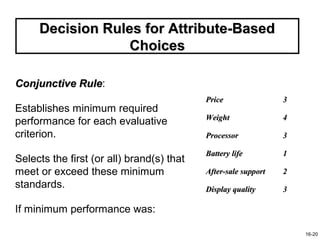
Conjunctive Rule:
            Rule
                                           Price                3
Establishes minimum required
                                           Weight               4
performance for each evaluative
criterion.                                 Processor            3

                                           Battery life         1
Selects the first (or all) brand(s) that
meet or exceed these minimum               After-sale support   2
standards.                                 Display quality      3

If minimum performance was:

                                                                    16-20
Decision Rules for Attribute-Based
                Choices
                    Conjunctive Rule
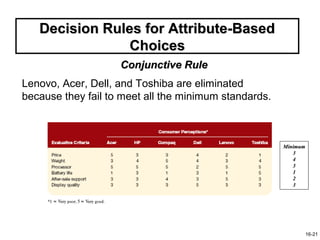
Lenovo, Acer, Dell, and Toshiba are eliminated
because they fail to meet all the minimum standards.


                                                       Minimum
                                                          3
                                                          4
                                                          3
                                                          1
                                                          2
                                                          3


                                                                 16-21
Decision Rules for Attribute-Based
                  Choices

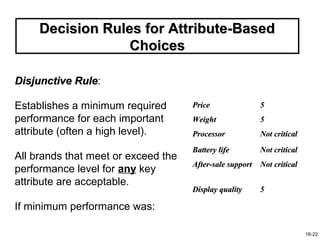
Disjunctive Rule:
            Rule

Establishes a minimum required       Price                5
performance for each important       Weight               5
attribute (often a high level).      Processor            Not critical
                                     Battery life         Not critical
All brands that meet or exceed the
                                     After-sale support   Not critical
performance level for any key
attribute are acceptable.
                                     Display quality      5

If minimum performance was:

                                                                         16-22
Decision Rules for Attribute-Based
              Choices
                 Disjunctive Rule
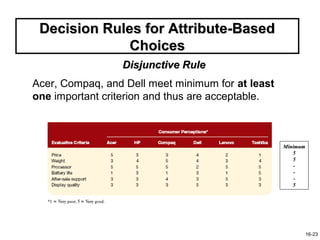
Acer, Compaq, and Dell meet minimum for at least
one important criterion and thus are acceptable.


                                                   Minimum
                                                      5
                                                      5
                                                       -
                                                       -
                                                       -
                                                      5


                                                             16-23
Decision Rules for Attribute-Based
                 Choices
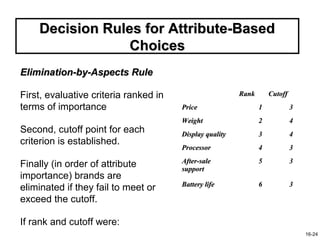
Elimination-by-Aspects Rule

First, evaluative criteria ranked in                     Rank       Cutoff
terms of importance                    Price                    1            3
                                       Weight                   2            4
Second, cutoff point for each          Display quality          3            4
criterion is established.
                                       Processor                4            3
                                       After-sale               5            3
Finally (in order of attribute         support
importance) brands are
                                       Battery life
eliminated if they fail to meet or                              6            3

exceed the cutoff.

If rank and cutoff were:
                                                                                 16-24
Decision Rules for Attribute-Based
                Choices
              Elimination-by-Aspects Rule
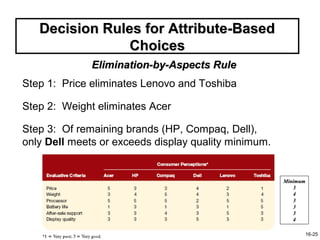
Step 1: Price eliminates Lenovo and Toshiba

Step 2: Weight eliminates Acer

Step 3: Of remaining brands (HP, Compaq, Dell),
only Dell meets or exceeds display quality minimum.


                                                      Minimum
                                                         3
                                                         4
                                                         3
                                                         3
                                                         3
                                                         4

                                                            16-25
Decision Rules for Attribute-Based
                 Choices
               Lexicographic Decision Rule
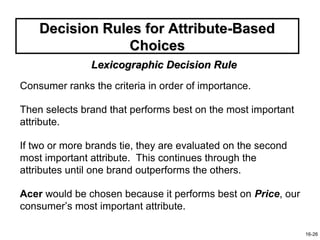
Consumer ranks the criteria in order of importance.

Then selects brand that performs best on the most important
attribute.

If two or more brands tie, they are evaluated on the second
most important attribute. This continues through the
attributes until one brand outperforms the others.

Acer would be chosen because it performs best on Price, our
consumer’s most important attribute.

                                                              16-26
Decision Rules for Attribute-Based
                Choices
              Compensatory Decision Rule

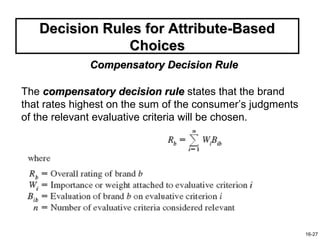
The compensatory decision rule states that the brand
that rates highest on the sum of the consumer’s judgments
of the relevant evaluative criteria will be chosen.


                                                            16-27
Decision Rules for Attribute-Based
                   Choices
                   Compensatory Decision Rule
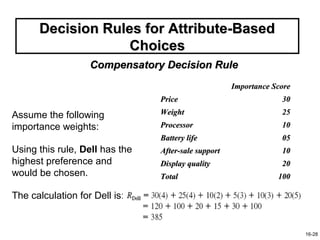
                                                     Importance Score
                                Price                             30

Assume the following            Weight                            25
importance weights:             Processor                         10
                                Battery life                      05
Using this rule, Dell has the   After-sale support                10
highest preference and          Display quality                   20
would be chosen.                Total                            100

The calculation for Dell is:


                                                                        16-28
Decision Rules for Attribute-Based
             Choices
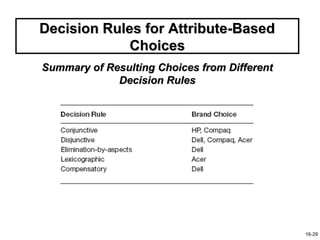
Summary of Resulting Choices from Different
             Decision Rules


                                              16-29

Ch016 alternative evaluation and selection

  • 1.
    PART IV: CONSUMERDECISION PROCESS 16-1
  • 2.
    CHAPTER 16 ALTERNATIVE EVALUATION AND SELECTION 16-2
  • 3.
    Consumer Behavior InThe News… Amazon is coming up with simpler packaging that uses less plastic and wire. This makes it cheaper for Amazon, better for the environment, and easier for consumers to open. Which are the features and which are the benefits?  Features:  Benefits: Which will sell better? Source: T. Iezzi, “Amazon One-Ups Santa Claus with Frustration-Free Packaging,” Advertising Age, November 17, 2008, p. 17 16-3
  • 4.
    Consumer Behavior InThe News… Which are the features and which are the benefits?  Features: less plastic and wire  Benefits: cheaper, green, easier to open Which will sell better?  If you said Benefits you are correct!  Direct consumer benefits key…green is indirect and many don’t care.  Has been labeled “Frustration-Free Packaging” to emphasize the direct consumer benefit. Source: T. Iezzi, “Amazon One-Ups Santa Claus with Frustration-Free Packaging,” Advertising Age, November 17, 2008, p. 17 16-4
  • 5.
  • 6.
    How Consumers MakeChoices In reality, all consumers have bounded rationality A limited capacity for processing information. Consumers also often have goals that are different from, or in addition to, selecting the optimal alternative. A metagoal refers to the general nature of the outcome being sought. 16-6
  • 7.
    How Consumers MakeChoices Metagoals in Decision Making • Maximize the accuracy of the decision • Minimize the cognitive effort required for the decision • Minimize the experience of negative emotion • Maximize the ease of justifying the decision 16-7
  • 8.
    How Consumers MakeChoices Three types of consumer choice processes: 1. Affective Choice 2. Attitude-Based Choice 3. Attribute-Based Choice 16-8
  • 9.
    How Consumers MakeChoices Affective Choice Affective choices tend to be more holistic. Brand not decomposed into distinct components for separate evaluation. Evaluations generally focus on how they will make the user feel as they are used. Choices are often based primarily on the immediate emotional response to the product or service. 16-9
  • 10.
    How Consumers MakeChoices Attribute- versus Attitude-Based Choice Processes Attribute-Based Choice Attitude-Based Choice •Requires the knowledge of •Involves the use of general specific attributes at the attitudes, summary time the choice is made, impressions, intuitions, or and it involves attribute-by- heuristics; no attribute-by- attribute comparisons attribute comparisons are across brands. made at the time of choice. 16-10
  • 11.
    How Consumers MakeChoices The Eton Radio ad provides consumers all the great features of its radio and uses the tag line “Tune in: to independence.” This is an example of attribute-based decision making. ©2008 Eaton Corporation. All rights reserved. 16-11
  • 12.
    Evaluative Criteria Nature of Evaluative Criteria Evaluative criteria are typically product features or attributes associated with either benefits desired by customers or the costs they must incur. Evaluative criteria can differ in  type  number  importance 16-12
  • 13.
    Evaluative Criteria Measurement of Evaluative Criteria Involves a determination of:  The Evaluative Criteria Used  Judgments of Brand Performance on Specific Criteria  The Relative Importance of Evaluative Criteria 16-13
  • 14.
    Evaluative Criteria Determination ofWhich Evaluative Criteria Are Used 1. Direct methods include asking consumers what criteria they use in a particular purchase. 2. Indirect techniques assume consumers will not or cannot state their evaluative criteria. • Projective techniques - allow the respondent to indicate the criteria someone else might use. • Perceptual mapping - researcher uses judgment to determine dimensions underlying consumer evaluations of brand similarity. 16-14
  • 15.
    Evaluative Criteria Perceptual Mappingof Beer Brand Perception 16-15
  • 16.
    Evaluative Criteria Determination ofConsumers’ Judgments of Brand Performance on Specific Evaluative Criteria Measuring consumer judgments of brand performance on specific attributes can include: Rank ordering scales Semantic Differential Scales Likert Scales 16-16
  • 17.
    Evaluative Criteria Determination of the Relative Importance of Evaluative Criteria The importance assigned to evaluative criteria can be measured either by direct or by indirect methods. The constant sum scale is the most common direct method. Conjoint Analysis is the most common indirect method. 16-17
  • 18.
    Individual Judgment andEvaluative Criteria  Accuracy of Individual Judgments  Use of Surrogate Indicators  The Relative Importance and Influence of Evaluative Criteria  Evaluative Criteria, Individual Judgments, and Marketing Strategy 16-18
  • 19.
    Decision Rules forAttribute-Based Choices  Conjunctive Rule  Disjunctive Rule Non-compensatory  Elimination-by-Aspects Rule  Lexicographic Rule  Compensatory Rule 16-19
  • 20.
    Decision Rules forAttribute-Based Choices Conjunctive Rule: Rule Price 3 Establishes minimum required Weight 4 performance for each evaluative criterion. Processor 3 Battery life 1 Selects the first (or all) brand(s) that meet or exceed these minimum After-sale support 2 standards. Display quality 3 If minimum performance was: 16-20
  • 21.
    Decision Rules forAttribute-Based Choices Conjunctive Rule Lenovo, Acer, Dell, and Toshiba are eliminated because they fail to meet all the minimum standards. Minimum 3 4 3 1 2 3 16-21
  • 22.
    Decision Rules forAttribute-Based Choices Disjunctive Rule: Rule Establishes a minimum required Price 5 performance for each important Weight 5 attribute (often a high level). Processor Not critical Battery life Not critical All brands that meet or exceed the After-sale support Not critical performance level for any key attribute are acceptable. Display quality 5 If minimum performance was: 16-22
  • 23.
    Decision Rules forAttribute-Based Choices Disjunctive Rule Acer, Compaq, and Dell meet minimum for at least one important criterion and thus are acceptable. Minimum 5 5 - - - 5 16-23
  • 24.
    Decision Rules forAttribute-Based Choices Elimination-by-Aspects Rule First, evaluative criteria ranked in Rank Cutoff terms of importance Price 1 3 Weight 2 4 Second, cutoff point for each Display quality 3 4 criterion is established. Processor 4 3 After-sale 5 3 Finally (in order of attribute support importance) brands are Battery life eliminated if they fail to meet or 6 3 exceed the cutoff. If rank and cutoff were: 16-24
  • 25.
    Decision Rules forAttribute-Based Choices Elimination-by-Aspects Rule Step 1: Price eliminates Lenovo and Toshiba Step 2: Weight eliminates Acer Step 3: Of remaining brands (HP, Compaq, Dell), only Dell meets or exceeds display quality minimum. Minimum 3 4 3 3 3 4 16-25
  • 26.
    Decision Rules forAttribute-Based Choices Lexicographic Decision Rule Consumer ranks the criteria in order of importance. Then selects brand that performs best on the most important attribute. If two or more brands tie, they are evaluated on the second most important attribute. This continues through the attributes until one brand outperforms the others. Acer would be chosen because it performs best on Price, our consumer’s most important attribute. 16-26
  • 27.
    Decision Rules forAttribute-Based Choices Compensatory Decision Rule The compensatory decision rule states that the brand that rates highest on the sum of the consumer’s judgments of the relevant evaluative criteria will be chosen. 16-27
  • 28.
    Decision Rules forAttribute-Based Choices Compensatory Decision Rule Importance Score Price 30 Assume the following Weight 25 importance weights: Processor 10 Battery life 05 Using this rule, Dell has the After-sale support 10 highest preference and Display quality 20 would be chosen. Total 100 The calculation for Dell is: 16-28
  • 29.
    Decision Rules forAttribute-Based Choices Summary of Resulting Choices from Different Decision Rules 16-29