Genius Thinking Strategies
•Geniuses find many different ways to look at a problem. Einstein, for example, and da
Vinci, looked at problems from many different perspectives.
• Geniuses make their thoughts visible. Da Vinci’s famous sketches, and Galileo’s diagrams
of the planets, allowed them to display information visibly.
• Geniuses produce. Thomas Edison had a quota of one invention every 10 days. Mozart
was among the most prolific composers during his short life.
• Geniuses make novel combinations. Einstein found the relationship between energy, mass,
and the speed of light (the equation E = mc²).
• Geniuses force relationships. They can make connections where others cannot. Kekulé
dreamed of a snake biting its tail, immediately suggesting to him the circular shape of the
benzene molecule.
• Geniuses think in opposites. This will often suggest a new point of view. Physicist Neils
Bohr conceived of light as being both a wave and a particle.
• Geniuses think metaphorically. Bell thought of a membrane moving steel, and its similarity
to the construction of the ear, leading to the telephone earpiece.
• Geniuses prepare themselves for chance. Fleming was not the first to see mold forming on
a culture, but was the first to investigate the mold, which eventually led to the discovery of
penicillin.
Source: Michael Michalko, “Thinking Like a Genius,” The Futurist, May 1998, pp. 21-25.
Figure 4.1
3.
Historic Roadblocks to
Creativity
“Ithink there is a world market for maybe five computers.”
Thomas Watson, Chair, IBM, 1943.
“Computers in the future may weigh no more than 1.5 tons.”
Popular Mechanics, 1949.
“I can assure you that data processing is a fad that won’t
last out the year.” Business books editor, Prentice-Hall, 1957.
“So we went to Atari and said, ... ‘We’ll give it to you. We
just want to do it. Pay our salary, we’ll come work for
you.’ And they said no. So then we went to HP, and
they said ‘We don’t need you, you haven’t got through
college yet.’” Steve Jobs, co-founder, Apple Computers.
“640K of RAM ought to be enough for anybody.” Bill Gates,
Microsoft, 1981.
4.
Historic Roadblocks to
Creativity
“Whothe hell wants to hear actors talk?” H.M. Warner, Warner
Bros., 1927.
“Stocks have reached what look to be a permanently high
plateau.” I. Fisher, Prof. of Economics, Yale, 1929.
“We don’t like their sound, and guitar music is on the way
out.” Dick Rowe, Decca Records executive, rejecting the
Beatles’ demo tape, 1962.
“This ‘telephone’ has too many shortcomings to be seriously
considered as a means of communication [and] is
inherently of no value to us.” Western Union, 1876.
“Heavier-than-air flying machines are impossible.” Lord
Kelvin, President, Royal Society, 1895.
“Everything that can be invented has been invented.” C. H.
Duell, Commissioner, U.S. Office of Patents, 1899.
5.
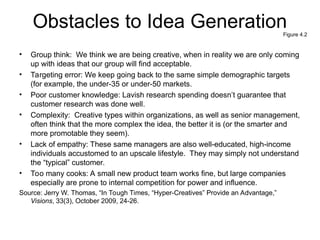
Obstacles to IdeaGeneration
• Group think: We think we are being creative, when in reality we are only coming
up with ideas that our group will find acceptable.
• Targeting error: We keep going back to the same simple demographic targets
(for example, the under-35 or under-50 markets.
• Poor customer knowledge: Lavish research spending doesn’t guarantee that
customer research was done well.
• Complexity: Creative types within organizations, as well as senior management,
often think that the more complex the idea, the better it is (or the smarter and
more promotable they seem).
• Lack of empathy: These same managers are also well-educated, high-income
individuals accustomed to an upscale lifestyle. They may simply not understand
the “typical” customer.
• Too many cooks: A small new product team works fine, but large companies
especially are prone to internal competition for power and influence.
Source: Jerry W. Thomas, “In Tough Times, “Hyper-Creatives” Provide an Advantage,”
Visions, 33(3), October 2009, 24-26.
Figure 4.2
6.
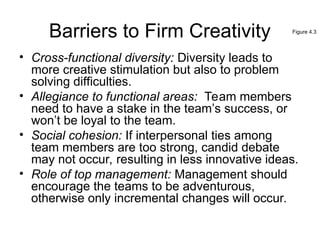
Barriers to FirmCreativity
• Cross-functional diversity: Diversity leads to
more creative stimulation but also to problem
solving difficulties.
• Allegiance to functional areas: Team members
need to have a stake in the team’s success, or
won’t be loyal to the team.
• Social cohesion: If interpersonal ties among
team members are too strong, candid debate
may not occur, resulting in less innovative ideas.
• Role of top management: Management should
encourage the teams to be adventurous,
otherwise only incremental changes will occur.
Figure 4.3
7.
The Role ofManagement in
Stimulating Creativity
• Recognize individuality
• Be tolerant of mistakes
• Be supportive under stress
• Techniques include:
– Competitive teams
– Idea bank of unused ideas for possible reuse
– Encourage interaction – even in how offices
are laid out
8.
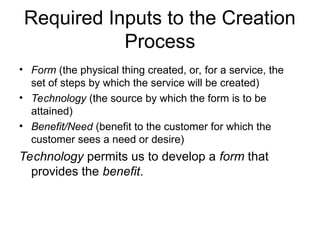
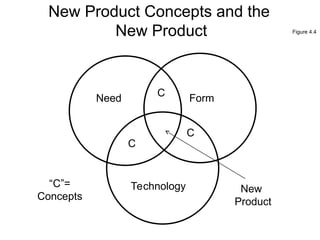
Required Inputs tothe Creation
Process
• Form (the physical thing created, or, for a service, the
set of steps by which the service will be created)
• Technology (the source by which the form is to be
attained)
• Benefit/Need (benefit to the customer for which the
customer sees a need or desire)
Technology permits us to develop a form that
provides the benefit.
9.
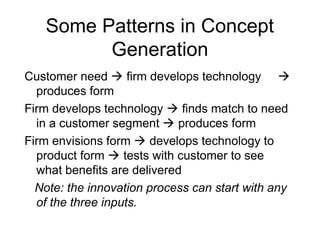
Some Patterns inConcept
Generation
Customer need firm develops technology
produces form
Firm develops technology finds match to need
in a customer segment produces form
Firm envisions form develops technology to
product form tests with customer to see
what benefits are delivered
Note: the innovation process can start with any
of the three inputs.
10.
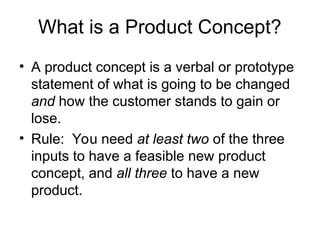
What is aProduct Concept?
• A product concept is a verbal or prototype
statement of what is going to be changed
and how the customer stands to gain or
lose.
• Rule: You need at least two of the three
inputs to have a feasible new product
concept, and all three to have a new
product.
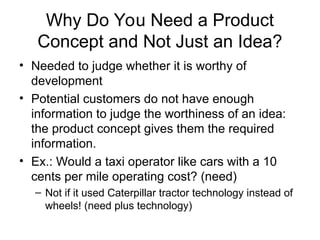
11.
Why Do YouNeed a Product
Concept and Not Just an Idea?
• Needed to judge whether it is worthy of
development
• Potential customers do not have enough
information to judge the worthiness of an idea:
the product concept gives them the required
information.
• Ex.: Would a taxi operator like cars with a 10
cents per mile operating cost? (need)
– Not if it used Caterpillar tractor technology instead of
wheels! (need plus technology)
12.
New Product Conceptsand the
New Product
Need Form
Technology New
Product
“C”=
Concepts
C
C
C
Figure 4.4
13.
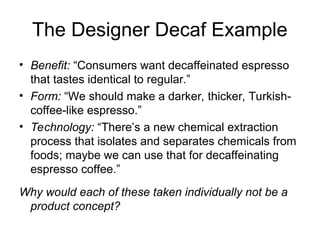
The Designer DecafExample
• Benefit: “Consumers want decaffeinated espresso
that tastes identical to regular.”
• Form: “We should make a darker, thicker, Turkish-
coffee-like espresso.”
• Technology: “There’s a new chemical extraction
process that isolates and separates chemicals from
foods; maybe we can use that for decaffeinating
espresso coffee.”
Why would each of these taken individually not be a
product concept?
14.
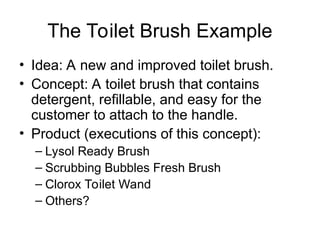
The Toilet BrushExample
• Idea: A new and improved toilet brush.
• Concept: A toilet brush that contains
detergent, refillable, and easy for the
customer to attach to the handle.
• Product (executions of this concept):
– Lysol Ready Brush
– Scrubbing Bubbles Fresh Brush
– Clorox Toilet Wand
– Others?
15.
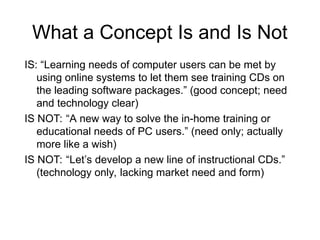
What a ConceptIs and Is Not
IS: “Learning needs of computer users can be met by
using online systems to let them see training CDs on
the leading software packages.” (good concept; need
and technology clear)
IS NOT: “A new way to solve the in-home training or
educational needs of PC users.” (need only; actually
more like a wish)
IS NOT: “Let’s develop a new line of instructional CDs.”
(technology only, lacking market need and form)
16.
Methods for GeneratingProduct
Concepts
Two Broad Categories of Methods:
• Gathering Ready-Made Product Concepts
• Using a Managed Process Run by the
New Products Team
17.
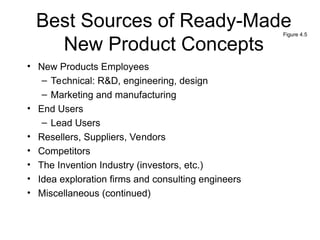
Best Sources ofReady-Made
New Product Concepts
• New Products Employees
– Technical: R&D, engineering, design
– Marketing and manufacturing
• End Users
– Lead Users
• Resellers, Suppliers, Vendors
• Competitors
• The Invention Industry (investors, etc.)
• Idea exploration firms and consulting engineers
• Miscellaneous (continued)
Figure 4.5
18.
Best Sources ofReady-Made New
Product Concepts (continued)
• Miscellaneous Categories
– Consultants
– Advertising agencies
– Marketing research firms
– Retired product specialists
– Industrial designers
– Other manufacturers
– Universities
– Research laboratories
– Governments
– Printed sources
– International
– Internet
Figure 4.5
19.
Toolkits for UserInnovation
• A set of design tools that customers can use to
customize a product best suited to them.
• Can incorporate CAD/CAM or rapid prototyping.
• Example: International Flavors and Fragrances:
Internet-based toolkit that provides a database of
flavor profiles and rules on how to combine them.
Customer can specify flavor mixes that are
immediately made into samples; customer can
then make adjustments until the desired flavor is
obtained.
• Product configurators are a kind of user toolkit.
20.
Crowdsourcing as aCreative
Source
Crowdsourcing: open idea solicitation from customers.
•Dell’s Idea Storm: encouraged customers to submit ideas for new
products and improvements to existing products online. Over 10,000
ideas were obtained from sources around the world.
•Apple used crowdsourcing in generating ideas for the iPad. Apple
monitored reviews and blogs and also obtained Voice of the Customer
data to understand the needs of potential users.
•Fiat solicited design ideas via their website when relaunching the 500
subcompact, and claims 500,000 combinations in their car configurator.
•Threadless invites contributors for T-shirt designs, encourages users
to vote for favorite designs, and produces and sells the favorites.
21.
Drawbacks of UserToolkits and
Crowdsourcing
• Most likely to generate modest product
improvements rather than new-to-the-world
products.
• Typical user less likely to come up with
ideas that are easily developed into real
products.
• Professionals, or experienced users may
have a more realistic view of what is
feasible.
22.
Lead Users asa Creative
Source
• An important source of new product ideas.
• Customers associated with a significant current trend.
• They have the best understanding of the problems faced,
and can gain from solutions to these problems.
• In many cases, have already begun to solve their own
problems, or can work with product developers to anticipate
the next problem in the future.
• Example: X-Games athletes for new high-performance
snowboards.
– They provide design requirements and also are early
adopters and good at stimulating word-of-mouth.
23.
What Should YouAsk Lead
Users (or Any Users)?
• Ask for outcomes – what they would like the
product to do for them.
• Don’t ask what product improvements they want!
– Customers say they want low-salt canned soup or low-
fat fast food but don’t buy them!
• Be “informed” by customers.
– Kawasaki Jet Ski: customers said they wanted padding
and other comfort improvements for the standing rider.
But by focusing on the outcome (comfort), competitors
found a better solution (add a seat).
24.
Open Innovation
• Theprocess by which a firm searches for research,
innovation, technologies, and products.
• Increases speed of research and innovation, cuts risks,
and generates new innovative ideas.
• Viewed by some as the dominant innovation model of
the 21st
century.
• Inputs can come from internal sources (marketing,
strategic planning) and external ones (customers, market
information, etc.).
• Sources such as inventors, startup companies, or
university laboratories are actively sought out.
25.
Principles of OpenInnovation
• Accept that “not all the smart people work for us.”
• Is both in- and out-bound: obtain knowhow technology,
patents, etc.) from external partners, and also monetize
technology (through licensing, sale, etc.) that is no
longer consistent with corporate strategy.
• It is not outsourcing! The external sources are viewed
as complementary to internal sources so that innovation
can be more efficient.
• Selecting the best partners is critical, and mutual trust is
important.
26.
Open Innovation atWork: P&G
• P&G’s “Connect and Develop” program, designed to allow for
internal intellectual property to be marketed outside, spun off, or
licensed.
• Avoids the “not invented here” syndrome.
• To execute Connect and Develop, P&G assigned a team to find
external partners, build brand equity, access new technologies, and
create new product categories.
• Examples:
– SunHealth Solutions (a P&G partner) developed the UV sensing
technology used in Huggies swimpants with UV sensors, that
help parents monitor their child’s exposure to UV radiation.
– Mr. Clean scrubbing brush uses technology originally used as
insulation in the auto industry.
– Magic Eraser cleaning pad was sourced from a German
chemicals company, and first noticed by P&G in use in Japan.
27.
Open Innovation Success
Stories:P&G and Clorox
Clorox and Procter & Gamble may be fierce competitors in the cleaning-
products arena, but are also open innovation partners elsewhere. P&G
had the intellectual property for plastic technology, in particular strong
plastic film, which is the technology used in two Clorox products: Glad
Press’n Seal and also Glad ForceFlex plastic garbage bags. P&G also
brought its global marketing expertise to the table, while Clorox
contributed the Glad brand equity, its R&D knowhow in plastics and
resins, and its organizational structure suited to marketing plastic film
products. Due to this open innovation partnership and the key
contribution of P&G to the plastics technology, Glad sales doubled within
four years, and Glad has become the second billion-dollar brand at
Clorox.
Source: Jacquelin Cooper, “How Industry Leaders Find, Evaluate and Choose the Most
Promising Open Innovation Opportunities,” Visions, 36(1), 2012, pp. 20-23.
Figure 4.8
28.
Open Innovation SuccessStories:
Kraft Foods and Bosch/Siemens
• Kraft Foods sought open innovation partners for its planned
Tassimo Beverage System. While they had the food knowhow,
suppliers, and distribution channel, they needed assistance in the
development and manufacture of the coffee maker. They assessed
different home appliance manufacturers for manufacturing and R&D
capabilities and competence in the appliance product category, and
also for brand value compatibility, cultural fit, and compatibility of
business strategies. In particular, they sought a manufacturer that
shared Kraft’s attitudes toward quality, convenience, and
responsibility. Ultimately, they selected the Bosch and Siemens
Home Appliance Group.
Source: Jacquelin Cooper, “How Industry Leaders Find, Evaluate and Choose the Most
Promising Open Innovation Opportunities,” Visions, 36(1), 2012, pp. 20-23.
Figure 4.8
29.
More Examples ofOpen
Innovation
• Lego: Web forum, sites, and blogs for participants
to share and improve proucts. Result: the on-line
community was instrumental in the development
of the LEGO robotics system.
• Philips: Specialized facility in Singapore (“the
Innohub”) that provides realistic environments for
end users and product developers to work on
breakthrough ideas.
• Some are completely online systems, like the
Innocreative web community.
30.
Advantages and Risksof Open
Innovation
Importing new ideas multiplies innovation building blocks—ideas and
expertise, resulting in more total sales generated from new products.
Exporting ideas raises cash (IBM gets about $2 billion per year in patent
royalties), and improves employee retention, since creative types know
that good ideas will be exported and not buried.
Exporting signals true worth of an innovation. Eli Lilly offers pharmaceutical
licenses, but if outsiders don’t bite it suggests the value of the new drug is
perceived to be low.
Exporting clarifies core business: Boeing sticks with design and systems
integration, and often finds partners for manufacturing.
Risk: deal is not structured in a way that captures the financial value of
your innovation – ask Xerox!
Proprietary secrets can be lost to a partner, even inadvertently.
Theft of technology, or poaching of top researchers, is a concern.
Figure 4.9


![Historic Roadblocks to
Creativity
“Who the hell wants to hear actors talk?” H.M. Warner, Warner
Bros., 1927.
“Stocks have reached what look to be a permanently high
plateau.” I. Fisher, Prof. of Economics, Yale, 1929.
“We don’t like their sound, and guitar music is on the way
out.” Dick Rowe, Decca Records executive, rejecting the
Beatles’ demo tape, 1962.
“This ‘telephone’ has too many shortcomings to be seriously
considered as a means of communication [and] is
inherently of no value to us.” Western Union, 1876.
“Heavier-than-air flying machines are impossible.” Lord
Kelvin, President, Royal Society, 1895.
“Everything that can be invented has been invented.” C. H.
Duell, Commissioner, U.S. Office of Patents, 1899.](https://image.slidesharecdn.com/ch04-250818130527-5086189a/85/Creativity-and-the-Product-Concept-for-Product-4-320.jpg)