Chapter : 1
Brand Management
Preview of the Chapter
 What is brand ?
 Why do brands matter ?
 Can everything be Branded ?
 What are strongest Brands ?
 Branding Challenges and Opportunities.
 The Brand Equity Concept.
 Strategic Brand Management process.
What is a Brand?
A brand is a name, term, sign, symbol or
design, or a combination of them, intended to
identify the goods or services of one seller or
group of sellers and to differentiate them from
those of competitors.
ESPN: A Strong Brand
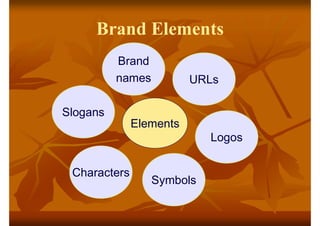
Brand Elements
Elements
Slogans
Brand
names URLs
Logos
Symbols
Characters
What is a Product?
A product is anything that can be offered to a
market for attention, acquisition, use, or
consumption to satisfy a want or need,
including physical goods, services,
experiences, events, persons, places,
properties, organizations, information, and
ideas.
Ashok
Leyland
is known
for its
products
Five Product Levels
Five Levels of meaning for a Product
1. The Core Benefit Level is the fundamental need or
want that consumer satisfy by consuming the
product or services.
2. The Generic Product Level is a basic version of the
product containing only those attribute absolutely
necessary for its but with no distinct features.
3. The Expected Product Level is a set of attribute
that buyers normally expect and agree to when they
purchase the Product.
Continue…..
Continue…..
4. The Augmented Product Level includes additional
product attributes, benefits, or related services that
distinguish the product from competitors.
5. The Potential Product Level includes all the
augmentation and transformation that a product
might undergo in the future.
Brand verses Product
Harvard’s Ted Levitt has argued that “ the new
competition is not between what companies
produce in their factories but between what they
add to their factory output in the form of
packaging, services, customer advice, financing,
delivery arrangements, warehousing, and other
things that people value.
A Brand is therefore more than a product,
because it can have dimensions that differentiated
it in some way from other products design to
satisfy the same need.
Continue…..
Continued…..
 Brand can also distinguished by its equity, sum
total of consumer’s perception and feeling about
the product’s attributes and how they perform,
about the brand name and what it stands for, and
about the company associated with the brand.
 Brand create competitive advantage with product
performance.
 Brand create competitive advantage through
non-product-related means.
 Strong Brands carry a number of different types
of association.
Importance of Brand
OR
Why do Brands Matter
 In Consumer’s perspective.
 In Firm’s perspective.
Consumer’s perspective
 The term encompass all types of customer, individuals as
well as industrial.
 Brand identify the source or maker of the product, which
allows consumers to assign responsibility to a
manufacturer or distributors.
 Based on the experience of previous use, consumer can
find out their satisfaction level.
 It provide means of simplification for their product
decision.
 If consumer recognize a Brand and have some
knowledge, it minimize processing of information to
make product decision.
Continue…..
Continued…..
 It also lower the search cost for product, both internally
and externally.
 Consumer can make assumption and form reasonable
expectation about what they may not know about the
brand.
 Consumer can offer trust and loyalty with the
understanding the performance of Brand.
 Brand can serve as symbolic device, allowing consumer
to project their self-image.
 It also reflect value and traits.
Role that Brand Play
(Consumer)
 Identification of source.
 Assignment of Responsibility to product maker.
 Risk reducer.
(Functional, Physical, Financial, Social,
Psychological, Time Risk. )
 Reduce search coast.
 Symbolic Device.
 Signal of Quality.
 Promise, Bond with maker of product.
Firm’s perspective
 They serve an identification purpose to simplify
product handling or tracing.
 Brands help to organize inventory and accounting
records.
 It also offers the firm legal protection for unique
feature.

 It retain intellectual property right and protected
through registered trademark.
Role that Brand Play
(Firm)
 Means of identification to simplify handling or tracing.
 Means of legally protecting unique features.
 Signal of quality level to satisfied customers.
 Means of endowing product with unique association.
 Source of competitive advantage.
 Source of financial returns.
Can Everything Be Branded ?
 Brand is something that resides in the minds of
consumers.
 The key to branding is that consumer perceive
differences among brands in a product
category.
 It benefits marketers whenever consumers are
in a choice situation.
 Physical Goods.
Physical Goods are what are traditionally associated
with Brands.
 Business to Business Product.
 B-B Brands are often corporate brands, so understanding
branding from corporate brand perspective is critical.
 High-tech Product.
 Many company struggled with branding.
 Managed by technologists, they often lack any kind of
brand strategy and see branding as simply naming their
product.
Physical Goods.
Services
 They are less tangible than products and more likely
very in quality.
 It depends on the particular person or people
providing them.
Retailers and Distributors
 Brand can generate loyalty and interest.
 Brands by using store name.
Online Products and Services.
 Providing tracking update.
 Find unique way to satisfy customer’s unmet need.
People and Organization.
 It is straightforward when the product is people.
(liked or Disliked by others)
 Similarly organization often take on meaning though
their program or activities.
Sports, Arts, and Entertainment
Geographic Location
Ideas and Causes
What are strong Brand ?
The best known or highly regarded.
 The five factors as the key to Brand Leadership.
 Vision of the Mass Market
 Managerial Persistence
 Financial Commitment
 Relentless Innovation
 Asset Leverage
Branding Challenges and Opportunities
 Savvy Customer.
 Expectation of what they want from the product is
higher than what they think brand will deliver
them, and the gap is growing.
 Brand proliferation.
 Rise in line and brand extension.
 Media Fragmentation.
 Erosion of traditional media and emergence of
non-traditional and other communication
alternatives.
Continue…..
Continued…..
 Increased Competition.
 Globalization.
 Low-priced competitors.
 Brand extension.
 Deregulation.
 Increased Cost.
 Grater Accountability.
Challenges to Brand Builders
 Savvy Customer.
 More complex brand families and portfolios.
 Maturing market.
 More sophisticated and increasing competition.
 Difficulty in differentiating.
 Decreasing brand loyalty.
 Growth of private labels.
 Increasing trade power.
 Fragmenting media coverage.
 Eroding traditional media effectiveness.
 Emerging new communication options.
 Increasing promotional expenditure.
 Decreasing advertising expenditure.
 Increasing cost of production and support.
 Increasing short term performance orientation.
 Increasing job turnover.
What is Brand Equity?
Brand equity is the added value endowed on
products and services, which may be reflected
in the way consumers, think, feel, and act with
respect to the brand.
But most observer believes that it consist of
marketing effect uniquely attributable to brand.
That is , why different outcome results from
marketing of branded product.
Branding is all about creating differences.
The principles of
Branding and Brand Equity
 Differences in outcome arises from the “added value”
endowed to a product as a result of past marketing
activities for the Brand.
 This value can be created for a Brand in many different
ways.
 Brand Equity Provides a common denominator for
interpreting marketing strategies and assessing the value of
the Brand.
 There are many different ways in which the value of a
Brand can be exploited to benefit the firm ( greater
proceeds or low cost or both).
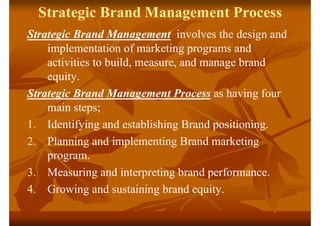
Strategic Brand Management Process
Strategic Brand Management involves the design and
implementation of marketing programs and
activities to build, measure, and manage brand
equity.
Strategic Brand Management Process as having four
main steps;
1. Identifying and establishing Brand positioning.
2. Planning and implementing Brand marketing
program.
3. Measuring and interpreting brand performance.
4. Growing and sustaining brand equity.
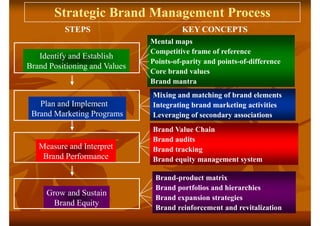
Strategic Brand Management Process
Mental maps
Competitive frame of reference
Points-of-parity and points-of-difference
Core brand values
Brand mantra
Mixing and matching of brand elements
Integrating brand marketing activities
Leveraging of secondary associations
Brand Value Chain
Brand audits
Brand tracking
Brand equity management system
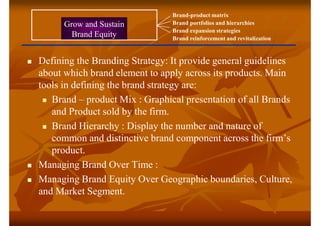
Brand-product matrix
Brand portfolios and hierarchies
Brand expansion strategies
Brand reinforcement and revitalization
KEY CONCEPTS
STEPS
Grow and Sustain
Brand Equity
Identify and Establish
Brand Positioning and Values
Plan and Implement
Brand Marketing Programs
Measure and Interpret
Brand Performance
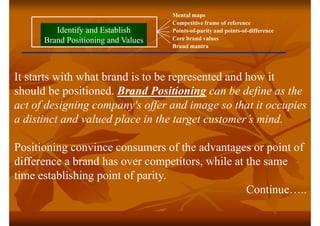
Identify and Establish
Brand Positioning and Values
Mental maps
Competitive frame of reference
Points-of-parity and points-of-difference
Core brand values
Brand mantra
It starts with what brand is to be represented and how it
should be positioned. Brand Positioning can be define as the
act of designing company's offer and image so that it occupies
a distinct and valued place in the target customer’s mind.
Positioning convince consumers of the advantages or point of
difference a brand has over competitors, while at the same
time establishing point of parity.
Continue…..
Continued…..
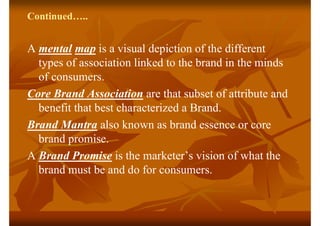
A mental map is a visual depiction of the different
types of association linked to the brand in the minds
of consumers.
Core Brand Association are that subset of attribute and
benefit that best characterized a Brand.
Brand Mantra also known as brand essence or core
brand promise.
A Brand Promise is the marketer’s vision of what the
brand must be and do for consumers.
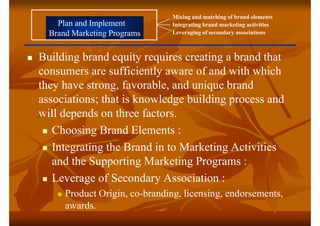
 Building brand equity requires creating a brand that
consumers are sufficiently aware of and with which
they have strong, favorable, and unique brand
associations; that is knowledge building process and
will depends on three factors.
 Choosing Brand Elements :
 Integrating the Brand in to Marketing Activities
and the Supporting Marketing Programs :
 Leverage of Secondary Association :
 Product Origin, co-branding, licensing, endorsements,
awards.
Mixing and matching of brand elements
Integrating brand marketing activities
Leveraging of secondary associations
Plan and Implement
Brand Marketing Programs
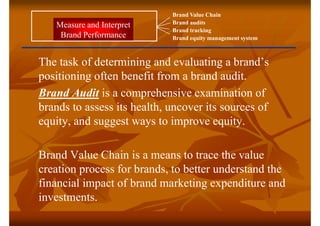
The task of determining and evaluating a brand’s
positioning often benefit from a brand audit.
Brand Audit is a comprehensive examination of
brands to assess its health, uncover its sources of
equity, and suggest ways to improve equity.
Brand Value Chain is a means to trace the value
creation process for brands, to better understand the
financial impact of brand marketing expenditure and
investments.
Brand Value Chain
Brand audits
Brand tracking
Brand equity management system
Measure and Interpret
Brand Performance
 It’s a consumer-focused exercise involving series of
procedure to access brand’s health
 Suggest ways to improve it’s equity
 Require the understanding of sources of brand equity
from the firm and consumer perspective
 Consist of two steps:
 Brand inventory : Current profile- how sold
 Brand exploratory: What consumer think & feel
Brand Audits
Brand Audits
Means the total financial value of the brand.
 Certain company build their brand portfolio for
growth.
 What is a brand worth?
 Brand’s Earnings
 Brand’s strength in terms of share, stability,
protection, trend
Brand Valuation
 Collect Information from consumers
 Employ quantitative measures to provide
current information
 Means of understanding where, how much and
in what ways brand value is being created.
 Important for manager in decision making.
 Provide valuable diagnostic.
Brand Tracking
 Brand Equity Management is a set of research
procedure designed to provide timely, accurate, and
actionable information for marketers so that it helps
in strategic decision.
 Implementing such a system involves brand tracking
and brand equity management system.
 Defining the Branding Strategy: It provide general guidelines
about which brand element to apply across its products. Main
tools in defining the brand strategy are:
 Brand – product Mix : Graphical presentation of all Brands
and Product sold by the firm.
 Brand Hierarchy : Display the number and nature of
common and distinctive brand component across the firm’s
product.
 Managing Brand Over Time :
 Managing Brand Equity Over Geographic boundaries, Culture,
and Market Segment.
Brand-product matrix
Brand portfolios and hierarchies
Brand expansion strategies
Brand reinforcement and revitalization
Grow and Sustain
Brand Equity
Brand Mgt.pdf