Next Generation Sequencing Analysis Series
February 18, 2015
Andrew Oler, PhD
High-throughput Sequencing Bioinformatics Specialist
BCBB/OCICB/NIAID/NIH
Bioinformatics and Computational
Biosciences Branch
§  “BCBB”
§  Group of ~30
§  Bioinformatics Software
Developers
§  Computational Biologists
§  Project Managers &
Analysts
http://www.niaid.nih.gov/about/organization/odoffices/omo/ocicb/Pages/bcbb.aspx 2
The plan…
§  RNA-seq introduction
§  Mapping RNA-seq reads with TopHat2
§  Transcript assembly with Cufflinks
§  Differential expression
•  USeq (DESeq2)
•  Cuffdiff
3
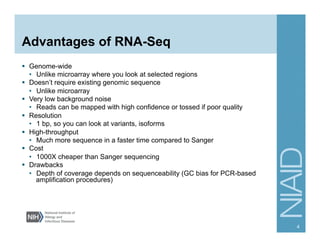
Advantages of RNA-Seq
§  Genome-wide
•  Unlike microarray where you look at selected regions
§  Doesn’t require existing genomic sequence
•  Unlike microarray
§  Very low background noise
•  Reads can be mapped with high confidence or tossed if poor quality
§  Resolution
•  1 bp, so you can look at variants, isoforms
§  High-throughput
•  Much more sequence in a faster time compared to Sanger
§  Cost
•  1000X cheaper than Sanger sequencing
§  Drawbacks
•  Depth of coverage depends on sequenceability (GC bias for PCR-based
amplification procedures)
4
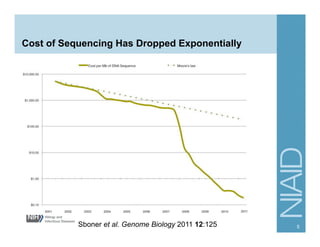
Cost of Sequencing Has Dropped Exponentially
5
Sboner et al. Genome Biology 2011 12:125
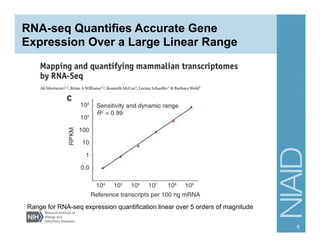
RNA-seq Quantifies Accurate Gene
Expression Over a Large Linear Range
6
Range for RNA-seq expression quantification linear over 5 orders of magnitude
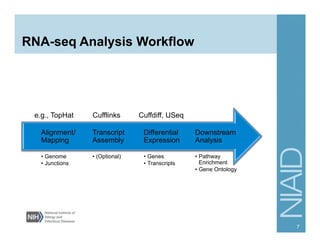
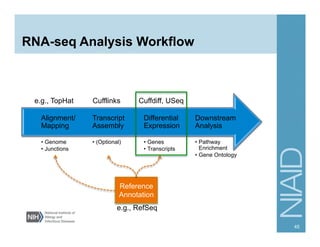
RNA-seq Analysis Workflow
•  Pathway
Enrichment
•  Gene Ontology
Downstream
Analysis
•  Genes
•  Transcripts
Differential
Expression
•  (Optional)
Transcript
Assembly
•  Genome
•  Junctions
Alignment/
Mapping
7
e.g., TopHat Cufflinks Cuffdiff, USeq
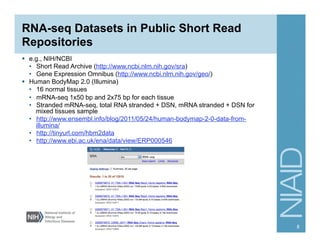
RNA-seq Datasets in Public Short Read
Repositories
§  e.g., NIH/NCBI
•  Short Read Archive (http://www.ncbi.nlm.nih.gov/sra)
•  Gene Expression Omnibus (http://www.ncbi.nlm.nih.gov/geo/)
§  Human BodyMap 2.0 (Illumina)
•  16 normal tissues
•  mRNA-seq 1x50 bp and 2x75 bp for each tissue
•  Stranded mRNA-seq, total RNA stranded + DSN, mRNA stranded + DSN for
mixed tissues sample
•  http://www.ensembl.info/blog/2011/05/24/human-bodymap-2-0-data-from-
illumina/
•  http://tinyurl.com/hbm2data
•  http://www.ebi.ac.uk/ena/data/view/ERP000546
8
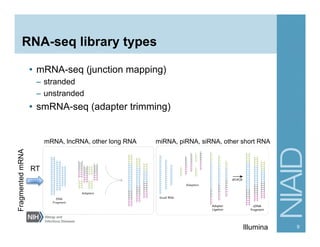
RNA-seq library types
•  mRNA-seq (junction mapping)
–  stranded
–  unstranded
•  smRNA-seq (adapter trimming)
9
3
roduction
This protocol explains how to prepare libraries of chromatin-immuno-
precipitated DNA for analysis on the Illumina Cluster Station and Genome
Analyzer. You will add adapter sequences onto the ends of DNA fragments
to generate the following template format:
Figure 1 Fragments after Sample Preparation
The adapter sequences correspond to the two surface-bound oligos on
the flow cells used in the Cluster Station.
DNA
Fragment
Adapters
3
Introduction
This protocol explains how to prepare libraries of small RNA for subsequent
cDNA sequencing on the Illumina Cluster Station and Genome Analyzer.
You will physically isolate small RNA, ligate the adapters necessary for use
during cluster creation, and reverse-transcribe and PCR to generate the
following template format:
Figure 1 Fragments after Sample Preparation
The 5’ small RNA adapter is necessary for reverse transcription and
amplification of the small RNA fragment. This adapter also contains the DNA
sequencing primer binding site. The 3’ small RNA adapter corresponds to
the surface bound amplification primer on the flow cell used on the Cluster
Station.
Small RNA
Adapters
cDNA
Fragment
Adapter
Ligation
RT-PCR
Illumina
miRNA, piRNA, siRNA, other short RNA
mRNA, lncRNA, other long RNA
Fragmented
mRNA
RT
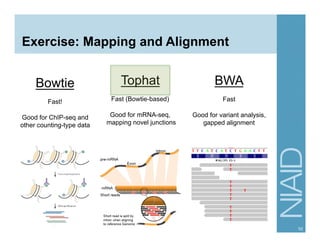
Exercise: Mapping and Alignment
10
Bowtie
Fast!
Good for ChIP-seq and
other counting-type data
Tophat
Fast (Bowtie-based)
Good for mRNA-seq,
mapping novel junctions
BWA
Fast
Good for variant analysis,
gapped alignment
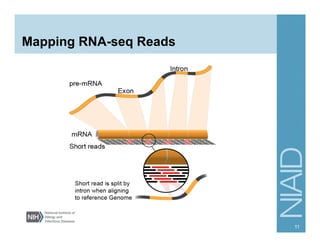
Mapping RNA-seq Reads
11
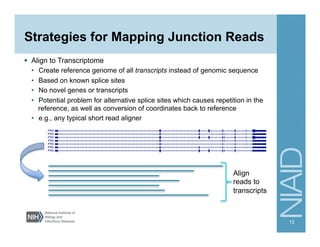
Strategies for Mapping Junction Reads
§  Align to Transcriptome
•  Create reference genome of all transcripts instead of genomic sequence
•  Based on known splice sites
•  No novel genes or transcripts
•  Potential problem for alternative splice sites which causes repetition in the
reference, as well as conversion of coordinates back to reference
•  e.g., any typical short read aligner
12
Align
reads to
transcripts
Strategies for Mapping Junction Reads
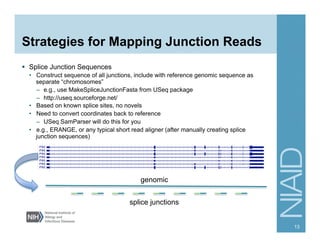
§  Splice Junction Sequences
•  Construct sequence of all junctions, include with reference genomic sequence as
separate “chromosomes”
–  e.g., use MakeSpliceJunctionFasta from USeq package
–  http://useq.sourceforge.net/
•  Based on known splice sites, no novels
•  Need to convert coordinates back to reference
–  USeq SamParser will do this for you
•  e.g., ERANGE, or any typical short read aligner (after manually creating splice
junction sequences)
13
genomic
splice junctions
Strategies for Mapping Junction Reads
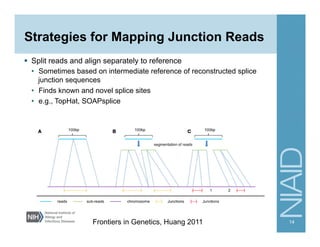
§  Split reads and align separately to reference
•  Sometimes based on intermediate reference of reconstructed splice
junction sequences
•  Finds known and novel splice sites
•  e.g., TopHat, SOAPsplice
14
Frontiers in Genetics, Huang 2011
Strategies for Mapping Junction Reads
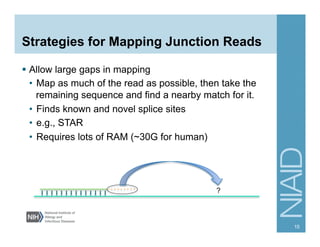
§  Allow large gaps in mapping
•  Map as much of the read as possible, then take the
remaining sequence and find a nearby match for it.
•  Finds known and novel splice sites
•  e.g., STAR
•  Requires lots of RAM (~30G for human)
15
?
De Novo Splice Junction Mappers
§  TopHat http://tophat.cbcb.umd.edu/
§  GMAP/GSNAP http://research-pub.gene.com/gmap/
§  SpliceMap http://www.stanford.edu/group/wonglab/SpliceMap/
§  SOAPsplice http://soap.genomics.org.cn
§  RUM http://www.cbil.upenn.edu/RUM/userguide.php
§  STAR http://gingeraslab.cshl.edu/STAR/
§  BFAST http://sourceforge.net/apps/mediawiki/bfast/
§  RNA-MATE/X-MATE http://grimmond.imb.uq.edu.au/RNA-MATE/
§  NextGENe http://www.softgenetics.com/NextGENe_11.html
§  Olego http://ngs-olego.sourceforge.net
§  HMMSplicer http://derisilab.ucsf.edu/index.php?software=105
§  SuperSplat http://supersplat.cgrb.oregonstate.edu
§  Qpalma http://www.raetschlab.org/suppl/qpalma
§  BLAT (not designed for short reads)
http://genome.ucsc.edu/FAQ/FAQblat.html
16
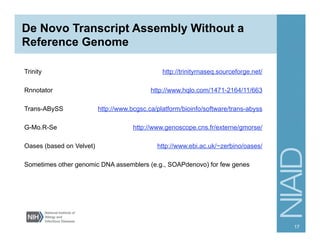
De Novo Transcript Assembly Without a
Reference Genome
17
Trinity http://trinityrnaseq.sourceforge.net/
Rnnotator http://www.hqlo.com/1471-2164/11/663
Trans-ABySS http://www.bcgsc.ca/platform/bioinfo/software/trans-abyss
G-Mo.R-Se http://www.genoscope.cns.fr/externe/gmorse/
Oases (based on Velvet) http://www.ebi.ac.uk/~zerbino/oases/
Sometimes other genomic DNA assemblers (e.g., SOAPdenovo) for few genes
TopHat
18
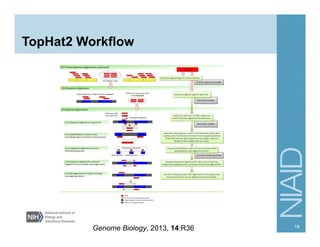
TopHat2 Workflow
19
Genome Biology, 2013, 14:R36
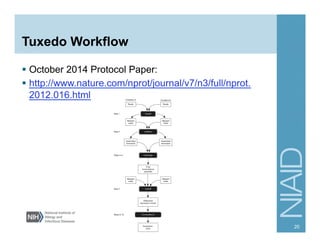
Tuxedo Workflow
§  October 2014 Protocol Paper:
§  http://www.nature.com/nprot/journal/v7/n3/full/nprot.
2012.016.html
20
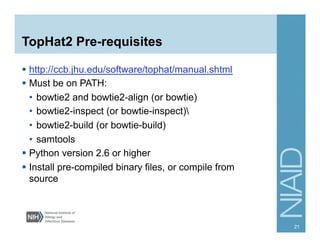
TopHat2 Pre-requisites
§  http://ccb.jhu.edu/software/tophat/manual.shtml
§  Must be on PATH:
•  bowtie2 and bowtie2-align (or bowtie)
•  bowtie2-inspect (or bowtie-inspect)
•  bowtie2-build (or bowtie-build)
•  samtools
§  Python version 2.6 or higher
§  Install pre-compiled binary files, or compile from
source
21
TopHat Command Line
22
tophat [options]* <index_base> <reads1_1> [reads1_2]
e.g., Paired-end
tophat hg19 SRR027894_1.fastq SRR027894_2.fastq
tophat hg19 SRR027894_1.fastq,SRR027895_1.fastq SRR027894_2.fastq,SRR027895_2.fastq
e.g., Single-end
tophat hg19 SRR036642.fastq
tophat hg19 SRR036642.fastq,SRR036643.fastq
Right mate in
paired-end
Single-end
or left mate in
paired-end
Index name
(genome)
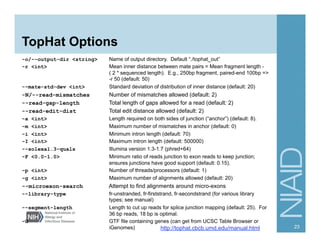
TopHat Options
-o/--output-dir <string> Name of output directory. Default “./tophat_out”
-r <int> Mean inner distance between mate pairs = Mean fragment length -
( 2 * sequenced length). E.g., 250bp fragment, paired-end 100bp =>
-r 50 (default: 50)
--mate-std-dev <int> Standard deviation of distribution of inner distance (default: 20)
-N/--read-mismatches Number of mismatches allowed (default: 2)
--read-gap-length Total length of gaps allowed for a read (default: 2)
--read-edit-dist Total edit distance allowed (default: 2)
-a <int> Length required on both sides of junction (“anchor”) (default: 8).
-m <int> Maximum number of mismatches in anchor (default: 0)
-i <int> Minimum intron length (default: 70)
-I <int> Maximum intron length (default: 500000)
--solexa1.3-quals Illumina version 1.3-1.7 (phred+64)
-F <0.0-1.0> Minimum ratio of reads junction to exon reads to keep junction;
ensures junctions have good support (default: 0.15).
-p <int> Number of threads/processors (default: 1)
-g <int> Maximum number of alignments allowed (default: 20)
--microexon-search Attempt to find alignments around micro-exons
--library-type fr-unstranded, fr-firststrand, fr-secondstrand (for various library
types; see manual)
--segment-length Length to cut up reads for splice junction mapping (default: 25). For
36 bp reads, 18 bp is optimal.
-G GTF file containing genes (can get from UCSC Table Browser or
iGenomes) 23
http://tophat.cbcb.umd.edu/manual.html
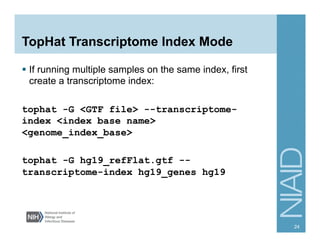
TopHat Transcriptome Index Mode
§  If running multiple samples on the same index, first
create a transcriptome index:
tophat -G <GTF file> --transcriptome-
index <index base name>
<genome_index_base>
tophat -G hg19_refFlat.gtf --
transcriptome-index hg19_genes hg19
24
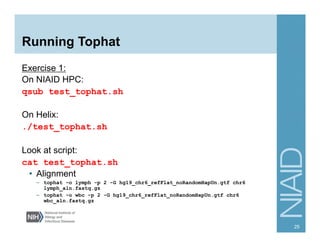
Running Tophat
Exercise 1:
On NIAID HPC:
qsub test_tophat.sh
On Helix:
./test_tophat.sh
Look at script:
cat test_tophat.sh
•  Alignment
–  tophat -o lymph -p 2 -G hg19_chr6_refFlat_noRandomHapUn.gtf chr6
lymph_aln.fastq.gz
–  tophat -o wbc -p 2 -G hg19_chr6_refFlat_noRandomHapUn.gtf chr6
wbc_aln.fastq.gz
25
Demo TopHat interface, or save to the end to do all in a workflow?
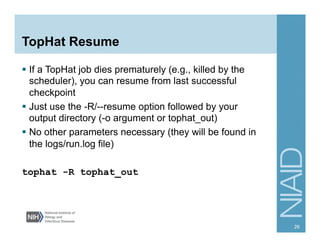
TopHat Resume
§  If a TopHat job dies prematurely (e.g., killed by the
scheduler), you can resume from last successful
checkpoint
§  Just use the -R/--resume option followed by your
output directory (-o argument or tophat_out)
§  No other parameters necessary (they will be found in
the logs/run.log file)
tophat -R tophat_out
26
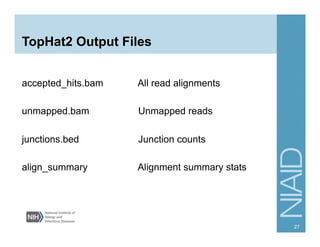
TopHat2 Output Files
accepted_hits.bam All read alignments
unmapped.bam Unmapped reads
junctions.bed Junction counts
align_summary Alignment summary stats
27
Post-Alignment Processing:
Transcript Assembly and
Annotation
28
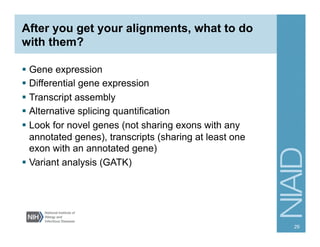
After you get your alignments, what to do
with them?
§  Gene expression
§  Differential gene expression
§  Transcript assembly
§  Alternative splicing quantification
§  Look for novel genes (not sharing exons with any
annotated genes), transcripts (sharing at least one
exon with an annotated gene)
§  Variant analysis (GATK)
29
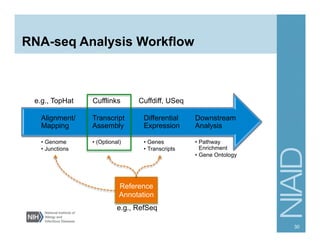
RNA-seq Analysis Workflow
•  Pathway
Enrichment
•  Gene Ontology
Downstream
Analysis
•  Genes
•  Transcripts
Differential
Expression
•  (Optional)
Transcript
Assembly
•  Genome
•  Junctions
Alignment/
Mapping
30
Reference
Annotation
e.g., TopHat Cufflinks
e.g., RefSeq
Cuffdiff, USeq
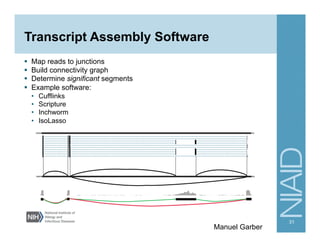
Transcript Assembly Software
§  Map reads to junctions
§  Build connectivity graph
§  Determine significant segments
§  Example software:
•  Cufflinks
•  Scripture
•  Inchworm
•  IsoLasso
31
[#%>)AT)K4%(FON)97%5:%(#7<)"-&677)#$%)5&">$)
[#%>)CT)3'(4)7'5('V-"(#)7%5:%(#7)
Statistical reconstruction of the transcriptome
Manuel Garber
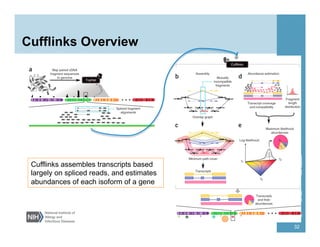
Cufflinks Overview
32
Cufflinks assembles transcripts based
largely on spliced reads, and estimates
abundances of each isoform of a gene
Cufflinks With or Without Reference
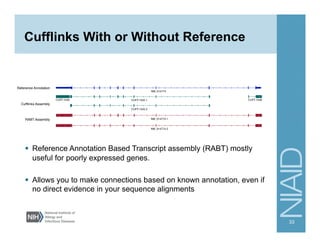
§  Reference Annotation Based Transcript assembly (RABT) mostly
useful for poorly expressed genes.
§  Allows you to make connections based on known annotation, even if
no direct evidence in your sequence alignments
33
Reference Annotation
Cufflinks Assembly
RABT Assembly
NM_014774.2
NM_014774.1
CUFF.1545.1
CUFF.1540
NM_014774
CUFF.1546
CUFF.1545.2
Fig. 3. Comparison of assembler output for an example gene. Lack of sequencing coverage in the UTR and across one splice junction caused the Cufflinks
ssembler (teal) to output three transfrags that match the reference (blue) and a fourth that contains a novel splice junction. The RABT assembler output
red) includes both the reference transcript (NM 014774.1) and a novel isoform (NM 014774.2) that is assembled from a combination of sequencing reads,
which reveal the novel junction, and faux-reads, which connect the three sections to form a single transcript. Note that even with the addition of the reference
ranscript, the total number of transfrags output by the assembler has been reduced for this locus, and the transfrag lengths have increased.
D. melanogaster Output Set # of Genes # of Transfrags Avg Transfrag Length Isoforms Per Gene
Reference Annotation 13,302 20,715 1,629 1.56
Cufflinks Assembly 7,167 8,701 2,334 1.21
Cufflinks Assembly (Novel Only) 350 3,205 2,741 -
RABT Assembly 13,634 23,913 1,815 1.75
RABT Assembly (Novel Only) 332 3,018 2,719 -
Table 2. Results for two different versions of assembly on the first Drosophila melanogaster embryo time-point from (Graveley et al., 2010). The categories
an be interpreted in the same manner as Table 1. These results show that the method also produces improved assemblies in fly.
http://bioinforma
Downloaded
from
Cufflinks Options
cufflinks [options]* <aligned_reads.(sam/bam)>
Options:
-o output directory
-p number of threads/processors (default: 1)
-G <path> Use GTF/GFF annotation file to use determine isoform
expression. Do not assemble novel transcripts.
-g <path> Use GTF/GFF to guide assembly of annotated transcripts
(RABT); also assembly novel genes and isoforms
-M <path> GTF/GFF file containing regions to exclude from analysis, e.g.,
chrM, rRNA
-b <genome.fa> perform bias correction
-u multi-read correction calculation
--library-type <str> fr-unstranded (default), fr-firststrand (dUTP method), fr-
secondstrand (directional Illumina)
-F <0.0-1.0> minimum isoform fraction to include an isoform. (default: 0.1,
which means at least 10% of the most abundant isoform of the
gene)
Command:
cufflinks -o cuff_out -p 5 -g hg19_refFlat.gtf -M chrM_rRNA.gtf 
-u -b genome.fa accepted_hits.bam
34
http://cufflinks.cbcb.umd.edu/manual.html
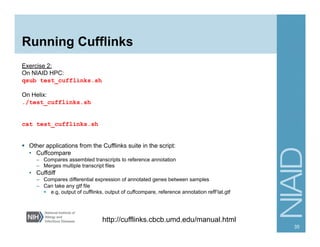
Running Cufflinks
Exercise 2:
On NIAID HPC:
qsub test_cufflinks.sh
On Helix:
./test_cufflinks.sh
cat test_cufflinks.sh
§  Other applications from the Cufflinks suite in the script:
•  Cuffcompare
–  Compares assembled transcripts to reference annotation
–  Merges multiple transcript files
•  Cuffdiff
–  Compares differential expression of annotated genes between samples
–  Can take any gtf file
§  e.g, output of cufflinks, output of cuffcompare, reference annotation refFlat.gtf
35
http://cufflinks.cbcb.umd.edu/manual.html
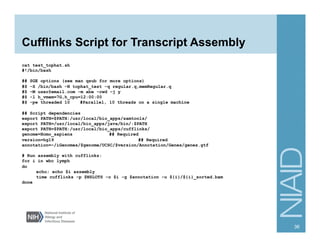
Cufflinks Script for Transcript Assembly
cat test_tophat.sh
#!/bin/bash
## SGE options (see man qsub for more options)
#$ -S /bin/bash -N tophat_test -q regular.q,memRegular.q
#$ -M user@email.com -m abe -cwd -j y
#$ -l h_vmem=7G,h_cpu=12:00:00
#$ -pe threaded 10 #Parallel, 10 threads on a single machine
## Script dependencies
export PATH=$PATH:/usr/local/bio_apps/samtools/
export PATH=/usr/local/bio_apps/java/bin/:$PATH
export PATH=$PATH:/usr/local/bio_apps/cufflinks/
genome=Homo_sapiens ## Required
version=hg19 ## Required
annotation=~/iGenomes/$genome/UCSC/$version/Annotation/Genes/genes.gtf
# Run assembly with cufflinks:
for i in wbc lymph
do
echo; echo $i assembly
time cufflinks -p $NSLOTS -o $i -g $annotation -u ${i}/${i}_sorted.bam
done
36
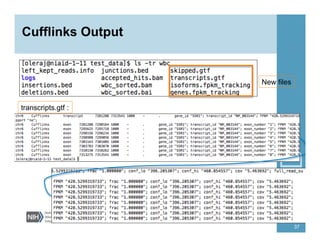
Cufflinks Output
37
New files
transcripts.gtf :
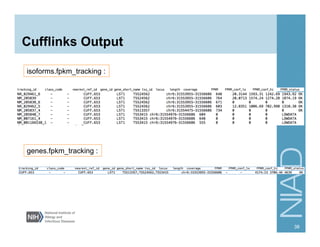
Cufflinks Output
38
isoforms.fpkm_tracking :
genes.fpkm_tracking :
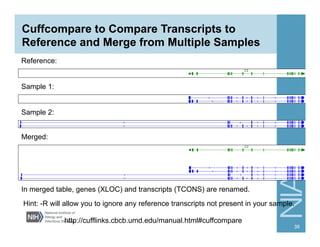
Cuffcompare to Compare Transcripts to
Reference and Merge from Multiple Samples
39
Reference:
Sample 1:
Sample 2:
Merged:
In merged table, genes (XLOC) and transcripts (TCONS) are renamed.
Hint: -R will allow you to ignore any reference transcripts not present in your sample.
http://cufflinks.cbcb.umd.edu/manual.html#cuffcompare
Running Cuffcompare
cuffcompare [options] <transcripts1.gtf>
<transcripts2.gtf> …
e.g.,
cuffcompare -r hg19_chr6_refFlat_noRandomHapUn.gtf
lymph/transcripts.gtf wbc/transcripts.gtf
-r [file] Reference transcripts in gtf format
-R Ignore reference transcripts not found in
RNAseq sample
40
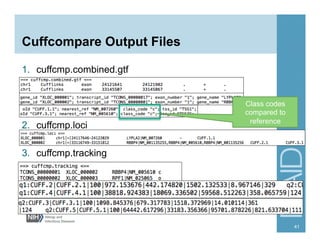
Cuffcompare Output Files
1.  cuffcmp.combined.gtf
2.  cuffcmp.loci
3.  cuffcmp.tracking
41
Class codes
compared to
reference
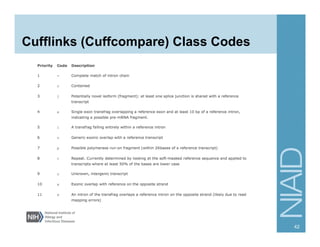
Cufflinks (Cuffcompare) Class Codes
42
Transcript Assembly Conclusion
§ RNA-seq reads can be processed to determine all
of the transcripts expressed in a tissue.
§ Important parameters for RNA-seq library prep if
transcript assembly is a goal are
•  long reads (50 bp, 75 bp, 100 bp …)
•  stranded could help…
•  paired-end reads help
§ RABT is good for genes with low expression…
§ Be aware that all of the reference transcripts will
be in the output if you use RABT.
§ Cuffcompare can be used to compare expressed
transcripts to a reference annotation
43
Post-Alignment Processing:
Gene Expression
44
RNA-seq Analysis Workflow
•  Pathway
Enrichment
•  Gene Ontology
Downstream
Analysis
•  Genes
•  Transcripts
Differential
Expression
•  (Optional)
Transcript
Assembly
•  Genome
•  Junctions
Alignment/
Mapping
45
Reference
Annotation
e.g., TopHat Cufflinks
e.g., RefSeq
Cuffdiff, USeq
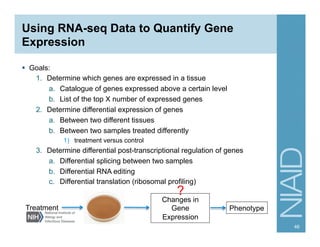
Using RNA-seq Data to Quantify Gene
Expression
§  Goals:
1.  Determine which genes are expressed in a tissue
a.  Catalogue of genes expressed above a certain level
b.  List of the top X number of expressed genes
2.  Determine differential expression of genes
a.  Between two different tissues
b.  Between two samples treated differently
1)  treatment versus control
3.  Determine differential post-transcriptional regulation of genes
a.  Differential splicing between two samples
b.  Differential RNA editing
c.  Differential translation (ribosomal profiling)
46
Treatment
Changes in
Gene
Expression
Phenotype
?
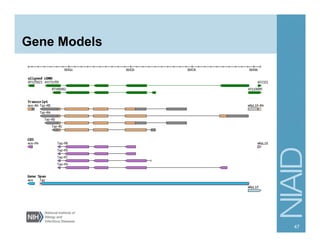
Gene Models
47
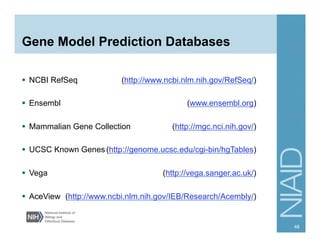
Gene Model Prediction Databases
§  NCBI RefSeq (http://www.ncbi.nlm.nih.gov/RefSeq/)
§  Ensembl (www.ensembl.org)
§  Mammalian Gene Collection (http://mgc.nci.nih.gov/)
§  UCSC Known Genes(http://genome.ucsc.edu/cgi-bin/hgTables)
§  Vega (http://vega.sanger.ac.uk/)
§  AceView (http://www.ncbi.nlm.nih.gov/IEB/Research/Acembly/)
48
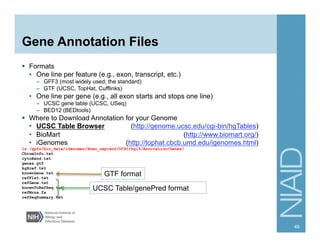
Gene Annotation Files
§  Formats
•  One line per feature (e.g., exon, transcript, etc.)
–  GFF3 (most widely used; the standard)
–  GTF (UCSC, TopHat, Cufflinks)
•  One line per gene (e.g., all exon starts and stops one line)
–  UCSC gene table (UCSC, USeq)
–  BED12 (BEDtools)
§  Where to Download Annotation for your Genome
•  UCSC Table Browser (http://genome.ucsc.edu/cgi-bin/hgTables)
•  BioMart (http://www.biomart.org/)
•  iGenomes (http://tophat.cbcb.umd.edu/igenomes.html)
ls /gpfs/bio_data/iGenomes/Homo_sapiens/UCSC/hg19/Annotation/Genes/
ChromInfo.txt
cytoBand.txt
genes.gtf
kgXref.txt
knownGene.txt
refFlat.txt
refGene.txt
knownToRefSeq.txt
refMrna.fa
refSeqSummary.txt
49
GTF format
UCSC Table/genePred format
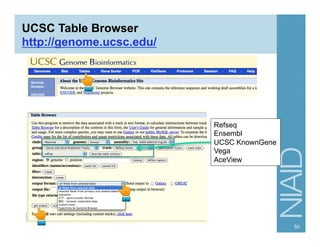
UCSC Table Browser
http://genome.ucsc.edu/
50
Refseq
Ensembl
UCSC KnownGene
Vega
AceView
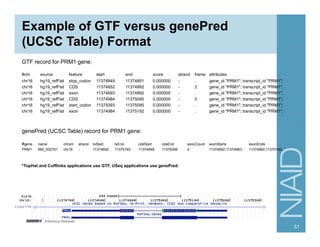
Example of GTF versus genePred
(UCSC Table) Format
GTF record for PRM1 gene:
#chr source feature start end score strand frame attributes
chr16 hg19_refFlat stop_codon 11374849 11374851 0.000000 - . gene_id "PRM1"; transcript_id "PRM1";
chr16 hg19_refFlat CDS 11374852 11374892 0.000000 - 2 gene_id "PRM1"; transcript_id "PRM1";
chr16 hg19_refFlat exon 11374693 11374892 0.000000 - . gene_id "PRM1"; transcript_id "PRM1";
chr16 hg19_refFlat CDS 11374984 11375095 0.000000 - 0 gene_id "PRM1"; transcript_id "PRM1";
chr16 hg19_refFlat start_codon 11375093 11375095 0.000000 - . gene_id "PRM1"; transcript_id "PRM1";
chr16 hg19_refFlat exon 11374984 11375192 0.000000 - . gene_id "PRM1"; transcript_id "PRM1";
genePred (UCSC Table) record for PRM1 gene:
#gene name chrom strand txStart txEnd cdsStart cdsEnd exonCount exonStarts exonEnds
PRM1 NM_002761 chr16 - 11374692 11375192 11374848 11375095 2 11374692,11374983, 11374892,11375192,
*TopHat and Cufflinks applications use GTF, USeq applications use genePred.
51
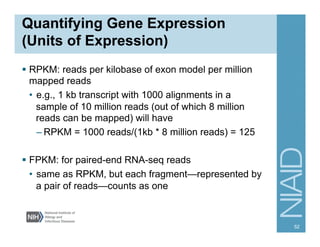
Quantifying Gene Expression
(Units of Expression)
§  RPKM: reads per kilobase of exon model per million
mapped reads
•  e.g., 1 kb transcript with 1000 alignments in a
sample of 10 million reads (out of which 8 million
reads can be mapped) will have
– RPKM = 1000 reads/(1kb * 8 million reads) = 125
§  FPKM: for paired-end RNA-seq reads
•  same as RPKM, but each fragment—represented by
a pair of reads—counts as one
52
Statistical Modeling of RNA-seq Data for
Quantifying Differential Gene Expression
§  Fitting the data to a model to get a p-value
•  RNA-seq data is basically “count” data (in terms of
computing differential gene expression)
•  Negative Binomial is a suitable statistical method
– Good for modeling skewed and overdispersed
data (e.g., biological data)
– Mean and Variance need to be learned from the
data to fit the model
§  Need many biological replicates for accurate
results (hint for experimental design)
53
Software for Modeling RNA-seq Using
Negative Binomial (NB) Distribution
§  edgeR (R package)
•  Works for small number of replicates (typical for RNA-seq)
•  Instead of learning both mean and variance, just learns mean; variance is
some function of mean.
•  Works fairly well
§  DESeq (R package)
•  Builds on edgeR
•  Estimates both mean and variance from data
•  Deals with the small number of replicates by pooling genes of similar
expression level to calculate variance
•  “More balanced selection of differentially expressed genes throughout the
dynamic range of the data”
§  Cuffdiff
§  USeq DefinedRegionDifferentialSeqs (DRDS), a java-based implementation
of DESeq
§  NBPSeq
§  baySeq
§  EBSeq
§  Review article:
•  http://www.biomedcentral.com/1471-2105/14/91 54
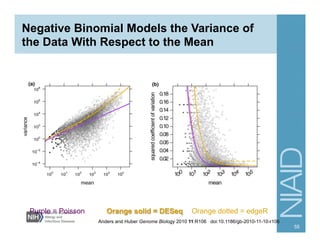
Negative Binomial Models the Variance of
the Data With Respect to the Mean
55
Anders and Huber Genome Biology 2010 11:R106 doi:10.1186/gb-2010-11-10-r106
Purple = Poisson Orange solid = DESeq Orange dotted = edgeR
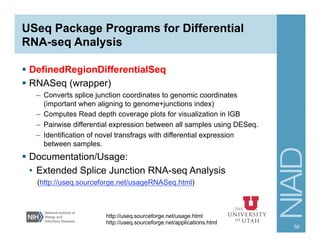
USeq Package Programs for Differential
RNA-seq Analysis
§  DefinedRegionDifferentialSeq
§  RNASeq (wrapper)
–  Converts splice junction coordinates to genomic coordinates
(important when aligning to genome+junctions index)
–  Computes Read depth coverage plots for visualization in IGB
–  Pairwise differential expression between all samples using DESeq.
–  Identification of novel transfrags with differential expression
between samples.
§  Documentation/Usage:
•  Extended Splice Junction RNA-seq Analysis
(http://useq.sourceforge.net/usageRNASeq.html)
56
http://useq.sourceforge.net/usage.html
http://useq.sourceforge.net/applications.html
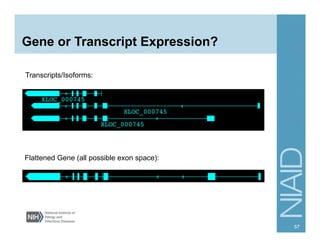
Gene or Transcript Expression?
57
Transcripts/Isoforms:
Flattened Gene (all possible exon space):
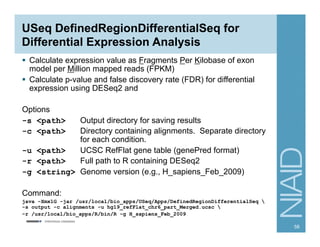
USeq DefinedRegionDifferentialSeq for
Differential Expression Analysis
§  Calculate expression value as Fragments Per Kilobase of exon
model per Million mapped reads (FPKM)
§  Calculate p-value and false discovery rate (FDR) for differential
expression using DESeq2 and
Options
-s <path> Output directory for saving results
-c <path> Directory containing alignments. Separate directory
for each condition.
-u <path> UCSC RefFlat gene table (genePred format)
-r <path> Full path to R containing DESeq2
-g <string> Genome version (e.g., H_sapiens_Feb_2009)
Command:
java -Xmx1G -jar /usr/local/bio_apps/USeq/Apps/DefinedRegionDifferentialSeq 
-s output -c alignments -u hg19_refFlat_chr6_part_Merged.ucsc 
-r /usr/local/bio_apps/R/bin/R -g H_sapiens_Feb_2009
58
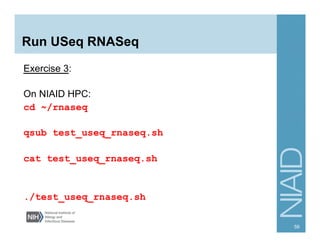
Run USeq RNASeq
Exercise 3:
On NIAID HPC:
cd ~/rnaseq
qsub test_useq_rnaseq.sh
cat test_useq_rnaseq.sh
./test_useq_rnaseq.sh
59
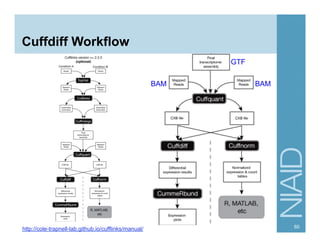
Cuffdiff Workflow
60
http://cole-trapnell-lab.github.io/cufflinks/manual/
BAM BAM
GTF
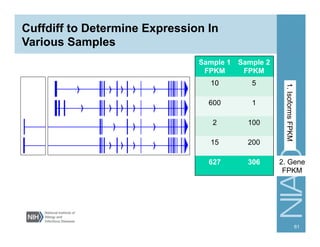
Cuffdiff to Determine Expression In
Various Samples
61
Sample 1
FPKM
Sample 2
FPKM
10 5
600 1
2 100
15 200
627 306 2. Gene
FPKM
1.
Isoforms
FPKM
Running Cuffdiff
cuffdiff [options] <transcripts.gtf> <sample1.bam>
<sample2.bam> …
e.g.,
cuffdiff -p 10 cuffcmp.combined.gtf lymph/
accepted_hits.bam wbc/accepted_hits.bam
-p [INT] Number of processors
-o Output directory (default = current dir)
-T Treat samples as a time series (default =
all against all comparison)
-u Multi-read correction for reads that map
to multiple places in the genome
Others (type “cuffdiff” to see other options)
62
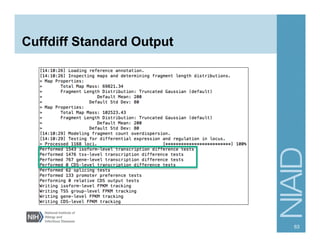
Cuffdiff Standard Output
63
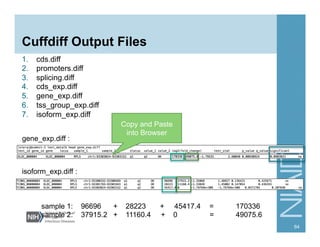
Cuffdiff Output Files
1.  cds.diff
2.  promoters.diff
3.  splicing.diff
4.  cds_exp.diff
5.  gene_exp.diff
6.  tss_group_exp.diff
7.  isoform_exp.diff
64
gene_exp.diff :
isoform_exp.diff :
sample 1: 96696 + 28223 + 45417.4 = 170336
sample 2: 37915.2 + 11160.4 + 0 = 49075.6
Copy and Paste
into Browser
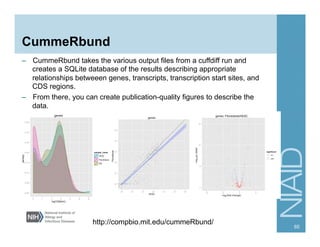
CummeRbund
–  CummeRbund takes the various output files from a cuffdiff run and
creates a SQLite database of the results describing appropriate
relationships betweeen genes, transcripts, transcription start sites, and
CDS regions.
–  From there, you can create publication-quality figures to describe the
data.
65
http://compbio.mit.edu/cummeRbund/
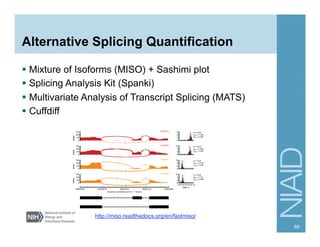
Alternative Splicing Quantification
§  Mixture of Isoforms (MISO) + Sashimi plot
§  Splicing Analysis Kit (Spanki)
§  Multivariate Analysis of Transcript Splicing (MATS)
§  Cuffdiff
66
http://miso.readthedocs.org/en/fastmiso/
Other Demonstrations (Time-permitting)
§ Visualization of output in Genome Browsers
• IGB
• IGV
• Links to BAM files
–  https://dl.dropbox.com/u/30379708/Upenn/
lymph_accepted_hits.bam
–  https://dl.dropbox.com/u/30379708/Upenn/
wbc_accepted_hits.bam
§ GO Miner or DAVID
67
Downstream analysis
§  Goal is to determine
•  What *types* of genes show a change in expression
•  What cellular pathways are activated/inactivated by
your treatment
§  Software/websites:
•  GO Miner
–  http://discover.nci.nih.gov/gominer/
GoCommandWebInterface.jsp
•  DAVID
–  http://david.abcc.ncifcrf.gov/
•  Ingenuity Pathway Analysis (IPA)
–  http://www.ingenuity.com/products/pathways_analysis.html
68
Other Resources
§  RNA-seq tutorials
•  https://sites.google.com/site/princetonhtseq/tutorials/rna-seq
•  https://docs.uabgrid.uab.edu/wiki/
UAB_Galaxy_RNA_Seq_Step_by_Step_Tutorial
•  http://en.wikibooks.org/wiki/Next_Generation_Sequencing_(NGS)/RNA
•  https://main.g2.bx.psu.edu/
•  http://useq.sourceforge.net/usage.html
•  http://www.rna-seqblog.com/
•  http://en.wikipedia.org/wiki/RNA-Seq
•  http://link.springer.com/protocol/10.1007/978-1-61779-839-9_16/
fulltext.html
§  Commercial Software for RNA-seq Analysis (No Command Line!)
•  Partek Genomics Suite
–  http://www.partek.com/?q=partekgs
•  CLCBio Genomics Workbench
–  http://www.clcbio.com/products/clc-genomics-workbench/
69
Thank You
For questions or comments please contact:
andrew.oler@nih.gov
ScienceApps@niaid.nih.gov
70

rnaseq2015-02-18-170327193409.pdf

  • 1.
    Next Generation SequencingAnalysis Series February 18, 2015 Andrew Oler, PhD High-throughput Sequencing Bioinformatics Specialist BCBB/OCICB/NIAID/NIH
  • 2.
    Bioinformatics and Computational BiosciencesBranch §  “BCBB” §  Group of ~30 §  Bioinformatics Software Developers §  Computational Biologists §  Project Managers & Analysts http://www.niaid.nih.gov/about/organization/odoffices/omo/ocicb/Pages/bcbb.aspx 2
  • 3.
    The plan… §  RNA-seqintroduction §  Mapping RNA-seq reads with TopHat2 §  Transcript assembly with Cufflinks §  Differential expression •  USeq (DESeq2) •  Cuffdiff 3
  • 4.
    Advantages of RNA-Seq § Genome-wide •  Unlike microarray where you look at selected regions §  Doesn’t require existing genomic sequence •  Unlike microarray §  Very low background noise •  Reads can be mapped with high confidence or tossed if poor quality §  Resolution •  1 bp, so you can look at variants, isoforms §  High-throughput •  Much more sequence in a faster time compared to Sanger §  Cost •  1000X cheaper than Sanger sequencing §  Drawbacks •  Depth of coverage depends on sequenceability (GC bias for PCR-based amplification procedures) 4
  • 5.
    Cost of SequencingHas Dropped Exponentially 5 Sboner et al. Genome Biology 2011 12:125
  • 6.
    RNA-seq Quantifies AccurateGene Expression Over a Large Linear Range 6 Range for RNA-seq expression quantification linear over 5 orders of magnitude
  • 7.
    RNA-seq Analysis Workflow • Pathway Enrichment •  Gene Ontology Downstream Analysis •  Genes •  Transcripts Differential Expression •  (Optional) Transcript Assembly •  Genome •  Junctions Alignment/ Mapping 7 e.g., TopHat Cufflinks Cuffdiff, USeq
  • 8.
    RNA-seq Datasets inPublic Short Read Repositories §  e.g., NIH/NCBI •  Short Read Archive (http://www.ncbi.nlm.nih.gov/sra) •  Gene Expression Omnibus (http://www.ncbi.nlm.nih.gov/geo/) §  Human BodyMap 2.0 (Illumina) •  16 normal tissues •  mRNA-seq 1x50 bp and 2x75 bp for each tissue •  Stranded mRNA-seq, total RNA stranded + DSN, mRNA stranded + DSN for mixed tissues sample •  http://www.ensembl.info/blog/2011/05/24/human-bodymap-2-0-data-from- illumina/ •  http://tinyurl.com/hbm2data •  http://www.ebi.ac.uk/ena/data/view/ERP000546 8
  • 9.
    RNA-seq library types • mRNA-seq (junction mapping) –  stranded –  unstranded •  smRNA-seq (adapter trimming) 9 3 roduction This protocol explains how to prepare libraries of chromatin-immuno- precipitated DNA for analysis on the Illumina Cluster Station and Genome Analyzer. You will add adapter sequences onto the ends of DNA fragments to generate the following template format: Figure 1 Fragments after Sample Preparation The adapter sequences correspond to the two surface-bound oligos on the flow cells used in the Cluster Station. DNA Fragment Adapters 3 Introduction This protocol explains how to prepare libraries of small RNA for subsequent cDNA sequencing on the Illumina Cluster Station and Genome Analyzer. You will physically isolate small RNA, ligate the adapters necessary for use during cluster creation, and reverse-transcribe and PCR to generate the following template format: Figure 1 Fragments after Sample Preparation The 5’ small RNA adapter is necessary for reverse transcription and amplification of the small RNA fragment. This adapter also contains the DNA sequencing primer binding site. The 3’ small RNA adapter corresponds to the surface bound amplification primer on the flow cell used on the Cluster Station. Small RNA Adapters cDNA Fragment Adapter Ligation RT-PCR Illumina miRNA, piRNA, siRNA, other short RNA mRNA, lncRNA, other long RNA Fragmented mRNA RT
  • 10.
    Exercise: Mapping andAlignment 10 Bowtie Fast! Good for ChIP-seq and other counting-type data Tophat Fast (Bowtie-based) Good for mRNA-seq, mapping novel junctions BWA Fast Good for variant analysis, gapped alignment
  • 11.
  • 12.
    Strategies for MappingJunction Reads §  Align to Transcriptome •  Create reference genome of all transcripts instead of genomic sequence •  Based on known splice sites •  No novel genes or transcripts •  Potential problem for alternative splice sites which causes repetition in the reference, as well as conversion of coordinates back to reference •  e.g., any typical short read aligner 12 Align reads to transcripts
  • 13.
    Strategies for MappingJunction Reads §  Splice Junction Sequences •  Construct sequence of all junctions, include with reference genomic sequence as separate “chromosomes” –  e.g., use MakeSpliceJunctionFasta from USeq package –  http://useq.sourceforge.net/ •  Based on known splice sites, no novels •  Need to convert coordinates back to reference –  USeq SamParser will do this for you •  e.g., ERANGE, or any typical short read aligner (after manually creating splice junction sequences) 13 genomic splice junctions
  • 14.
    Strategies for MappingJunction Reads §  Split reads and align separately to reference •  Sometimes based on intermediate reference of reconstructed splice junction sequences •  Finds known and novel splice sites •  e.g., TopHat, SOAPsplice 14 Frontiers in Genetics, Huang 2011
  • 15.
    Strategies for MappingJunction Reads §  Allow large gaps in mapping •  Map as much of the read as possible, then take the remaining sequence and find a nearby match for it. •  Finds known and novel splice sites •  e.g., STAR •  Requires lots of RAM (~30G for human) 15 ?
  • 16.
    De Novo SpliceJunction Mappers §  TopHat http://tophat.cbcb.umd.edu/ §  GMAP/GSNAP http://research-pub.gene.com/gmap/ §  SpliceMap http://www.stanford.edu/group/wonglab/SpliceMap/ §  SOAPsplice http://soap.genomics.org.cn §  RUM http://www.cbil.upenn.edu/RUM/userguide.php §  STAR http://gingeraslab.cshl.edu/STAR/ §  BFAST http://sourceforge.net/apps/mediawiki/bfast/ §  RNA-MATE/X-MATE http://grimmond.imb.uq.edu.au/RNA-MATE/ §  NextGENe http://www.softgenetics.com/NextGENe_11.html §  Olego http://ngs-olego.sourceforge.net §  HMMSplicer http://derisilab.ucsf.edu/index.php?software=105 §  SuperSplat http://supersplat.cgrb.oregonstate.edu §  Qpalma http://www.raetschlab.org/suppl/qpalma §  BLAT (not designed for short reads) http://genome.ucsc.edu/FAQ/FAQblat.html 16
  • 17.
    De Novo TranscriptAssembly Without a Reference Genome 17 Trinity http://trinityrnaseq.sourceforge.net/ Rnnotator http://www.hqlo.com/1471-2164/11/663 Trans-ABySS http://www.bcgsc.ca/platform/bioinfo/software/trans-abyss G-Mo.R-Se http://www.genoscope.cns.fr/externe/gmorse/ Oases (based on Velvet) http://www.ebi.ac.uk/~zerbino/oases/ Sometimes other genomic DNA assemblers (e.g., SOAPdenovo) for few genes
  • 18.
  • 19.
  • 20.
    Tuxedo Workflow §  October2014 Protocol Paper: §  http://www.nature.com/nprot/journal/v7/n3/full/nprot. 2012.016.html 20
  • 21.
    TopHat2 Pre-requisites §  http://ccb.jhu.edu/software/tophat/manual.shtml § Must be on PATH: •  bowtie2 and bowtie2-align (or bowtie) •  bowtie2-inspect (or bowtie-inspect) •  bowtie2-build (or bowtie-build) •  samtools §  Python version 2.6 or higher §  Install pre-compiled binary files, or compile from source 21
  • 22.
    TopHat Command Line 22 tophat[options]* <index_base> <reads1_1> [reads1_2] e.g., Paired-end tophat hg19 SRR027894_1.fastq SRR027894_2.fastq tophat hg19 SRR027894_1.fastq,SRR027895_1.fastq SRR027894_2.fastq,SRR027895_2.fastq e.g., Single-end tophat hg19 SRR036642.fastq tophat hg19 SRR036642.fastq,SRR036643.fastq Right mate in paired-end Single-end or left mate in paired-end Index name (genome)
  • 23.
    TopHat Options -o/--output-dir <string>Name of output directory. Default “./tophat_out” -r <int> Mean inner distance between mate pairs = Mean fragment length - ( 2 * sequenced length). E.g., 250bp fragment, paired-end 100bp => -r 50 (default: 50) --mate-std-dev <int> Standard deviation of distribution of inner distance (default: 20) -N/--read-mismatches Number of mismatches allowed (default: 2) --read-gap-length Total length of gaps allowed for a read (default: 2) --read-edit-dist Total edit distance allowed (default: 2) -a <int> Length required on both sides of junction (“anchor”) (default: 8). -m <int> Maximum number of mismatches in anchor (default: 0) -i <int> Minimum intron length (default: 70) -I <int> Maximum intron length (default: 500000) --solexa1.3-quals Illumina version 1.3-1.7 (phred+64) -F <0.0-1.0> Minimum ratio of reads junction to exon reads to keep junction; ensures junctions have good support (default: 0.15). -p <int> Number of threads/processors (default: 1) -g <int> Maximum number of alignments allowed (default: 20) --microexon-search Attempt to find alignments around micro-exons --library-type fr-unstranded, fr-firststrand, fr-secondstrand (for various library types; see manual) --segment-length Length to cut up reads for splice junction mapping (default: 25). For 36 bp reads, 18 bp is optimal. -G GTF file containing genes (can get from UCSC Table Browser or iGenomes) 23 http://tophat.cbcb.umd.edu/manual.html
  • 24.
    TopHat Transcriptome IndexMode §  If running multiple samples on the same index, first create a transcriptome index: tophat -G <GTF file> --transcriptome- index <index base name> <genome_index_base> tophat -G hg19_refFlat.gtf -- transcriptome-index hg19_genes hg19 24
  • 25.
    Running Tophat Exercise 1: OnNIAID HPC: qsub test_tophat.sh On Helix: ./test_tophat.sh Look at script: cat test_tophat.sh •  Alignment –  tophat -o lymph -p 2 -G hg19_chr6_refFlat_noRandomHapUn.gtf chr6 lymph_aln.fastq.gz –  tophat -o wbc -p 2 -G hg19_chr6_refFlat_noRandomHapUn.gtf chr6 wbc_aln.fastq.gz 25 Demo TopHat interface, or save to the end to do all in a workflow?
  • 26.
    TopHat Resume §  Ifa TopHat job dies prematurely (e.g., killed by the scheduler), you can resume from last successful checkpoint §  Just use the -R/--resume option followed by your output directory (-o argument or tophat_out) §  No other parameters necessary (they will be found in the logs/run.log file) tophat -R tophat_out 26
  • 27.
    TopHat2 Output Files accepted_hits.bamAll read alignments unmapped.bam Unmapped reads junctions.bed Junction counts align_summary Alignment summary stats 27
  • 28.
  • 29.
    After you getyour alignments, what to do with them? §  Gene expression §  Differential gene expression §  Transcript assembly §  Alternative splicing quantification §  Look for novel genes (not sharing exons with any annotated genes), transcripts (sharing at least one exon with an annotated gene) §  Variant analysis (GATK) 29
  • 30.
    RNA-seq Analysis Workflow • Pathway Enrichment •  Gene Ontology Downstream Analysis •  Genes •  Transcripts Differential Expression •  (Optional) Transcript Assembly •  Genome •  Junctions Alignment/ Mapping 30 Reference Annotation e.g., TopHat Cufflinks e.g., RefSeq Cuffdiff, USeq
  • 31.
    Transcript Assembly Software § Map reads to junctions §  Build connectivity graph §  Determine significant segments §  Example software: •  Cufflinks •  Scripture •  Inchworm •  IsoLasso 31 [#%>)AT)K4%(FON)97%5:%(#7<)"-&677)#$%)5&">$) [#%>)CT)3'(4)7'5('V-"(#)7%5:%(#7) Statistical reconstruction of the transcriptome Manuel Garber
  • 32.
    Cufflinks Overview 32 Cufflinks assemblestranscripts based largely on spliced reads, and estimates abundances of each isoform of a gene
  • 33.
    Cufflinks With orWithout Reference §  Reference Annotation Based Transcript assembly (RABT) mostly useful for poorly expressed genes. §  Allows you to make connections based on known annotation, even if no direct evidence in your sequence alignments 33 Reference Annotation Cufflinks Assembly RABT Assembly NM_014774.2 NM_014774.1 CUFF.1545.1 CUFF.1540 NM_014774 CUFF.1546 CUFF.1545.2 Fig. 3. Comparison of assembler output for an example gene. Lack of sequencing coverage in the UTR and across one splice junction caused the Cufflinks ssembler (teal) to output three transfrags that match the reference (blue) and a fourth that contains a novel splice junction. The RABT assembler output red) includes both the reference transcript (NM 014774.1) and a novel isoform (NM 014774.2) that is assembled from a combination of sequencing reads, which reveal the novel junction, and faux-reads, which connect the three sections to form a single transcript. Note that even with the addition of the reference ranscript, the total number of transfrags output by the assembler has been reduced for this locus, and the transfrag lengths have increased. D. melanogaster Output Set # of Genes # of Transfrags Avg Transfrag Length Isoforms Per Gene Reference Annotation 13,302 20,715 1,629 1.56 Cufflinks Assembly 7,167 8,701 2,334 1.21 Cufflinks Assembly (Novel Only) 350 3,205 2,741 - RABT Assembly 13,634 23,913 1,815 1.75 RABT Assembly (Novel Only) 332 3,018 2,719 - Table 2. Results for two different versions of assembly on the first Drosophila melanogaster embryo time-point from (Graveley et al., 2010). The categories an be interpreted in the same manner as Table 1. These results show that the method also produces improved assemblies in fly. http://bioinforma Downloaded from
  • 34.
    Cufflinks Options cufflinks [options]*<aligned_reads.(sam/bam)> Options: -o output directory -p number of threads/processors (default: 1) -G <path> Use GTF/GFF annotation file to use determine isoform expression. Do not assemble novel transcripts. -g <path> Use GTF/GFF to guide assembly of annotated transcripts (RABT); also assembly novel genes and isoforms -M <path> GTF/GFF file containing regions to exclude from analysis, e.g., chrM, rRNA -b <genome.fa> perform bias correction -u multi-read correction calculation --library-type <str> fr-unstranded (default), fr-firststrand (dUTP method), fr- secondstrand (directional Illumina) -F <0.0-1.0> minimum isoform fraction to include an isoform. (default: 0.1, which means at least 10% of the most abundant isoform of the gene) Command: cufflinks -o cuff_out -p 5 -g hg19_refFlat.gtf -M chrM_rRNA.gtf -u -b genome.fa accepted_hits.bam 34 http://cufflinks.cbcb.umd.edu/manual.html
  • 35.
    Running Cufflinks Exercise 2: OnNIAID HPC: qsub test_cufflinks.sh On Helix: ./test_cufflinks.sh cat test_cufflinks.sh §  Other applications from the Cufflinks suite in the script: •  Cuffcompare –  Compares assembled transcripts to reference annotation –  Merges multiple transcript files •  Cuffdiff –  Compares differential expression of annotated genes between samples –  Can take any gtf file §  e.g, output of cufflinks, output of cuffcompare, reference annotation refFlat.gtf 35 http://cufflinks.cbcb.umd.edu/manual.html
  • 36.
    Cufflinks Script forTranscript Assembly cat test_tophat.sh #!/bin/bash ## SGE options (see man qsub for more options) #$ -S /bin/bash -N tophat_test -q regular.q,memRegular.q #$ -M user@email.com -m abe -cwd -j y #$ -l h_vmem=7G,h_cpu=12:00:00 #$ -pe threaded 10 #Parallel, 10 threads on a single machine ## Script dependencies export PATH=$PATH:/usr/local/bio_apps/samtools/ export PATH=/usr/local/bio_apps/java/bin/:$PATH export PATH=$PATH:/usr/local/bio_apps/cufflinks/ genome=Homo_sapiens ## Required version=hg19 ## Required annotation=~/iGenomes/$genome/UCSC/$version/Annotation/Genes/genes.gtf # Run assembly with cufflinks: for i in wbc lymph do echo; echo $i assembly time cufflinks -p $NSLOTS -o $i -g $annotation -u ${i}/${i}_sorted.bam done 36
  • 37.
  • 38.
  • 39.
    Cuffcompare to CompareTranscripts to Reference and Merge from Multiple Samples 39 Reference: Sample 1: Sample 2: Merged: In merged table, genes (XLOC) and transcripts (TCONS) are renamed. Hint: -R will allow you to ignore any reference transcripts not present in your sample. http://cufflinks.cbcb.umd.edu/manual.html#cuffcompare
  • 40.
    Running Cuffcompare cuffcompare [options]<transcripts1.gtf> <transcripts2.gtf> … e.g., cuffcompare -r hg19_chr6_refFlat_noRandomHapUn.gtf lymph/transcripts.gtf wbc/transcripts.gtf -r [file] Reference transcripts in gtf format -R Ignore reference transcripts not found in RNAseq sample 40
  • 41.
    Cuffcompare Output Files 1. cuffcmp.combined.gtf 2.  cuffcmp.loci 3.  cuffcmp.tracking 41 Class codes compared to reference
  • 42.
  • 43.
    Transcript Assembly Conclusion § RNA-seqreads can be processed to determine all of the transcripts expressed in a tissue. § Important parameters for RNA-seq library prep if transcript assembly is a goal are •  long reads (50 bp, 75 bp, 100 bp …) •  stranded could help… •  paired-end reads help § RABT is good for genes with low expression… § Be aware that all of the reference transcripts will be in the output if you use RABT. § Cuffcompare can be used to compare expressed transcripts to a reference annotation 43
  • 44.
  • 45.
    RNA-seq Analysis Workflow • Pathway Enrichment •  Gene Ontology Downstream Analysis •  Genes •  Transcripts Differential Expression •  (Optional) Transcript Assembly •  Genome •  Junctions Alignment/ Mapping 45 Reference Annotation e.g., TopHat Cufflinks e.g., RefSeq Cuffdiff, USeq
  • 46.
    Using RNA-seq Datato Quantify Gene Expression §  Goals: 1.  Determine which genes are expressed in a tissue a.  Catalogue of genes expressed above a certain level b.  List of the top X number of expressed genes 2.  Determine differential expression of genes a.  Between two different tissues b.  Between two samples treated differently 1)  treatment versus control 3.  Determine differential post-transcriptional regulation of genes a.  Differential splicing between two samples b.  Differential RNA editing c.  Differential translation (ribosomal profiling) 46 Treatment Changes in Gene Expression Phenotype ?
  • 47.
  • 48.
    Gene Model PredictionDatabases §  NCBI RefSeq (http://www.ncbi.nlm.nih.gov/RefSeq/) §  Ensembl (www.ensembl.org) §  Mammalian Gene Collection (http://mgc.nci.nih.gov/) §  UCSC Known Genes(http://genome.ucsc.edu/cgi-bin/hgTables) §  Vega (http://vega.sanger.ac.uk/) §  AceView (http://www.ncbi.nlm.nih.gov/IEB/Research/Acembly/) 48
  • 49.
    Gene Annotation Files § Formats •  One line per feature (e.g., exon, transcript, etc.) –  GFF3 (most widely used; the standard) –  GTF (UCSC, TopHat, Cufflinks) •  One line per gene (e.g., all exon starts and stops one line) –  UCSC gene table (UCSC, USeq) –  BED12 (BEDtools) §  Where to Download Annotation for your Genome •  UCSC Table Browser (http://genome.ucsc.edu/cgi-bin/hgTables) •  BioMart (http://www.biomart.org/) •  iGenomes (http://tophat.cbcb.umd.edu/igenomes.html) ls /gpfs/bio_data/iGenomes/Homo_sapiens/UCSC/hg19/Annotation/Genes/ ChromInfo.txt cytoBand.txt genes.gtf kgXref.txt knownGene.txt refFlat.txt refGene.txt knownToRefSeq.txt refMrna.fa refSeqSummary.txt 49 GTF format UCSC Table/genePred format
  • 50.
  • 51.
    Example of GTFversus genePred (UCSC Table) Format GTF record for PRM1 gene: #chr source feature start end score strand frame attributes chr16 hg19_refFlat stop_codon 11374849 11374851 0.000000 - . gene_id "PRM1"; transcript_id "PRM1"; chr16 hg19_refFlat CDS 11374852 11374892 0.000000 - 2 gene_id "PRM1"; transcript_id "PRM1"; chr16 hg19_refFlat exon 11374693 11374892 0.000000 - . gene_id "PRM1"; transcript_id "PRM1"; chr16 hg19_refFlat CDS 11374984 11375095 0.000000 - 0 gene_id "PRM1"; transcript_id "PRM1"; chr16 hg19_refFlat start_codon 11375093 11375095 0.000000 - . gene_id "PRM1"; transcript_id "PRM1"; chr16 hg19_refFlat exon 11374984 11375192 0.000000 - . gene_id "PRM1"; transcript_id "PRM1"; genePred (UCSC Table) record for PRM1 gene: #gene name chrom strand txStart txEnd cdsStart cdsEnd exonCount exonStarts exonEnds PRM1 NM_002761 chr16 - 11374692 11375192 11374848 11375095 2 11374692,11374983, 11374892,11375192, *TopHat and Cufflinks applications use GTF, USeq applications use genePred. 51
  • 52.
    Quantifying Gene Expression (Unitsof Expression) §  RPKM: reads per kilobase of exon model per million mapped reads •  e.g., 1 kb transcript with 1000 alignments in a sample of 10 million reads (out of which 8 million reads can be mapped) will have – RPKM = 1000 reads/(1kb * 8 million reads) = 125 §  FPKM: for paired-end RNA-seq reads •  same as RPKM, but each fragment—represented by a pair of reads—counts as one 52
  • 53.
    Statistical Modeling ofRNA-seq Data for Quantifying Differential Gene Expression §  Fitting the data to a model to get a p-value •  RNA-seq data is basically “count” data (in terms of computing differential gene expression) •  Negative Binomial is a suitable statistical method – Good for modeling skewed and overdispersed data (e.g., biological data) – Mean and Variance need to be learned from the data to fit the model §  Need many biological replicates for accurate results (hint for experimental design) 53
  • 54.
    Software for ModelingRNA-seq Using Negative Binomial (NB) Distribution §  edgeR (R package) •  Works for small number of replicates (typical for RNA-seq) •  Instead of learning both mean and variance, just learns mean; variance is some function of mean. •  Works fairly well §  DESeq (R package) •  Builds on edgeR •  Estimates both mean and variance from data •  Deals with the small number of replicates by pooling genes of similar expression level to calculate variance •  “More balanced selection of differentially expressed genes throughout the dynamic range of the data” §  Cuffdiff §  USeq DefinedRegionDifferentialSeqs (DRDS), a java-based implementation of DESeq §  NBPSeq §  baySeq §  EBSeq §  Review article: •  http://www.biomedcentral.com/1471-2105/14/91 54
  • 55.
    Negative Binomial Modelsthe Variance of the Data With Respect to the Mean 55 Anders and Huber Genome Biology 2010 11:R106 doi:10.1186/gb-2010-11-10-r106 Purple = Poisson Orange solid = DESeq Orange dotted = edgeR
  • 56.
    USeq Package Programsfor Differential RNA-seq Analysis §  DefinedRegionDifferentialSeq §  RNASeq (wrapper) –  Converts splice junction coordinates to genomic coordinates (important when aligning to genome+junctions index) –  Computes Read depth coverage plots for visualization in IGB –  Pairwise differential expression between all samples using DESeq. –  Identification of novel transfrags with differential expression between samples. §  Documentation/Usage: •  Extended Splice Junction RNA-seq Analysis (http://useq.sourceforge.net/usageRNASeq.html) 56 http://useq.sourceforge.net/usage.html http://useq.sourceforge.net/applications.html
  • 57.
    Gene or TranscriptExpression? 57 Transcripts/Isoforms: Flattened Gene (all possible exon space):
  • 58.
    USeq DefinedRegionDifferentialSeq for DifferentialExpression Analysis §  Calculate expression value as Fragments Per Kilobase of exon model per Million mapped reads (FPKM) §  Calculate p-value and false discovery rate (FDR) for differential expression using DESeq2 and Options -s <path> Output directory for saving results -c <path> Directory containing alignments. Separate directory for each condition. -u <path> UCSC RefFlat gene table (genePred format) -r <path> Full path to R containing DESeq2 -g <string> Genome version (e.g., H_sapiens_Feb_2009) Command: java -Xmx1G -jar /usr/local/bio_apps/USeq/Apps/DefinedRegionDifferentialSeq -s output -c alignments -u hg19_refFlat_chr6_part_Merged.ucsc -r /usr/local/bio_apps/R/bin/R -g H_sapiens_Feb_2009 58
  • 59.
    Run USeq RNASeq Exercise3: On NIAID HPC: cd ~/rnaseq qsub test_useq_rnaseq.sh cat test_useq_rnaseq.sh ./test_useq_rnaseq.sh 59
  • 60.
  • 61.
    Cuffdiff to DetermineExpression In Various Samples 61 Sample 1 FPKM Sample 2 FPKM 10 5 600 1 2 100 15 200 627 306 2. Gene FPKM 1. Isoforms FPKM
  • 62.
    Running Cuffdiff cuffdiff [options]<transcripts.gtf> <sample1.bam> <sample2.bam> … e.g., cuffdiff -p 10 cuffcmp.combined.gtf lymph/ accepted_hits.bam wbc/accepted_hits.bam -p [INT] Number of processors -o Output directory (default = current dir) -T Treat samples as a time series (default = all against all comparison) -u Multi-read correction for reads that map to multiple places in the genome Others (type “cuffdiff” to see other options) 62
  • 63.
  • 64.
    Cuffdiff Output Files 1. cds.diff 2.  promoters.diff 3.  splicing.diff 4.  cds_exp.diff 5.  gene_exp.diff 6.  tss_group_exp.diff 7.  isoform_exp.diff 64 gene_exp.diff : isoform_exp.diff : sample 1: 96696 + 28223 + 45417.4 = 170336 sample 2: 37915.2 + 11160.4 + 0 = 49075.6 Copy and Paste into Browser
  • 65.
    CummeRbund –  CummeRbund takesthe various output files from a cuffdiff run and creates a SQLite database of the results describing appropriate relationships betweeen genes, transcripts, transcription start sites, and CDS regions. –  From there, you can create publication-quality figures to describe the data. 65 http://compbio.mit.edu/cummeRbund/
  • 66.
    Alternative Splicing Quantification § Mixture of Isoforms (MISO) + Sashimi plot §  Splicing Analysis Kit (Spanki) §  Multivariate Analysis of Transcript Splicing (MATS) §  Cuffdiff 66 http://miso.readthedocs.org/en/fastmiso/
  • 67.
    Other Demonstrations (Time-permitting) § Visualizationof output in Genome Browsers • IGB • IGV • Links to BAM files –  https://dl.dropbox.com/u/30379708/Upenn/ lymph_accepted_hits.bam –  https://dl.dropbox.com/u/30379708/Upenn/ wbc_accepted_hits.bam § GO Miner or DAVID 67
  • 68.
    Downstream analysis §  Goalis to determine •  What *types* of genes show a change in expression •  What cellular pathways are activated/inactivated by your treatment §  Software/websites: •  GO Miner –  http://discover.nci.nih.gov/gominer/ GoCommandWebInterface.jsp •  DAVID –  http://david.abcc.ncifcrf.gov/ •  Ingenuity Pathway Analysis (IPA) –  http://www.ingenuity.com/products/pathways_analysis.html 68
  • 69.
    Other Resources §  RNA-seqtutorials •  https://sites.google.com/site/princetonhtseq/tutorials/rna-seq •  https://docs.uabgrid.uab.edu/wiki/ UAB_Galaxy_RNA_Seq_Step_by_Step_Tutorial •  http://en.wikibooks.org/wiki/Next_Generation_Sequencing_(NGS)/RNA •  https://main.g2.bx.psu.edu/ •  http://useq.sourceforge.net/usage.html •  http://www.rna-seqblog.com/ •  http://en.wikipedia.org/wiki/RNA-Seq •  http://link.springer.com/protocol/10.1007/978-1-61779-839-9_16/ fulltext.html §  Commercial Software for RNA-seq Analysis (No Command Line!) •  Partek Genomics Suite –  http://www.partek.com/?q=partekgs •  CLCBio Genomics Workbench –  http://www.clcbio.com/products/clc-genomics-workbench/ 69
  • 70.
    Thank You For questionsor comments please contact: andrew.oler@nih.gov ScienceApps@niaid.nih.gov 70