Name: Sowmya B N
Class: Junior M.Sc (Agricultural Extension Education)
Subject: Capacity Development, AEX-505
Submitting to: the course teacher (AEX-505)
Topic : 1. Purpose of Evaluation
2. Principles of Evaluation
3. Types of Evaluation
1
Evaluation
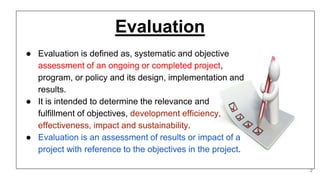
● Evaluation is defined as, systematic and objective
assessment of an ongoing or completed project,
program, or policy and its design, implementation and
results.
● It is intended to determine the relevance and
fulfillment of objectives, development efficiency,
effectiveness, impact and sustainability.
● Evaluation is an assessment of results or impact of a
project with reference to the objectives in the project.
2
Uses of Evaluation
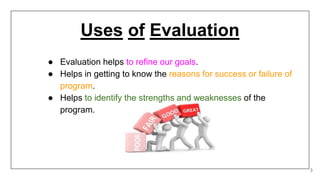
● Evaluation helps to refine our goals.
● Helps in getting to know the reasons for success or failure of
program.
● Helps to identify the strengths and weaknesses of the
program.
3
Purpose of evaluation
● To determine the relative effectiveness of the programme.
● Shows how far our project plans have progressed.
● To ascertain the worth of time, energy and resources invested in
programme.
● Shows whether we are proceeding in the right direction. It may point
out omissions,recommend changes and suggest new directions.
● To identify students' growth or lack of growth in acquiring desirable
knowledge, skills, attitudes and societal values.
● To help teachers determine the effectiveness of their teaching
techniques.
4
Principles of Evaluation
5
Capacity development evaluation principles refer to the
fundamental standards and guidelines that should be
followed when evaluating capacity development initiatives
or programs.
1. Relevance: should be relevant to
the objectives, goals, and strategies
of the capacity development initiative
or program.
● The evaluation should answer the
questions related to what the
initiative or program aimed to
achieve, why, and for whom.
6
2. Credibility: should be conducted in a manner that is fair,
unbiased, and impartial.
● This can be achieved through the use of reliable data sources,
transparency in the evaluation process, and clear
documentation of the methods used.
3. Feasibility: should be feasible, considering the available
resources, time, and scope of the initiative or program.
● The evaluation should be practical and cost-effective, and the
results should be achievable and usable by stakeholders.
7
4. Utilization: The evaluation should be designed to ensure that the
results are relevant and useful for decision-making and improving the
effectiveness of the capacity development initiative or program.
● This requires stakeholder participation and a clear understanding of
their needs and expectations.
5. Ethics: Capacity development evaluation should adhere to ethical
principles and standards, such as respect for human dignity,
confidentiality, informed consent, and minimizing risks and harm to
participants.
8
6. Sustainability: The evaluation should contribute to
sustainable capacity development by identifying opportunities for
improvement, building on strengths, and learning from successes
and failures.
● The evaluation should also promote accountability and
transparency, leading to continuous learning and
improvement.
By following these principles, capacity development evaluation
can contribute to improving the quality, effectiveness, and impact
of capacity development initiatives and programs
9
Types of evaluation
1. Formative Evaluation
2. Summative Evaluation
3. Sustainability Evaluation
4. Process Evaluation
5. Outcome evaluation
6. Impact evaluation
7. Cost effectiveness evaluation
10
11
1. Formative Evaluation: This type of evaluation is
conducted during the early stages of a capacity
development program or initiative, usually before or
during its implementation.
● The purpose is to provide feedback on the design,
implementation, and delivery of the program.
● This is meant to help improve the program or initiative
while it is still being developed or implemented, by
identifying areas for improvement, potential barriers to
success, and areas of strength that can be built on.
12
2. Summative evaluation: conducted at the end of a
program or project to determine its overall effectiveness,
impact, and success.
● It is typically used to assess whether a program has
achieved its intended outcomes and to determine whether it
has met the needs and expectations of its stakeholders.
3. Sustainability evaluation: This evaluation type
assesses whether the capacity development program is likely
to be sustained over the long term.
● It examines whether the target audience has the resources
and support necessary to continue applying the knowledge
and skills gained from the program.
13
4. Process evaluation: This evaluation type focuses on the
implementation of the capacity development program.
● It assesses how well the program is being delivered, how it
is being received by the target audience, and whether the
program is being implemented as intended.
5. Outcome evaluation: This evaluation type focuses on
the short- and medium-term results of the capacity
development program.
● It assesses the extent to which the program has achieved
its objectives and produced the intended outcomes, such
as changes in knowledge, skills, and attitudes.
14
6. Impact evaluation: This evaluation type focuses on the
long-term results of the capacity development program.
● It assesses the extent to which the program has led to
sustained changes in behavior, improved performance, and
increased organizational or community capacity.
7. Cost-effectiveness evaluation: This evaluation type
examines the relationship between the costs of the capacity
development program and the outcomes achieved.
● It assesses whether the program represents a good
investment of resources.
References:
● https://youtu.be/eliaAbM9LeM
● https://mypeer.org.au/monitoring-
evaluation/types-of-evaluation/
15
….thank you.

Evaluation, purpose, principle and types of evaluation

  • 1.
    Name: Sowmya BN Class: Junior M.Sc (Agricultural Extension Education) Subject: Capacity Development, AEX-505 Submitting to: the course teacher (AEX-505) Topic : 1. Purpose of Evaluation 2. Principles of Evaluation 3. Types of Evaluation 1
  • 2.
    Evaluation ● Evaluation isdefined as, systematic and objective assessment of an ongoing or completed project, program, or policy and its design, implementation and results. ● It is intended to determine the relevance and fulfillment of objectives, development efficiency, effectiveness, impact and sustainability. ● Evaluation is an assessment of results or impact of a project with reference to the objectives in the project. 2
  • 3.
    Uses of Evaluation ●Evaluation helps to refine our goals. ● Helps in getting to know the reasons for success or failure of program. ● Helps to identify the strengths and weaknesses of the program. 3
  • 4.
    Purpose of evaluation ●To determine the relative effectiveness of the programme. ● Shows how far our project plans have progressed. ● To ascertain the worth of time, energy and resources invested in programme. ● Shows whether we are proceeding in the right direction. It may point out omissions,recommend changes and suggest new directions. ● To identify students' growth or lack of growth in acquiring desirable knowledge, skills, attitudes and societal values. ● To help teachers determine the effectiveness of their teaching techniques. 4
  • 5.
    Principles of Evaluation 5 Capacitydevelopment evaluation principles refer to the fundamental standards and guidelines that should be followed when evaluating capacity development initiatives or programs.
  • 6.
    1. Relevance: shouldbe relevant to the objectives, goals, and strategies of the capacity development initiative or program. ● The evaluation should answer the questions related to what the initiative or program aimed to achieve, why, and for whom. 6
  • 7.
    2. Credibility: shouldbe conducted in a manner that is fair, unbiased, and impartial. ● This can be achieved through the use of reliable data sources, transparency in the evaluation process, and clear documentation of the methods used. 3. Feasibility: should be feasible, considering the available resources, time, and scope of the initiative or program. ● The evaluation should be practical and cost-effective, and the results should be achievable and usable by stakeholders. 7
  • 8.
    4. Utilization: Theevaluation should be designed to ensure that the results are relevant and useful for decision-making and improving the effectiveness of the capacity development initiative or program. ● This requires stakeholder participation and a clear understanding of their needs and expectations. 5. Ethics: Capacity development evaluation should adhere to ethical principles and standards, such as respect for human dignity, confidentiality, informed consent, and minimizing risks and harm to participants. 8
  • 9.
    6. Sustainability: Theevaluation should contribute to sustainable capacity development by identifying opportunities for improvement, building on strengths, and learning from successes and failures. ● The evaluation should also promote accountability and transparency, leading to continuous learning and improvement. By following these principles, capacity development evaluation can contribute to improving the quality, effectiveness, and impact of capacity development initiatives and programs 9
  • 10.
    Types of evaluation 1.Formative Evaluation 2. Summative Evaluation 3. Sustainability Evaluation 4. Process Evaluation 5. Outcome evaluation 6. Impact evaluation 7. Cost effectiveness evaluation 10
  • 11.
    11 1. Formative Evaluation:This type of evaluation is conducted during the early stages of a capacity development program or initiative, usually before or during its implementation. ● The purpose is to provide feedback on the design, implementation, and delivery of the program. ● This is meant to help improve the program or initiative while it is still being developed or implemented, by identifying areas for improvement, potential barriers to success, and areas of strength that can be built on.
  • 12.
    12 2. Summative evaluation:conducted at the end of a program or project to determine its overall effectiveness, impact, and success. ● It is typically used to assess whether a program has achieved its intended outcomes and to determine whether it has met the needs and expectations of its stakeholders. 3. Sustainability evaluation: This evaluation type assesses whether the capacity development program is likely to be sustained over the long term. ● It examines whether the target audience has the resources and support necessary to continue applying the knowledge and skills gained from the program.
  • 13.
    13 4. Process evaluation:This evaluation type focuses on the implementation of the capacity development program. ● It assesses how well the program is being delivered, how it is being received by the target audience, and whether the program is being implemented as intended. 5. Outcome evaluation: This evaluation type focuses on the short- and medium-term results of the capacity development program. ● It assesses the extent to which the program has achieved its objectives and produced the intended outcomes, such as changes in knowledge, skills, and attitudes.
  • 14.
    14 6. Impact evaluation:This evaluation type focuses on the long-term results of the capacity development program. ● It assesses the extent to which the program has led to sustained changes in behavior, improved performance, and increased organizational or community capacity. 7. Cost-effectiveness evaluation: This evaluation type examines the relationship between the costs of the capacity development program and the outcomes achieved. ● It assesses whether the program represents a good investment of resources.
  • 15.