Black Hole Attack Detection
in AODV
By : BIRJU TANK(141060753017)
M.E 3rd Sem WiMC
GTU PG School, BISAG-CDAC, Gandhinagar
birjutank27@gmail.com
Ad-hoc On-Demand Distance Vector
• Reactive Protocol
• On-Demand
• Low processing power
• Low network utilization
birjutank27@gmail.com
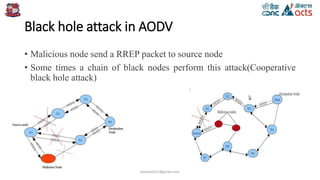
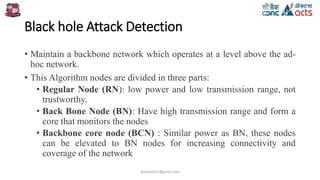
Black hole attack in AODV
• Malicious node send a RREP packet to source node
• Some times a chain of black nodes perform this attack(Cooperative
black hole attack)
birjutank27@gmail.com
Black hole Attack Detection
• Maintain a backbone network which operates at a level above the ad-
hoc network.
• This Algorithm nodes are divided in three parts:
• Regular Node (RN): low power and low transmission range, not
trustworthy.
• Back Bone Node (BN): Have high transmission range and form a
core that monitors the nodes
• Backbone core node (BCN) : Similar power as BN, these nodes
can be elevated to BN nodes for increasing connectivity and
coverage of the network
birjutank27@gmail.com
Cont’d
• This algorithm is having mainly two parts.
1. Core Formation and maintenance
2. Detection of Black/malicious nodes.
• Core Formation and maintenance: Core formation progresses
incrementally. During this BCN node perform some tasks those are
I. Detect RN in its neighbourhood, if found broadcast “invitation”
message.
II. On receiving Join request from RN, check if it is reachable in
specified number of hops, if yes add in associated node list else
in unassociated list.
III. if no other request go to next grid.
birjutank27@gmail.com
Cont’d
IV.If BCN detects any BN in its vicinity then this node sends a
coordination message to BN and waits for reply.
V. BCN on receiving reply to coordination message, it executes
action which is specified in the reply.
• Action of a Regular node:
I. Every Regular node first check if it is associated with some
BCN or BN, if yes then terminate its actions.
II. On receiving invitation message send a join request, and after
getting reply for its join request from BN or BCN send
“accept” to BN or BCN.
birjutank27@gmail.com
Cont’d
• Detection of Black/malicious nodes : The key idea is that source
node, after every block of data packets, asks the backbone network to
perform end-to-end check with the destination, whether the packets
have reached it.
• If destination did not receive a block of data packets, then backbone
network initiates the detection of the chain of malicious nodes.
birjutank27@gmail.com
Cont’d
• Let Suppose here :
• S : Source node,
• D: Destination node,
• N1:Backbone node, to which S
is associated
• N2:Backbone node, to which D
is associated V : Regular Node
• Nr: is the node which send
RREP to S (For the RREQ for S
to D route)
birjutank27@gmail.com
Cont’d
• Actions of S
• Divide the data into k equal parts let say Data[1..k].
• end a prelude message to D with shared key k.
• Sends the data to D and after that send a message check having Nr,
to N1.
• If an “ok” is received from N1 the continue data sending.
• if a “not ok” is received from N1 then sets a timer for malicious
removal. If before timeout receive the “removed ok” from N1 then
go to step 2, else terminate.
• D on receiving prelude from S. Wait for data packet and after
receiving data send a postulate message from N1 and S stating the
number of packets received from S.birjutank27@gmail.com
Conclusion
• Using this Algorithm the Simple black hole attack, Cooperative black
hole attack can be removed, and also to some extent Gray hole attack
can also be removed.
• This algorithm takes O(md) number of hops to detect black nodes.
Where m is the number of malicious nodes and d is the diameter of the
network.
birjutank27@gmail.com
References
• Izhak Ruhin,Arash Behzad, Runlie Zhang, Iluiyu Luo,Eric Caballero :
TBONE: A Mobile-Backbone Protocol for Ad Hoc Wireless Networks.
• H. Deng, W. Li, and D. P. Agrawal. Routing security in wireless ad hoc
network. IEEE Communications Magzine, pages 70 - 75, 2002.
• Kishor Jyoti Sarma, Rupam Sharma, Rajdeep Das. A Survey of Black
Hole Attack Detection in Manet. 978-1-4799-2900-9/14/$31.00 ©2014
IEEE
• Nidhi Sharma, Alok Sharma. The Black-hole node attack in MANET.
2012 Second International Conference on Advanced Computing &
Communication Technologies. 978-0-7695-4640-7/12 $26.00 © 2012
IEEE
birjutank27@gmail.com

Blackhole Attck detection in AODV Protocol

  • 1.
    Black Hole AttackDetection in AODV By : BIRJU TANK(141060753017) M.E 3rd Sem WiMC GTU PG School, BISAG-CDAC, Gandhinagar birjutank27@gmail.com
  • 2.
    Ad-hoc On-Demand DistanceVector • Reactive Protocol • On-Demand • Low processing power • Low network utilization birjutank27@gmail.com
  • 3.
    Black hole attackin AODV • Malicious node send a RREP packet to source node • Some times a chain of black nodes perform this attack(Cooperative black hole attack) birjutank27@gmail.com
  • 4.
    Black hole AttackDetection • Maintain a backbone network which operates at a level above the ad- hoc network. • This Algorithm nodes are divided in three parts: • Regular Node (RN): low power and low transmission range, not trustworthy. • Back Bone Node (BN): Have high transmission range and form a core that monitors the nodes • Backbone core node (BCN) : Similar power as BN, these nodes can be elevated to BN nodes for increasing connectivity and coverage of the network birjutank27@gmail.com
  • 5.
    Cont’d • This algorithmis having mainly two parts. 1. Core Formation and maintenance 2. Detection of Black/malicious nodes. • Core Formation and maintenance: Core formation progresses incrementally. During this BCN node perform some tasks those are I. Detect RN in its neighbourhood, if found broadcast “invitation” message. II. On receiving Join request from RN, check if it is reachable in specified number of hops, if yes add in associated node list else in unassociated list. III. if no other request go to next grid. birjutank27@gmail.com
  • 6.
    Cont’d IV.If BCN detectsany BN in its vicinity then this node sends a coordination message to BN and waits for reply. V. BCN on receiving reply to coordination message, it executes action which is specified in the reply. • Action of a Regular node: I. Every Regular node first check if it is associated with some BCN or BN, if yes then terminate its actions. II. On receiving invitation message send a join request, and after getting reply for its join request from BN or BCN send “accept” to BN or BCN. birjutank27@gmail.com
  • 7.
    Cont’d • Detection ofBlack/malicious nodes : The key idea is that source node, after every block of data packets, asks the backbone network to perform end-to-end check with the destination, whether the packets have reached it. • If destination did not receive a block of data packets, then backbone network initiates the detection of the chain of malicious nodes. birjutank27@gmail.com
  • 8.
    Cont’d • Let Supposehere : • S : Source node, • D: Destination node, • N1:Backbone node, to which S is associated • N2:Backbone node, to which D is associated V : Regular Node • Nr: is the node which send RREP to S (For the RREQ for S to D route) birjutank27@gmail.com
  • 9.
    Cont’d • Actions ofS • Divide the data into k equal parts let say Data[1..k]. • end a prelude message to D with shared key k. • Sends the data to D and after that send a message check having Nr, to N1. • If an “ok” is received from N1 the continue data sending. • if a “not ok” is received from N1 then sets a timer for malicious removal. If before timeout receive the “removed ok” from N1 then go to step 2, else terminate. • D on receiving prelude from S. Wait for data packet and after receiving data send a postulate message from N1 and S stating the number of packets received from S.birjutank27@gmail.com
  • 10.
    Conclusion • Using thisAlgorithm the Simple black hole attack, Cooperative black hole attack can be removed, and also to some extent Gray hole attack can also be removed. • This algorithm takes O(md) number of hops to detect black nodes. Where m is the number of malicious nodes and d is the diameter of the network. birjutank27@gmail.com
  • 11.
    References • Izhak Ruhin,ArashBehzad, Runlie Zhang, Iluiyu Luo,Eric Caballero : TBONE: A Mobile-Backbone Protocol for Ad Hoc Wireless Networks. • H. Deng, W. Li, and D. P. Agrawal. Routing security in wireless ad hoc network. IEEE Communications Magzine, pages 70 - 75, 2002. • Kishor Jyoti Sarma, Rupam Sharma, Rajdeep Das. A Survey of Black Hole Attack Detection in Manet. 978-1-4799-2900-9/14/$31.00 ©2014 IEEE • Nidhi Sharma, Alok Sharma. The Black-hole node attack in MANET. 2012 Second International Conference on Advanced Computing & Communication Technologies. 978-0-7695-4640-7/12 $26.00 © 2012 IEEE birjutank27@gmail.com
  • 12.

Editor's Notes

  • #4 next hop information is also asked than malicious node provide next malicious node as next hop, so when confirmed with the next hop then next malicious node replies that i am having route to the destination node but actually they don't have any information of routes to destination.