Learning Objectives
Distinguish Processcosting and Job –Costing
Record the flow of materials, labor, and
overhead through a process cost system.
Compute the equivalent units and cost per
equivalent unit( Primarily for WIP ending)
Assign costs to units completed and units in
process
3.
Process Costing System
Is a costing method most commonly used in industries that
produce essentially homogeneous (i.E. Uniform) products in
mass on a continuous basis.
Each unit receives the same amounts of direct materials
costs, direct labor costs, and manufacturing overhead
Unit costs are computed by dividing total costs incurred by
the number of units of output from the production process
Similarities
Both systemsassign( trace and allocate) material,
labor, and overhead costs assigned to products to
compute unit costs.
Both systems use the same manufacturing accounts:
Raw Materials,
Work in Process, and
Finished Goods accounts .
The flow of costs is basically the same in both systems.
6.
Differences
Process costingis used when a single identical product is
produced is mass on a continuing basis , where as Job-
order costing is used when many different jobs are worked
on each period.
Process costing systems accumulate costs by department.
Job-order costing systems accumulated costs by individual
jobs.
Process costing systems use department production reports
to accumulate costs. Job-order costing systems use job
sheets to accumulate costs.
Process costing systems compute unit costs by department.
Job-order costing systems compute unit costs by job.
8
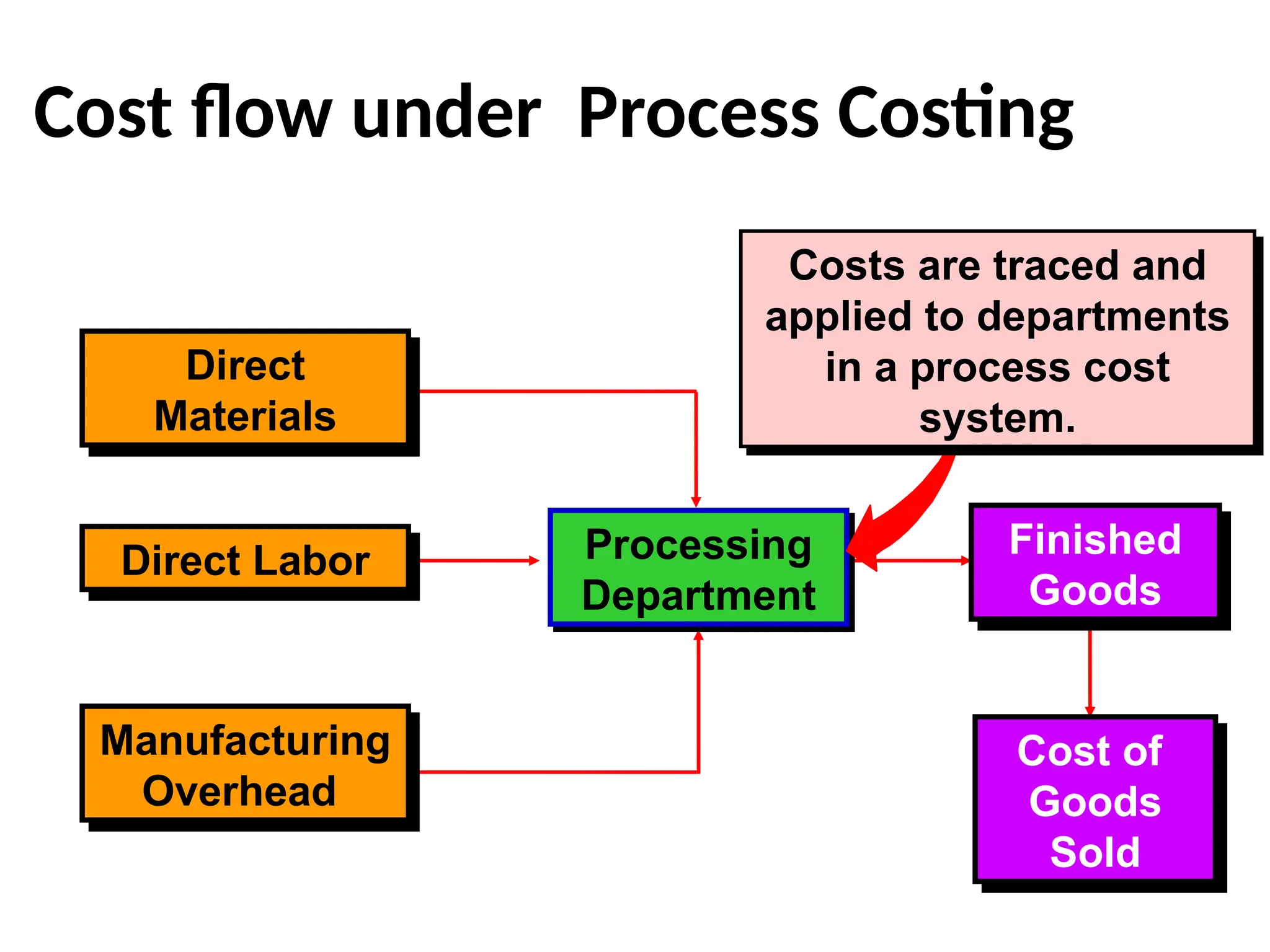
Cost Flow underProcess –
Costing
Assume a Coca-Cola Company with two
subsequent production departments
• Mixing Department
• Bottling Department
9.
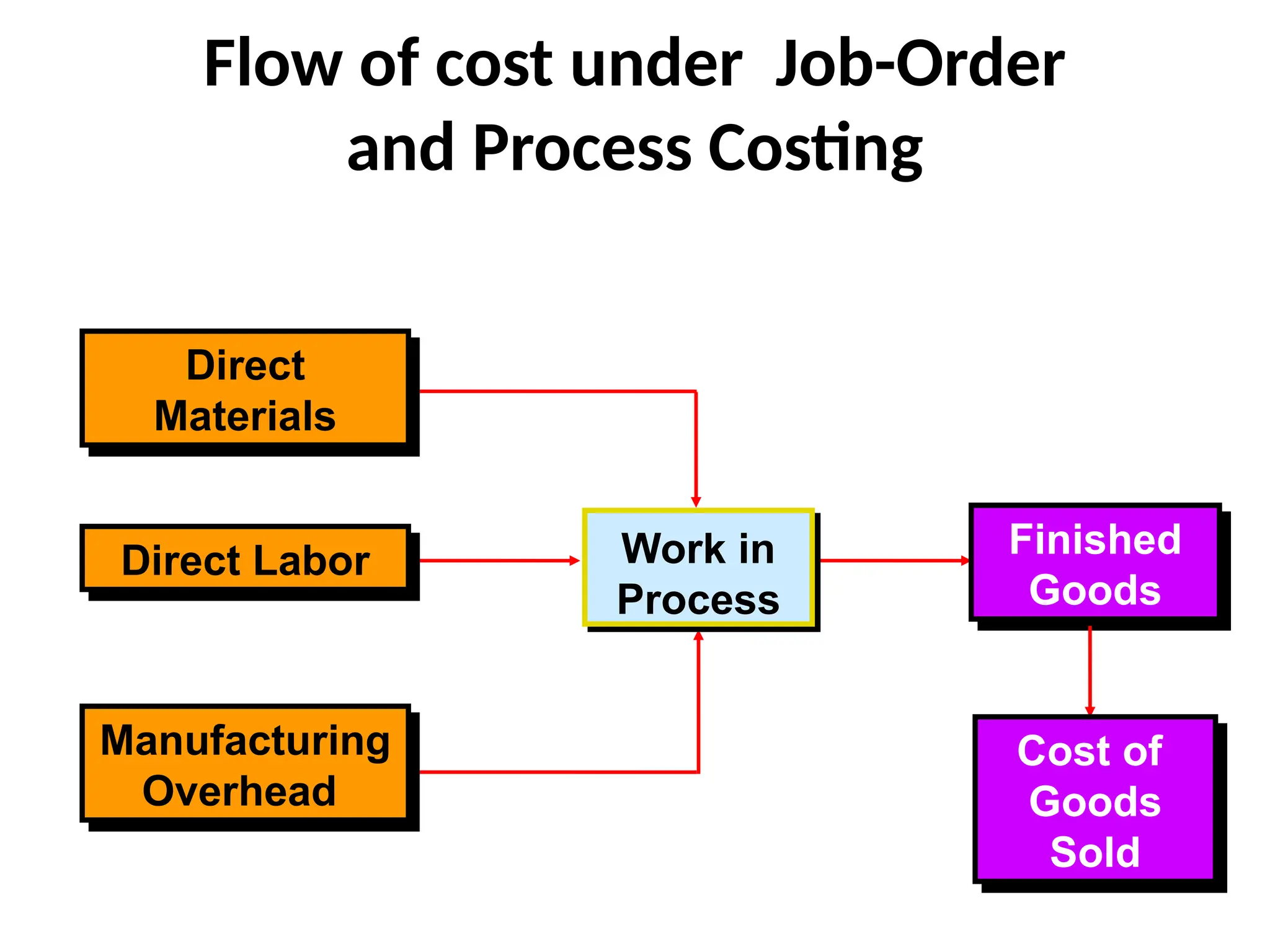
Flow of costunder Job-Order
and Process Costing
Finished
Goods
Cost of
Goods
Sold
Work in
Process
Direct
Materials
Direct Labor
Manufacturing
Overhead
10.
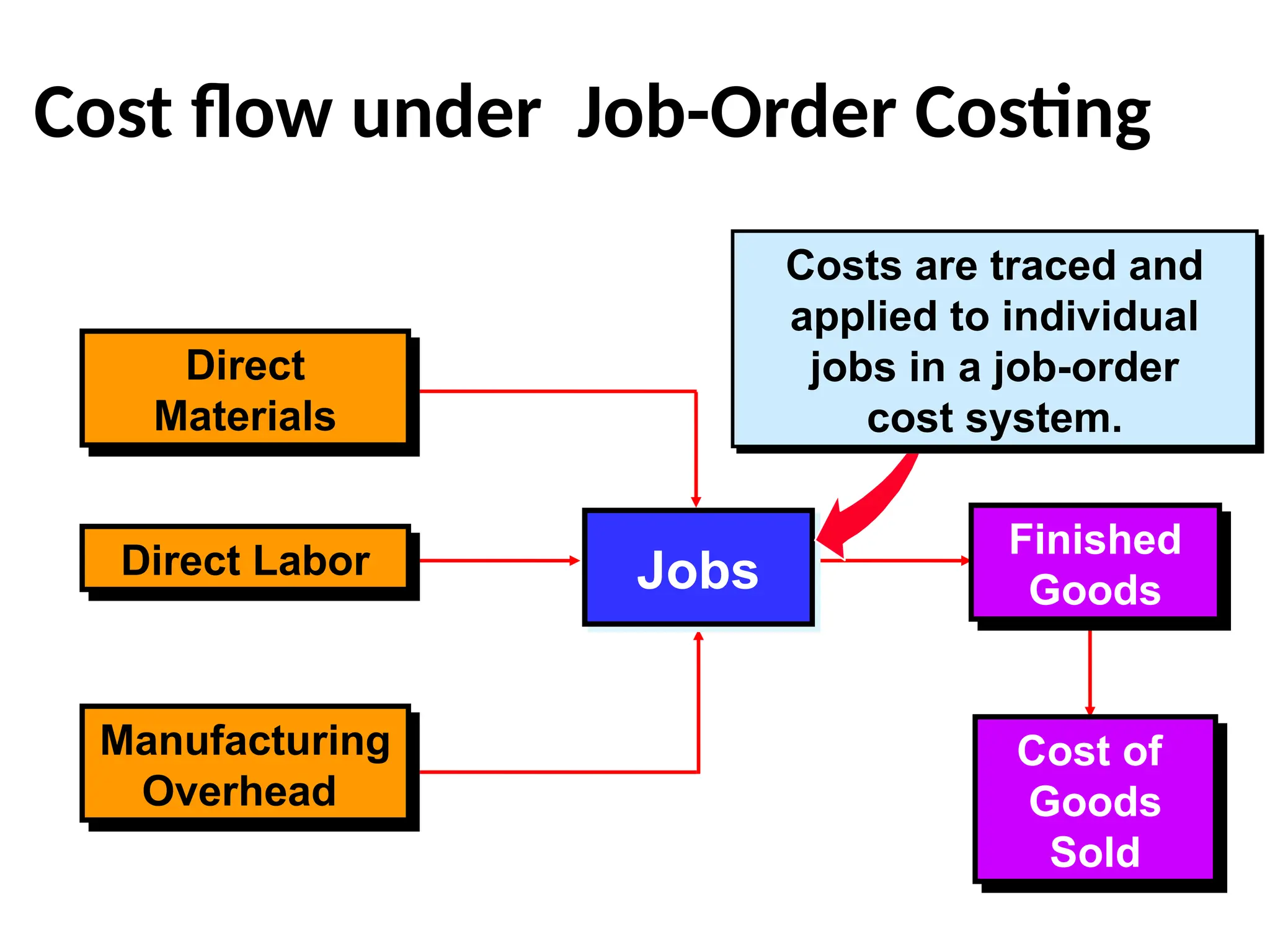
Cost flow underJob-Order Costing
Finished
Goods
Cost of
Goods
Sold
Direct Labor
Manufacturing
Overhead
Jobs
Costs are traced and
applied to individual
jobs in a job-order
cost system.
Direct
Materials
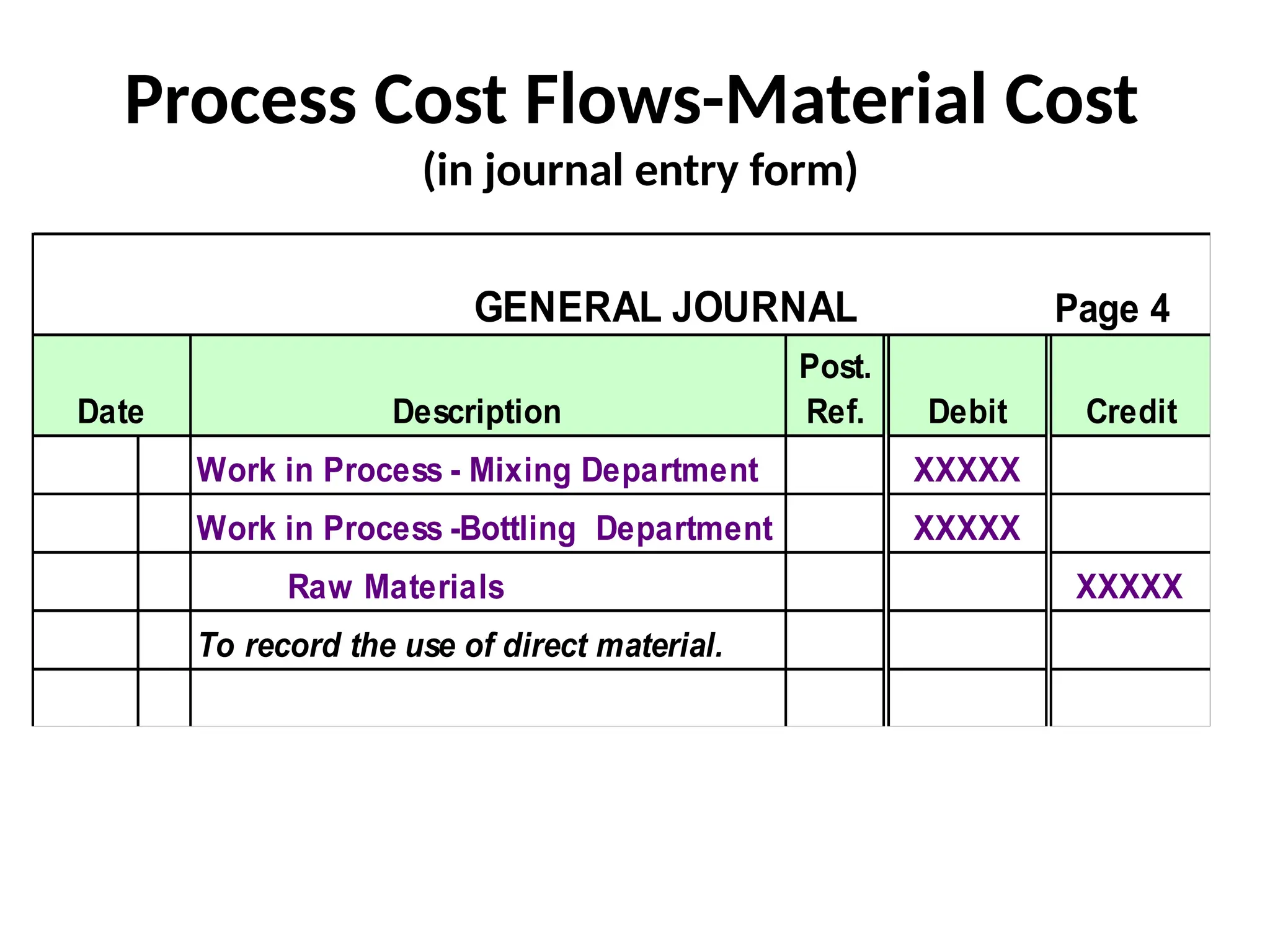
Process Cost Flows-MaterialCost
(in journal entry form)
GENERAL JOURNAL Page 4
Date Description
Post.
Ref. Debit Credit
Work in Process - Mixing Department XXXXX
Work in Process -Bottling Department XXXXX
Raw Materials XXXXX
To record the use of direct material.
13.
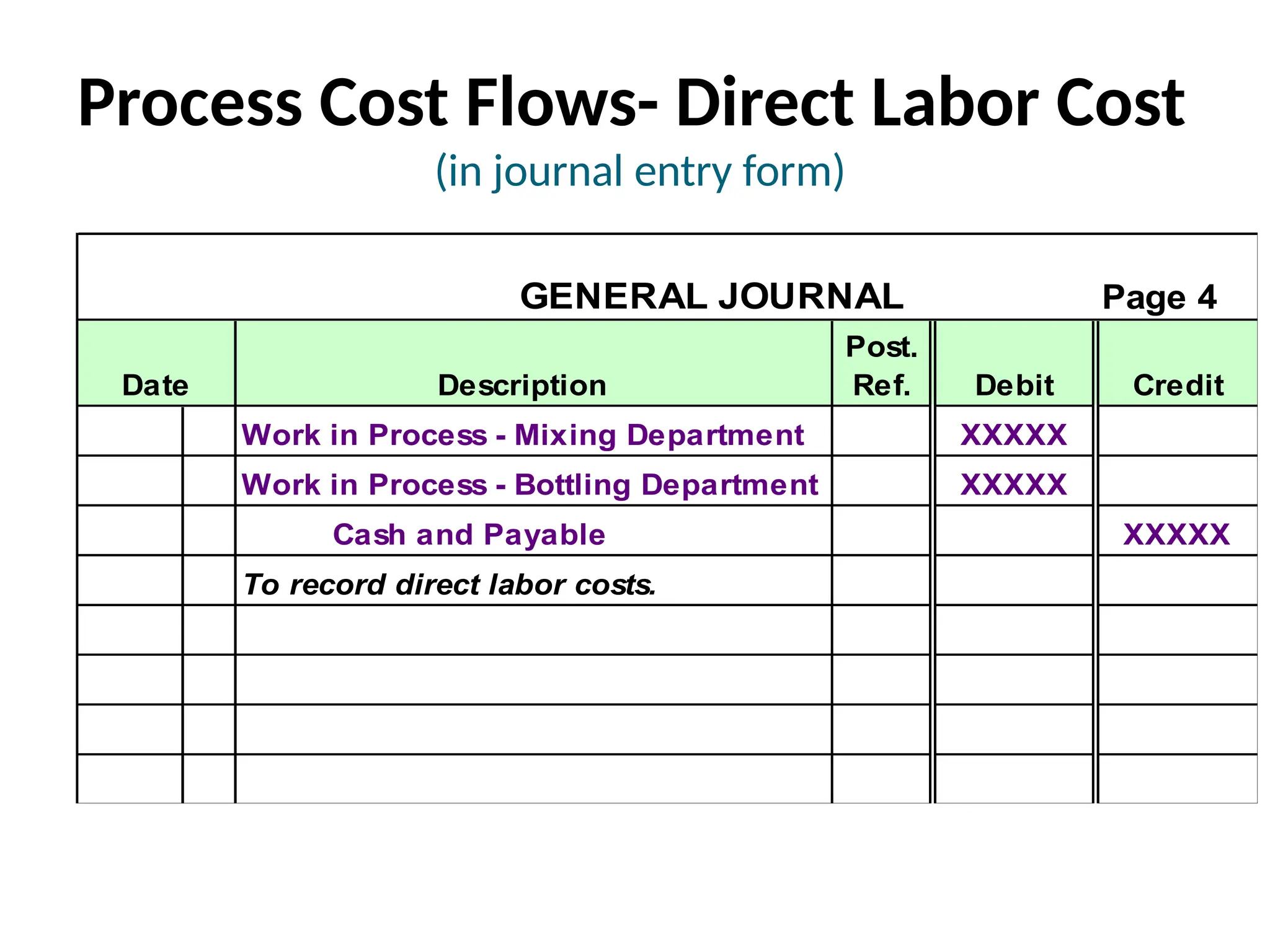
Process Cost Flows-Direct Labor Cost
(in journal entry form)
GENERAL JOURNAL Page 4
Date Description
Post.
Ref. Debit Credit
Work in Process - Mixing Department XXXXX
Work in Process - Bottling Department XXXXX
Cash and Payable XXXXX
To record direct labor costs.
14.
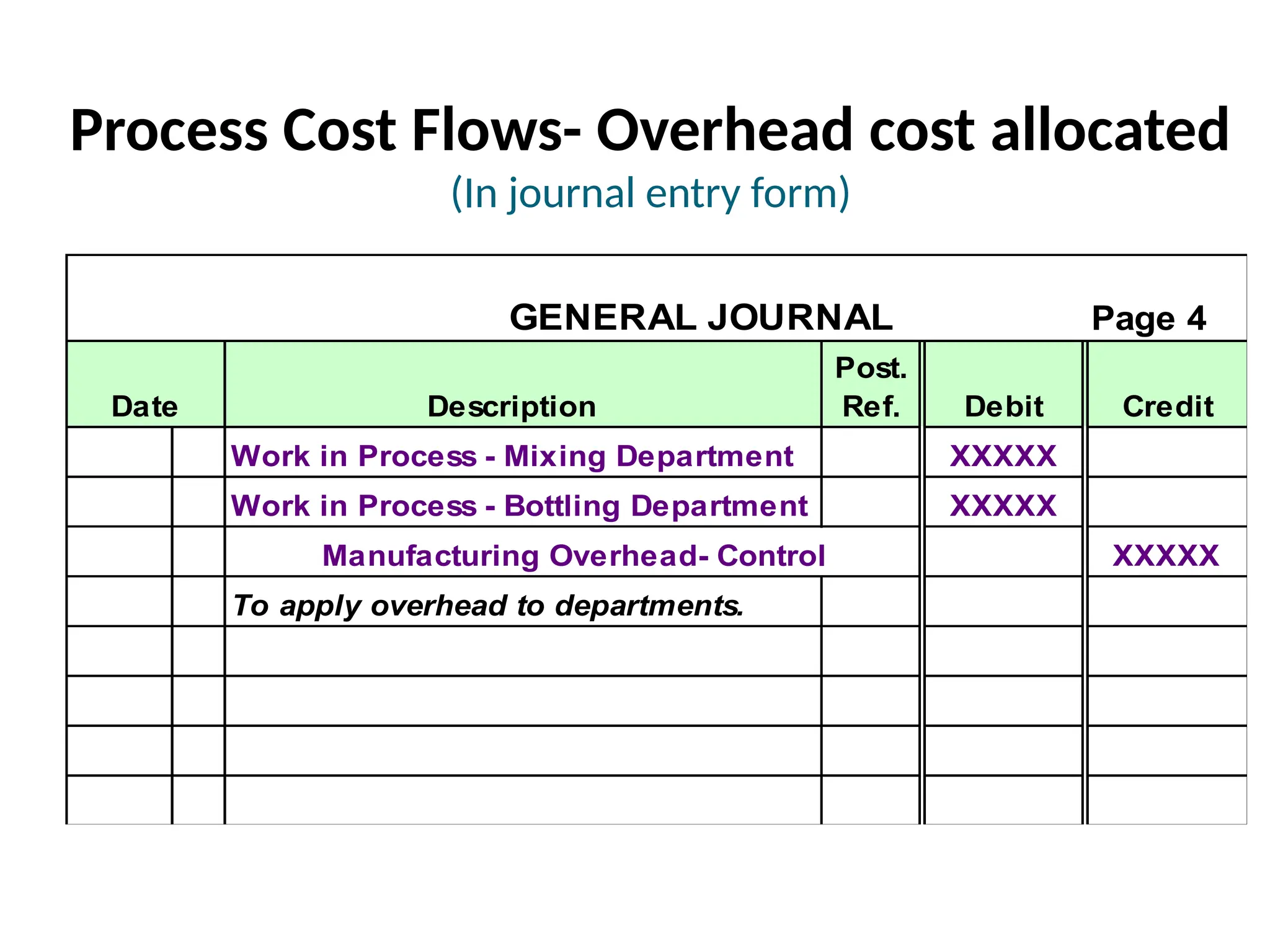
Process Cost Flows-Overhead cost allocated
(In journal entry form)
GENERAL JOURNAL Page 4
Date Description
Post.
Ref. Debit Credit
Work in Process - Mixing Department XXXXX
Work in Process - Bottling Department XXXXX
Manufacturing Overhead- Control XXXXX
To apply overhead to departments.
15.
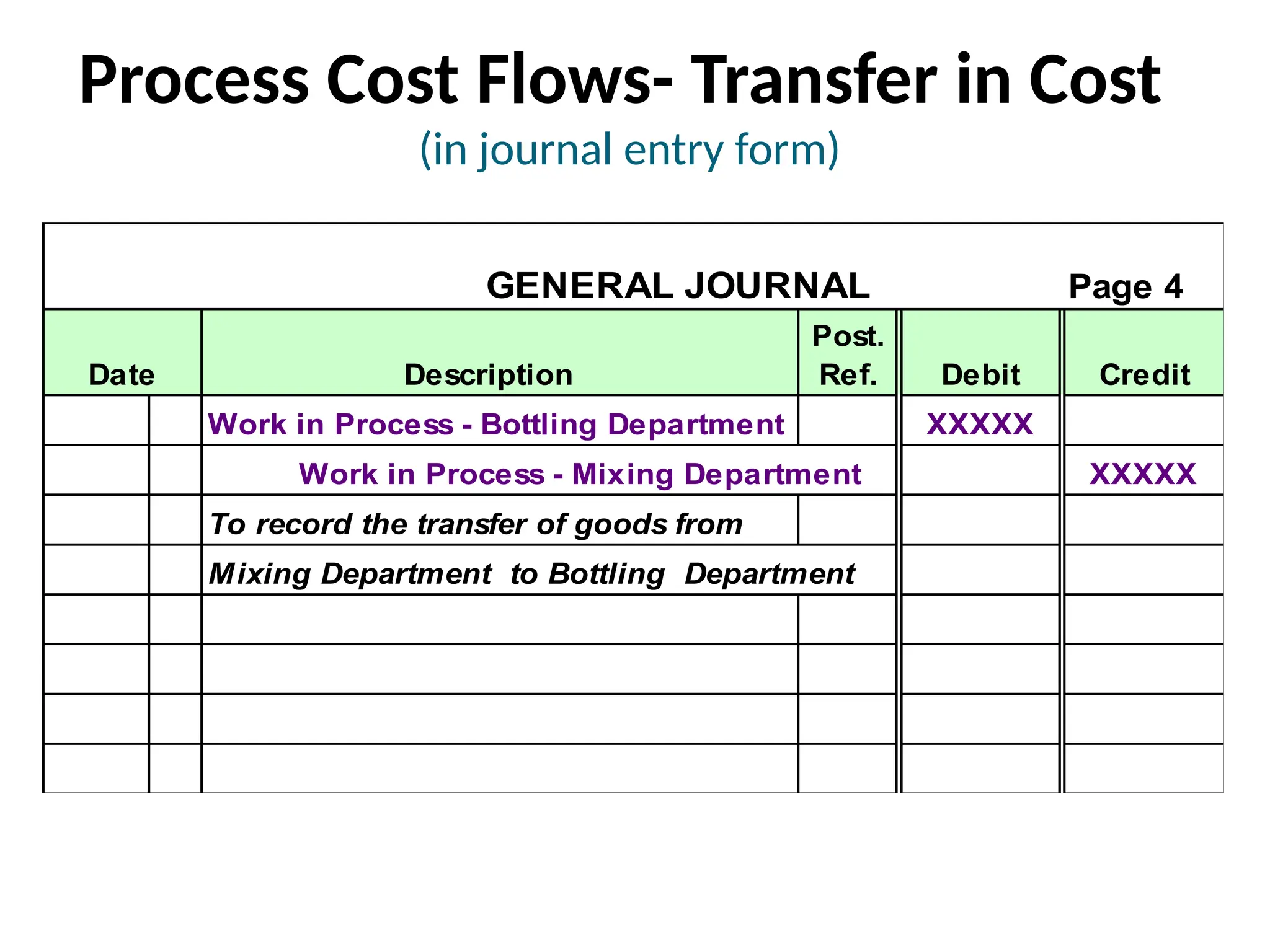
Process Cost Flows-Transfer in Cost
(in journal entry form)
GENERAL JOURNAL Page 4
Date Description
Post.
Ref. Debit Credit
Work in Process - Bottling Department XXXXX
Work in Process - Mixing Department XXXXX
To record the transfer of goods from
Mixing Department to Bottling Department
16.
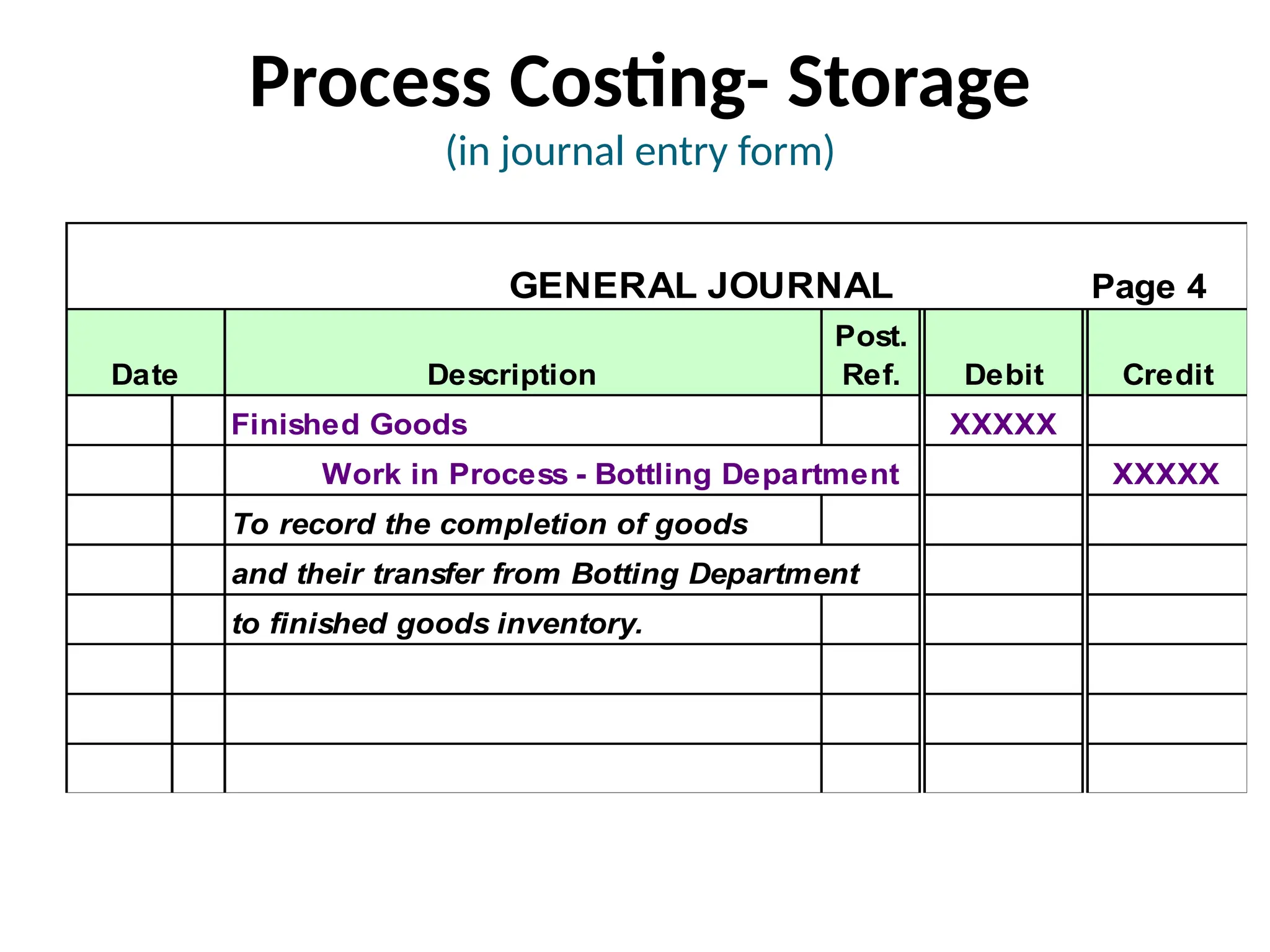
Process Costing- Storage
(injournal entry form)
GENERAL JOURNAL Page 4
Date Description
Post.
Ref. Debit Credit
Finished Goods XXXXX
Work in Process - Bottling Department XXXXX
To record the completion of goods
and their transfer from Botting Department
to finished goods inventory.
17.
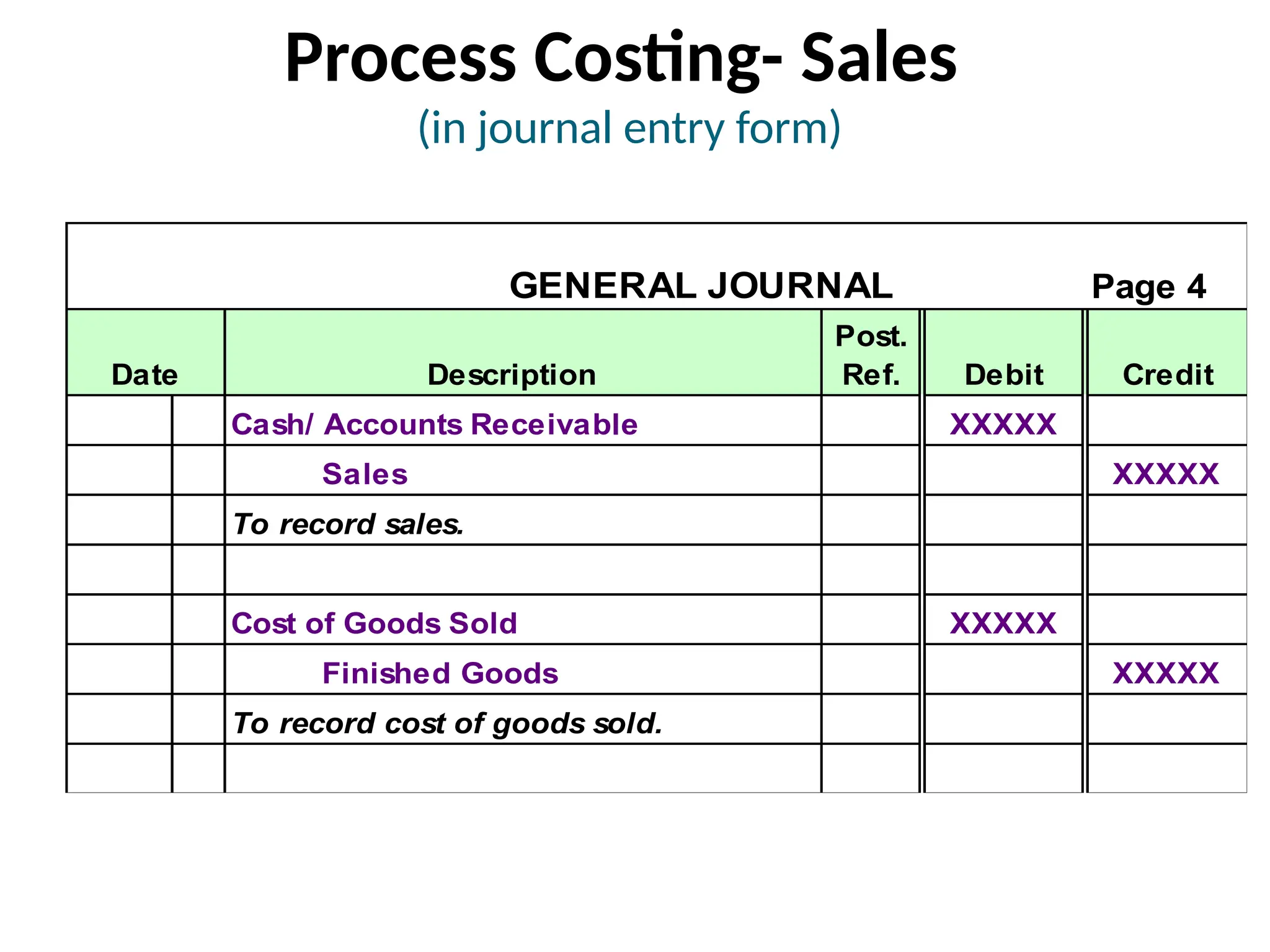
Process Costing- Sales
(injournal entry form)
GENERAL JOURNAL Page 4
Date Description
Post.
Ref. Debit Credit
Cash/ Accounts Receivable XXXXX
Sales XXXXX
To record sales.
Cost of Goods Sold XXXXX
Finished Goods XXXXX
To record cost of goods sold.
18.
Process-Costing Assumptions
DirectMaterials are added at the beginning of the
production process, or at the start of work
Conversion Costs are added evenly along the
production process
19.
Five-Steps in Process-CostingCost assignment
1. Summarize the flow of physical units of
output
2. Compute output in terms of equivalent units
3. Compute cost per equivalent unit
4. Summarize total costs to account for
5. Assign total costs to units completed and to
units in ending Work-in-Process
20.
26
Equivalent Units
isan expression of the amount of work done on units of
output that are partially completed at the end of the year.
Is the expression the partially completed units(WIP
ending units) in terms of fully completed units.
Equivalent units = Number of physical units ×
Percentage of completion
For example
if four physical units of product are 50 percent complete at
the end of the period, an equivalent of two units has been
completed
(2 equivalent units = 4 physical units × 50 percent).
If four desks manufacturing is 50 percent complete at
year end , an equivalent unit of two desks has been
completed.
21.
27
Equivalent Units
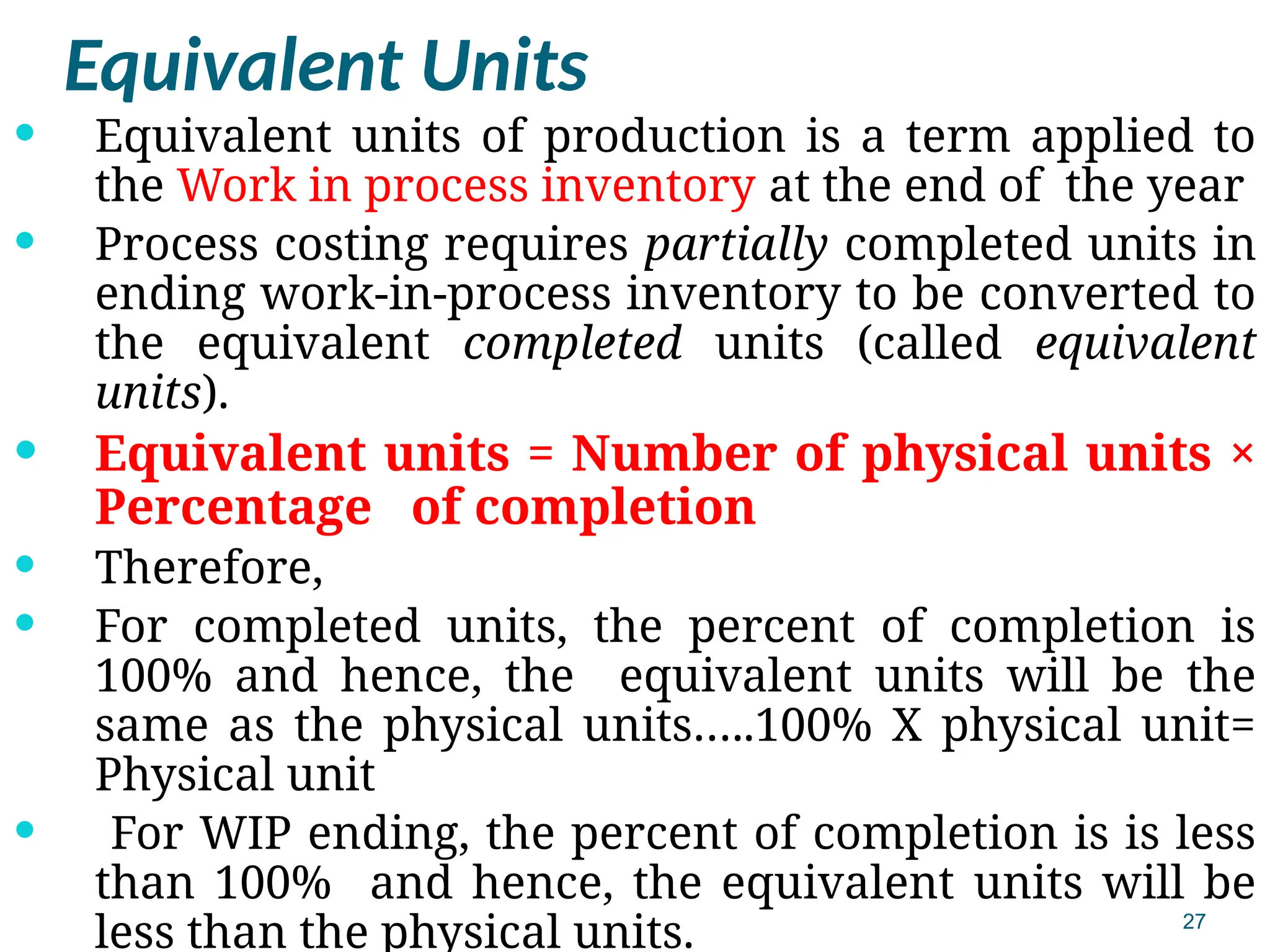
Equivalentunits of production is a term applied to
the Work in process inventory at the end of the year
Process costing requires partially completed units in
ending work-in-process inventory to be converted to
the equivalent completed units (called equivalent
units).
Equivalent units = Number of physical units ×
Percentage of completion
Therefore,
For completed units, the percent of completion is
100% and hence, the equivalent units will be the
same as the physical units…..100% X physical unit=
Physical unit
For WIP ending, the percent of completion is is less
than 100% and hence, the equivalent units will be
less than the physical units.
22.
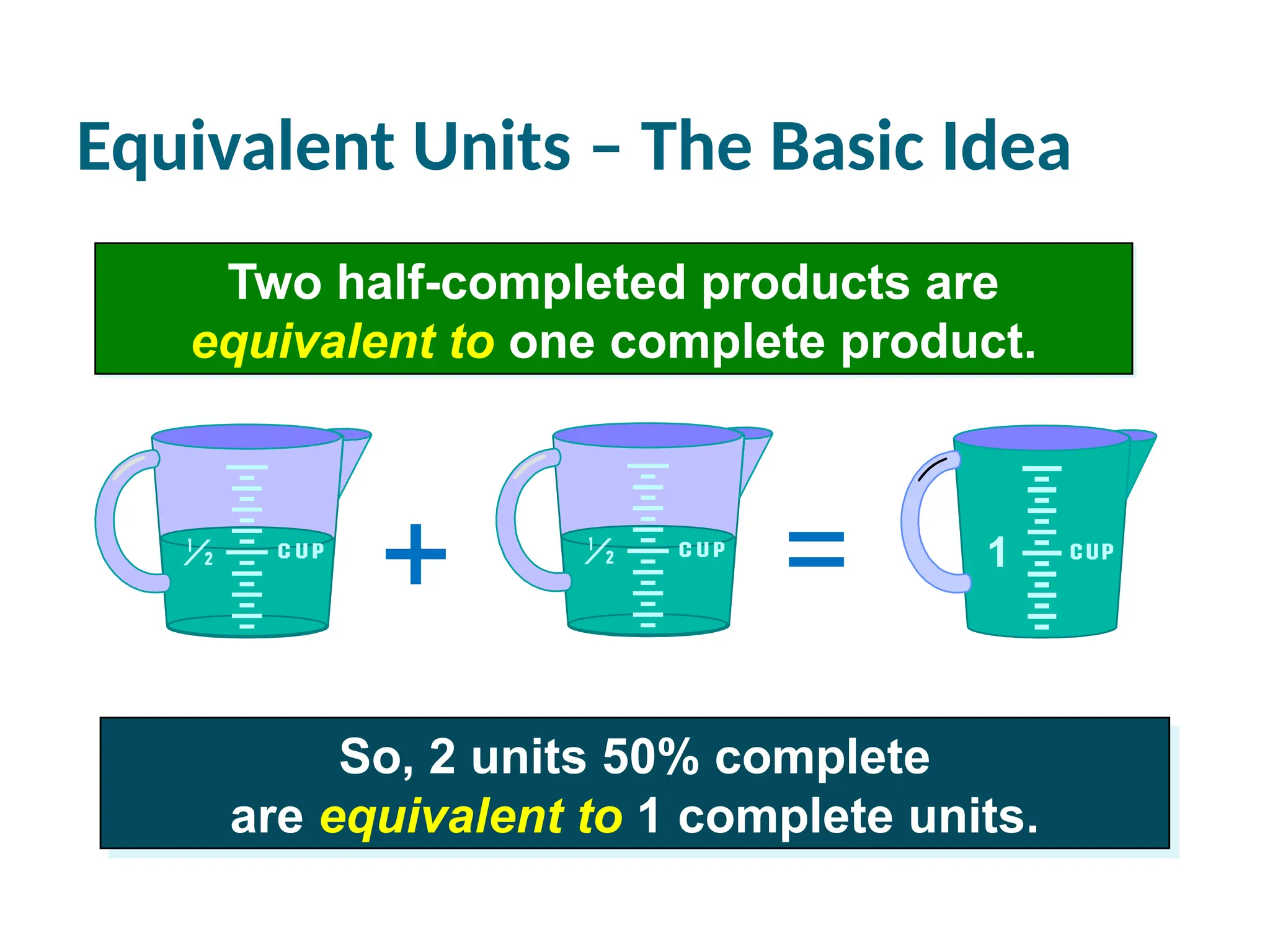
Equivalent Units –The Basic Idea
Two half-completed products are
equivalent to one complete product.
So, 2 units 50% complete
are equivalent to 1 complete units.
+ = 1
23.
29
Illustrating Example -ProcessCosting
Assume Coca-Cola Chemical Company Produces Coke
and uses process costing system to account for its
operation.
The soft drink is produced in two processing
departments: the Mixing Department and the Bottling
Department.
The product is bottled in 300ml bottles.
24.
30
Part I: MixingDepartment
In the Mixing Department, various ingredients are
added at the start of the process
costs are accumulated in two pools, one for direct
material and another for all conversion costs.
Direct material is added at the beginning of the
process
conversion costs are applied evenly through out the
process.
Data for the first month of operation (September) of
the Mixing Department is given below:
25.
31
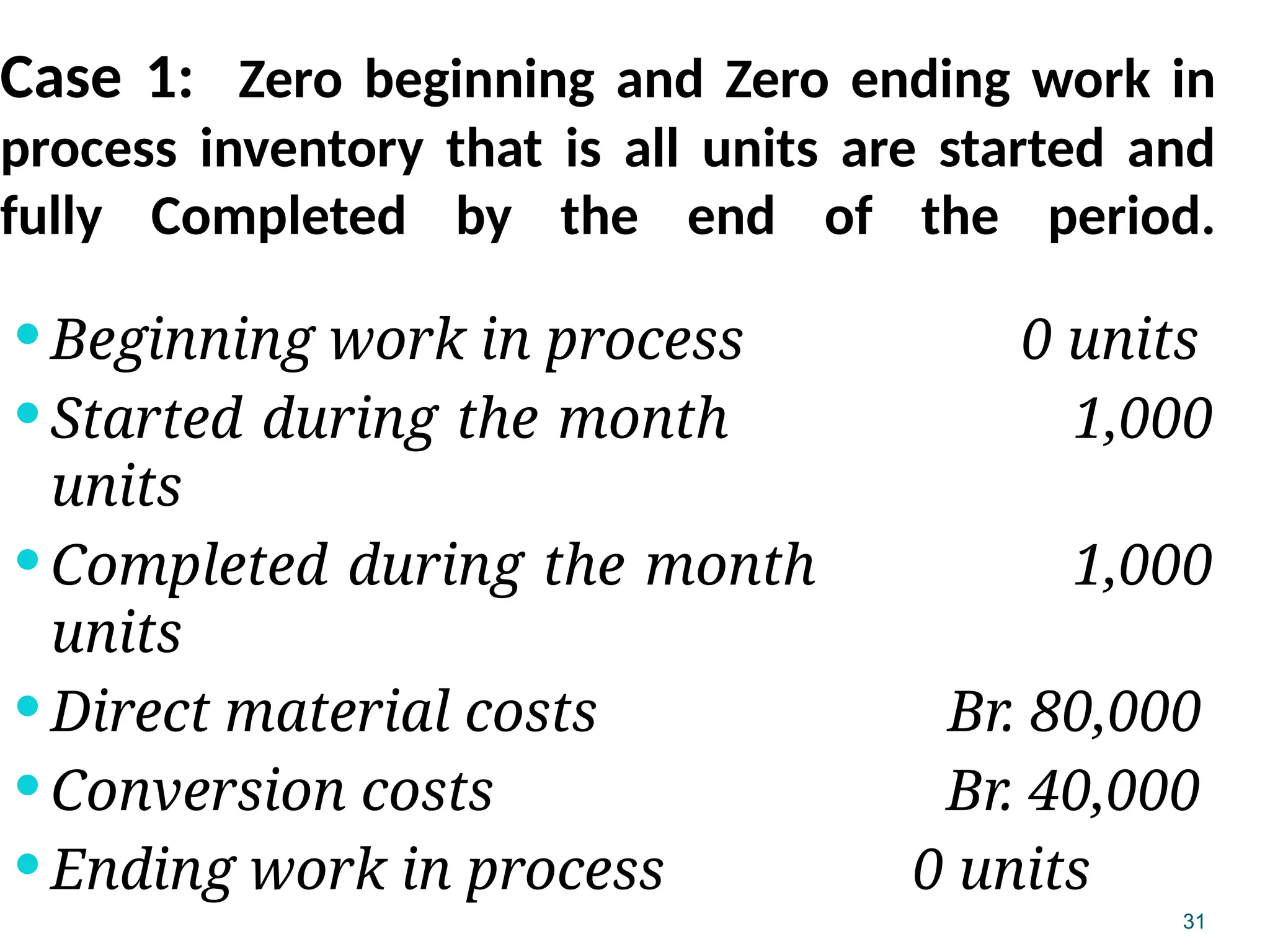
Case 1: Zerobeginning and Zero ending work in
process inventory that is all units are started and
fully Completed by the end of the period.
Beginning work in process 0 units
Started during the month 1,000
units
Completed during the month 1,000
units
Direct material costs Br. 80,000
Conversion costs Br. 40,000
Ending work in process 0 units
26.
32
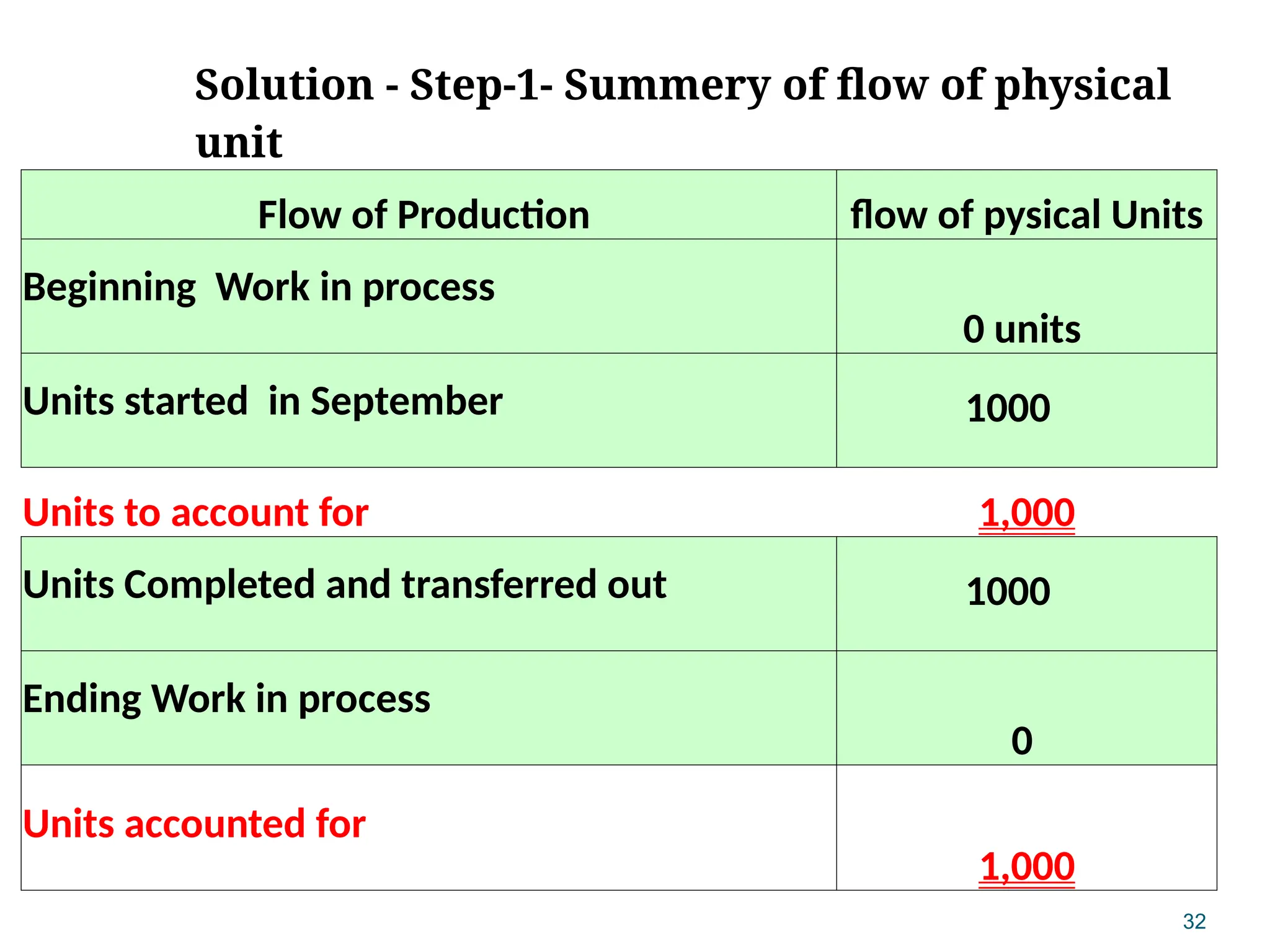
Solution - Step-1-Summery of flow of physical
unit
Flow of Production flow of pysical Units
Beginning Work in process
0 units
Units started in September 1000
Units to account for 1,000
Units Completed and transferred out 1000
Ending Work in process
0
Units accounted for
1,000
27.
33
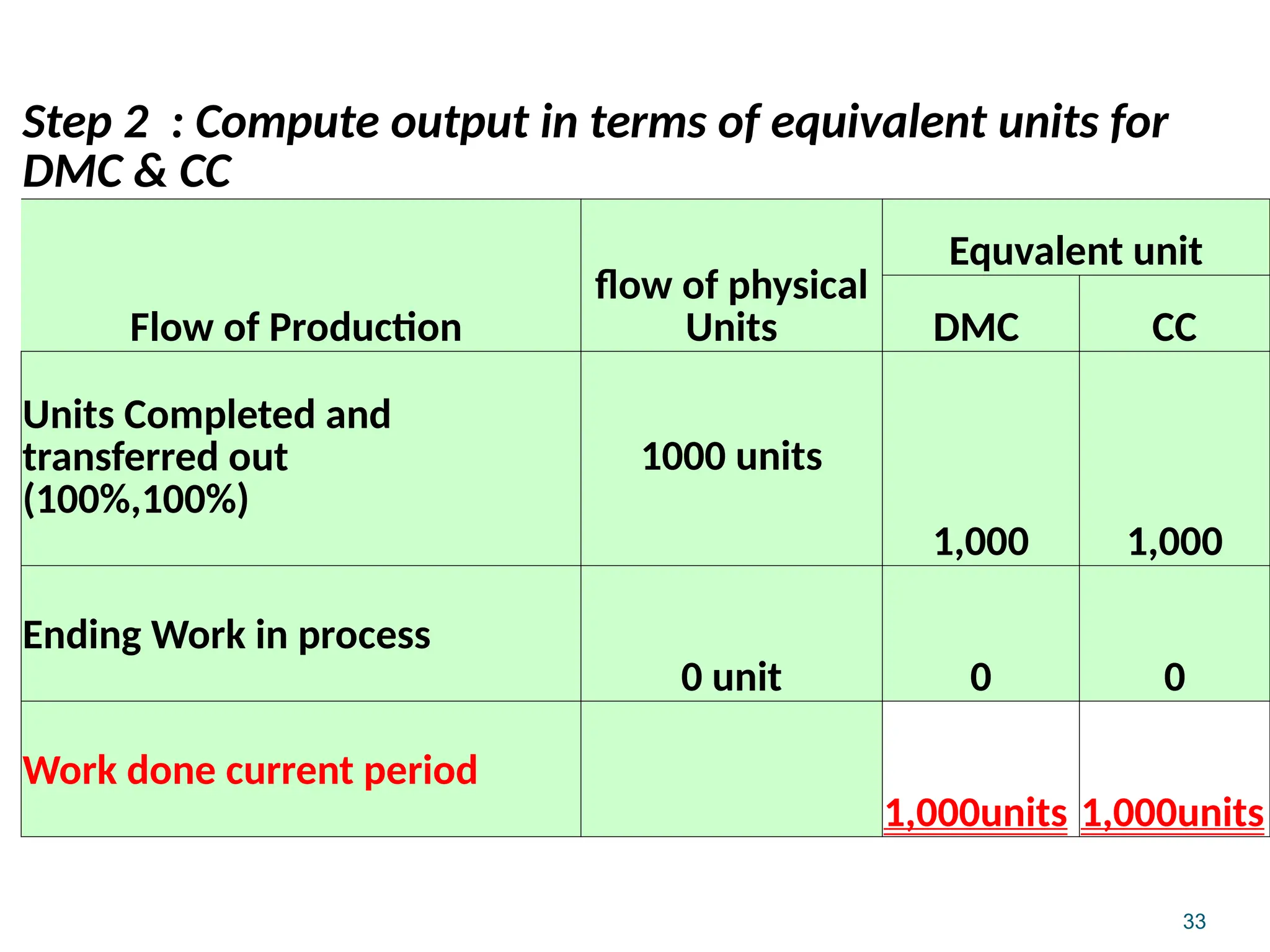
Step 2 :Compute output in terms of equivalent units for
DMC & CC
Flow of Production
flow of physical
Units
Equvalent unit
DMC CC
Units Completed and
transferred out
(100%,100%)
1000 units
1,000 1,000
Ending Work in process
0 unit 0 0
Work done current period
1,000units 1,000units
28.
34
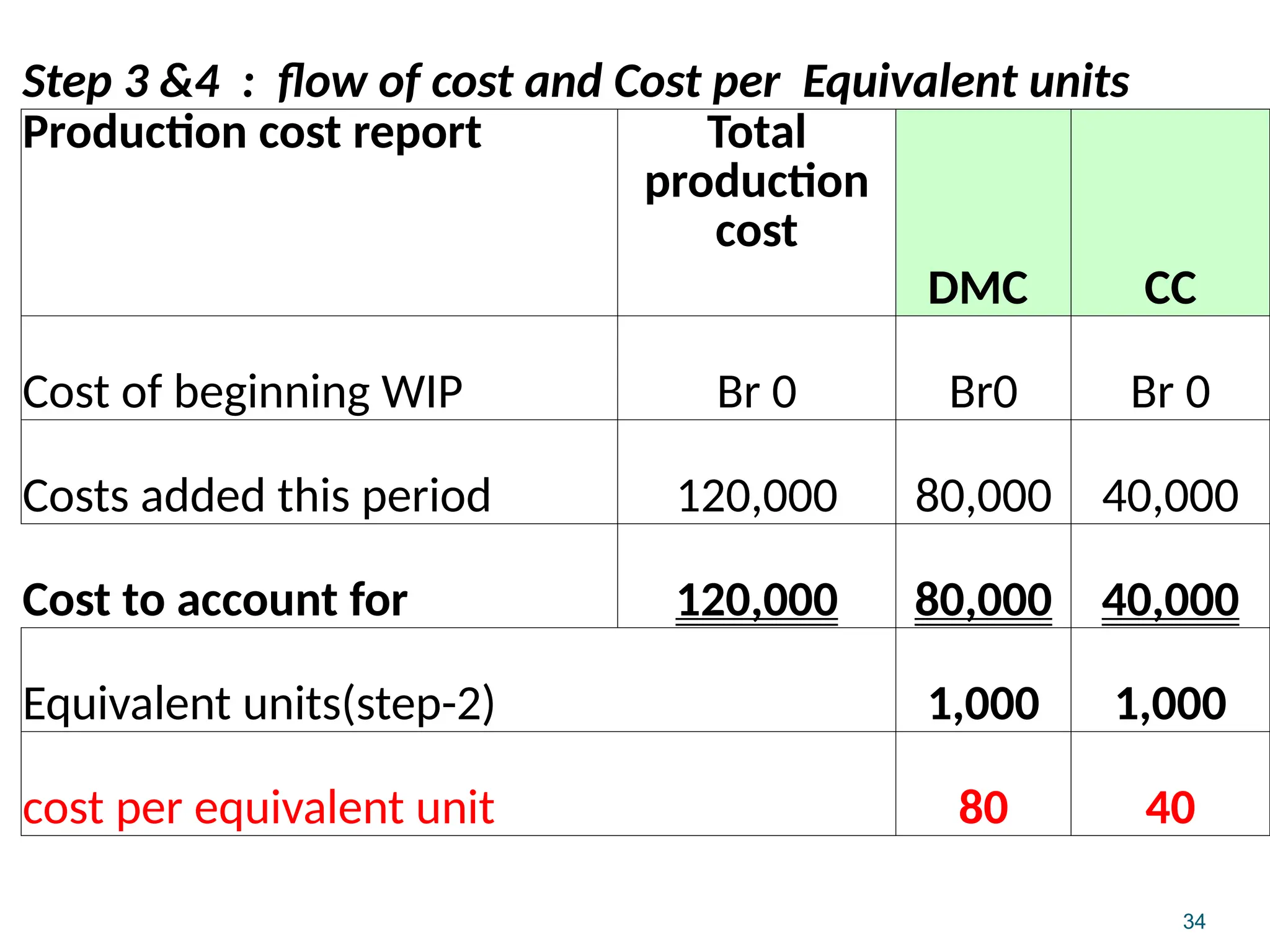
Step 3 &4: flow of cost and Cost per Equivalent units
Production cost report Total
production
cost
DMC CC
Cost of beginning WIP Br 0 Br0 Br 0
Costs added this period 120,000 80,000 40,000
Cost to account for 120,000 80,000 40,000
Equivalent units(step-2) 1,000 1,000
cost per equivalent unit 80 40
29.
35
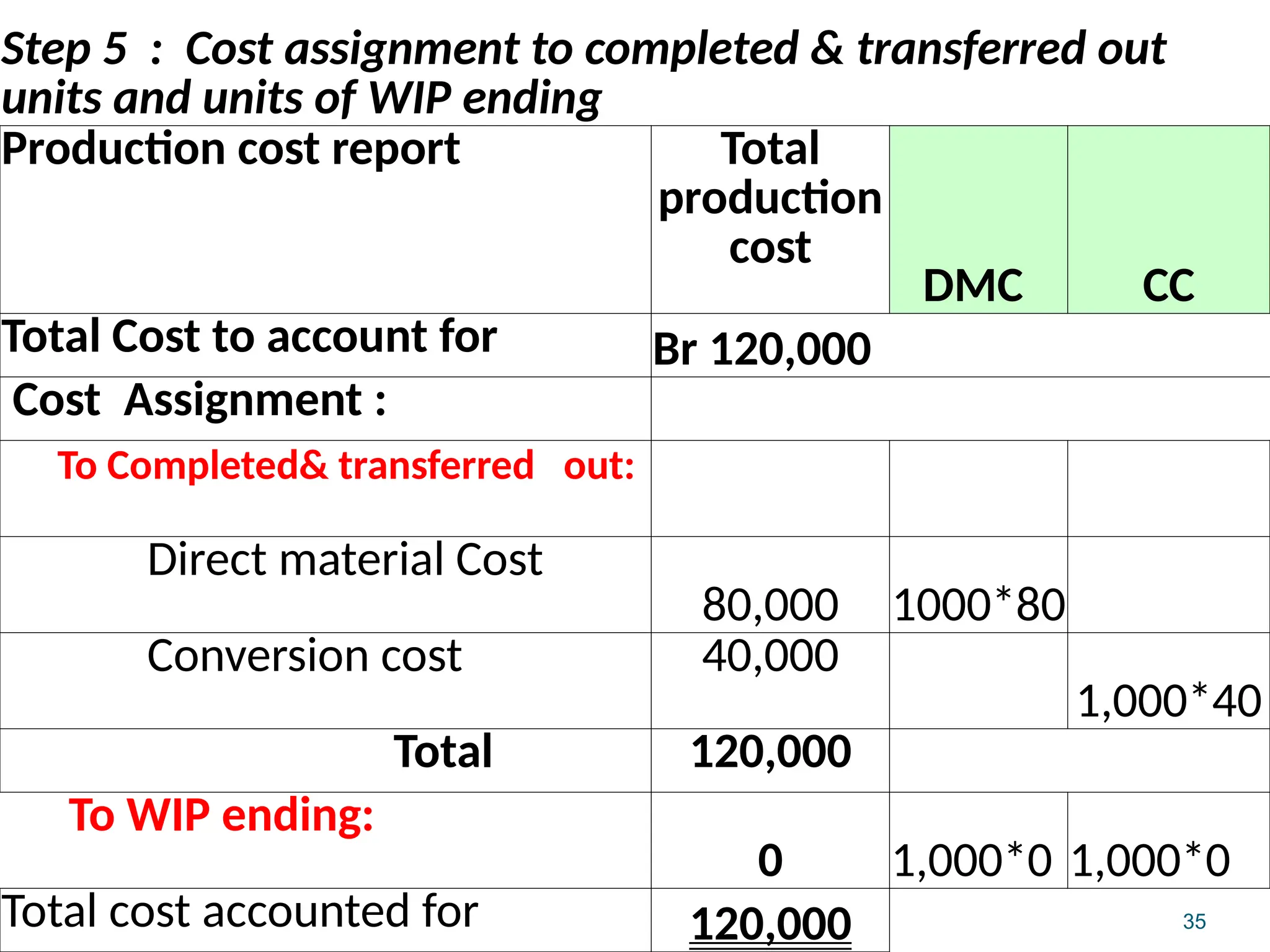
Step 5 :Cost assignment to completed & transferred out
units and units of WIP ending
Production cost report Total
production
cost
DMC CC
Total Cost to account for Br 120,000
Cost Assignment :
To Completed& transferred out:
Direct material Cost
80,000 1000*80
Conversion cost 40,000
1,000*40
Total 120,000
To WIP ending:
0 1,000*0 1,000*0
Total cost accounted for 120,000
30.
36
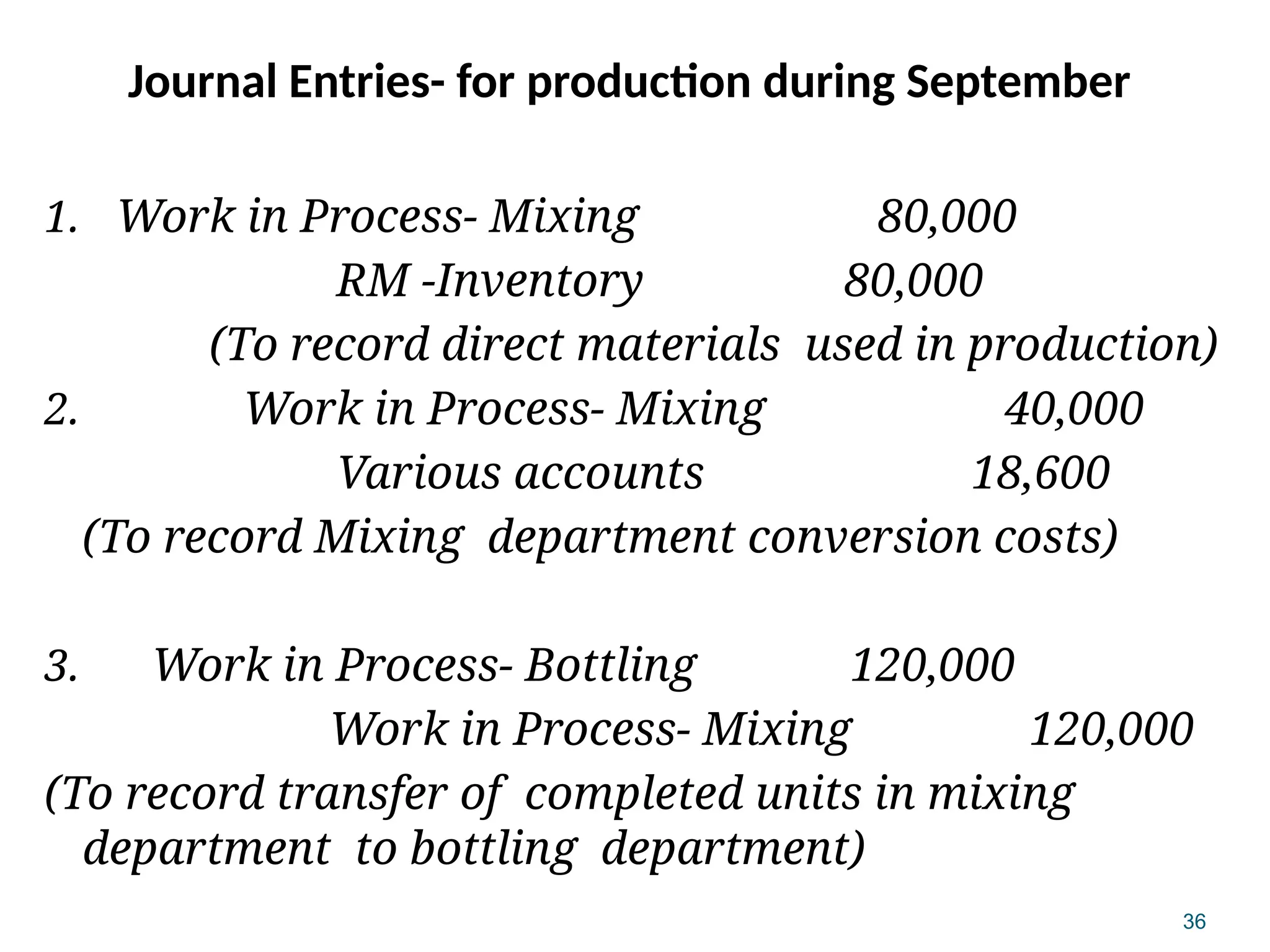
Journal Entries- forproduction during September
1. Work in Process- Mixing 80,000
RM -Inventory 80,000
(To record direct materials used in production)
2. Work in Process- Mixing 40,000
Various accounts 18,600
(To record Mixing department conversion costs)
3. Work in Process- Bottling 120,000
Work in Process- Mixing 120,000
(To record transfer of completed units in mixing
department to bottling department)
31.
37
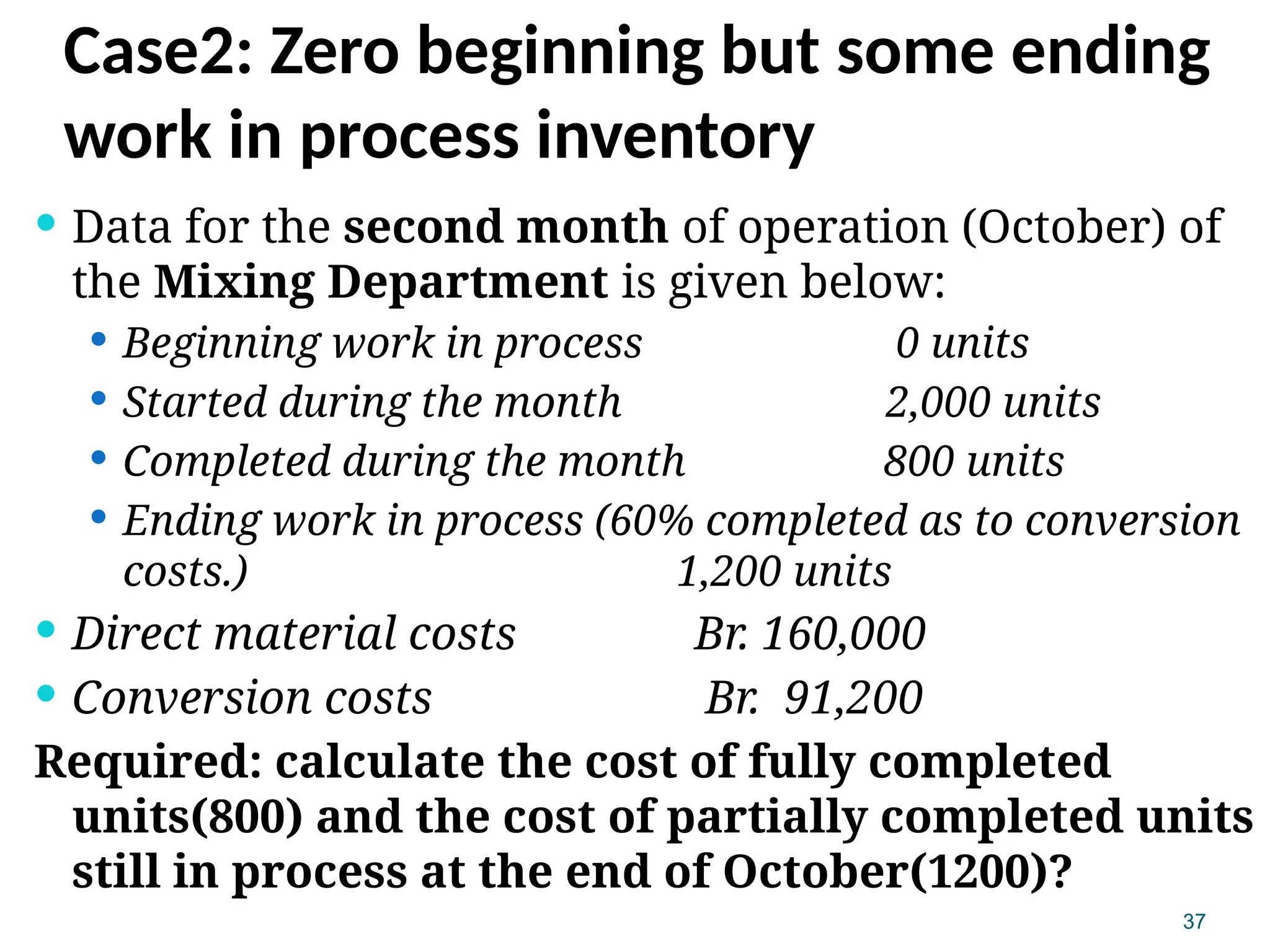
Case2: Zero beginningbut some ending
work in process inventory
Data for the second month of operation (October) of
the Mixing Department is given below:
Beginning work in process 0 units
Started during the month 2,000 units
Completed during the month 800 units
Ending work in process (60% completed as to conversion
costs.) 1,200 units
Direct material costs Br. 160,000
Conversion costs Br. 91,200
Required: calculate the cost of fully completed
units(800) and the cost of partially completed units
still in process at the end of October(1200)?
32.
38
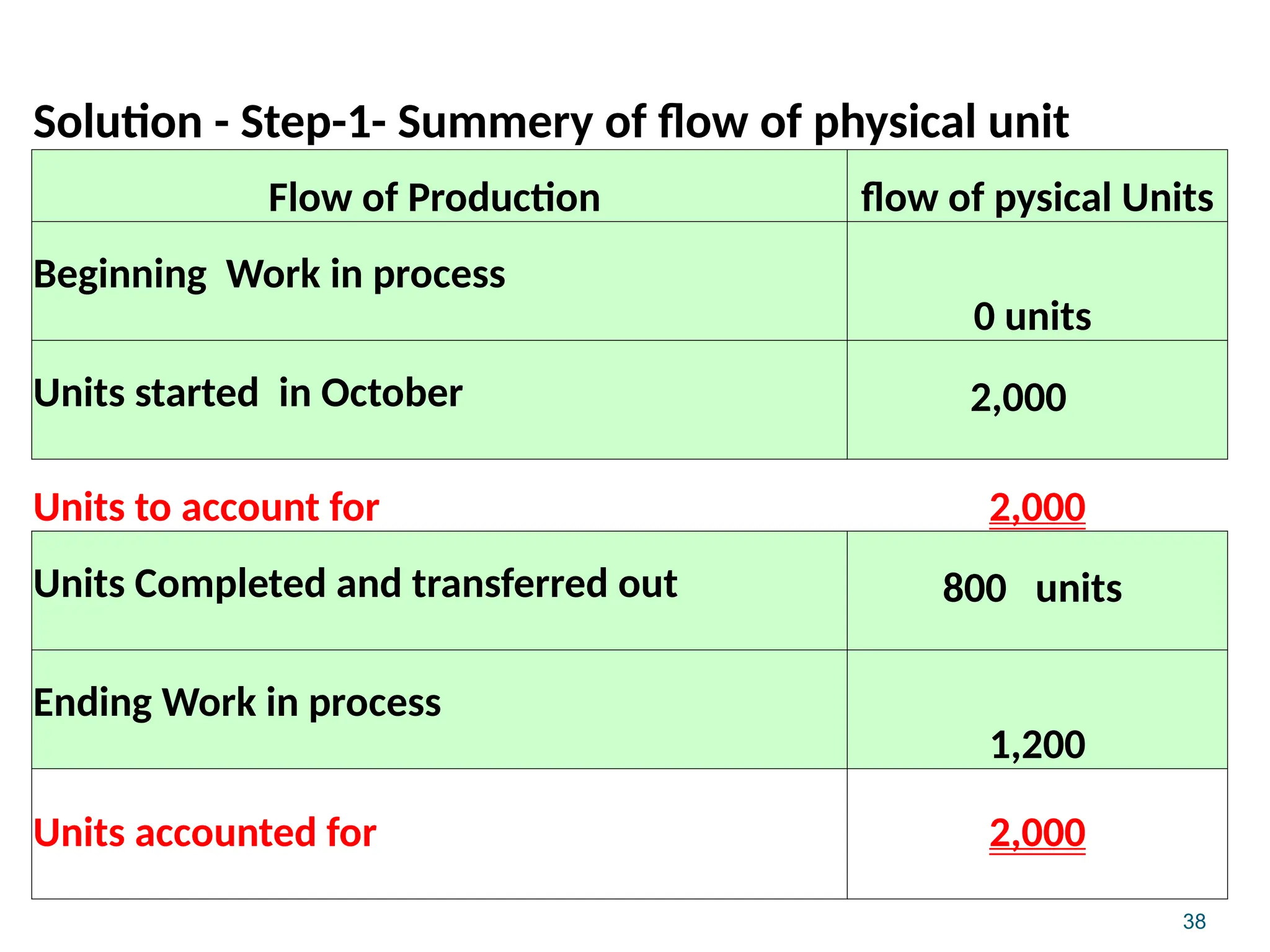
Solution - Step-1-Summery of flow of physical unit
Flow of Production flow of pysical Units
Beginning Work in process
0 units
Units started in October 2,000
Units to account for 2,000
Units Completed and transferred out 800 units
Ending Work in process
1,200
Units accounted for 2,000
33.
39
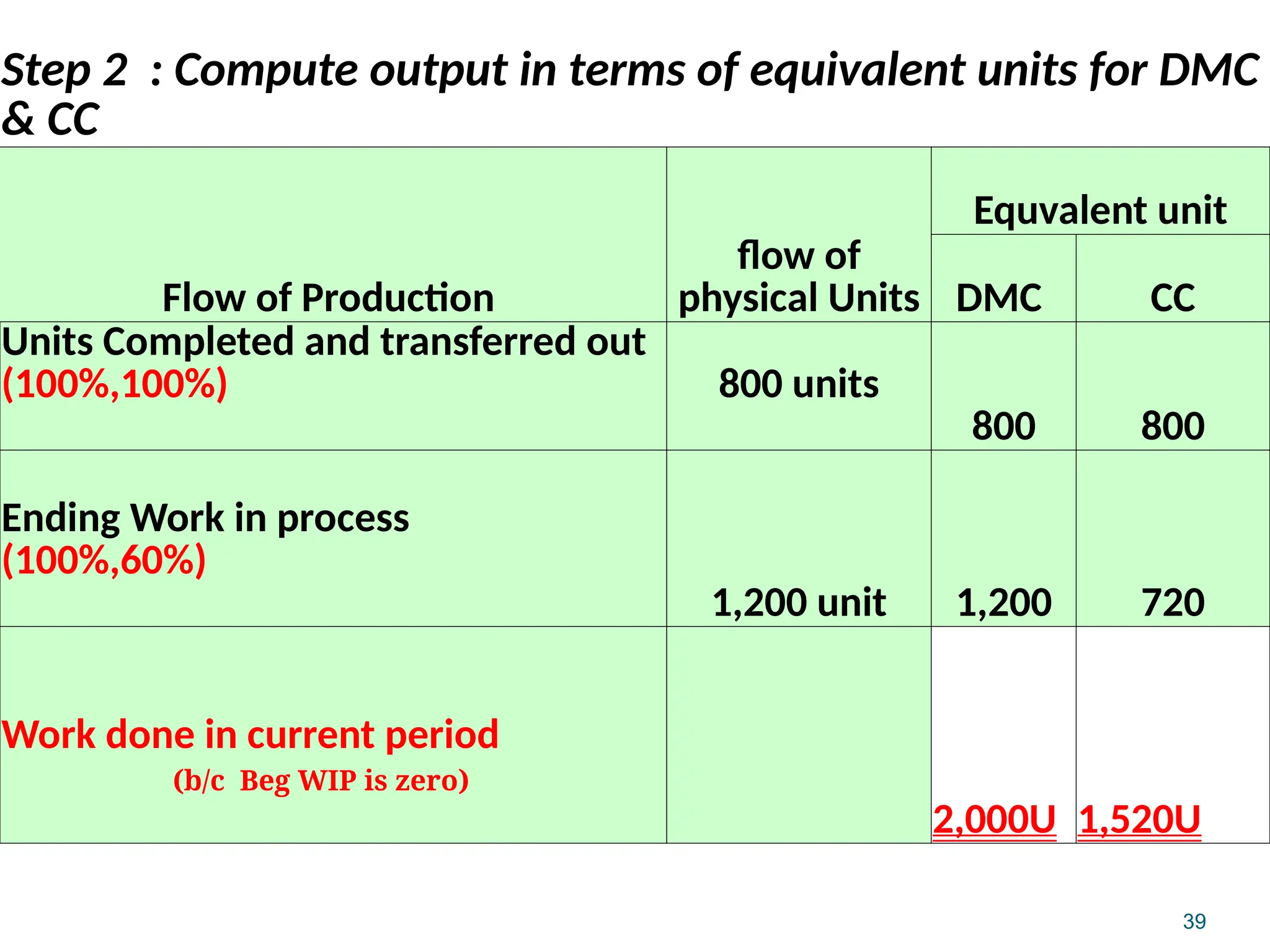
Step 2 :Compute output in terms of equivalent units for DMC
& CC
Flow of Production
flow of
physical Units
Equvalent unit
DMC CC
Units Completed and transferred out
(100%,100%) 800 units
800 800
Ending Work in process
(100%,60%)
1,200 unit 1,200 720
Work done in current period
(b/c Beg WIP is zero)
2,000U 1,520U
34.
40
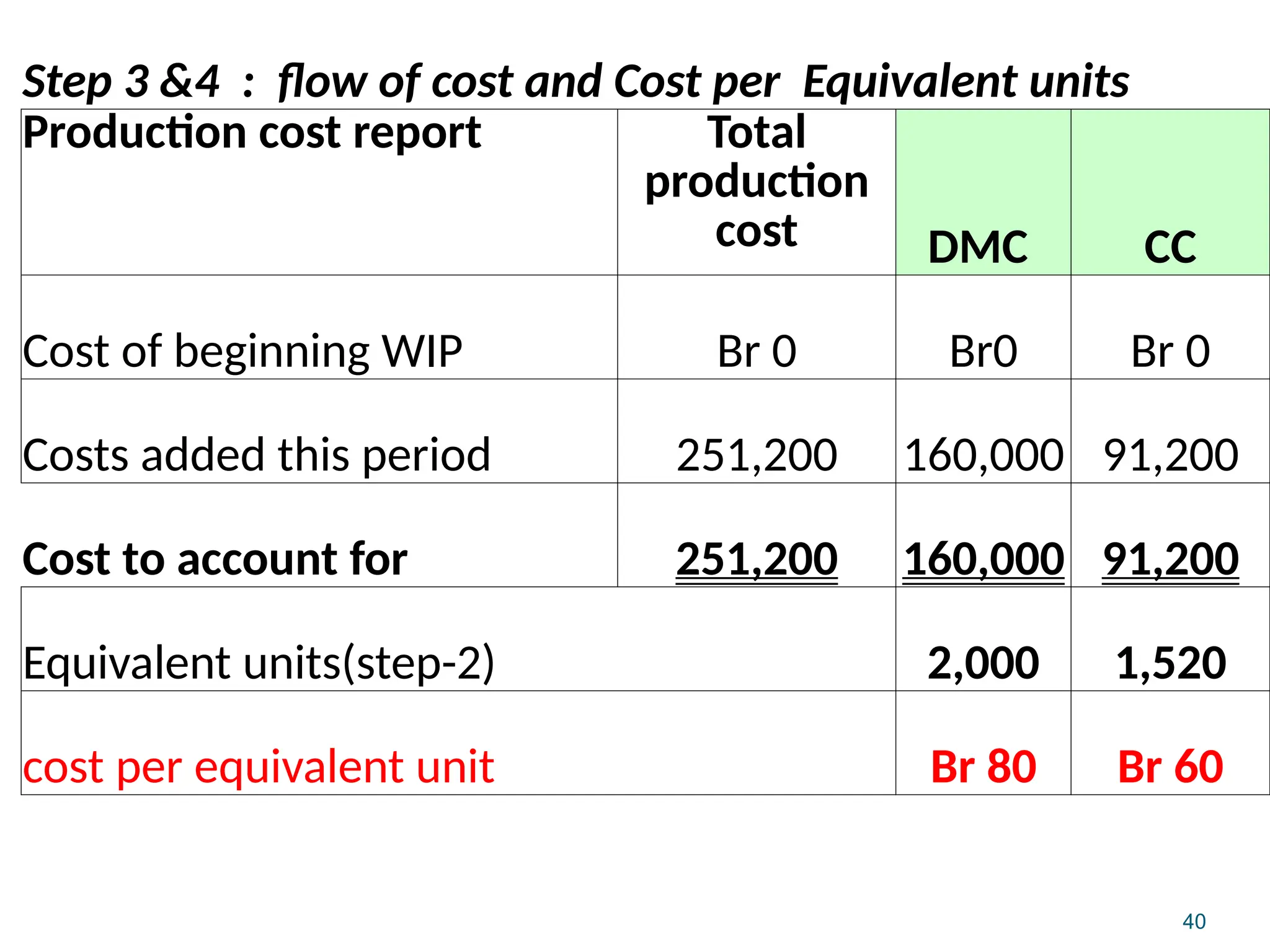
Step 3 &4: flow of cost and Cost per Equivalent units
Production cost report Total
production
cost DMC CC
Cost of beginning WIP Br 0 Br0 Br 0
Costs added this period 251,200 160,000 91,200
Cost to account for 251,200 160,000 91,200
Equivalent units(step-2) 2,000 1,520
cost per equivalent unit Br 80 Br 60
35.
41
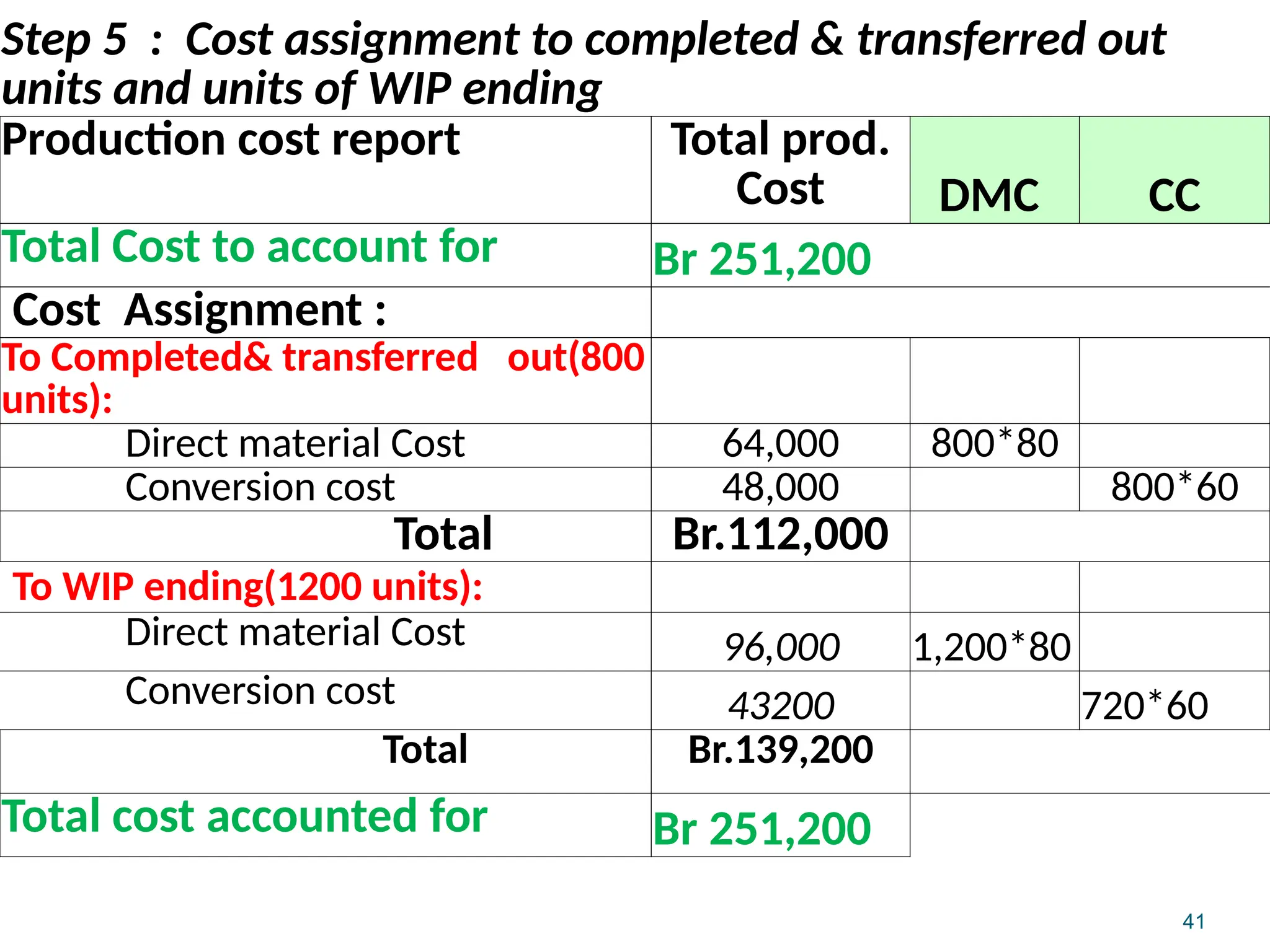
Step 5 :Cost assignment to completed & transferred out
units and units of WIP ending
Production cost report Total prod.
Cost DMC CC
Total Cost to account for Br 251,200
Cost Assignment :
To Completed& transferred out(800
units):
Direct material Cost 64,000 800*80
Conversion cost 48,000 800*60
Total Br.112,000
To WIP ending(1200 units):
Direct material Cost 96,000 1,200*80
Conversion cost 43200 720*60
Total Br.139,200
Total cost accounted for Br 251,200
36.
42
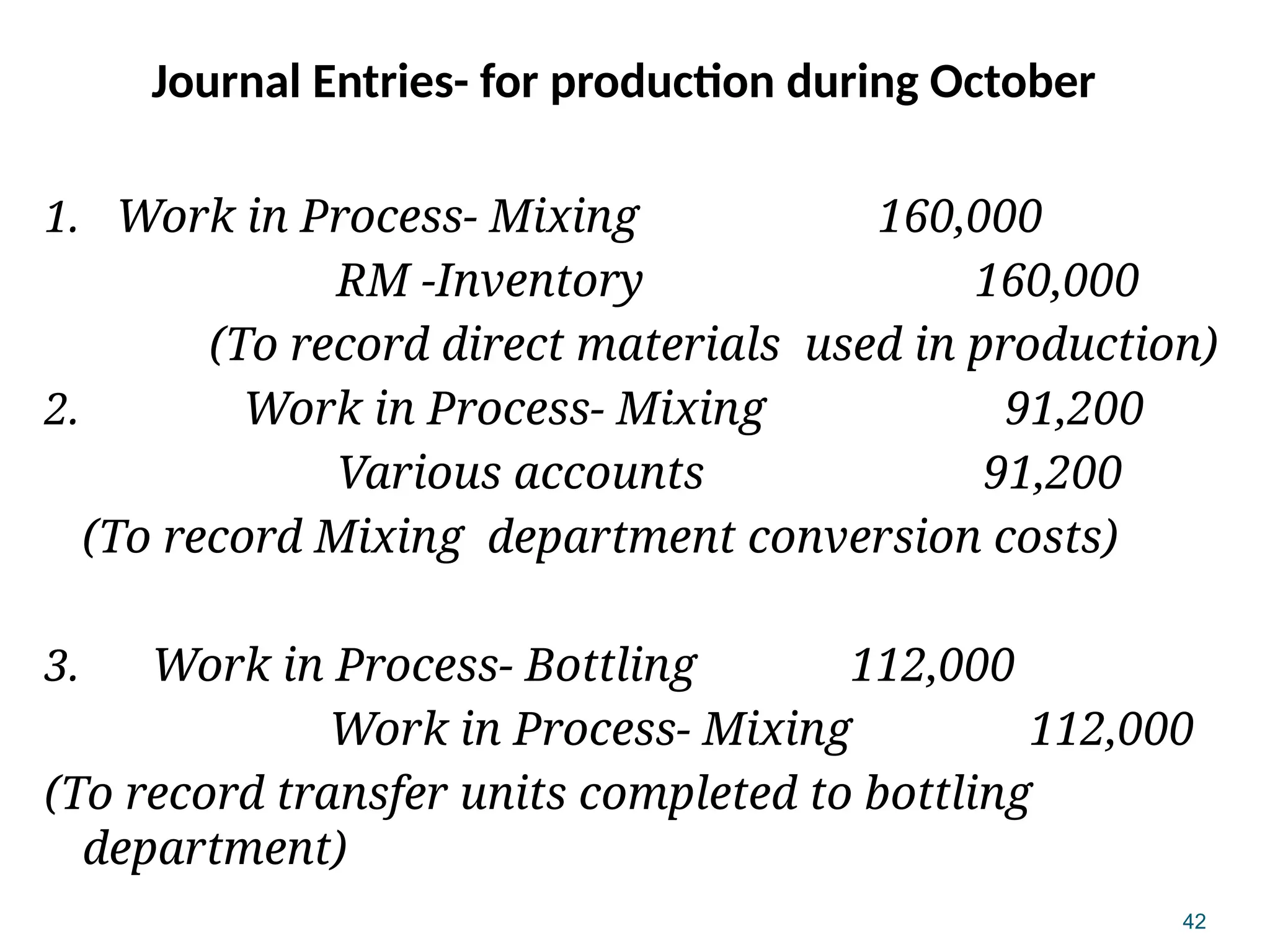
Journal Entries- forproduction during October
1. Work in Process- Mixing 160,000
RM -Inventory 160,000
(To record direct materials used in production)
2. Work in Process- Mixing 91,200
Various accounts 91,200
(To record Mixing department conversion costs)
3. Work in Process- Bottling 112,000
Work in Process- Mixing 112,000
(To record transfer units completed to bottling
department)
37.
43
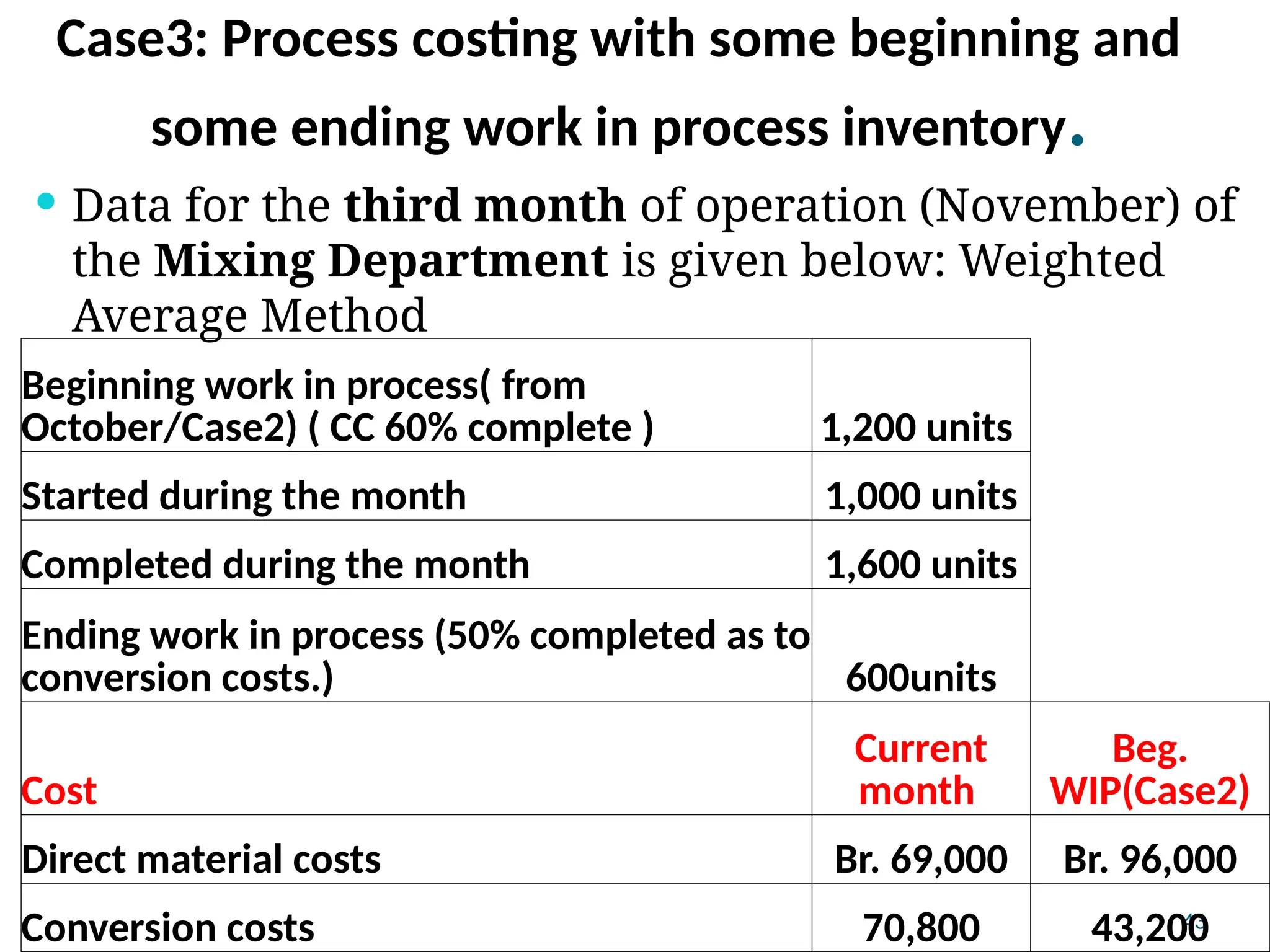
Case3: Process costingwith some beginning and
some ending work in process inventory.
Data for the third month of operation (November) of
the Mixing Department is given below: Weighted
Average Method
Beginning work in process( from
October/Case2) ( CC 60% complete ) 1,200 units
Started during the month 1,000 units
Completed during the month 1,600 units
Ending work in process (50% completed as to
conversion costs.) 600units
Cost
Current
month
Beg.
WIP(Case2)
Direct material costs Br. 69,000 Br. 96,000
Conversion costs 70,800 43,200
38.
44
When bothWIP beginning and ending have balances
, there two methods of process costing accounting:
1. Weighted Average Method
2. FIFO Method
39.
45
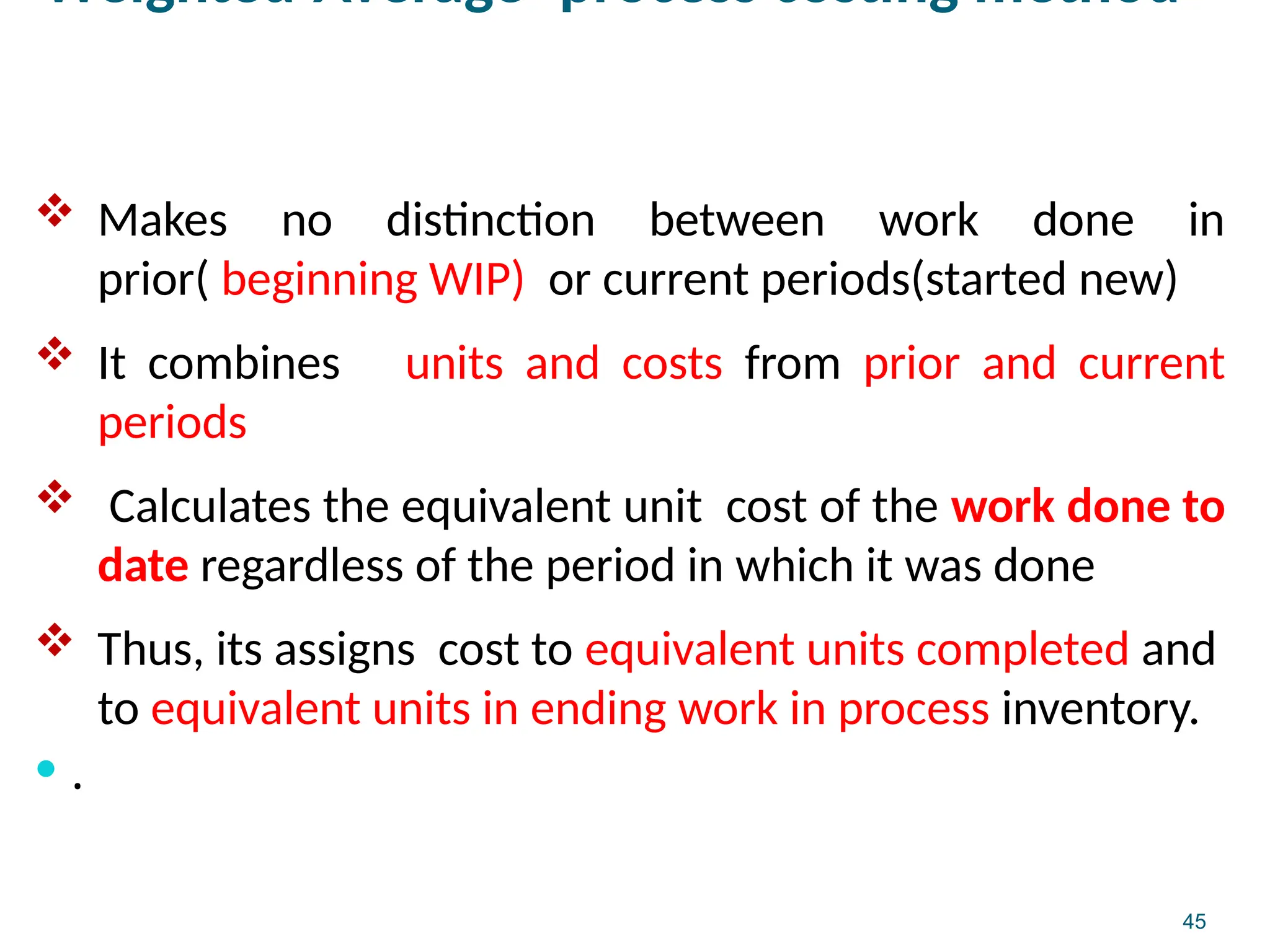
Weighted-Average -process costingmethod
Makes no distinction between work done in
prior( beginning WIP) or current periods(started new)
It combines units and costs from prior and current
periods
Calculates the equivalent unit cost of the work done to
date regardless of the period in which it was done
Thus, its assigns cost to equivalent units completed and
to equivalent units in ending work in process inventory.
.
40.
46
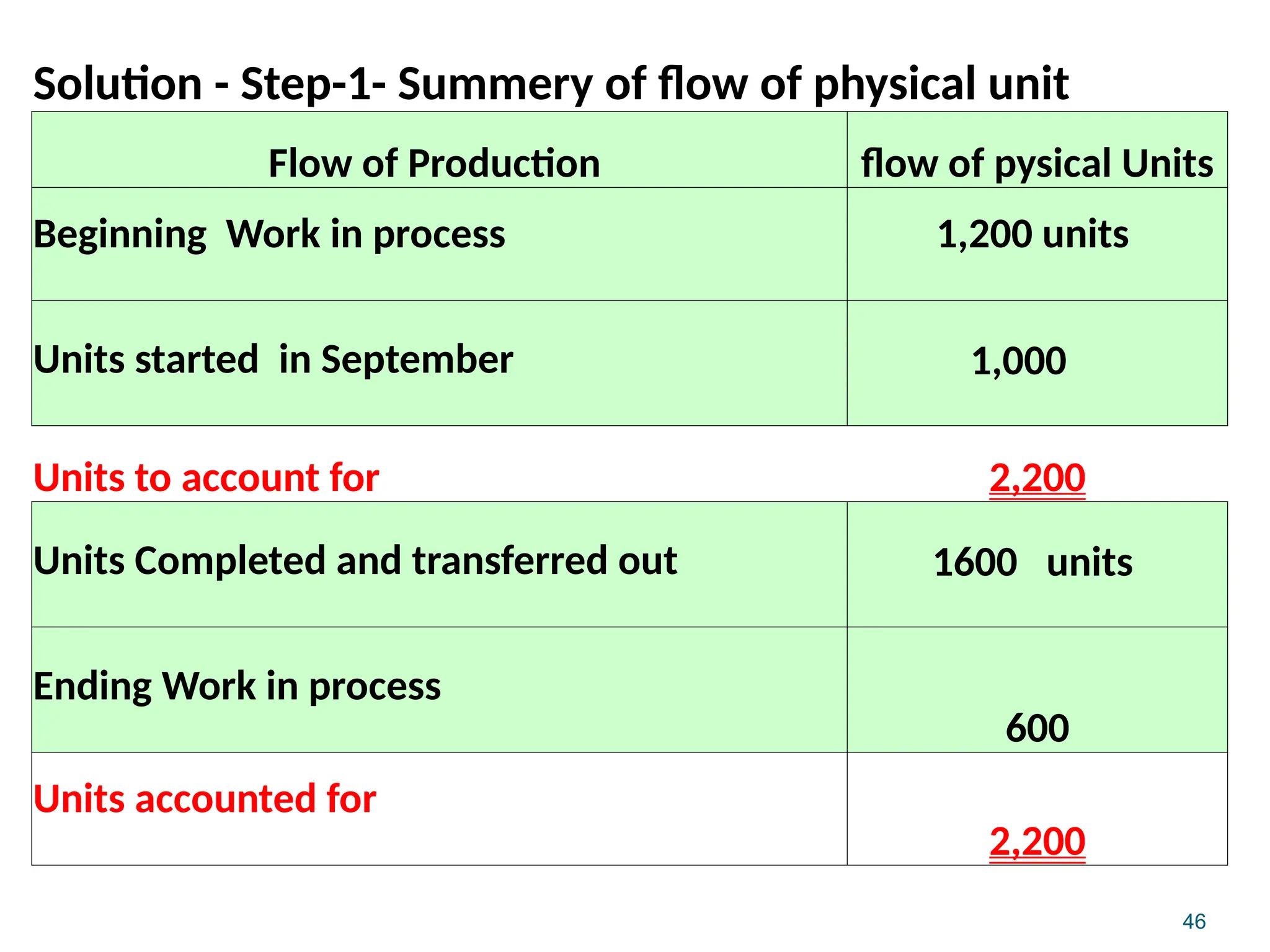
Solution - Step-1-Summery of flow of physical unit
Flow of Production flow of pysical Units
Beginning Work in process 1,200 units
Units started in September 1,000
Units to account for 2,200
Units Completed and transferred out 1600 units
Ending Work in process
600
Units accounted for
2,200
41.
47
Step 2 :Compute output in terms of equivalent units for
DMC & CC
Flow of Production
flow of physical
Units
Equivalent Unit
DMC CC
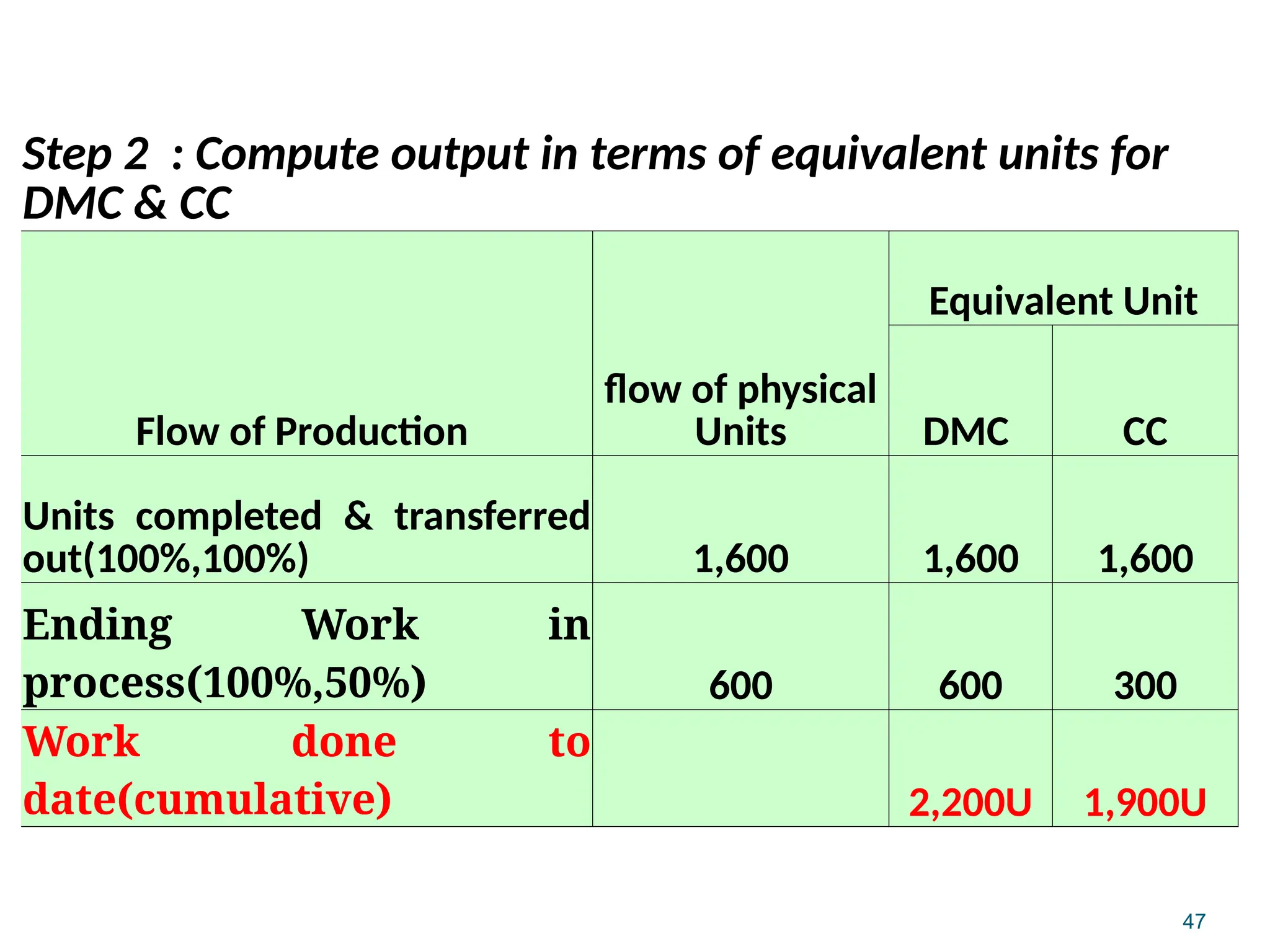
Units completed & transferred
out(100%,100%) 1,600 1,600 1,600
Ending Work in
process(100%,50%) 600 600 300
Work done to
date(cumulative) 2,200U 1,900U
42.
48
Step 3 &4: flow of cost and Cost per Equivalent units
Production cost report Total
production
cost
DMC CC
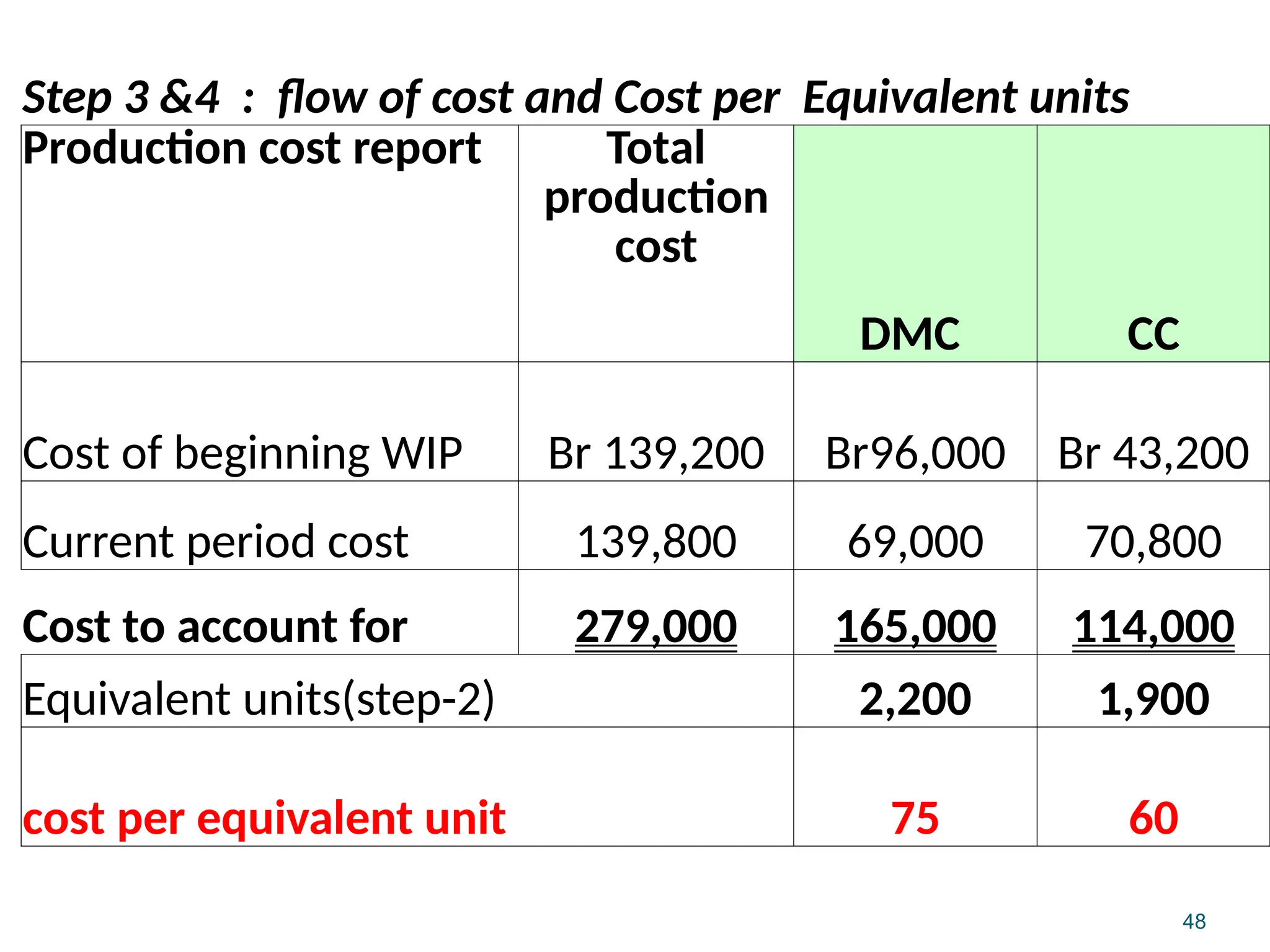
Cost of beginning WIP Br 139,200 Br96,000 Br 43,200
Current period cost 139,800 69,000 70,800
Cost to account for 279,000 165,000 114,000
Equivalent units(step-2) 2,200 1,900
cost per equivalent unit 75 60
43.
49
Step 5 :Cost assignment to completed units and to units of
WIP ending
Production cost report Total prod.
Cost DMC CC
Total Cost to account for Br 279,000
Cost Assignment :
To Completed& transferred out(800
units):
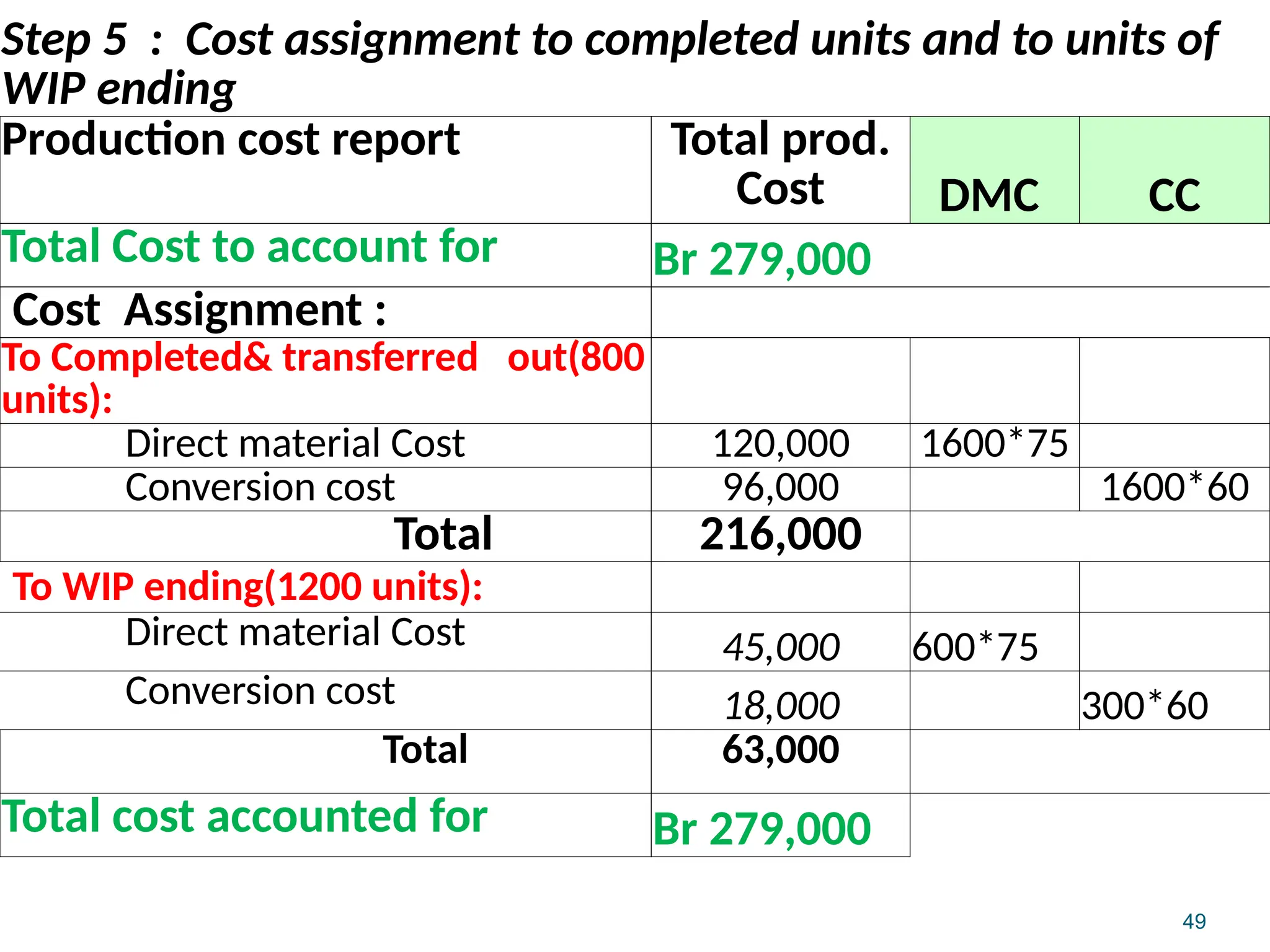
Direct material Cost 120,000 1600*75
Conversion cost 96,000 1600*60
Total 216,000
To WIP ending(1200 units):
Direct material Cost 45,000 600*75
Conversion cost 18,000 300*60
Total 63,000
Total cost accounted for Br 279,000
44.
50
Journal Entries- forproduction during November
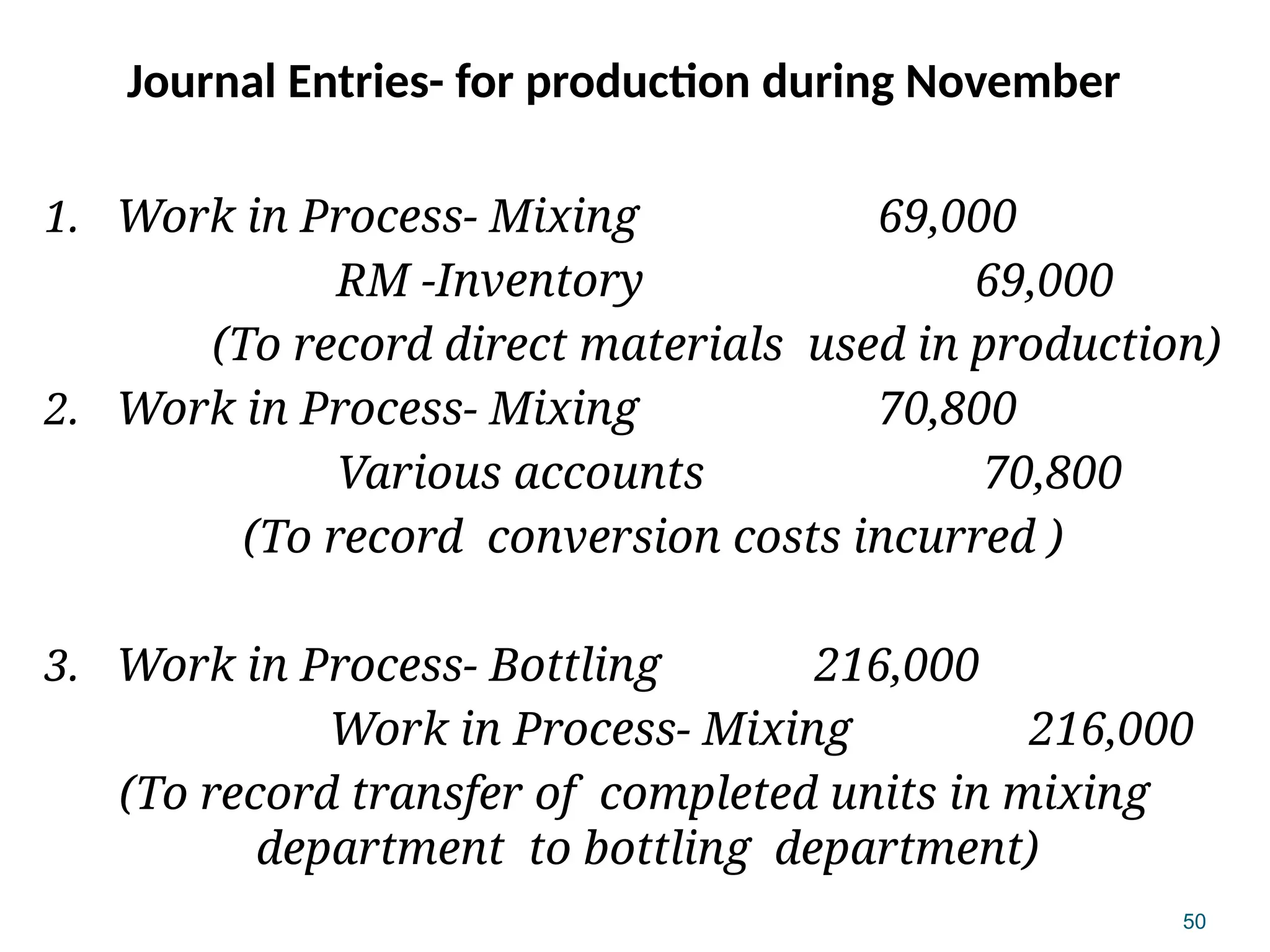
1. Work in Process- Mixing 69,000
RM -Inventory 69,000
(To record direct materials used in production)
2. Work in Process- Mixing 70,800
Various accounts 70,800
(To record conversion costs incurred )
3. Work in Process- Bottling 216,000
Work in Process- Mixing 216,000
(To record transfer of completed units in mixing
department to bottling department)
45.
51
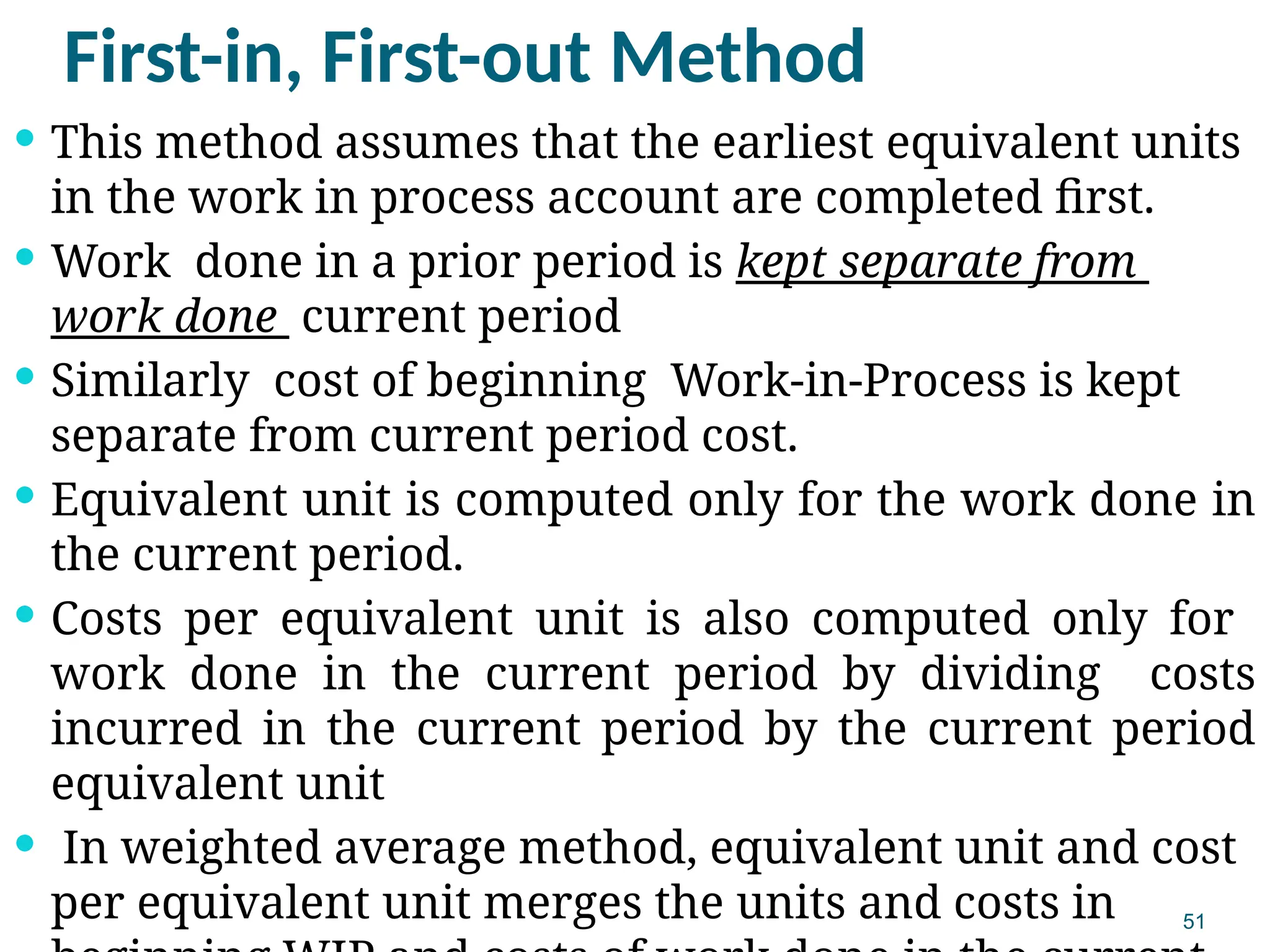
First-in, First-out Method
This method assumes that the earliest equivalent units
in the work in process account are completed first.
Work done in a prior period is kept separate from
work done current period
Similarly cost of beginning Work-in-Process is kept
separate from current period cost.
Equivalent unit is computed only for the work done in
the current period.
Costs per equivalent unit is also computed only for
work done in the current period by dividing costs
incurred in the current period by the current period
equivalent unit
In weighted average method, equivalent unit and cost
per equivalent unit merges the units and costs in
46.
52
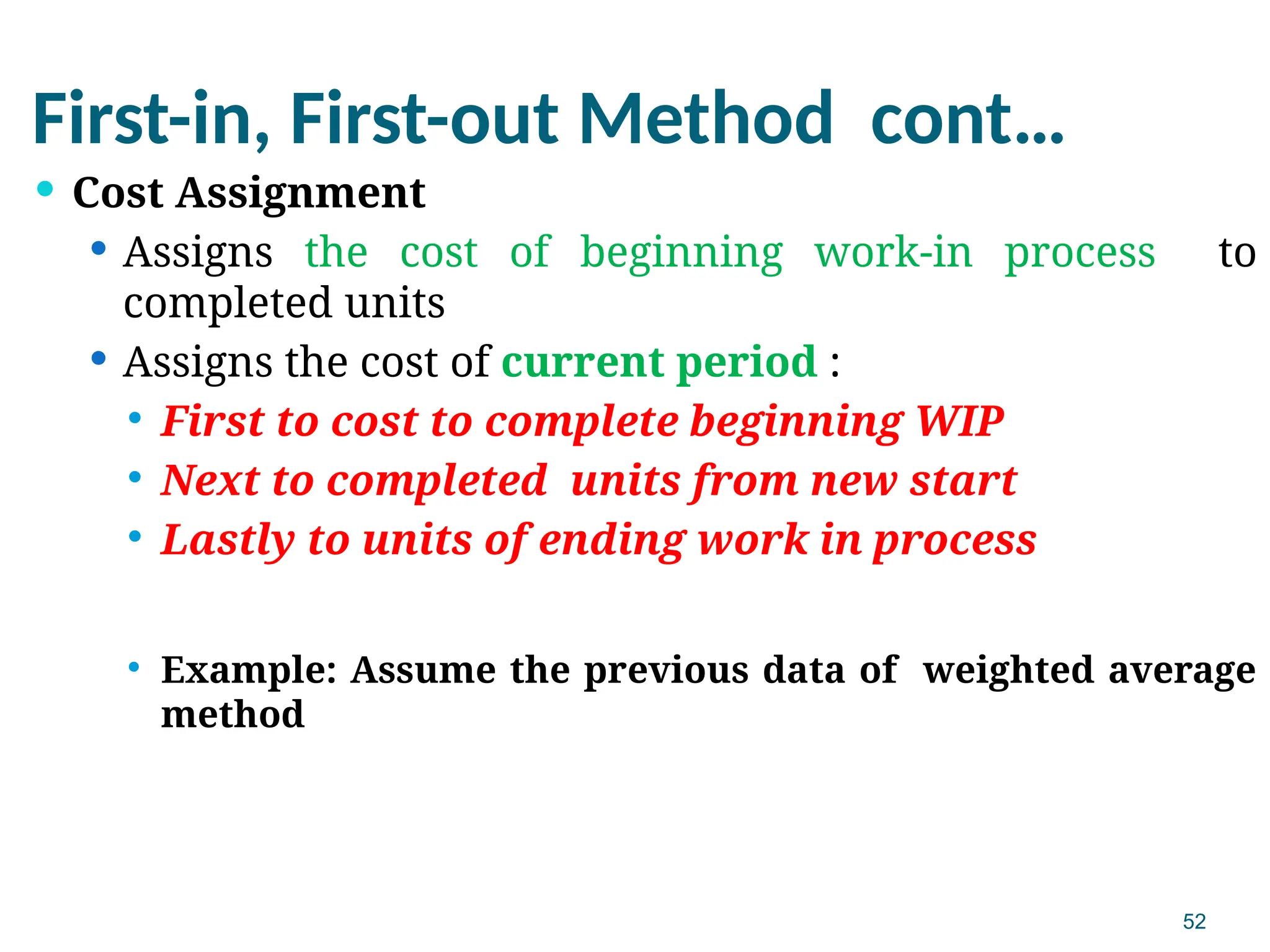
First-in, First-out Methodcont…
Cost Assignment
Assigns the cost of beginning work-in process to
completed units
Assigns the cost of current period :
First to cost to complete beginning WIP
Next to completed units from new start
Lastly to units of ending work in process
Example: Assume the previous data of weighted average
method
47.
53
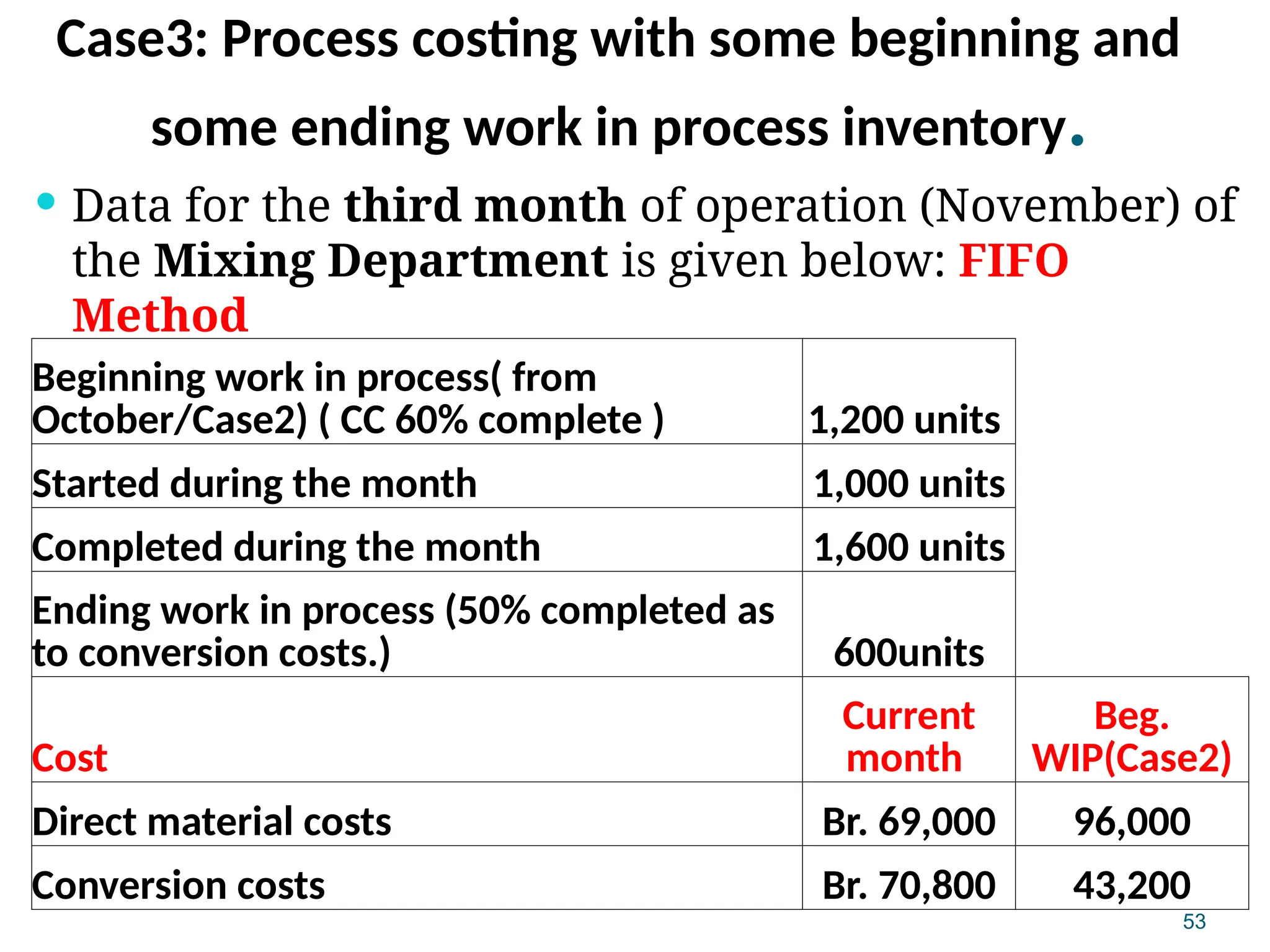
Case3: Process costingwith some beginning and
some ending work in process inventory.
Data for the third month of operation (November) of
the Mixing Department is given below: FIFO
Method
Beginning work in process( from
October/Case2) ( CC 60% complete ) 1,200 units
Started during the month 1,000 units
Completed during the month 1,600 units
Ending work in process (50% completed as
to conversion costs.) 600units
Cost
Current
month
Beg.
WIP(Case2)
Direct material costs Br. 69,000 96,000
Conversion costs Br. 70,800 43,200
48.
54
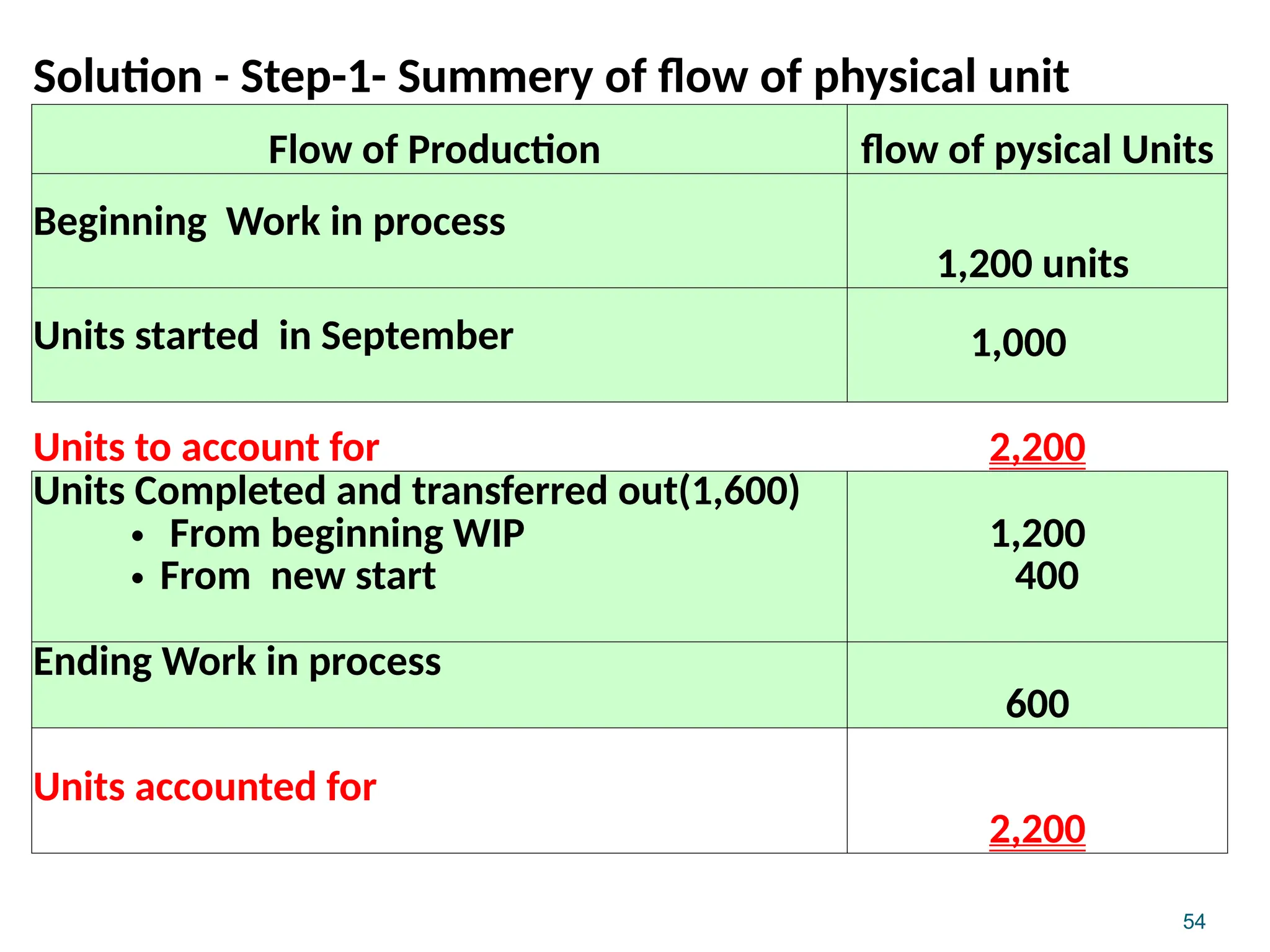
Solution - Step-1-Summery of flow of physical unit
Flow of Production flow of pysical Units
Beginning Work in process
1,200 units
Units started in September 1,000
Units to account for 2,200
Units Completed and transferred out(1,600)
• From beginning WIP
• From new start
1,200
400
Ending Work in process
600
Units accounted for
2,200
49.
55
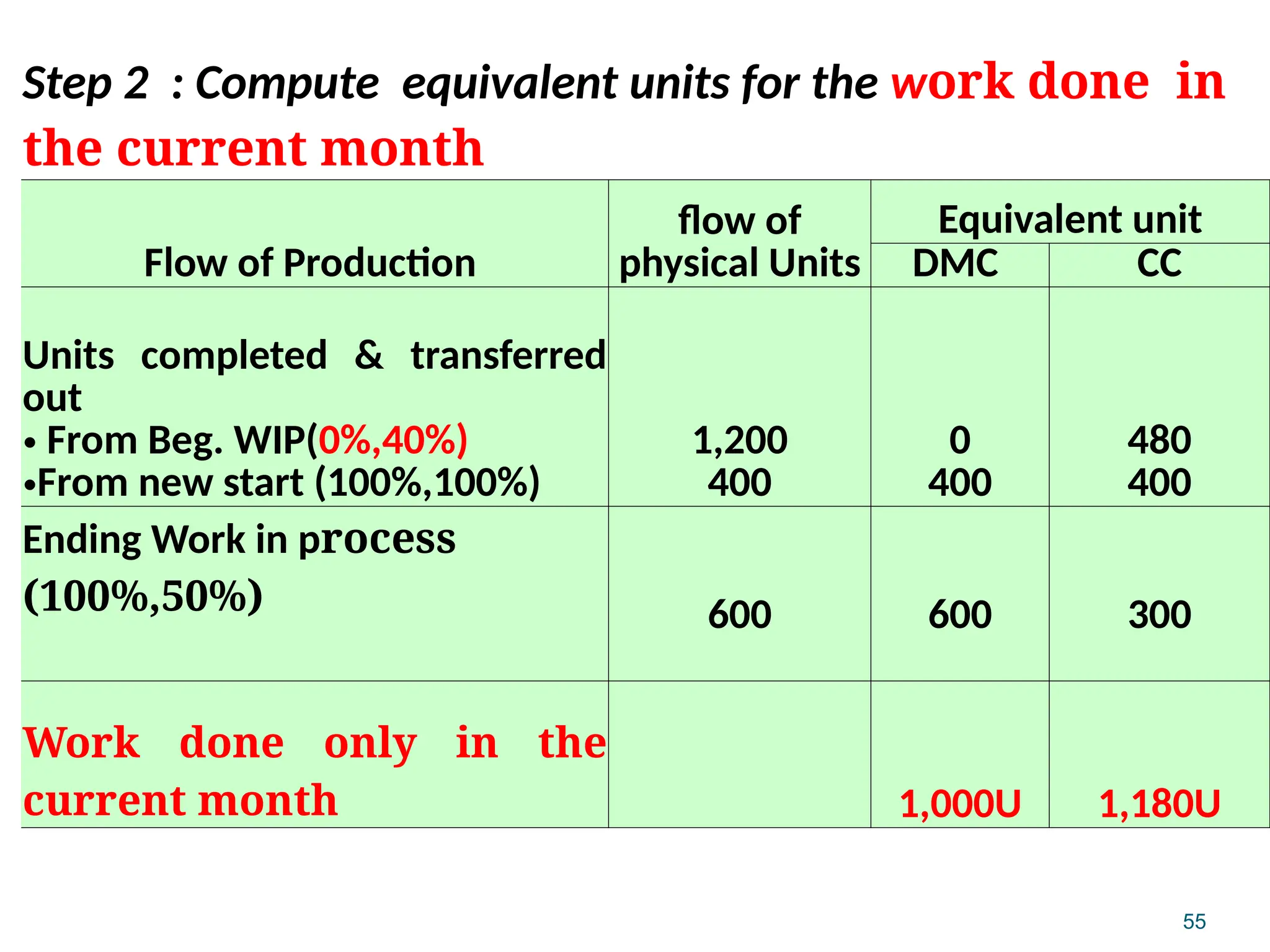
Step 2 :Compute equivalent units for the work done in
the current month
Flow of Production
flow of
physical Units
Equivalent unit
DMC CC
Units completed & transferred
out
• From Beg. WIP(0%,40%)
•From new start (100%,100%)
1,200
400
0
400
480
400
Ending Work in process
(100%,50%) 600 600 300
Work done only in the
current month 1,000U 1,180U
50.
56
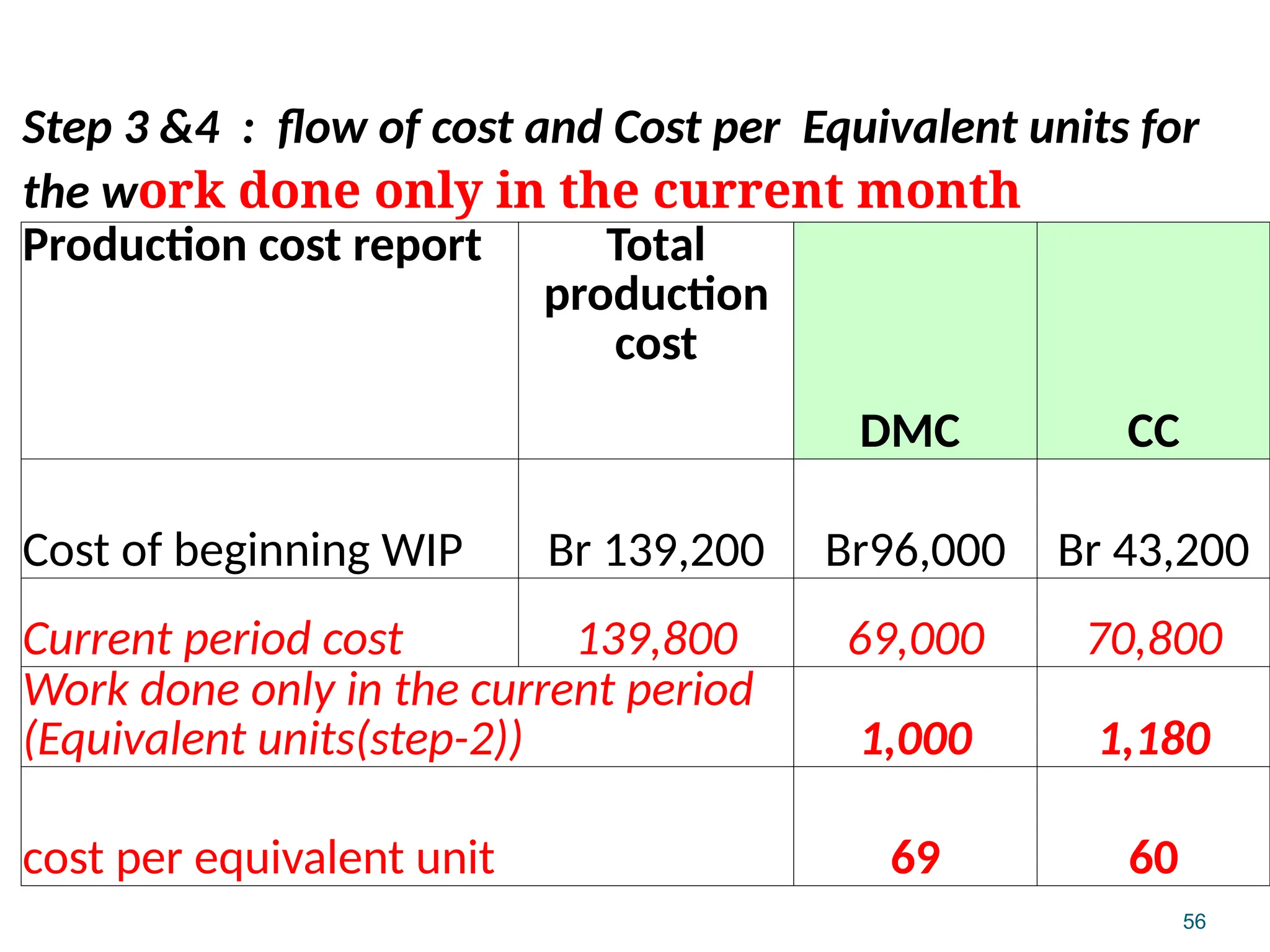
Step 3 &4: flow of cost and Cost per Equivalent units for
the work done only in the current month
Production cost report Total
production
cost
DMC CC
Cost of beginning WIP Br 139,200 Br96,000 Br 43,200
Current period cost 139,800 69,000 70,800
Work done only in the current period
(Equivalent units(step-2)) 1,000 1,180
cost per equivalent unit 69 60
51.
57
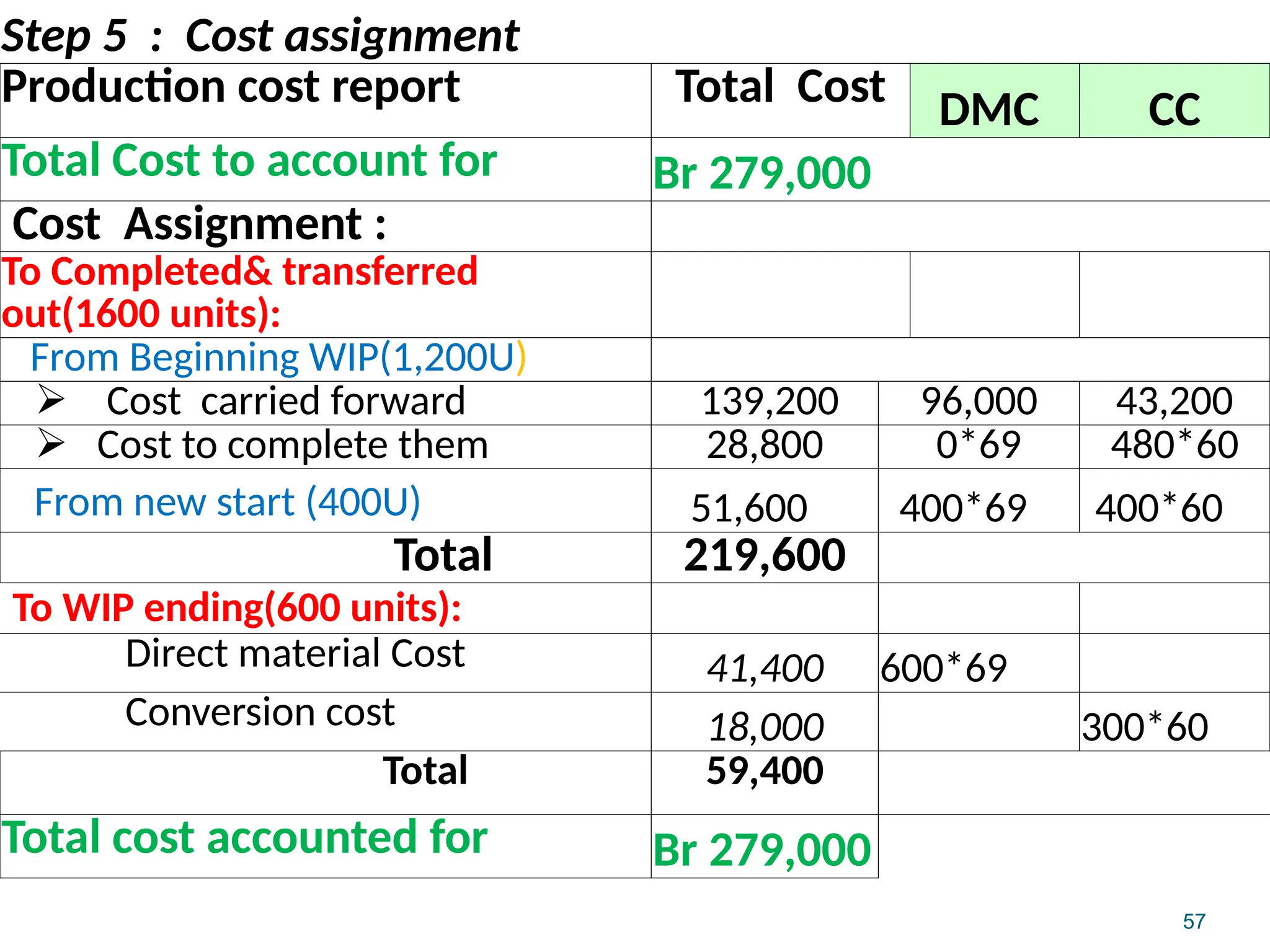
Step 5 :Cost assignment
Production cost report Total Cost DMC CC
Total Cost to account for Br 279,000
Cost Assignment :
To Completed& transferred
out(1600 units):
From Beginning WIP(1,200U)
Cost carried forward 139,200 96,000 43,200
Cost to complete them 28,800 0*69 480*60
From new start (400U) 51,600 400*69 400*60
Total 219,600
To WIP ending(600 units):
Direct material Cost 41,400 600*69
Conversion cost 18,000 300*60
Total 59,400
Total cost accounted for Br 279,000
52.
58
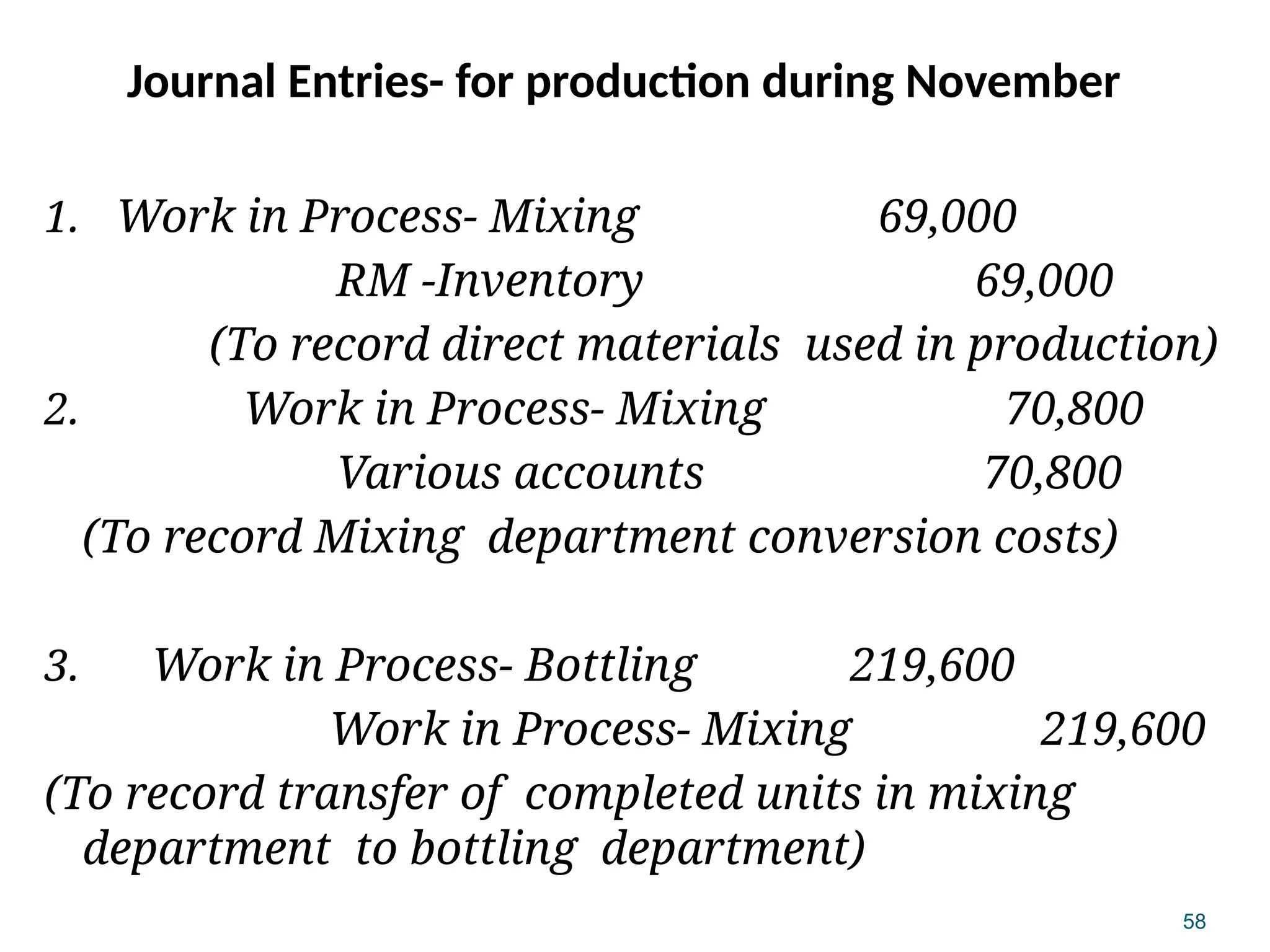
Journal Entries- forproduction during November
1. Work in Process- Mixing 69,000
RM -Inventory 69,000
(To record direct materials used in production)
2. Work in Process- Mixing 70,800
Various accounts 70,800
(To record Mixing department conversion costs)
3. Work in Process- Bottling 219,600
Work in Process- Mixing 219,600
(To record transfer of completed units in mixing
department to bottling department)
53.
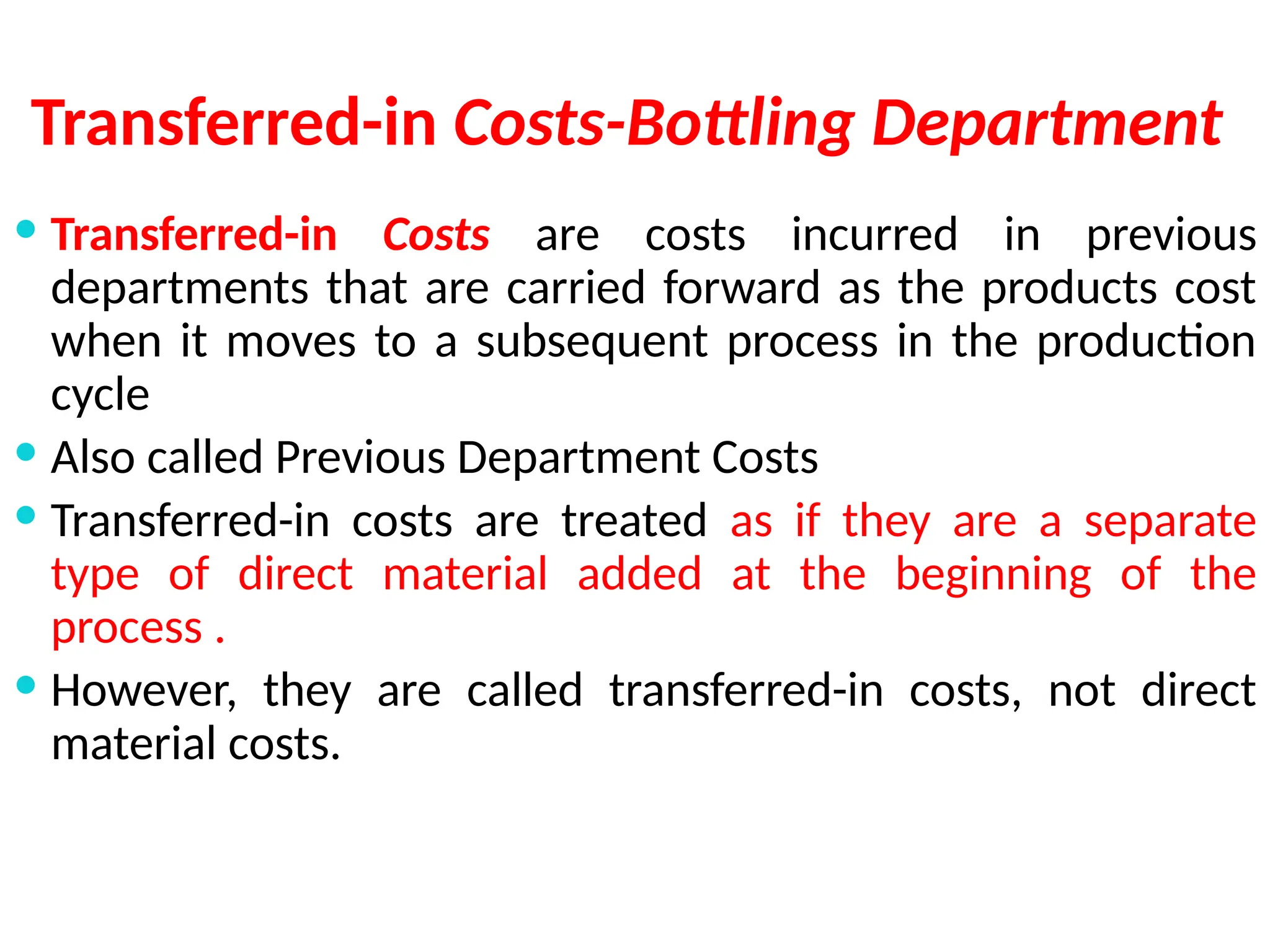
Transferred-in Costs-Bottling Department
Transferred-in Costs are costs incurred in previous
departments that are carried forward as the products cost
when it moves to a subsequent process in the production
cycle
Also called Previous Department Costs
Transferred-in costs are treated as if they are a separate
type of direct material added at the beginning of the
process .
However, they are called transferred-in costs, not direct
material costs.
54.
60
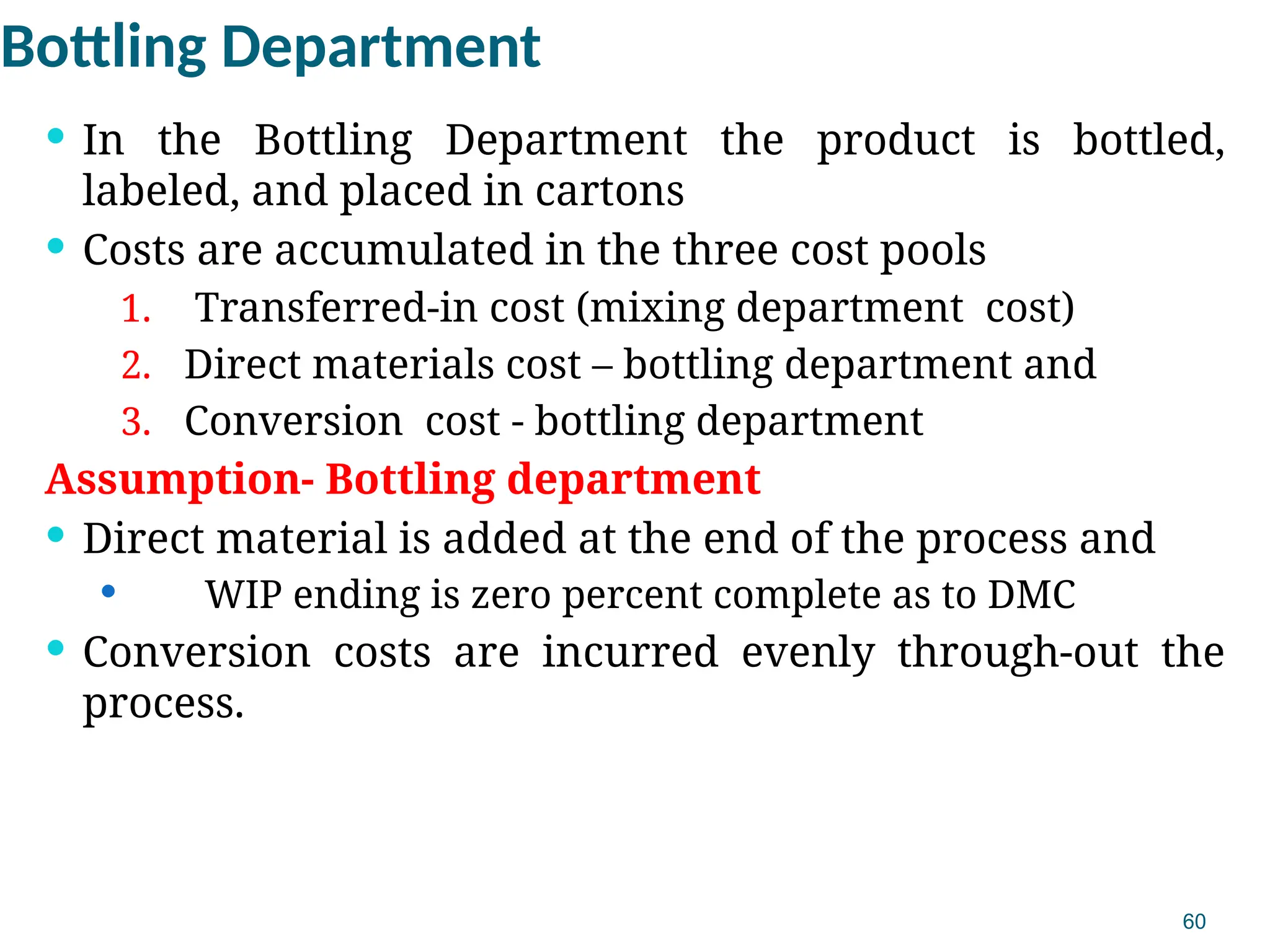
Bottling Department
Inthe Bottling Department the product is bottled,
labeled, and placed in cartons
Costs are accumulated in the three cost pools
1. Transferred-in cost (mixing department cost)
2. Direct materials cost – bottling department and
3. Conversion cost - bottling department
Assumption- Bottling department
Direct material is added at the end of the process and
WIP ending is zero percent complete as to DMC
Conversion costs are incurred evenly through-out the
process.
55.
61
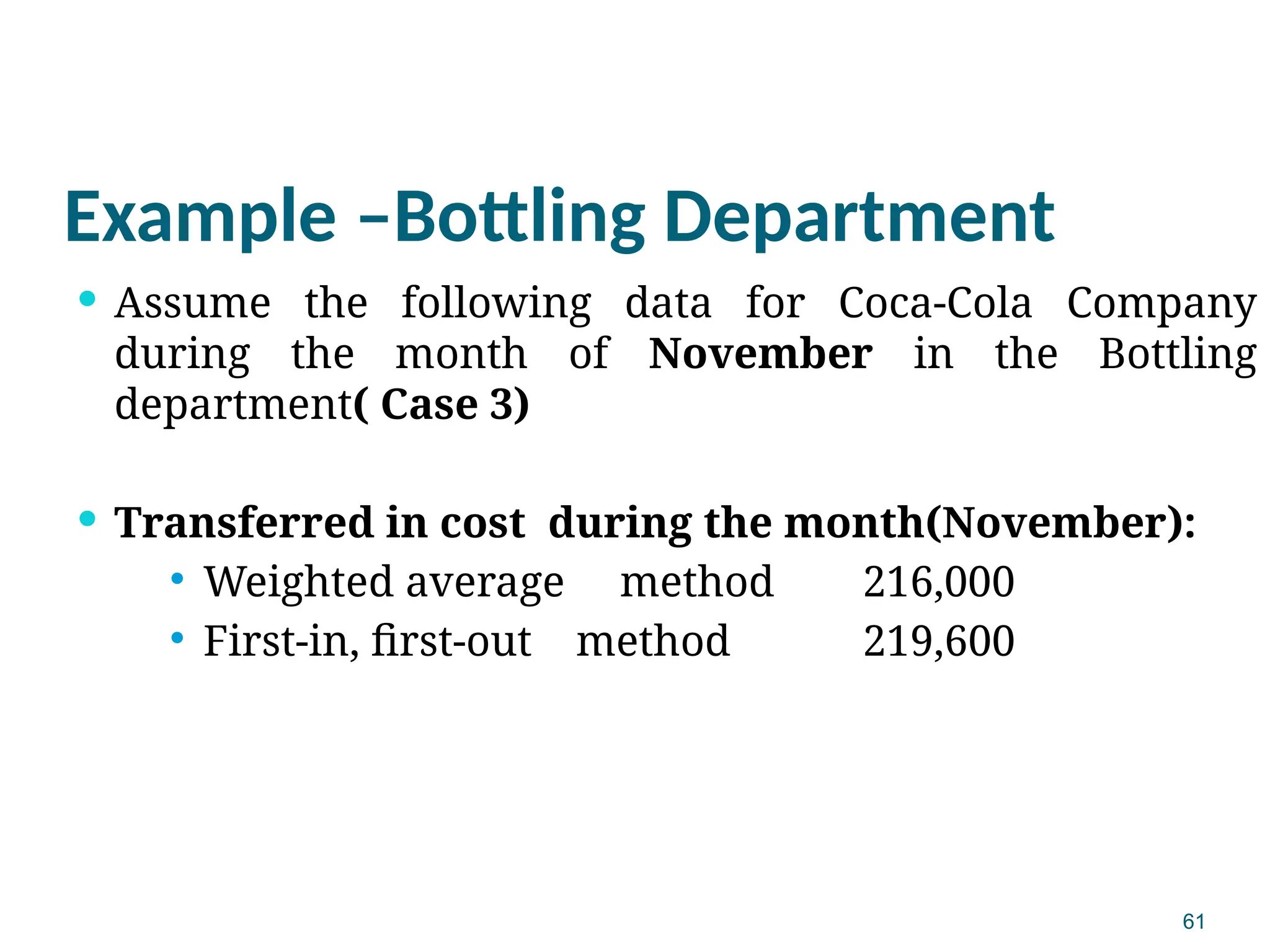
Example –Bottling Department
Assume the following data for Coca-Cola Company
during the month of November in the Bottling
department( Case 3)
Transferred in cost during the month(November):
Weighted average method 216,000
First-in, first-out method 219,600
56.
62
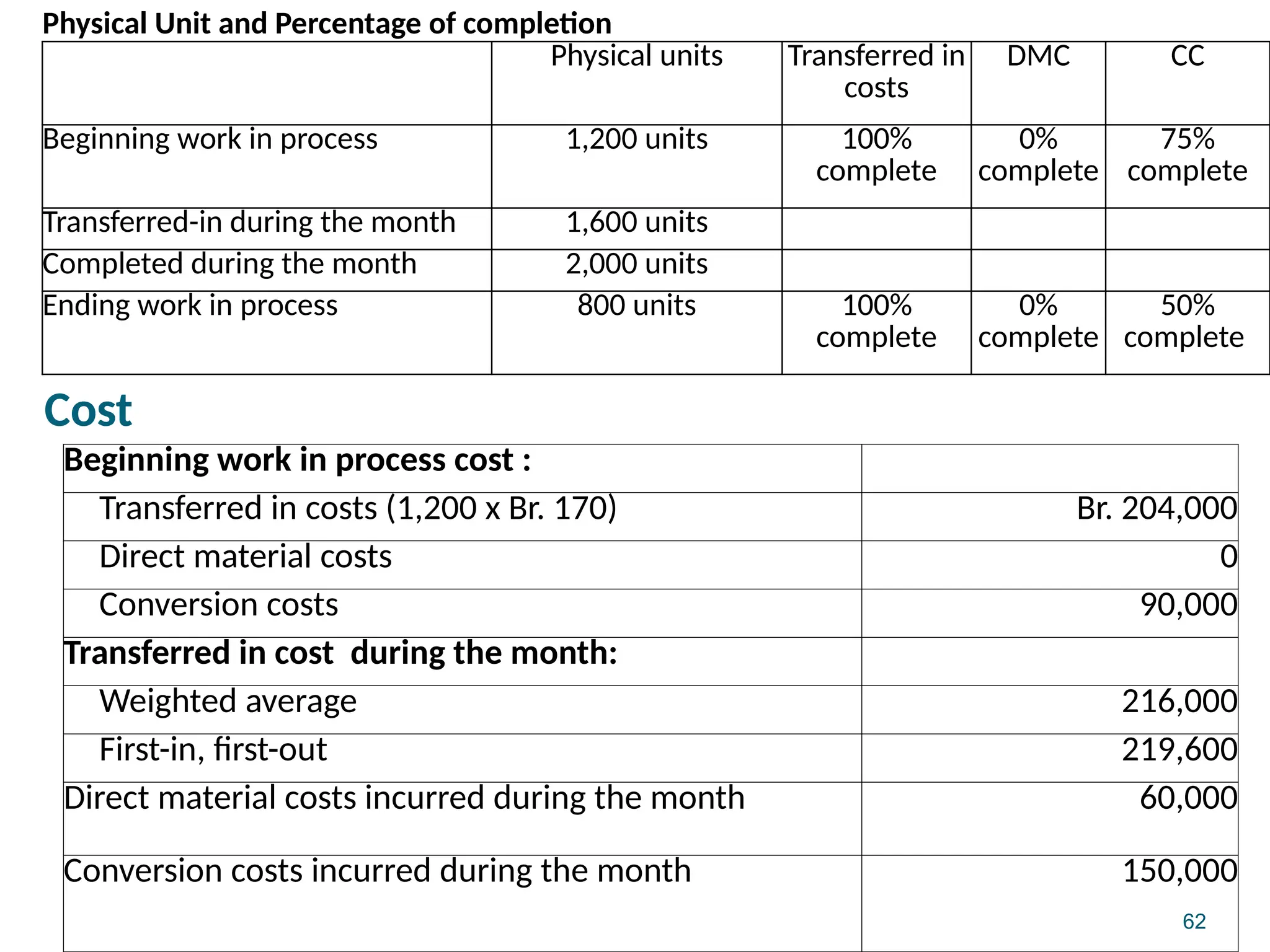
Physical Unit andPercentage of completion
Physical units Transferred in
costs
DMC CC
Beginning work in process 1,200 units 100%
complete
0%
complete
75%
complete
Transferred-in during the month 1,600 units
Completed during the month 2,000 units
Ending work in process 800 units 100%
complete
0%
complete
50%
complete
Cost
Beginning work in process cost :
Transferred in costs (1,200 x Br. 170) Br. 204,000
Direct material costs 0
Conversion costs 90,000
Transferred in cost during the month:
Weighted average 216,000
First-in, first-out 219,600
Direct material costs incurred during the month 60,000
Conversion costs incurred during the month 150,000
57.
63
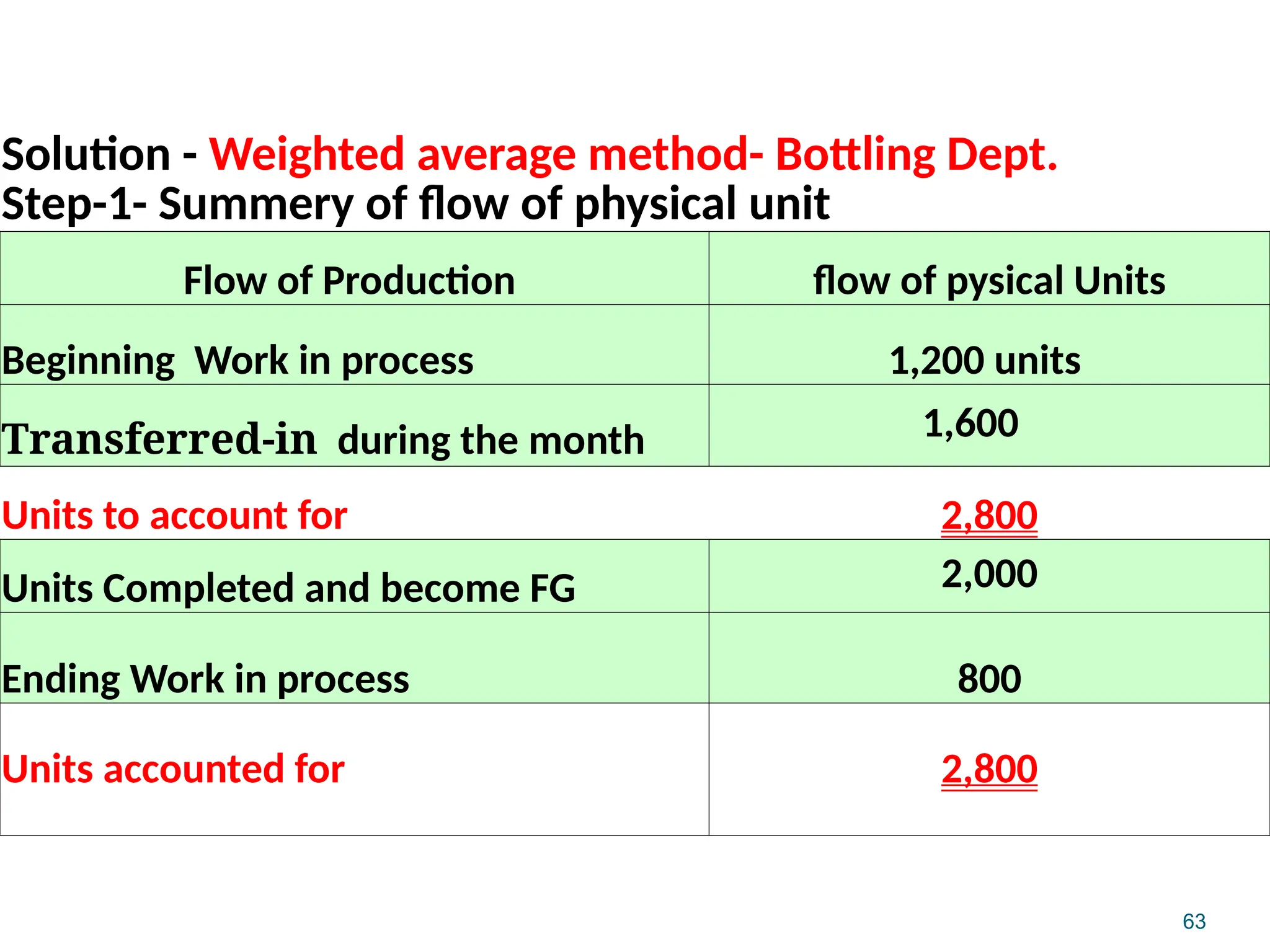
Solution - Weightedaverage method- Bottling Dept.
Step-1- Summery of flow of physical unit
Flow of Production flow of pysical Units
Beginning Work in process 1,200 units
Transferred-in during the month 1,600
Units to account for 2,800
Units Completed and become FG 2,000
Ending Work in process 800
Units accounted for 2,800
58.
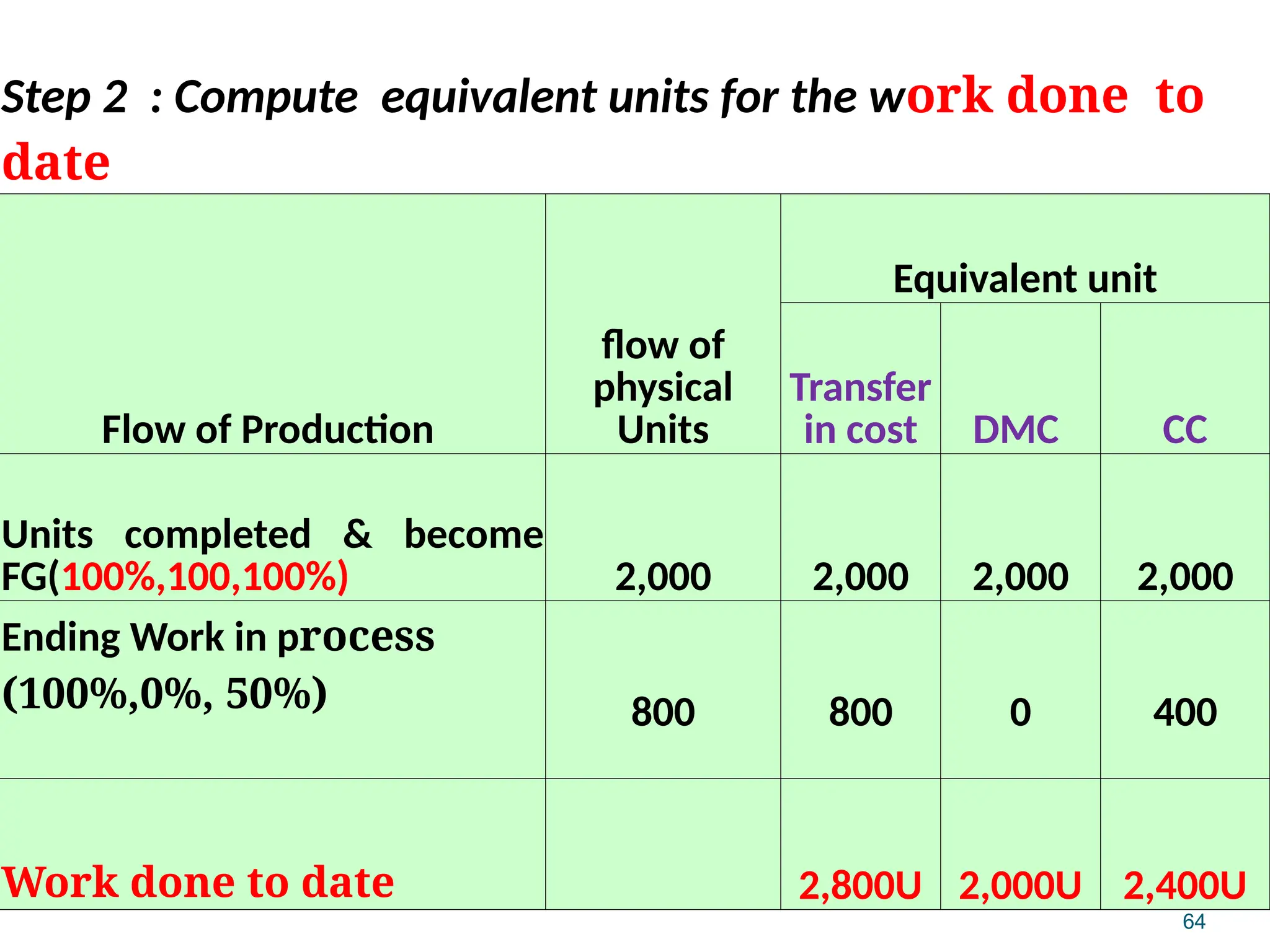
64
Step 2 :Compute equivalent units for the work done to
date
Flow of Production
flow of
physical
Units
Equivalent unit
Transfer
in cost DMC CC
Units completed & become
FG(100%,100,100%) 2,000 2,000 2,000 2,000
Ending Work in process
(100%,0%, 50%) 800 800 0 400
Work done to date 2,800U 2,000U 2,400U
59.
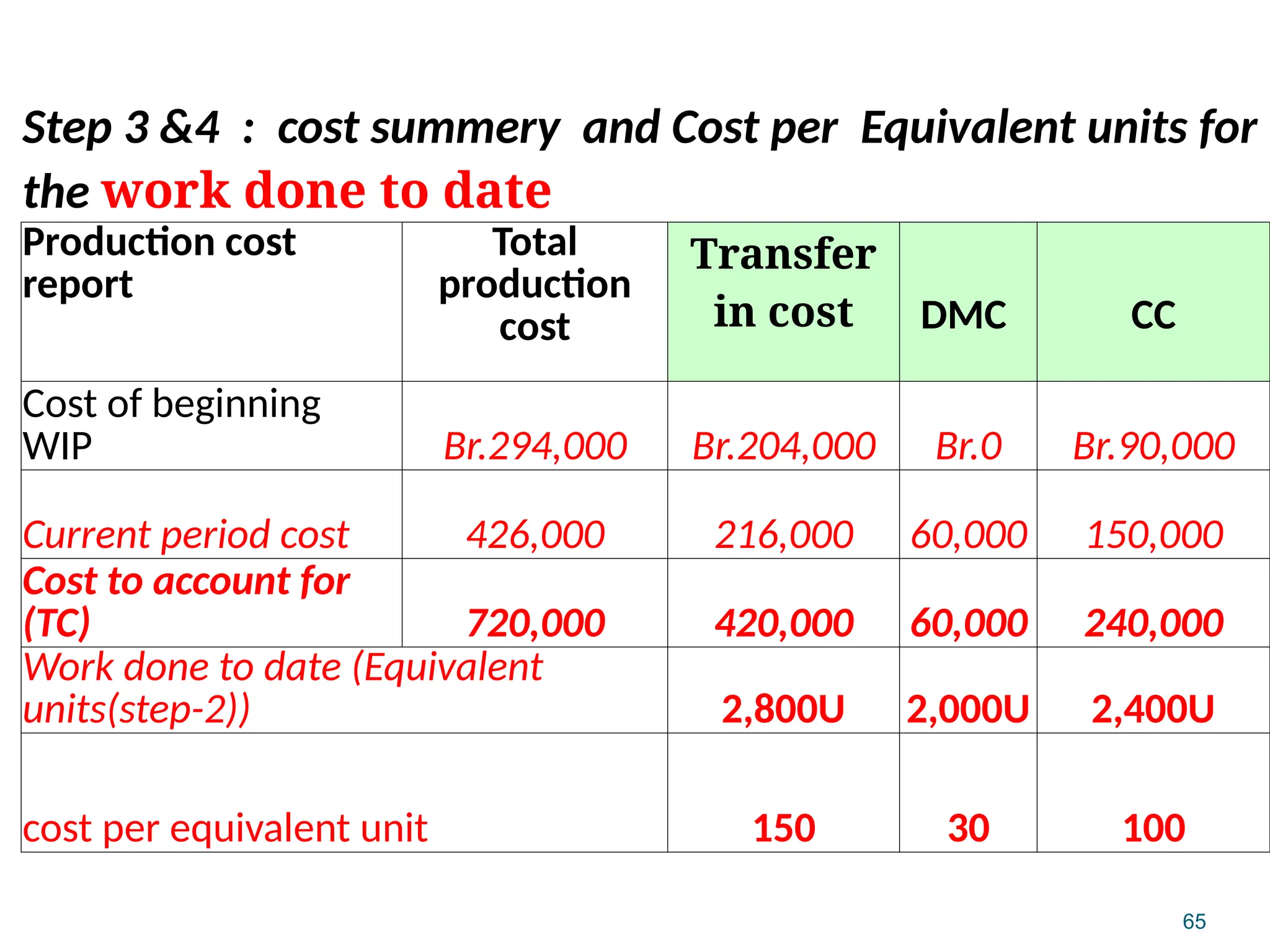
65
Step 3 &4: cost summery and Cost per Equivalent units for
the work done to date
Production cost
report
Total
production
cost
Transfer
in cost DMC CC
Cost of beginning
WIP Br.294,000 Br.204,000 Br.0 Br.90,000
Current period cost 426,000 216,000 60,000 150,000
Cost to account for
(TC) 720,000 420,000 60,000 240,000
Work done to date (Equivalent
units(step-2)) 2,800U 2,000U 2,400U
cost per equivalent unit 150 30 100
60.
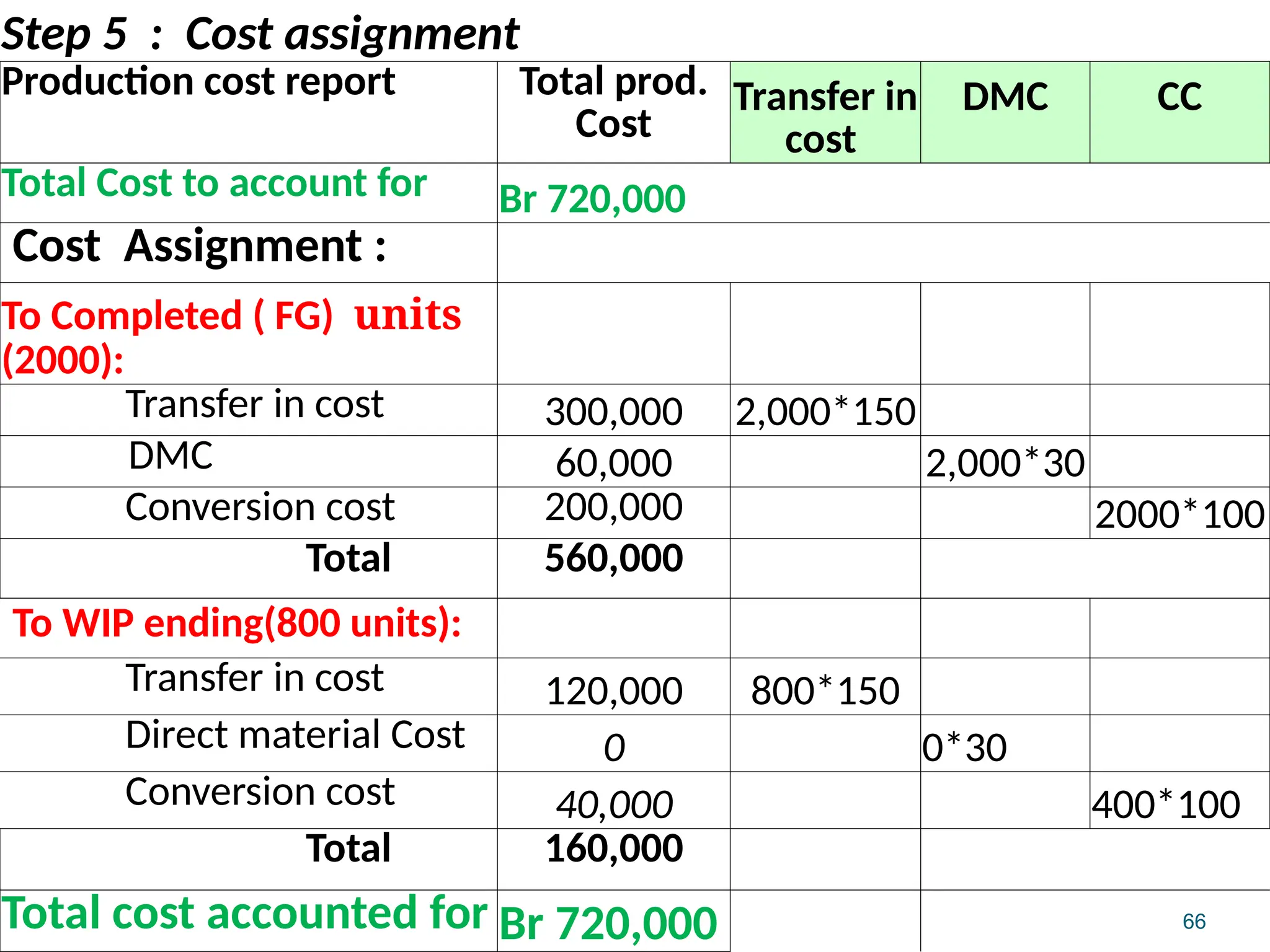
66
Step 5 :Cost assignment
Production cost report Total prod.
Cost
Transfer in
cost
DMC CC
Total Cost to account for Br 720,000
Cost Assignment :
To Completed ( FG) units
(2000):
Transfer in cost 300,000 2,000*150
DMC 60,000 2,000*30
Conversion cost 200,000 2000*100
Total 560,000
To WIP ending(800 units):
Transfer in cost 120,000 800*150
Direct material Cost 0 0*30
Conversion cost 40,000 400*100
Total 160,000
Total cost accounted for Br 720,000
61.
67
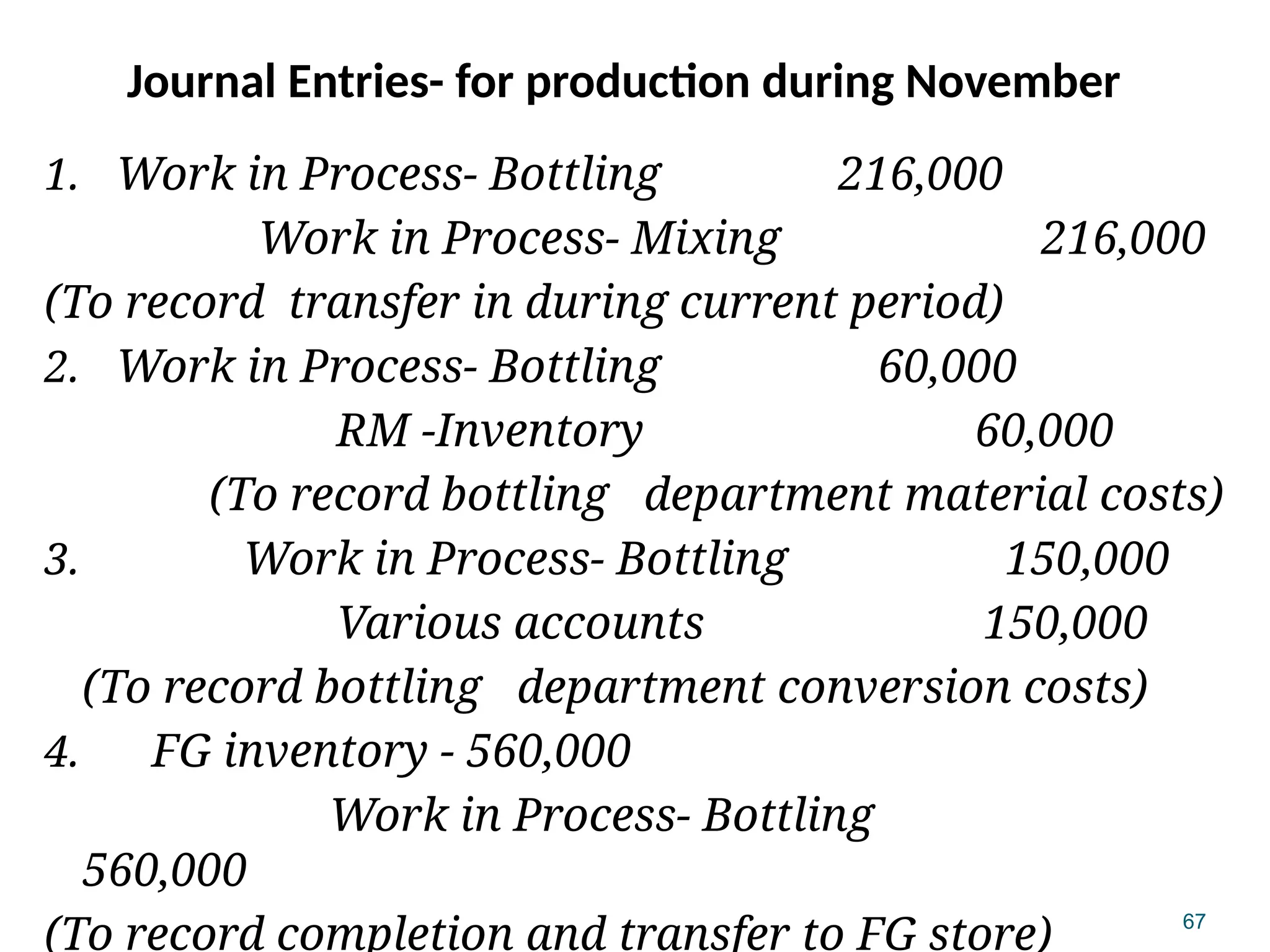
Journal Entries- forproduction during November
1. Work in Process- Bottling 216,000
Work in Process- Mixing 216,000
(To record transfer in during current period)
2. Work in Process- Bottling 60,000
RM -Inventory 60,000
(To record bottling department material costs)
3. Work in Process- Bottling 150,000
Various accounts 150,000
(To record bottling department conversion costs)
4. FG inventory - 560,000
Work in Process- Bottling
560,000
(To record completion and transfer to FG store)
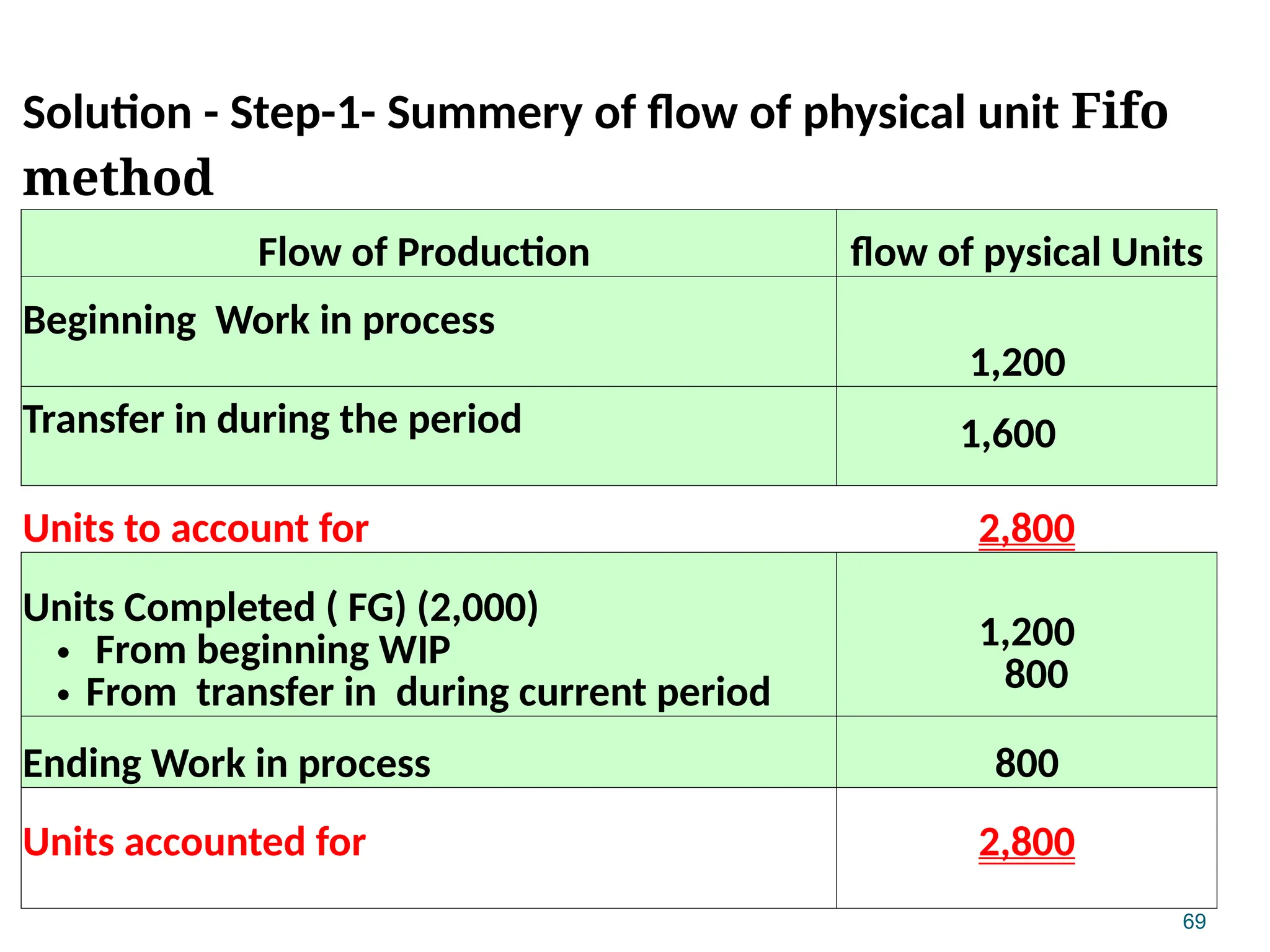
69
Solution - Step-1-Summery of flow of physical unit Fifo
method
Flow of Production flow of pysical Units
Beginning Work in process
1,200
Transfer in during the period 1,600
Units to account for 2,800
Units Completed ( FG) (2,000)
• From beginning WIP
• From transfer in during current period
1,200
800
Ending Work in process 800
Units accounted for 2,800
64.
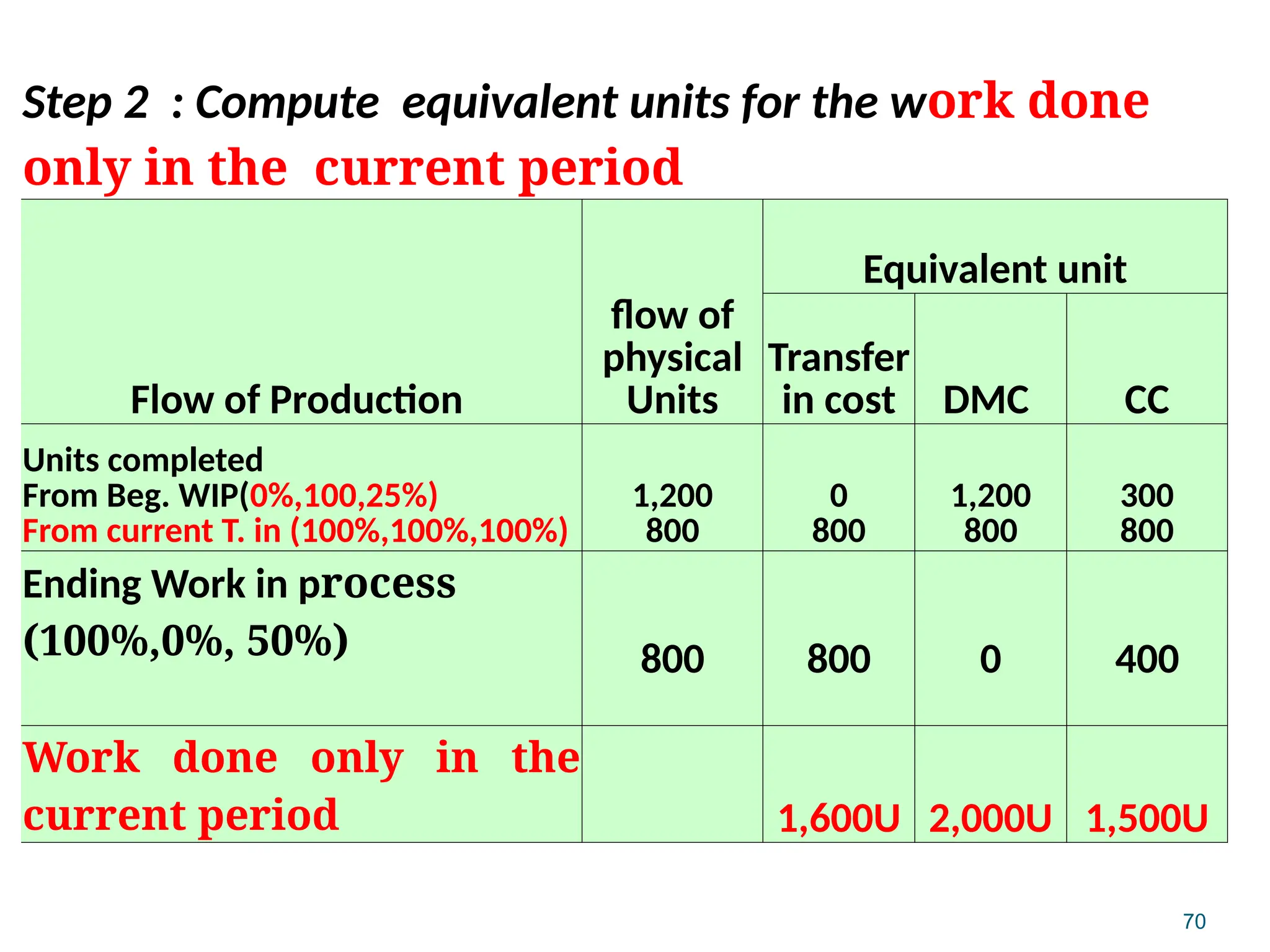
70
Step 2 :Compute equivalent units for the work done
only in the current period
Flow of Production
flow of
physical
Units
Equivalent unit
Transfer
in cost DMC CC
Units completed
From Beg. WIP(0%,100,25%)
From current T. in (100%,100%,100%)
1,200
800
0
800
1,200
800
300
800
Ending Work in process
(100%,0%, 50%) 800 800 0 400
Work done only in the
current period 1,600U 2,000U 1,500U
65.
71
Step 3 &4: flow of cost and Cost per Equivalent units for
the work done only in the current month
Production cost report Total
production
cost
Transfer
in cost DMC CC
Cost of beginning WIP Br.294,000 Br.204,000 Br.0 Br.90,000
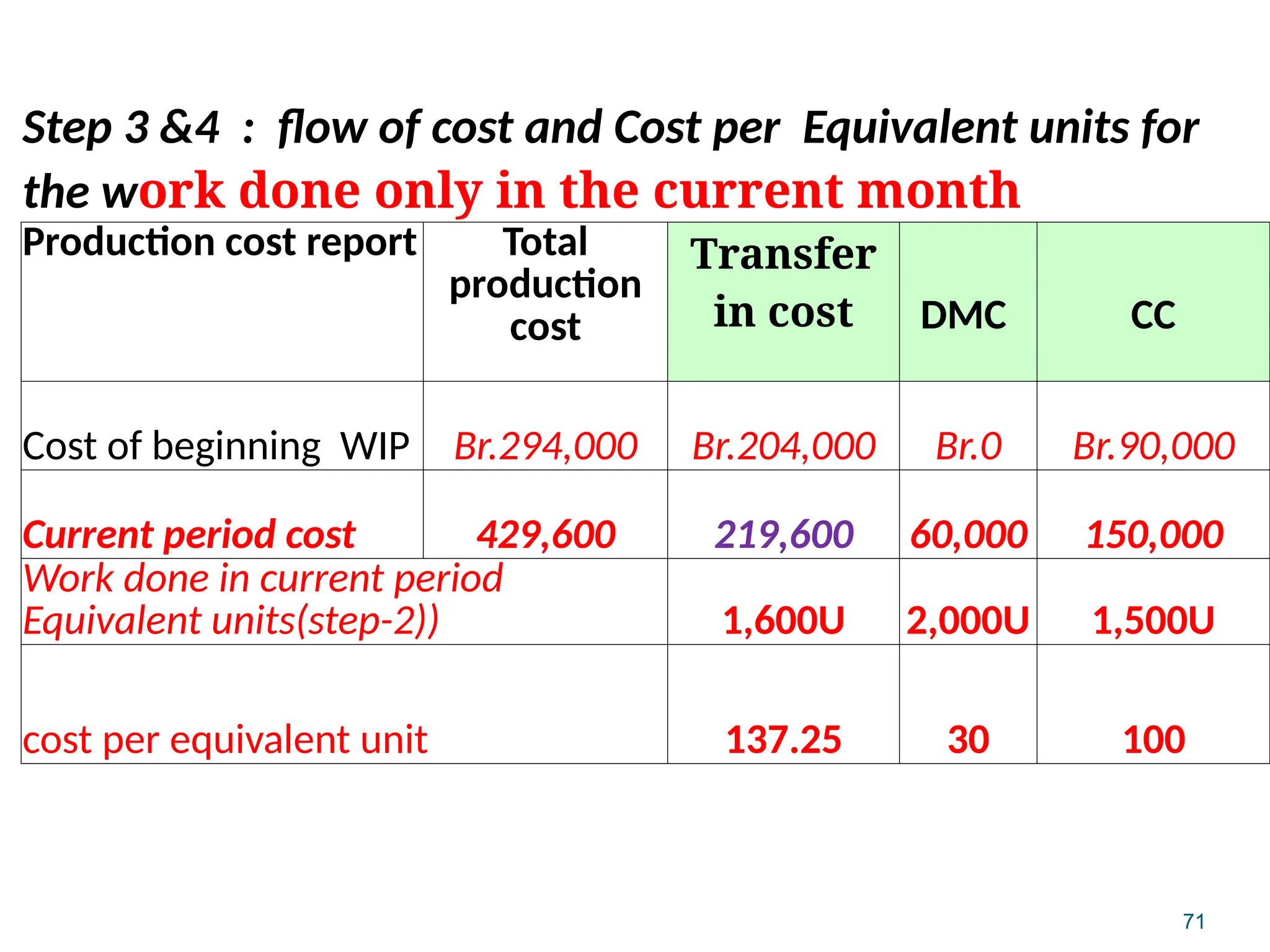
Current period cost 429,600 219,600 60,000 150,000
Work done in current period
Equivalent units(step-2)) 1,600U 2,000U 1,500U
cost per equivalent unit 137.25 30 100
66.
72
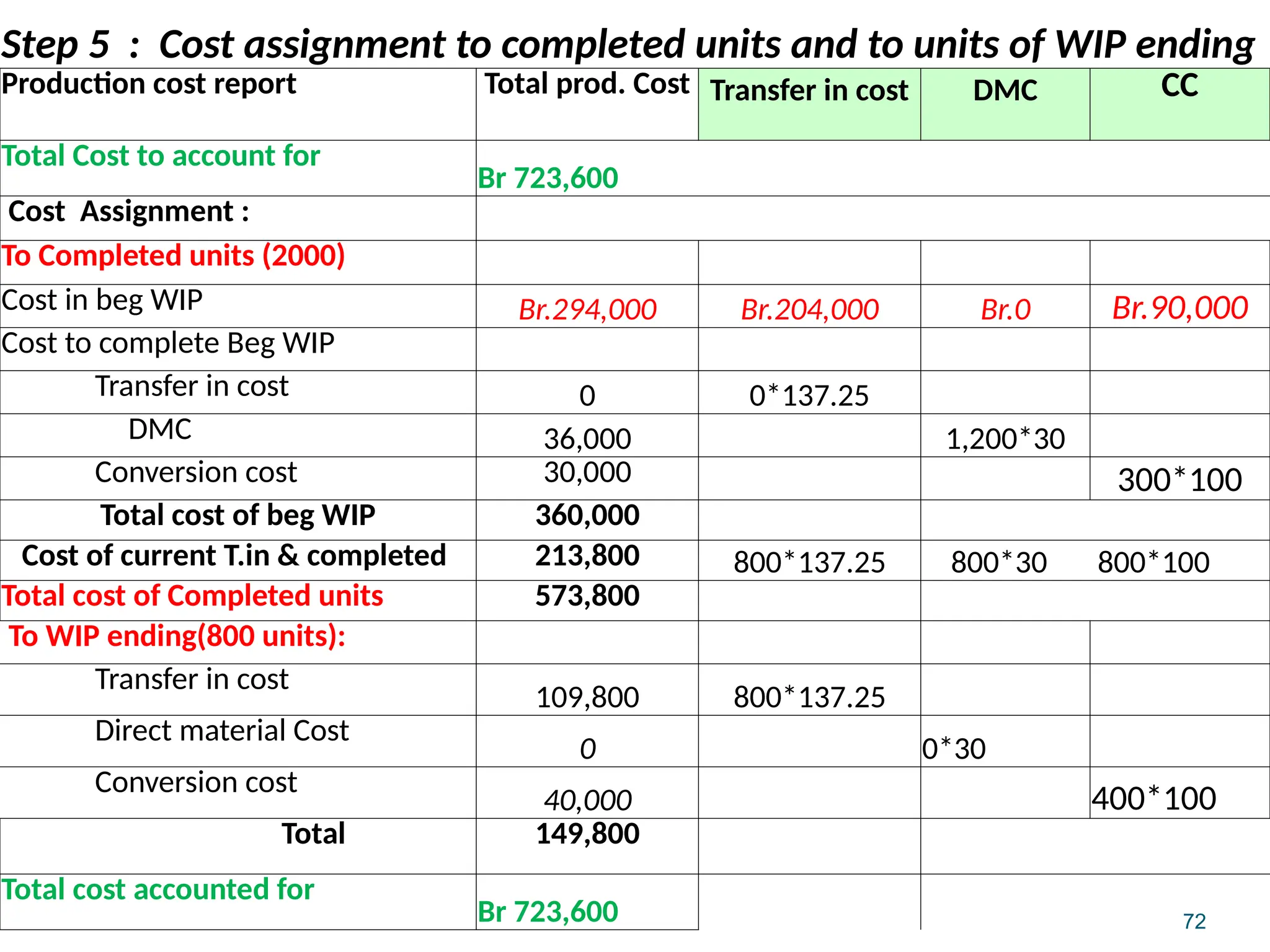
Step 5 :Cost assignment to completed units and to units of WIP ending
Production cost report Total prod. Cost Transfer in cost DMC CC
Total Cost to account for
Br 723,600
Cost Assignment :
To Completed units (2000)
Cost in beg WIP Br.294,000 Br.204,000 Br.0 Br.90,000
Cost to complete Beg WIP
Transfer in cost 0 0*137.25
DMC 36,000 1,200*30
Conversion cost 30,000 300*100
Total cost of beg WIP 360,000
Cost of current T.in & completed 213,800 800*137.25 800*30 800*100
Total cost of Completed units 573,800
To WIP ending(800 units):
Transfer in cost
109,800 800*137.25
Direct material Cost
0 0*30
Conversion cost
40,000 400*100
Total 149,800
Total cost accounted for
Br 723,600
67.
73
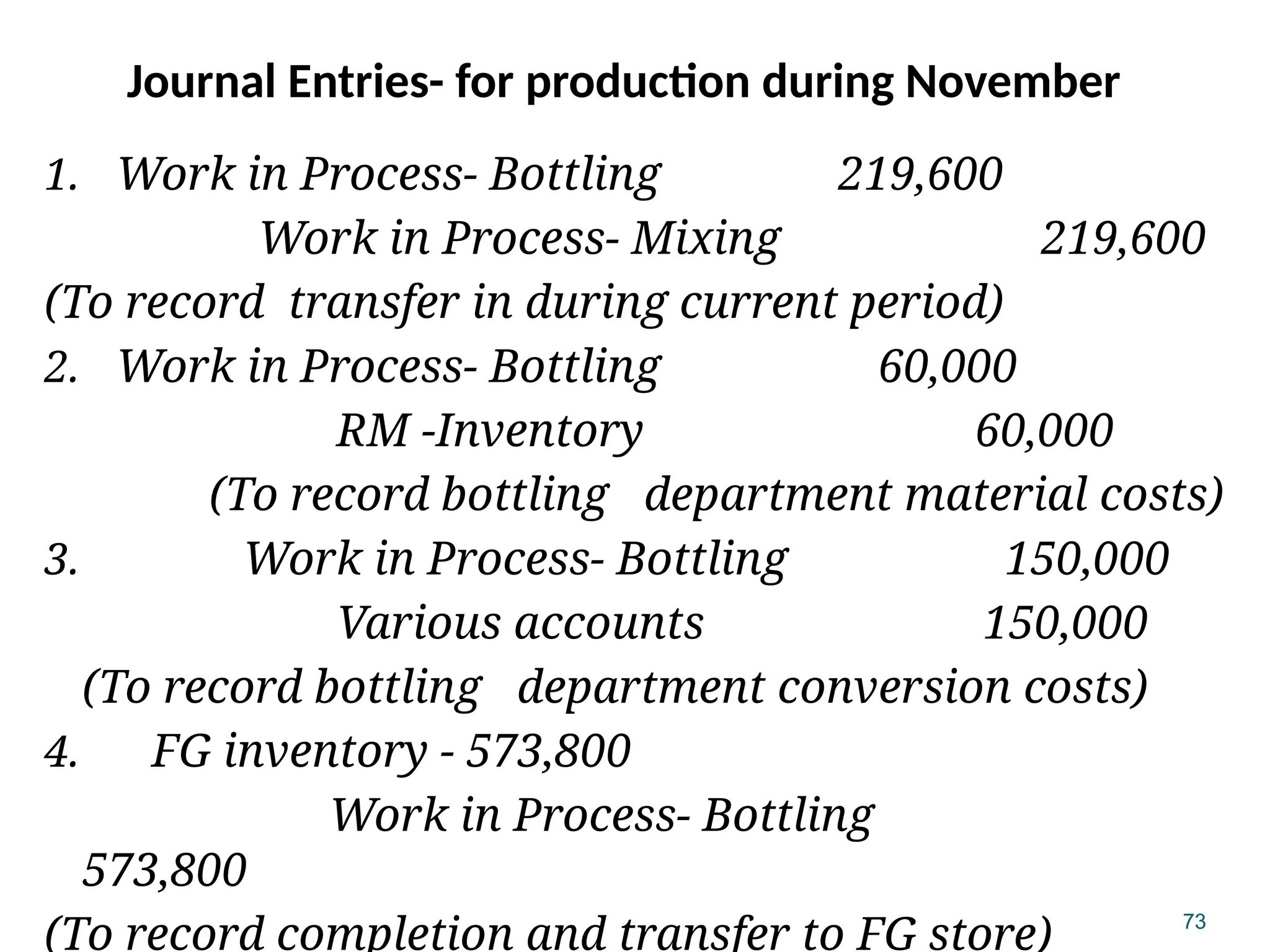
Journal Entries- forproduction during November
1. Work in Process- Bottling 219,600
Work in Process- Mixing 219,600
(To record transfer in during current period)
2. Work in Process- Bottling 60,000
RM -Inventory 60,000
(To record bottling department material costs)
3. Work in Process- Bottling 150,000
Various accounts 150,000
(To record bottling department conversion costs)
4. FG inventory - 573,800
Work in Process- Bottling
573,800
(To record completion and transfer to FG store)
#3 The difference between job order and process costing system is, thus, the extent of the averaging used to compute unit cost. In job order costing each job differs in terms of material used, labor incurred, and manufacturing overhead. Hence, it is impossible to assign the same cost for different jobs. On the contrary, identical units produced in mass took equal amount of direct material, direct labor, and manufacturing overhead. Thus, the unit cost can be found by dividing total cost by the number of units produced.
#5 Job-order and process costing are similar in that they both deal with assigning materials, labor and overhead to products as a way to calculate the unit product cost.
Both systems use raw materials inventory, work in process inventory, and finished goods inventory.
The flow of costs is similar, but not exactly the same, in the two systems.
#6 Process costing is best suited for the production of a single product that is continuously produced for a long period of time. Recall the mixing and bottling of Coca-Cola from Chapter Three. Job-order costing is best suited when jobs are produced as discrete projects. For example, building a house.
Process costing accumulates costs by department, while job-order costing accumulates costs by individual jobs.
Process costing uses a fundamental document called a department production report, while job-order costing uses the job cost sheet.
In process costing unit cost is computed by department, while in job-order systems unit cost is computed by job.
While there are similarities between the two systems, there are also significant differences.
#9 In all manufacturing systems, direct material, direct labor, and manufacturing overhead are charged to Work in Process Inventory. As we complete the production process, goods are transferred to the Finished Goods Inventory. Finally, when we sell the finished goods, we transfer the cost to cost of goods sold.
#10 In a job-order cost system costs are traced to individual jobs. All of the jobs in process make up the company’s Work in Process Inventory.
#11 In a process costing systems, costs are traced to departments that process the goods. In some companies there may be several processing departments that goods must pass through to become finished goods.
#12 Part I
Direct materials can be requisitioned for use in both Department A and Department B. These direct materials are likely to be different in nature.
#13 The journal entry that shows the requisition of direct materials for use in Processing Departments A and B, is to debit the processing department of the direct materials requisitioned and credit Raw Materials Inventory. Notice that the direct materials are placed into a separate work in process account for each processing department.
#14 Direct labor is transferred from the wages payable account into the work in process account of departments A and B depending upon where the individual employee worked.
#15 Manufacturing overhead is applied to each processing department based on a predetermined rate for each department. The predetermined rate does not have to be based on the same cost driver for each processing department.
#16 Here is the journal entry to place the direct labor into the work in process inventory of departments A and B.
#17 This is the journal entry we use to apply overhead to the work in process inventory of each of the processing departments.
#18 The cost of units complete as to processing in Department A are transferred into Department B for additional work.. Department B has incurred additional costs to work on units that were in process at the beginning of the period. The transferred-in costs from Department A are added to the manufacturing costs incurred in Department B.
#19 To transfer the costs, we debit the work in process inventory in Department B, and credit, or reduce, the work in process inventory in Department A.
#20 Here we see the transfer of completed goods our of Work in Process – Department B and into Finished Goods Inventory. The costs transferred represent the cost of good manufactured.
#21 The necessary journal entry is to debit finished goods inventory and credit work in process inventory in Department B to transfer finished production.
#22 Once we sell finished goods, we debit cost of goods sold and credit finished goods inventory.
#23 If we assume the company uses the perpetual inventory system, two entries are required to record a sale. The first entry is to record the sale and account receivable. The second entry is to transfer the finished goods sold to cost of goods sold.
Sales are recorded at selling price and cost of good sold is recorded at cost. The difference between the two is the gross margin on the sale.
#28 The basic idea behind equivalent units is quite easy to understand, but the computation of equivalent can become complex. Here we can say the two half-completed units of production are equal to one complete unit. Using this logic, we can say that 10,000 units that are 70% complete are equivalent, or the same as, 7,000 complete units.