HYGIENE
HYGIENE
• Hygiene is the science of health and its
maintenance.
• PERSONAL Hygiene is the self-care by which
people attend to such functions as:
•Bathing
•Toileting
•General body hygiene
•Grooming
• Hygiene is a highly personal matter determined
by individual values and practices.
• It involves care of the skin, hair, nails, teeth,
oral and nasal cavities, eyes, ears and
perineal-genital areas.
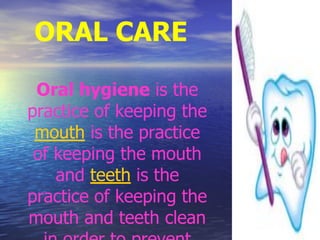
ORAL CARE
Oral hygiene is the
practice of keeping the
mouth is the practice
of keeping the mouth
and teeth is the
practice of keeping the
mouth and teeth clean
DEVELOPMENTAL VARIATIONS
– Teeth usually appear 5 to 8 months after birth.
– Baby-bottle syndrome may result in decay of all of the
upper teeth and the lower posterior teeth.
– This syndrome occurs when an infant is put to bed with
a bottle of sugar water, formula, milk, or fruit juice.
– The carbohydrates in the solutions cause
dimineralization of the tooth enamel which leads to
tooth decay.
– By the time children are 2 years old, they usually have
all 20 of their temporary teeth.
– At about age 6 or 7, children start losing their
deciduous teeth, and these are gradually replaced by
the 33 permanent teeth.
– By age 25, most people have all of their permanent
teeth.
ASSESSMENT
NURSING HISTORY - The nurse obtains data
about the client’s:
•Oral hygiene practices including dental visits – helps
the nurse determine learning needs and incorporate
the client’s needs and preferences in the plan of care.
•Self-care abilities – determines the amount and type of
nursing assistance to provide
– Client’s who need assistance from the nurse:
❖ Whose hand coordination is impaired – stroke patient
❖ Whose illness alters energy levels and motivation
❖ Whose therapy imposes restrictions on activities
•Past or current mouth problems – alerts the nurse to
specific interventions required or referrals that may be
necessary.
ORAL PROBLEMS
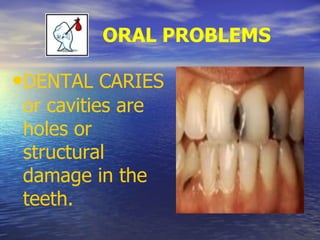
•DENTAL CARIES
or cavities are
holes or
structural
damage in the
teeth.
DENTAL CARIES
• DENTAL CARIES (cavities) and periodontal
disease are the two problems that most
frequently affect the teeth. Both problems are
commonly associated with plaque and tartar
deposits.
– Cavities are holes, or structural damage, in the teeth.
– Tooth decay is one of the most common of all
disorders, second only to the common cold.
– It usually occurs in children and young adults but can
affect any person. It is a common cause of tooth loss
in younger people.
ORAL PROBLEMS
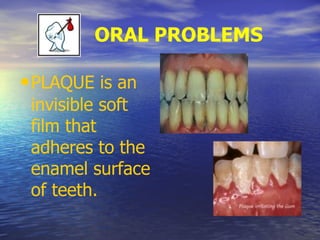
•PLAQUE is an
invisible soft
film that
adheres to the
enamel surface
of teeth.
PLAQUE
• Bacteria are normally present in the mouth. The bacteria
convert all foods -- especially sugar and starch -- into
acids.
• Bacteria, acid, food debris, and saliva combine in the
mouth to form a sticky substance called plaque that
adheres to the teeth.
• It is most prominent on the back molars, just above the
gum line on all teeth, and at the edges of fillings.
• Plaque begins to build up on teeth within 20 minutes
after eating (the time when most bacterial activity
occurs). If this plaque is not removed thoroughly and
routinely, tooth decay will not only begin, but flourish.
• When plaque is unchecked, tartar (dental calculus) is
formed.
• The acids in plaque dissolve the enamel surface of the
tooth and create holes in the tooth (cavities).
ORAL PROBLEMS
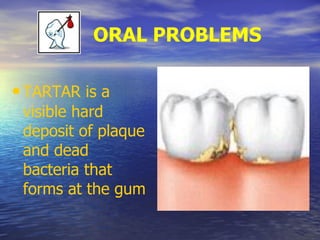
•TARTAR is a
visible hard
deposit of plaque
and dead
bacteria that
forms at the gum
ORAL PROBLEMS
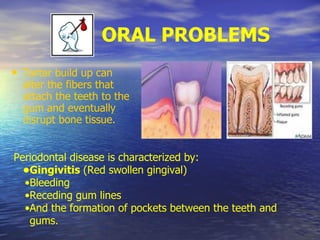
• Tartar build up can
alter the fibers that
attach the teeth to the
gum and eventually
disrupt bone tissue.
Periodontal disease is characterized by:
•Gingivitis (Red swollen gingival)
•Bleeding
•Receding gum lines
•And the formation of pockets between the teeth and
gums.
ORAL PROBLEMS
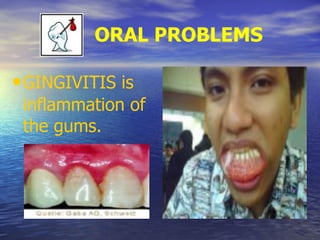
•GINGIVITIS is
inflammation of
the gums.
ORAL PROBLEMS
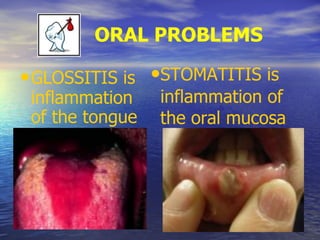
•GLOSSITIS is
inflammation
of the tongue
•STOMATITIS is
inflammation of
the oral mucosa
ORAL PROBLEMS
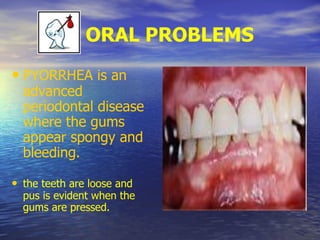
• PYORRHEA is an
advanced
periodontal disease
where the gums
appear spongy and
bleeding.
• the teeth are loose and
pus is evident when the
gums are pressed.
ORAL PROBLEMS
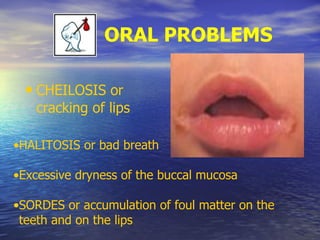
• CHEILOSIS or
cracking of lips
•HALITOSIS or bad breath
•Excessive dryness of the buccal mucosa
•SORDES or accumulation of foul matter on the
teeth and on the lips
MEASURES TO PREVENT TOOTH DECAY
• Brush the teeth thoroughly after meals and at bedtime.
Assist children or inspect their mouths to be sure the
teeth are clean. If the teeth cannot be brushed after
meals, vigorous rinsing of the mouth with water is
recommended.
• Floss the teeth daily.
• Ensure an adequate intake of nutrients, particularly
calcium, phosphorous, vitamin A, C, D and fluoride.
• Avoid sweet foods and drinks between meals. Take them
in moderation at meals.
• Eat coarse, fibrous foods (cleansing food) such as fresh
fruits and raw vegetables.
• Have topical fluoride applications as prescribed by the
dentist.
• Have a check up by a dentist every 6 months
GOOD ORAL HYGIENE
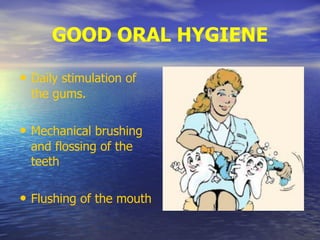
• Daily stimulation of
the gums.
• Mechanical brushing
and flossing of the
teeth
• Flushing of the mouth
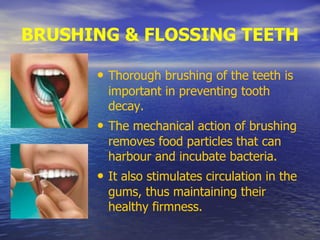
BRUSHING & FLOSSING TEETH
• Thorough brushing of the teeth is
important in preventing tooth
decay.
• The mechanical action of brushing
removes food particles that can
harbour and incubate bacteria.
• It also stimulates circulation in the
gums, thus maintaining their
healthy firmness.
PURPOSES
• To remove food particles from
around and between teeth.
• To remove dental plaque.
• To promote the client’s feelings of
well being.
• To prevent sores and infection of
the oral tissues.
PREPARATION
ASSESS:
• Determine the extent of the client’s self-care
abilities.
• Assess the client’s usual mouth care practices
• Inspect lips, gums, oral mucosa, and tongue for
deviations from normal.
• Identify presence of oral problems such as tooth
caries, halitosis, gingivitis, and loose or broken
teeth.
• Check if the client has bridgework or wears
dentures.
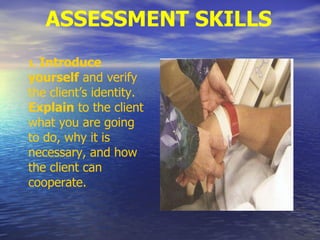
ASSESSMENT SKILLS
1. Introduce
yourself and verify
the client’s identity.
Explain to the client
what you are going
to do, why it is
necessary, and how
the client can
cooperate.
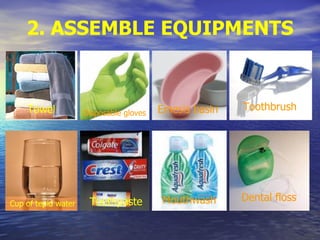
2. ASSEMBLE EQUIPMENTS
Towel Disposable gloves Emesis basin Toothbrush
Cup of tepid water Toothpaste Mouthwash Dental floss
3.Provide for
client privacy
by drawing the
curtains or
closing the door.
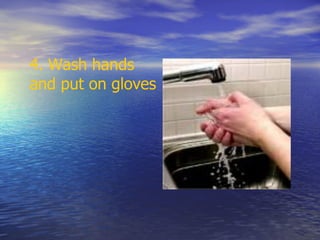
4. Wash hands
and put on gloves
ASSESSEMENT SKILLS
• CONSCIOUS
PATIENT
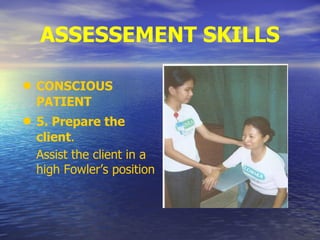
• 5. Prepare the
client.
Assist the client in a
high Fowler’s position
6. Place the towel under the client’s chin and lower
cheek to receive thr fluid from the mouth.
7. on disposable gloves.
Apply the toothpaste to the toothbrush
8. Brushes the teeth carefully and avoid injuring
the gums.
9. Rinses thoroughly.
10. Make sure that all the rinsing solution has run
out from the mouth to the basin.
11. Clean mouth tissues with foam swabs or gauze
and cleaning solution on one cheek if they
appear dry and unclean.
12. Does the same on the other area
13. Discard the swab, tongue blades in the waste
container.
14. Rinse the client’s mouth
15. Remove the basin, and dry around the client’s
mouth with the towel
16. Returns artificial dentures
17. Lubricate the client’s lips with lip moisturizer
18. Removes and discard gloves
19. Documents care.
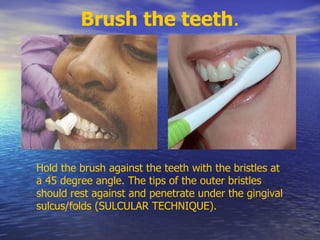
Brush the teeth.
Hold the brush against the teeth with the bristles at
a 45 degree angle. The tips of the outer bristles
should rest against and penetrate under the gingival
sulcus/folds (SULCULAR TECHNIQUE).
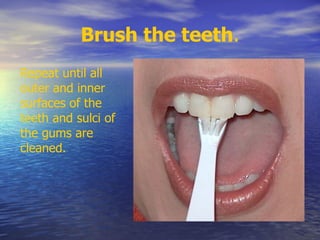
Brush the teeth.
Repeat until all
outer and inner
surfaces of the
teeth and sulci of
the gums are
cleaned.
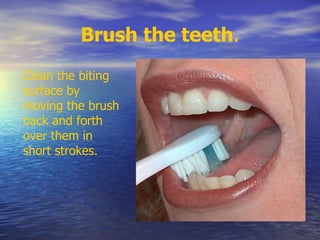
Brush the teeth.
Clean the biting
surface by
moving the brush
back and forth
over them in
short strokes.
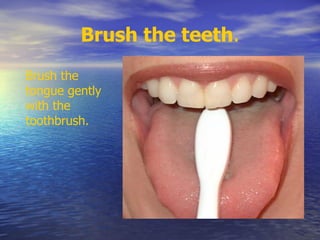
Brush the teeth.
Brush the
tongue gently
with the
toothbrush.
Brush the teeth.
• Hand the client the water cup or
mouthwash to rinse the mouth vigorously.
Then ask the client to spit the water and
excess dentrifice into the basin.
• Repeat the preceding steps until the
mouth is free of dentrifice and food
particles.
• Remove the curved basin and help the
client wipe the mouth.
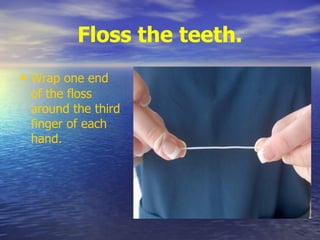
Floss the teeth.
• Wrap one end
of the floss
around the third
finger of each
hand.
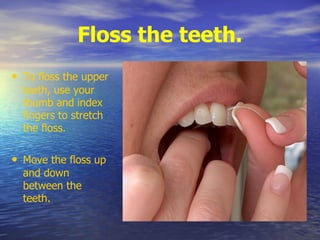
Floss the teeth.
• To floss the upper
teeth, use your
thumb and index
fingers to stretch
the floss.
• Move the floss up
and down
between the
teeth.
Floss the teeth.
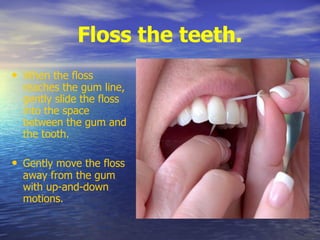
• When the floss
reaches the gum line,
gently slide the floss
into the space
between the gum and
the tooth.
• Gently move the floss
away from the gum
with up-and-down
motions.
Floss the teeth.
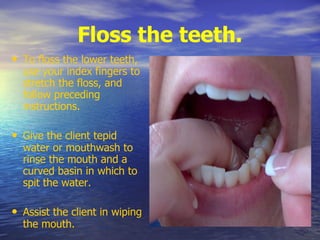
• To floss the lower teeth,
use your index fingers to
stretch the floss, and
follow preceding
instructions.
• Give the client tepid
water or mouthwash to
rinse the mouth and a
curved basin in which to
spit the water.
• Assist the client in wiping
the mouth.
Floss the teeth.
• Remove and dispose of equipment
appropriately.
– Remove and clean the curved basin.
– Remove and discard the gloves.
• Document assessment of the teeth,
tongue, gums and oral mucosa.
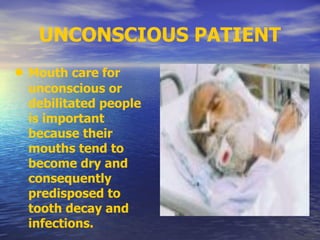
UNCONSCIOUS PATIENT
• Mouth care for
unconscious or
debilitated people
is important
because their
mouths tend to
become dry and
consequently
predisposed to
tooth decay and
infections.
CLIENTS WITH SPECIAL ORAL HYGIENE NEEDS
• For the client who is debilitated or unconscious or who
has excessive dryness, sores, or irritations of the mouth,
it may be necessary to clean the oral mucosa and tongue
in addition to the teeth.
• Depending on the health of the client’s mouth, special
care may be needed every 2 to 8 hours.
• Mouth care for unconscious or debilitated people is
important because their mouths tend to become dry and
consequently predisposed to tooth decay and infections.
• Saliva has antiviral, antibacterial and antifungal effects.
• Dry mouth – called XEROSTOMIA – occurs when the
supply of saliva is reduced, which can be caused by:
– Side effects of certain medications (antihistamines,
antidepressants, antihypertensives)
– Oxygen therapy
– Tachypnea
– NPO status
PURPOSES
• To maintain the intactness and health of
the lips, tongue, and mucous membranes
of the mouth
• To prevent oral infections
• To clean and moisten the membranes of
the mouth and lips
ASSESSMENT
• Inspect the lips, gums, oral mucosa and
tongue for deviations from normal.
• Identify the presence of oral problems
such as tooth caries, halitosis, gingivitis,
and loose or broken teeth.
• Assess for gag reflex if appropriate.
EQUIPMENT
• Towel
• Curved basin
• Disposable clean gloves
• Toothbrush
• Cup of Tepid water
• Tissue or piece of gauze (optional
• Mouthwash
• Rubber tipped bulb syringe
• Suction catheter with suction apparatus
• Foam swabs and cleaning solution
• Water-soluble lip moisturizer
ASSESSMENT SKILLS
1. Introduce yourself and explain the
procedure to the watcher.
2. Assemble the equipment
3. Provide for client privacy by drawing the
curtains or closing the door.
4. Perform hand hygiene & Puts on gloves
5. Position the unconscious client in a side-lying
position, with the head of bed lowered. If the
client’s head cannot be lowered, turn it to one
side.
6. Place the towel under the client’s chin.
7. Place the curved basin against the client’s chin
and lower cheek to receive the fluid from the
mouth.
8. Brushes the teeth carefully and avoid
injuring the gums.
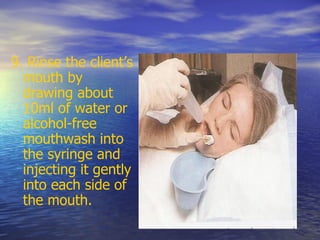
9. Rinse the client’s
mouth by
drawing about
10ml of water or
alcohol-free
mouthwash into
the syringe and
injecting it gently
into each side of
the mouth.
10. Make sure that all the rinsing solution
has run out of the mouth into the basin. If
not, suction the fluid from the mouth.
11. Repeat rinsing until the mouth is free of
dentrifice used.
PROCEDURE
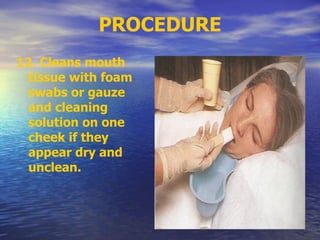
12. Cleans mouth
tissue with foam
swabs or gauze
and cleaning
solution on one
cheek if they
appear dry and
unclean.
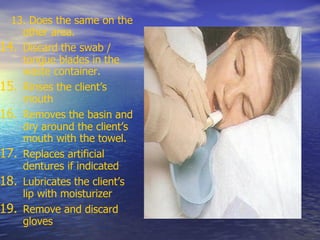
13. Does the same on the
other area.
14. Discard the swab /
tongue blades in the
waste container.
15. Rinses the client’s
mouth
16. Removes the basin and
dry around the client’s
mouth with the towel.
17. Replaces artificial
dentures if indicated
18. Lubricates the client’s
lip with moisturizer
19. Remove and discard
gloves
PROCEDURE
• Observe the tissues closely for
inflammation and dryness.
• Rinse the client’s mouth as described
above.
• Remove and discard gloves.
PROCEDURE
Ensure client comfort.
• Remove the basin, and dry around the client’s
mouth with the towel.
• Replace artificial dentures, if indicated. Lubricate
the client’s lips with water-soluble moisturizer.
• Document assessment of the teeth, tongue,
gums, and the oral mucosa. Include any
problems such as sores or inflammation and
swelling of the gums.
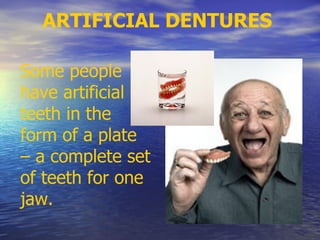
ARTIFICIAL DENTURES
Some people
have artificial
teeth in the
form of a plate
– a complete set
of teeth for one
jaw.
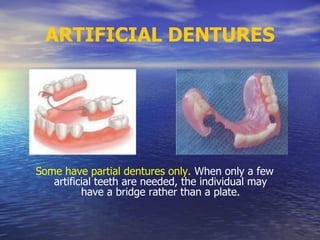
ARTIFICIAL DENTURES
Some have partial dentures only. When only a few
artificial teeth are needed, the individual may
have a bridge rather than a plate.
EQUIPMENT
• Disposable gloves
• Tissue or piece of gauze
• Denture container
• Clean washcloth
• Toothbrush or stiff-bristled brush
• Dentrifice or denture cleaner
• Tepid water
• Container of mouthwash
• Curved basin (emesis basin)
• Towel
PROCEDURE
Remove the dentures.
• Put on gloves.
• If the client cannot remove the dentures, take the tissue
or gauze, grasp the upper plate at the front teeth with
your thumb and index fingers, and move the denture up
and down slightly.
• Lower the upper plate, move it out of the mouth, and
place it in the denture container.
• Lift the lower plate, turning it so that the left side, for
example, is slightly lower than the right, to remove the
plate from the mouth without stretching the lips. Place
the lower plate in the denture container.
• Remove a partial denture by exerting equal pressure on
the border of each side of the denture, not on the
clasps, which can bend or break.
PROCEDURE
Clean the
dentures.
Take the denture
container to a
sink. Take care
not to drop the
dentures. Place a
washcloth in the
bowl of the sink.
PROCEDURE
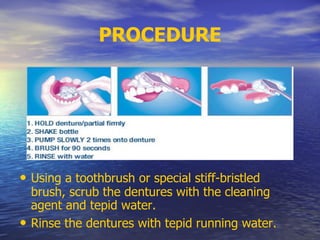
• Using a toothbrush or special stiff-bristled
brush, scrub the dentures with the cleaning
agent and tepid water.
• Rinse the dentures with tepid running water.
PROCEDURE
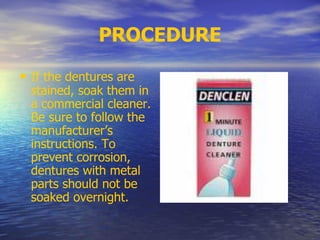
• If the dentures are
stained, soak them in
a commercial cleaner.
Be sure to follow the
manufacturer’s
instructions. To
prevent corrosion,
dentures with metal
parts should not be
soaked overnight.
PROCEDURE
Inspect the dentures and the mouth.
• Observe the dentures for any rough, sharp, or
worn areas that could irritate the tongue or
mucous membranes of the mouth, lips, and
gums.
• Inspect the mouth for any redness, irritated
areas, or indications of infection.
• Assess the fit of the dentures.
PROCEDURE
Return the dentures to the mouth.
• Offer some mouthwash and a curved
basin to rinse the mouth. If the client
cannot insert the dentures independently,
insert the plates one at a time. Hold each
plate at a slight angle while inserting it, to
avoid injuring the lips.
PROCEDURE
Assist the client as
needed.
• Wipe the client’s hands
and mouth with a
towel.
• If the client does not
want to or cannot wear
the dentures, store
them in a denture
container with water.
Label the container
with the client’s name
and identification
number.
AFTER CARE
• Remove and discard the gloves.
• Document all assessments and include
any problems such as an irritated area on
the mucous membrane.
Thank you…

7.Oral-Care.pdf

  • 1.
  • 2.
    HYGIENE • Hygiene isthe science of health and its maintenance. • PERSONAL Hygiene is the self-care by which people attend to such functions as: •Bathing •Toileting •General body hygiene •Grooming • Hygiene is a highly personal matter determined by individual values and practices. • It involves care of the skin, hair, nails, teeth, oral and nasal cavities, eyes, ears and perineal-genital areas.
  • 3.
    ORAL CARE Oral hygieneis the practice of keeping the mouth is the practice of keeping the mouth and teeth is the practice of keeping the mouth and teeth clean
  • 4.
    DEVELOPMENTAL VARIATIONS – Teethusually appear 5 to 8 months after birth. – Baby-bottle syndrome may result in decay of all of the upper teeth and the lower posterior teeth. – This syndrome occurs when an infant is put to bed with a bottle of sugar water, formula, milk, or fruit juice. – The carbohydrates in the solutions cause dimineralization of the tooth enamel which leads to tooth decay. – By the time children are 2 years old, they usually have all 20 of their temporary teeth. – At about age 6 or 7, children start losing their deciduous teeth, and these are gradually replaced by the 33 permanent teeth. – By age 25, most people have all of their permanent teeth.
  • 5.
    ASSESSMENT NURSING HISTORY -The nurse obtains data about the client’s: •Oral hygiene practices including dental visits – helps the nurse determine learning needs and incorporate the client’s needs and preferences in the plan of care. •Self-care abilities – determines the amount and type of nursing assistance to provide – Client’s who need assistance from the nurse: ❖ Whose hand coordination is impaired – stroke patient ❖ Whose illness alters energy levels and motivation ❖ Whose therapy imposes restrictions on activities •Past or current mouth problems – alerts the nurse to specific interventions required or referrals that may be necessary.
  • 6.
    ORAL PROBLEMS •DENTAL CARIES orcavities are holes or structural damage in the teeth.
  • 7.
    DENTAL CARIES • DENTALCARIES (cavities) and periodontal disease are the two problems that most frequently affect the teeth. Both problems are commonly associated with plaque and tartar deposits. – Cavities are holes, or structural damage, in the teeth. – Tooth decay is one of the most common of all disorders, second only to the common cold. – It usually occurs in children and young adults but can affect any person. It is a common cause of tooth loss in younger people.
  • 8.
    ORAL PROBLEMS •PLAQUE isan invisible soft film that adheres to the enamel surface of teeth.
  • 9.
    PLAQUE • Bacteria arenormally present in the mouth. The bacteria convert all foods -- especially sugar and starch -- into acids. • Bacteria, acid, food debris, and saliva combine in the mouth to form a sticky substance called plaque that adheres to the teeth. • It is most prominent on the back molars, just above the gum line on all teeth, and at the edges of fillings. • Plaque begins to build up on teeth within 20 minutes after eating (the time when most bacterial activity occurs). If this plaque is not removed thoroughly and routinely, tooth decay will not only begin, but flourish. • When plaque is unchecked, tartar (dental calculus) is formed. • The acids in plaque dissolve the enamel surface of the tooth and create holes in the tooth (cavities).
  • 10.
    ORAL PROBLEMS •TARTAR isa visible hard deposit of plaque and dead bacteria that forms at the gum
  • 11.
    ORAL PROBLEMS • Tartarbuild up can alter the fibers that attach the teeth to the gum and eventually disrupt bone tissue. Periodontal disease is characterized by: •Gingivitis (Red swollen gingival) •Bleeding •Receding gum lines •And the formation of pockets between the teeth and gums.
  • 12.
  • 13.
    ORAL PROBLEMS •GLOSSITIS is inflammation ofthe tongue •STOMATITIS is inflammation of the oral mucosa
  • 14.
    ORAL PROBLEMS • PYORRHEAis an advanced periodontal disease where the gums appear spongy and bleeding. • the teeth are loose and pus is evident when the gums are pressed.
  • 15.
    ORAL PROBLEMS • CHEILOSISor cracking of lips •HALITOSIS or bad breath •Excessive dryness of the buccal mucosa •SORDES or accumulation of foul matter on the teeth and on the lips
  • 16.
    MEASURES TO PREVENTTOOTH DECAY • Brush the teeth thoroughly after meals and at bedtime. Assist children or inspect their mouths to be sure the teeth are clean. If the teeth cannot be brushed after meals, vigorous rinsing of the mouth with water is recommended. • Floss the teeth daily. • Ensure an adequate intake of nutrients, particularly calcium, phosphorous, vitamin A, C, D and fluoride. • Avoid sweet foods and drinks between meals. Take them in moderation at meals. • Eat coarse, fibrous foods (cleansing food) such as fresh fruits and raw vegetables. • Have topical fluoride applications as prescribed by the dentist. • Have a check up by a dentist every 6 months
  • 17.
    GOOD ORAL HYGIENE •Daily stimulation of the gums. • Mechanical brushing and flossing of the teeth • Flushing of the mouth
  • 18.
    BRUSHING & FLOSSINGTEETH • Thorough brushing of the teeth is important in preventing tooth decay. • The mechanical action of brushing removes food particles that can harbour and incubate bacteria. • It also stimulates circulation in the gums, thus maintaining their healthy firmness.
  • 19.
    PURPOSES • To removefood particles from around and between teeth. • To remove dental plaque. • To promote the client’s feelings of well being. • To prevent sores and infection of the oral tissues.
  • 20.
    PREPARATION ASSESS: • Determine theextent of the client’s self-care abilities. • Assess the client’s usual mouth care practices • Inspect lips, gums, oral mucosa, and tongue for deviations from normal. • Identify presence of oral problems such as tooth caries, halitosis, gingivitis, and loose or broken teeth. • Check if the client has bridgework or wears dentures.
  • 21.
    ASSESSMENT SKILLS 1. Introduce yourselfand verify the client’s identity. Explain to the client what you are going to do, why it is necessary, and how the client can cooperate.
  • 22.
    2. ASSEMBLE EQUIPMENTS TowelDisposable gloves Emesis basin Toothbrush Cup of tepid water Toothpaste Mouthwash Dental floss
  • 23.
    3.Provide for client privacy bydrawing the curtains or closing the door.
  • 24.
    4. Wash hands andput on gloves
  • 25.
    ASSESSEMENT SKILLS • CONSCIOUS PATIENT •5. Prepare the client. Assist the client in a high Fowler’s position
  • 26.
    6. Place thetowel under the client’s chin and lower cheek to receive thr fluid from the mouth. 7. on disposable gloves. Apply the toothpaste to the toothbrush 8. Brushes the teeth carefully and avoid injuring the gums. 9. Rinses thoroughly. 10. Make sure that all the rinsing solution has run out from the mouth to the basin. 11. Clean mouth tissues with foam swabs or gauze and cleaning solution on one cheek if they appear dry and unclean.
  • 27.
    12. Does thesame on the other area 13. Discard the swab, tongue blades in the waste container. 14. Rinse the client’s mouth 15. Remove the basin, and dry around the client’s mouth with the towel 16. Returns artificial dentures 17. Lubricate the client’s lips with lip moisturizer 18. Removes and discard gloves 19. Documents care.
  • 28.
    Brush the teeth. Holdthe brush against the teeth with the bristles at a 45 degree angle. The tips of the outer bristles should rest against and penetrate under the gingival sulcus/folds (SULCULAR TECHNIQUE).
  • 29.
    Brush the teeth. Repeatuntil all outer and inner surfaces of the teeth and sulci of the gums are cleaned.
  • 30.
    Brush the teeth. Cleanthe biting surface by moving the brush back and forth over them in short strokes.
  • 31.
    Brush the teeth. Brushthe tongue gently with the toothbrush.
  • 32.
    Brush the teeth. •Hand the client the water cup or mouthwash to rinse the mouth vigorously. Then ask the client to spit the water and excess dentrifice into the basin. • Repeat the preceding steps until the mouth is free of dentrifice and food particles. • Remove the curved basin and help the client wipe the mouth.
  • 33.
    Floss the teeth. •Wrap one end of the floss around the third finger of each hand.
  • 34.
    Floss the teeth. •To floss the upper teeth, use your thumb and index fingers to stretch the floss. • Move the floss up and down between the teeth.
  • 35.
    Floss the teeth. •When the floss reaches the gum line, gently slide the floss into the space between the gum and the tooth. • Gently move the floss away from the gum with up-and-down motions.
  • 36.
    Floss the teeth. •To floss the lower teeth, use your index fingers to stretch the floss, and follow preceding instructions. • Give the client tepid water or mouthwash to rinse the mouth and a curved basin in which to spit the water. • Assist the client in wiping the mouth.
  • 37.
    Floss the teeth. •Remove and dispose of equipment appropriately. – Remove and clean the curved basin. – Remove and discard the gloves. • Document assessment of the teeth, tongue, gums and oral mucosa.
  • 38.
    UNCONSCIOUS PATIENT • Mouthcare for unconscious or debilitated people is important because their mouths tend to become dry and consequently predisposed to tooth decay and infections.
  • 39.
    CLIENTS WITH SPECIALORAL HYGIENE NEEDS • For the client who is debilitated or unconscious or who has excessive dryness, sores, or irritations of the mouth, it may be necessary to clean the oral mucosa and tongue in addition to the teeth. • Depending on the health of the client’s mouth, special care may be needed every 2 to 8 hours. • Mouth care for unconscious or debilitated people is important because their mouths tend to become dry and consequently predisposed to tooth decay and infections. • Saliva has antiviral, antibacterial and antifungal effects. • Dry mouth – called XEROSTOMIA – occurs when the supply of saliva is reduced, which can be caused by: – Side effects of certain medications (antihistamines, antidepressants, antihypertensives) – Oxygen therapy – Tachypnea – NPO status
  • 40.
    PURPOSES • To maintainthe intactness and health of the lips, tongue, and mucous membranes of the mouth • To prevent oral infections • To clean and moisten the membranes of the mouth and lips
  • 41.
    ASSESSMENT • Inspect thelips, gums, oral mucosa and tongue for deviations from normal. • Identify the presence of oral problems such as tooth caries, halitosis, gingivitis, and loose or broken teeth. • Assess for gag reflex if appropriate.
  • 42.
    EQUIPMENT • Towel • Curvedbasin • Disposable clean gloves • Toothbrush • Cup of Tepid water • Tissue or piece of gauze (optional • Mouthwash • Rubber tipped bulb syringe • Suction catheter with suction apparatus • Foam swabs and cleaning solution • Water-soluble lip moisturizer
  • 43.
    ASSESSMENT SKILLS 1. Introduceyourself and explain the procedure to the watcher. 2. Assemble the equipment 3. Provide for client privacy by drawing the curtains or closing the door. 4. Perform hand hygiene & Puts on gloves
  • 44.
    5. Position theunconscious client in a side-lying position, with the head of bed lowered. If the client’s head cannot be lowered, turn it to one side. 6. Place the towel under the client’s chin. 7. Place the curved basin against the client’s chin and lower cheek to receive the fluid from the mouth. 8. Brushes the teeth carefully and avoid injuring the gums.
  • 45.
    9. Rinse theclient’s mouth by drawing about 10ml of water or alcohol-free mouthwash into the syringe and injecting it gently into each side of the mouth.
  • 46.
    10. Make surethat all the rinsing solution has run out of the mouth into the basin. If not, suction the fluid from the mouth. 11. Repeat rinsing until the mouth is free of dentrifice used.
  • 47.
    PROCEDURE 12. Cleans mouth tissuewith foam swabs or gauze and cleaning solution on one cheek if they appear dry and unclean.
  • 48.
    13. Does thesame on the other area. 14. Discard the swab / tongue blades in the waste container. 15. Rinses the client’s mouth 16. Removes the basin and dry around the client’s mouth with the towel. 17. Replaces artificial dentures if indicated 18. Lubricates the client’s lip with moisturizer 19. Remove and discard gloves
  • 49.
    PROCEDURE • Observe thetissues closely for inflammation and dryness. • Rinse the client’s mouth as described above. • Remove and discard gloves.
  • 50.
    PROCEDURE Ensure client comfort. •Remove the basin, and dry around the client’s mouth with the towel. • Replace artificial dentures, if indicated. Lubricate the client’s lips with water-soluble moisturizer. • Document assessment of the teeth, tongue, gums, and the oral mucosa. Include any problems such as sores or inflammation and swelling of the gums.
  • 51.
    ARTIFICIAL DENTURES Some people haveartificial teeth in the form of a plate – a complete set of teeth for one jaw.
  • 52.
    ARTIFICIAL DENTURES Some havepartial dentures only. When only a few artificial teeth are needed, the individual may have a bridge rather than a plate.
  • 53.
    EQUIPMENT • Disposable gloves •Tissue or piece of gauze • Denture container • Clean washcloth • Toothbrush or stiff-bristled brush • Dentrifice or denture cleaner • Tepid water • Container of mouthwash • Curved basin (emesis basin) • Towel
  • 54.
    PROCEDURE Remove the dentures. •Put on gloves. • If the client cannot remove the dentures, take the tissue or gauze, grasp the upper plate at the front teeth with your thumb and index fingers, and move the denture up and down slightly. • Lower the upper plate, move it out of the mouth, and place it in the denture container. • Lift the lower plate, turning it so that the left side, for example, is slightly lower than the right, to remove the plate from the mouth without stretching the lips. Place the lower plate in the denture container. • Remove a partial denture by exerting equal pressure on the border of each side of the denture, not on the clasps, which can bend or break.
  • 55.
    PROCEDURE Clean the dentures. Take thedenture container to a sink. Take care not to drop the dentures. Place a washcloth in the bowl of the sink.
  • 56.
    PROCEDURE • Using atoothbrush or special stiff-bristled brush, scrub the dentures with the cleaning agent and tepid water. • Rinse the dentures with tepid running water.
  • 57.
    PROCEDURE • If thedentures are stained, soak them in a commercial cleaner. Be sure to follow the manufacturer’s instructions. To prevent corrosion, dentures with metal parts should not be soaked overnight.
  • 58.
    PROCEDURE Inspect the denturesand the mouth. • Observe the dentures for any rough, sharp, or worn areas that could irritate the tongue or mucous membranes of the mouth, lips, and gums. • Inspect the mouth for any redness, irritated areas, or indications of infection. • Assess the fit of the dentures.
  • 59.
    PROCEDURE Return the denturesto the mouth. • Offer some mouthwash and a curved basin to rinse the mouth. If the client cannot insert the dentures independently, insert the plates one at a time. Hold each plate at a slight angle while inserting it, to avoid injuring the lips.
  • 60.
    PROCEDURE Assist the clientas needed. • Wipe the client’s hands and mouth with a towel. • If the client does not want to or cannot wear the dentures, store them in a denture container with water. Label the container with the client’s name and identification number.
  • 61.
    AFTER CARE • Removeand discard the gloves. • Document all assessments and include any problems such as an irritated area on the mucous membrane.
  • 62.