Procedural Sedation
James Winton
March 2016
Procedural Sedation
• What we’ll focus on
– Concept
– Safety
– You
• What we won’t
– Drugs
– Procedure
What is procedural sedation?
“The patient is in a state of drug induced tolerance of
uncomfortable or painful diagnostic or interventional
medical, dental or surgical procedures”
– ANZCA guideline endorsed by colleges including ACEM
• American (ACEP) definition includes the idea that
cardiorespiratory function is maintained
• Australian (ANZCA) definition recognises the fact that
although this is intended, there may be a degree of
compromise that needs to be managed by someone
trained in the skills to do so
The aim of procedural sedation
• Focus on patient
– Comfort
– Awareness
– Ability to complete procedure
• Focus on safety
– Depth of sedation
– Variability of effect
Procedural sedation terminology
• Conscious sedation term coined in 1985
– Describing lightly sedated dental patients
– Used then in paediatric sedation guidelines
• Deep sedation
– Patients difficult to rouse
• General anaesthesia
– Unable to rouse patient
– Needs an anaesthetist
• Procedural sedation and analgesia (PSA)
– Describes a continuum which also includes dissociative
sedation
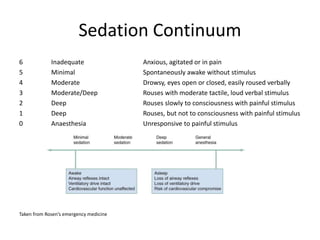
Sedation Continuum
6 Inadequate
5 Minimal
4 Moderate
3 Moderate/Deep
2 Deep
1 Deep
0 Anaesthesia
Taken from Rosen’s emergency medicine
Anxious, agitated or in pain
Spontaneously awake without stimulus
Drowsy, eyes open or closed, easily roused verbally
Rouses with moderate tactile, loud verbal stimulus
Rouses slowly to consciousness with painful stimulus
Rouses, but not to consciousness with painful stimulus
Unresponsive to painful stimulus
Risks of procedural sedation
• Depression of protective
airway reflexes
• Loss of patency of airway
• Depression of respiration
• Depression of
cardiovascular system
• Risk inherent in
procedure
• Individual variation in
response
• Possibility of deeper
sedation being required
• Drug interactions,
anaphylaxis
Respiratory events
Clinical governance for Procedural
sedation in ED
• Training
– Procedures
– Drugs
– Equipment
– Monitoring
• Risk
– Identification
– Management
• Audit
– Future advancements
ANZCA Guidelines on Sedation and/or
Analgesia for Diagnostic and Interventional
Medical, Dental or Surgical Procedures
• https://acem.org.au/getattachment/9ef3110d-9863-44e8-89e5-aaa894b18236/P09-Guidelines-on-
Sedation-and-or-Analgesia-for-Di.aspx
Business time
• Patient/Procedure selection
• Consent
• Assessment
• Staff
• Equipment/Monitoring
• Drugs
• Documentation
• Recovery and discharge
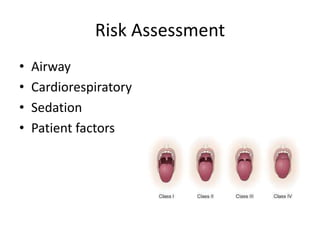
Risk Assessment
• Airway
• Cardiorespiratory
• Sedation
• Patient factors
Staff
• Minimum staffing requirements
• Adequate training
Equipment/Monitoring
– This is a test
• Location
• Lighting
• Oxygen
• Suction
• Self inflating bag and
mask
• Advanced airway devices
• IV access
• Resuscitation drugs
• Pulse oximeter
• Blood pressure
• CO2 monitoring
• ECG monitoring
• Defibrillator
• Means of summoning
assistance
• Clinical response to
deterioration plan
Drugs – which do I choose?
Sedation
• Propofol
• Ketamine
• Midazolam
• Effect profile
• Side effects
• Duration
• Contraindication
Analgesia
• Fentanyl
• Morphine
• Nitrous Oxide
• Ketamine
Other drugs
• Ketofol
• Others……
Much more important question
• Drugs – How much do I give?
• Knowledge
• Experience
Evidence Based Practice? – ACEP
policy guideline
• Literature concludes PSA is safe in ED
• Proprofol and ketamine most widely studied
and safe – level A
• Fasting not required – level B
• Capnography should be used – level B
• Minimum personnel – level C
– At least 2 – continuous monitoring and ability to
identify and manage complications
Adequate sedation – how do you know?
Situational Awareness
• The skill of maintaining an overall view of the
situation at hand, not becoming preoccupied
with minor details missing the most critical
aspect of the moment.
– Innate in some
– Can be learned/taught
At the end of the day….
• Documentation
• Recovery
• Discharge advice
OSCE practice scenarios
Procedural Sedation THM
• It is performed safely in the ED if you
– Assess the patient adequately
– Prepare for worst case scenario
– Know your poison
– Develop skills in situational awareness
• Don’t use intramuscular promethazine to
sedate anyone for anything if you want to pass
your end of term assessment
References
• ANZCA guideline on sedation/analgesia
– https://acem.org.au/getattachment/9ef3110d-9863-44e8-89e5-aaa894b18236/P09-Guidelines-on-
Sedation-and-or-Analgesia-for-Di.aspx
• Ketofol for procedural sedation revisited: pro and con. Ann Emerg
Med. 2015
– Ann Emerg Med. 2015 May;65(5):489-91. doi: 10.1016/j.annemergmed.2014.12.002. Epub 2014 Dec 24.
• ACEP Clinical Policy: Procedural Sedation and Analgesia in the
Emergency Department
– Annals of Emergency Medicine Volume 63, Issue 2, February 2014
• Rosen’s Emergency Medicine 8th edition 2014
• @hughcards

Procedural sedation

  • 1.
  • 2.
    Procedural Sedation • Whatwe’ll focus on – Concept – Safety – You • What we won’t – Drugs – Procedure
  • 6.
    What is proceduralsedation? “The patient is in a state of drug induced tolerance of uncomfortable or painful diagnostic or interventional medical, dental or surgical procedures” – ANZCA guideline endorsed by colleges including ACEM • American (ACEP) definition includes the idea that cardiorespiratory function is maintained • Australian (ANZCA) definition recognises the fact that although this is intended, there may be a degree of compromise that needs to be managed by someone trained in the skills to do so
  • 7.
    The aim ofprocedural sedation • Focus on patient – Comfort – Awareness – Ability to complete procedure • Focus on safety – Depth of sedation – Variability of effect
  • 8.
    Procedural sedation terminology •Conscious sedation term coined in 1985 – Describing lightly sedated dental patients – Used then in paediatric sedation guidelines • Deep sedation – Patients difficult to rouse • General anaesthesia – Unable to rouse patient – Needs an anaesthetist • Procedural sedation and analgesia (PSA) – Describes a continuum which also includes dissociative sedation
  • 9.
    Sedation Continuum 6 Inadequate 5Minimal 4 Moderate 3 Moderate/Deep 2 Deep 1 Deep 0 Anaesthesia Taken from Rosen’s emergency medicine Anxious, agitated or in pain Spontaneously awake without stimulus Drowsy, eyes open or closed, easily roused verbally Rouses with moderate tactile, loud verbal stimulus Rouses slowly to consciousness with painful stimulus Rouses, but not to consciousness with painful stimulus Unresponsive to painful stimulus
  • 10.
    Risks of proceduralsedation • Depression of protective airway reflexes • Loss of patency of airway • Depression of respiration • Depression of cardiovascular system • Risk inherent in procedure • Individual variation in response • Possibility of deeper sedation being required • Drug interactions, anaphylaxis
  • 11.
  • 12.
    Clinical governance forProcedural sedation in ED • Training – Procedures – Drugs – Equipment – Monitoring • Risk – Identification – Management • Audit – Future advancements
  • 13.
    ANZCA Guidelines onSedation and/or Analgesia for Diagnostic and Interventional Medical, Dental or Surgical Procedures • https://acem.org.au/getattachment/9ef3110d-9863-44e8-89e5-aaa894b18236/P09-Guidelines-on- Sedation-and-or-Analgesia-for-Di.aspx
  • 14.
    Business time • Patient/Procedureselection • Consent • Assessment • Staff • Equipment/Monitoring • Drugs • Documentation • Recovery and discharge
  • 15.
    Risk Assessment • Airway •Cardiorespiratory • Sedation • Patient factors
  • 16.
    Staff • Minimum staffingrequirements • Adequate training
  • 17.
    Equipment/Monitoring – This isa test • Location • Lighting • Oxygen • Suction • Self inflating bag and mask • Advanced airway devices • IV access • Resuscitation drugs • Pulse oximeter • Blood pressure • CO2 monitoring • ECG monitoring • Defibrillator • Means of summoning assistance • Clinical response to deterioration plan
  • 18.
    Drugs – whichdo I choose? Sedation • Propofol • Ketamine • Midazolam • Effect profile • Side effects • Duration • Contraindication Analgesia • Fentanyl • Morphine • Nitrous Oxide • Ketamine Other drugs • Ketofol • Others……
  • 19.
    Much more importantquestion • Drugs – How much do I give? • Knowledge • Experience
  • 20.
    Evidence Based Practice?– ACEP policy guideline • Literature concludes PSA is safe in ED • Proprofol and ketamine most widely studied and safe – level A • Fasting not required – level B • Capnography should be used – level B • Minimum personnel – level C – At least 2 – continuous monitoring and ability to identify and manage complications
  • 21.
    Adequate sedation –how do you know?
  • 22.
    Adequate sedation –how do you know?
  • 23.
    Situational Awareness • Theskill of maintaining an overall view of the situation at hand, not becoming preoccupied with minor details missing the most critical aspect of the moment. – Innate in some – Can be learned/taught
  • 24.
    At the endof the day…. • Documentation • Recovery • Discharge advice
  • 25.
  • 26.
    Procedural Sedation THM •It is performed safely in the ED if you – Assess the patient adequately – Prepare for worst case scenario – Know your poison – Develop skills in situational awareness • Don’t use intramuscular promethazine to sedate anyone for anything if you want to pass your end of term assessment
  • 27.
    References • ANZCA guidelineon sedation/analgesia – https://acem.org.au/getattachment/9ef3110d-9863-44e8-89e5-aaa894b18236/P09-Guidelines-on- Sedation-and-or-Analgesia-for-Di.aspx • Ketofol for procedural sedation revisited: pro and con. Ann Emerg Med. 2015 – Ann Emerg Med. 2015 May;65(5):489-91. doi: 10.1016/j.annemergmed.2014.12.002. Epub 2014 Dec 24. • ACEP Clinical Policy: Procedural Sedation and Analgesia in the Emergency Department – Annals of Emergency Medicine Volume 63, Issue 2, February 2014 • Rosen’s Emergency Medicine 8th edition 2014 • @hughcards

Editor's Notes

  • #9 Recent definitions include 5 stages you can ready them in the guidelines and policy documents
  • #10 Transition from one to another can be difficult to predict and can occur without giving further sedation and will be different for each individual patient. So be careful and use judicious doses
  • #11 It is unanticipated risks that we need to prepare for most because they are unanticipated and occur without warning. Predictable risks may be life threatening but more manageable because they are predictable. Procedure risks are important sometimes like in a respiratory procedure
  • #13 DSI with NIV or proc sed with NIV safely in groups of people – great work ruben strayer
  • #15 Now patient/procedure selection AND consent Assessment ASA 1-3
  • #19 Before 2 – what do you need to consider/know about all these drugs? Promethazine
  • #20 It will be different for everybody and difficult to predict.
  • #22 When is the patient ready for the procedure to commence? How do you know? What do you look for? Jason Bourne Important in environments where there is a high turn over of information and poor decisions can lead to serious consequences. (think – military, aviation and critical care medicine) Lacking or inadequate situational awareness is a major contributor to human error
  • #24 Emergency medicine/critical care probably not your field if this happens to you Jason Bourne Important in environments where there is a high turn over of information and poor decisions can lead to serious consequences. (think – military, aviation and critical care medicine) Lacking or inadequate situational awareness is a major contributor to human error